
.
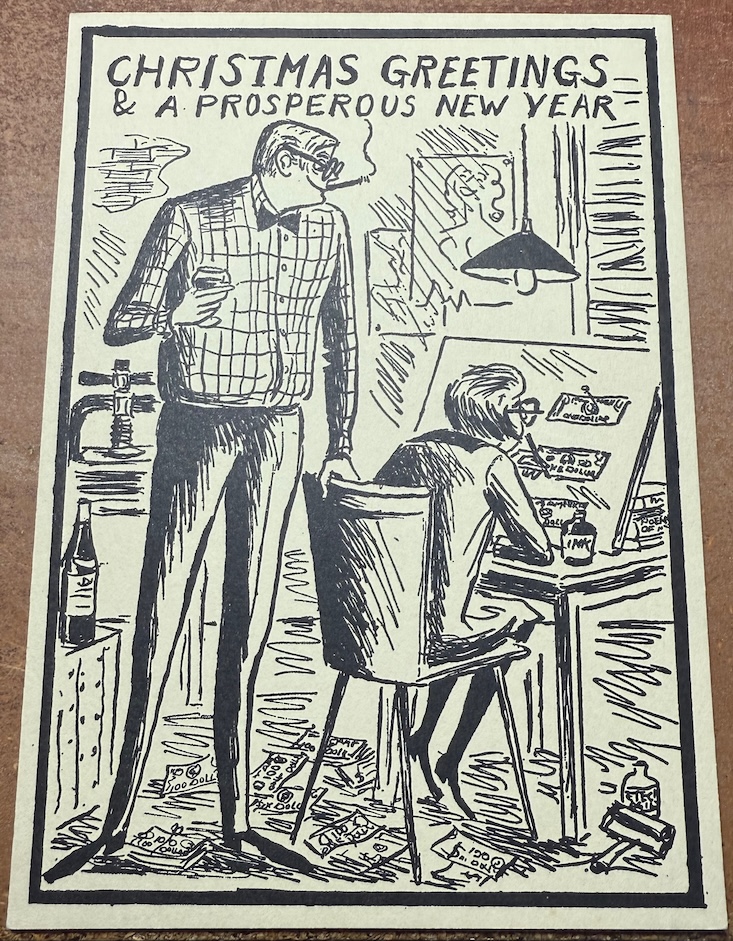
The well-heeled readers of the special Christmas edition of The Bookman in 1930 who were looking for presents for their nearest and dearest might have been tempted by some of the items described in the magazine’s Book Collecting feature.
Catalogues of books and manuscripts ranging from their own time to past centuries feature in this article, but it is noticeable that the latest craze for modern first editions is well catered for. Readers today may well be puzzled by the high prices quoted for books published by writers that are now largely forgotten, or at least, downgraded, but that’s the nature of collecting. Doubtless, many writers celebrated today ( no names, no pack drill) will, in decades to come, suffer the same fate as people like Lascelles Abercrombie and Gerald Bullett.
Luckily, medieval manuscripts will never be subject to passing fashion, mainly because factors such as scarcity, historical significance and a reverence for the lost art of calligraphy, are the presiding reasons for their popularity among a certain class of wealthy collector.
One of these manuscripts for sale is the fifteenth century ‘ Les Dites des Philosophes’ translated from Latin into French by William de Tignonville. Covering 159 leaves of vellum, with five illuminated miniatures within borders of flowers and grotesques in gold and colours, it was available from the famous antiquarian booksellers Ellis at £900 ( today around £150,000 ).
Now come the modern first editions. Bertram Rota ( still going) offered a ‘ good ‘ collection of works by Brett Young, the Midlands novelist who is still revered in that part of the world, but not elsewhere, for £3.10s, books by Hugh Walpole, then highly prized, for 25/- and ‘ many works’ by J. B. Priestley, then still riding high. Actually, the article doesn’t explicitly maintain that all, or even many, of these books are firsts.
Much more interestingly, mention is made of modern manuscripts for sale, including those by D. H. Lawrence, who had just died. Such a pity that no details are given regarding the Lawrence manuscripts. Were they letters, and were they included in the edition then being prepared by Aldous Huxley ?
There are more modern firsts with fancy prices included in a catalogue published by a certain Mr Halewood. Among these are firsts of J. M. Barrie’s Window in Thrums at 16 guineas and Coppard’s Adam and Eve and Pinch Me at 6 guineas. From another bookseller we find a first of Arnold Bennett’s Old Wives’ Tale at £50 ( about £9,000
today) and Hardy’s Under the Greenwood Tree at £105 ( about £18,000 today). Both are priced at well over what they would fetch in 2025.
One remarkable fact gathered from this article concerns W. H. Smith. Far from being dominated by chicklit and celebrity memoirs, as it is today, the branch in Southport back then sold modern firsts. I kid you not. Unfortunately, no details are given. The writer seems more impressed by the very lengthy catalogue brought out by Maggs Bros ( still there) , which contained ‘ collections ‘ of H. G. Wells, Walter Scott and
Alfred Noyes, the latter, rather amusingly, being bracketed with other ‘ great writers ‘ in English Literature.
To continue with modern firsts, a certain Mr Worthington impressed by including in his catalogue ‘a little group ‘of books by Lascelles Abercrombie, now regarded as a very minor poet indeed, and a book entitled Nicky, Son of Egg, by Gerald Bullett, who wholly failed to live up to the promise predicted by our writer, who also judged the anarchist knight, Sir Herbert Read to be ‘ a fine thinker’ and one to be collected in the future.
The article continues with much higher quality material from high-end booksellers Davis and Orioli, including seventeen autograph letters and six postcards written by D. H. Lawrence to an ‘ intimate friend’ at £60 ( I wonder who bought these) and several books by T. S. Eliot, whose books, our writer recommends, ‘ should be carefully sought for, and preserved for their literary , as well as for their economic value ‘.
The article ends with some advice on remaindered books. Elsewhere on our former blog Bookride and Jot 101 we have alluded to books by famous authors, such as Thomas Hardy and the Brontes, which were remaindered and perhaps even pulped. It seems extraordinary to think back to this practice, but it did happen. With this in mind our writer suggests that speculators in this field write to Henry J. Glaisher for his catalogue. Research has established that Glaisher was a publisher who specialised in rather niche books on science and technology and in fact brought out a very early work of science fiction , Backwards and Forwards by ‘ Summer Spring ‘ that today fetches over a thousand pounds.
R. M. Healey.
Christmas card by ‘Anton.’