
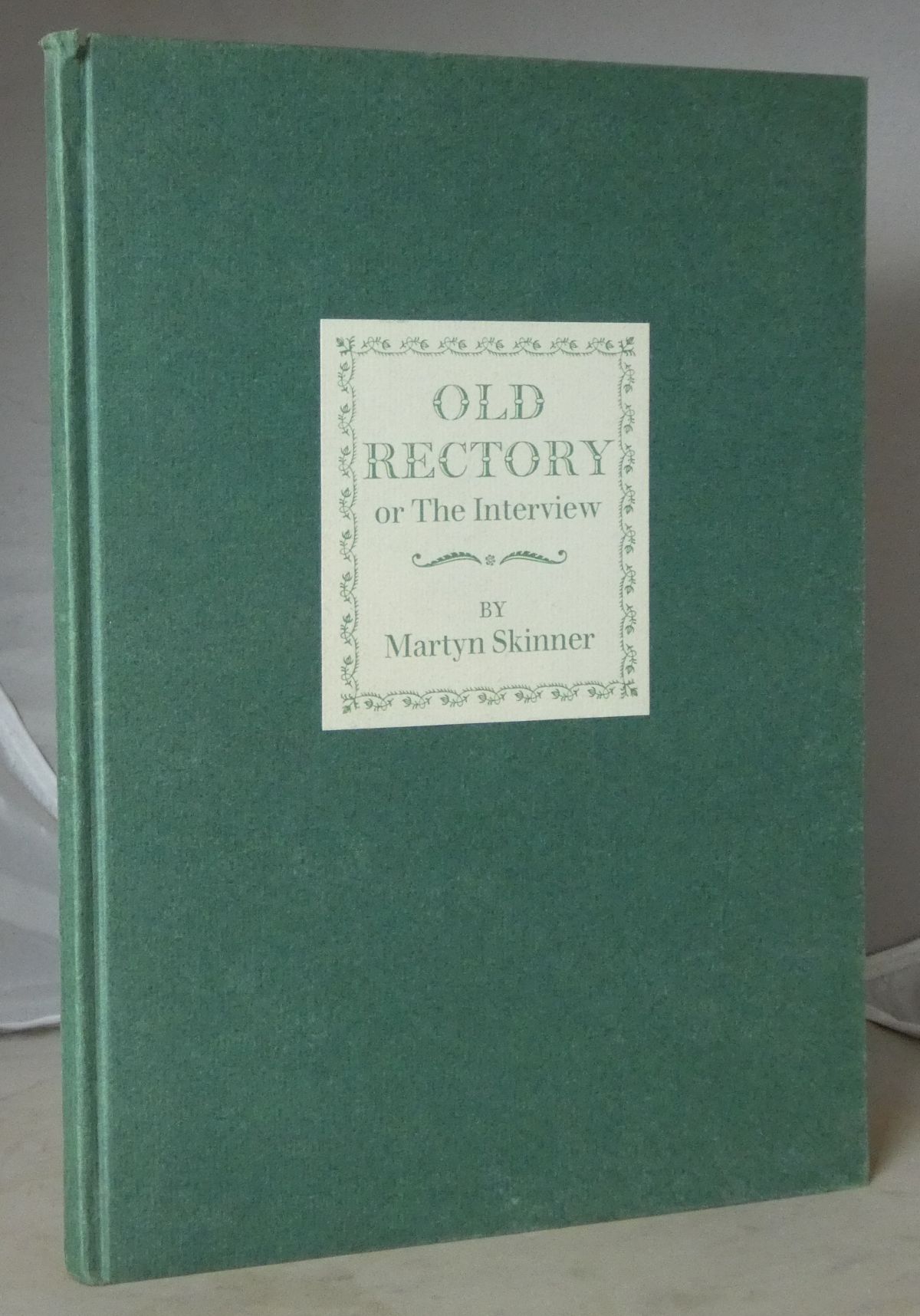
Found in my copy of Old Rectory by Martyn Skinner, a sheaf of letters and memos associated with this largely incomprehensible, privately printed ( by the highly respectable Rampant Lions Press ) long ‘ poem’ by a farmer-poet and former winner of the Hawthornden prize for Letters to Malaya ( 1941 – 47 ).
The book was published in late 1977 as the last volume of a sequence that went back several years, but the correspondence in question spans just over a year. It starts when Skinner included a covering letter in a signed copy of his book, which he sent on 15th December 1977 to Colin Welch at the Daily Telegraph. It ended when the book was finally rejected for review in January 1978. Here is the initial letter in full:
Martyn Skinner, Ilex House, Fitzhead, Taunton.
December 15th 1977.
Dear Mr Welch,
Four years ago you kindly accepted a copy of the previous volume of Old Rectory; so I hope you won’t mind my following up with a copy of the Epilogue, which concludes the work, and probably my poetic output as well.
I came on a comment by Coleridge the other day which seems apropos—in which he described one of his own books as ‘ a secret confided to the public and very faithfully kept.’
Yours sincerely,
Martyn Skinner.
Four days later, Colin Welch replied:
‘It is not kind of me to accept your books but, of course, the very greatest kindness in you to give them. I am deeply grateful. I greatly look forward to reading your latest, though I hope it won’t be your last.
With all warm good wishes for Christmas and the New Year.
Four days later David Holloway, the Literary Editor, writing on Daily Telegraph headed noted paper, sent the following memo to Telegraph deputy editor Colin Welch:
‘I don’t think I can honestly do anything about this. It is in a limited edition of 125 copies and if it were reviewed someone might actually want to buy it and this would clearly cause consternation. Much better that it should go to Michael Wharton.
And so it did. However, it would seem that Wharton was also unimpressed and accordingly wrote back to Welch thus:
‘If you think this bloke is any good, would you like to say so in your column ? If not, could I have the book back? Otherwise, over to you.
Unfortunately, Welch thought little of Skinner or his book and so the correspondence ends with Old Rectory being returned to Wharton.
There is no evidence that Skinner’s book was ever reviewed in The Telegraph, either by Wharton or by any other benighted reviewer. Nor, it seems, was it reviewed elsewhere in the press. It is a salutary tale, but one that authors might benefit from. For all his success with Letters to Malaya, Skinner couldn’t rely on his reputation to impress literary editors—even ones that had graduated from Oxbridge and were familiar with many of the Latin tags with which Old Rectory is handsomely sprinkled.
Michael Wharton, of course, was the real name of the brilliant satirist ‘ Peter Simple ‘, whose column had entertained reader of the Daily Telegraph since 1957 . With a cast of hilarious caricatures of mainly but not exclusively trendy left-wingers, such as the psychotherapist Dr Heinz’ We are all guilty ‘ Kiosk, Dr Spacely Trellis, the ‘go-ahead Bishop of Bevindon’, the writer Julian Birdbath who was writing his Life of Stephen Spender in a disused lead mine of Derbyshire and J. Bonington-Jagworth, spokesperson for the Motorists’ Liberation Front , Wharton may have intended to use Skinner’s book to add to this cast of grotesques, though the poet was not his usual target. Certainly, Welch and Holloway had good reason not to promote Old Rectory as a book that Telegraph readers might like to buy. In fact, with its obscure biblical references and unfocussed prophetic tone signalling the end of the world, it’s hard to imagine who the text is aimed at.
One poet who did admire Skinner was John Betjeman, who became friendly with him when the two men were fellow undergraduates at Magdalen College, Oxford. After graduating Skinner and some friends spent nearly a year pursuing the simple life in a Cotswold cottage. Here they would milk cows and sell the milk to support themselves, read the Bible and tune into the rhythm of Nature. At a later time he returned to Oxfordshire to take up organic farming in Ipsden, a short distance from the self-sufficient community of Braziers Park, where won awards for his barley. Here Betjeman may have visited him several times. Skinner dedicated the first volume of the Old Rectory saga to him, possibly as a thank-you for his friend’s very positive review of one of his Return of Arthur books. The archive of their long correspondence over the years can be found in the Bodleian Library. When Skinner in 1961 decided to leave his farm for Ealing Betjeman composed ‘Lines written to Martyn Skinner before his departure from Oxfordshire in search of quiet ‘ ( High and Low, 1966).
Return, return to Ealing.
Worn poet of the farm!
Regain your boyhood feeling
Of uninvaded calm!
For there the leafy avenues
Of lime and chestnut mix’d
Do widely wind, by art designed,
The costly houses twixt…
Skinner ended up at his boyhood home at Fitzhead, near Taunton, where he died in 1993.
Fun facts.
Colin Welch was the grandfather of Florence Welch, the pop singer, whose mother is Professor Evelyn Welch, the American-born art historian and author of the prize winning book, Shopping in the Renaissance.
R. M. Healey