
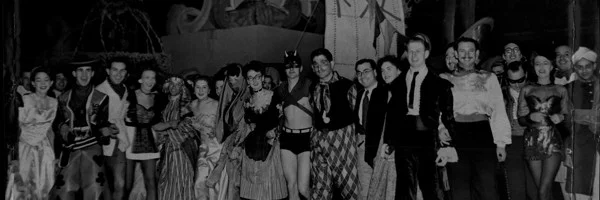
Journalist Peter Browne was obviously drawn to the more singular attractions of post-war London. Having covered Limehouse in his survey of alternative sights for Today magazine, he then turned his attention to Chelsea and Speakers’ Corner.
Paris has Montmartre, New York has Greenwich Village—-and London has Chelsea. Passing through this paint-splashed suburb ina ‘bus, trippers stare with eyes a-pop. That strange young man with beard and green corduroys—an existentialist artist ? ( He’s an average adjuster from Peckham.) And that girl with the pudding-bowl haircut and jodhpurs—a model ? ( She’s senior bristle-chopper in a Tottenham toothbrush factory.)
As the ‘bus rolls down King’s Road, the passenger wonders, with vague memories of La Boheme, where the wildest orgies are to be found. Wild orgies ? Off the ‘bus, sir. Rap on that green door.
Here you are. A struggling artist. His name is Henry. Observe his sober gent’s suiting, neatly mown hair and blameless chin. Walk through his studio and regard the familiar three-piece suite. Look in vain for hashish; sniff in vain for incense. The only odour is the homely moth-ball .
Across the road lives his model, a City typist named Agatha. In her evenings she earns an honest penny by posing for Henry while solving the Times crossword puzzle.
But you still want a Bohemian orgy? Then the best we can offer you is the Chelsea Arts Ball, held, with unassailable logic, in Kensington . The public must get what it expects—-so once a year, feeling rather embarrassed, artist stage an orgy—-and another British Illusion is sustained.
This is a rather weird article. First of all, let’s start with London’s famous arty district being described as a ‘suburb‘. No, Peter, Palmer’s Green is a suburb, Chelsea is very much an area of London, or what the French would call a ‘quartier’. Would you call Montmartre a suburb of Paris? Then there’s that young with a beard and green corduroys. Was he indeed an ‘existentialist artist ‘? At the time, young men with beards who dressed in anything that wasn’t pinstripe or tweed were usually seen as impoverished artists, political radicals or students, and to label any young man dressed unconventionally (yes, corduroy was unconventional dress) as an admirer of Sartre or Camus was pretty par for the course for a reader of Punch or The Daily Express.
The photograph accompanying this article is also rather bizarre. Headed ‘Chelsea’, this shows a group of young proto-beatniks (who were probably art students) of both sexes in various costumes spread-eagled on the floor. One is dressed as an Arab, another as a matador, while another male, much older than the rest and with long hair, is bare-chested and holds what appears to be a small axe. All seem to be stoned or high on something ( possibly hash) . These it would seem, were guests at the Chelsea Arts Ball ( photo at top) referred to by Browne. The Chelsea Arts Ball was an annual event founded by the Chelsea Arts Club in 1890 , it took place on New Year’s Eve/New Year’s Day at the Albert Hall. A raucous event that some journalists might regard as being close to an orgy, it gave London art students the opportunity to commingle with their peers, drink large amounts of alcohol and show off their skills in costume making. There were also floats, all of which had to be deliberately destroyed during the evening. Each Ball had a theme. In 1946/47 this was ‘The Renaissance’, which explains the dress of some of those students spread-eagled on the floor, notably the bare-chested male brandishing an axe, who had doubtless come as a Renaissance sculptor.
Over the years the Chelsea Arts Ball was well documented on film, particularly by Pathe News ( look online for examples) and there are also photos . One shows the future Labour politician Barbara Castle seated rather solemnly at a table with her husband Ted.
Speakers’ Corner.
‘Do you want to see a cross-section of the polyglot melting pot that is London?, asks Mr Browne. He continues.
‘Then go to Marble Arch. You will find a great crowd in search of free entertainment milling around the soap-boxes, step-ladders and collapsible rostrums. Whereon stand the apostles of free and fiery speech.
You will hear a weird cacophony. Sonorous rumble and high-pitched yelp; voices chanting psalms and voices roaring bar-room ballads’ words sour with invective and sweet with reason, uttered by the men with an axe to grind.
Is a Briton convinced that Armageddon will fall on St Swithin’s Day, 1950 ? Does he believe that wholemeal bread can make this a nation of supermen? Then he acquires a soap-box, a pair of leather lungs and a store of repartee and catches a ‘ bus to Marble Arch.
To you, gentlemen, coming from countries where strong words are followed by bloody deeds, all this may seem rather alarming. For here you can hear the Briton damn his
government, unload his grudges against society or just babble-double-talk for hours on end. He may say what he will and how he will; but he will meet no worse fate than a ribald jest from a practised heckler. And having unburdened himself, the rabbit in lion’s clothing will pack up his trappings and retire to a suburban bed-sitting room. He has said his piece. The soap-box is London’s safety -valve.’
It was the government of 1872 that set aside a corner of Hyde Park for free speech and today Speakers’ Corner is still the best place to hear arguments aired in public , as long as the speech is ‘ lawful ‘, that is to say, no ‘ hate speech ‘. Today, presumably, there are police officers milling around to ensure that the rules are not broken, although this must be difficult to enforce. Over the years, many big-name orators have been attracted to the Corner, including Dr Karl Marx, Lenin, William Morris, George Orwell and the theologian Lord Soper. Nearly eighty years on from Mr Browne’s report some things have changed. Step-ladders and tables are now prohibited for healthy and safety reasons. Otherwise, things have hardly changed at all. One noticeable difference from 1947, if the accompanying photograph is any evidence, is the almost complete absence of female audience members. And indeed, Mr Browne doesn’t mention women with grievances. There must surely be a few women or girls in the background, but the photograph does not show them. Also, hats. Flat caps, trilbies and the occasional sailor’s cap worn by demobbed servicemen can be observed. Today, how many people attending Speakers’ Corner might wear a hat of any sort? And how many women might be speaking or listening to the speakers? Quite a few, is probably the answer.
R. M. Healey