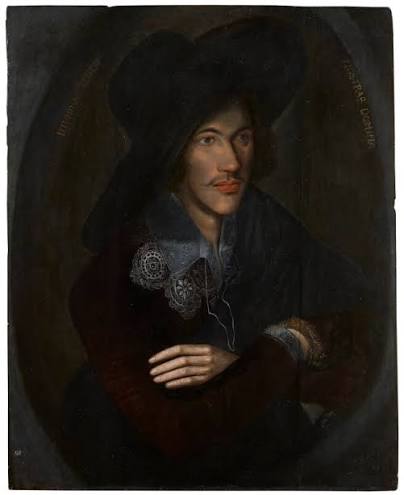
First lines…Who wrote the following and what was the name of the poem?
1) ‘Go and catch a falling star’
2) ‘ Tis the middle of the night by the castle clock’.
3) ‘The sea is calm tonight’.
What the well-dressed character wears. Identify the characters and name the stories in which they appear.
1) Needing a new dress for a business trip, she made one out of some green velvet curtains.
2) He wore a red coat, blue trousers, and purple shoes with crimson soles and crimson linings.
3) He wore a beautiful cravat ( or was it a belt/) that had been given to him by the king as an un-birthday present.
Famous words by famous people. Can you identify who said them and where they appeared?
1) ‘ You mentioned your name as if I should recognize it, but beyond the obvious facts that you are a bachelor, a solicitor, a Freemason, and an asthmatic, I know nothing whatever about you.’
2) ‘My soul ain’t yours ! It’s been bought and paid for by One that is able to keep it. Ye may kill my body but you can’t harm my soul.’
3) ‘ I chose my wife as she did her wedding gown, not for a fine glossy surface, but such qualities as should wear well.’
Gentlemen of the Cloth. Can you identify the clergymen described here and name the stories in which they appeared ?
1) After seven years of worrying about it, this minister publicly confessed his adultery.
2) After proposing three times to Elizabeth Bennet, this humourless and formal-mannered rector married her dearest friend.
3) During a famine this bishop assembled the poor people in a barn and burned them to death in order to have more food for the rich, and was presently punished when an army of rats swarmed into his tower and devoured him.
William TjadenSenior Executive at theTreasury, Taxonomist, Gardener, Writer and DIY enthusiast.
The Lewisham Train Disaster
Wednesday 4th December , 1957.
Foggy most of day.
Evening. Leave office at 6.20 because expect a fog service. Board train on platform 1 at Charing X. Leaves at 6.30 ( concourse crowded). Take 1 ½ hours to London Bridge. Then hear of bad accident at the flyover at St John’s. No more trains. So tube to Elephant—walk to Bricklayer’s Arms (8.30). Stay in B.L. for a bite and a drink till 9.10, then luckily catch bus which crawls steadily to Eltham Church ( ar. 10). Walk home in fog from there (ar.11). Madge gets to Catford & walks from there in the fog.
Over 90 killed in the accident (steam train hits stationary Hayes train & knocks bridge down).
Thursday 5th December
Evening. Home about 7—trains both ways tolerable in view of the accident.
Christmas Celebrations, 1957.
Wednesday 18th December.
Lunch hour. Buy few toys at Hamley’s, then “ Eugene Onegin” at the EMG shop (£6.6.0 odd ! 3 records & libretto).
Evening. Treasury Cocktail Party (what a waste of money & time. I keep very sober)…trains still very poor.
Thursday 19th December.
Lunch hour. Visit Selfridges aimlessly with Don…
Sunday 22nd December.
…Cycle to Jack & Annes’s (via Douglas & Joan’s) with Xmas presents. Of course watch some TV. Home again about 10…
Tuesday 24th December.
Privilege Day. Nice & mild.
Leave home usual time—train to Hailsham via Eastbourne. Arrive at Aunt Win’s about 10 to 12. Spend afternoon with her—go shopping in afternoon.. Leave at 5.45. Catch 6.45 at Eastbourne, but it’s ½ hour late, so get back home 9.30 pm. Mum is already installed comfortably for Xmas. Put up decorations.
Wednesday 25th December.
Another nice dry mild day.
Quiet Xmas with Mum & Winnie staying. First light Hurdapta for first time—also the paraffin convector heater. Jim H rings. Put up a few more decorations in front room. Spend rest of morning in the Waldor knocking out chrysanthemum stools and putting them together—interrupted by Ted & Janet, and later John & Shirley.
P.M. After excellent Christmas dinner, listen to wireless & Eugene Onegin on records. Tea also enjoyed because I didn’t eat too much dinner.
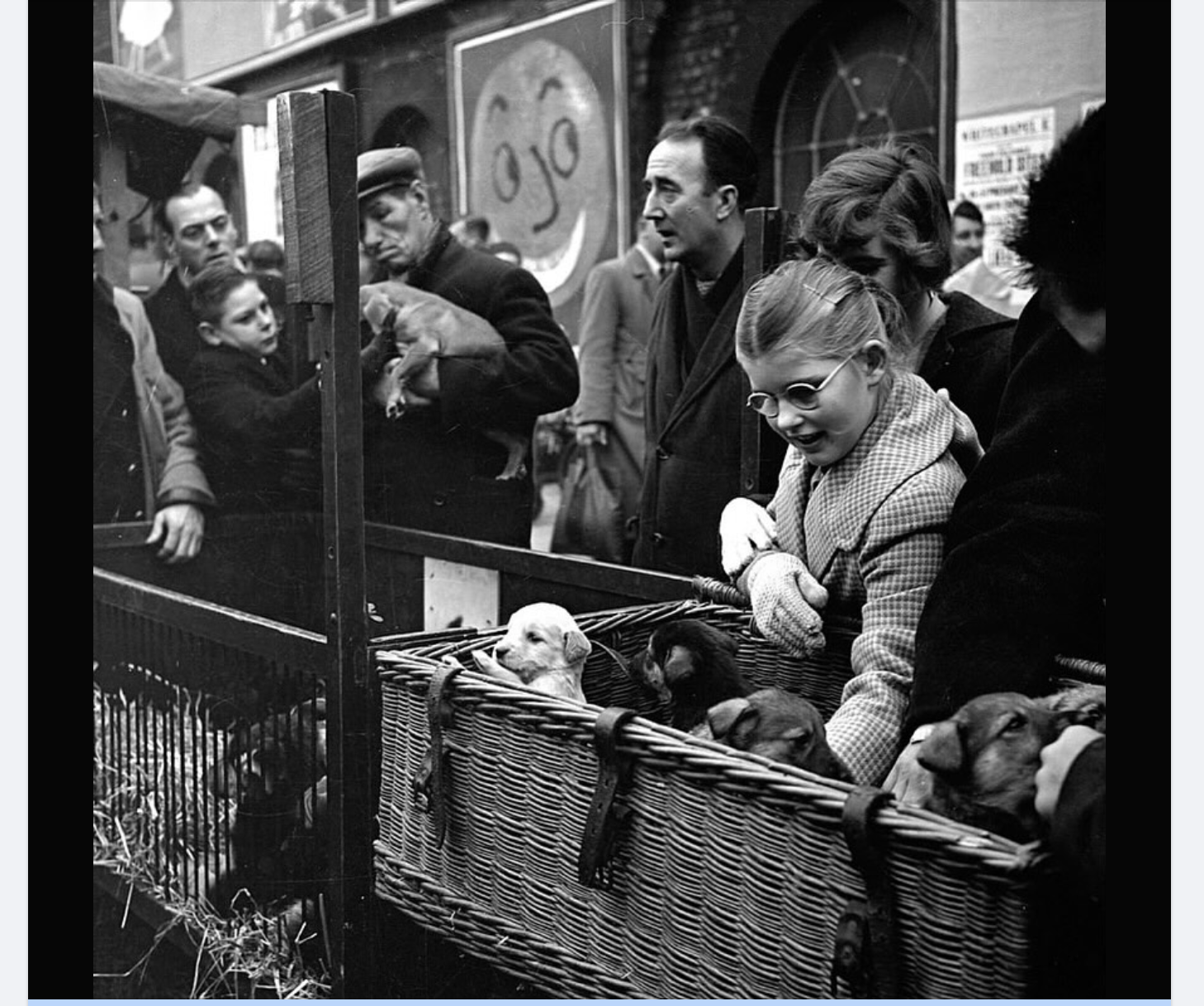
As recently as the early eighties Club Row in Shoreditch was renowned as a Sunday market where pets, including songbirds and puppies, could be bought for next to nothing with no questions asked. The short street, located between Arnold Circus and Bethnal Green Road, is still there but the market was abolished in 1983, the victim of animal welfare legislation.
A photojournalist from Today( Photo World) visiting the place in September 1952 captured the essence of the market, which spilt into the present Sclater Street, with telling studies of animals, vendors and potential customers. There is even a friendly ‘bobby ‘chatting to some of the customers. The market specialised in song-birds but vendors weren’t just stall-holders. One large emporium, called ‘ The Bird House ‘, presumably open for business during the week, had a shop front plastered over with adverts and cages.
Here is the journalist’s view of the birds for sale:
‘ Above this ordinary slum the Sunday hymn of bird song rises from cages that are loaded high on barrows, dumped on the pavement, or piled against walls until they look like blocks of flats—each little room by an ounce of twittering, high-strung life. These tenements- in- miniature mostly contain members of the linnet, goldfinch, chaffinch, thrush and skylark families. Beside them the vendors shout, “ Buy, buy, buy. All prime birds with lovely flights.” And with the hope of a sale, they stretch wide the wings of their merchandise for the crowd to see.
There is a marked difference in technique for the sale of dogs. There are, in fact, very few dogs to be seen in the Row. There might be a number of ‘pedigrees’ attached by lengths of string to fanciers who stand chatting in groups, a handful of puppies who yelp to passers-by from crates by the roadside, and a occasional woolly head will pop out and boggle at the world from the pocket of a vendor, but most dogs change hands over business deals in the nearby cafes.
The majority of these deals are introduced by lounging. If you look idle enough and
lean disinterestedly against a wall, a man in a well-worn suit, a cap and a muffler will sidle up to you and whisper hoarsely , “ Want a dawg, Mister?” The accepted reply to this is, “ Maybe”. Then he will say, “ How about a Fox?”. If you really want a Fox-terrier, you pause for a moment then add, “ That might do.” The hoarse voice says, “ See me at the café over the road in arfa mo.”
The café over the road is packed with men who are also in cloth caps and mufflers. They sit chatting, drinking tea and eyeing mysterious packagers n the taales in from of them. The contents of these parcels—which are about the size of biscuit tins and wrapped round with dark cloth—do not remain a mystery for long. The covering induces inside to sing—an old trick known to these fanciers—and from time to time there is a sound peculiar only to a café of this type: the song of a wild bird singing for the sun.
In “arfa no” the owner of the hoarse voice comes in with a “ Fox “ on a lead. If you know anything about pedigrees there is no doubt that the dog is a good one. A few pounds change hands and the deal is soon completed.
As long ago as 1933, a Bill was introduced in Parliament that would prohibit this form of buying and selling. Lord Buckmaster, who proposed the Bill, wanted particularly to prohibit the sale of wild birds. But the Government of that day, if not unaware of this fact remained unmoved by it..” An innocent recreation “would be spoilt they said, and the “ trade in bird seed…seriously affected. “
Today, nearly twenty years later, it seems that Parliament is still unable, or perhaps too busy, to choose between the voice of the birds and the voice of the bird-seed vendors.
Fifty years earlier, another journalist visited Club Row and reported his findings to George R. Sims, the editor of Living London (1901). Once again, Sclater Street is identified as ‘ Club Row’ , but having earlier visited Petticoat Lane market, the writer found the animal market very different.
‘ It is Petticoat Lane over again on a much smaller scale; with next to no Jews, hardly any women, less diversity, no side-shows ( unless you count the betting tipster and refreshment stalls right out past the limits of the crowd); no frivolity in short but strict attention to business.
Journalist Peter Browne was obviously drawn to the more singular attractions of post-war London. Having covered Limehouse in his survey of alternative sights for Today magazine, he then turned his attention to Chelsea and Speakers’ Corner.
Paris has Montmartre, New York has Greenwich Village—-and London has Chelsea. Passing through this paint-splashed suburb ina ‘bus, trippers stare with eyes a-pop. That strange young man with beard and green corduroys—an existentialist artist ? ( He’s an average adjuster from Peckham.) And that girl with the pudding-bowl haircut and jodhpurs—a model ? ( She’s senior bristle-chopper in a Tottenham toothbrush factory.)
As the ‘bus rolls down King’s Road, the passenger wonders, with vague memories of La Boheme, where the wildest orgies are to be found. Wild orgies ? Off the ‘bus, sir. Rap on that green door.
Here you are. A struggling artist. His name is Henry. Observe his sober gent’s suiting, neatly mown hair and blameless chin. Walk through his studio and regard the familiar three-piece suite. Look in vain for hashish; sniff in vain for incense. The only odour is the homely moth-ball .
Across the road lives his model, a City typist named Agatha. In her evenings she earns an honest penny by posing for Henry while solving the Times crossword puzzle.
But you still want a Bohemian orgy? Then the best we can offer you is the Chelsea Arts Ball, held, with unassailable logic, in Kensington . The public must get what it expects—-so once a year, feeling rather embarrassed, artist stage an orgy—-and another British Illusion is sustained.
This is a rather weird article. First of all, let’s start with London’s famous arty district being described as a ‘suburb‘. No, Peter, Palmer’s Green is a suburb, Chelsea is very much an area of London, or what the French would call a ‘quartier’. Would you call Montmartre a suburb of Paris?Then there’s that young with a beard and green corduroys. Was he indeed an ‘existentialist artist ‘? At the time, young men with beards who dressed in anything that wasn’t pinstripe or tweed were usually seen as impoverished artists, political radicals or students, and to label any young man dressed unconventionally (yes, corduroy was unconventional dress) as an admirer of Sartre or Camus was pretty par for the course for a reader of Punch or The Daily Express.
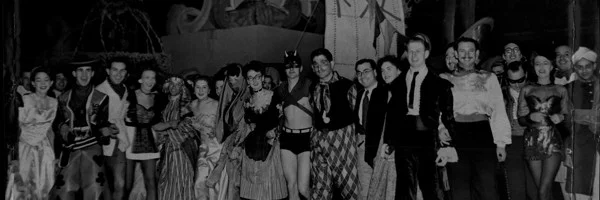
The photograph accompanying this article is also rather bizarre. Headed ‘Chelsea’, this shows a group of young proto-beatniks (who were probably art students) of both sexes in various costumes spread-eagled on the floor. One is dressed as an Arab, another as a matador, while another male, much older than the rest and with long hair, is bare-chested and holds what appears to be a small axe. All seem to be stoned or high on something ( possibly hash) . These it would seem, were guests at the Chelsea Arts Ball ( photo at top) referred to by Browne. The Chelsea Arts Ball was an annual event founded by the Chelsea Arts Club in 1890 , it took place on New Year’s Eve/New Year’s Day at the Albert Hall. A raucous event that some journalists might regard as being close to an orgy, it gave London art students the opportunity to commingle with their peers, drink large amounts of alcohol and show off their skills in costume making. There were also floats, all of which had to be deliberately destroyed during the evening. Each Ball had a theme. In 1946/47 this was ‘The Renaissance’, which explains the dress of some of those students spread-eagled on the floor, notably the bare-chested male brandishing an axe, who had doubtless come as a Renaissance sculptor.
Over the years the Chelsea Arts Ball was well documented on film, particularly by Pathe News ( look online for examples) and there are also photos . One shows the future Labour politician Barbara Castle seated rather solemnly at a table with her husband Ted.
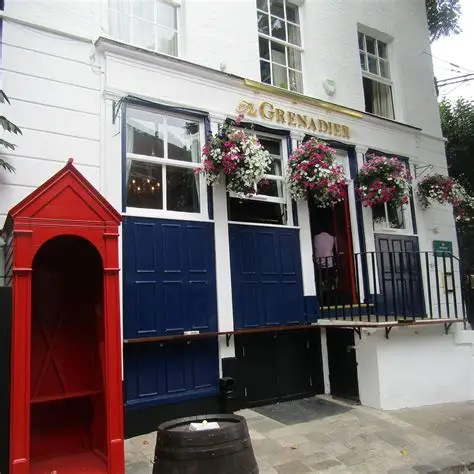
‘ This serves very decent food, far better than the average pub meal ( though naturally priced accordingly) .It does have a great deal of physical charm, in a particularly nice setting. Its connection is more to do with the Duke of Ellington than with the Grenadier Guards ( though a Colour Sergeant is detailed to pose for the inn sign whenever it needs repainting, and the barmen wear mess jackets). It used, in fact, to be a mess for the Duke’s officers , and Duke himself is alleged to have played cards there.’
Today, the pub is owned by Sir Jim Radcliffe, the chemical engineer who became boss of INEOS and is now the major shareholder of Manchester United. It was Radcliffe’s favourite pub and it was here that he and his friends planned from scratch the Grenadier car that bears the name of the pub, which he bought from Greene King in 2022. Madonna and William, Prince of Wales have been recent customers. The pub is said to be haunted by a subaltern nicknamed Cedric who was beaten to death for cheating at cards in 1818.
The London Spy was correct about the price and quality of the food served here. Dishes from the main menu are still expensive, like all pub meals served in Mayfair, but the food is very appealing. Starters range from £10 to £16.25, while the ‘famous Beef Wellington comes in at a bargain £39.95.
The Star Tavern, Belgrave Mews West.
‘…This belongs to no clique that can actually be pigeon-holed, but you get the impression that if the master-minds behind the Great Train Robbery ever used a pub, it would be one remarkably like the Star. There is the atmosphere of discreet opulence about the place, and inevitably a Jaguar or two outside…’
Well, rather bizarrely, the speculation of 1966 regarding criminal activity, is repeated as fact by those marketing the pub today. According to this:
‘ Bruce Reynolds, who coordinated the robbery, regularly drove his Aston Martin from his Streatham home to meet (Buster) Edwards and one or two other members of the gang in The Star to go over details during the run up to the robbery…’
Arty pubs
Queen’s Elm, Fulham Road. Chelsea.
‘One of the most famous ‘ arty’ pubs in Chelsea is the Queen’s Elm, where the importance of the customer can be gathered by the way he is greeted by the landlord, who will rush forward if he is a famous novelist or actor, but who will also—let it be said—cash a cheque for the odd poet ( Patrick Kavanagh, the Irish poet, used the pub when in London).’
Alas, the Queen’s Elm no longer exists, having closed its doors in 1990s.It is now yet another clothes shop. The publican referred to in the New London Spy was the Irishman Sean Treacy, who was one of those rare creatures, a chronicler of his own pub. To one commentator, his memoir, A Smell of Broken Glass was a ‘ masterpiece’. To another writer the pub was a refuge for those barred from the Chelsea Arts Club. The film director, Joseph Losey, liked the place and used it as a location for ‘The Servant’ (1963), which starred Dirk Bogarde.
Finch’s ( aka The King’s Arms), Fulham Road.
‘ Finch’s is slightly less pretentious than the Queen’s Elm, and is excellently staffed …It is patronised by actual painters and sculptors, Frank Bowling and Elizabeth Frink, for instance. There is also a hard core of regular locals, being the kind of place you could return to after ten years in Tangier and be sure of running into people you used to know in Finch’s in the old days.’
Today, there is a reference in the online entry to ‘ thespian hell-raisers ‘ ( whatever that means) in the sixties when this pub was known as Finch’s, which is perhaps the reason why the owners decided to drop this name and return to the King’s Head. It is now a pretty standard Victorian pub with the usual period fittings. There are no references to Liz Frink and Frank Bowling, whoever he was.
‘ Junk is other people’s left-overs, which they never usually wanted in the first place anyway. Junkards collect these left-overs, which they never usually know they wanted until they suddenly see them…’
‘…Everybody gathers a lot of junk. It is the diversity of personal litter that gives a room its ‘lived in’ character. The junk-hunter recognises this phenomenon and plays it . Instead of limiting his choice to beautiful things, he mixes them with objects that are attractive for other reasons. The skill is in the mixing, and the end product is a true expression of personal taste.
The good taste market has long ago been cornered by the antique dealers, the art-craft enthusiasts and the ‘contemporary’ Scandinavian designers. Their prices are as elegant as their goods. Junk is cheap: the problem is not how to afford it, but where to find it.
Modern junk abounds, particularly in the souvenir shop that cluster round the travel termini and the Places of Interest. You may occasionally find bits of new rubbish worth a nicker in your scheme of things. They may mellow with time, and accumulate charm; bit it is the old, démodé stuff that is most worth going after, because it is unfamiliar and has to be hunted for…
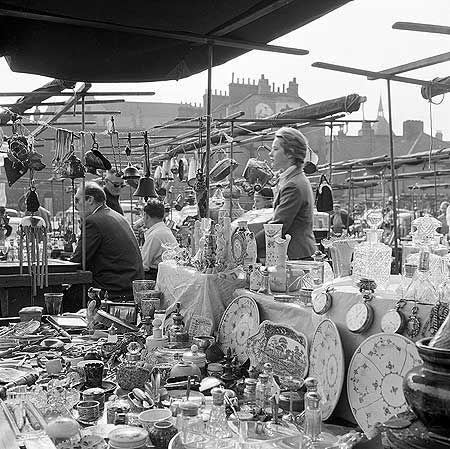
Market stalls can be deceptive. There is something about an open- air display that suggests cheapness and bargains. Dealers know this as well as shoppers. When a market has won a rotation among the connoisseurs, the pricier dealers join the bonanza and establish what are in effect branch businesses there.
This had already happened to the Caledonian Market before it was moved to its present pitch besides Tower Bridge Road. It has long been true of the Portobello Road, certainly at its southern end. When a dealer takes a stall in the Caledonian Market , he adds 20% to his prices, and the Portobello Road 40%. ‘
Junk stalls in 2025.
Caledonian and Portobello Road Markets.
It’s not true about the 20% and 40 % price rises. To your Jotter, who has acquired many a bargain at the Caledonian and Portobello Road Markets over the years, the prices are very fair, mainly because few dealers have the overheads that come with running an antique shop, but buyers must beware. The Caledonian, which opened in Bermondsey in 1950, was for many years an infamous ‘market overt’ , which meant that ‘ hot ‘ goods could be sold there in good faith between designated hours. This loophole was closed in 1995. After noon many dealers packed up their stalls, possibly for fear of being nabbed by the police, though for obvious reasons this seldom happens. When the New London Spywrote about the Caledonian, it was a very high quality antique market which occupied the whole of the square in Bermondsey village. Then, eighteen years ago everything changed. A towering hotel was plonked right in the middle of the square, taking up valuable space. As a result, many stallholders decided to decamp elsewhere, leaving behind a rump of devoted dealers determined to remain. But it’s not the same in 2025 as it was in its heyday. The number of stalls has diminished and the quality of the stock has declined and if it is visited at all by collectors, these are generally tourists attracted by the reputation it once had, rather than serious lovers of antiques.
As for the Portobello Road, the smartest dealers have either snazzy shops or only slightly less snazzy indoor cubicles that are often ( like the junk shops in the poorer parts of London ) ‘permanently shut’. But it is true that the junk is concentrated on stalls at the northern end of the Road, particularly Golborne Road, where, as well as decent antiques, there is real junk at very low prices of a quality similar to that to be found in your average village jumble sale. And yes, I do suspect that some of the ‘ here today and gone tomorrow’ traders in Golborne Road do indeed ‘destroy most of what they have not sold at the end of the day.’
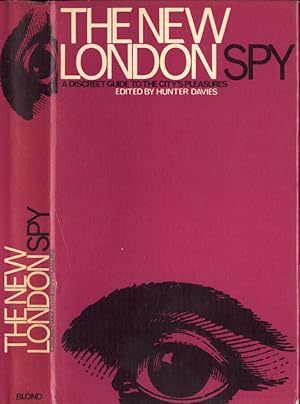
With these popular paperback ‘lowdown’ guides to London the trick is to date them without looking at the title page or other publishing information. What is needed is a perfunctory whiz through some of the contents and then a guess. I guessed at 1968. It turned out that it came out in 1966, when its well informed editor was in his twenties. I say ‘well-informed’ but ‘Oonter ‘ Davies ( as Private Eye dubbed him) does call on a long list of specialist contributors, including such household names as Dominic Behan, David Benedictus, Chaim Bermant, John Betjeman, Anthony Blond, Quentin Crewe, Maureen Duffy, Martin Green, Tim Heald, Michael Horowitz, George Mikes, Philip O’ Connor, Jonathan Routh, and a few less well known writers.
One party game might be to identify who wrote what. Some are pretty easy. John Betjeman almost certainly wrote on London churches. I would guess that the surrealist poet Philip O’Connor wrote the chapter on the Underworld or Down and Out, mainly because he was down and out for most of his chaotic life. Dominic Behan, brother of Brendan and an active IRA supporter as well as a prolific songwriter and playwright, probably contributed the bit on Irish London and possibly some of the material on pubs, since he liked a pint or three. Jonathan Routh, humorist, prankster and the man behind the British version of ‘ Candid Camera’ , could have written on a number of subjects, but it’s possible that he wrote on ‘ homosexual London’, since he published several little books on the subject of the best loos. His first book on this subject is actually mentioned under ‘ Lavatories ‘ on page 147. Chaim Bermant must surely have written the very scholarly piece on Jewish London and may have contributed to other chapters. The highly successful publisher Anthony Blond , a bon viveur who lost his exhibition to New College Oxford through his over indulgence in ‘ the joys of drink, people, parties, fancy waistcoats, foreign travel and falling in love—mostly with young men ‘ could have contributed to the chapters on restaurants and night clubs, but may also, as a bisexual, have been the author of the piece on homosexual London, which shows a very sympathetic view towards the plight of gay men just before homosexual relations were made legal in 1967
It is interesting to note that although the Paris Metro began its operation s in July 1900, this ‘ revised and updated ‘fourth edition of The Continong, which bears the date of 1906, omits to mention the existence of the famous rapid transportation system. This is bizarre, especially when under the heading ‘ Buses and Trams ‘ Mr Anar de la Grenouillere, complains about the extreme slowness of these old methods of transport which the Metro was partially designed to replace.
Phrases of politeness and greeting
‘ …never answer oui nor non along to a question; that’s English, but always add@ Monsieur, Madame, or Mademoiselle; that’s French.
…use the words Monsieur, Madame, Mademoiselle freely; sallow your insular pride, and do in France as the French do. Take of your hat to men as well as to ladies, when you meet them or come up to speak to them. If you have been introduced to a person, lady or gentleman, older than yourself, take off your hat first, when you meet him or her. Contrary to what is the custom in England, never wait for a lady to bow to you before taking your hat off to her.
When you are going to pay a call put your gloves on. When you are asked ti dinner, keep them on after being shown into the drawing- room until you go into the dining-.room. Don’t excuse yourself for wearing gloves when you are shaking hands. It is not only permissible but customary to shake hands with gloves on . Fashion has decreed it. The reason is this: in France gloves are not merely put on to prevent than hands from getting dirty, as seems to be the case in England, but they are part of the dress, i. e an ornament. Never wear soiled gloves when you are in Sunday attire…
Post-Offices.
When you get into a Post-Office in Paris, or in any other large French town, the first thing you notice is the foulness of the air. So, take a long breath before you go in…there are not nearly enough Post-Offices on Paris, and the result is that at certain hours of the day they are crowded beyond endurance. Moral:::::::: NEVER go to a Post-Office to buy a stamp, go to a Tobacconist’s…
N.B. Most Post-Offices are provided with a Cabine telephonique publique.
Letter boxes.
‘…There are a few pillar-boxes after the English style in Paris, but these have been painted a dark green colour, so they are not very conspicuous. They also sometimes have advertisements posted at the top of them; hence the pillar-box lloks like an ordinary pillar and not a receptacle for letters…
Tobacconists
…To most Frenchmen, English baccy tastes like hay, and is only fit for…Englishmen…
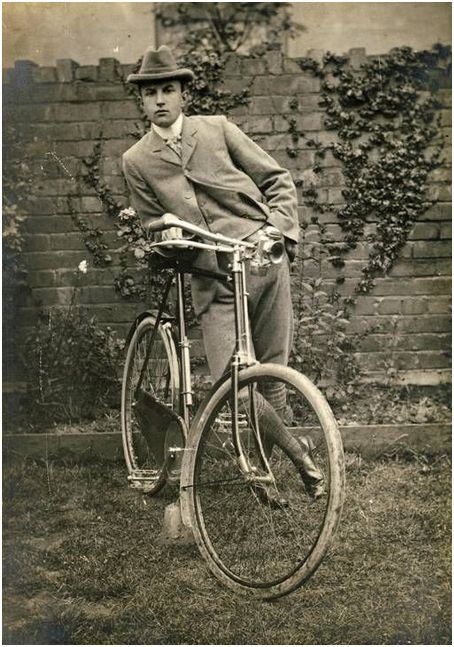
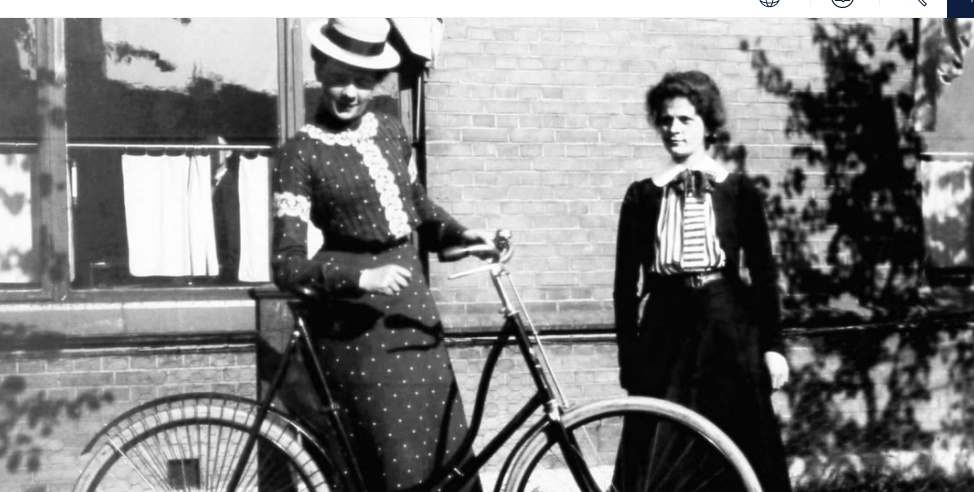
Two things that jump out from a cursory glance at The Continong by the pseudonymous Anar de la Grenouillere, F.O.N.S., of which a file copy of the fourth edition of 1906 was found at Jot HQ the other day, is first the rather forced facetious tone of its advice to travellers to France, and secondly the predominance of references to cyclists.
In 1894, when The Continong first appeared, the motor car had only been around for a handful of years and so presumably the author did not feel it necessary even to acknowledge its existence. But by 1906, when many more manufacturers were producing cars, this rise in traffic is not acknowledged in this ‘revised and updated ‘edition. Touring France for the English speaker was still all about railways or, in Paris, ‘buses and trams ( though not the Metro, although this had been established by 1906) possibly walking, horse-drawn ‘cabs’ but most of all, cycling. Compared to the four pages devoted to railways and three on cabs and cabbies, the author provides fifteen pages of advice for cyclists.
The first few pages of this advice are devoted to what to expect on arriving in France. British cyclists are urged to join the TFC (Touring Club de France) which was founded in 1890. For a mere five shillings a year, benefits include a Handbook, and the exemption of duty on their cycles, and for a few extra francs a Year-book containing a list of over 3,000 approved hotels, at which members enjoy a privileged position as to charges, a Year-book for foreign countries and a book of ‘skeleton tours’ for the whole of France and adjoining countries. Incidentally, a compulsory requirement for cycles being ridden in France and elsewhere on the continent was a name-plate ‘bearing the name and address of the owner (and) attached to the machine’. This seems to have been the equivalent of a car licence plate, which back then became a legal required for motor vehicles in 1903. Again, this suggests that cycles were seen as the predominant form of personal transport, at least in France.
The Continong continues with a selection of these cycling tours, picking out some of the more interesting sights. There is also a warning that ‘ if you are interested in French politics and would like to ascertain, while in Rouen, whether Paris is quite free from anarchists and from their bombastic speeches, you had better go and read the latest telegrams that are put up outside the offices of the Journal de Rouen, in the Rue Saint-Lo. ( my italics).Anarchism had become rife in parts of northern Europe by this period and in the East End of London was to culminate in the famous ‘ Siege of Sidney Street’ orchestrated by the celebrated Estonian activist ‘ Peter the Painter ‘ in 1910.
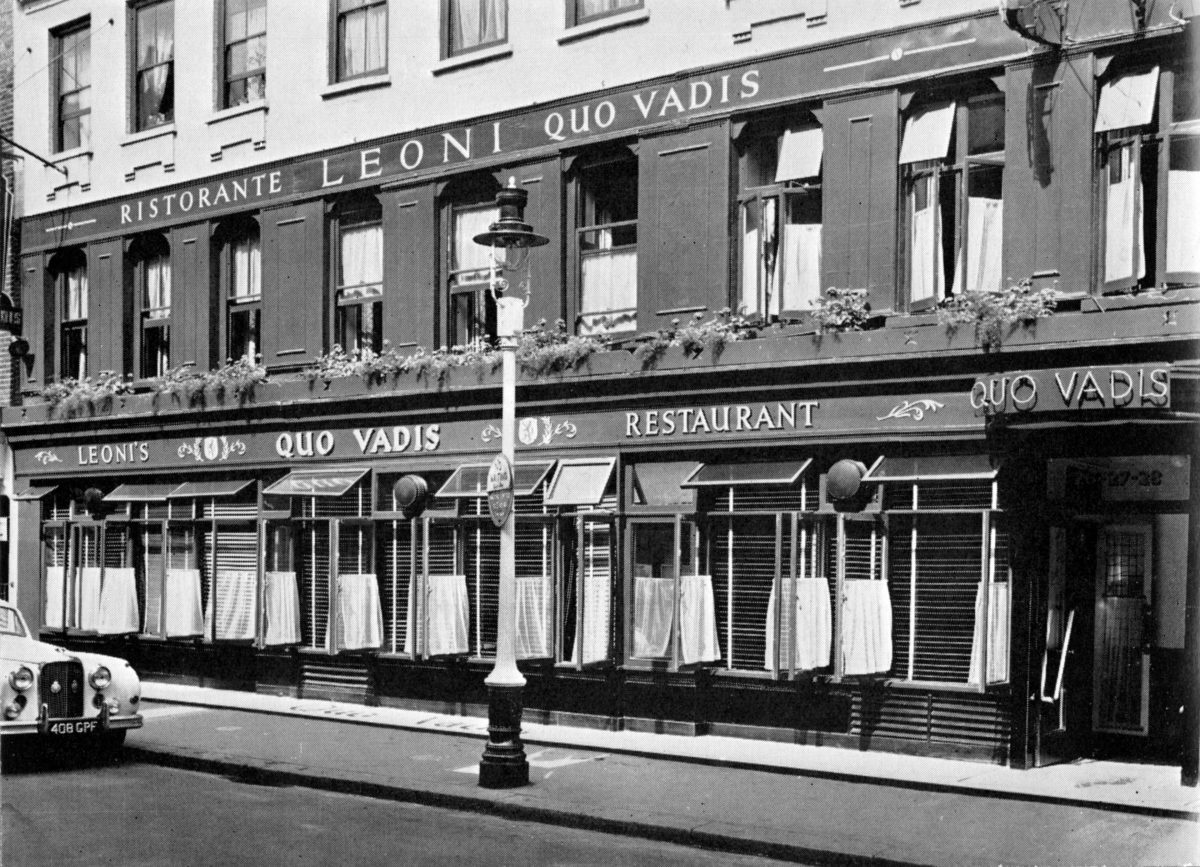
We don’t know whether Fanny and Johnnie Cradock, aka ‘Bon Viveur’, were fans of James Bond’s creator Ian Fleming , but the three writers had one thing in common. They all liked dining at Quo Vadis in Dean Street, in the heart of London’s Soho.
Throughout the fifties, when Fleming was writing the Bond thrillers, he was dining and drinking regularly at a number of top London restaurants, particularly favouring L’Etoile, The Ivy, Overton’s, Pimms, Quo Vadis , the Ritz Grill, the Savoy Grill, Scott’s, the ‘ Big ‘ Wheelers and Wilton’s. Of these famous eateries Fanny and Johnnie only chose to write about Quo Vadis, the Ivy and ‘Big’ Wheeler’s in their 1955 Bon Viveur guide, possibly because they felt that the others didn’t need the publicity, or perhaps because the food and wine they served was over priced
Fleming had no such scruples. According to one source, he was particularly drawn to the rather rich French cuisine that many of his favourite eating places were happy to serve. He also drank heavily and smoked at a time when this unpleasant habit was permitted, and even encouraged in restaurants. No wonder he died at the age of 56.
If the dishes sampled by Fanny and Johnnie in the London restaurants they did cover in their guide, were any indication of their tastes, they and Fleming were equally drawn to continental cuisine. This is obvious in their entry on Quo Vadis:
Scarcely just a restaurant any more, but additionally an institution, a landmark, an integral part of Soho life. Signor Leoni’s restaurant, with the wall paintings and the air of having been there for ever, has nothing to envy in terms of famous clients from the most fashionable Mayfair restaurant squib exploded in a blare of phoney publicity . ‘Everyone’; goes to see Leoni, who exudes friendliness and enthusiasm and who can be passionately severe without the slightest effort if some part of his standard of cooking and service momentarily slips.
Leoni recommends ( and we, of course, concur) that you should try his Omelette Leoni ( 4s 6d) , his Pollo alla Yolanda ( with cheese and asparagus tips , 9s 6d. , his Calves Head Florio ( 4s 9d.), Artichokes in Hollandaise ( 6s 6d) , Lasagne Verde (3s 6d), and one of these two special house gateaux Gianella or Lorenzia. There are all provided a la carte . In addition, the table d’hote three course luncheons ( 8s 6d) and dinner ( 10s 6d) invariably includes such Italian favourites as Minestrone, Pollo Romana, Ravioli, Tagliatelli and Risotto.
Leoni will willingly help you make a happy marriage at the table with one of the many Italian wines he sells. He may evince a special partiality towards the white Sabioncella Leoni Reserve’47 ( 22s 6d per bottle, 11s per half-bottle) and the red, costing 23s. 6d per bottle, 12 6d. per half-bottle. And why not ?Both these wines come from Cannero, on Lago Maggiore, which is his birthplace. The event which has pleased the proprietor most this year in the winning by his team of chefs of no less than three gold nedals1st class and one Silver Medal at the International Catering Exhibition, Berne, 1954.
Two things that jump out from a cursory glance at The Continong by the pseudonymous Anar de la Grenouillere, F.O.N.S., of which a file copy of the fourth edition of 1906 was found at Jot HQ the other day, is first the rather forced facetious tone of its advice to travellers to France, and secondly the predominance of references to cyclists.
In 1894, when The Continong first appeared, the motor car had only been around for a handful of years and so presumably the author did not feel it necessary even to acknowledge its existence. But by 1906, when many more manufacturers were producing cars, this rise in traffic is not acknowledged in this ‘revised and updated ‘edition. Touring France for the English speaker was still all about railways or, in Paris, ‘buses and trams ( though not the Metro, although this had been established by 1906) possibly walking, horse-drawn ‘cabs’ but most of all, cycling. Compared to the four pages devoted to railways and three on cabs and cabbies, the author provides fifteen pages of advice for cyclists.
The first few pages of this advice are devoted to what to expect on arriving in France. British cyclists are urged to join the TFC (Touring Club de France) which was founded in 1890. For a mere five shillings a year, benefits include a Handbook, and the exemption of duty on their cycles, and for a few extra francs a Year-book containing a list of over 3,000 approved hotels, at which members enjoy a privileged position as to charges, a Year-book for foreign countries and a book of ‘skeleton tours’ for the whole of France and adjoining countries. Incidentally, a compulsory requirement for cycles being ridden in France and elsewhere on the continent was a name-plate ‘bearing the name and address of the owner (and) attached to the machine’. This seems to have been the equivalent of a car licence plate, which back then became a legal required for motor vehicles in 1903. Again, this suggests that cycles were seen as the predominant form of personal transport, at least in France.
Forget the Season of Good Will. Behaving insultingly is much more fun. Over Christmas why not try out some of these stunts.
Abroad.
Insist on paying for everything in sterling.
Ask for local delicacies and leave them on your plate.
Drink Guinness or Scotch everywhere.
Wear your military decorations at all customs checks
Order a cup of tea at 9.00 p.m. in a pavement café on a Saturday night and sit over it for as long as you dare.
Wave back at policemen who whistle at you and wave their truncheons. ( Have your number plates covered in mud first!)
In banks
If there isn’t a queue form one by asking the cashier as many questions as you can think of until the people get fed up and either go out or move to another window.( Questions about holiday money just before Christmas are always a success.)
If there is a queue make it longer by writing your cheque incorrectly. Get the date wrong. Write another name by mistake and appear to see the fraud, enter a huge sum, say £10,000, and then change it to £10.00. Drop your pen, or lose it in your handbag while this is going on.
On the Beach.
Play your transistor very loud, but play Radio 3.
Take elaborate picnics with iced wine and proper cutlery, especially if you’ve noticed that everyone else is eating corned beef out of a tin.
At Christmas
Refuse to give any guests a drink on the grounds that it’s for their own good not to drink and drive. Have plenty of soft drinks to offer them though. Then pour yourself a large Scotch on the grounds that you aren’t going anywhere and don’t have to worry.
Send no Christmas cards at all.
Send the television set to be serviced on Christmas Eve.
Fill the children’s stockings with ‘useful presents’—O level revision cards, that sort of thing.
Turn up the television when the carol singers arrive and turn off the lights until they go away.
Detectives making last-minute enquiries went to a stable in Berkshire yesterday. They wanted to interview the occupier.
Evening Standard.
Miss Y—, the well known singer was nearly poisoned at one time. So she said at the meeting on Tuesday. When she stated that she had been nearly poisoned , the features of the members expressed regret.
Irish Paper.
This policy offers absolute security in the event of any kind of fatal accident.
Insurance advert
London firemen with rescue gear were called early yesterday to Dorset Street, Marylebone, where a man fell into a basement yard. He was lifted to road level, injured, and taken to hospital.
Daily Mail.
The young woman, with a baby in her arms, appeared at the window amidst flames and smoke and yelled quick proof to the editor.
Sunday Paper.
The lad was described as lazy, and when his mother asked him to go to work he threatened to smash her brains out. The case was adjourned for three weeks in order to give the lad another chance.
Manchester Paper.
The service was conducted by te Rev. Charles H—–MA, the bridegroom. The service was of a quiet nature owing to the recent death of the bride.
Blackpool Times.
WANTED, a Gent’s or Lady’s Bicycle for a Pure Bred Sable and White Collie.
Lincolnshire Paper.
There is a sub-department at Scotland Yard which looks after Kings and visiting potentates, Cabinet Ministers, spies, anarchists, and other undesirables.
It is generally agreed that human beings acquire sleeping sickness from biting flies
The Pioneer.
It is estimated that about 16 foxes were shot or killed by the hounds
FOR SALE. Baker’s business, good trade, large oven, present owner been in it for seventeen years.
FATHER OF TEN SHOT
________________
MISTAKEN FOR RABBIT
Headline in New York paper.
What is more beautiful for the blonde to wear for formal dances than while tulle? My
Answer—and I’m sure you will agree with me—is ‘ Nothing’.
Worcester ( Massachusetts) Evening Gazette.
Mr Lloyd George, patron saint of the Liberal Party, was a very astute gentleman with both ears glued to the ground. Naturally, he could not see very far ahead.
Scottish paper
A representative said that people saw in the movement a real big octopus which would put its ring around them and swallow them up.
Essex paper
This criticism is not open, as Britishers would be, and consequently is difficult to nail down, but, lie a snake in the grass, is whispered behind a hand which covers a sneering face.
Letter in Rugeley Mercury
In the first important utterance of the Chairman of the Board, he has, so to say, thrown the Board overboard and ploughed his own canoe.
Ceylonese Paper.
Said a Farnborough shopkeeper, ‘ The Council is pulling the bread and butter from under our feet’.
Farnborough Paper.
The great white elephant which is slowly emerging from the chrysalis at the end of Sepoy Lines has yet to be opened.
Malayan Paper
The rich man’s motor may sow the seed of the class war, but the landlord’s horse yielded the milk of human kindness.
Bradford Paper.
‘Gentlemen, we will have nothing to do with it; it is but the thin end of a white elephant.’
Hampshire Town Councillor.
Speaking at Mablethorpe Council meeting, Councillor P. Thomas said: ‘ This Council is fiddling while Mablethorpe is settling under the pounding hoofs of motorists.’
Local Paper.
Fortunately for the workmen the glass fell perpendicularly, for had it fallen vertically, the accident in all probability would have proved serious.
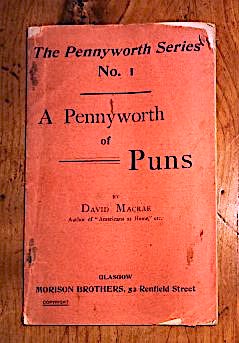
Found at Jot HQ the other day, a small booklet of 48 pages entitled A Pennyworth of Puns, which in its references to Home Rule and The New Woman, can be dated to the close of the nineteenth century. In its attempts to describe various types of pun, to date its origin to Ancient Greece and to comment on its place in the history of English humour, this is more a disquisition on the pun than a mere list of examples of it. Perhaps we should begin with some punning book titles.
In a previous Jot we listed some witty book titles which one writer had concocted for books in his library. Thomas Hood was asked by the Duke of Devonshire to come up with titles that he could place on the spines of a ‘ blind door ‘ in his library at Chatsworth. Not all can be appreciated today, but the following are some of the best.
Book titles
Cooke’s Specimens of the Sandwich Tongue
Wolfe’s Treatment of Sheep
Boyle on the Gums
Bunyan on the Foot: by a Pilgrim
Walker’s Excursions to the Birthplaces of distinguished Travellers.
Conundrums
Why is a postage stamp like a naughty boy?
Because it’s licked and put in a corner.
What makes Treason reason, and Ireland wretched ?
The absentee (T)
Why is it a dangerous thing to sit in the free seats at church?
Because you learn to be good for nothing
Why is a novelist the most extraordinary of animals?
Because his tale comes out of his head.
Why is blindman’s buff like sympathy ?
Because it is a fellow feeling for a fellow creature.
Illustration from DALL-E when asked for a book cover for Buchan’s The Three Hostages. It doesnt seem to understand his name..
I asked Chat GPT to come up with a John Buchan parody. The brief was to write a piece with the context of rain outside, a man and wife inside and an unexpected visit by a friend. This had been the brief for a parody found in the annual school magazine of Clovelly-Kepplestone (1930) a private boarding school for girls in Eastbourne, Sussex. It flourished from 1908 until 1934 and was familiarly known to staff and pupils as “Clo-Kepp”. There is a very comprehensive piece on it at Wikipedia.
The Clo-Kepp John Buchan parody, probably by a school girl, is an amusing and well tuned effort:
“The night was wild and rainy and reminded me of the time when old Hatiron and I were engaged in that business of the Forty-second Psalm. My wife, who was busily employed in the stitching and repairing of one of my shirts, torn during the day’s shooting at Clan Haggis, remarked upon the persistently bad weather we had been experiencing of late, and wondered, the streams being then in spate, whether I should not take a week off to try the mettle of the fish in the Ben Slioch burns.
I opened The Times, and, glancing casually through its pages, noted with surprise that Flaxman had resigned his post in the Ministry. He was always pretty keen on politics, though strangely recondite in his views on Empire Policy, which he declared was sheer jingoism and inflated proletarianism. However, it seemed strange that he should leave the Ministry at a time when Burton was intent on seeing that England got what she wanted.
” Well, what’s the news ? ” inquired my wife.
” Oh, very little,” I replied, ” the usual things ; I see Flaxman has retired. I can’t help thinking there must be something to it.”
Just then the bell rang, and after a moment Breeves came in to ask if we were at home to Mr. Thoughtnot.
” Why, Jimmy,” I cried, ” this is a marvellous surprise.” The last time I had heard of him he had been wandering about Samarkand disguised as a Shiari ; and had you spoken of him in a certain hovel where the mountains dip down beside the valley, which runs towards Tashkent, you would have heard strange things of him. For Jimmy was a Lawrence in those parts, and there is not a wandering pedlar on the Kirgiz Steppe who will not give a night’s lodging to him who mentions Raskashpol.
Two tablespoonful of paraffin oil added to the footpath will relieve and refresh aching feet. Local paper.
The Churchillian jaw was outthrust and the Prime Minister thumped the despatch box with a heavy fish. Canadian paper.
A Grand Jury in Los Angeles have indicted welter weight boxer Art Aragon on a charge of offering a bride to an opponent. Bradford Telegraph and Argus.
You really do no good by constantly scalding a child
Woman’s paper.
By this time the blenny had learned to come up to the surface of the water and take shreds of muscle from my friend’s fingers. The Scotsman.
According to the estimation of Mine Host of Saxmundham, the Saxulation of Popmundham is 1,368. Suffolk Paper.
Aunts in the house are a serious nuisance and are not easily expelled once they have established a kingdom. Perhaps a chemist in your town could help you.
People’s Friend.
England’s team manager said|: ‘There seems to be some hoodoo over the English forwards in their inability to get gals’.
Owing to a plague of wasps in the Sheffield district, farmers have had to stop harvesting operations to take wasp wasp nests before they could gather in their wasps.
Edinburgh Evening Dispatch.
Along the Parkway schoolchildren hurled roses in the General’s path. Two schoolgirls presented him with a large bouquet of roses . ‘God bless you my children, and thank you,’ he said as he killed both girls. Philadelphia Paper.
With nine wickets down, Enthoven changed his tactics and bit both bowlers.
Manchester Paper.
Following on yesterday’s defeat of the Government in the Dail, a meeting of the Cabinet was hell this morning. Dublin Paper.
The letter pointed out that whereas there were definite allocation of oranges from time to time, the supply of demons was very short. Northants Paper
Humidity is perhaps the distinctive Christian virtue. Indian Paper.
Many other brides in the collection are scheduled as ancient monuments. Bath Paper.
When this is done sit on a very hot stove and stir frequently. Cookery book.
At Taunton this week an ex-soldier was charged on remand with having bigamously married, his awful wife being alive. West Country Paper.
An official of the Patent Office said that many of the inventors abandon their parents during the first year of life. Surrey Paper
Mr John M’Fadden was reappointed to wind, oil and keep the Town Clerk in order.
In recent years much has been predicted concerning the demise of movie theatres as a result of the popularity of streaming. Why, it is argued, would cinemagoers make the effort and pay money to visit a movie theatre when they could sit at home and watch the film on their TV screen through something like a Netflix subscription ?
Microwave repeater station
Back in fifties America, long before the Internet was even thought of and movies weren’t available to hire or buy, our man in America, Alistair Cooke, was voicing the fears of many movie makers who saw TV as their most dangerous rival. In a broadcast dated 10th June 1954 and afterwards published in the Listener, Cooke pointed out that since 1950:
’… the paying audience for movies has been going steadily —at first violently– down. It is now down by about thirty per cent….fewer and fewer people are going to the movies. This in as four year period in which the national income is higher, the number of people in jobs greater, than at any period in American history…’
The effect on Hollywood, according to Cooke, was devastating. The fifty or sixty big-time stars remained unaffected, but the bit players and others employed in the movie industry were certainly victims of the down turn:
‘… Feature players who have been doing nicely for ten, or even twenty, years suddenly do not appear any more. There is a lot of doubling up of casts, and economical commuting of actors between studios. About fifty per cent of the writers on long-term contracts have been fired, and there had been a general paring-down of technical crews, and rehearsal time , and costs….’
Movie makers were loathe to admit that TV was the villain of the piece, but everyone in the industry knew the truth. And everyone who drove around the States could identify how the landscape was changing due to the mushrooming of the new medium.
Tony Body of York wanted to know the origin of the political terms left wing and right wing ?
Some may have guessed that the terms had something to do with football, but Mr Ross Ferguson-Ford of Stirling University seemed certain that the two terms could ‘ clearly be traced back to Revolutionary France in the last decade of the eighteenth century’.
‘In the legislative assembly of the French Republic, the convention was dominated by two factions—the Montagnards and Girodins. As a result of their respective beliefs and the seating arrangements of the Assembly ( the former sat to the left of the chamber and the latter to the right ), the labelling of political beliefs according to left/right polarity was instigated.
However, neither was a political party , despite the Montagnardas showing the first traits of socialism in the form of the Jacobin splinter group, and the application to them of the terms ‘ left wing’ and ‘right wing’ in their modern sense is inappropriate’.
Most commentators agree that this was the origin of the terms.
Why do most countries drive on the right? The Sunday Times wanted to know this.
Richard Sotnik put the blame on Napoleon for this. Before he became a dominant influence in Europe ‘it was customary to drive or ride on the left hand side. Historically this was to enable the great majority of persons to draw their sword against an oncoming opponent.’
‘ Napoleon modernised this thinking in marching his armies south to Italy. In order to gain time he took advantage of the cool of the shadows of the trees in the strong afternoon sun and therefore obtained extra kilometres. Naturally Britain declined to acknowledge this crude upset to tradition.
Most of the other correspondents to the Sunday Times agreed that Napoleon was the culprit, though no-one else felt that he chose the right handed side because he wanted to take advantage of the cool shadows of the roadside.
Why does the fair hair of so many children darken as they mature ?
Mr James Ellinthorpe of Wiltshire asked this very good question, which your Jotter, whose own golden auburn hair at twenty has now turned to a rather boring shade of dark brown.
Mr Patrick James, whose answer possesses the erudition of a trichologist, explains thus:
Hair and eye colour are interrelated. Colouring depends on two pairs of genes, each pair of the same chromosome but fairly far apart. ‘E’ would represent dominant dark eye; ‘e’ light eye ’H’ would be dark hair and ‘h’ light hair. Thus:
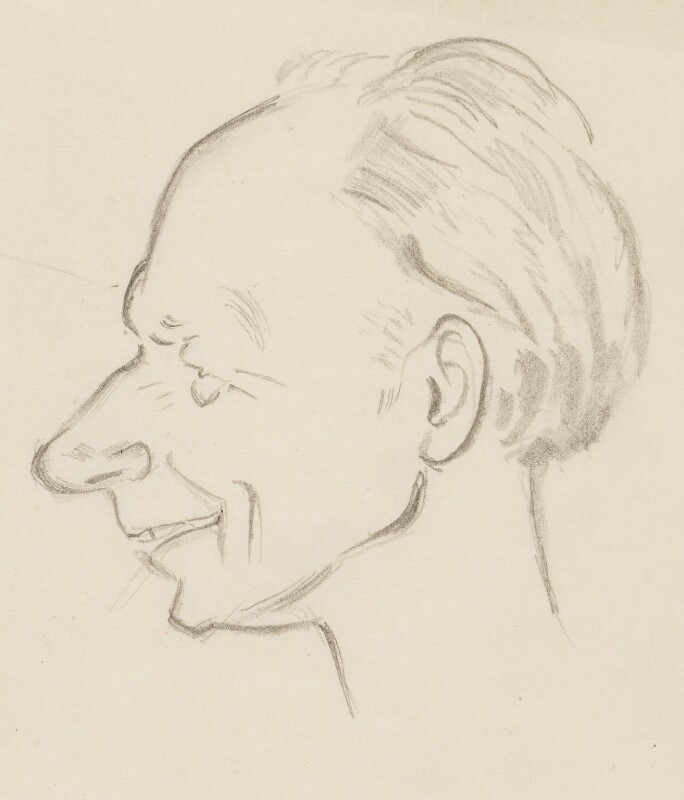
Steohen Potter. From the National Portrait Gallery (many thanks)
Books sponsored by companies, particularly drug companies, were more common in the nineteenth or early twentieth century, than they are now. A few years ago we featured one sponsor –a manufacturer of a tonic for those lacking energy—on Jot 101. The book they sponsored was a self-help treatise aimed at those high-fliers whose jobs overloaded them with work to the detriment of their health. We were reminded of this when, while looking at a pile of books at Jot 101 HQ the other day, we found a rare example of a mid-twentieth book sponsored by another drug company, in this case Roche, a multinational concern. By putting their name to Stephen Potter’s relaxmanship (1965) the company hoped to sell bucket loads of Libraxin, a drug sold to alleviate the symptoms of ‘ nervous dyspepsia ‘—a digestive condition brought about by stress and anxiety.
But let the advertising executives acting for Roche ( or even Potter himself) tell you about the benefits of Libraxin:
‘You may regard relaxation as an art. Not all of us, perhaps, are able to cultivate it to meet Mr Potter’s high requirements. But if properly approached , the holiday season can provide a real opportunity to unwind and to forget day-to-day worries for a short time.
Clearly this is excellent therapy for the nervous dyspeptic; his lack of anxiety reduces his dyspepsia. Sooner or later, however, he will have to return to work and to all his old problems and anxieties. This is the time when Libraxin can be of particular value. Libraxin, which combines the anti-anxiety properties of Librium with the anti-secretory properties of clidinium, is most effective on the treatment of nervous dyspepsia.
It is possible that Potter’s booklet was aimed at GPs or psychiatrists rather than members of the public, for printed on the back flap were the following words:
Basic NHS cost 25 tablets:
3/10 ½ (500 rate)
4/8d. (100 rate)
5/4d.(25 rate)
Potter is an interesting writer. Born in London on 1 February 1900, just a week after the death of Queen Victoria, he also missed action in the First World War, it having ended while he was training to be an officer. He then went on to study English at Oxford. On graduating he was offered a job as a Talks Producer for the fledgling BBC, but turned it down because it was based in Birmingham, where he didn’t want to live. Instead he established himself as an elocution teacher in London, advertising ‘Cockney accents cured ‘. He was then a tutor and schoolmaster before becoming private secretary to the playwright Henry Arthur Jones.