
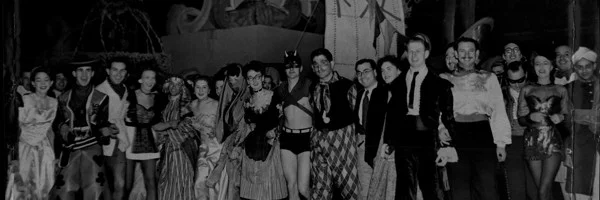
Journalist Peter Browne was obviously drawn to the more singular attractions of post-war London. Having covered Limehouse in his survey of alternative sights for Today magazine, he then turned his attention to Chelsea and Speakers’ Corner.
Paris has Montmartre, New York has Greenwich Village—-and London has Chelsea. Passing through this paint-splashed suburb ina ‘bus, trippers stare with eyes a-pop. That strange young man with beard and green corduroys—an existentialist artist ? ( He’s an average adjuster from Peckham.) And that girl with the pudding-bowl haircut and jodhpurs—a model ? ( She’s senior bristle-chopper in a Tottenham toothbrush factory.)
As the ‘bus rolls down King’s Road, the passenger wonders, with vague memories of La Boheme, where the wildest orgies are to be found. Wild orgies ? Off the ‘bus, sir. Rap on that green door.
Here you are. A struggling artist. His name is Henry. Observe his sober gent’s suiting, neatly mown hair and blameless chin. Walk through his studio and regard the familiar three-piece suite. Look in vain for hashish; sniff in vain for incense. The only odour is the homely moth-ball .
Across the road lives his model, a City typist named Agatha. In her evenings she earns an honest penny by posing for Henry while solving the Times crossword puzzle.
But you still want a Bohemian orgy? Then the best we can offer you is the Chelsea Arts Ball, held, with unassailable logic, in Kensington . The public must get what it expects—-so once a year, feeling rather embarrassed, artist stage an orgy—-and another British Illusion is sustained.
This is a rather weird article. First of all, let’s start with London’s famous arty district being described as a ‘suburb‘. No, Peter, Palmer’s Green is a suburb, Chelsea is very much an area of London, or what the French would call a ‘quartier’. Would you call Montmartre a suburb of Paris? Then there’s that young with a beard and green corduroys. Was he indeed an ‘existentialist artist ‘? At the time, young men with beards who dressed in anything that wasn’t pinstripe or tweed were usually seen as impoverished artists, political radicals or students, and to label any young man dressed unconventionally (yes, corduroy was unconventional dress) as an admirer of Sartre or Camus was pretty par for the course for a reader of Punch or The Daily Express.
The photograph accompanying this article is also rather bizarre. Headed ‘Chelsea’, this shows a group of young proto-beatniks (who were probably art students) of both sexes in various costumes spread-eagled on the floor. One is dressed as an Arab, another as a matador, while another male, much older than the rest and with long hair, is bare-chested and holds what appears to be a small axe. All seem to be stoned or high on something ( possibly hash) . These it would seem, were guests at the Chelsea Arts Ball ( photo at top) referred to by Browne. The Chelsea Arts Ball was an annual event founded by the Chelsea Arts Club in 1890 , it took place on New Year’s Eve/New Year’s Day at the Albert Hall. A raucous event that some journalists might regard as being close to an orgy, it gave London art students the opportunity to commingle with their peers, drink large amounts of alcohol and show off their skills in costume making. There were also floats, all of which had to be deliberately destroyed during the evening. Each Ball had a theme. In 1946/47 this was ‘The Renaissance’, which explains the dress of some of those students spread-eagled on the floor, notably the bare-chested male brandishing an axe, who had doubtless come as a Renaissance sculptor.
Over the years the Chelsea Arts Ball was well documented on film, particularly by Pathe News ( look online for examples) and there are also photos . One shows the future Labour politician Barbara Castle seated rather solemnly at a table with her husband Ted.
Continue reading