
An artist in the new nation of Israel
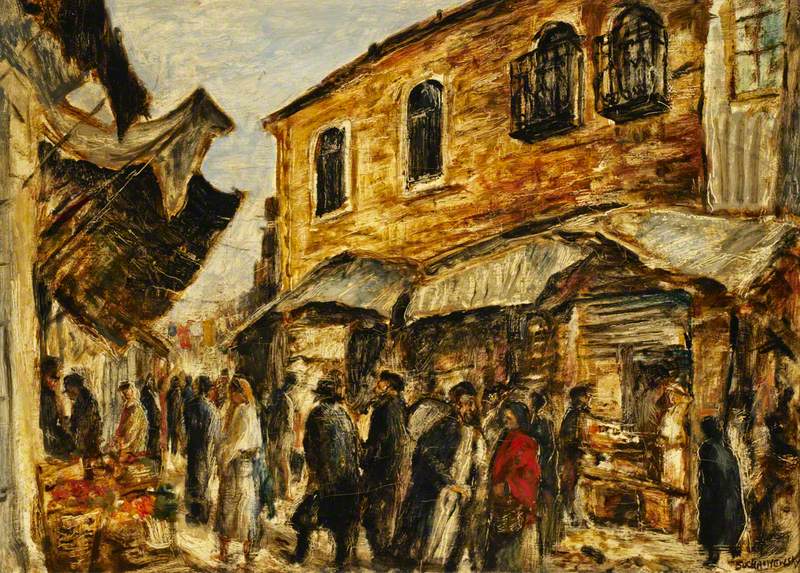
The recent conflicts involving Israel have brought to light reflections on the development of the state of Israel in the late forties and early fifties. At this time many Jews in Europe and the USA were drawn to the new country, not only as a possible home, but also as a place to visit. One of these was the artist Maurice Sochachewsky, whose drawings of Israel in 1949 were published in the December 1950 issue of Photo World.
Maurice Sochachewsky had been born in London in 1918 of Jewish stock, his father having emigrated to England from Poland in 1910. He had demonstrated talent as a draughtsman from the age of six. At just fourteen he entered St Martin’s School of Art and after four years there learned of the economic plight of miners in and around Pontypool. He ended up working alongside miners at Tal-y-wain, with his board pressed against the coal face, frantically sketching his workmates hacking out coal. Returning to London, he held a one man exhibition of his paintings and drawings at the Bloomsbury Galleries and was proclaimed an artist of great promise. Called up to serve in 1939, he was present at the D Day landings and was injured in the head, losing the sight of his left eye.
Fast forward to 1949 and Sochachewsky found himself booking a passage to Israel—a country he felt was the answer to the post-war Jewish problem.
‘ I began to believe in the Israeli scheme of re-population. You felt that nothing mattered to them but to get to a country in which they each believed absolutely without question. The disappointments of the past did not merely fade in the face of their enthusiasm: it was as if they had never happened.
I shall never forget arriving at Haifa, the only Englishman in the place, wit the sun blistering down on to the glaring new concrete like a steel-cutter’s torch .
The chamzin was blowing straight off the desert, and I was never so nearly grilled alive in my life, but it was then—as soon as I walked down to the jetty—that I realised an extraordinary thing…These people were not visitors on the make, but farmers coming home to their own place…It is quite impossible to remain outside this overall personal enthusiasm throughout Israel…’
The reporter, John Carruthers, takes up the story:
‘ Everywhere, says Maurice, there are strange contrasts in ways of life more clear-cut that anywhere else in the world. Within sight of the vast new oil wells, the labourers tend their fields with ox-drawn wooden ploughs that Moses would have recognised, and the desert stretches up to the very borders of orange plantations watered by complex methods of irrigation designed by 20th century American scientists . The hectic bustle of Tel Aviv—jagged, sprawling city of half-dried cement and rasping concrete-mixers, where the skyline changes every month—is a background to immortal Nazareth, with its streets unaltered in 2,000 years.
The communal unit of Israel is the kibbutz, which may be translated approximately as ‘family working party ‘. The kibbutz is probably the most courageous organisation in the world. Made up of a handful of families and their friends, the little teams move off into the hinterland carrying with them everything they possess and settle down to build a new village where previously there has been nothing but barren scrubland.
“ I have reached a kibbutz many miles from a main road,” says Maurice, “ and had to shuffle through sand almost up to my knees for an hour to get to the settlement.”
In more that 1,000 miles of hitchhiking and strolling up and down the country, Maurice never lost his feeling of exhilaration and of being in the presence of history in the making , but he was the most impressed by the universal integrity of the new citizens.
“There are many shortages,” he declares, “especially of clothing and luxury foods, but although most people are very shabby and extremely tired of the monotony of their diet, I never heard of a single black marketeer exploiting the situation. It is as if the virtue of the new country was almost sacred , and no effort is spared to ensure that the children should grow up with their standards unimpaired. “
People do not appear to think of themselves at all, but only of the land there are developing .”, he muses, “ and their preoccupation with their lot of ground somehow becomes identified with their hopes for their children.”
The only extraneous influence in Israel, he reports, are the legacies from the years of the British Mandate, which lives on in the pattern for domestic legislation and in the model for the police and armed forces, but in all else the Israeli has absorbed the proud, stubborn qualities which gave his forefathers their nickname of sabra—the cactus. And the cactus is a very tough plant.
Sochachewesky’s career went from strength to strength. His drawings from this Israel trip were exhibited in 1953 at the Ben Uri Gallery and later his drawings appeared in the London Evening Standard. He retired to Kent and died there at just fifty-one in 1969.
R.M.Healey