
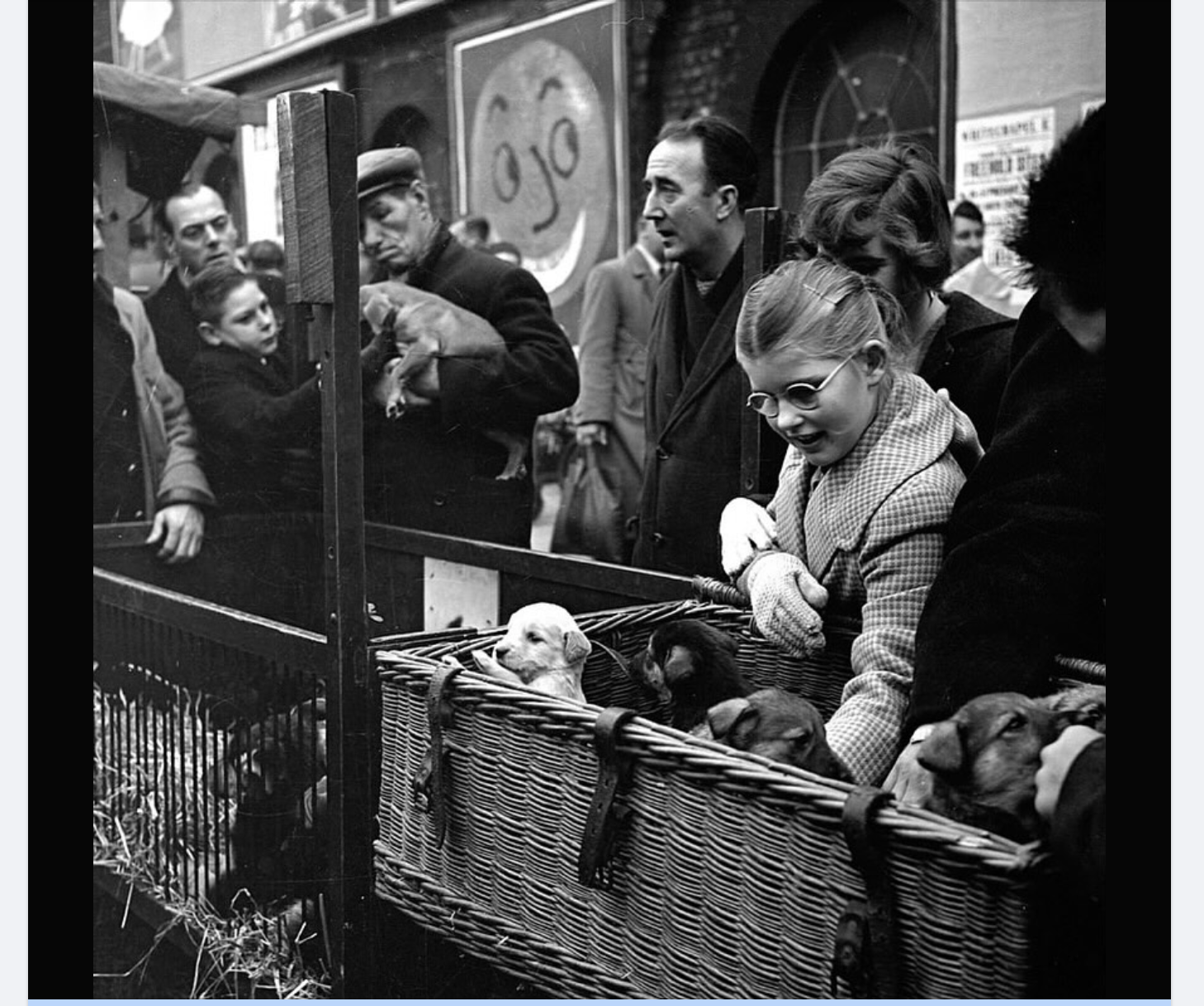
1) Club Row
As recently as the early eighties Club Row in Shoreditch was renowned as a Sunday market where pets, including songbirds and puppies, could be bought for next to nothing with no questions asked. The short street, located between Arnold Circus and Bethnal Green Road, is still there but the market was abolished in 1983, the victim of animal welfare legislation.
A photojournalist from Today( Photo World) visiting the place in September 1952 captured the essence of the market, which spilt into the present Sclater Street, with telling studies of animals, vendors and potential customers. There is even a friendly ‘bobby ‘chatting to some of the customers. The market specialised in song-birds but vendors weren’t just stall-holders. One large emporium, called ‘ The Bird House ‘, presumably open for business during the week, had a shop front plastered over with adverts and cages.
Here is the journalist’s view of the birds for sale:
‘ Above this ordinary slum the Sunday hymn of bird song rises from cages that are loaded high on barrows, dumped on the pavement, or piled against walls until they look like blocks of flats—each little room by an ounce of twittering, high-strung life. These tenements- in- miniature mostly contain members of the linnet, goldfinch, chaffinch, thrush and skylark families. Beside them the vendors shout, “ Buy, buy, buy. All prime birds with lovely flights.” And with the hope of a sale, they stretch wide the wings of their merchandise for the crowd to see.
There is a marked difference in technique for the sale of dogs. There are, in fact, very few dogs to be seen in the Row. There might be a number of ‘pedigrees’ attached by lengths of string to fanciers who stand chatting in groups, a handful of puppies who yelp to passers-by from crates by the roadside, and a occasional woolly head will pop out and boggle at the world from the pocket of a vendor, but most dogs change hands over business deals in the nearby cafes.
The majority of these deals are introduced by lounging. If you look idle enough and
lean disinterestedly against a wall, a man in a well-worn suit, a cap and a muffler will sidle up to you and whisper hoarsely , “ Want a dawg, Mister?” The accepted reply to this is, “ Maybe”. Then he will say, “ How about a Fox?”. If you really want a Fox-terrier, you pause for a moment then add, “ That might do.” The hoarse voice says, “ See me at the café over the road in arfa mo.”
The café over the road is packed with men who are also in cloth caps and mufflers. They sit chatting, drinking tea and eyeing mysterious packagers n the taales in from of them. The contents of these parcels—which are about the size of biscuit tins and wrapped round with dark cloth—do not remain a mystery for long. The covering induces inside to sing—an old trick known to these fanciers—and from time to time there is a sound peculiar only to a café of this type: the song of a wild bird singing for the sun.
In “arfa no” the owner of the hoarse voice comes in with a “ Fox “ on a lead. If you know anything about pedigrees there is no doubt that the dog is a good one. A few pounds change hands and the deal is soon completed.
As long ago as 1933, a Bill was introduced in Parliament that would prohibit this form of buying and selling. Lord Buckmaster, who proposed the Bill, wanted particularly to prohibit the sale of wild birds. But the Government of that day, if not unaware of this fact remained unmoved by it..” An innocent recreation “would be spoilt they said, and the “ trade in bird seed…seriously affected. “
Today, nearly twenty years later, it seems that Parliament is still unable, or perhaps too busy, to choose between the voice of the birds and the voice of the bird-seed vendors.
Fifty years earlier, another journalist visited Club Row and reported his findings to George R. Sims, the editor of Living London (1901). Once again, Sclater Street is identified as ‘ Club Row’ , but having earlier visited Petticoat Lane market, the writer found the animal market very different.
‘ It is Petticoat Lane over again on a much smaller scale; with next to no Jews, hardly any women, less diversity, no side-shows ( unless you count the betting tipster and refreshment stalls right out past the limits of the crowd); no frivolity in short but strict attention to business.
Most the shops in Sclater Street are kept by bird dealers, and their outer walls up to the first floor have all broken into a eruption of bird cages. Beside the shop doors and in the gutters hutches and cage, towering one above another, swarm with rabbits,
fowls, pigeons , ducks, cockatoos, parrots, thrushes, canaries, and such smaller birds in amazing variety; and the sellers bawl against each other, and the birds crow, coo, quack, scream and sing against each other deafeningly. Men without shops or stands roan in the crowd carrying a cage or two and crying their wares; men and boys waylay you in the crush or on the skirts of it with wriggling heaps of rabbits at the bottom of small sacks, and offer you the pick of the bunch for six pence…’
The Club Row Market continued to function throughout the nineteen sixties and seventies, though it was never as popular as it had been. A growing voice in defence of animal rights was becoming louder until it could not be ignored. Animal welfare legislation aimed at animals and birds for sale came into operation and in 1983 the Club Row pet market closed for good. Today, Sclater Street looks like a rather tawdry version of the more bustling Brick Lane vintage market nearby, with a scatter of fruit and vegetable stalls, together with ones selling discounted groceries and tools. A more interesting vintage market does a good trade each Sunday off the street in a vacant lot, but every sign of caged animals and birds, including the famous ‘ Bird House’, have fled.
R. M. Healey