Saki on The Champagne Standard

Saki letter to Annie E. Lane ( wife of his  publisher John Lane.) Not dated (July 31st.) About 1906. Sold on a Charing Cross Road catalogue 2005.

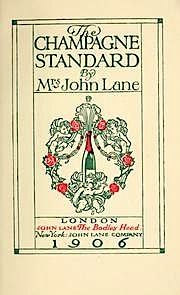
On the headed paper of the now vanished Cocoa Tree Club of St James Street in London S.W. Signed 'H.H. Munro.' Munro (ie the genius of the modern English short story 'Saki') thanks Mrs Lane for a book of her writings she had produced in 1905 about women's roles, high society, champagne etc., called 'The Champagne Standard' --'I have been enjoying its contents, which are new to me with the exception of one article which I had read somewhere. Being much out of England I have missed much of current literature...' He adds 'I hope to be able to break in upon your Devonshire fastness when I am down that way...' adding regards to her husband and sometime publisher John Lane (of The Bodley Head.) 2 sides of notepaper about 90 words.

The Individualists (E.V. Knox)

A satirical piece by E.V. Know ('Evoe' - see earlier entries on him.) Probably never published and it feels unfinished, or at least unrevised. It has a '1984' feeling and also may be mocking Mosleyites who were still around after the war.

A CHARTER OF FREEDOM
 The sound of the rhythmic tramping of many feet aroused me from my day-dreams. I hurried to the window and there, with swinging arms and muscles firm, they strode. The gaze of every marcher was glued firmly to the back of the neck of the marcher in front, and every leg was lifted with the precision of an automaton till the foot was a yard or more from the ground.

  Each, in his left hand, carried a stick or an umbrella, and on that day of slushy pavements and lowering skies the spectacle was one to fill the heart with enthusiasm. Old men were amongst them, veterans of bygone campaigns, grizzled and tanned by wind and sun, pale-faced youngsters of the later levies, gaunt women with steely eyes, and maidens lovely as a rose in June.

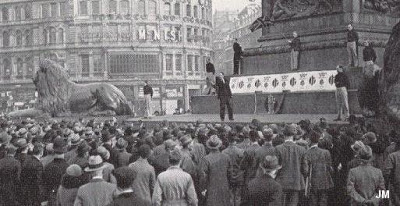
  I knew them. They were marching to Trafalgar Square. They were the serried armies of the Individualists. High above them floated the purple banner embroidered with gold and bearing the motto of the Order, "All for one, and one for all." Perfectly disciplined, they divided into companies, wheeled, halted, turned and faced the plinth. The startled pigeons scattered upwards, the lions lay unmoved. The masked leader arose, and the vast multitude, at the word of command, gave him the Salute of Freedom, in which the right arm is lifted to the level of the shoulder, with the palm of the hand held vertical, and then brought suddenly backwards and pressed over the lower portion of the face.

  He began to address them. From my distant station I could only hear snatches of his speech, but from the fact that no murmur arose from the ranks and that every man and woman remained standing to attention, in spite of their obvious colds, I knew well with what reverent attention they were listening to him.

  "We must fight not merely in the open, but underground" - "The eyes of England are upon us" - "in this great meeting-place of democracy" - "We are cogs in the vast machine of Individualist Enterprise" - "shoulder to shoulder, and without thought of personal comfort" - "à bas les Bureaucrats!" - "the Leader's will is all" - "No Individualist thinks of himself, but of the Party alone" ... These were some of the phrases that filtered through the leaden air and seemed to bring a wan sunlight even to that dreary winter afternoon.

  Individualism! How much I prized it! How often had I felt the iron-handed tyranny of the State! Was it too late, I wondered, for me also to join the mighty regiment of Independence and Liberty?

  I noticed that men carrying papers and collecting-bags were moving amongst the sightseers behind the demonstration. Hastily, I put on my goloshes, my overcoat, my muffler, my hat. I went out into the street. I encountered a canvasser.
  "Enrol me amongst the brethren!" I cried. He looked at me sternly, putting his face close to mine.
  "Do you see eye to eye with us?" he asked.
  "Eye to eye," said I. "Aye, and nose to nose."
  "If you speak truthfully you can be inducted into the brotherhood."

  I was ushered into a darkened room, where I took off my coat and rolled up the sleeve of my tattered shirt. A small incision was made in my arm with a sharp knife, and in that of a hooded inquisitor, my blood was smeared on his arm, and his on mine. I repeated the fearful words of the oath.

  I swear to obey the lightest command of the Leader, and those who rule under him, without criticism, whatsoever they may ordain, and, if need be, to lay down my life in the Cause, Every act that I do, every word that I speak, shall be done or spoken in the Name of Individualism, and for the sake of Freedom alone.

  I was allowed to ask certain questions of a subordinate official of the hierarchy before I was released.

  "Who is the Leader?" I asked.
  "His name is not revealed," was the answer. "We speak of him in secret as The Autarch."
  "And you others?"
  "The rest of us have no names. We are numbers." He told me mine.
  "At any hour, any day, you may receive a message in code, telling you of some service you must render, without fail, for Liberty."
  "Even if it means - "
  "Even if it means imprisonment. There are worse things," he said grimly, "than imprisonment."

  I learned then that every Individualist is shadowed night and day by a Fellow Individualist, to see that he has no truck with Bureaucracy and resists, on every occasion, the invidious advances of State Control. I was anxious to know what happened to an Individualist who wavered, or stumbled by the way, and was told that, for a light offence, expulsion with ignominy from the Society was the normal penalty.
  "But for a serious lapse from Individualism," I said, and my voice faltered a little.
  "You will be taken, at night, to a room at the Headquarters of the Brotherhood, and there a man, whose face you will not see, will leave you alone with a loaded revolver on the table."
  I understood (almost at once) the grave implication of the words.
  "Is there anything more? I murmured.
  The speaker's face brightened, and he pulled out a fountain pen.
  "Your subscription," he said, "to the Cause."
  "What happens to the - er - well - to the money?"
  "You are not here to ask questions. You are here to obey. Is not every penny spent fighting the extortions of Bureaucracy in the service of the nation? Don't we send you these pamphlets? Don't we make proselytes? Don't we have to organize?"

  I agreed. I filled in the form. I subscribed. Only a little, because I was poor. But I became a blood-brother. I became a secret servant of Liberty. I went out of the room with a feeling of elation, realizing that I was no more a cipher amongst ciphers, but a sworn comrade of the Individualist Co-operative Union.
  "All for one," I repeated to myself happily, "and one for all."

  And then I remembered suddenly that I had forgotten my number, and given, by some stupid error, a false name and address. But there was an unaccustomed bulge in my waistcoat pocket. I had also forgotten, I remembered, to return the fountain pen.

Knowledge is Golden

Seen when emerging from the book fair at the mighty Concourse building on 8th and Brannan this sign seemed to refer to books but it is more about the way that IT has become so big in San Francisco. The mural appears at first to be a ghost sign - i.e. the remnants of some old advertising writing done years back - but this was made in 2012 by the '1: AM' group - Roman Cesario, Jurne, Robert Gonzalez, and Daniel Pan

Dan Pan spoke to Art & Architecture San Francisco about the  mural:

For “Knowledge is Golden” the inspiration was specific to the area which the mural was done. San Francisco is seeing its second gold rush with information and knowledge being the currency of today. SOMA, being slated to be developed as the new downtown of San Francisco with technology leading the transformation, is why we chose this location for our message.

Gold miners have been replaced by tech innovators. Pickaxes and shovels have been replaced with laptops and desktops. Though the times have changed, the human thirst for chasing opportunity remains prevalent in these times. And with this influx of new people, San Francisco culture as we know it will never be the same.

The American Mercedes

The American Mercedes
by Daimler Manufacturing Co.

In 1982 Mercedes-Benz of North America reprinted a rare 1906 booklet by Daimler Manufacturing Co., who built American Mercedes cars on Long Island.It brings to life this long-dormant U.S. partnership with Steinway (of piano fame). Describes the cars, engineering features, and relationship with Daimler in Germany. The original which is a small hardback is so rare that Mercedes themselves do not have one and has been seen for sale at $2000. The factory burnt down in 1907 and no more cars were made in America, although recently a Mercedes SUV has been made here.

A WORD ABOUT
THE AMERICAN MERCEDES

  IT IS a distinct pleasure for us to publish this exact copy of a brochure issued in New York in 1906 on the American Mercedes automobile. We do so with the feeling that the 59,000 owners of Mercedes-Benz automobiles in the U.S., and many of our friends, will find it interesting to read about the first Mercedes cars in this country.
  Some weeks ago, we ran across the original in the Thomas McKean Automobile Reference Collection in Philadelphia. It was tattered and yellow with age–the last bit of printed material covering these early contemporary automobiles–and we found it intriguing to go back 56 years, almost to the beginning of the Automobile Era in America.
  The history of the American Mercedes automobile actually commenced in 1888 when William Steinway, the prominent New York piano-maker, paid a visit to Europe and, while traveling there, chanced to hear that Gottlieb Daimler in Cannstatt, Germany, was experimenting with self-propelled vehicles. Steinway was sufficiently intrigued with this report that he paid a visit to Daimler and later wrote in his diary that he had ridden "across the country" in one of Daimler's motorized quadricycles. Steinway was a man of imagination and vision, and he forthwith secured the American patent rights to Daimler engines and vehicles and, upon his return to the U. S., incorporated the so-called Daimler Motor Company.

Continue reading

Mad March Hare Card Party

From a 1921 booklet published in Cincinatti. The game of 500 (a Contract Bridge related game close to Euchre) was popular in the 1920s and tally cards for it sometimes turn up on Ebay.  The book also has suggestions for an October Nut party where guests come as the thing they most dislike 'thus a man may rouge his cheeks and paint his lips and spray himself with a strong perfume, while a woman may wear a plug of tobacco on cord as a pendant' and many nut related dishes can be served including 'black walnut ice cream.' Autre temps, autres moeurs.

MARCH
A Mad March Hare Card Party

  Trace the outline of a rabbit in the corner of a correspondence card and write thereon this invitation:

  The Hatter and the Dormouse and the Mad March Hare–all three,
  Would like to have the pleasure of your jolly company,
  To help them celebrate in a manner fit and hearty
  The umptieth anniversary of their famous "Mad Tea Party".

  Below are the names of the hostess, and the day, date, and hour. The guests arrive to find the rooms all upset–chairs crowded into a heap, books on the floor, curtains askew, card tables still folded, and jonquils and other spring flowers scattered on tables beside vases of water. The hostess explains that a March wind has just blown through her rooms and disarranged them. With the help of the guests the rooms are quickly put in order, and progressive Five Hundred begins, with rabbit-shaped tally cards. At the end of four hands the hostess announces that who already have made slams must deduct 1000 from their scores, and in the future must subtract 500 for each slam. This causes much bewailing until, at the end of the play, the hostess awards the first prize to the lowest score, and the booby to the highest.

  Tea is served at the dining table, bearing as centerpiece a toy bunny with a high paper hat on one ear. China and silver are in a jumbled heap on a buffet, from which each guest selects what she needs.

  When all are seated the hostess pours the tea, which is accompanied by cinnamon toast, thin sandwiches of various kinds, tiny iced cakes, bonbons and salted nuts. When all are eating merrily the hostess calls out "Change Seats", and every other guest changes seats with his left hand neighbor. The newcomers at each place have to eat what they find there, regardless of personal preferences. Places are changed several times during tea, whenever the hostess signals.

World’s most intelligent man

William James Sidis, born in Boston in 1898 to Russian émigré Boris, a psychologist and his wife Sarah, a physician, showed astonishing intellectual qualities from an exceptionally early age. By the age of one he had learned to spell in English. He taught himself to type in French and German at four and by the age of six had added Russian, Hebrew Turkish and Armenian to his repertoire. At five he devised a system which could enable him to name the day of the week on which any date in history fell. Hot-housed by his pushy father, Sidis entered Harvard at eleven, and was soon lecturing on 4 dimensional bodies to the University’s Maths Society. At twelve he suffered his first nervous breakdown, but recovered at his father’s sanatorium, and after returning to Harvard, graduated with first class honours in 1914, aged just sixteen. After a prepared talk at Harvard age 14 , when the audience applauded William turned from the podium and broke into hysterical giggles. Law School followed and by the age of twenty Sidis had become a professor of maths at Texas Rice Institute.

It was then that his troubles began . Looking back at his social gaucheness, hatred of crowds, physical awkwardness and obsessions, it seems very probable that Sidis suffered from Asperger’s Syndrome. But decades before the condition was recognised his eccentricities and aloofness were put down to arrogance. His good looks didn’t help him and he was teased by his female students, especially when he pronounced publicly that he would never marry and intended to live the rest of his life in seclusion.

Continue reading

I Was a Beatnik

From a Christian book We Found our Way Out by James R. Adair and Ted Miller (Baker Book House, Grand Rapids Michigan 1965.) People tell their stories 'of how God led them from the confusion of false religions and philosophies to a life of peace in Jesus...a first hand glimpse into many heresies.' The Beatnik chapter gives an insight into a vanished world. Others escaped from communism, Armstrongism, Satan and Theosophism...many other contemporary portrayals of Beatniks have them as followers of Eastern religions.

I Was a Beatnik

  The day I turned twenty I thought I knew all there was to know about life. Yet the kind of life I was wrapped up in was filled with idle conversation, liquor, and pep pills.
  I was living piecemeal by doing commercial art off and on. Most of the time I sat around in the back booth of a dark little tavern and played things "cool," beatnik-style.
  I was fairly proud of that title "beatnik." I read a lot of philosophy, looking desperately for something on which to hang the threads of my life. Nights I wandered aimlessly to my noisy beat retreat and sat. There I would stay with my little clan of beatniks until the wee hours of the morning, locking hornrims over some discussion subject and working it to death.
  I was getting fed up with life, which seemed so cheap. And I was sick of trying to look "way-out." I felt I had gone to "Nowheresville," that I was too tired and too old and oh, so weary. I hated myself.
  One night after I got back to my room from the tavern, I stretched on the floor and looked over my books to find one I thought would be light reading. I decided on Early Will I Seek Thee, by Eugenia Price.
  At first the book's literary style captivated my attention. It was sheer simplicity. I turned on one of my very, very blue jazz records and began to read the style–not the message.

  After I had scanned the book, the record ended and the needle was scratching its way back and forth. I picked up the needle, turned off the machine and sat foggy-eyed and unthinking for quite some time. Then I started the book again on the first page. This time I read the message.
  The book said that God would not force us to believe in Him...(gap)

  My life didn't change "presto-chango!" In fact, I had some desperate problems. And I tried to live the new Christian life by myself.
  My first thought after I became a Christian was to tell everyone. And I quit smoking, drinking, swearing, and about everything, that was on the list.
  After I had accomplished this, entirely by willpower, I felt extremely empty. I didn't take in of Christ's strength and nearness, and I soon fell back into the old patterns. But now there was a difference: in my misery I knew who the Answer was.
  I'll never forget the time I sat in a little "beat" tavern with some of the bearded, ragged, intellectual clientele. We were engrossed in some inane subject, and now and then I was throwing in my two-cents' worth. Someone ordered another pitcher of beer and we all exchanged tranquilizers. "Hey, Lorrie, try this kind. It will make you calm and collected all day."
  Suddenly an old-type beat ambled up to our table and made some crack about my being too realistic with my art.
  I was annoyed, and I said so.
  He eyed me for a moment and then grumbled something about a pain in the neck. He introduced himself as George and invited himself to sit at our table. The other "beats" were off on another "talkathon" about a favorite subject–religion.
  "Nobody, but nobody believes in this salvation stuff. It's old news, man," George scoffed. A little blonde across the table piped, "God's my buddy, sometimes. Like sometimes I think I need Him."
  Everyone sighed, as if they were very sorry for a poor child who should believe something like that.
  "Listen much, you meathead. Nobody believes in God anymore. He's obsolete like last year's new look."

Long Beach Bookmark

Long Beach bookshops from the 1960s including the long gone 'world famous 'Acres of Books' - probably the biggest bookshop in the world. At the time Long Beach was a sort of Hay on Wye of books, now all these shops have vanished and several others not on this bookmark like the Book Baron.

How to open a book

From a collection of bookmarks found in Berkeley California. Probably from about 1910. J.H. Furst of Baltimore is still in business as a printer having 'opened their doors' in 1904.

It is possible their books were subject to cracking especially when new but the instructions seem slightly fussy by today's standards although any violence towards a book is still, of course, abhorrent.

BOOK MARK


TWO SUGGESTIONS

HOW TO OPEN
A NEW BOOK

  STAND the book, back downward, on a table or smooth surface. Press the front cover down until it touches the table, then the back cover, holding the leaves in one hand while you open a few of the leaves at the back, then at the front, alternately pressing them down gently until you reach the center of the volume. This should be done two or three times. Never open a book violently nor bend back the covers. It is likely not only to break the back but also to loosen the leaves.


HOW TO CARE
FOR A BOOK

  THE covers of a new binding are likely to warp while seasoning. This warping may be prevented by placing the book under weight while it is not in use, or wedging tightly between other books on the shelf.


J.H. FURST COMPANY
BALTIMORE, MARYLAND

Michael Cooper’s 1960s

Michael Cooper. BLINDS & SHUTTERS. Genesis/ Hedley, Guildford, 1990. A limited edition book of 5000 copies each copy signed by persons covered in the book (between 9 and 15 signatures per book.)

No two copies are alike. This is a random list of signers as comprehensive as it gets: a merry galaxy of 60's movers, shakers, posers, celebs and characters:

Bill Wyman (signed every copy) Colin Self, Neil Aspinall, Adam Cooper, Terry Doran, Richie Havens, Allen Jones, John Mayall, Richard Merkin, Billy Al Bengston, Gerald Malanga, Bridget Riley, Steve Winwood, Michael McClure, Sandy Lieberson, Spencer Davis, Dennis Hopper, Dean Stockwell, Harry Nilsson, Jenny Boyd, Jo Bergman, John Dunbar, Richard Hamilton, Anita Pallenberg, George Harrison, Pattie Clapton, Peter Blake, Francis Bacon, Donald Cammell, Anthony Caro, Allen Ginsberg, Astrid Kirchner, Claes Oldenburg, Perry Richardson, Ringo Starr, Jurgen Vollmer, Klaus Voorman, Eric Clapton, Christopher Gibbs, Keith Richard, Nigel Waymouth, Ann Marshall, Marianne Faithfull, Larry Rivers, Brian Auger, Larry Bell, William Burroughs, Andy Warhol, Pattie Clapton, Jann Howarth, John Mayall, Bridget Riley, Terry Southern, Kenneth Anger, Don Bachardi, David Hockney, Graham Nash, Derek Taylor, Julie Driscoll, Stanislas Klossowski de Rola, Nicholas Monro.

Michael Cooper 'a person of tremendous
love and vision.' (1941 - 1973)

Francis Bacon is possibly the Button Gwinnet of the pack, although it is said that the Warhol signature does most for the value of the book.The book came out after his death but signature sheets had been circulated for many moons before printing… Colin Self is the second most common signer  and Peter Blake is, as always, fairly ubiquitous. More info at our sister site Bookride.

Wallis foreseen…

Of the then Prince of Wales, later to be Edward VIII (and shortly thereafter Duke of Windsor and married in 1937 to Wallis Simpson) Cheiro* wrote in 1928:

  "It is within the bounds of possibility... that he will in the end fall victim to a devastating love affair. If he does, I predict that the Prince will give up everything, even the chance of being crowned, rather than lose the object of his affection." 

*COUNT LOUIS HAMON (Cheiro) 1866-1936. Brilliant and charming bon vivant whose consultations were sought by the wealthy and famous, author of several best sellers.

About the Long Hole (E.V. Knox)

From the papers of Edmund George Valpy Knox (1881 - 1971), comic writer, poet and satirist who wrote under the pseudonym 'Evoe'. He was editor of Punch 1932-1949, having been a regular contributor in verse and prose for many years. The typed paper has yellowed and it appears to be from the 1940s, possibly earlier.

This is an amusing parody of British golf writing with a nod towards Wodehouse...

Straight in front of him, and as far as his eye can reach, the traveller who stands on the teeing-ground of our tenth hole, observes the illimitable undulating scenery of the veldt. Perhaps a solitary vulture wheels overhead in the heavens, and along the central track may be discerned a few bleaching bones of caddies and the broken shafts and skulls of drivers and brassies. Far away to the left is a strip of woodland, and beyond that the sluggish inexorable river. What secrets it bears in its massive bosom or in the murky ooze of its heart! A bad pull (to be more explicit) will take you nicely over the edge, and many a stout golfer has gone home at evenfall with an empty creel owing to his rash refusal to carry a landing net and play with amphibious balls.

Continue reading

The New Bohemianism

Another Jeremy Reed unpublished manuscript in his trademark purple ink. From 2007 when Doherty was much discussed in the media. 'Mais où sont les neiges d'antan?'

The New Bohemianism

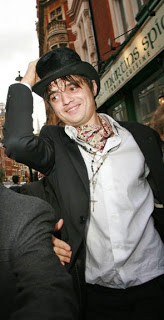
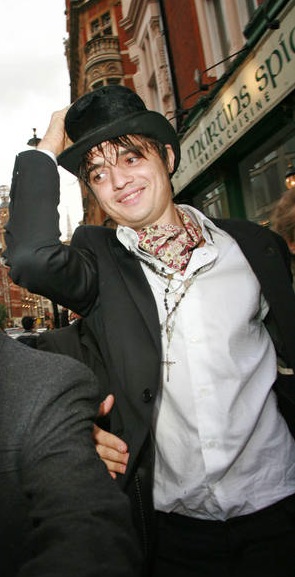
5:30 at Red Snapper Books, 22 Cecil Court, under moodily atmospheric London skies, and the red desk at which I write poetry is the lapidary colour of a dull ruby. When Peter Doherty surges in fedora or top hat angled on his intense fringe, a gun-grey Dior suit, white shirt and square cut Hardy Amies black tie, and a cheap Brick Lane pirate scarf then the reinvented bohemian look comes alive naturally, not as an image, but as the unmodified real thing. We face each other, poet and musician, as two anti-establishment artists, whose lifestyles and social viewpoints go radically wide of convention. When Aaron, the shop's owner comes up the stairs from his basement office, in a wide-brimmed black felt hat, a serpent brooch pinned to his striped blazer, with the offer to Pete, to jam in the basement over a bottle of Jack Daniels, we are three, joined by an inherent bohemian instinct. Pete gives me a Big Purple, turtle-shaped Quality street chocolate, explosive with praline, before taking the steps down to the shop's insulated basement. I carry on writing while the two go through an impromptu version of the Kinks' plaintive 'Tired of Waiting For You.'

Continue reading

I Once Kept a Diary (E.V. Knox)

From the papers of Edmund George Valpy Knox (1881 - 1971), comic writer, poet and satirist who wrote under the pseudonym 'Evoe'. He was editor of Punch 1932-1949, having been a regular contributor in verse and prose for many years.This piece is probably from the 1950s after his editorship. In the archives is a good pic of him, at present unfindable (will upload soon) - for the moment this below. He was married to the daughter of the Winnie the Pooh illustrator E.H.Shepard. Mary Shepard in her turn illustrated Mary Poppins. His daughter from an earlier marriage was the Booker prize winning novelist Penelope Fitzgerald - known in the family as 'Mops' and author of the book below on the gifted Knox family.

This is a very amusing parody of British rural diarists such as Parson Woodforde, Francis Kilvert etc., n.b.- a 'pyghtle' is a small piece of land, a small farm or croft - a word still heard in Suffolk..

I once kept a diary...
but only once. And only for one month. I found it too sad. For some unaccountable reason it took on the semblance of those terrible rustic diaries of a hundred and fifty, or two hundred years ago.

Continue reading

Gargoyle Club Members 3

It wasn't all insouciance and jollity at the Gargoyle - there were occasional fights usually involving Lucian Freud, insults usually involving Brian Howard, a couple of armed raiders (laughed out of the club and into the arms of the law) and serious discussion. Michael Luke in David Tennant and the Gargoyle Years reports the following: "…Johnny Craxton was sitting with Peter Watson at a table with Graham Greene and Freddie Ayer…Greene was challenging Freddie to furnish arguments from the depth of his agnosticism to demolish the religion he had embraced. 'Talk me out of it', he said. 'De-Catholicize me with your logical positivism.' 'And all this was going on', said Johnny 'in a Club where there was dancing and all this terrible kitsch music…that was the good thing about it. People could sit on the banquettes and little gold chairs and have proper and improper conversations and Brian Howard could go from table to table telling people terrible, cruel home truths - and the band played on without drowning it at all…'"

The following list has a few non-members but known habituees of the club, ordinary members up from Wimbledon for a night's dining and dancing were known as 'dentists'.

Dancers at the Gargoyle 1940

[Writers, Poets, Publishers, Journalists] Partrick Leigh Fermor, Alan Moorhead, Peter Quennell, Dylan Thomas, Caitlin Thomas, Cyrl Connolly, Stephen Spender, Arthur Koestler, John Betjeman, Norman Douglas, John Lehmann, William Samson, Ruth Sherardski, Angus Wilson, George Orwell, Sonia Brownell, Robert Kee, George Weidenfield, Humphrey Slater,Nina Hamnett, Aleister Crowley, Lance Sieveking, William Gerhardie, Walter de la Mare, Constantine Fitzgibbon, Theodora Fitzgibbon, John Davenport, Marjorie Davenport, Tom Hopkinson, Julian Maclaren-Ross, Harold Acton, Anthony West, Alexandra Emmett, Henry Yorke, Dig Yorke, Jocelyn Baines, Raymond Mortimer, Colin Macinnes, Alan Pryce Jones, Christopher Sykes, Rosamund Lehmann, Tambimuttu, Mulk Raj Amand, Kingsley Martin, Malcom Muggeridge, Lawrence Durrell, Louis, Macneice, Hugh Massingham, Pauline Massingham, Geoffrey Gorer, 

Roger Lubbock, Colin Wilson, Elaine Dundy, Reggie Smith, Olivia Manning, Nanos Valaoritis, Patrick O'Donovan, Terrance Kilmartin, Joanna Richardson, James Cameron, Bernard Gutteridge, John Raymond, Paul Johnson, Keidrich Rhys, Peter de Polnay, Maurice Richardson, Brigid Richardson, Giles Romilly, Mary Romilly, Sam White,James Commotion,  Ruthven Todd, Allen Lane, Sefton Delmar, Patric Cross, Jenny Nicholson, Lionel Birch, Sidney Graham,  Paul Potts, Patrick Kavanaugh, Hugh Macdiarmid,  Derek Patimore, Heywood Hill, Anthony Blond, Derek Verschoyle, Peter Watt, Diana Graves, Charles Wrey Gardiner, David Archer, George Barker, Elizabeth Smart, Margaret Taylor, A.J.P. Taylor, Simon Herbert Smith, Walter Baxter, James Kennaway, Susan Kennaway, Patrick Kirwan, Ronnie Hyde, Rodney Acland, Dan Farson, Frank Owen, Anna Phillips, Vincent Brome, John Moore, Marcus Morris, Ved Metha, David Moraes, Terry Southern, Martha Gellhorn, William Burroughs, Gregory Corso, Allen Ginsberg, Bob Silvers, William Saroyan, Harry Brown, John Steinbeck, Ray Bradbury, Dunstan Thompson, Henry Kurnitz, Irwin Shaw.[ + mentioned in Luke's book as having hung out there - T.S. Eliot, Virginia Woolf, Francis Bacon, Noel Coward, Edwina Mountbatten, Kim Philby, Randolph Churchill, H.G. Wells, Matisse, Tallulah Bankhead]

Gargoyle Club Members 2

Two well known members at the Gargoyle Club were the spies Guy Burgess and Donald Maclean. Luke recounts a night of serious drinking where Maclean walked between tables loudly proclaiming 'I am the English Hiss' (i.e the American spy Alger Hiss) and after a few more drinks 'I work for Uncle Joe'. No-one took the slightest interest assuming his behaviour was just pour épater. At the time he was head of the American desk at the Foreign Office.

Luke is unclear as to precisely when it finished but a rock and roll night in 1956 was considered a sort of death knell. The evidence of there being members like Ginsberg, Corso and Terry Southern indicates that it may have struggled on into the 1960s. Michael Luke,author of David Tennant and the Gargoyle Years (1991) was the son of Sir Harry Luke, friend of Baron Corvo. It is unlikely had Corvo still been around in the 1930s he would have been a member ( 4 guineas a year). More members from Michael Laws roll-call to come..

[Theatre & Films] Robert Newton, Anne Newton, Michael Redgrave, Freddie Ashton, Gottfied Reinhardt, Sylvia Reinhardt, Wolfgang Reinhardt, Anthony Asquith, Peter Glenville, George Minter, Dennis Foreman, Ken Tynan, Adrian Pryce, Sally Anne Field, Hermione Gingold,
[Regulars & Adventurers] Quentin Crewe, Colin Crewe, Sally Crewe, Xan Fielding, William Moss, Michael Alexander, Richard Wolheim, Anne Wolheim, Ran Antrim, Anthony Frere Marocco, Michael Morris, Poldy Loewenstein, Bianca Loewenstein, Werner Alvensleben, Henry Weatherall, Hugh Cruddes.

[Politburo & Mainstream Regulars] David Tennant, Hermione Baddeley, Virginia Bath, David Tennant Jr., Pauline Tennant, Sabrina Tennant, Georgia Tennant, Henry Bath, Daphne Fielding, Tony Vyvian, Robert Boothby, Patrick Kinross, Angela Culme Seymour, Maynard Keynes, Bertrand Russell, Clair Bell, Vanessa Bell, Duncan Grant, Paul Roche, Diana Mosley, Nancy Mitford, Jessica Mitford, David Herbert, Augustus John, Philip Toynbee, Victor Rothschild, Richard Wyndham, Roland Penrose, Lee Miller, Anthony Powell, Violet Powell, John Sutro, Gillian Sutro, Ivan Moffat, John Hayward, Phillip Dunn, John Strachey, Isabel Strachey, James Strachey.

[Mainstream Regulars] Derek Jackson, Gotfried von Hoffmanstahl, Lisa von Hoffmanstahl, Iris Tree, Auberon Herbert, Michael Young, Peter Watson, Norman Fowler, Brian Howard, Sara Langford, Rodney Phillips, Monica Phillips, Mark Culme Seymour, Robin Campbell, Mary Campbell, Clarissa Churchill, Michael Harrison, Maria Harrison, Poppet John & Pol, Joy Craig, Dennis Craig, Robert Heber Percy, Pauline Gates, Sylvester Gates, Igor Vinogradov, Claud Cockburn, Ralph Partridge, Francis Partridge, John Young, Ray Parsons, Alan Peile, Freddie Ayers, Nancy Cunard.

Gargoyle Club Members 1

Lucian Freud and Caroline Blackwoood

List of Gargoyle Club members compiled by Michael Law (a friend of Ivan Moffatt) in the late 1950s and found illustrated (as a hand-written list - hence some inaccuracies) in Michael Luke's David Tennant and the Gargoyle Years (1991) To quote from Michael Luke's 2005 obituary: 'This rooftop den was founded by David Tennant in 1925, high above the corner of Dean and Meard streets, and reached by a rickety lift whose dimensions were such that strangers entering it left as intimate friends at the top.

The Gargoyle Club was a theatrical arena for London society, high and low. The Moorish interior - its walls narcissistically mirrored with fragments of 18th-century glass and inspired by Henri Matisse (himself a member) - was described by Luke as "Mystery suffused with a tender eroticism". On its dance floor Augustus John, Dylan Thomas and Tallulah Bankhead conducted a rite of hedonistic alcoholic abandon while Noël Coward and Francis Bacon looked on, and Guy Burgess and Donald Maclean filled out membership applications...'

Many more names to come (Writers, Poets and Politburo.) The full list pretty much covers  London society including boho and haute boho from 1925 -1965. Some of the names are now untraceable...

[Ladies etc.,] Joan Wyndham (Shivarg), Janetta Parlade, Caroline Blackwood, Mamaine Paget, Sally Belfrage, Barbara Skelton, Henrietta Moraes, Caryl Chance, Nora Sayre, Jeanne Campbell, Kitty Epstein, Natalie Newhouse (Newton) Margaret Lygon, Sarah Macmillan, Margaret - Ann Ducaine, Glur Dyson Taylor (Quennell) Josephine Lowry Carry, Suna Portman, Pamela Tellerson, Jennifer Fry, Sonia de Leon (Quennell) Venetia Murray, Jennifer Renwick, Tania Vinogradov (Hobson) Deidre Craig (Levi), Anne Dunn, Antonia Fraser, Anne Paget, Charlotte Starbussman, Patricia Cutts,Mary Keene, Louisa Morriss, Rosamund Fellows, Rita Wheatley, Dinora Mar (Mendelsohn)Vivien Talbot Brady, Ingrid Wyndham (Channon)

[Arts & Music] Freddie Mayor, Edward James, Tilly Losch,  Feliks Topolski, Matthew Smith, Francis Bacon, Michael Wishart, Douglas Cooper, Lucian Freud, John Minton, John Craxton, Constant Lambert, Alan Rawsthorne, Marion Leigh, Isabel Lambert, George Melly, Rodrigo Moynihan, Elinor Moynihan, John Moynihan, David Sylvester, Erica Bransen, Malcolm Arnold, John Heath Stubbs, Gwynneth John, John Banting, Hellen Lessore, Colquhoun & McBryde, Peter Palham, Mary & Rose Palham, Eduardo Paolozzi, Nina Hamnett, Robin Darwin, Bebé Berard.

Two in the morning at the Gargoyle (Virginia Bath) 

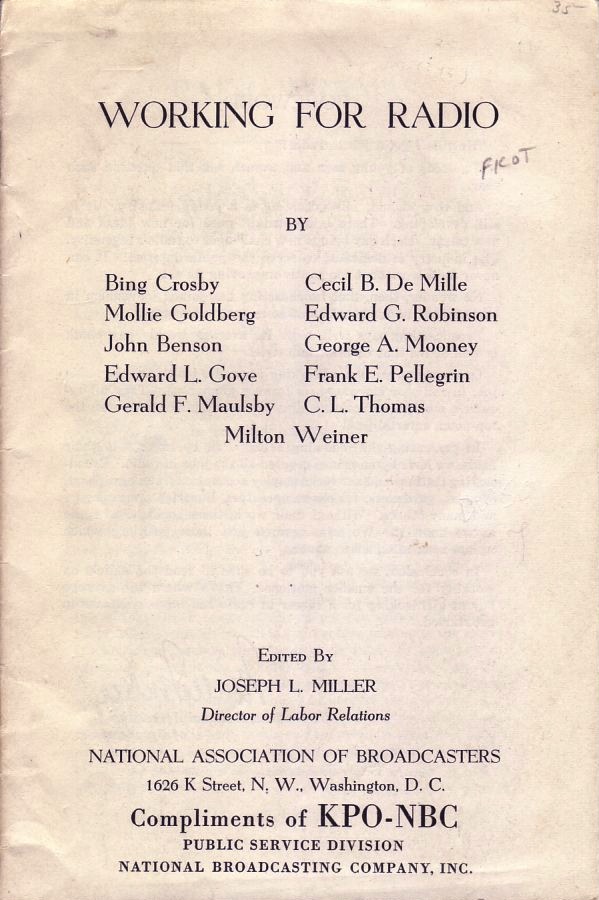
Radio Acting

 Cecil B. De Mille, Bing Crosby
and Edward G Robinson.

ACTING FOR RADIO

By Cecil B. De Mille
Director of CBS Lux Radio Theater

  Once when my father was writing stage plays on Broadway with David Belasco, Harper's Magazine paid him $1000 in advance for an article listing the "Ten Commandments for a Playwright."
  After many weeks, my father returned the money with a note reading, "I have written the 'Ten Commandments' of Playwriting but don't dare allow them to be published for fear I might be expected to live up to them."
  If I had inherited my father's caution, I'd never have promised to do an article under such a dangerous title as "How to Act for Radio." Good acting is an art, and for art there are no unbreakable rules except complete sincerity and hard work.
  Bernard Shaw says that the way to learn to write is to write–and write. Similarly, the way to learn to act is to act–and act. You don't need a stage or an audience. Charlie Chaplin, perhaps the greatest pantomimist of our time, mastered most of his technique standing in front of a bureau mirror; Demosthenes, the ancient Greek orator, achieved perfect diction standing on the sea shore with his mouth full of pebbles, talking to the waves.
  I know radio actors who record their voices by means of inexpensive attachments on their home phonographs, then play the records back time after time to study their own deliveries and techniques in reading lines and correct their errors.
  The best beginning, of course, is to get a good teacher. Although I make it a rule never to recommend a dramatic school or coach, there are many excellent ones specializing in radio acting-and remember that acting for radio is different from any other form of the art.
  In the days of silent pictures, our job was to make the audience see sound; in the Lux Radio Theater we try to make the audience hear sight. A good radio actor can project his own image–or rather the image of the character he's portraying, which is very seldom his own image-–over the air.

  In the talking pictures of today, of course, pantomime remains a highly important part of dramatic technique. But what a screen actor can do with a look or a gesture, the radio actor must do with his voice alone. You may have noticed that some very fine screen actors are very poor on the air, and that some of the best radio actors, transported to the screen, seem hopelessly inadequate.
  The stage actor must play to the last row in the gallery, but the radio actor plays only to that terrifyingly intimate little object called a microphone, which is the candid camera of his art. It is also an unfailing lie detector. You can't get away with insincerity on the air.
  But the radio itself can give you better advice than I can. Listen to it. Study the form of radio. Study good and bad actors alike, learning from both kinds.
  From this point you're on your own.
  Competent guidance, constant practice, complete sincerity and concentrated study-those are the instruments to guide you over the air lanes. They're a bit bumpy sometimes, those air lanes, but they open up the most exciting vistas in the dramatic world.
  Happy landings.[1942 pamphlet from KPO-NBC]

Lawrence of Arabia refuses to review books…

Letter (unpublished?)  from an irritated T.E. Lawrence (as T.E. Shaw) to Cyril Laken of The Sunday Times (2/ 7/ 1933) stating that he does not want to review books. The concluding part is quoted in a loosely inserted  addendum to Donald Weeks *pamphlet on Lawrence, Wilfred Ewart, John Gawsworth etc.,

"In my life I have reviewed (I think) three books - years ago - and while I am in the R.A.F. I do not need the money and have not the leisure to do more. Inclination I never had, for reviewing.

Please leave me alone! This beastly thing has now cost three postages. T.E.S."

* Donald Weeks. T. E. Lawrence. An Hitherto Unknown Biographical / Bibliographical note. Privately Printed (Tragara Press, Edinburgh 1983)

8vo. pp 16. Frontis portrait. Green textured wraps (with  title label on cover) attached to plain white paper covers. 230 copies printed. Loosely inserted is a one page 'additional note' about Lawrence's dislike of reviewing books. A closely written piece about Lawrence's proof reading work on Wilfrid Ewart's Scot's Guard, with much mention of the young John Gawsworth and his friendship with Lawrence with whom he went on walks in Holborn. Gawsworth had written Annotations on Some Minor Writings of T.E. Lawrence. The book is dedicated to John Gawsworth and the writer and book dealer Iain Sinclair who 'scouted' the proof copy that occasioned this fascinating sidelight on Lawrence.