BOOKS, THEATRES & BOMBS.

From the papers of Ifan Kyrle Fletcher, sometime book dealer, Edward Gordon Craig specialist, theatrical history and dance expert. Published in a somewhat revised form in 'London Calling' (BBC Overseas service journal) June 5 1941. 6 million books lost in blitz at Paternoster Square - unimaginable treasures.

BOOKS, THEATRES & BOMBS.
by Ifan Kyrle Fletcher
February 7, 1941.

Nearly eight years ago, as we can now see, the Nazis revealed themselves in their true colours. What happened on the night of May 13 1933 was no obscure diplomatic or political more, unknown to all but statesmen. It was a simple act of destruction which has profoundly effected the lives of us all. Do you remember? Twenty-five thousand books were made into a bonfire outside the University of Berlin and were destroyed in the presence of about forty thousand people.
    At the time it may have seemed nothing more than the triumph of one political party over another but we know now that all the violence and suffering of the interviewing years are, as it were, lit up by the flames of that bonfire. By its light we see and understand another fire seven and a half years later - the fire of the night of December 29, 1940, when, in the district around St Paul's Cathedral, nearly six million books were destroyed and some of the most precious treasures of our architecture were wrecked. By its light we see and understand other events, the destruction of the library of University College, London; the destruction of the library at Holland House and the partial destruction of this lovely and historic mansion, for which the people of West London had feelings of the warmest affection. We see and understand the destruction of the library of the city of Tours and the looting of the museums and art collections of Austria, Czechoslovakia, Poland, Holland, and Belgium. Recently, the Louvre and the famous chateaux of France have been plundered, not to satisfy artistic craving for possession but to provide funds from the art markets of neutral countries for more weapons of destruction.
Continue reading →

Roger Fry

From the papers of  Janet Ashbee wife of C.R. Ashbee
(Arts & Crafts Movement). This is Fry before Bloomsbury...

74 Cheyne Walk, Chelsea,
March 1902

    Roger Fry came up from Dorking to see me today, and I felt rather like my small self at 6 years when a strange child was asked to tea, and we were told to "make friends". I had seen him but for a moment at our play, and had remarked only his gaunt face and air erect as of one who sees a ghost and is afraid.
    We plunged at once, and talked of civilization, the town and the country, and the real sane life. He says he finds the Carpenterian "Simplification of Life" leads to endless complexity, and he has given it up -- it was a clean waste of energy.
    "I like civilization", he said, "not the cumbrous artificial kind of course, but a civilization so perfect that it tends to complete simplicity."
    But the servant question is harassing him much, the Dorking menage being at present without the Great Indispensables. He railed at the independence of latterday servants--
    "They dont enjoy it", he said, "look at these half-educated maids, do you think they're any the happier for their sense of reverence having disappeared? not a bit. The old folks may have commanded their servants like dogs, but the servants looked up to them, and stuck to them. There was something to admire and something stable and human that they could become attached to. And see how they run!" he concluded, "and what misery it is without them!"
    He was delighted with out little Umbrian Madonna, and I saw he was burning to restore it.
    "Yes, it's a lovely thing," he said, "I COULD make those little angels and their gold frocks come out if I tried!"
    He lives now, I understand, by lecturing on Art and by restoring old pictures. As a creative artist he seems to have been so susceptable to everyone else's style that his own clever painting went to the wall. The only possible trade became the submersion of his own style in that of each painter whose work he restored. He is said to be an adept at it, and his judgements are received in artistic circles I hear with entire submission.
    He complains that the criticism of modern pictures is deadening; entirely destructive and negative.
    He was much more sympathetic than I had imagined-- I had heard much of him, of the emancipation from his Quaker family, of his strange marriage with Helen Coomb, of her mysterious illness, their exile in Italy, their reappearance and the arrival of the little son. I gather that his horizon is now quite filled with the boy. It was pretty to hear him talk of him, and the child is to be brought up without any theories whatever, except the eminently male one that the mother is to do all the educating, for the present anyway.
    I was glad to have the chance of seeing what manner of man he was. He has the eyes and the smile of the idealist who at the same time is human.

I once met… Clare Winnicott

I once met Clare Winnicott. She was one of the leading British social workers of the 20th century.  The wife of Donald (D.S.) Winnicott, an analysand of Melanie Klein, a wartime innovator in caring for evacuated children, a teacher and mentor to a generation of social workers, and a gifted psychotherapist. Her husband had died in 1971 and in 1980 she called me to her flat in Knightsbridge to help her sell some of her books.

She was a pleasant woman and showed no sign of what I later found was a bout with cancer. Her books belonged to her and her late husband and had annotations by them and were mostly concerned with psychoanalysis and sociology. She had a small collection of TS Eliot which she kept. She died 4 years later and seemed to be in her late 60s at the time. I bought a van driver with me to help load and on hearing that she was a psychoanalyst he asked her what she thought of us, something I would not have asked. She replied cheerfully 'You are two of the most normal people I have met for a long time." Which was reassuring - although I had a feeling it was a stock reply!

A Look at Monte Carlo

This is a cutting from a book from about 1990 that fell out of another book...wonder if this is the man who broke the bank!

A Look at Monte Carlo
The longest consecutive run of even numbers in the history of roulette at Monte Carlo is a series of twenty-eight. The mathematical odds against a series of twenty-nine even numbers occurring are so great, that the wheel at Monte Carlo would have had to have been spun since prehistoric times (about 6500 years ago) to give a statistically justified expectation of such a sequence occurring once.

Odd Showers [frogs, lizards and pilchards]

From a scarce work (1882) which covers such curious subjects as revivals after execution, female jockeys, Blind Jack the roadmaker of Knaresborough, singular funerals, whimsical wills, curious epitaphs, the Caistor Gad-whip Manorial Service, dog whippers and sluggard wakers, how the town of Alfreton was played for at a game of cards etc.,The author seems to have been a contributor to 'Notes & Queries' and fascinated by the odd, curious and strange. God preserve us from a shower of pilchards...

  More remarkable still than a shower of frogs is that of lizards. The scarcity of these animals, one would think, would almost exclude the possibility of their appearing in such numbers as to constitute what might be termed a shower. The following, however, appeared in the Montreal Weekly Gazette of 28th December, I857-- " During the heavy rain of Sunday last, live lizards, some of them measuring four inches in length, fell from the clouds like manna, though not as plentiful, nor alf so welcome. They were found crawling on the side walks and in the streets, like infantile fugitive alligators in places far removed from localities which they inhabit."
  Carriber, in his interesting little volume, entitled " Odd Showers," gives the following account of a descent of fishes: "On Wednesday before Easter, in I666, a pasture field of two acres, at Cranstead, near Wrotham, in Kent, was all overspread with little fishes, supposed to have rained down, as there was at the time a great tempest of thunder and rain. Wrotham is far  from the sea, there were no fish-pinds near, but a great scarcity of water. The fish were of the length of the little finger, and proved to be about a bushel; none were found in any adjoining fields. This account was given a letter from Dr. Robert Conny, to the late Dr. Robert Plot, F.R.S., who it seems had promised the former an account of a shower of herrings."
  The Rev. Aaron Roberts, B.A., curate of St. Peter's, Caermarthen, wrote a letter to the Times, which appeared in that paper of February 25th, I859, giving particulars of a shower of pilchards which occurred at Mountain Ash, Glamorganshire. From his account it appears that some of the fishes were about four inches long. A number were caught and preserved in fresh water, salt water killing them almost as soon as they were put in it.

Sylvia Plath

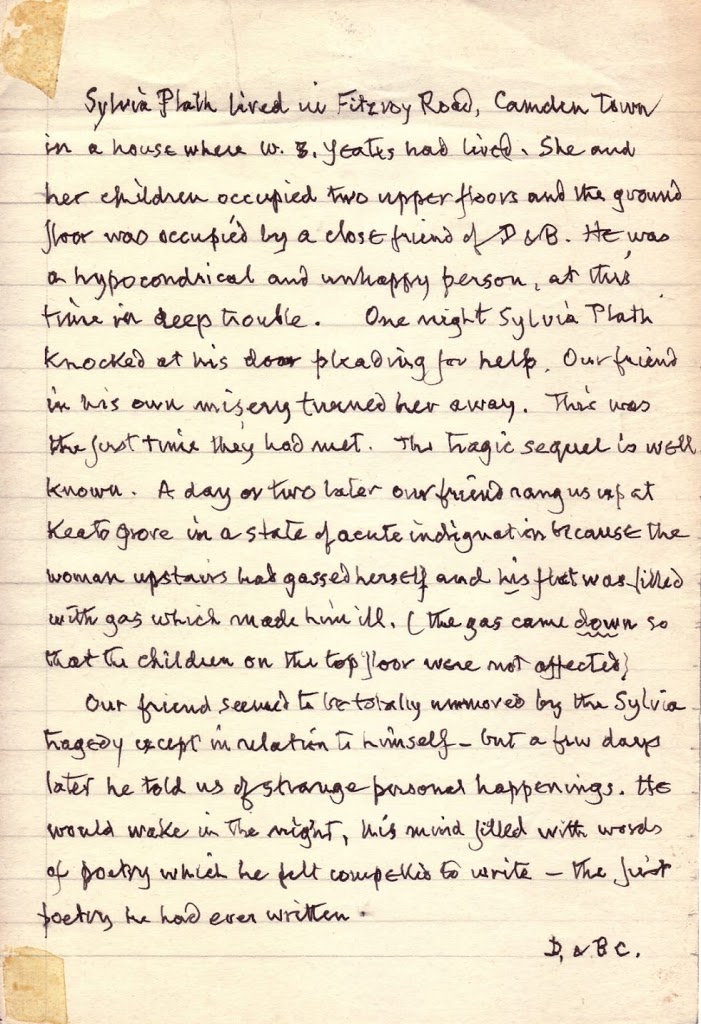
This strange note fell out of an old paperback collection of her poems. It came from a house in Fortune Green. Oddly enough the 'professor' mentioned in the note  wrote a book about his experiences and the 'channelled' poems. Sylvia Plath-Last Encounters (Bedford 1989)

  Sylvia Plath lived in Fitzroy Road, Camden Town in a house where W. B. Yeats had lived. She and her children occupied two upper floors and the ground floor was occupied by a close friend of D & B.  He was a hypochondriacal and unhappy person, at this time in deep trouble. One night Sylvia Plath knocked at his door pleading for help. Our friend in his own misery turned her away. This was the first time they had met. The tragic sequel is well known. A day or two later our friend rang us in at Keats Grove in a state of acute indignation because the woman upstairs had gassed herself and his flat was filled with gas which made him ill. (The gas came down so that the children on the top floor were not affected.)
  Our friend seemed to be totally unmoved by the Sylvia tragedy except in relation to himself _ but a few days later he told us of strange personal happenings. He would wake in the night, his mind filled with words of poetry which he felt compelled to write _ the first poetry he had ever written.
D, & BC.

Withnail & I script

From the catalogue of Charing Cross Road Bookshop (2002) It was priced at £1500 and is no longer for sale.

Bruce Robinson. Withnail and I. Typed manuscript..82 pages typed recto only  in rung bound folder.(1976)  Closely written typed pages written in the first person mainly describing the picaresque London and deep country adventures of 2 out of work actors. The main character is Withnail, although this treatment reads somewhat differently form the script of the 1986 film the essential plot and the outrageous character of Withnail is the same. Many good scenes were not included in the film , possibly for reasons of time. Robinson appears to have written the story out as a novel with a great deal of dialogue, the typescript has his name and Fulham address (c/o Linda Seifort) and phone number with an arrow and the handwritten words ‘Me till Set ‘76.’ The tyescript was apparently touted around the film industry for years until Bruce Robinson managed to make the film himself in 1986. The typescript appears to be mostly ‘top copy’ i.e. straight from the typewriter with occasional tippexed corrections or new typed lines cut out and stuck to the page over the corrected line.

There are a small amount of short handwritten corrections. Some of the memorable lines in the cult film are here--for example the drug dealer Danny (here called Sammy) advises Withnail who is contemplating having his hair cut --’"A very foolish move man. All hairdressers are in the employment of the government...Hairs are your aerials. They pick up signals from the cosmos, and transmit them directly into the brain. This is the reason bald-headed men are uptight." It is hard to think of a cult film with a more dedicated following than ‘Withnail and I’ - the village where the country scenes (Stony Stratford) are shot still has visitors  bothering the tea room with lines from the film such as:-  “We want the finest wines available to humanity, and we want them here and we want them now...” Semi aubiographical based on his experiences sharing a flat with the actor Vivian Mackenderell an elegant wastrel, the typescript ends in the same way as the film with Marwood and Withnail looking at the wolves in a cage in Regents Park.

Coffee Then and Now

Press cutting (Sunday Times, London?) dated 1960 found in a copy of Aytoun Ellis's book Essence of Beauty. Interesting how the modern Mocha is no longer a food drink...

SIR,–No meals were served in the seventeenth-century coffee-houses. The serving of coffee after dinner was however an established practice before that century ended, although only in the nobility. Richard Hoare, the goldsmith, who had removed from Cheapside to Fleet Street in 1690, made " a plain coffee port " for Lord Derby, to be sent to Knowsley with " six pounds of coffee berries." (The coffee doubtless came from Hoare's neighbor at Temple Bar–Thomas Twinning.)
  By the mid-eighteenth-century, when most of London's 2,000 coffee-houses had closed down or become clubs, taverns, or chop-houses, coffee was served with meals in certain of the inns and eating-houses, particularly in provincial towns like Chester, Exeter, Liverpool, and in Edinburgh and Glasgow.   Anyone who has tasted Mocha coffee as made in the early coffee-houses–" the bitter black drink " (as Pepys called it)–will agree that it was food and drink in one! The only complaints appear to have come from " the trade," jealous of this new and formidable rival, and from the women, who complained that they were neglected by their husbands whose addiction to this " enfeebling " drink made them " as unfruitful as the desert from where that unhappy berry is said to be brought."
                J. A. Aytoun-Ellis     Sussex.

*                      *                      *                       *                       *

SIR,–In " The Cook's Oracle " by Dr. Wm. Kitchiner (seventh edition, 1823) you read:-
  Coffee, as drank in England, debilitates the Stomach, and produces a slight nausea. In France and in Italy it is made strong from the best coffee, and is poured out hot and transparent. In England it is usually made from bad coffee, served out tepid and muddy, and drowned in a deluge of water, and sometimes deserves the title given to it in " The Petition against Coffee," 4to, 1674, p. 4, " a base, black, thick, nasty, bitter, stinking Puddle Water." . . . . No coffee will bear drinking with what is called milk in London.
Has the situation changed very much?
                W. H. S. Williams.
    Tenterden.