Guernica Exhibition London 1938

A 4 page flier / brochure for the New Burlington Galleries October 1938 exhibition. 60 preparatory sketches paintings and studies by Picasso. List of patrons (including Virgina Woolf, McKnight Kauffer, E M Forster and organisers (E L T Mesens, Herbert Read etc.,) Quotes on back page from newspapers about the bombing at Guernica. Mesens again! Patrons mainly the great and the good among British writers, poets and bohemians inc Ruthven Todd ('the Reverend Todd.')

Toni Del Renzio: Piano, a Surrealist Prose Poem for Art Hodes (1945)

Late surrealist poem found in 1945 magazine Piano Jazz, published by The Jazz Sociological Society, Neasden, London. Toni del Renzio (Antonino Romanov del Renzio dei Rossi di Castellone e Venosa 1915 - 2007) was part of the small club of British surrealists most of whom seem to have fallen out with one another. Roger Cardinal in his Guardian obituary notes:

"Del Renzio was also something of a poet, and one evening in 1944, E.L.T. Mesens and his followers sabotaged their enemy's reading at the International Arts Centre - objects were thrown, and del Renzio and Ithell (Colquhoun) had to duck behind a piano." Take it away Toni--

Piano of tumultuous melody pouring through the milky way in staccato spurts of harsh lyricism alight with the ecstasy of the blues and the stomp and the rag beautiful twists of primitive innocence more marvellous than civilisation.

Piano of mercury and arsenic flowers dissolve in the promises of reefers and alcohol which steadies and firms the sensitive hands of love long-fingered with desires hollow-palmed with hopes slender-wristed with the sending practice of the boogie surprise.

Piano of fireflies sinking in the dark warm swamp of memory where the images of what was are convulsed into the shaking outline of what must be and what will be when the gutted lie in streamers across the barricades of the night and in the distance can be heard the feminine song of a well-licked clarinet.

Skeleton piano of terrors and fears.

Iron piano of inescapable fates fanning paths of hazard.

Stone piano of social neglect beneath the skies of benevolence and other hateful qualities.

Continue reading →

Celebrities’ Choice 1966

24 page pamphlet, published by the National Book League, London 1966.  The favourite books of such diverse celebrities as John Lennon, Julie Christie, J. Paul Getty, Joyce Grenfell, Philip Larkin, Harold Pinter, Margery Allingham, Joan Sutherland, etc. John Lennon had chosen some interesting books. he has divided them into up to the age of 11 (Alice, Wind in Willows), teens (Brave New World, Animal Farm, 1984, Sartre, Steinbeck, Thurber), from the age of 20 (De Sade, Heller, A.A. Milne, Alan Watts), current reading (Thomas Stanley, Pre-Roman Britain).

Harold Pinter chose 2 Becketts, a Donne, a Dostoyevsky, a Joyce, and Kafka's The Castle. Philip Larkin  plumped for Barbara Pym.

Coffee Log / Coffee Universities

One of many Nescafe cake recipes (John Bull magazine, London  1958). Instant coffee is still used for cake flavouring...in fact in some kitchens that is what is now kept for.

Below that is the actual editorial matter which would have compelled Nescafe to advertise - to the right it shows 3 early coffee houses including the Turk's Head in Cambridge - so popular that nearby pubs suffered. One Cambridge professor declared that a man could pick up more useful knowledge in a coffee-house than at university - a claim I have heard made for the original Peet's in Berkeley!

Coffee Log

One swiss roll, Nescafé mocha icing, browning or brown colouring, chopped pistachio nuts, sprig of holly or a robin. Beat in sufficient browning to make the Nescafé mocha icing similar in colour to tree bark. Cut a slice off the swiss roll and mash it with a fork, form into shape of a small stumpy branch. Place on top of the swiss roll near to one end fixing it with a little icing. Spread the surface with icing and cover the round joins at each end of the roll with icing. Mark with a fork to resemble tree bark. Decorate with pistachio nuts and holly or a robin.

  MOCHA ICING.–2 level teaspoonfuls Nescafé, 2-3 oz. margarine, 2 level tablespoonfuls cocoa, 8 oz. icing sugar, 2 tablespoonfuls hot water. Beat all the dry ingredients to a cream gradually adding the water.

Scott Fitzgerald ‘forced sale’ book list

Scott Fitzgerald wrote this list (found in a literary journal -no longer sure which) when he was broke in about 1936. His friend/ lover Sheilah Graham (she described herself as "a woman who loved Scott Fitzgerald for better or worse until he died") wrote in College of One:

He expected to realize $25 from nine autographed Mencken books (some firsts); $5 from Tarkington's Seventeen (autographed); $5 from Dos Passos” Three Soldiers (with autographed card); two books by Charles Norris (autographed), $15; $2 from Jurgen(autographed); $3 from Emperor Jones (first). “400 books,” he wrote, “range 10c to $1.50, average 40c. Probable value of library at forced sale $300.

He seemed better when we were back in Hollywood. The books he loved were still in his apartment...

It appears that Scott in the end did not need to sell them -- although most of the authors he was trying to sell are no longer seriously collected, with his association the 400+ books would probably now fetch a million dollars or more. Who knows?

The Native Matchlock – Tiger Hunting in India

A slightly  bloodthirsty story (to our squeamish modern taste) but with an amazing moment of suspense straight out of Kipling or Conrad. A real life account - the author was almost certainly Lieutenant Colonel J. W. Wray. The manuscript was in an envelope with 3 other chapers addressed to him at 'The Croft, Guildford' and he is known to have written With rifle and spear : reminiscences of Lt.-Col. J.W. Wray. Copac gives his dates as 1851-1924 and record this book as being published by The General Press, Ltd.,. They estimate the date as 1925. Certainly these accounts mention rifles and spears, Wray was a dedicated game hunter. The manuscripts came from a couple of very old soldiers Basil and Russell Steele.

No copies of the book are available and it has not been digitised. Web archives reveal he was in the 108th Foot Regiment and he was a member of the Northumberland and Northern Counties Club. Punch mentions him and his wife in 1916 - the victim of a Pooter like misprint: 'Mrs. Wray entertained the recruiting staff, numbering £21, to tea at Brett's Hall, Guildford, on Thursday.' They add 'Sterling fellows obviously'.

The photo, supplied merely to give atmosphere, is actually of Franz Ferdinand von Österreich-Este in Rajasthan 1892, Wray's adventure is probably from a decade later. The game of "fly loo" needs reviving, especially with global warming - a game for very hot days, played for high stakes.

Continue reading →

Francis King

Francis King (4 March 1923 - 3 July 2011), acclaimed novelist, poet, critic and editor. President Emeritus of International PEN and appointed  CBE in 1985. He came out in the 1970s and wrote his autobiography 'Yesterday Came Suddenly' in 1993, after the death of his long-term partner.

3 photos of him with his cat in London by the US photographer Miriam Berkley. The envelope is dated 1991. The Daily Telegraph obituary said 'he was naturally reticent, concealing his inner turbulence from friends who saw only a witty and equable companion with exceptionally good manners.

Honey Water formula

Typed pages from the working papers of Aytoun Ellis's for his book Essence of Beauty. Published by Secker in 1960. A litre of brandy?

Fragrant waters have been in use for thousands of years, Theophrastus mentioning them nearly 400 years before the Christian era.
Oldest of all, if one excepts rose-water from this category, is HONEY WATER (which) there seems little doubt, was used in this country from an early date but it was in the reign of JAMES II that it really became popular, George Wilson making it for the King to such a formula as the following:

100 Honey
100 Coriander fruit
9 Clovers
6 Nutmegs
6 Gum benzoin
6 Storax
6 Vanilla pods
10 Yellow lemon rind
-----
243
-----
The directions were to:
"...bruise the cloves, nutmegs, coriander-seed and benzoin, cut the vanilla pods in pieces, and put all into a glass alembic with a litre of French brandy, and after digesting 48 hours, distill.
To one litre of the distillate add:
150 Damask rose water: 150 Orange flower water:
0.1 Musk: 0.1 Ambergris.
Grind the musk and ambergris in a glass mortar, and afterwards put all together into a large matrass and let them circulate three days and three nights in a gentle heat; let them cool.
Filter and keep the water in bottles well stoppered."

Whether the King used Wilson's preparation for his hair or his complexion is uncertain but it certainly had some merit and reveals the perfumer as knowing a great deal about his craft.

    In that age of quackery when many harmful ingredients were being used, it is interesting to see in his recipe a rational approach to the subject. With such innocuous ingredients the HONEY WATER could not have harmed His Majesty even if it had found its way into his mouth. A very different case was that of a Belgian singer, M. Zegler, less than a century ago when, during a performance of William Tell at the Royal Italian Opera House, some of his make-up trickled into his mouth. Being a deadly poison it cost him his life.

Drawing of young girl – about 1800

Not sure where I got this (junk shop in Munster Road, Fulham?) but it shows a young girl, presumably Jewish (see the Star of David outline behind her head and the style of hair - echoes of the world of George Eliot's novel Daniel Deronda.)  Could it be by Blake or Flaxman? Possibly it is a print that has been hand-coloured. The clouds are dramatic and somewhat foreboding...info welcomed.

Scent of Danger – essence of tuberose

Part of a collection of press cuttings. This incident is (so far)  UBI  i.e. unknown by internet probably because it is from the defunct UK newspaper The Daily Herald (1960). The sum quoted for the final value of distilled essence of tuberose lilies would now be about £40,000,000. Distilled essence of tuberose lilies is restricted to very high end perfumery due to the expense….

New Bohemians

Obtained from the poet and writer Jeremy Reed and unpublished in this form. Transcribed from his  handwritten  purple ink manuscript. Probably from about 2008/9. [Somewhere we have more of this inc writings about new bohos such as Pete Doherty.Will find. Wilde's attitude is reminiscent of a later writer Norman Douglas who told Elizabeth David 'Always do as you please and send everybody to hell and take the consequences. Damned good rule of life...']

Bohemians / New Bohemians / Jeremy Reed

Continue reading →

Theatre programme for Simon Gray’s Cell Mates

The original  1995 theatre programme for the short-lived Albery Theatre's production of Cell Mates signed by cast member Stephen Fry. The play also starred Rik Mayall. It has 36 pages.

Fry's involvement - or rather, almost immediate non-involvement - in the production was the focus of much media rumpus at the time, although he now recalls the episode with philosophical good humour. The whole episode is covered elsewhere in some detail and the playwright Simon Gray later published an account of events in his diary, Fat Chance.

Peter Baron – ‘Who?’ (1927)

Peter Baron was the pseudonym of thriller writer Leonard Worswick Clyde (1906 Nov 21 - 1987 Nov 16). He wrote 4 now scarce crime / detective novels. The dust jacket pictured is from his 1927 novel 'Who?' The artist of this striking jacket is unknown and very little is known about Worswick Clyde. Hubin's Bibliography of Crime Fiction, 1749-1975 lists the following:

Who? [1927]
Jerry The Lag (US: Murder In Wax) [f|1928]
The Poacher [1929]
The Opium Murders [f|1930]

Answering Machine Hacking and other papers (late 1980s)

An odd and weirdly topical collection. [Beadle collection- paranoia, revenge and general weirdness] called Alternative Inphormation Unlimited (USA). 45 loose printouts hole-punched and contained in a store-bought plastic ring binder. Publications from the late 80s and early 90s by an organisation called Alternative Inphormation Unlimited and concern wire tapping and other forms of telephone exploitation and subversion.

Each paper is several pages in length and many are illustrated with technical diagrams. All publications state that they are sold 'FOR INFORMATIONAL PURPOSES ONLY'. Alternative Inphormation Unlimited's slogan was 'Keeping You Informed of Big Brother.' Contents read thus:

  Answering Machine Hacking - How it's done and how to stop it; AT & T & BOC Routing Codes!!!; Beige Box - How to build and use a lineman's handset; Black Box - Complete schematics and instructions; Blue Box - Uses and applications; Blue Box - C64 home computer; Brown Box - Why pay Ma Bell for extra services such as a 3 way calling and touch tone service?; Bug Detection on Home Telephones; Bull Shitting the Operator; Call Forwarding Box; Call-Waiting Phone Tap; Cellular Telephones and Tapping Cellular; Clear Box; CNA List - Customer name & address no's used by Ma Bell. Those secret No's revealed; Converting a Tone Dialler into a Red Box; Dial 900 §'s For Free - How to; Free Phone Calls to Any Point in the World!; Gold Box; Illegal Access Code and How to Get Them!; Infinity Transmitter; Legendary Ether Box! - Snatch phone calls out of thin air! The ultimate wireless phone tap!;Listening In!!; Miniature FM Transmitter; Monitoring Phone Calls with a TVRO; Obtaining Unlisted Phone §'s; Pay Telephones; Phantom Phone Phucker!; Phone Phucking - The art of; Phone Phreaks Guide to Loops; Phone Utility for the C64/128 - The amazing rainbow box program!! the only program you'll ever need to make free long distance phone calls; Poorman's Voice Changer! - $30 device better than $250 units; Red Box - Complete guide to; Red Box - Build a; Remote Pay Phone Phreaking; Silver Box Phone; Snooper Extension Phone; Taping Telephone Conversations; Telephone Ear Piercer! The ultimate defence tactic for obscene fone calls!; Tons of Tones - The complete guide as used by Ma Bell!!; Two Minute Bug; Voice Controller; Voice Paging - Free; War Games Autodialler; Watergate Surveillance Package! Taps and Bugs.

Michael Jackson’s 48 Laws of Power

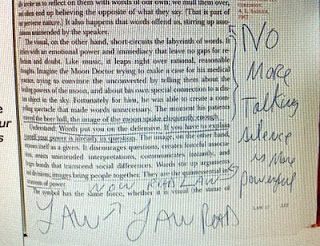
In June 2011 at auction in Los Angeles someone paid $15000 for a self-help book annotated by Michael Jackson. It was The 48 Laws Of Power by Robert Greene (Viking 1998) a book that can usually be bought on Amazon for $10.  Bonham's catalogue entry goes thus:

"... a number of pages with passages underlined and annotated in various pens by Michael, providing an insight into his view of the world, with comments such as 'Make yourself respected, a God Demands Worship' and 'No more talking silence is more powerful', and 'you create your own circumstances even in the manner in which you are treated and looked upon', and 'deer are special because they hide if they walked the streets like dogs no one would care' + 'the moon comes every night so people don't care to look to the heavens Haleys Comet,the fact it comes once in a lifetime makes it important...'

A useful work, somewhat cynical and ruthless for a self help book with ideas taken from Machiavelli, Sun Tzu, Gracian, Talleyrand, Bismarck and also various 'con artists.'

It is really for one aspiring to wealth and fame and it is odd that Michael was so inspired by it. The author has gone on to write the 50th Law (10 lessons in Fearlessness) with the rapper named 50 cent.

MJ's lawyer Bob Sanger is on record as saying '..he loved to read. He had over 10,000 books at his house.' At one session in an LA bookstore he spent $6,000 on books and allowed anyone in his entourage to take books. Marvellous man. I like to think that was in Book Soup, my favourite LA shop.

The Penny Universities – coffee quiz

From a publicity leaflet for  The Penny Universities  a history of the coffee-houses. 'Penny University' is a term originating from the 18th-century coffee houses in London, England. Instead of paying for drinks, people were charged a penny to enter a coffeehouse. Once inside, the patron had access to coffee, company, various discussions, pamphlets, bulletins, newspapers, and the latest news and gossip. Reporters called "runners" went around to the coffeehouses announcing the latest news. No need for a runner in modern java joints- all you need now is the Wi-Fi code… I do not have the answers, the only one I can get is 5 (clue the R of the L)

  1. Who was the famous physician who experimented with coffee as a possible antidote to melancholia and alcoholism ?
  2. What was the "wooden oracle", referred to by Pepys and where was it ?
  3. How did the Royal Society come into being ?
  4. Who gave Nell Gwyn her first part on the stage and who wrote the play ?
  5. A great poem grew out of coffee-house gossip. What was it and who wrote it ?
  6. Who was Angier and what was "Angier's Fume" ?
  7. Who was the privateering doctor whose adventures inspired Robinson Crusoe ?
  8. Which notorious coffee-house in Covent Garden was kept by an old Etonian ?
  9. A fantastic instance of wagering through the medium of an insurance policy concerned the sex of a distinguished diplomat. Who was he and what was the outcome ?
  10. Who was the Aberdeen tailor who turned quack and was knighted ?

Mulk Raj Anand ‘Curries’ 1932

An early work on the subject. The author gives the names of two London suppliers of all the ingredients used in the book - Stembridge in Cecil Court  and C.A. Naidu in Lexington Street, Soho. Anand begins with a tribute to Norman Douglas "...with that subtle irony and happy wit characteristic of him, Mr. Norman Douglas once declared that 'Curry is India's greatest contribution to mankind.' Those whose lucky star has bought them under the spell of Mr. Douglas will understand the sense in which that epigram is true. I laughed heartily when I read the statement...'

Mulk Raj Anand also quotes Aleister Crowley:-

'...Curries with their vast partitioned platter of curious condiments to lackey them, speak for themselves. They sting like serpents, stimulate like strychnine; they are subtle, sensual like Chinese courtesans, sublime and sacred, inscrutably inspiring and intelligently illuminating, like Cambodian carvings.'

Here is a simple recipe from Anand

DAL (LENTILS)
1/2 lb. lentils
1/2 oz. butter
1 small onion (sliced)
1/2 teaspoonful of black pepper
1/2 teaspoonfulred pepper
1/2 teaspoonful powdered turmeric
Salt to tatse.

Carefully pick the stones out of the dal and soak for about an hour in a panful of cold water. Put it to boil in a panful of boiled water. Sprinkle in some salt and turmeric and stir. When the lentils are tender, fry the sliced onion in melted butter with black and red pepper in a different pan. Pour this fried mixture into the pan containing the dal to the consistency of porridge over a gentle heat. Take care while putting in the butter to keep the lid partly on so that the liquid does not fly back to your face and hands.

A simple dal that might be improved with frying a small amount of cumin seeds and some chopped garlic. The orange dal needs no soaking, but some lentils require much longer than an hour and stones can still be found.

Halitosis – a firing offence (1940)

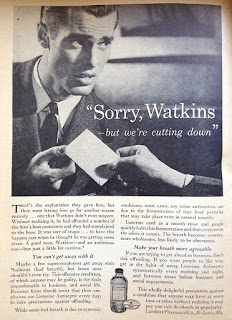
Vintage ad for Listerine on the inside of a mystery fiction magazine from 1940, the end of the era of the 'shudder-pulps.' Ads in these mags often relied on shaming the reader - acne, bad breath, weedy body (the guy who gets sand kicked in his face.) The rare pulp 'Red Star Mystery' was the first ever of that title, it lasted about a year. Don Diavolo (The Scarlet Wizard) seen on the cover  was the inspiration for Rawson's famous hero, the Great Merlini. Did the phrase 'Sorry Watkins but we're cutting down' have some currency in the 1940s? Listerine suggests all firms have their employees use it once a day 'maybe a few super- employees can get away with it, but lesser ones shouldn't even try...'

Letter about Ian Fleming from his biographer.

Found in a copy of John Pearson's book and addressed to someone called Jeremy. Dated 30/10/70 from Knightsbridge. Pearson was a friend of Fleming and had been his assistant at the Sunday Times. The tone is friendly and urbane but very frank; it is important to record that John Pearson adds this postscript 'He did have a great sense of humour about himself which made it all tolerable...''

I have been thinking about what you said about Flem[ing] being sort of a rebel. You're right up to a point. He would certainly have agreed with you...As a pseudo-Marxist I would say he was at best -or worst - a phoney rebel. Whatever rebellion or rebelliousness he went in for began as a reaction against his money-grubbing family , his intolerable mother, his unbeatable brother and the memory of his impeccable father.

What is interesting about him is that the rebelliousness this produced never channelled into any political form at all although his teens coincided with the 1930s...He was far too narcissistic , too self-absorbed,too lonely to indulge in politics. There was also an extraordinary vein of caution or cowardice in him. He was not the man to kick against the system in any serious sense at all. He wanted money , social position , worldly success ; and his rebelliousness came from the feeling that these social goodies were being unjustly denied him - not that they were wrong in themselves.

Continue reading →

Publisher’s Promotional Leaflet for J.R.R. Tolkien (1967)

This was found in a reprint set of Lord of the Rings and is a sort of news sheet to keep Tolkien lovers abreast of the latest news, almost certainly 1967 when Smith of Wootton Major came out. The Silmarillion was eventually published posthumously in 1977.

No, we are not publishing THE SILMARILLION yet! Professor Tolkien is still writing this book and we will let you know when we have a date for its appearance, but on the 9th November we are publishing SMITH OF WOOTTON MAJOR – a mid-winter tale, half homely, half fay. The setting of Tolkien’s new story is the village of Wootton Major, where the office of Master Cook was exalted once in twenty-four years by the preparation of a Great Cake to mark the Feast of Good Children. Although the merry-making over which the Cook presided was human and hearty, other, less material powers were exchanged during the ceremonies, and for some the world of man and the world of faery met and blended in a strange, beneficent conjunction. Pauline Baynes has illustrated this little book, which costs 7s. 6d. net and will be available from your usual retail bookseller. It is an ideal present for a Christmas stocking, or for those who deserve something more than a card.

Coming soon after Christmas will be THE ROAD GOES EVER ON, a handsomely produced song-book of Donald Swann's musical sittings to a number of Tolkien's poems. Professor Tolkien has embellished the pages with calligraphy and notes that will be great interest to enthusiasts.

At about the same time Philips Records will issue THE POEMS AND SONGS OF MIDDLE EARTH. On this disc the Song Cycle will be sung by William Elvin with Donald Swann as accompanist. On the second side, for the first time, Professor Tolkien can be heard reading a selection of his poems in English and Elvish.