Author Archives: Jot 101

An album of Oscar Wilde letters

oscar_wildeFrom a 1946 catalogue of ‘scarce and interesting original autograph letters manuscripts historical documents’ from London dealer Winifred Myers.  She was a major player in the field of autographs into the 1960s. These were listed at £80. After 70 years it would be a safe bet to say they have gone up by over 2000 times …Fortunately they were bought by a collector who let them be published in Rupert Hart- Davis’s collection of Oscar’s letters that appeared in 1962. Are they still in the ‘choicely bound’ Riviere album?

WILDE (Oscar). 1856-1900. Author. 9 Autograph letters signed, with original envelopes, 38 pp., 4to. and 8vo., and one autograph post card signed O.W. (some letters are signed in full, some “Oscar” and some with initials), Paris, Dieppe, Naples, etc., 1897-99, to his publisher Leonard Smithers, chiefly regarding his “Ballad of Reading Gaol.” A very fine collection of letters of the utmost importance. The first letter written from Berneval only three months after his release from prison, expresses the hope that he will finish the Ballad within a few days, begs Smithers to get an answer from Beardsley about doing the frontispiece; a long letter from Naples deals fully with the title-page and his pseudonym C.3.3.; speaks affectionately of Robt. Ross; were all his friends like Ross he would not be “the pariah dog of the nineteenth century.” Refers to Lord Alfred Douglas who is staying with him, “He has also ruined my life, so I can’t help loving him,” his wife’s letter of reconciliation. “In questions of the emotions and their romantic quality, unpunctuality is fatal.” “I am going to try and find a place near Genoa!… The chastity of Switzerland has got on my nerves,” asking for money, “I have no money at all. I am in a dreadful state… I am nearly in the gutter,” mentioning “The Importance of Being Earnest,” etc. Probably the most important and moving collection of Wilde letters ever offered for sale, mounted with typescripts in an album, choicely bound, green morocco gilt, g.e. lettered in gold on spine, by Riviere.
A train spotter writes…

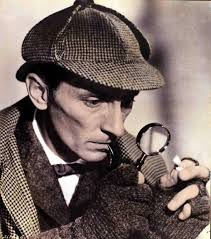
Sherlock Holmes CushingWe all know about the nerds who post online corrections to errors or omissions in books, films, dramatisations and the like. Well back in 1987 , before the Internet made it all too easy, there were people like R. Lujer, who typed their complaints to—in this case—the publisher of Peter Haining’s The Television Sherlock Holmes. Haining, who was doubtless royally entertained by this particular letter, kept it in his Archive. Here it is in full.
Dear Mr Haining,

I received a copy of your book last Christmas and have thoroughly enjoyed dipping into it before embarking upon a more orthodox read, until I reached page 179 and “The Mystery of Watson’s Dog”. I remember the review by Nancy Banks Smith and thought at the time that she had resurrected a non-event. The real mystery is the TRAIN, not the dog.

Bulldogs experience, as a rule, shortish lives, the result of overweight front ends and convolutory respiratory passages. Trains, or more exactly steam locomotives, generally had working lives of 50 or more years. Even some of the G.W.R. “Bulldog” class of 1901, transformed into “Earls” in the 1930s, were still running in the 1960s. Surely Watson’s dog simply died an early, natural death; and he found it convenient or prudent (or both) not to secure a replacement.But what of the locomotive in “The Copper Beeches”? Continue reading

Virginia Woolf – An Appreciation (1941)

4e2b6da99ff0d5c9f24dfefdfec9abfcFound- a press-cutting from The Observer – April 6th, 1941 a week after the suicide by drowning of Virginia Woolf. This ‘appreciation’ accompanied a memorial poem by Vita Sackville-West. It was by the now slightly forgotten critic Basil de Sélincourt.  Virginia Woolf notes in her diary how she was heartened  when he praised her novel The Waves (1937). It was said to be her favourite review. There is a good photo of Selincourt at the National Portrait Gallery by Lady Ottoline Morrell.

An Appreciation – Basil de Selincourt

The loss of Virginia Woolf is not only a grave blow to English letters, but will also be widely felt by many who had no personal acquaintance with her. It was not for nothing that she collected her brilliant, or radiant, studies in Criticism under the title “The Common Reader”. The originality of her mind and the acuteness and range of her perception never isolated her, never led her to forget that the foundation of the literary art is sympathy, that we write to be understood, to make our vision carry. True, the reading of her novels can be a strenuous exercise, but it is an exercise in intimacy. The greatest of them, “The Waves,” most of us must be content to wonder at; we can hardly hope to comprehend it. But however we may be baffled by work of hers, we have never been offended. Its elusiveness is the elusiveness of nature. Her waters are limpid as the sea’s on a solitary shore; her phrase has the decisiveness, the crisp outline of a shell. Her horizons only are unfathomable. She has preferred to keep here even for herself a quality of mystery, as if the greatest communication a writer has to make were the sense of an incommunicable infinite, of a truth always present wholly, and therefore never seizable in any part.  Continue reading

Harry Grindell Matthews—inventor extraordinaire

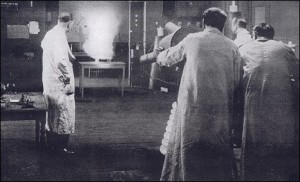
Matthews operating the Death Ray

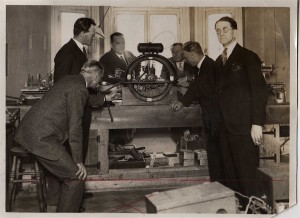
If ever a man was the epitome of the ‘mad inventor‘ it was Harry Grindell Matthews, though his many supporters would perhaps bridle at the word ‘ mad’. But if he wasn’t dotty, he was certainly controversial and decidedly eccentric. For it was the habit of this electrical engineer, born in Winterbourne, now a northern suburb of Bristol, in 1881, to claim a startlingly interesting innovation while refusing to cooperate with interested parties, including government agencies. In 1911 he claimed to have invented a radio-telephone, which if developed might have been a prototype of our modern mobile; he also boasted that he had created the world’s first talking movie in 1921, but this too was never financed. He is best known today ( if he is known at all) for inventing an invisible Death Ray which he claimed would stop electrical machinery at a distance, thus immobilising enemy threats, such as aircraft and bombs. However, when an eager government stipulated that to convince the scientists he would be required to stop a petrol-driven motorcycle engine remotely, Matthews refused the challenge. In this press photo dated 1930 from the London based Sports and General agency, which found its way into the marvellous El Mundo archive, Matthews is shown on the right, cigarette in hand, while a group of engineers eagerly examine what appears to be the motorcycle engine which he was asked to stop. In another photo we see Matthews operating the Death Ray itself. Needless to say, the inventor’s refusal to cooperate in a controlled experiment spelt the end of this promising piece of technology.

Grindell matthews inventor082

Undeterred, Matthews continued to offer new inventions. The most exciting was a Sky Projector, which he demonstrated with some success. Had this got off the ground we may have had laser-type shows in the 1930s. When at last he did manage to tempt serious investors to part with their money, he used much of it to build a state of the art laboratory and a private airfield overlooking the Swansea Valley at Clydach. His financial state received another boost in 1938 when he married an opera singer called Ganna Walska whose five former husbands had left her with a fortune of around $125m. Unfortunately, he did not live long to enjoy his good fortune. Matthews died in Swansea in 1941 at just 60.

Gloucestershire has produced at least another brilliant electrical engineer. Joe Meek, the equally eccentric electronic music pioneer who produced the cult favourite ‘Telstar’ in 1962, worked on radios as a teenage prodigy. His shed can still be seen at the rear of his father’s old shop (blue plaque) off the Market Place in Newent. [R.M.Healey]

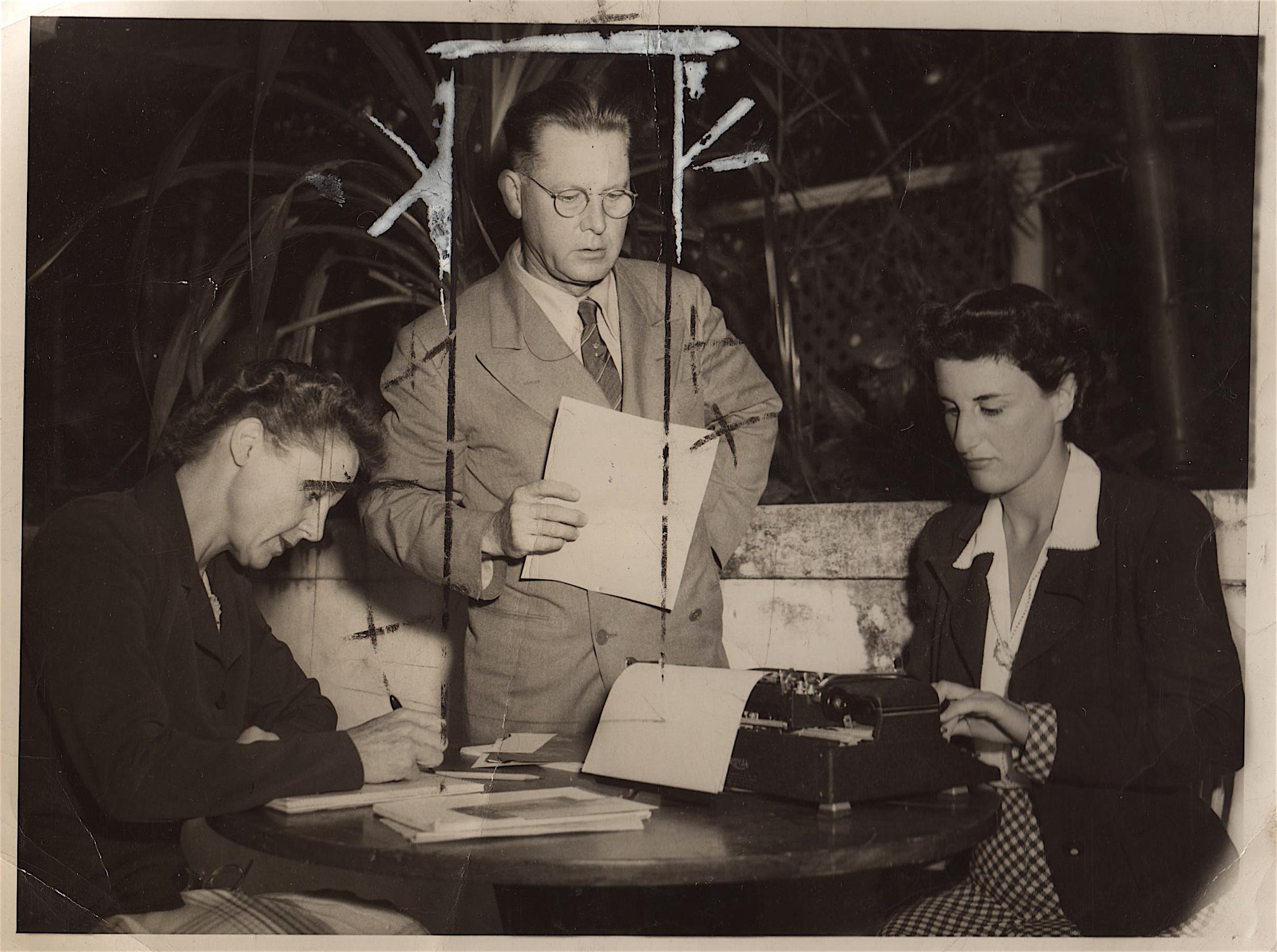
The creator of Perry Mason with two of his team of secretaries

Erle Stanley Gardner 001When Erle Stanley Gardner( 1889 – 1970), the famous American crime novelist, began contributing stories to pulp magazines in the twenties, he used his own two fingers to type. However, realising that self-imposed targets of 1,200, 000 words a year were unlikely to be achieved in this primitive way, he took on what eventually became a ‘ team ‘ of secretary/typists. In this press photo of 1943 from the El Mundo archive we see two of them, Jean Bethel and Henriette Trilling, on either side of the ( ) year old novelist. The two women seem to be performing different tasks. Bethel is possibly taking notes on plots and characters for the novel that her partner is typing out from Gardner’s dictation, for future novels or for the travel books that the prolific writer also published. Gardner’s secretaries also acted as temporary corpses—assuming positions on the floor for added verisimilitude.

Over the years Gardner must have become very attached to Jean Bethel in particular. In 1968, following the death of his first wife, he took his ‘ faithful secretary’, then aged 66, as his second. At his death in 1970, aged 80, Jean became his literary executor and twenty years later, at 88, she was still administering his estate, which included a huge archive. [R.R.]

The Herlock Sholmes Parodies, 1915 – 1940

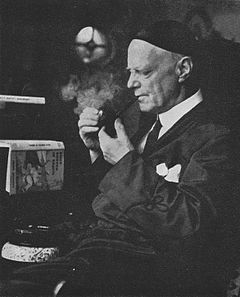
Frank_Richards_Smoking

The contribution of W.O.G. Lofts ( 1923 – 1997) to the history of boys’ fiction in the British periodical press is immense. ‘Bill’ Lofts, a mechanical engineer by training, but a fact-collector by inclination (why did he never enter BBC’s Mastermind ?), was also interested in detective stories. Sexton Blake and Sherlock Holmes were two creations on which his skills as an astonishingly assiduous researcher were exercised to great effect. Years spent among the riches of the British Museum Periodical Library at Colindale on projects which probably no-one else had either the energy or commitment to pursue produced what turned out to be invaluable guides to the more obscure purlieus of popular literature. One such study was The Adventures of Herlock Sholmes: a History and Bibliography, a pamphlet co-written in 1976 with the owner of the Dispatch Box Press, Jon Lellenberg, an expert in the history of Sherlock Holmes in parody and pastiche.

According to Lofts and Lellenberg, the story of the Herlock Sholmes parodies was also the story of their creator, Charles Hamilton (above)  the most prolific writer in the English language, who as the mainstay of Amalgamated Press, is estimated to have written around 72 million words in his whole career , the equivalent of a thousand full-length novels. Using the pen name ‘Peter Todd’, which was the name of a pupil at Greyfriars School, which Hamilton had dreamed up for The Magnet, Hamilton made Todd a contributor of Sherlock Holmes parodies to The Greyfriars Herald, the school’s own newspaper, which Amalgamated Press brought out as a separate publication.

Continue reading

In Memoriam Virginia Woolf (1941)

Unknown-1

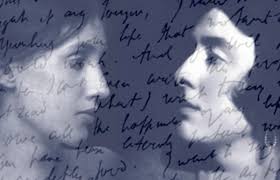
Found - a press-cutting of an 'In Memoriam' poem written by Vita Sackville-West and published in The Observer on 6 April 1941 a week after her friend (and lover) Virginia Woolf had drowned herself in the River Ouse. It is odd that this version of the poem is not online (except possibly at a cash-for-knowledge site which reprints a version from the Winnipeg Tribune from May 17 1941 which may or may not be the same.) There is some suggestion that the free version available online was found at Sissinghurst in Vita's tower/study. From that version, presumably a later revision of the Observer poem (or just possibly an early draft) I have printed the changed words in square brackets. The word 'smell' in the tower version is surely wrong...'Mrs Brown' must be taken as representing 'unknown people.' The  lines:

How small, how petty seemed the little men

Measured against her scornful quality.

the same in both versions, have been praised as being particularly acute.

IN MEMORIAM VIRGINIA WOOLF

Many words crowd, and all and each unmeaning.

The simplest words in sorrow are the best.

So let us say, she loved the water-meadows,

The Downs; her books; her friends; her memories;

[her friends; her books;her memories]

The room which was her own.

London by twilight; shops and unknown people;

[shops and Mrs Brown] 

Donne's church; the Strand; the buses, and the large

Swell of humanity that passed her by.

[Smell of humanity]

I remember she told me once that she, a child,

Continue reading

Books we must not read. Part Two

Lady-chatterleys-lover-701x1024

Recently, following the lead of an article by William Mason-Owen published in a 1951 issue of The Colophon magazine, Jot 101 looked at some of the manuscripts and typescripts in the British Museum Library that were then withheld from publication due to the sensitivity of their contents. In part two we examine the banned printed books mentioned in the article.

First on the Colophon list is Cantab, by the otherwise respected Irish writer Shane Leslie, which appeared in 1926. This was ‘withdrawn under threat of legal proceedings for obscenity’. Your Jotter hasn’t examined the novel, which recounts the adventures and misadventures of a Cambridge undergraduate, but those in the know have maintained that any indelicacies it contains are inoffensive and certainly do not justify the ban.

D.H.Lawrence’s The Rainbow and Lady Chatterley’s Lover were also regarded as dangerous to public morality. Around half the first edition of the former was burned in 1915, hence its comparative rarity. Moreover, if you can find a copy in the original rather sensationalist dust wrapper you will get a few thousand pounds for it.

Ulysses (1922) was another on the list. The Little Review, in which excerpts appeared, was prosecuted in the US and the whole book remained suppressed here until 1934.The Egoist, which published parts of it in the UK was also the subject of court action. The first edition of the book appeared in Paris in 1922, but copies of this and subsequent continental editions were subject to seizure by British customs until a ban was lifted on its publication in the thirties.

Continue reading

How much do you know?

Found- How much do you know? The book of a thousand questions and answers. It was edited by Harold F. B. Wheater and published in London (Oghams Press, circa 1937.) It is part of a set of 10 practical self improvement books bought in a secondhand bookshop (Chapel Books, Westleton). Condition was way above average but the books are of modest value.

IMG_1457

Some of the information is very dull but at JOT we occasionally do dullness. Some info is very dated and some possibly erroneous - if the Ying Lo Ta Tien was 23000 books that would put it on a par with a printed out version of Wikipedia 2016 (in English). Possibly volumes were thin with big lettering...the first entry sounds like the luckiest accident ever and the one on Schubert is a tragedy and a terrible waste- what was sold for 8 shillings would probably now make £8 million.

What is the largest gold nugget ever found?

The 'Welcome Stranger', discovered by accident in Victoria, Australia, in 1869, through a cart making a rut in the ground. It weighed 2520 ounces.

What was the world's largest encyclopaedia?

The Ying Lo Ta Tien, or Great Standard of Yung Lo, compiled in China by order of the emperor of that name during the fifteenth century A.D. It consisted of 22,937 books and contained nearly 367,000,000 written characters. Only three copies were made; two perished when the Ming dynasty fell in 1644; the third (with the exception of a few volumes) was destroyed in the siege of the Legations at Peking (Peiping) by the Boxers in 1900.

Continue reading

An amazing Art Deco garage photograph

garage 1930 London cars074

From the ever-giving El Mundo archive is this quite astonishing Fox Photos pic of a multi-storey garage housing what appear to be bran new, high-class, automobiles. Along with the press agency stamp and the date 6 Feb 1930 is a description in Spanish of the scene. Here it is in full:

Un “garage” moderno, ofrece a los ojos un aspecto fantastico y desconcertante .El automovil ha reemplazado definitivamente al caballo como elemento de transporte y las grandes ciudades se preparan par albergar la avalanche de coches que diariamente sugen de las fabricas e inundan las callas. Este “garage” , que pareciera el producto de una fantasia, ha sido construido en Paris.**

I have yet to see a photo that better expresses the visual impact of the Art Deco era. [R.M.Healey]

**A modern "garage " offers a fantastic and baffling appeal to the eyes. The car has definitely replaced the horse as a transport medium and big cities are preparing to host the avalanche of cars daily coming out of factories and flooding the streets. This " garage " which seems the product of a fantasy , has been built in Paris .

Author’s rejection list

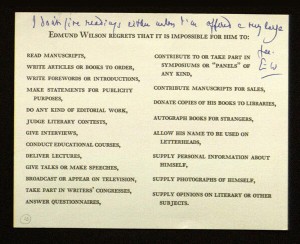
wilson-1-2This was sent by Edmund Wilson (or his secretary) to people who wrote to him. It is a measure of his fame at the time (1950s?) He is now remembered more for his association with other writers, especially Vladimir Nabokov and Scott Fitzgerald. G.B. Shaw used to send out something similar and also Evelyn Waugh. Apparently people would write to Wilson just to get a copy of the slip. The note on it reads: “I don’t [do] live readings either unless I’m offered a very large fee. EW”. These type of generic rejection/ fob-off lists have now graduated to email…any examples welcome.

Edmund Wilson regrets that it is impossible for him to:
Read manuscripts,
Write articles or books to order,
Write forwards or introductions,
Make statements for publicity purposes,
Do any kind of editorial work,
Judge literary contests, give interviews,
Take part in writers’ conferences,
Answer questionnaires,
Contribute to or take part in symposiums, or “panels” of any kind,
Contribute manuscripts for sales,
Donate copies of his books to libraries,
Autograph works for strangers,
Allow his name to be used on letterheads,
Supply personal information about himself,
Or supply opinions on literary or other subjects.

Ian Fletcher

Victor Plarr cover

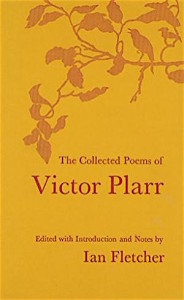
Found in the Peter Haining archive, an Independent obituary by Peter Mendez of the fin de siecle scholar Ian Fletcher (1920 – 88). As the obituarist remarks, Fletcher’s vertiginous rise in 1955 from humble book-stamper in Catford Public Library to University teacher was extraordinary and may be unique in the history of modern British academic life. Today, when the possession of a Ph D is obligatory for entry into academia, and when many with this qualification are either unemployed or in low-grade jobs, the idea that someone with no degree at all could be elevated to a lectureship in English Literature would be laughed out of court.

But this was Fletcher’s position in 1955. Not only did he lack a higher degree, but he had never attended a University. However, in compensation he became a prolific contributor to such neo-Romantic post-war magazines as Tambimuttu’s Poetry London, Peter Russell’s Nine and Wrey Gardiner’s Poetry Quarterly. In 1948 Tambimuttu published a volume of his poems entitled, Orisons. He also brought out an edition of Lionel Johnson’s Collected Poems in 1953. Fletcher’s passion for the aesthetic movement and the literature of the eighteen nineties had begun early. His book-hunting excursions in that golden age of the forties and early fifties, when rare titles could be had for under ten shillings, led him to assemble a large collection which became a valuable resource. At the same time his growing reputation as a poet and scholar attracted the attention of Professor D. J. Gordon of Reading University, who saw that the young librarian might be a valuable addition to his staff. And it soon became apparent that Gordon’s trust in him was well placed.

Continue reading

Firework Poems from Turkey

IMG_1446

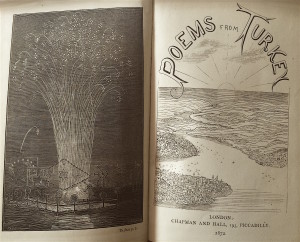
Found- a copy of a rare book: Poems from Turkey (Taylor and Co., London, 1872). The author is anonymous but is known to be William Platt Ball (born 1844). Loosely inserted is a note giving info about him (see below*.) Of interest is the fact that he was in Turkey advising the Sultan about fireworks and while there seems to have put on a few shows. The frontispiece illustration shows a display over water with the fireworks being launched from a raft or jetty. There are poems about fireworks in the book one of which  ('Pyro's Pilgrimage') is quoted after his preface:

These poems (except a few pages on Turkish subjects added since my return) were written during a stay of fourteen months in Constantinople. During this period I superintended (under His Excellency Halil Pasha)  the Sultan's firework displays, organised a firework factory, and taught the complete art and mystery of firework making to a set of forty Turk soldiers, and English (in the mornings) to a class of four Efendis.

Continue reading

Camp I.Q. Check List

IMG_1445.JPGFound in The Camp Followers’ Guide! (Niles Chignon. New York: Avon Books, 1965) this groovy quiz to ascertain how camp you are – aimed at men and women. Some tastes have changed, some clubs have vanished…a ‘Yes’ to over half means you are fairly serious about being camp.

Camp I.Q. Check List

Are you fanatical about egg creams?

Do you collect Wold War II ration books, old buttons, music boxes, stereoscopes and Ball jars?

Do you use banana soap?

Do you prefer Mexican paper flowers to real ones?

Do you have a Thirties Modern Vanity designed by Carl Hammerstrom in redwood burl with rounded corners and a big oval mirror?

Do you have a Bevelacqua chair with chrome flat bar steel arms?

Have you see Gunga Din five times? Goldiggers of 1933, ten? The Devil is a Woman, fifteen? The Creation of the Humanoids, twenty?

Do you have toys in your bathtub?

Do you play with a jump rope, a Whee-lo toy, or a giant Japanese Yo-yo?

Continue reading

‘The sewer of this vile book’ : one man’s rage against a poetry anthology.

Paths of Glory poems 001

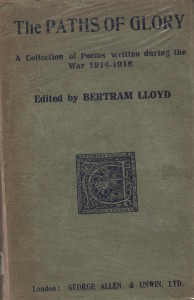
Today, a hundred years on, most historians find it difficult to justify the carnage that was the Great War. Back in 1919, many were morally divided on the issue. One man who saw the fight against German brutality as a wholly justified, glorious crusade, was the poet and playwright Henry Newman Howard (1861 – 1929). On reading The Paths of Glory, an anthology of anti-war poetry, he sent a scathing letter to its pacifist editor, Bertram Lloyd. A typewritten copy of this letter was recently found, tucked in with a batch of press cuttings relating to the offending book, in a copy of it , which may have been Lloyd’s own, that ended up the library of Maria Assumpta College, Kensington and was subsequently de-accessioned into the secondhand book trade.

Here in full is Howard’s letter to Lloyd:

29 Jan 1919

25, Charlbury Road,

Oxford.

Sir,

Your’ anthology ‘of War Poems is a crime. I grieve that the publishing house fathered by noble John Ruskin should be Sponsors to this execrable publication. Never again will I purchase a book bearing the stamp fouled by the guilt of this sinister booklet. Other books there are one recalls as foul things. Il Principe, possibly John Davidson’s Testament; Nietzsche—these last, like the German Empire, died mad of their guilty thoughts. Your book, garbage from end to end—if not in the individual poems, assuredly in their bringing together—carries the sickly unction of a spurious humanitarianism.

Continue reading

Hidden treasure in Epping Forest

Discovered in the Haining archive, this letter from someone called Lame Jack treasure letter 001D.L.Rolton of Ambleside, Cumbria, a fan of Haining’s The Fortune Hunter’s Guide. In ‘ gratefulness ‘ to the author for his ‘ useful and interesting ‘ book Rolton offers the following nugget of information regarding ‘ Lame Jack’s Fortune’.
I suggest you obtain ( borrow, beg or hire for one day ) a metal detector. On that fine day, try alongside the left side of the road, as one goes from Woodford to Epping —but only in the region of the fork that leads to Loughton ( diagram inserted ).

No! I am not being funny at all—I am most serious, and I don’t think you need to stray far from the side of the road. Try it !

Yours Sincerely,

D.L Rolton

It is not known where Rolton found the reference to Lame Jack’s treasure. It may be part of local folklore, although Lame Jack is not to be found using Google. It does not follow that because Rolton addressed his letter from Ambleside that he wasn’t acquainted with the site, which on the map is occupied by woodland named ‘ Reed’s Forest ‘. If any metal detectorist wishes to investigate the site, some research in the local history section of Loughton Library may yield clues. A study of W.R.Fisher’s The Forest of Essex (1887) could be also be useful. But be warned –it is over 40 years since Rolton sent the letter, and a huge amount of metal detecting has been done in this time. [R.M.Healey ]

Hollywood bookplate (1928)

IMG_1443

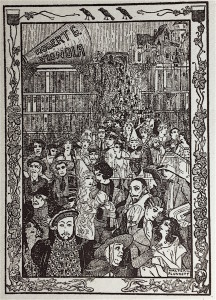
A bookplate from Hollywood 1928 right at the end of the silent movie era. It was done for actor and film director Robert G. Vignola (1888 - 1953) and was found in his copy of Emil Lucka's Eros. The Development of the Sex Relations Through the Ages (Putnam's , N.Y. 1915.) It was drawn by the film costume designer Walter Plunkett, presumably a friend of the distinguished director and 26 years old at the time. By this time Vignola had acted in many movies and had directed at least 60, some of which are no longer to be found.

Vignola's  career seems to have come to and end  just after 'talkies' came in, a not uncommon fate for older directors. The figures in the bookplate represent stars of the time and probably relate to movies he had made. Other film  directors who had bookplates include George Cukor, Bryan Forbes, Charlie Chaplin and Cecil B de Mille.

Haining brought to task on the subject of Black Magic

crowley

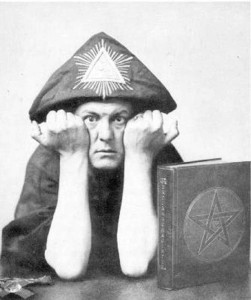
Found in the Peter Haining Archive, two letters that raise objections to the author’s views on Black Magic expressed in his Witchcraft and Black Magic (1971). Both emanate from distinctly offbeat sources. Here is the first letter. The second may feature in a later Jot.

The first letter ( dated only May 30th) was sent by someone called August Vironeem on behalf of ‘ the Directors ‘ of an American ‘Thelemic ‘ group ‘ described by Vironeem as an ‘ offshoot of Aleister Crowley’s ‘Initiatory lodge in England known as the Hermetic Order of the Golden Dawn ‘. Objecting to Haining’s section on Crowley as ‘ totally eroneous ‘, the writer goes on to repudiate ‘ with a high degree of certainty ‘ the Great Beast’s association with Black Magic:

'neither Crowley, not any of his disciples, partisans, sympathisers, nor modern day devotees do have, or have ever had, anything thing at all to do with black magic, ( and here , I must firmly state that Manson’s Solar Lodge of the O/T/O and other perversions do not bear upon Crolwey. Had he been alive today He’d have been nasueated by such groups.'

Vironeem ends by maintaining that although Crowley had his faults, he also had his ‘ moments of genius’; he then invites Haining to ‘take a quick look at’ Crowley’s ten volume set of The Equinox.

Vironeem letter 001

Your present Jotter is not really qualified to comment on Crowley or his philosophy, but most of his apologists have strongly denied that their hero practiced Black Magic. Indeed, the Crowley Wikipedia entry tends to suggest that his cult of Thelema was a much more intellectually nuanced philosophy than his simple-minded critics would have us believe. To me as a tyro it seems to be a philosophy that centres on a world view of extreme individualism, containing aspects of anarchism, and showing the influence of William Blake.

It appears that someone with the name August Vironeem actually exists and very probably did have connections with Thelema. Today, in Wilshire Boulevard, Beverly Hills, lives August Vironeem, aged 65. According to the records, someone with this name was born in 1951 in New York. And as the present HQ of the International College of Thelema is in Sacramento, CA, it seems possible that our Mr Vironeem became an early follower of Crowley, then by his early twenties had moved to California to take a leading role in the‘ offshoot‘ of the Hermetic Order of the Golden Dawn that eventually ended up as the International College of Thelema. This is all speculation, but the facts are suggestive...[R.M.Healey]

Puzzles and Problems, mostly punning

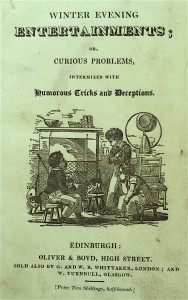
From A Winter Evening Entertainments; or, Curious Mathematical and Philosophical Problems, etc. (Jasper Wiseman, Edinburgh: Oliver and Boyd 1820.) Most of these puzzles have punning answers that might nowadays elicit groans.. Almost all are present in many other books and magazines of the time, it is doubtful that the author made up any of them. Wise man.

IMG_1430.JPG

What step must I take to remove the letter A from the alphabet?

By B heading it.

If I buy four oranges for a penny, and give one of them away, why am I like a telescope?

Because I make a far-thing present.

Which of the cardinal virtues will water be when just frozen?

Just-ice.

Why is spectator like a bee-hive?

Because he is a be-holder.

Why is an axe like coffee?

Because it must be ground, before it can be used.

Continue reading

Books we must not read. Part One

In issue number 11 ( January 1951) of the book miscellany Colophon someone called W. Mason- Owen describes some of the literary material that remains locked away in two departments of the British Library ( or British Museum Library as it was then known). Incidentally, didn’t unfashionable novelist Angus Wilson work in the Manuscript department of the BM around this time? I bet he had a peek at these banned items.

2012AA42076

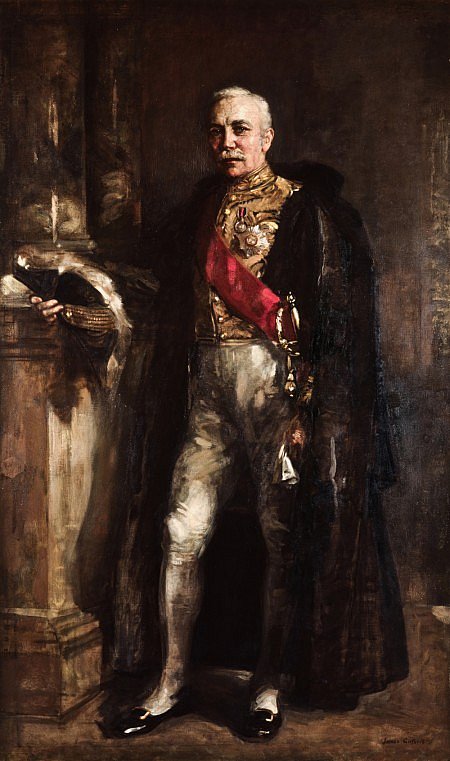
Henry Campbell-Bannerman ( James Guthrie)

In 1951 the first and most important of these departments was the Copyright Department, in which ‘ neatly packed away in brown paper parcels ‘ could be found ‘ politician’s diaries , books, letters and documents of scientists, inventors, poets and literary men, Court gossipers and King’s Messengers’. According to Mason-Owen, many of these writings wouldn’t be available to read for another fifty years---some perhaps would never be read. Owen then describes a few examples of the material locked away:-

  • Sir Henry Campbell-Bannerman’s private papers. Apparently, according to Mason-Owen, Campbell-Bannerman was Prime Minister in the early part of ‘ the nineteenth century’ , which should of course read ‘ the twentieth century ‘. Never mind. The reason they’re hidden away was because this particular politician was ‘famed for his caustic outbursts ‘against his more intransigent opponents. It’s hard to imagine that many of these MPs would have been alive forty or fifty years on, but there you are. I suppose war hero Winston Churchill might have been one of them.
Continue reading