Hemingway at Mont St. Michel 1944

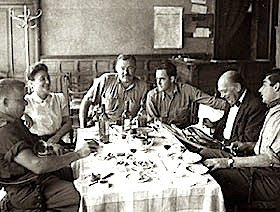
Hotel de la Mere Poularde, Mont-St.-Michel, August 1944 pictured (left to right) Bill Walton, Mme. Chevalier, Ernest Hemingway, an unidentified Signal Corps photographer, M. Chevalier, and Robert Capa.

The 'unidentified Signal Corps photographer' is almost certainly Ivan Moffat a British screenwriter, film producer and socialite. His account of his time with Hemingway appears in The Ivan Moffat File: Life Among the Beautiful and Damned in London, Paris, New York,and Hollywood (Gavin Lambert 2004). He was the son of beautiful Bloomsbury figure Iris Tree several of whose letters we have and will post. During World War II, he filmed activities of the U.S. Army for the Signal Corps and after the war worked  at Paramount Pictures. In the 1950s, between his two marriages, Moffat had a series of love affairs, notably with Elizabeth Taylor and Lady Caroline Blackwood who later married Lucian Freud. He wrote or co-wrote screenplays for a number of well-known films, including Giant and later the TV series Colditz. He appears to have been fairly unfazed by the Hemingway mythos. Mont St Michel still serves good omelettes, but is the tile initialled by Hemingway still on the roof of the church?

Ernest Hemingway joined our unit at Mont St. Michel, a small cluster of houses below a tall medieval church, perched on a small rocky island near the border of Normandy and Brittany. Irwin [Shaw] had taken me to meet Hemingway in his suite at the Dorchester Hotel in London, where he had shown off his collection of shotguns and rifles, pre-invasion rows of boots, and a portable canvas device that would enable him to cross rivers.
  I had wondered why he needed all that stuff as a war reporter for Colliers, but was either too awed or too polite to ask. A few weeks later I had met Hemingway again at the beachhead. He wore a Wehrmacht belt and told me, "I got it off a dead Kraut." This time I wondered, again without asking, why he bothered to explain.
  At Mont St. Michel a woman ran out from an inn to greet Hemingway, and he lifted her up in his arms as she laughed and kissed him and called him Papa. Then, at the inn, he toasted Irwin and Stevens with wine and Calvados, and we ate delicious omelettes, the first good meal any of our outfit had tasted since London.
  As it grew dark, brilliant artillery flashes lit up the sky, not very far away toward the east. They grew even more dazzling as the sound of gunfire grew louder. An American colonel joined us and said there was a heavy German counterattack from Mortaing, aimed at splitting our army in two. By then we were all a bit high, and enjoying a sense of vicarious participation in an event that was exciting but not in the least threatening.
  In the morning Hemingway and I climbed the steep narrow steps to the church, then up to the church roof, where we scraped our initials on one of the slate tiles, and Hemingway grinned like a kid.
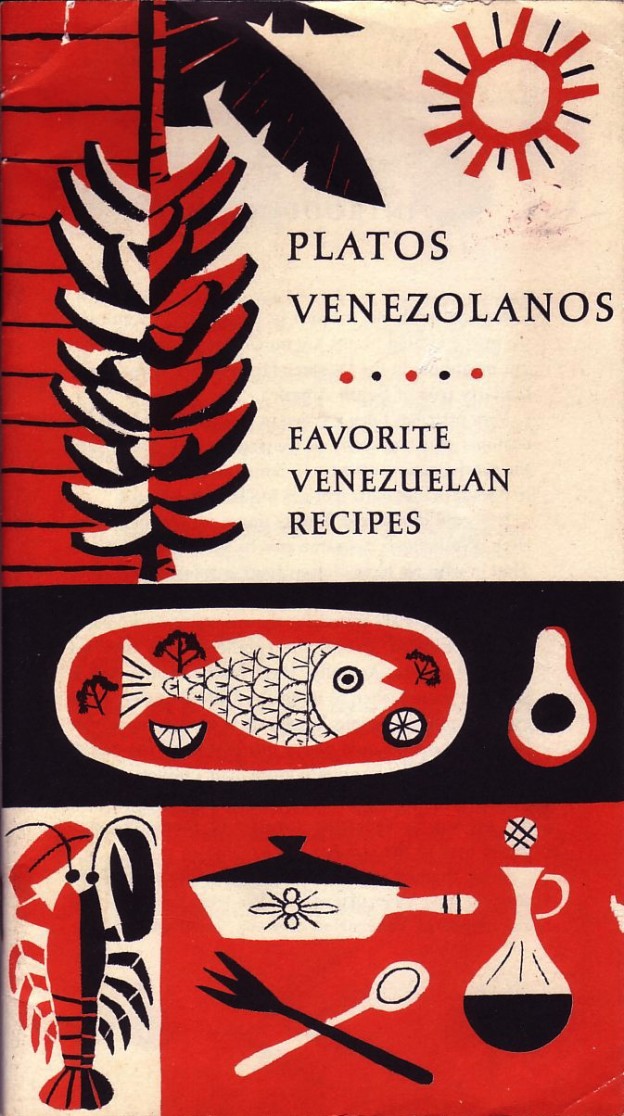
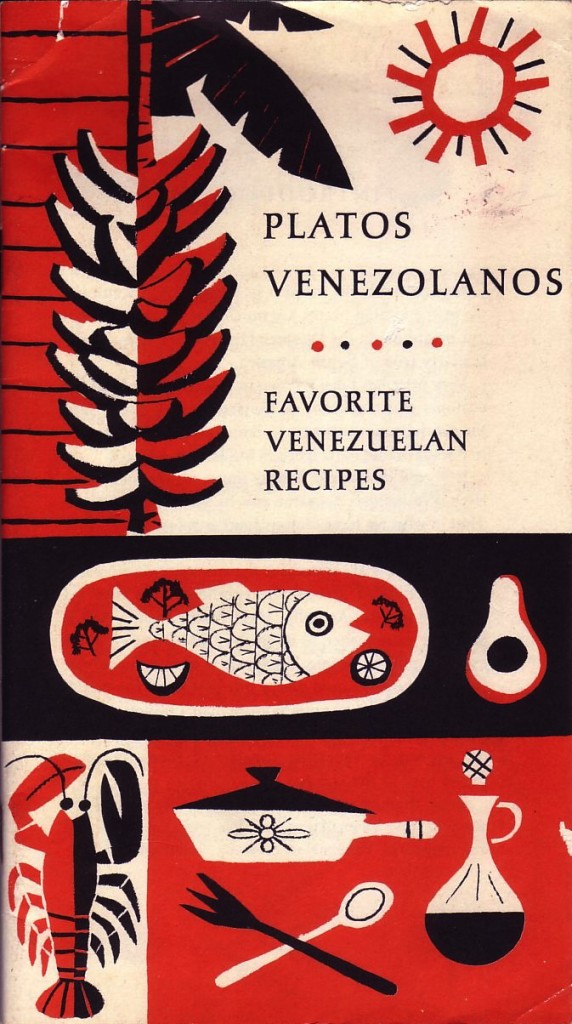
Platos Venezolanos – Lobster Margarita

A Venezuelan Cook Book put out by Creole Petroleum Company (published in New York about 1959) - illustrator unknown but not unlike Warhol of that period (see Bookride) A 20 page pamphlet. Not impossibly scarce. The lobster dish is the centre spread. Best washed down with something from Louis Roederer..

Here is a lobster dish with an incomparable flare and fillip to the Venezuelan sauce that will earn for any woman the distinction of being the "hostess with the mostes'." We think you'll agree that any descriptive adjectives would only be superfluous and could not really begin to do justice to the wonderful succulence of this dish.

Lobster Margarita • Langosta Flambée Margarita

4 pkgs. frozen lobster tails
1/4 c. butter or margarine
1/2 onion, minced
1 clove garlic, crushed
1/2 tsp. salt
1/4 tsp. pepper
1/4 tsp. oregano
1/4 tsp. nutmeg
1/4 c. flour
3/4 c. canned beef consommé
1/2 c. apple juice or cider
juice of 1/2 lemon
dash of Angostura bitters
2 tbs. chopped parsley
2 egg yolks
3 c. cooked rice
1/4 c. rum
parsley sprigs to garnish

Put lobster tails in cold water which has been salted. Heat until water comes to boil, at which time the lobster tails are done.

  Meanwhile, melt half of the butter or margarine in a saucepan and sauté chopped onion and garlic until tender. Add remaining butter, seasoning and blend in flour. Now stir in beef consommé, apple juice, lemon juice and bitters and heat. Stir constantly until thickened and smooth. Add chopped parsley.
  Lightly beat egg yolks with a fork, add a little of the heated sauce to the yolks, and then stir them back into the sauce. Simmer, stirring for 2 or 3 minutes.
  Rinse lobster tails, remove from shell and cut in half crosswise. On a Iarge round platter, make a wreath of hot cooked rice, fill center with lobster.
  In a small skillet, heat 1/4 cup rum, remove from stove, carefully, ignite and let burn until flame almost disappears. Now top lobster with hot sauce and finally pour burning rum over all. Garnish with parsley sprigs and serve at once. Serves 6.

Walking in London (1912)

From Walking Essays by A.H. Sedgwick.
(Edward Arnold 1912)

Many of the observations in this book hold true today e.g. 'there are so many people in London that they do not notice each other. If the Londoner paid the slightest attention to his neighbour he would go mad in a fortnight..' Also the idea that there are walking 'lines' in London vaguely prefigures the tramps 'ley lines' conjured up in Iain Sinclair's 1975 work Lud Heat (and re-trod by Peter Ackroyd in Hawksmoor). Sedgwick talks of an 'innate craving for big lines' and a direct path  from Central London to the King's Road- 'the line by which the citizens of London went to Chelsea to eat buns...'

London walking is a quite distinct and peculiar thing, utterly unlike any other town-walking. It is a unique branch of walking in general and solitary walking in particular : for all the circumstances which make town-walking solitary apply ten-thousandfold in London. But if you accept this condition, and walk London alone, you will find a very curious thing, namely that in this biggest and most monstrous of all towns you approach most nearly to pure rusticity. The strictly physical conditions, dirt, noise, smell, constriction of outlook, multiplicity of people, are as bad or worse in London than other towns ; but in certain other points, by no means unimportant to a walker, the end of the series is like the beginning, the infinite is like the infinitesimal. What was possible on the South Downs, difficult in Cheltenham, and unthinkable in Liverpool, becomes possible again in London.

Continue reading

Phaedo ‘Ersatz’ Thessaloniki 1953

Slim volume of poetry from Francis King archive.

Ersatz. (Phaedo) Privately Printed, Greece, 1953.Large 8vo. Wraps. pp 30 (unpaginated). Greek and English texts. Possibly anonymous or the author's name is there in Greek (which is Greek to me.) Presentation copy: 'To Francis King with thoughts/ Phaedo. Thessaloniki 12-5-1953 A. D.' The last 10 pages have the author's slightly angst ridden but amusing poems in English. 300 copies. Signed again on second page. From the library of Francis King (4 March 1923 - 3 July 2011), acclaimed novelist, poet, critic and editor. President Emeritus of International PEN and appointed  CBE in 1985. He came out in the 1970s and wrote the novel 'Yesterday Came Suddenly' in 1993, after the death of his long-term partner.

Two poems from 'Phaedo'

I Knew an Honest Man

I knew an honest man once
With brown eyes you could look deep in
Not read his thoughts
Or know his mind
But see his clean soul
Touch and love it

Honesty of course
Being something highly disturbing
When not kept within the limits
Of spoken words
He used to wear sunglasses

Yet when we were together
He used to take them off

P.S.

You know my friend
What is terrible about the dead
Is not that they are dead
It is the infinite times we failed
them - while they were alive

An attack on the tie

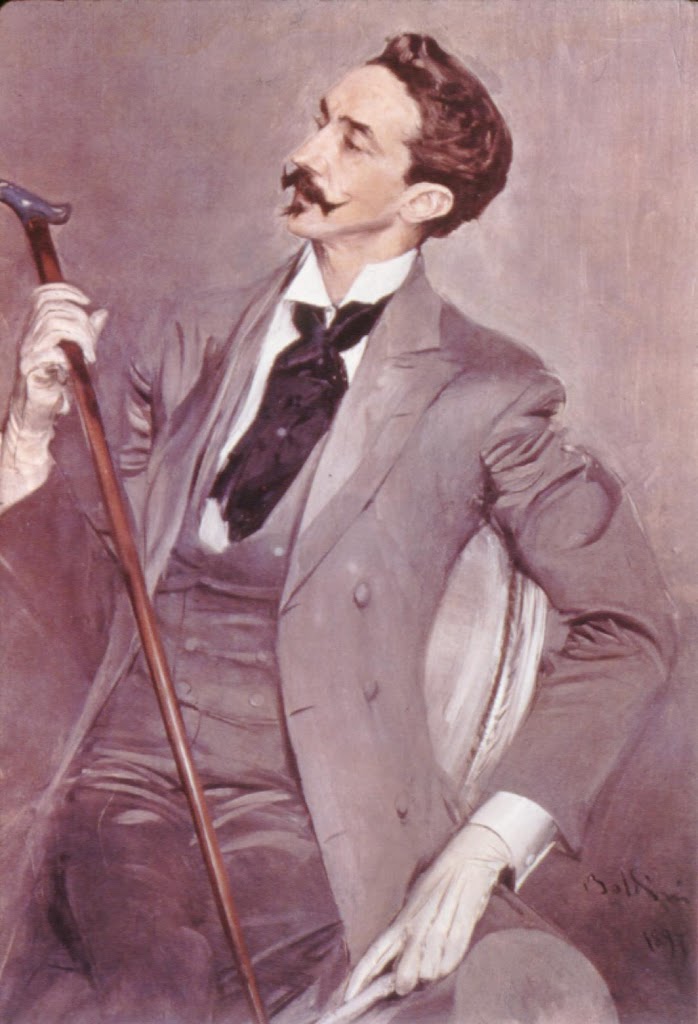
From Walking Essays by A.H. Sedgwick. This book appeared in 1912 and is mainly about walking - with a good piece on walking in London. As well as attacking ties, Sedgwick also attacks the waltz and its ubiquity. The reference to the 'ridiculous' ties of 1892 is illustrated  by a picture of an 1890s dandy (Robert de Montesquiou). Oscar Wilde went in for a fairly fat tie but it is hard to find good pictures of his neck wear...

Ties furnish perhaps the clearest instance of the break-down of utilitarianism. They serve no material purpose of any kind. The days are long gone by when the tie added perceptibly to the warmth of the body : even the ties of 1892, which seem ridiculous to-day, cannot have saved a single valetudinarian of that age (as he thought) from a cold in the chest, or (as we now learn) have weakened his capacity to resist chill. No man's health or bodily comfort would now be affected in the slightest degree by the presence or absence of a tie. Nor, if utilitarians take the rash step of admitting beauty into the system of pleasures, can very much be said for ties. It is true that they sometimes add a desirable touch of colour ; but if beauty were our aim in ties, should we stop for a moment within the present limitations of either colour or shape ? A large flounced piece of drapery with an elaborate colour scheme, twisted in decorative lines across our chest to a bow on the hips or the small of the back, would be the very least we should put up with. Can any one with a little knot of monochrome peering bashfully from a minute triangular opening in a waste of drab monotony talk seriously about beauty in ties ?

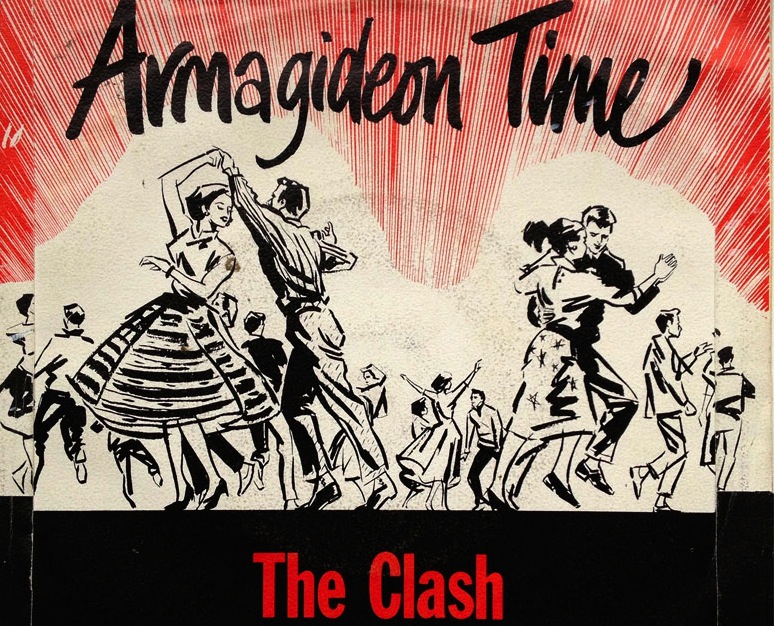
I once met…The Clash

I once met The Clash. It was the summer of 1977, the year of Punk. Somehow I knew the roadie of the Sex Pistols who was known as Boogie (as in 'book' not 'boon') - later he became an art dealer like his father and I rented him a gallery, back then his flat near Bell Street (many bookshops there then) was always full of punk musos inc Malcolm McLaren, Bernie Rhodes - I even saw Vivienne Westwood there once.

I recall meeting the whole of The Clash there once, they were standing about in zipped and paint spattered clothes. They were off to the West End and wanted to know the way to Shaftesbury Avenue. As there were 5 of them (for some reason they had Steve Jones of the Sex Pistols with them) I suggested they just get a cab. Joe Strummer's reaction was interesting he said 'No cabs. We'll walk there, we're in love with life.' His voice was vaguely middle class, something he didn't bother to hide. I liked him. That's it.

Artist Elizabeth Campbell (1893 – 1978)

Almost UBI (unknown by internet) but no longer. Her entry in Fielding's American Painters, Sculptors and Engravers (NY 1987) reads: Elizabeth Campbell. Born in 1893 in Iowa Falls...Studied with Alexander Nepote at Marian Hartwells School of Design, San Fran; and San.Fran Art Inst., ...Taught privately. Received grant from Montalva foundation, Cal. Exhibited at Cal. Palace, San Fran; Louis Terah Haggin Mem. Galleries, Stockton; and SF Museum of Art. Living in San Francisco in 1965. This painting is presented (on the rear of the canvas) to American composer Lou Harrison and his partner Bill Colvig from whose estate it was acquired in 2007. It has no title but always reminds me of a street grid. The painting came with some ephemera about her, a handout from the Maggie Kress gallery in Taos, a press cutting 'Beyond the Third Dimension' about her painting showing at San Francisco Museum of Art (undated but the 64th Annual Exhibition.) Also this artists' statement:

"I am intuitively aware that space-time-form - the expression of reality - is in the process of becoming; the three-in-one appearing in an act of simultaneity. Realizing this, I sought for an objective structure  that could express new plastic relations in other than the then employed dimensions, and which could in turn, express the spontaneity I experienced in this process. Musical forms - and their relation to time elements and spatial structure - have been of special significance and inspiration to me in painting."

Continue reading

Carew Finch (1908 – 1985)

Carew Finch (1908-1985) was a British, possibly Irish artist, who studied at Grosvenor School of Modern Art. The NIVAL Artists Database (National Irish Visual Arts) gives his dates, his full name as Richard Henry Carew Finch and notes that he worked in oils in the Abstract and Landscape genres and that he is listed in Buckman's Dictionary of Artists in Britain since 1945 (1998). The final note 'Virtually no information available on this artist' says much. The above picture (gouache?) has no name but may evoke a fairground ride..

The painting was bought from Jane England (England and Co) in London in the 1980s. At the time she was dealing in Outsider Art and lesser known 20th Century artists. Auction records show one painting sold in the last 20 years - a gouache entitled Rain Steam and Speed. Price unknown. Nothing more known. The Grosvenor School was both a bricks and mortar school (33 Warwick Square, Pimlico) and a 'school of artists' (mostly associated with printmaking) its better known members were Claude Flight, Iain MacNab, Cyril Edward Power and Sybil Andrews + the Swiss artist Lill Tschudi.
Crook Frightfulness

'A Victim'. CROOK FRIGHTFULNESS. Birmingham: Cornish, 1932; Birmingham: Moody Bros., revised edition, 1936.

A strange and slightly disturbing book. Some consider it unintentionally hilarious. It tells of how a young man whose business was rent collecting in London's East End became the victim of of a life-long 'persecution' by crooks, even as he travelled round the world - persecution by muttering and whispering, staring, gassing, obscenities and 'Ventriloquial Terrorism.' The writer believed that his tormentors possessed a "stethoscope apparatus that enable[d] them to hear [his] thoughts". The subtitle of the book gives something of its flavour : "They are the most powerful, terrible and pitiless killers, cunning, amazingly and enormously treacherous."  Bizarre Books (Lake and Ash) describes it thus:

Continue reading

Misha Black – early work

Misha Black (born 1910 in Bacu, Russia died 1977) designed posters for London Transport 1936-1947. He was one of the most influential exhibition and product designers of his time. He designed posters from the age of seventeen. In 1928, he designed the stand for the Rio Tinto Company at the Seville Exhibition. This cover to the Cambridge magazine Experiment

is from the same year and must be one of his earliest published works. He was 18. The magazine was edited by William Empson, Hugh Sykes Davies, Humphrey Jennings and William Hare (Lord Ennismore) and Jacob Bronowski. See recent Man Ray post for an extract from it. He was later responsible for designing Westminster's iconic street name signs. He is covered on various design sites and at Wikipedia but information on his earliest work is sketchy.

The Aquarian Guide (London 1970)

The Aquarian Guide to Occult, Mystical, Religious, Magical London and Around. Francoise Strachan [Aquarian Press, London 1970]

A guide with names, addresses etc. Amazing collection - rainmakers, clairvoyants, robe makers, temple painters, even the artist who did the cover (Ken Crampton) is in there as a mystical painter, also an occult B & B in Coombe Martin, The Process -'Church of the Final Judgement (Balfour Place, Mayfair), Gandalf's Garden (hippy tea-room) The Ghost Club (founded 1862) Lodges, Priories, Cabalistic & Chivalric Orders, Druids, Avatars, Astrologers, Findhorn, Hypnotists, OAHSPE, Fuller D'Arch Smith (occult books), an Isis Unveiled Class, an exorcist, and a spiritual candle maker. The author, now known as Francesca Rossetti, can now be found on Library Thing.

E.V. Knox (‘Evoe’) Vitamins

From the papers of Edmund George Valpy Knox (1881 - 1971), comic writer, poet and satirist who wrote under the pseudonym Evoe. He was editor of Punch 1932-1949, having been a regular contributor in verse and prose for many years.This piece is probably from the 1950s after his editorship. In the archives is a good pic of him, at present unfindable (will upload soon) - for the moment this below. He was married to the daughter of the Winnie the Pooh illustrator E.H.Shepard. Mary Shepard in her turn illustrated Mary Poppins. His daughter from an earlier marriage was the Booker prize winning novelist Penelope Fitzgerald - known in the family as 'Mops' and author of the book below on the gifted Knox family.

VITAMINS
It seems to be the invariable practice of those who are recovering from the fall scourge of influenza; or desire to ward off its attacks, to eat grit. The substance takes various forms, but nearly every family consumes with one or other of its daily meals a spade or shovelful of marl, concretes sawdust, fine gravel, or sand.
    The discovery of this new diet basis was providential in the extreme. An eminent doctor was watching an ostrich at the zoo; and noticed the bird devouring several pieces of paving-stone and a couple of bricks. Interested he returned the following day and found the ostrich looking, if anything, fitter than before. Immediately the idea struck him:
    "What if vitamins lurk in the gritty part of farinaceous substances., banished by modern mechanical methods of food preparation from our daily fare?"
    Analysing a gritty substance he found a vitamin lurking there, and his theory was confirmed.
    Grit became instantly one of the most fashionable ingredients of the British breakfast menu. My friends the Wilkinsons emerge refreshed from the following imbroglio each day:

Continue reading

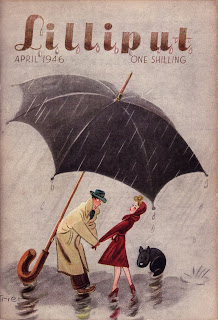
I Hate Producers! (James Mason)

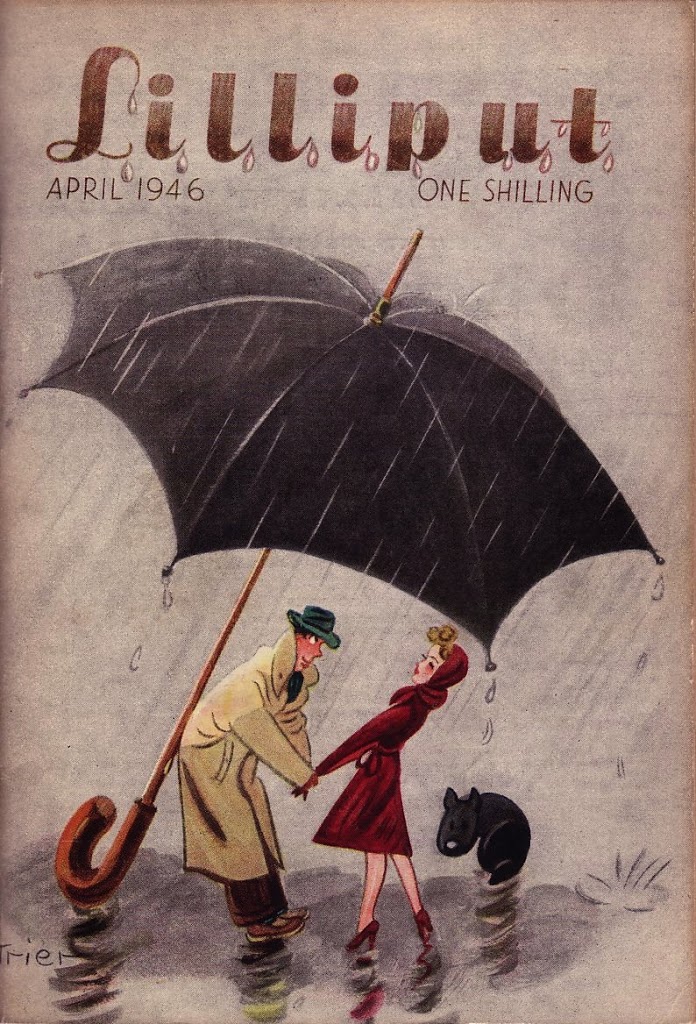
Found in the UK mag Lilliput of April 1946. James Mason's response to recent Ben Hecht book I Hate Actors. A great actor and the best Humbert Humbert so far...look out for his coinage 'hambaiting' in paragraph 5.

  EVERYONE says that Walt Disney is the happiest producer in Hollywood because he does not have to put up with actors around his studio. Further evidence is to be found in in the title page of Ben Hecht's recent book "I Hate Actors." And I am prepared to testify that the feeling therein expressed is by no means peculiar to Hollywood.
  The abhorrence that flickers in a film producer's eye when the sanctity of his script or the ability of his pet director is rashly questioned by an actor is an awesome vision. It is as if the gates of hell swing open.
  For this reason I would recommend to this branch of our art only those aspirants who have exceptional resilience. Those without it are a prey to duodenal ulcers and persecution mania. For tho' the hatred may be mutual the struggle is unequal.
  The average producer's civility towards an actor extends only to the moment when the contract is signed. He is a skillful coaxer, all teeth and cigars, and even permits himself to say nice things about the fellow's acting in an effort to ingratiate. Then, almost before the ink is dry, he seems to say "O.K. We've got his signature. Now let's give him hell."

Continue reading

Arland Ussher on Godot etc., (circa 1955)

Letter from the papers of Lady Glenavy. To her husband from Arland Ussher.

Percival "Percy" Arland Ussher (1899 -1980) was an Anglo-Irish academic, essayist and translator. He published The Face and Mind of Ireland (1949) and Three Great Irishmen (1952), a comparative study of Shaw, Yeats, and Joyce. This letter gives a good, and reasonably sympathetic, view of Beckett's masterwork as it was seen at the time that it was first performed.

Charles Henry Gordon Campbell, 2nd Baron Glenavy (1885–1963) was a barrister who married Beatrice the artist Elvery. He was a contemporary of D. H. Lawrence, to whom he was introduced by Katherine Mansfield and John Middleton Murry. Known as Gordon Campbell, he served as Secretary of the new Department of Industry and Commerce. He was appointed a director of the Bank of Ireland. He and his wife were on the fringes of the Bloomsbury set.

I8 Green Rd
Blackrock
Dear Glenavy,
  Thanks for your interesting letter. It's always good to hear these fellows attacked. They get away with it too easily. But still..
  When we came out from GODOT I said to my companion, & heard other people saying:
Let's go have a drink.
- No good, it's much too late. Everything shuts.
- Let's go to XX
- No. Too far. I haven't enough petrol.
- We'll find somehwere we can have coffee.
- Oh it's too much of a crush at this hour.
    I want to go to bed.
- It's so late, I know I shan't sleep.
- Why did we come? - Oh we had to see Godot.
Continue reading

John Buchan parody

Clovelly-Kepplestone was a private boarding school for girls in Eastbourne, Sussex. It flourished from 1908 until 1934 and was familiarly known to staff and pupils as "Clo-Kepp". There is a very comprehensive piece on it at Wikipedia. The annual school magazine of which we have the 1930 issue has a frontis of the charismatic Miss Frances Browne the 'principal' of the school (see below). The magazine is of a high order full of news of old girls and poetry, essays and humour from past and present Clo-Keppians.

The following John Buchan parody is a good example. The brief was to write a piece with the context of rain outside, a man and wife inside and an unexpected visit by a friend. The 3 subjects were Wodehouse, Edgar Wallace and John Buchan. We did the Wodehouse a few posts back and will do the Wallace only on demand.The authors are given as Phyllis Inglis (née Kay) C-K and O.G.C.

Continue reading

Filson Young Quote

If happiness were really attainable through the doctrine of
everyone for himself, the world would at once become a
very happy place.
 (English Review, London 1918)

Filson Young (1876–1938) was a journalist, who published the first book about the sinking of the Titanic in 1912 only 37 days after the sinking.

Found in Ambrosia by Request ( A Companion Volume to Nectar in a Nutshell) Allen & Unwin 1946. Previous to the Titanic Filson Young had a succès de scandale in 1905 with a novel about prostitution The Sands of Pleasure (much admired by Jean Rhys.) Later James Joyce was disappointed when Filson's publisher Grant Richards failed to persuade Filson to write an introduction for the first edition of Joyce's collection of stories, Dubliners, which Filson had been one of the first to praise when the manuscript had reached him in his capacity as Richards' reader. What he would have made of Ayn Rand is unknowable.

N.N. Sen on Man Ray

A contemporary review of Man Ray's movie L'Étoile de Mer by N.N. Sen in the first issue of the  literary journal Experiment (Cambridge, 1928). It was edited by William Empson, Hugh Sykes Davies, Humphrey Jennings and William Hare (Lord Ennismore) and Jacob Bronowski.

N.N. Sen (Nikhil N. Sen) was a friend of Mulk Raj Anand (mentioned in an earlier posting on curries) and moved in the same circles in London in the 1920s. Not much is known about Sen; however, Anand mentions him extensively in his Conversations in Bloomsbury (1981). The Open University site has this on him:

Continue reading

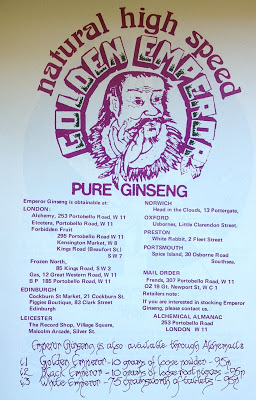
UK Ginseng shops 1971

From The Alchemical Almanac and Handbook of Herbal Highs (1971)  See 3rd Ear Band. An interesting list of long lost alternative 'head' shops. The epicentre of Ginseng seems to have been Portobello Road.

Emperor Ginseng is obtainable at

LONDON

Alchemy, 253 Portobello Road W 11
Etcetera Portobello Road W 11
Forbidden Fruit
   295 Portobello Road W 11
   Kensington Market W8
   Kings Road (Beaufort St) SW7
Frozen North 85 Kings Road SW3
Gas 12 Great Western Road W11
B P 185 Portobello Road

EDINBURGH

Cockburn St Market, 21 Cockburn St
Piggies Boutique 83 Clark Street

LEICESTER

The Record Shop, Village Square
Malcolm Arcade, Silver St

NORWICH

Head in the Clouds, 13 Pottergate

OXFORD 

Usbornes, Little Clarendon St

PRESTON

White Rabbit, 2 Fleet Street

PORTSMOUTH

Spice Island, 30 Osborne Road, Southsea

MAIL ORDER 

Frendz 307 Portobello Road W11
OZ 19 Gt Newport ST WC1

I once met… Marty Feldman

The funny thing with Marty Feldman is that he came up to me -it was at Swiss Cottage, London and asked me the way somewhere.

He was in a hurry and when he saw that I recognised him (who couldn't? - it was those eyes) he waved his hands in front of his face as if to say 'forget all that mate, just tell me the way!' I like to think I put him on the right road. That was about 1970.

Oddly enough I saw him again in a mall in Westwood (L.A.) window-shopping with a woman (wife?) early evening in the summer of  1972. I was on holiday. I did not bother him. [Sent in by Barry Cox - for which much thanks.]