
For someone brought up with the Beatles, it’s difficult to understand the attraction for teenagers of what came immediately before the Fab Four transformed pop music for ever. Here, for instance, is the back page Film Review promo for Beat Girl,  a movie released in 1960 that purported to show ‘ squares ‘ what their ‘beatnik’ teenage sons and daughters were getting up to behind their backs. Starring the pop singer Adam Faith ( his film debut at the age of 18 ), horror star Christopher Lee, a young Oliver Reed and the fifteen year old bilingual starlet Gillian Hills, it was also the debut of John Barry, who went on to forge a glittering career in film music.
In 1960, most pop music fans were more interested in how teen idol Faith would cut it as an actor, than they were seeing ‘ the second Bardot ‘, as Roger Vadim hyped the fifteen year Hills, but looking back, it is odd that latter’s acting career never took off. Here was an actress, whose striking blonde beauty and obvious acting talent should have propelled her to greater things. In ‘Beat Girl’ Hills plays the ‘ bad girl ‘ Jennifer, the sulky-looking beatnik, who rejects the values of her respectable parents and lives for the kicks she gets out of dancing in night clubs and hanging out in milk bars. In the opening scenes of the film she is a pouting, free-spirited presence as she descends the stairs to the basement dance floor, where, seemingly oblivious to everything and everyone around her, she begins a freestyle dance routine. On her website ( which is worth a visit ) Hills describes the dance thus: ‘ my brain flipped, my feet followed and I was off’. As for her role as Jennifer, she saw it as a protest at her treatment by her Lycee in Paris, who expelled her for taking on a debut role in Vadim’s ‘Les Liaisons Dangereux ‘.
‘I could vent my frustration, my disgust, the helplessness and despair, and the anger at what had happened to my life in the recent months.’
‘Beat Girl’ proved popular in Britain, but was banned in France. However, this did not prevent Hills from taking roles in a number of French films in the early sixties and from recording pop songs in French, including the annoyingly catchy ‘ Zou Bisou Bisou’ (1961), which was later used in ‘Mad Men’. But in Britain the film roles were small. She was a brunette in the cultish ‘Blow Up ‘(1966) and in ‘A Clockwork Orange’ she had a cameo. She also appeared occasionally on British TV.
In 1975 Hills decided to stop making films and left for New York City to try her luck as a book and magazine illustrator. Judging from the artwork on her website, she appears to have genuine artistic talent too! At 72, Hills now lives in England with her husband Stewart Young, manager of AC/DC and Cyndi Lauper, among other artistes. [R.M.Healey]

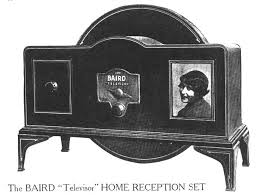 Published in the monthly miscellany Medley for September 1935 is this winning prediction from a competition run by The Manchester Guardian. It looks forward to what life might be like in 1950.
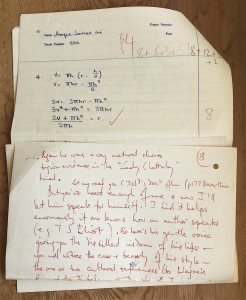 Found among the papers of the mathematician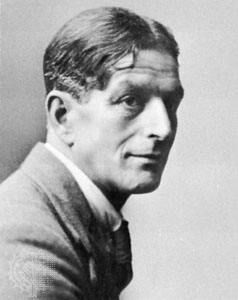


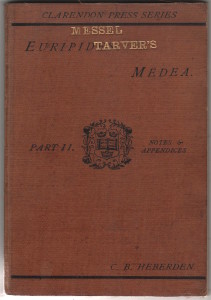 Found in a box of old text books (Zinn collection) is this copy of part two of C. B. Heberden’s edition of Euripedes’ Medea ( notes and appendices) published by the Clarendon Press in 1886.Stamped in gold lettering on the light brown cover of this distinctly dull-looking school text book are the words MESSEL/TARVERS. Inscribed in pencil on the fly-leaf we find ‘ L.Messel/Tarvers ‘, which suggests that it belonged at one time to Leonard Charles Rudolph Messel ( 1872 – 1953), father of the famous stage designer Oliver Messel. Beneath the inscription are two pencil and ink drawings—one of a veiled lady in Victorian dress, the other a small profile of a man’s head.
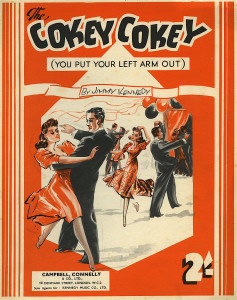 Found- some sheet music for the song The Cokey Cokey which later became the song (and dance) the Hokey Cokey. This is what it is all about… There are many theories about its origins – dealt with at Wikipedia and in a
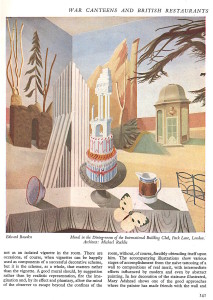 It is a sad fact that most of the best mural paintings executed in canteens, cafes and restaurants in the UK no longer exist. Unlike those executed for some public buildings, those in private premises are subject to the taste of those who take over the property. By far the most notorious example was, of course, the murals executed around 1913 on the walls of Rudolf Stulik’s Restaurant de la Tour Eiffel in Percy Street, just off Tottenham Court Road, by Wyndham Lewis, which were later painted over.
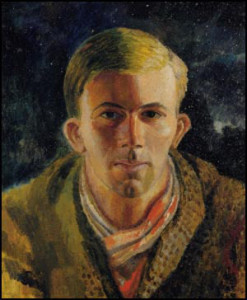 Found amongst the papers of the late distinguished bookseller and publisher Joan Stevens this cutting from a catalogue. It appears to be dated in 1976, bookseller not named but it does not sound like Joan.
  Found – this newscutting from The Times (London 1926) about the origins of the much loved hymn ‘Abide with me’ by