
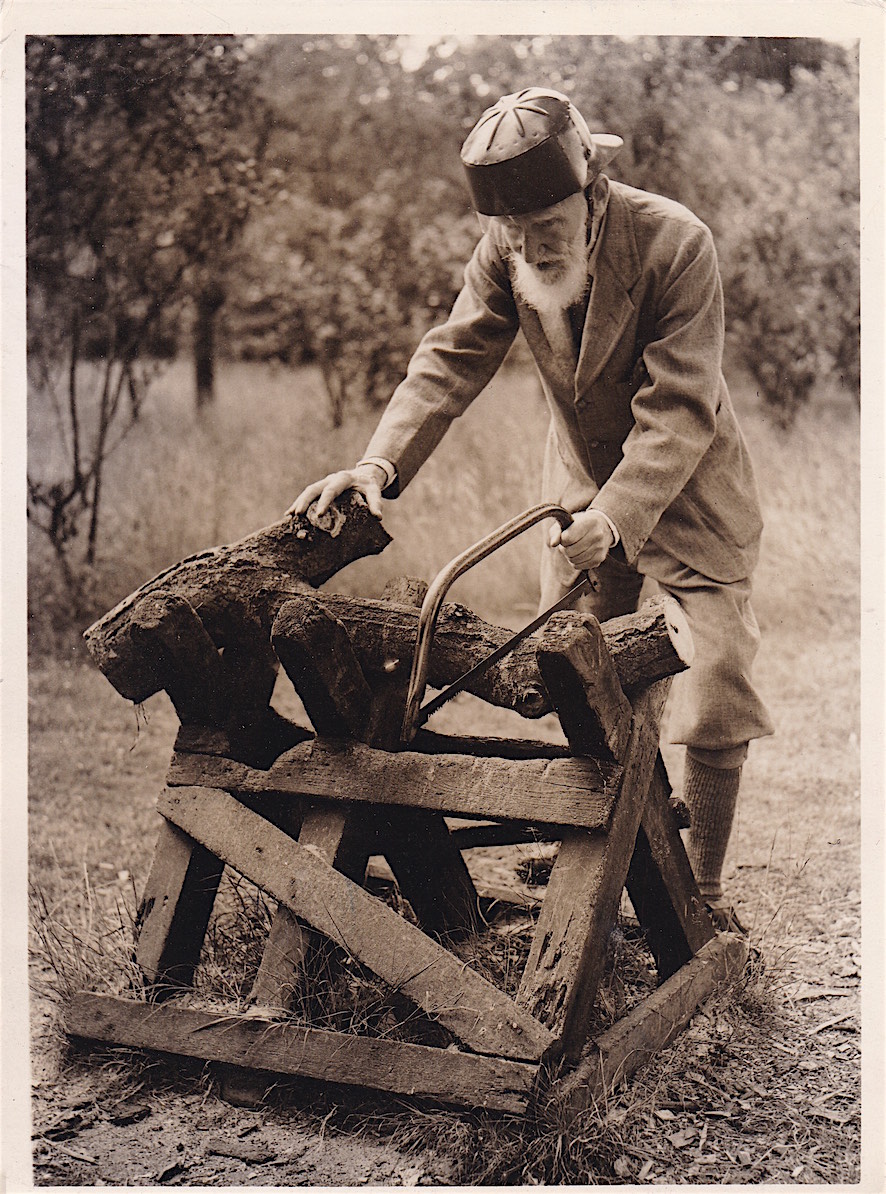
 Found – a sepia photo of George Bernard Shaw sawing wood. The photo measures 8 inches by 6 and on the back is written “GBS 88th birthday”. It was probably a press photo taken in the grounds of his garden at Ayot St Lawrence. It was 1944 and nine of his plays were staged in London during that year – he was undergoing a revival in his popularity but was concentrating mainly on journalism…He died six years later at the age of ninety-four of complications precipitated by injuries incurred by falling while pruning a tree. The hat looks Russian, possibly leather, and is rather splendid.
Author Archives: Jot 101
The pioneers who gave us the first true Copyright Act

Writers of all kinds should be grateful for the work done of their behalf by two men, the lawyer, MP, and writer, Thomas Noon Talfourd (1795 – 1854) and the Tory MP and historian Lord Mahon (1805 – 75), who were the driving forces behind the Literary Copyright Act of 1842. But this was not the first Act that granted authors rights over their work. The first to do so became law in 1709. Up to this time copyright was restricted to booksellers who, as publishers, would buy up all rights from authors for a fixed sum. The 1709 Act first made it legal to anyone to own a copyright—even authors, although it gave them a meagre fourteen years. A further Act of 1790 extended this period to 28 years. Although this was an improvement, it still meant that a young writer like Dickens, whose Pickwick Papers was dedicated to Talfourd in 1837, could not expect to profit from his early works beyond his mid fifties. It is probable that his friendship with the novelist prompted Talfourd to pursue legislation that would benefit writers like him and to this end he presented an initial version of the 1842 bill to Parliament in 1837.
This bill failed, but Talfourd remained determined. Further bills were presented and at last, in 1842, the Literary Copyright Act became law. This extended copyright to the life of the author plus seven years, and where copyright already existed in a work under earlier legislation, it was to be extended to that provided by the new Act. The Act was further amended in 1911 and several times since.
So here is a rather rare item –a letter from Lord Mahon to T. N. Talfourd written six years before the famous Act was passed. Although the issue of copyright is not mentioned in the letter, the contents do suggest that the two men, who shared literary interests, were on friendly terms. Talfourd had sought election to the Athenaeum, a prestigious London club which numbered many writers, artists and scientists among its members. He was unsuccessful on this occasion, not because, as Mahon explains, the committee doubted Talfourd’s ‘eminent qualification ‘, but because there were insufficient committee members present to vote.
Although Talfourd’s literary career was unremarkable, he became a guiding presence on the Bench and died at the comparatively early age of 59 while delivering judgement in court. [R.M.Healey]
The Evil Girls behind the Teddy Gangs
 Apparently, there are now academic papers on the ‘Teddy Girls’ of the late 1950s. One paper submitted by a woman from a liberal arts college in the middle of the Canadian grain belt defines Teddy Boys and Girls as ‘passionate spectators of urban life who incorporated aspects of the Baudelarian dandy with a more vigorous embodied relationship to the city.’ Or not…
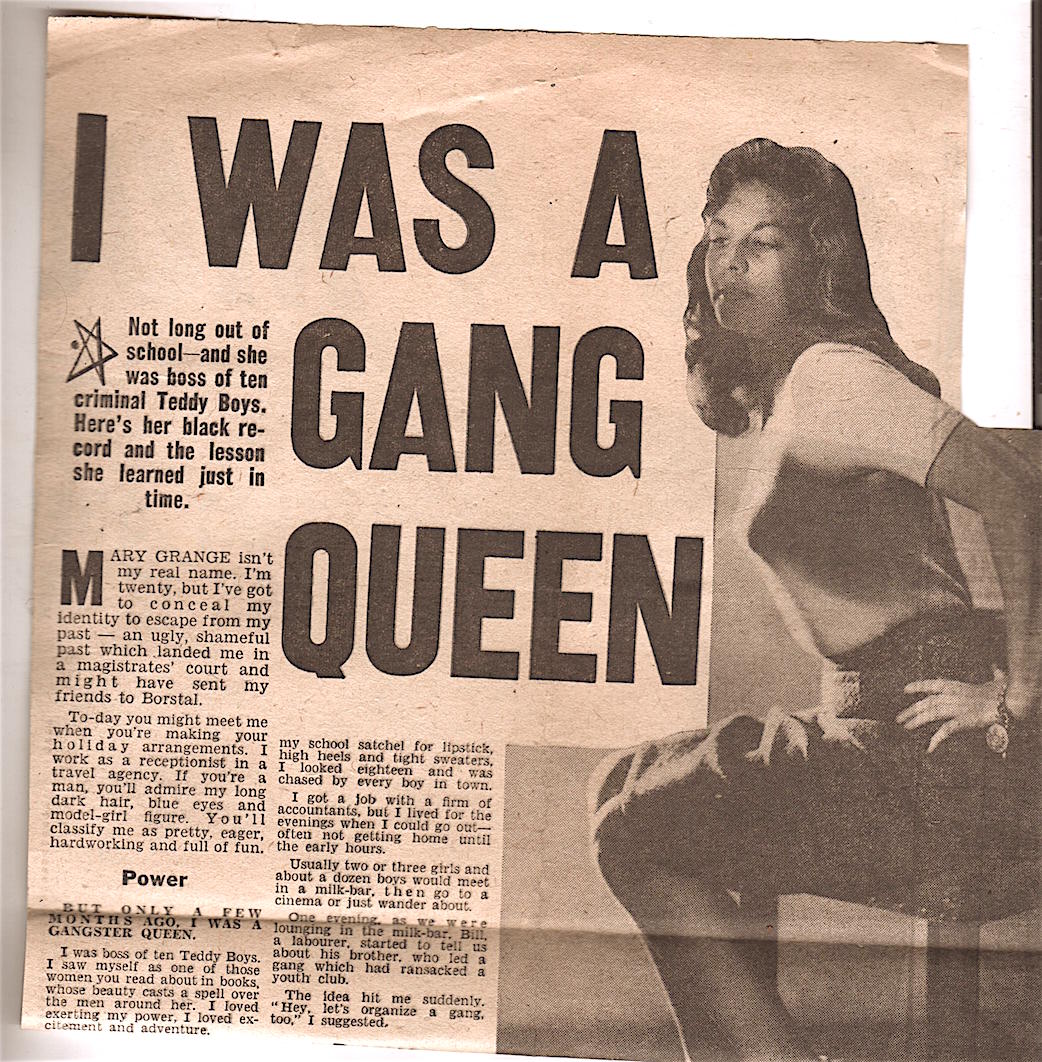
Anyway, forget Baudelaire; here is a real story of one of these Teddy Girls, plucked from the ever-giving Peter Haining archive. It’s a contemporary account that appeared in the sensationalist weekly ‘ Fling ‘ c 1959 by a self-confessed ‘moll’ who calls herself ‘ Mary Grange ‘ and who entitles her salutary story ‘ I was a Gang Queen ‘.
Mary Grange isn’t my real name. I’m twenty, but I’ve got to conceal my identity to escape from my past—-an ugly, shameful past which landed me in a magistrates court and might have sent my friends to Borstal.
To-day you might meet me while making your holiday arrangements. I work as a receptionist in a travel agency. It you’re a man, you’ll admire my long dark hair, blue eyes and model-girl figure. You’ll classify me as pretty, eager, hardworking and full of fun.
Power
BUT ONLY A FEW MONTHS AGO I WAS A GANGSTER QUEEN
I was boss of ten Teddy Boys. I saw myself as one of those women you read about in books, whose beauty casts a spell over the men around her. I loved exerting my power. I loved excitement and adventure.
I used to “dare” the boys to steal gifts for me, just for the thrill of it.
First it was bottles of gin, then dresses, then the week’s taking from a shop till.
At the time they seemed like daring games. Now I see them as the stupid, criminal antics they were.
Warning
Why, you’ll ask, am I reviving a past that’s best buried and forgotten? Because I want to warn others against the pitfalls which put my name on police records.
I can’t plead the excuse of a slum home, a pavement playground. I live in what you might call a “select neighbourhood” in the suburbs of a large town in the north of England.
“Fadeless Sundour”
Found on the dust jacket of a Collins 1939 edition of Alice in Wonderland this notice:
This book is bound in fadeless Sundour cloth, which can be lightly rubbed with a sponge when soiled, with perfect safety.
The cloth has hardly faded in its 77 year life and does not need sponging. The Sundour company is still going (in Warrington, Lancs) but now deals almost exclusively with curtains. Its involvement with book cloth seems to have ceased in the 1940s. There is very little online about this and Sundour’s fadeless cloth is mostly mentioned in the more meticulous used bookseller’s lists…

How to become a female home decorator c 1930
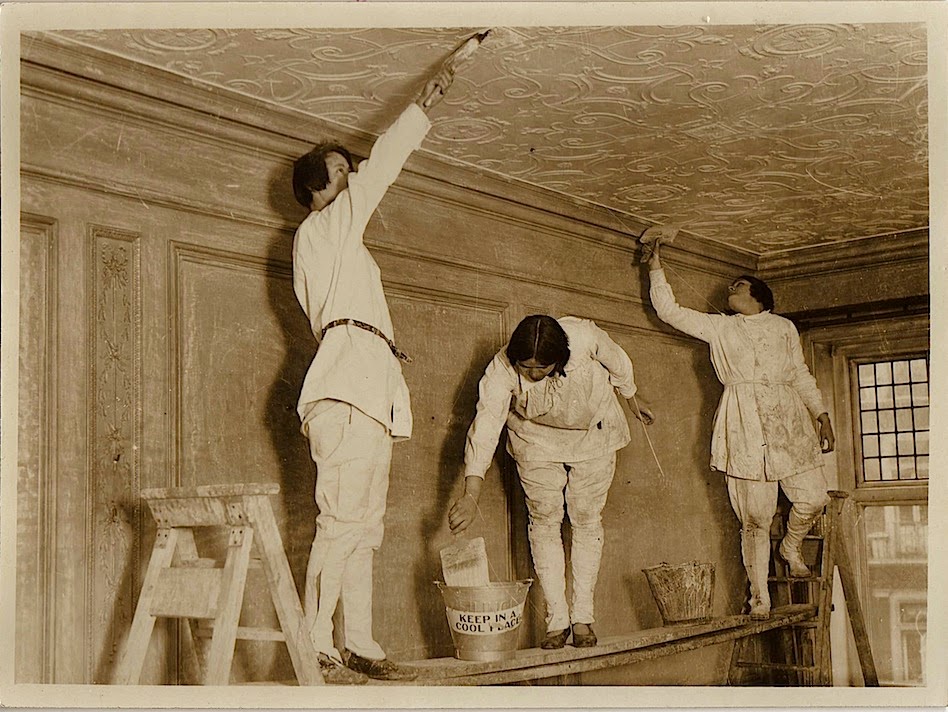 Devoted Jot101 followers will perhaps recall a previous jot of about a year ago which featured some unusual photographs of three ‘ women home decorators’ going about their work inside a what appeared to be a Georgian town house. The snaps, which appear to date from the late twenties or very early thirties, were attached to a short handwritten article composed by a women of feminist sympathies outlining the rewards and pitfalls of self-employment for a woman intent upon a career as a decorator. It is not known whether the article was ever published—possibly not, as the manuscript was recovered from an archive of various material. Anyway, here is the article in full.
Home Decoration as a Career.
‘House Decorations is a most enthralling & interesting business, but let no-one imagine it is not a very serious undertaking.
Its aims are artistic, its ideas are artistic, but in the carrying out of these ideas stern business ability is required and no-one need undertake it who does not realise this.
Plain Business means incessant work, physical and mental control, knowledge of men & things, and insight into the character of others.
Miseries of Twenty First Century Life – Travelling
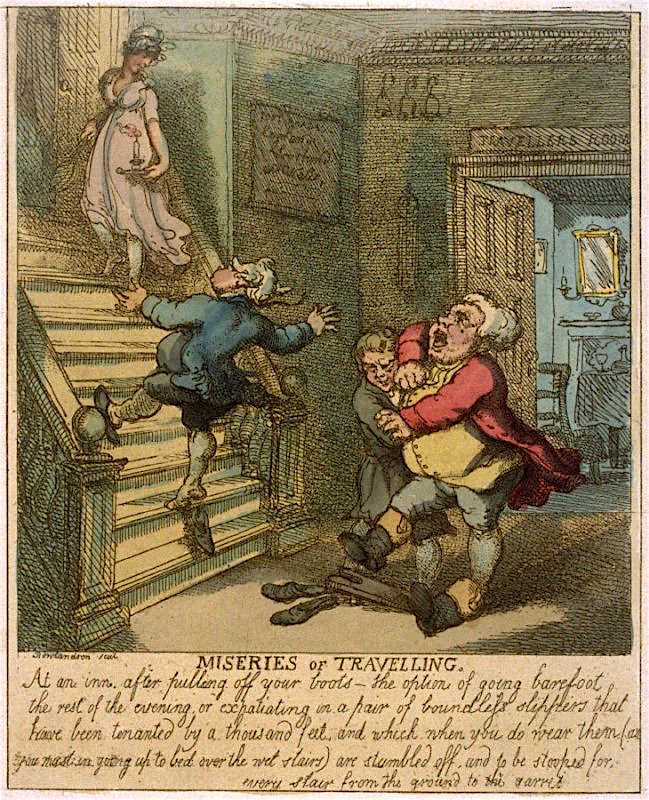 Miseries of Twenty First Century Life (inspired by James Beresford’s 1806 masterpiece).
Miseries of Travelling.
Arriving at Middlesborough station and finding your way somehow to your B & B in some godawful back street, you are show to your room but after unpacking your suitcase, find that a mini-monsoon has prevented you from leaving your room in search of a pub, and with the town centre over a mile away. The TV doesn’t seem to be working, you can’t get a signal on your mobile , so for entertainment you first inspect the walls for perhaps an old steel engraving of a local beauty spot or two and find instead a reproduction of a rural scene by Helen Allingham and a daub of a cat by a girl aged 8; you then turn in desperation to a couple of shelves opposite the bed and find a Goss china souvenir of Harrogate, a lamp made out of a Chianti bottle, a pottery frog and a leaping dolphin hand crafted from grey resin. You look among some likely looking books and find nothing but three scruffy paperbacks of James Herbert, a mint copy of The Maid of Buttermere by Melvyn Bragg, a slimmer’s cookbook with an introduction by Gloria Hunniford, four Joanna Trollopes, two chicklit novels by women called Charlotte Gibbons and Vicki Manderson, an Argos catalogue of 2003, a battered poetry anthology by C Day Lewis, an odd volume of the works of Walter Scott, undated but c 1880, the autobiography of Alan Shearer, a paperback of popular astrology by Dale Winton, a local bus timetable dated 1985, a 1970s guide to Athens and an old copy of This England with several pages missing… [R.M.Healey]
Private Eye & ‘The New Satire’ 1963
 Found in the short-lived early 1960s London cultural magazine Axle Quarterly (Spring 1963) in their column of complaints , rants and broadsides (‘Axle grindings’) this mild attack on the British satirical magazine Private Eye (still going strong with a circulation of 225,000). Axle is almost forgotten, it is occasionally seen being traded for modest sums on eBay, abebooks etc., It survived for 4 issues – contributors included Gavin Millar, Paul R. Joyce, David Benedictus, Michael Wolfers, Paul Overy, Roger Beardwood, Mark Beeson, Ray Gosling, Simon Raven, Tony Tanner, Richard Boston, Melvyn Bragg and Yvor Winters. This piece was anonymous.
Millions can’t be wrong aided by The Observer’s unerring flair for pursuing fads of its own creation, Private Eye’s achievement of a 65,000 circulation in just over a year is an interesting phenomenon. This is a figure comparable to that which, say, The Spectator has had to build up gradually over many decades. That Was The Week That Was has been even more successful. It is estimated that it is watched by approximately 11 and a half million people, or nearly a quarter of the population.
First of all why has Private Eye been so successful? It’s easy to read, of course, or rather, easy to skip through. Few read the extended written pieces like Mr. Logue’s boring True Stories. And what most people do read requires about as much effort as a Daily Express cartoon. It’s funnier, and cleverer, and more sophisticated, but all it demands is that one has skimmed the headlines and watched TV occasionally. It doesn’t require any mental effort to take it in (although it may stimulate it).
‘Good to look at, but bad to live in’— rural slums in 1934

Copyright alamy.com (many thanks).
Today, most rural slums have either fallen into ruin or been gentrified by second home owners. In the thirties, however, some of the terrible privations characteristic of the urban slums described by George Orwell in The Road to Wigan Pier , were equally true of many rural slums. In an article entitled ‘Clean Up Our Country Slums’ in the April 6th 1934 issue of the news weekly Everyman, Orwell’s contemporary, the journalist Hamilton Fyfe (1869 – 1951), who was also a man of the Left, went behind the façade of a pretty country cottage inhabited by some agricultural tenants and was shocked to find damp walls, cracked plaster, peeling wallpaper and a shared sink.
‘All their water they have to fetch in pails from a farm a couple of hundred yards away. They have no drainage, no light, no indoor sanitation ( as the house agents delicately put it); they enjoy none of the amenities that so may of us consider absolute necessities of life. And these cottage are not exceptional, They are typical of the homes in which our country folk mostly live…I could take you to a house where in two small rooms father, mother, grown-up son and four children ( thirteen to nine) sleep. I could show you rows of houses on the outskirts of little towns, where except for the fresher air, conditions are every bit as bad as in the black spots of London, Liverpool or Glasgow’
According to Fyfe, two Acts of Parliament:
‘make it possible for owners of cottages to borrow money on easy terms so that they may “ reconstruct and improve” their property, put in water supply, baths, light and more wholesome sanitary arrangements. Owners have been very slow, however, in asking for loans. The truth is that the farmer was badly stung over the purchase of his farm from the local viscount and is really not able to spend money on repairs. And he owes his bank so much that he shrinks from the idea of borrowing and more. The right solution, the only solution I can see, is that the community should take over the cottages and make them fir to live in. But most councils are as unwilling as most individuals to take advantage of the Acts of Parliament.
Bailey, Keeler, Tree & Faithfull in 1969
Found – this 1969 press photo. The byline reads: “1/10/69 London. Christine Keeler (left), whose name figured prominently a few years back in a scandal that rocked the British government attends a party in Chelsea 11/9 to launch a new book on the “Swingin’ Sixties”. With her is photographer David Bailey actress Penelope Tree and singer Marianne Faithfull (right).”

We covered this in an earlier jot with a different photo. One comment said that the super model Penelope Tree ‘owned’ the photo, but in this shot she shares the limelight with the handsome hippified Bailey. A rhyme at the time went: ‘David Bailey/ Makes love daily.’ Christine Keeler appears uncharacteristically jolly and Marianne Faithfull was appearing at the Theatre Royal Brighton in Alice in Wonderland about this time.
The book was Goodbye Baby & Amen. A Saraband for the Sixties. The text was by Peter Evans and photos by Bailey. The sitters included Brigitte Bardot, Cecil Beaton, Marisa Berenson, Jane Birkin, Michael Caine, Julie Christie, Ossie Clark, Joan Collins, Catherine Deneuve, Mia Farrow, Albert Finney, Jean-Luc Godard, Mick Jagger, Brian Jones, John Lennon, Paul McCartney, Dudley Moore, Rudolf Nureyev, Oliver Reed, Keith Richard, Peter Sellers, Jean Shrimpton, Barbra Streisand, Andy Warhol, Franco Zeffirelli. Presumably some of these illuminati were at the party..
Catch-phrases – interjections and rejoinders
 This is a list sent in by a nameless jotter. It is by no means exhaustive. It had no notes but each well worn phrase has been used as banter- a rejoinder or an amusing interruption in a conversation or during an anecdote or monologue. Almost all use irony, sarcasm or mild mockery and are cliches – but they could possibly still incite mirth if the timing was right. Thumping cliches have asterisks. I’ll get my coat.
I am now off on a bike to the Bodleian to consult Partridge’s 1977 Dictionary of Catch Phrases in manuscript (as you do). It will be interesting to see how many of these he recorded. Most are site specific but fairly obviously so – for example if someone is going on about a politician – how he should be incarcerated, hung drawn and quartered etc., you might say “tell us how you really feel..”
Amen to that!
And this affects me how?
And you know this it how?
Are you nuts?
As it were (after an unintended pun)
As the Bishop said to the actress (archaic)
A Parisian Aladdin’s Cave of Children’s Books

Found in a small magazine/ booklet published in Edinburgh 1953.
– COLLECTORS ITEMS A BIBLIO-TYPOGRAPHICAL MISCELLANY (No. 2, Vol. 1) this piece on Gumuchian – a collector and dealer in children’s books (now a hot collecting area.) His book Les Livres de L’Enfance (Paris, 1930) is still in print (Holland Press modern reprint, right.) Originals are seldom under 1000 euros.
A Parisian Aladdin’s Cave of Children Books
Short and bearded, and somewhat like Tolous-Lautrec in appearance, Victor Gumuchian was one of the great booksellers of the past fifty years. Gumuchian will probably be known for posterity by his immense two volume catalogue of children’s books, “Les Livres de l’Enfance de XVe au XIXe Siecle,” which he published in 1930. But apart from hi knowledge of juvenile literature, he was a great authority on old buildings and books relating to flying and locomotion. He was a man He was a man of erudition, wide knowledge and versatility. A great traveller and linguist, as well as a writer and dramatist, he was also gourmet and a cook of rare quality. He knew where the best food could be eaten in Paris, or, in fact, anywhere in France.
How well I remember my first visit to his bookshop in the Rue Richelieu in Paris. A small window, with perhaps a dozen or two rare books on show; inside, a somewhat dull room, lined with glass covered book shelves full of uncommon and interesting books of all centres. At the end of the room was a small door through which he took me, up a dark winding staircase, such as is only possible in Paris, to a door in the first floor. This he unlocked, and switched on the electric light… I was in an Aladdin’s Cave! There were three rooms, leading one into the other, with thousands of children’s books, all in perfect condition, arranged to show the beautiful points of as many as possible, whether an illustration, a binding, or a page of superb typography. These books were the fruit of his three years’ collecting, and the basis of his great catalogue. I was dumbfounded at what I saw. I had never seen, nor shall I ever see again, such a galaxy of treasures: all so beautifully arranged and delighted displayed. From that moment I became, not an enthusiast, but a fanatic – and have remained so to this day.
M. Gumuchian died in America in 1949, after a series of great misfortunes and after a long illness that caused him much suffering.
A rare friend whom I can never forget.
Jane Deverson—the forgotten poet who invented Generation X
 If you Google Jane Deverson all you will find is that she was the journalist, who with Charles Hamblett, invented the catchy term ‘Generation X’ to describe the disaffected youth born just after the close of the Second World War. Today they are better known as ‘ Baby Boomers ‘, but back in 1963, when she co-wrote the feature in question for the magazine ‘Woman’s Own’, that particular label had not yet been invented. Anyway, Generation X sounds a lot cooler. A book followed in 1964 and it was a copy of this, which budding punk Billy Idol found in his mother’s home, that inspired him to form a band with the same name.
Fast forward eight years to 1972 and the thirty-two year old publishes Night Edge, a collection of distinctly visceral poems whose imagery often recalls the nihilism of Ted Hughes’ Crow, which had appeared two years earlier:
Frank J. Minnitt (1892-1958)
 Found in the Peter Haining archive this piece by his friend the tireless researcher W.O.G. Lofts. Both men noted in former jots. Minnitt is not forgotten as long as Billy Bunter is still part of our culture and it is worthwhile recording this Lofts piece which appears not to have been published.
Frank J. Minnitt - Billy Bunter Artist in The Knockout.
By W.O.G. Lofts.
Every so often someone emerges from the shadows as it were to become the leading light of the show. An understudy replaces the star and becomes an overnight hit. A reserve footballer or twelfth man cricketer is promoted to the first team, and scores a hat trick, plus the winning goal, or a sparkling ceatury as the case may be. Another case in point: when Gerald Campion - a small part actor on the screen- landed the T.V. part of Billy Bunter. Completely unknown to the public at large, overnight he became a star. And so it was once with a comic artist named Prank J. Minnitt, who after years of plodding along, drawing the centre pages of small - now long forgotten strips - when was given the job of illustrating a character who today is a household word. The name of course being Billy Bunter the fat boy of Greyfriars School in Kent.
Although one can write the whole life story and history of Billy Bunter, almost nothing is known at all about the artist who drew him in Knockout except for his birth and death dates. Born in 1892, possibly at Warlord, nothing is known of him until his work appears on the scene in 1927 in several Amalgamated Press comic papers. His art work that featured in such top selling papers as Chips Jester, and Joker, with a curious rounded style (that was to stand him in good stead in later years) could be said to be competent enough to fill the centre pages. Never in the class of Bert Brown, Percy Cooking, G.W. Wakefield, or Roy Wilson, he was never even considered to duplicate like most artists for these great illustrators. His style was so distinctive that it is hard to see how he could copy any other artists work. Seemingly, he was just content to plug along, eking out a living for a few guineas a week, and never improving sufficent to get bigger commissions to draw the front pages.
Continue readingThe Truth about Publishing (1926)
Found in  The Truth about Publishing (Allen & Unwin, London 1926) this flier/ order form for the book ‘to be published in September.’ Quite an early use of the word ‘blurb.’ The pamphlet ends with this tongue-in-cheek claim ‘…The Truth about Publishing is a long book but it is published at a low price. This happy combination is due to the fact that the publishers were able to dictate their own terms to the author.’ Our illustration shows a later version of the book illustrated with a portrait of Sir Stanley Unwin by Oskar Kokoschka. He is not to be confused with the great comedian Stanley Unwin (‘deep joy.’)
A ‘Blurb’
Mr. Stanley Unwin is not tongue-tied, like the ghost of the elder Hamlet. No power on earth or in heaven can forbid him to tell the secrets of his publishing house. ‘The Truth About Publishing’ – how fascinating a theme! Cannot we see authors (whose name is legion, but who, in general, are parsimonious book-buyers) queuing up in Museum Street, burning with eagerness to have their should harrowed by these revelations? ‘Are our suspicions to be justified? Will it prove as bad as we thought?’ – thus we can imagine one Author saying to another while they await their turn.
Readers of ‘The Truth About Publishing’ will find it a fascinating book, of fit is written by one who is a master of his craft of book-publishing; has served his apprenticeship in the book-printing trade, as a publisher’s traveller, and as volunteer assistant to a German bookseller; and has the witty and humorous pen of a ready writer. A successful publisher, withal, eager, not only to inform, but also to criticise. Genially and shrewdly he criticises, not authors alone, but publishers and printers and papermakers and bookbinders and booksellers and book buyers (when there are any) as well. This criticism is always kindly, always helpful – always directed towards the cause he has most at heart, the production and distribution of good books. Incidentally, he makes a modest livelihood (not a fortune!) by the process? Agreed! That is why he is so well qualified to tell us all about it, and to convince his readers that the good publisher is an expert in whom, with due precautions, we may trust; not a necessary evil, but a necessary good.
On his title-page is a quotation from a famous publisher of an artier generation, with which this blurb may aptly close. (Yes, Mr. Stanley Unwin tells us all about blurbs, in his volume of cheerful indiscretions! – but he has not written this one himself). ‘It is by books that mind speaks to mind, by books the world’s intelligence grows; books are the tree of knowledge, which has grown into and twined its branches with those of the tree of life, and of their common fruit men eat and become as gods knowing good and evil.’
The Golden Dustmen of Dickens’ time
 A central character in Dickens’ Our Mutual Friend (1865) is Nicodemus Boffin, nicknamed ‘The Golden Dustman ‘ because of the wealth he inherited from his old employer John Harmon, who had made his fortune as a Dust Contractor at Somers Town. These famous rubbish piles stood where the filthy Maiden’s Lane (now roughly York Way) joined onto Pentonville Road, near where Kings Cross station now stands. Here, just about anything could be found—‘dust ‘ was a Victorian euphemism; there was more likely to be dead dogs ,cats, horses, discarded pots and pans, crockery, shoes, boots, old clothes and all sorts of debris from the surface of roads, including grit, horse dung, dog dirt, as well as the human excrement collected by the scavengers. All this so called ‘dust’, once separated, could be sold to various factory owners for large profits. Dickens, who loved exploring London, once lived in Doughty Street, which is just a mile from the famous Somers Town dust heaps, and must have known them well. He also became friendly with a wealthy Dust Contractor from Islington called Henry Dodd who, at his death in 1881, left a fortune of £111,000. It has been argued that the character of Boffin was based on Dodd.
A contemporary sketch of the Somers Town site is dated 1836, but doubtless contractors had been adding to the muck heaps for many years up this date. Scavengers are depicted clambering over the filthy heaps in search of the more valuable items to sell on, a process that still takes place in some third world countries. It is interesting to find, therefore, a London Times classified advertisement of December 6th 1820, when Dickens was a boy of eight, requesting Dust Contractors to tender for a contract in Chelsea.
A Norfolk Dr Frankenstein ?

Discovered on a stall in Portobello Road is this fascinating auction poster of 1815 announcing the forthcoming sale of household furniture and effects that once belonged to a bankrupt called T. Hunter. Research in Norfolk County Record Office produced nothing about Mr Hunter, although I was luckier with Robert Cruso, who was a prominent King’s Lynn auctioneer at this time. Indeed his name is preserved in the present firm of valuers and surveyors, Cruso and Wilkin of King’s Lynn, which was established in 1756 and now claims to be one of the oldest auction houses in the UK.
However, the auctioneer and his unusual name aren’t the only features that stand out in this poster. Some of items listed for sale are unusual, to say the least. Among the usual mirrors, chests of drawers and pictures can be found a ‘compound universal microscope in mahogany case complete’, a ‘full size double barrel Air Pump’, and most intriguing of all, an ‘Electrifying Machine’. These items prompt the questions; who exactly was T. Hunter, and what was he was doing with these scientific instruments?
Continue readingCuppa in the City
 From the Good Cuppa Guide by Jonathan Routh (1966) in the ‘Tea in the City’ section. Jonathan Routh (1928-2008) was a hoaxer and practical joker, most famous as the presenter of ITV’s Candid Camera. Previous to this he had successfully invented a fictitious 18th Century poet, gaining him a mention in the TLS. As well as his guide to tea shops in London he produced the Good Loo Guide (1968); the New York version was called the Good John Guide. He was also a prolific, and eccentric, painter – Queen Victoria was depicted trying to lose weight using a hula-hoop. Some of his paintings occasionally turn up in auction..
The Leadenhall Tea Room and Billiards Salon
(Licensed for Billiards and Tobacco)
21 Lime Street
This vast subterranean arena which hasn’t changed one iota since 1880 is one of the weirdest sights in England. In it are maybe two hundred men drinking fivepenny cups of tea – which is all that’s served for their refreshment – watching another fifty on the billiard tables. It seemed only right that, in purchasing my cup, I should have received change for my 6d with an Edwardian penny. I felt, too, that at last I’d stumbled across what that ‘Something’ is that people who are ‘Something in the City’ do. As I say, it’s weird; and it goes on from 10 in the morning to 9 at night. Just the click of cue on ball and spoon on cup. An absolute must for those who like to take their tea in surroundings that are different.
Medicinal Virtues of Strong Coffee

18th Century Coffee House*
‘Strong coffee, in the proportion of an ounce and a half to a pint, and particularly when made by infusion, is not only truly grateful to the palette, but wonderfully fortifies and strengthens the stomach, as well as the whole nervous system. It adds, maintains one of its warmest panegyrists, or gives spirits to the body, on any sinking, faintness, weakness, or weariness, of mind or body, and that beyond whatever the best wine can effect; conveying, as it were, life and strength to the whole frame. It is, doubtless, very good against consumptions, vapours and hysterics, and all cold and moist diseases afflicting the head, brain etc; it prevails also, on being long and plentifully used, against the scurvy, dropsy, and gout , as well as all manner of rheumatic pains ; absorbing all acidities in the human body, and destroying the congelative powers by which those diseases are chiefly generated; while, by it’s(sic) diuretic property, it carries off all those heterogene and morbific humours, after a very singular manner. “
It may be, says Salmon, the medical writer here in part quoted, “that I have said a great deal in commendation of this strong coffee, but I can truly assert that I have said nothing but what I know myself, and that in my own person, to be truth, and have had confirmed by manifold and daily experiences for a great many years, to my exceeding satisfaction. I was also cured, about ten years since, of a rheumatic pain in my shoulder; which was so vehement that, besides the perpetual pain, I could not as much lift my arm or hand up to my head, not put it behind my back , for nearly two years , in which I received no benefit by a long application of vesicatories, and continual use of opiates. Of this vehement rheumatism, I was perfectly cured by drinking a full quart of strong coffee at a time, and continuing it some days together, nor have I since the smallest return. The like relation I have had from two other persons, particular patients of mine, who were much more grievously afflicted, by their own accounts, than even I was; who by an extravagant drinking of strong coffee, to use their own words, were perfectly cured, and freed from their deplorable lameness, after manifold applications, and the use of many other things, both external and internal, had for some years past been tried in vain.”
Group Captain F.C. “Griff” Griffiths and the Maquis
 Found loosely inserted in his book Winged Hours this account by Group Captain F.C. “Griff” Griffiths (1913-1996) of his time in France with the Maquis and his attempts after the war to trace members of the French Resistance who had helped him escape. In April 1943, Frank Griffiths, then a Squadron Leader, was posted to No. 138 Special Duty Squadron to take part in SOE ‘drops’ taking men and supplies to resistance organisations in occupied Europe. On the night of the 14/15 August 1943 his Halifax aircraft serial JD180 was brought down when flying low over Annecy (near the French/Swiss border) by small arms fire from an Italian Alpini corporal. He was one of two survivors and escaped his Italian captors and was subsequently sheltered by the Maquis and eventually escaped over the border to Switzerland, returning to England around Christmas 1943. The problem with tracing his brave saviours after the war was that none of them had used their real names…
PYRENEAN PICNIC
One of the sad things about Escaping/Evading experiences is that to protect our helpers we did not wish to know their real names or to remember addresses. We thus failed to make contact with many of them after the war.
For over 43 years I endeavoured to trace a helper with whom I had formed a strong rapport. All I knew of him was that his name was “Antoine” (obviously a nom de guerre) and that his French was difficult to understand because he was a Catalan.
Gerald Heard on J.W. Dunne’s Theory of Time
 Found – the typescript of a review by Gerald Heard of J.W. Dunne’s The Serial Universe (1934). Dunne proposed that our experience of time as linear was an illusion brought about by human consciousness. He argued that past, present and future were continuous in a higher-dimensional reality and only experienced sequentially because of our mental perception of them. He went further, proposing an infinite regress of higher time dimensions inhabited by the conscious observer, which he called “serial time.” In his time Dunne’s work was highly influential, Aldous Huxley (a friend of Gerald Heard) J.P. Priestley and T.S. Eliot all used his ideas in their work. Gerald Heard is sometimes cited as a proto hippie or father of the ‘New Age’ movement. Wikipedia writes: ‘His work was a forerunner of, and influence on, the consciousness development movement that has spread in the Western world since the 1960s.’ He also wrote several still rated supernatural fantasies. This typescript was probably published in a newspaper at the time.
MR. DUNNE'S THEORY
OF TIME
'IMMENSELY IMPORTANT' FOR MAN
The Serial Universe. By J. W. Dunne.
(Faber. 10s. 6d.)
Reviewed by GERALD HEARD
In pre-Nazi days in Germany there used to be a popular print. It showed one of the great German philosophers walking along the main street of his home town with his manuscript under his arm, on the way to the printers. He keeps close to the wall because down the street's centre dashes that dreaded black travelling carriage inside which can be seen Napoleon, Europe's tyrant, rushing from-one battlefield to another.
Continue reading