Author Archives: Jot 101

The Magus – ‘a bizarre and baffling film’ 1970

A contemporary piece about this ill-fated movie, which although often slated, most notably by Woody Allen ('If I had to live my life again, I'd do everything the same, except that I wouldn't see The Magus') has become something of a cult. The article was found in PHOTOPLAY (February 1970) a British film and pop music magazine. The long winding part about the plot has been mostly excised.

The Magus - a bizarre and baffling film which winds through a labyrinth of fantastic happenings. 

What is a Magus? According to the best dictionaries it is "one skilled in Oriental magic and astrology, an ancient magician sorcerer."

And so to our story:

Continue reading

‘There will be no beautiful women on Mars’–and that’s official

[raw]

Speculation on whether there is life on Mars and what form it might take has been going on since the planet began to be seriously studied. Writers of fiction have let their imaginations run riot, with ludicrous results, but even scientists have been guilty of groundless speculation. Two items from the Peter Haining archive —an incomplete clipping dated 1924 from the Daily Express and a chapter from The Universe in Space and Time of 1935 throw interesting light on the subject.

Back in 1924 the Daily Express published a report by a certain Monsieur Camille Flammarion, ‘the famous French astronomer’, that ‘ the people of the earth will be both shocked and disillusioned if ever they become acquainted with the Martians’. “First of all”, he states, “there will be no beautiful women there. They may be beautiful according to Martian standards, but to us they will probably look frightfully hideous.” It’s all to with the ‘rarer’ atmosphere of the planet, apparently.

Continue reading

Earthquake in England

Found in John Thomas's Earthquake in England (Unbelievable but True) -published by Blackwood's in 1938, this press cutting from the late 1970s from an unnamed newspaper.

Quakes can be our worry, too. Peter J. Smith

At 9.18 on the mining of April 22, 1884, Dr Alexander Wallace and his family were in their garden looking across at the roofs and spires of the town near by. Suddenly, with a roll of sound like "passing wagons", the buildings began to sway and chimneys crashed to the ground in clouds of dust. Dr Wallace saw his house rise and fall and heard ornaments hitting the floor. He felt sick and shaken, but the fence he grasped for support was rocking too. Less than six seconds later it was all over.

What Dr Wallace and his family had experienced was an earthquake. But they were not visiting Japan, California, the Mediterranean or any other of the world's known belts of destructive earthquakes. This was Colchester, Essex, where such things were unheard of.

In the town itself more than 400 buildings were damaged... the brunt of the damage was taken by villages closer to the shock centre to the east and south-east of Colchester. At Peldon, for example, no house or cottage escaped and 70 percent of chimney stacks were thrown down. Nobody was killed, but within an area of about 150 square miles more than 1200 buildings required repair.

The Colchester earthquake of 1884 was the most destructive ever known in Britain and was felt as far away as Exeter in the west and beyond York in the north. But it was not the first British earthquake; nor, contrary to popular belief, are such events uncommon.

Continue reading

The Liberty League—a campaign against Bolshevism

This interesting cutting from the Haining archive tells some of the story of the short-lived Liberty League. Less than three years after the Russian Revolution had erupted, leading figures in public life, alarmed by the progress of its ideas in the West, got together to initiate a counter campaign that would challenge Bolshevism in the UK and throughout the empire. The new force for good was ‘The Liberty League’ and on 3rd March 1920 an open letter declaring its objectives and signed by H. Rider Haggard, Rudyard Kipling, Lord Sydenham, H. Bax-Ironside, John Hanbury Williams, Algernon Maudslay and  Lt –Col G Maitland- Edwards, was published in the Times. The signatories began by defining Bolshevism and its aims.

Bolshevism is the reverse of what mankind has built up of good by nearly two thousand years of effort. It is the Sermon of the Mount writ backward. It has led to bloodshed and torture, rapine and destruction. It repudiated God and would build its own throne upon the basest passions of mankind. There are some misguided people of righteous instincts in this country who believe in Bolshevism; there are others who have been influenced by secret funds. There are many who hope to fish in its bloodstained waters.

We, the undersigned, and those we represent, being assured that if it is allowed to conquer it will mean in the end the destruction  of individual rights, the family, the nation, and the whole British Commonwealth, together wit the handing over of all we hold sacred into the power of those who stand behind and perhaps have fashioned this monstrous organization...

Continue reading

John Steinbeck and ‘The Wizard of Maine’

Found among a collection of modern first edition catalogues this offering from Bradford Morrow in a catalogue entitled John Steinbeck: A Collection of Books and Manuscripts, Formed by Harry Valentine of Pacific Grove, California (Bradford Morrow Bookseller: Catalogue 8/1980). Morrow has subsequently become a distinguished novelist.  Hopefully this was  bought by a library but it could also have gone to a wealthy private collector. It does not appear to have ever been published. Many such items, especially letters and association copies sometimes disappear completely, and the only record of the item is a catalogue entry…

Manuscript of Unpublished Novella

289. ‘The Wizard of Maine’. Original holograph manuscript written on 30 folio leaves and laid into original three-quarter cloth and marbled paper binder, of an unpublished novella by Steinbeck. Each sheet is written on recto only
in Steinbeck’s distinctively cramped and neat hand, and the length of the text amounts to well over 15000 words. The novella begins with the following passage:

In a time not so very long ago, an ancient creaking, complaining caravan squeaked and grumbled through the hamlets and towns of Eastern America. From Maine it went to the cool lakes of Wisconsin and, by-passing Chicago, too itself to the fabulous meadows of Kentucky. It smooth [sic] oak tongue and ancient harness were shared by a succession of horse rescued for a time from glue and fox feed factories. And it was a good life for these horse for the caravan did not go far nor fast in a day and it stopped where there was pasturage…

‘The Wizard of Maine’ is divide into six sections,and is the story of a travelling elixir salesman and magician who has set out from his home in Maine and travels across the country in hope of being discovered, so that he can perform his tricks on stage as a professional. Composition date for the manuscript is unknown, but would seem to date from the 1940s based upon the style of the binder housing the paper. The manuscript has numerous alterations and is in need of minor editing. It is, however, a highly diverting and typical Steinbeck story which should be published…Needless to say, Steinbeck manuscripts of this length and importance, which are still unpublished, are virtually gone from the market place. Enclosed in folio custom morocco slipcase. Further details available to interested parties. $27500.00

[RMJ – London]

An ‘innocent hoax’ played on Frank Kermode

[raw]

The late Frank Kermode is best known today as the most prominent Romantic critic in twentieth century English letters—a more intelligent version of Herbert Read. Among rare book traders he is also notorious as the man who, in 1996, lost most of his collection, which included some valuable first editions, to the refuse collectors of Cambridge City Council, who, mistaking them for rubbish, disposed of them in the city tip. It seems that Mr Kermode was prone to absent mindedness where books were concerned. In an article of October 1973 from the Haining archive that appeared in The Daily Telegraph he recounts how he somehow lost his ‘whole collection, including The Darkening Ecliptic ‘on his trip home from Australia in 1945.

Continue reading

The Princess Alice paddle steamer disaster of 1878—-why was the death toll so high?

The late Peter Haining was one of many writers fascinated by the terrible events of the evening of 3rd September 1878, when the paddle steamer ‘Princess Alice’, laden with over 800 day trippers returning from an excursion to Margate, was rammed by the collier Bywell Castle close to North Woolwich. Over 630 men, women and children perished in the disaster, which remains the worst in the history of river navigation—not just in the UK, but in the world.

Hoping to publish a book on the subject, Peter Haining kept clippings both from the centenary coverage of the disaster in 1978 and from August 1989,when a much smaller vessel, the ‘Marchioness’, sank further upstream in the Thames. He also researched a similar Victorian sinking in 1875, when the’ Deutschland’ went down off the Kentish coast, carrying among its passengers,   five German  nuns--- a disaster which  prompted Gerard Manly Hopkins to compose his famous poem The Wreck of the Deutschland.

Continue reading

Obscure Victorian magazines—number 3—The Pantile Papers

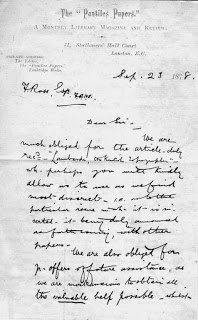
If we hadn’t found this letter among a pile of other manuscripts it is unlikely that anyone else would have written anything useful on E.S.Littleton or his short-lived literary magazine, The Pantile Papers. Having said that, at least one book dealer has recorded that this was a ‘very rare’ periodical. However, two examples are currently in the market---one single issue priced at £120; the other a complete run for £350. So perhaps it’s not so rare—but interesting at least.

According to a very brief notice in George Hull’s The Poets of Blackburn  Edward  Littleton was born in Blackburn, Lancashire, the son of a minister. In 1877 he published a slim volume entitled Hamand and other Poems and not long afterwards moved to Tunbridge Wells to set up a new ‘Monthly Literary Magazine and Review ‘which he christened The Pantile Papers in honour of the towns’s famous street, The Pantiles. Confusingly, the magazine’s editorial address appears on our featured letter  as 11, Stationer’s Hall Court, London EC, which could suggest that Littleton felt an address in the City might attract more contributors and readers.

Continue reading

The Beatles – Where do they go from here? (1965)


Found in Photoplay from April 1965 this speculative article about The Beatles by Anne Hooper -'Where do they go from here?' Some now slightly forgotten names are mentioned -Pete Murray, Ray Noble, David Jacobs, Maureen Cleave and also the unfortunately not forgotten Jimmy Savile ('that crazy, way-out disc jockey') who claims (surely falsely?) that  he worked at Liverpool  docks with the lads...

What is to happen to our golden boys? How along will they last? What will they be doing in , say five years time? These are among the dozens of questions that are asked today about the phenomenal Beatles.

Rumours of splits and break-ups are often heard. Fierce competition from groups like 'The Rolling Stones' has had the fans shaking their heads and saying, "Well, they've had it good, but can't last." But it has, though. The Beatle's last single "I Feel Fine" proved that the boys were still very much on top. They haven't been eclipsed by the Stones and, with their second film about to be produced, they're not likely to be by anyone...

Continue reading

Accolades for Elvis, King of Rock

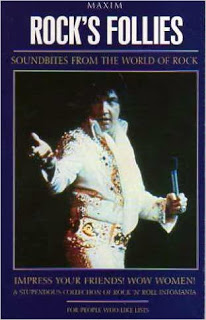
Found in an amusing slim music trivia paperback Rock's Follies: Soundbites from the world of rock this collection of (mostly) eulogistic quotes about Elvis Presley, oddly titled 'The father of us all?' The book was given away with the April 1996 issue of  men's lifestyle magazine Maxim. Amongst the quotes were these (1-11) and we were inspired to find a few more (12-22)  by this excellent book (illustrated  by the late, great Ray Lowry, R.I.P.) The last entry by Nik Cohn would probably end up in Pseud's Corner in the cynical U.K. but it addresses the King's spiritual side.

The father of us all?

1. Without Elvis, none of us could have made it. - Buddy Holly

2. I didn't think he was as good as the Everly Brothers the first time I ever laid eyes on him. - Chuck Berry.

3. It took people like Elvis to open the door for this kind of music, and I thank God for Elvis Presley. - Little Richard.

4. Gosh, he's so great. You have no idea how great he is, really you don't. You have no comprehension - it's absolutely impossible. I can't tell you why he's so great, but he is. He's sensational. He can so anything with his voice. He can sing anything you want him to, anyway you tell him. The unquestionable King of rock 'n' roll. - Phil Spector.

5. When I first heard Elvis' voice I just knew that I wasn't going to work for anybody; and nobody was going to be my boss. Hearing him for the first time was like busting out of jail. - Bob Dylan.

Continue reading

English translation howlers

From Funny or Die site (thanks)

From the Peter Haining Archive. These are taken from a collection compiled by Thomas Cook employees in Nottingham during the period 1987 – 95:

‘You are invited to take advantage of the chambermaid ‘
Notice in Japanese hotel

‘Ladies are requested not to have children in the bar’
Announcement in Norwegian cocktail lounge.

‘The lift is being fixed. During that time we regret you will be unbearable’
Notice in a Bucharest hotel lobby.

‘The flattening of underwear with pleasure is the job of the chambermaid’
Notice in a Yugoslav hotel.

‘Our wines leave you with nothing to hope for ‘.
Swiss restaurant menu.

‘Ladies may have fit upstairs’
Outside a Hong Kong tailors

‘Special today—no ice cream’
Swiss mountain inn

‘Order your summer suit. Because of big rush we will execute customers in strict rotation’
In a Rhodes tailors.

‘We take your bag and send it in all directions’
Copenhagen airline ticket

‘Teeth extracted by the latest Methodists’
Hong Kong dentist 

[R.R.]

Point It Out: The Picture Speech For All Nations

Found - a handy little book Point It Out: The Picture Speech For All Nations by one Walter Sefton. It was published 'by authority of the War Office Welfare Department' (Leicester, 1944.) The title page notes that the book was '…designed to make help all men and women of the Allied Services in making their needs easily understood in foreign countries - a guide and comfort and friend when in any difficulty.' This type of book is still published (The Wordless Travel Book and the Point it Traveller's Language Kit),and there may even be an app - although now people probably just find an image on their phones and show it to a helpful foreigner..

The page shown is for use on board a steamship, possibly to answer requests such as 'Where is my car?' and 'Can I smoke in the bar?' 'I need a rug for sitting on the deck chair' and 'Where is the ship's library?'

Occupation: Female Companion

Joan Fontaine in 'Rebecca'

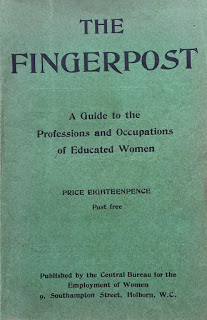
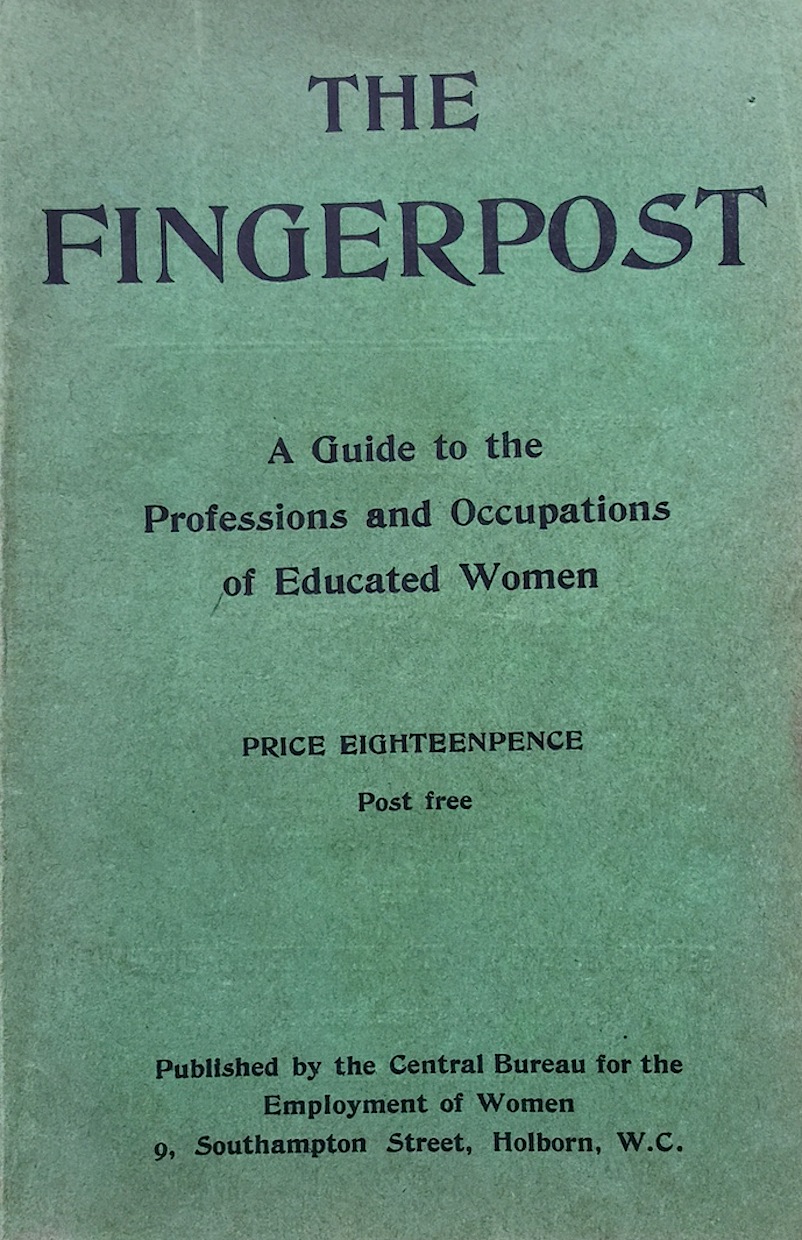
Found in  The Fingerpost: A Guide to Professions for Educated Women, with Information as to Necessary Training (Central Bureau for the Employment of Women,1906) an article about getting work as a female companion. It suggests that the occupation, often found in thrillers and novels up to the late 1930s, hardly existed even in 1906. Vere Cochran, the writer of this piece, says that the profession was at its height in early Victorian times when 'semi invalidism' was a prevailing fashion. 'Who (now) can afford the doubtful luxury of a paid companion?' One of the most notable companions in fiction is the unnamed narrator of Daphne du Maurier's Rebecca (1938) While working as the companion to a wealthy American woman on holiday in Monte Carlo she meets the rich and troubled widower Max de Winter who whisks her off to his country mansion Manderley...

"Companion, Housekeeper, or any position of trust - I could undertake work of this kind".

If the many seekers after work who open their campaign with these words could gauge their true import, or the effect which they produce, they would not so lightly use them. Few words could more clearly display their ignorance with regard to the conditions of the labour market;indeed, to the ears of those who know and who receive year by year hundreds of such applications, these words almost constitute a badge of incapacity.

Continue reading

John Thomas Smith as Hamlet

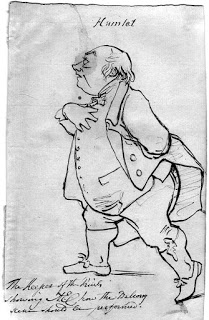
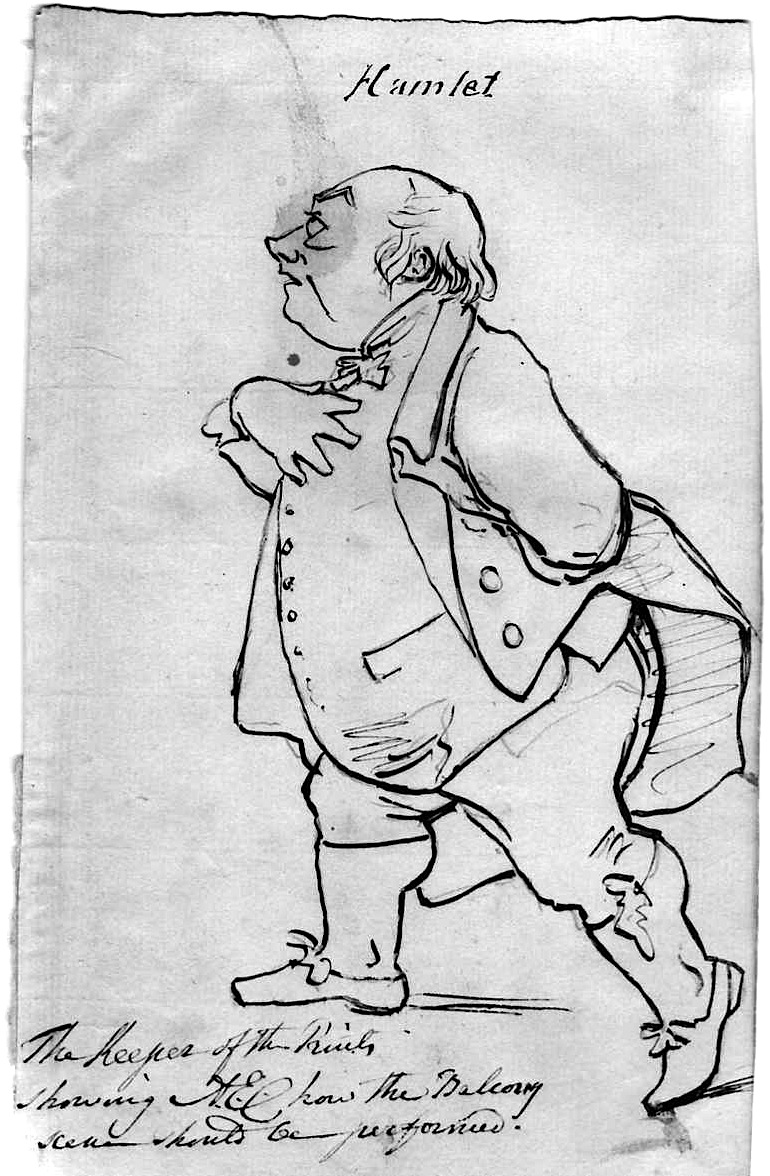
‘The Keeper of the prints showing A.E.C. how the Balcony scene should be performed' (Pen and ink drawing by Edward Chalon)

One of the most famous Keepers of Prints at the British Museum was John Thomas Smith (1760 - 1833), who was also a gifted amateur artist, an antiquary, and a writer on art and artists, whose two most acclaimed books were the scurrilous Nollekens and his Times (1828) and the exceedingly scarce and sought after Vagabondiana (1817), which contains forty or more etchings of well known mendicants in the metropolis based on his own sketches.

But in his early days Smith had hopes of becoming an actor, and in 1787 was promised an engagement with the Royalty Theatre in London. Unfortunately, this fell through and he set up as a drawing master instead. But if the portraitist Alfred Edward Chalon (1780 – 1860) is to be believed, Smith retained an interest in performing throughout his life. Here we have a pen and ink drawing by Chalon of the Keeper as a distinctly middle aged and podgy Hamlet. It may have been sketched following the publication of the sitter’s biography of the brilliant sculptor Nollekens, which portrayed him (possibly with truth) as a miserly curmudgeon. It has been said that Smith decided to write the book--dubbed ‘the most candid biography in English literature’--after the disappointment of not receiving the generous bequest he had been led to expect from his friend.

Smith died in harness aged just 66 in 1833. A Book for a Rainy Day, which contained his largely unpublished writings appeared posthumously.

[R.M.H]

The Yellow Perils – Yokohama F.C. (1909)

'The idea of Japs playing football ----in the English Cup too- struck them as being intensely amusing …'

So wrote the sports writer William Pollock of the fans and players before the match in his short story 'The Yellow Perils' which appeared in the  January 28th 1909 number of Pearson’s Weekly. It’s also unlikely that these same sceptics would have backed a Japanese rugby team to beat the South Africans in the 2015 World Cup in England.

'The Yellow Perils' is a fictional account of the exploits of a visiting soccer team, Yokohama F.C. in pursuit of The English Cup, where their extraordinary success in trouncing not only a few lowly London teams, such as Hammersmith Rovers and Shepherd’s Bush, but also such League One titans as Chelsea, Aston Villa, Newcastle United, Tottenham Hotspur, and Manchester City, astounded everyone who witnessed them play.

Continue reading

Literary scams and pitfalls (1906)

Found in The Fingerpost: A Guide to Professions for Educated Women, with Information as to Necessary Training (Central Bureau for the Employment of Women. 1906) an article called 'Literary Catchpennies' which outlines various scams played on would be writers of the time. Some of these scams, often for bigger stakes, are still with us on the web.

Literary Catchpennies

The perennial literary advertisement trick is, perhaps, the most specious of all. A "Publishing Firm" will offer to consider MSS. sent to Box so-and-so at the offices of the paper in which the advertisements appears. Or the advertisement asks for some specified requires a fee; sometimes he merely swallows all the MSS. sent to him and is heard of no more. A plausible gentleman, with an office in London, extracted from a struggling authoress of my acquaintance a fee of 10s. 6d. for the purpose of making copies of a little tale of hers for the American Press. Another required a specimen of already existing work as a "proof of competency," before employment. With wary caution a printed specimen was submitted, which was duly returned, with a word of approval and with an article taken from a Nonconformist journal - a sketch of some famous preacher - which the applicant for employment was required to paraphrase and return. This being done the MSS. apparently vanished into space for upon a visit of inquiry being made to the address mentioned in the advertisement, the advertiser's name was unknown! Again, a budding composer advertised for "Lyrics." A little poem on "Daffodils" was sent to him. After a weary wait, a gentlemanly young man called on my friend to explain that out of hundreds of lyrics though which he had waded hers was the only good for anything. He asked permission to set it to music and promised to pay a small sum - with many apologies for the smallness. A few days later came - not the small sum - but a tortured love song of Elizabethan or Stuart period. That is to say a phrase here and there was given with dashes in between. These gaps were to be filled up with suitable words. This curious piece of literary patchwork being done, it joined the Daffodil lyric - in oblivion. What budding authoress has not sent precious MSS. to advertised "Literary agencies" with timid hopes that the agent's joyful acceptance of them - together with the "unusual deposit" for "placing same" - will set her free on the first step of the ladder of fame. If the MSS. is "placed" the deposit may nicely counterbalance the price secured for the article plus the commission to the agency; or, more probably at some pains and after some delays the article may be rescued by the author - minus the deposit. Since, however, no author is entirely comment to judge of the selling value of his work, it may reasonably be supposed that a properly conducted literary agency could serve a useful purpose in introducing the budding author to his public. The unfortunate thing is that the budding author generally pays dearly before he discovers that the really bona-fide agency has little need to advertise daily in a score of papers for "suitable MSS."

Other pitfalls to unwary persons "who can write" are the advertisements offering prizes in competitions for more or less intricate word spinning. It is hardly necessary to utter warnings against these, for they appeal mostly to the enterprising speculative sort of person, in whom the gambling instant is not strictly suppressed. It may be noted, however, that "prizes" won in such conceptions seldom pay the competitor for the trouble involved in winning them. They certainly do not pay the genuine work seeker.

Fortunes to Order

Answers to much-advertised offers to teach the work seeker "How to make a fortune" generally result in the return of a fascinating booklet, detailing with the utmost gravity the "trade secrets" of some industry which is sure to be entirely foreign to the fortune seeker's taste or capacity. Two such treatises are before me; one has to do with allotment gardening and the other with pastry making. When all the "ifs" and "ands" are counted the reader comes to the conclusion that although the advertiser's experiences might be genuine a fortune would be much more quickly made by writing a similar booklet and selling it in thousands at 1s. or 1s. 6d., than by rolling out any of the precepts contained therein.  

The £10 a year Professor—-academic privations in post WW1 Austria


When the Austro-Hungarian empire was dissolved following the end of World War One the new nation of Austria came into being. The economic consequences for this country was a drastic devaluation of the krone (or Crown) and inevitable hyperinflation. The following short article in the December 1921 issue of the University College Magazine is a chilling report of the privations suffered by academics in Austria and other countries in central Europe:

As a result of the privations which they had to undergo, ten per cent of the professors in Austria died between1918 – 20. Consumption is usually the first symptom---and that means the end is not very far off when there are no supplies of fresh milk and nourishing food, with nothing but a chilly room in the heart of winter, and no fire in the grate.
On October 15th 1921, one tin of milk in Vienna cost kr. 240, and today, since the appalling crash of the krone, probably costs 500 at least. A professor’s weekly salary therefore would be entirely expended on the purchase of three tins of milk.
The case of a Professor of Egyptology---met personally by the present writer in Vienna—is typical of many. He was working many hours every day as a clerk in the tramway office. Imagine---and pardon the suggestion—Professor Flinders Petrie filling up returns of ‘bus tickets, at the headquarters of the L.G.O.C, and being proud to have obtained such dignified work.
Eighty to 120 thousand kronen is the average salary of a professor. At present exchange rates this represents a maximum of £10 a year.
Try to imagine a professor in the University of London living on £10 a year!!
And the lot of a student is by no means brighter.2,000 kronen, the average monthly income of about 7,000 Austrian students will now buy 3s 6d, or a pound.
But there is fortunately a happier side to this otherwise gloomy picture.
The Universities of twenty-nine different countries banded themselves together last year to save, in so far as they could, the thousands of students and professors in the Universities of Central Europe. The £150,000 raised “fulfilled a noble purpose”, as Sir Maurice de Bunsen, former British Ambassador in Vienna wrote, “in keeping alight the torch of learning in countries where its brilliancy has been overshadowed by the national disaster.”
Let us all unite again this year and continue this splendid work.
Complete guarantees have now been obtained which warrant us starting relief work immediately in the Russian Universities. Your help is needed to make this possible.
[L.W.Harford]

I once met….John Heath-Stubbs

John Heath-Stubbs by Patrick Swift

Coming across a copy of a relatively recent booklet entitled The Guide to Bayswater (Sunrise Press) I turned to the page on Artesian wells which  accounted for much of the water supply to Bayswater in the early nineteenth century. The next entry was on Artesian Road, which reminded me of a visit to the poet and critic John Heath-Stubbs circa 1994. I think I must have got his address and phone number from Who’s Who.

I knew little about him as a person, apart from the fact that he was blind and had a very large head. I didn’t much enjoy his poetry, but was interested in hearing his views on Geoffrey Grigson, on whom I was writing a biography-- not because either of them had seriously clashed in print or in person, but because Heath-Stubbs was part of the neo-Romantic reaction to Auden and his generation, of which Grigson was a member, and also perhaps because the latter had violently attacked two neo-romantic poets—George Barker and Dylan Thomas, and inter alia their literary mentor, Edith Sitwell.

Looking back over twenty years, all I can recall of our conversation was the fact that Heath-Stubbs defended the poetic aesthetic of Sitwell, which I had decried, and that he showed a degree of irritation with the more extreme manifestations of neo-romanticism.
He also urged me to read his recently published autobiography, Hindsights, which alas, I had failed to do.

But what impressed me the most about this very remarkable man, whose head was indeed enormous, was the way he coped with his blindness. I had never before interviewed a blind man—indeed I had never been inside the home of one. Something I did find bizarre was the fact that as someone who had been totally blind for nearly forty years, he had pictures on his wall.Unless these had been hung when he had had some residual vision, their presence seemed pointless. I was also appalled by the large and obviously dangerous holes in his carpets. Why had no-one urged him to install brand new ones? These might have incurred some expense, but tripping up on a threadbare carpet could have killed or seriously injured the poet. It then occurred to me that as a blind man it was in his interest to know where all the potential dangers in his home were located, and these included holes in carpets. I was also impressed by the ease with he made me a cup of coffee, although the mug was left balancing precariously on the edge of a table. I later learnt that he often cooked for his guests—and did it well—so for him making a coffee must have been a simple task. I also noticed, as so many others had done, before and since, the evidence of spilt food and drink on his clothes.

Just before I left, a much younger man let himself into the house. He was clutching some books, I seem to recall, and I assumed that this was his friend and housekeeper, the legendary Eddie Linden, who was in the habit of reading to him.
[R.M.Healey.]

The Beatles as a religious cult

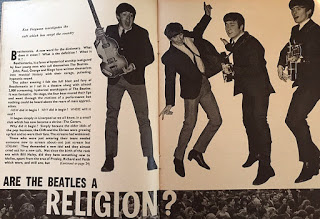
Found in Photoplay- A British Film Magazine from March 1964, this piece by Ken Ferguson who appears to have been the magazine's editor. It was called 'Are the Beatles a Religion' and has soundbites from fans, vicars (who had more of a voice in 1964) teachers, impresarios and the lads themselves. The 'Adam' referred to is Adam Faith, a pop star of the time. 'Cliff', of course, is Cliff Richard…here is an abridged version:

Beatlemania, is a form of hysterical worship instigated by four young men who call themselves The Beatles. John, Paul, George, Ringo have written themselves into musical history with their savage, pulsating, hypnotic sound.

The other evening I felt the full blast and fury of Beatlemania as I sat in a theatre along with almost 2000 screaming, hysterical worshippers of the Beatles. It was fantastic. On stage, the four boys moved their lips and went through the motions of a performance but nothing could be heard above the roars of mass appreciation. How did it begin? Why did it begin? Where will it end?

Continue reading

Schoolboy exam howlers through the ages

These were being published in books from at least the late nineteenth century. Peter Haining, most of whose archive we now hold, collected a number of them for a projected book. Here are some examples he found. The first were sent in for a prize competition of c1900, the second bunch was assembled by Charlie James from a northern comprehensive school in 1987 and the third lot of howlers has a more international flavour:

1900

Ben Johnson was the man who wrote a life of Bothwell. Bothwell was the man who murdered Mary Queen of Scots.

The fire of London, although looked on at first as a calamity, really did a great deal of good. It purified the city from the dregs of the plague and burnt down 89 churches.

Edward III would have been King of France if his mother had been a man.

When will you expect an eclipse of the sun to take place? In the night.

The sun never sets on English possessions because the sun sets in the west and our colonies are in the north, south and east.

The zebra is like the horse, only striped, and is chiefly used to illustrate the letter Z.

A primate is a Prime Minister’s wife.

The Iliad was written by Marie Corelli.

Continue reading