 |
| Frankfort-Moore in his Italian Home |
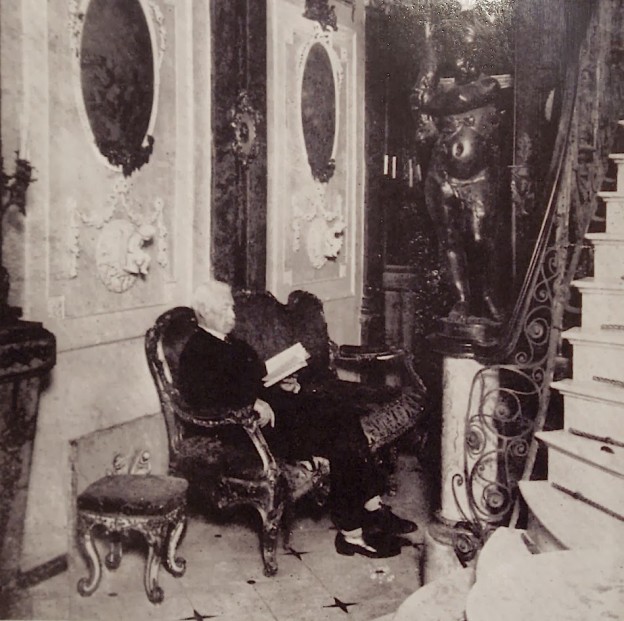
From A Mixed Grill : a Medley in Retrospect / by the author of "A Garden of Peace". London : Hutchinson, [1930.] The anonymous author was, in fact, Frank Frankfort Moore (1855–1931) an Irish dramatist, biographer, novelist and poet. Born in Limerick, Ireland, Moore worked as a journalist (1876–92) before gaining fame as an author of fiction. The frontispiece of this book shows him in his 'Italian Home' - this was actually a house in St. Leonards called 'The Campanile' filled with Italian artefacts that was on sale in 2010. On the subject of ghosts he is somewhat sceptical but most subjects, as the title implies, are seen from a slightly gastronomic viewpoint:
All the great ghost-seers on record have been also eminent dyspeptics - men and women who were deficient in pep or who had ruined their digestions by irregularity in diet or by a wrong diet. The ghost is really a symptom and it is rightly so regarded by the medical profession. We all know the sort of person who is associated with a ghost story - the ethereal girl like the sister of Sir Galahad who saw the Holy Grail - "I thought she might have risen and floated" - that girl has really risen and floated in innumerable ghost stories - the type of girl on whom that form of rash, known as the stigmata, has from time to time appeared. This may be the ghost of indulgence. In the days of gluttons there was a glut of ghosts, and there are few men of middle age to-day who have not had some experience of the man whose ghosts take the questionable shape of blue monkeys pr black cats, sometimes even of such minor crawling things as spiders or black beetles in natural colours, or, more frequently, snakes of no recognised classification. These are all the result of an over indulgence in the drug known as alcohol. Other drugs such as opium or cloral are productive of more pleasing spectral shapes; but this class of ghost has nothing in common with the phenomena of Spiritualism. Their capacity of self-expression does not go beyond the ordinary gibber. They are not worthy of serious consideration, except, of course, from the standpoint of a medical prognosis.
A humble variant is, of course, the nightmare, a horror due to such a ridiculous accident as a slipped pillow or a superfluous eiderdown, but more frequently to an incautious or a too hasty supper...