I once met A.E. Coppard

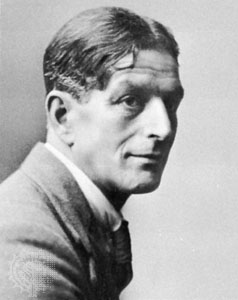
icoppar001p1Found – a  handwritten  letter signed by E.V. Knox (‘Evoe’) to someone called Magniont asking for recollections of A.E. Coppard. This was almost certainly Dr Jean-Louis Magniont who translated Coppard into French. The letter is undated but mention of a recent BBC adaptation of Coppard’s stories dates it as 1969. ‘Evoe’ writes:

I will tell you all I can recollect about A.E. Coppard. But I fear that it is very little and perhaps not very helpful to you.

As you mentioned, I wrote a small episode, and he considerably longer one, for the Kidlington Pageant of 1931. Those were the days when pageants kept popping up everywhere. This one was arranged by Frank Evay, who lived at Shepton Manor where the pageant was held. He was a friend of mine and an eccentric. For instance, he collected tramps, gave them a meal and a the nights lodging in a barn and sent them on their way. He introduced me to A.E. Coppard whom he had first met, as he told me, when Coppard was collecting tickets at Oxford railway station.

I remember him as small, prosaic, and self-contained and perhaps determined not to be eccentric. Possibly that is an illusion of my own. I became at once a “fan.” Coppard, I think, was very little known at that time, for at a dinner of a literary club I told Desmond McCarthy, then perhaps our leading critic, that I thought that Coppard was our best English short story writer, and Desmond had not heard of him. He said however- ”Well we must try to read this Coppard of yours.”  Clearly he did. Continue reading →

Malayan secret society ritual

IMG_1560 (4)Found – a rare Malayan police manual Notes on secret societies (Caxton Press, Kuala Lumpur 1953) by one C. T. Dobree. It is more of an anthropological study than a detective’s manual with much emphasisis on the  initiation ceremonies of each society; there are also notes on secret methods of communication known only to society members. This what he writes on the Wah-Kee (aka ‘Chow Fah Chee Tow’  or ‘Sze Kor Long.’) The way of refusing a cigarette is interesting – ‘push back the cigarette with hand-palm facing inwards.’

Jargons and signs.

After initiations the new members to the brotherhood are taught the secret jargons and signs by which strangers to one another may identify themselves as being of the one brotherhood.

These are some of the jargons and signs in common use: –

Questions.

a) Where do you come from? – from Singapore. (This is because the Malayan Wah Kee started in Singapore).

b) What is your surname? – Either Sui (Water) or Loke (land), or Peng (Peace) or Onn (Tranquility).

Continue reading →

Baked Elephant’s Foot

Minithology on banquets 001Baked Elephant’s Foot. Just one of the exotic dishes that features in Spotlight on Lucullus, A miniature Anthology of the pleasures of the Table –which is twenty-eighth in the series of ‘ minithologies ‘ created by a certain Max Crombie, some of the others being devoted to bird poetry, Christmas, love lyrics, the prose of Richard Jefferies, drink songs and the four seasons. Originating from the modest Knights Press in Northwood, Middlesex, from c 1940 to 1942, these booklets were slightly smaller than Penguin paperbacks and certainly shorter, being, in most cases, no more than twenty four pages in length. Well known book illustrators provided the ‘decorations ‘in the form of vignettes. The subject matter covered was presumably chosen to lift wartime spirits ( though the irony of describing banquets at a time of wartime shortages was doubtless not lost on many readers,) and perhaps to inject a little nationalist pride into a demoralised populace.
As for the account of the baked elephant’s foot, it was supplied by the French gastronome Le Vaillant, who witnessed the culinary practices of the Hottentots while travelling through Africa:

‘They cut off the four feet of the animal, and made in the earth a hole about three feet square. This was filled with live charcoal, and, covering the hole with very dry wood, a large fire was kept up during part of the night. When they thought the hole was large enough it was emptied; a Hottentot then placed within it the four feet of the animal, covered then with hot ashes, and with charcoal and small wood; and this fire was kept burning until the morning. My servants presented me at breakfast with an elephant’s foot. It had considerably swelled in the cooking; I could hardly recognise the shape, but it appeared so good, exhaled so inviting an odour, that I hastened to taste it. I could not conceive how so heavy , so material an animal as the elephants, could furnish a dish so fine and delicate, and I devoured without bread, my elephant’s foot, while my Hottentots, seated around me, regaled themselves with other parts which they found equally delicious.’  

[R.M.Healey]

It’s fun finding out… about Chapman Pincher

fun finding out title page retry 001

Discovered in a box of books is this copy of It’s Fun Finding Out, putatively by Bernard Wicksteed, but actually written with Chapman Pincher, the man who was to become a true legend among spy-hunters.

Back in 1947, when the book was published by the Daily Express, Wicksteed, an RAF war hero, was an ex sub-editor who had published his first book, Father’s Heinkel in 1944. Pincher was an ex physics teacher who had recently joined the Express as a science correspondent. One day Express editor Arthur Christiansen had the bright idea of bringing the two men together to compile an exploration of weird facts something along the lines of the American Ripley Believe It Or Not books. The result was It’s Fun Finding Out.

Structured so as to reveal facts while on visits to several places, including a Zoo, the seaside, a farm, a wood at night, a river bank, the country in Autumn, a grouse moor, an art gallery and the Science Museum, the book also considers facts relating to social history, philately, the amazing physical toughness of Winston Churchill, the French view of the English and vice versa, and guppies, among many other topics. Continue reading →

A relic of the talented Messel Family

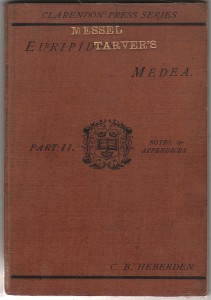
Messel Medea cover 001Found in a box of old text books (Zinn collection)  is this copy of part two of C. B. Heberden’s edition of Euripedes’ Medea ( notes and appendices) published by the Clarendon Press in 1886.Stamped in gold lettering on the light brown cover of this distinctly dull-looking school text book are the words MESSEL/TARVERS. Inscribed in pencil on the fly-leaf we find ‘ L.Messel/Tarvers ‘, which suggests that it belonged at one time to Leonard Charles Rudolph Messel ( 1872 – 1953), father of the famous stage designer Oliver Messel. Beneath the inscription are two pencil and ink drawings—one of a veiled lady in Victorian dress, the other a small profile of a man’s head.

Leonard was the eldest son of Ludwig Messel, a German stockbroker who had emigrated to Britain, possibly in the late 1860s.He married and in 1890 bought Nymans, a 600 acre estate near Hayward’s Heath in West Sussex. His son Leonard was sent to Eton, where he joined Tarver’s house, and that is all we really know about his life as a schoolboy. However, if he did execute the two drawings, then he obviously passed on his artistic skills to his son Oliver, who may also have inherited skills from his mother, who was the daughter of Edward Linley Sambourne, the eminent Punch cartoonist. This being so, it is equally likely that Oliver, who also attended Eton, inherited his father’s copy of Heberden’s Euripides, and it was he who drew the veiled woman and male profile. Continue reading →

Spoof/ Nonsense handbill

IMG_1532Found at the Ephemera Society fair– this spoof April Fool’s day handbill/ poster. It probably dates from the late 19th century. It is in the tradition of British nonsense that goes back past Edward Lear and Lewis Carroll and was carried on with J.B. Morton’s ‘Beachcomber’, The Goons, Monty Python, Bonzo Dog, John Lennon and Professor Stanley Unwin and The Mighty Boosh. There is a West Derby Road in Liverpool. The reference to the young woman’s dress being composed of ‘spare ribs of pork’ is reminiscent of a costume recently worn on stage by the the singer Lady Gaga…

Missing from the neighbourhood of Black Rock Street, West Derby Road, about the first of April last, a short, middle-sized, and very tall young woman… had on when last seen a fashionable dress, composed of spare ribs of Pork with sage and onion trimmings; a double-breasted bonnet with Rattlesnake feathers – on her neck Dick’s hat-band that went nine times round and wouldn’t tie; a Chignon made of Shandy Gaff; Cast Iron stockings; Papier Mache drawers; Jack the Giant killer’s seven leagued boots, recently repaired, with holes in the soles; wears the Roman fall in the protuberance of the breast; must be recognised by her lovely piebald eyes, turned up Grecian nose, and a dew drop at the end of it, with savoury duck lips; has a splendid Carriage but no Horses; is supposed to have gone in search of the “Man in the Moon,” and will be known by looking two ways at once on Sunday’s; generally walks on her hands for the sake of cooling her heels, and always taking one step forward and one back, laments that she’s stationary in the world. Has been subjected to brutal treatment by her parents, having been born without father or mother, and wears mourning for a brother that never was in existence, being a son of her uncle Polly’s!

BY TELEGRAM. – When last seen was carrying a Satchel made of Boiled Cabbage, and was in a fearful state of exasperation, having too much of her own way in everything.

N.B. – She lives in Nim Nam Street, and is a Pan Mug Weaver.

Seth speaks…


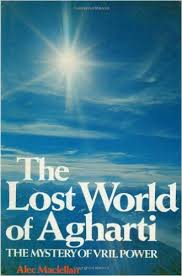
Agharti 1982Found in the Peter Haining Archive ( though how it got there is anybody’s guess) is a letter addressed to Alec McClelland, author of The Lost World of the Agharti from someone called John Hanning-Lee.

Bearing no year date ( but it must be dated after 1982, when The Lost World of Agharti appeared ) it urges McClelland to read Seth Speaks by the American psychic and author Jane Roberts (1929 – 84), who from 1964 received spirit messages from a male being called ‘ Seth’, whose pronouncements were later made the subject of a number of published works by Roberts collectively known as the ‘Seth material’. In his letter Hanning –Lee particularly focuses on the chapter in Seth Speaks devoted to the lost underground civilisation that predated Atlantis. Hanning-Lee describes the inhabitants and their civilisation thus:

‘They had blown up their own civilisation prior to that and the underground existence that followed was, of course, a reincarnational one. They excavated whole cities, by that I mean they excavated extensively so that their cities and communicating passages were entirely beneath the surface. The means of doing this was by means of sound vibrations where certain low notes sounded with power can cause a tunnel to form where there was solid earth. I suppose an analogy would be if you were to manipulate iron filings so that a path was formed through a mass of them placed on a sheet of paper and the paper tapped lightly. These ‘ caves ‘ they formed were, then, far more extensive than the ordinary idea of the word ‘cave’ and ran for miles, Their knowledge of the plates of the Earth’s crust and the science of earthquakes was almost certainly far superior to ours. Continue reading →

Exactly who wrote ‘The Hound of the Baskervilles’?

Baskerville Addington Peace book cover
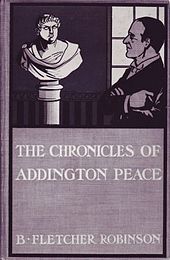
The title page of the 1902 first edition bears just one name—Arthur Conan Doyle. And if you believe Conan Doyle’s son Adrian and just about every Sherlockian you’ll ever meet, only one man wrote the famous detective story. But in a newspaper cutting from the Daily Express dated March 16 1959 in the Haining Archive, the journalist Peter Evans tells how he met an 88 year old man from Dartmoor who swears that another writer of detective stories, Bertram Fletcher Robinson (1870 – 1907), the author of The Chronicles of Addington Peace (1905) contributed some material to the book. That man was Harry Baskerville and he had worked as the coachman to Fletcher Robinson’s father.

According to most accounts, Fletcher Robinson’s only contribution was to tell his friend Conan Doyle about the West Country legend of a ghostly hound and to borrow the name of the family coachman for Sir Henry Baskerville. Indeed, the octogenarian even showed Evans the inscribed first edition of the book in which Fletcher Robinson acknowledges as much. But Baskerville claimed much more for his employer’s son:

‘Doyle didn’t write the story himself. A lot of the story was written by Fletcher Robinson. But he never got the credit he deserved. They wrote it together at Park Hill, over at Ippleden. I know, because I was there.

According to Baskerville, long before Conan Doyle arrived at Park Hill, Fletcher Robinson had confided:

“Harry, I’m going to write a story about the moor and I would like to use your name”.

Baskerville then continued:

“Shortly after his return from the Boer War, Bertie (Robinson) told me to meet Mr Doyle at the station. He said they were going to work on the story he had told me about. Continue reading →

The Land Girl

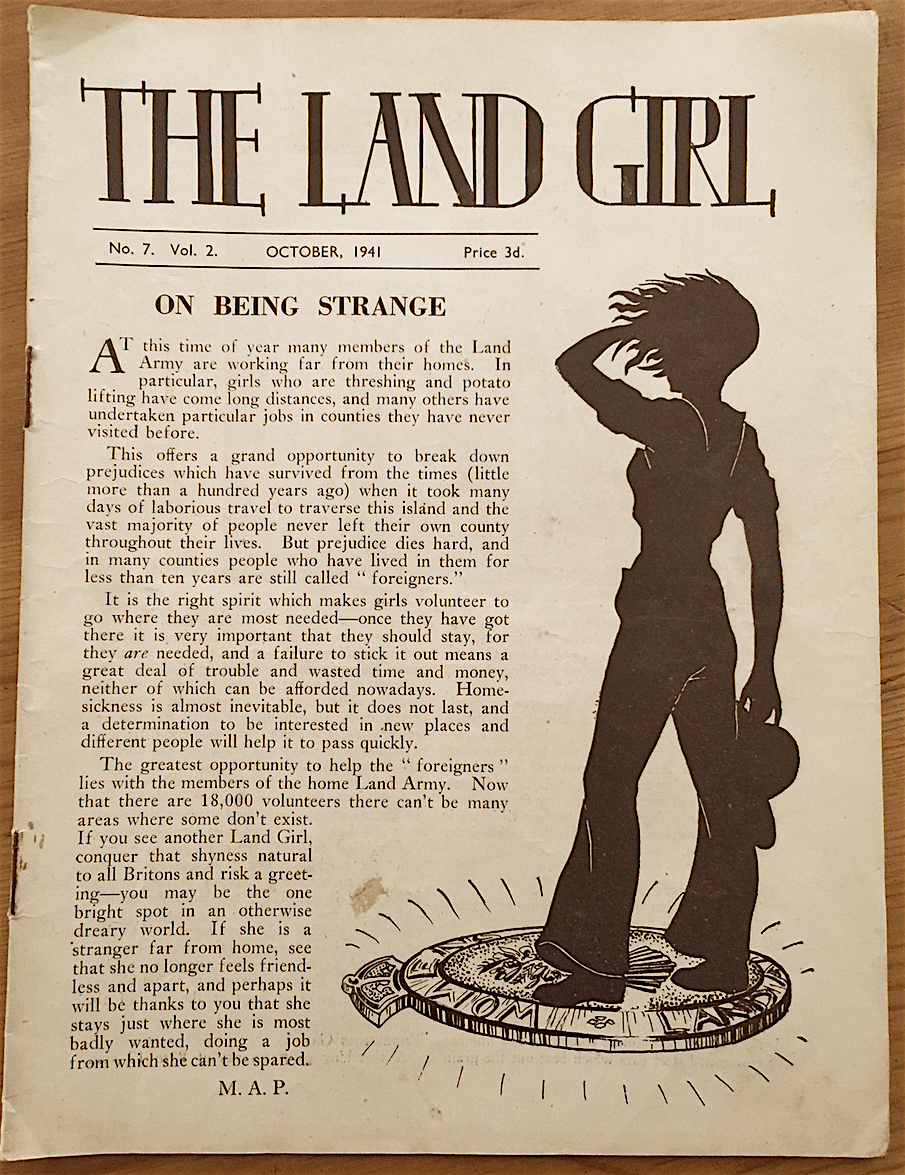
IMG_1510Found at the London 2016 May Ephemera Fair – an issue of this magazine – THE LAND GIRL. (NO. 7. VOLUME 2, OCTOBER 1941.) This was issued by the Women’s Land Army The first article  is an encouraging piece aimed at the new Land Girl, who possibly for the first time, will be meeting other girls from far flung parts of Britain and  the British Commonwealth.

On Being Strange.

At this time of year many members of the Land Army are working far from their  homes. In particular, girls who are threshing and potato lifting have come long distances, and many others have undertaken particular jobs in counties they have never visited before.

This offers a grand opportunity to break down prejudices which have survived from the times (little more than a hundred years ago) when it took many days of laborious travel to traverse this island and the vast majority of people never left their own county throughout their lives. But prejudice dies hard, and in many counties people who have lived in them for less than ten years are still called “foreigners.”

It is the right spirit which makes girls volunteer to go where they are most needed – once they have got there it is very important that they should stay, for they are needed, and a failure to stick it out means a great deal of trouble and wasted time and money, neither of which can be afforded nowadays. Home-sickness is almost inevitable, but it does not last, and a determination to be interested in new places and different people will help it to pass quickly. Continue reading →

How to dance the Hokey Cokey

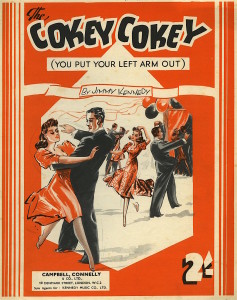
60670Found- some sheet music for the song The Cokey Cokey which later became the song (and dance) the Hokey Cokey. This is what it is all about… There are many theories about its origins – dealt with at Wikipedia and in a Mental Floss piece on its ‘dubious origins.’ Possibly the name came from the magician’s ‘hocus pocus’. This version was written in 1942 by Jimmy Kennedy (1902-1984). Jimmy Kennedy states that his version is based on ‘a traditional action song known long ago in the mining camps and saloons of the Canadian West. The word ‘Cokey’ means a dope fiend but what this has to do with the dance is not at all clear!’ As he says – it then came over in World War 2 with the Canadian troops. He explains on the back of the sheet music exactly how to do the dance:
This is one of the simplest dances ever. You hold your partner in the normal way and while the verse is being played you may fox-trot using any steps you like.   When the chorus starts, that is, on the words, ‘Left arm out’, you put your left arm in line with your shoulder, continuing on the words ‘Left arm in’ by bending the left arm in and touching your shoulder, then ‘Left arm out’ as before.  You hold your partner with the other arm. ‘Shake it all about’ explains itself —you simply shake your hand and arm with a circular motion. On the next line ‘You do the Cokey Cokey and turn around’ the appropriate action is to place the forefinger of the right hand pointing downward on top of your head and do a complete turnaround. ‘That’s what it’s all about’ ends the actions and you take hold of your partner in the normal way. Then the chorus starts over again with the right arm, then left foot and then the right foot etc., It should not be taken to fast..

This dance, since its introduction here by the Canadian forces, has caught on like wildfire and bids fair to out-rival some of the most sensational dance successes of the past.

Note: Alternatively the dance maybe performed by partners facing each other in line as in the Palais Glide and on the words ‘That’s what it’s all about’ both hands are spread out palm upwards. SEE?

At the Bookshop 1822 and 2016

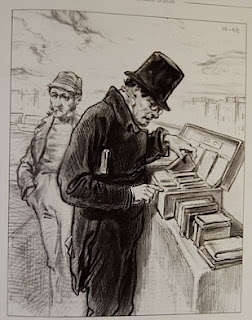
Retrieved from our old Bookride site – this not unamusing extract from an 1820s English/ French conversation manual.  It gives an interesting insight into a vanished world. It is followed by our modern version where the translation was slightly robotic, so apologies for that…

Note the concern with the appearance and quality of the books, the perennial problems with trying to get the binder to do what the bookseller and customer wants, and on time. The eagerness of the collector to be the first to be offered fresh stock from the shop has changed very little. Still with us are the problems of delay in postal sytems…  Also it is interesting that in the early nineteenth century women bookbuyers were thought likely to be attracted to ‘Large Paper Copies’ and vellum bound books. The customer’s knowledge of book lore and binding styles has changed somewhat.

1822    
Well ! you are a man of your word, as usual: and the books that you were to send me, when shall I have them?
Eh bien ! vous etes un homme de parole, comme a l’ordinaire: et ces livres que vous deviez m’emvoyer, quand viendront-ils?
You are under great obligations to your binder; he often furnishes you with an excuse.
Vous avez un relieur a qui vous avez de grardes obligations , car il vous sert souvent de manteau.
I protest that I sent them to him the same day you came to buy them.
Je vous proteste que je les ai fait porter chez lui le meme jour que vous etes venu les acheter.

Continue reading →

Wonder Wall—Second World War murals in restaurants and canteens

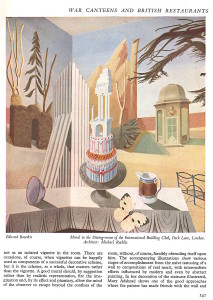
Murals Bawden 001It is a sad fact that most of the best mural paintings executed in canteens, cafes and restaurants in the UK no longer exist. Unlike those executed for some public buildings, those in private premises are subject to the taste of those who take over the property. By far the most notorious example was, of course, the murals executed around 1913 on the walls of Rudolf Stulik’s Restaurant de la Tour Eiffel in Percy Street, just off Tottenham Court Road, by Wyndham Lewis, which were later painted over.

The prevalence of the post-war obsession of interior decorators with the ‘ white wall ‘ was a possible explanation for the disappearance of most the Second World War murals that feature in an article by the architect Oliver Hill in the November 1943 issue of The Studio magazine. Working within the tradition of thirteen centuries of mural painting in English churches, and using the contemporary iconography of posters, notably those of McKnight Kauffer, many of the muralists commissioned during the Second World War were asked to address what was essentially a captive audience –diners at many British restaurants, staff dining rooms and government canteens. Muralists saw these projects as an opportunity to introduce otherwise unappreciative diners to good public art. To the architect Hill, the mural was not the equivalent of a large framed representational painting that focussed the attention of the viewer on itself, but was part of the building on which it was painted. As such, rather than realistic representation, a ‘good mural ‘ should, according to Hill, ‘ fire the imagination and, by its effect and phantasy, allow the mind of the observer to escape beyond the confines of the room, without, of course, forcibly obtruding itself upon him ‘. Continue reading →

Gerald Brenan – Diaries and Journals 1925-1932

gerald-brenanFound amongst the papers of the late distinguished bookseller and publisher Joan Stevens this cutting from a catalogue. It appears to be dated in 1976, bookseller not named but it does not sound like Joan. Gerald Brenan was still alive and his reputation well established, but it has subsequently grown, especially through his strong Spanish connections and the price looks very reasonable indeed. It was probably bought by, or sold on to, the University of Texas who seem to have most of his papers. They are unpublished but were used by Jonathan Gathorne-Hardy in his 1992 biography The Interior Castle: a Life of Gerald Brenan. As a dedicated Powysite Joan Stevens would have been interested in Brenan’s connection to Gamel Woolsey who had a passionate and painful affair with Llewellyn Powys. Gathorne-Hardy notes that, with typical Bloomsbury disdain, both Carrington and Lytton Strachey regarded her as a ‘bore.’ The part of Brenan was played by Samuel West in the 1995 movie Carrington.

307. Gerald Brenan’s Diaries and Journals, 1925-1932

Typescript, with manuscript corrections and additions. Two volumes, 239pp, 4to.

A document of both literary merit and literary significance. The majority of Brenan’s diary is devoted to the record of his long affair with the painter Dora Carrington. Although chronicled elsewhere (David Garnett’s “Carrington, Letters and Extracts from her Diary” 1970), Brenan’s own version of the frustration and anguish culminating in the inevitable ending of their relationship makes a fascinating counterpoint to the version found in Carrington’s letters to him, as edited by their mutual friend Garnett. Continue reading →

‘Abide with me’ – an answered prayer

51vLEzW1JIL._SX362_BO1,204,203,200_Found – this newscutting from The Times (London 1926) about the origins of the much loved hymn ‘Abide with me’ by Henry Francis Lyte. The reference to Wembley Stadium is slightly  obscure as Wikipedia says the hymn was first sung there in 1927 at the cup final…

AN ANSWERED PRAYER.

TO THE EDITOR OF THE TIMES.

Sir, – As one of the few living descendants of the author of the hymn “Abide with Me,” which nightly thrills the great audience in the Wembley Stadium, I have been greatly interested in the correspondence in ‘The Times’. It is only those who know the tragic circumstances under which this beautiful hymn was written who can explain the inner meaning of the words “Fast falls the eventide.”

My great-grandfather, the Rev. Henry Francis Lyte, the author of the hymn, was vicar of Lower Brixham, in those days a picturesque little fishing village on the shores of Torbay. He was the author of numerous poems and hymns, some of which are in “Hymns Ancient and Modern.” During the latter part of his life he devoted himself to the service of the humble fisher folk of Brixham, among whom were many of his best friends. His labours undermined his health, but he persisted in his noble work until his health broke down completely under the strain and his doctor told him he must go abroad at once. He was then dying of consumption. He preached his farewell sermon the following Sunday evening in Lower Brixham Church and, after the service, walked slowly home to his house at Berry Head. It happened that on that night  there was one of those glorious sunsets which are sometimes to be seen at Torbay. The sun was setting in a blaze of glory and the purple hills of distant Dartmoor stood out darkly against a flaming sky. In the foreground was Brixham harbour like a pool of molten gold. Several times on the way home  the poet stopped to rest and to gaze on this wonderful manifestation of nature. We can well imagine his feelings. He had just said “Goodbye” for the last time to his parishioners, and he knew that he had only a few weeks at most to live. The setting day reminded him insistently of his life, which was drawing swiftly to its close. Continue reading →

Desiderata—a weekly publication for libraries and booksellers

Desiderata 001How come nothing can be found online about the little weekly periodical entitled Desiderata, a copy of which was found in a box of books the other day? It resembles the Clique in some respects, but unlike the latter, whose main job was to put collectors and booksellers in touch with one another, it aimed instead to provide ‘ a direct link between library and bookseller ‘.

The copy we found is probably fairly typical. It is issue number 36 of volume 8 and is dated September 9th 1955. Its 12 pages comprise an editorial in the form of a salutary story about a bookseller’s ring; there follows a rather silly defence of the inept ‘poet‘, Alfred Austin, against the entirely justifiable description of him by Evelyn Waugh as a ‘obnoxious nonentity ‘. Five whole pages of Wanted adverts from the British Museum then follow, and the rest of the issue is taken up by what appear to more Wanted ads from various public libraries, some small ads from booksellers and a full page ad from the eminent Guildford booksellers Traylen. A miscellany of literary notes and announcements takes up the back page.

The British Museum books wanted advert is the most interesting feature of the magazine. Listed in this case from ‘Tovey’ to ‘Trial’, the items demonstrate how keen the Library was (and presumably still is) to hold all editions of a particularly title, however seemingly obscure. This is, after all, its raison d’etre. However, one example listed seems out of place. There was a call put out for the 1915 second edition and its 1930 reprint of Pitman’s Dictionary of Secretarial Law and practice edited by Philip Tovey. Why would a 1930 reprint differ in any meaningful way from the 1915 second edition? Insisting on reprints for the sake of completeness is per se rather ludicrous. Continue reading →

An album of Oscar Wilde letters

oscar_wildeFrom a 1946 catalogue of ‘scarce and interesting original autograph letters manuscripts historical documents’ from London dealer Winifred Myers.  She was a major player in the field of autographs into the 1960s. These were listed at £80. After 70 years it would be a safe bet to say they have gone up by over 2000 times …Fortunately they were bought by a collector who let them be published in Rupert Hart- Davis’s collection of Oscar’s letters that appeared in 1962. Are they still in the ‘choicely bound’ Riviere album?

WILDE (Oscar). 1856-1900. Author. 9 Autograph letters signed, with original envelopes, 38 pp., 4to. and 8vo., and one autograph post card signed O.W. (some letters are signed in full, some “Oscar” and some with initials), Paris, Dieppe, Naples, etc., 1897-99, to his publisher Leonard Smithers, chiefly regarding his “Ballad of Reading Gaol.” A very fine collection of letters of the utmost importance. The first letter written from Berneval only three months after his release from prison, expresses the hope that he will finish the Ballad within a few days, begs Smithers to get an answer from Beardsley about doing the frontispiece; a long letter from Naples deals fully with the title-page and his pseudonym C.3.3.; speaks affectionately of Robt. Ross; were all his friends like Ross he would not be “the pariah dog of the nineteenth century.” Refers to Lord Alfred Douglas who is staying with him, “He has also ruined my life, so I can’t help loving him,” his wife’s letter of reconciliation. “In questions of the emotions and their romantic quality, unpunctuality is fatal.” “I am going to try and find a place near Genoa!… The chastity of Switzerland has got on my nerves,” asking for money, “I have no money at all. I am in a dreadful state… I am nearly in the gutter,” mentioning “The Importance of Being Earnest,” etc. Probably the most important and moving collection of Wilde letters ever offered for sale, mounted with typescripts in an album, choicely bound, green morocco gilt, g.e. lettered in gold on spine, by Riviere.

A train spotter writes…

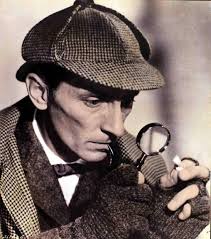
Sherlock Holmes CushingWe all know about the nerds who post online corrections to errors or omissions in books, films, dramatisations and the like. Well back in 1987 , before the Internet made it all too easy, there were people like R. Lujer, who typed their complaints to—in this case—the publisher of Peter Haining’s The Television Sherlock Holmes. Haining, who was doubtless royally entertained by this particular letter, kept it in his Archive. Here it is in full.

Dear Mr Haining,

I received a copy of your book last Christmas and have thoroughly enjoyed dipping into it before embarking upon a more orthodox read, until I reached page 179 and “The Mystery of Watson’s Dog”. I remember the review by Nancy Banks Smith and thought at the time that she had resurrected a non-event. The real mystery is the TRAIN, not the dog.

Bulldogs experience, as a rule, shortish lives, the result of overweight front ends and convolutory respiratory passages. Trains, or more exactly steam locomotives, generally had working lives of 50 or more years. Even some of the G.W.R. “Bulldog” class of 1901, transformed into “Earls” in the 1930s, were still running in the 1960s. Surely Watson’s dog simply died an early, natural death; and he found it convenient or prudent (or both) not to secure a replacement.But what of the locomotive in “The Copper Beeches”? Continue reading →

Virginia Woolf – An Appreciation (1941)

4e2b6da99ff0d5c9f24dfefdfec9abfcFound- a press-cutting from The Observer – April 6th, 1941 a week after the suicide by drowning of Virginia Woolf. This ‘appreciation’ accompanied a memorial poem by Vita Sackville-West. It was by the now slightly forgotten critic Basil de Sélincourt.  Virginia Woolf notes in her diary how she was heartened  when he praised her novel The Waves (1937). It was said to be her favourite review. There is a good photo of Selincourt at the National Portrait Gallery by Lady Ottoline Morrell.

An Appreciation – Basil de Selincourt

The loss of Virginia Woolf is not only a grave blow to English letters, but will also be widely felt by many who had no personal acquaintance with her. It was not for nothing that she collected her brilliant, or radiant, studies in Criticism under the title “The Common Reader”. The originality of her mind and the acuteness and range of her perception never isolated her, never led her to forget that the foundation of the literary art is sympathy, that we write to be understood, to make our vision carry. True, the reading of her novels can be a strenuous exercise, but it is an exercise in intimacy. The greatest of them, “The Waves,” most of us must be content to wonder at; we can hardly hope to comprehend it. But however we may be baffled by work of hers, we have never been offended. Its elusiveness is the elusiveness of nature. Her waters are limpid as the sea’s on a solitary shore; her phrase has the decisiveness, the crisp outline of a shell. Her horizons only are unfathomable. She has preferred to keep here even for herself a quality of mystery, as if the greatest communication a writer has to make were the sense of an incommunicable infinite, of a truth always present wholly, and therefore never seizable in any part.  Continue reading →

Harry Grindell Matthews—inventor extraordinaire

Matthews operating the Death Ray

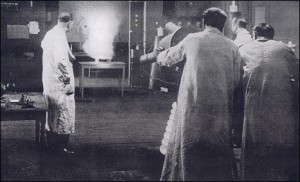
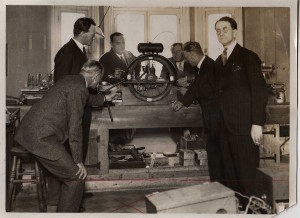
If ever a man was the epitome of the ‘mad inventor‘ it was Harry Grindell Matthews, though his many supporters would perhaps bridle at the word ‘ mad’. But if he wasn’t dotty, he was certainly controversial and decidedly eccentric. For it was the habit of this electrical engineer, born in Winterbourne, now a northern suburb of Bristol, in 1881, to claim a startlingly interesting innovation while refusing to cooperate with interested parties, including government agencies. In 1911 he claimed to have invented a radio-telephone, which if developed might have been a prototype of our modern mobile; he also boasted that he had created the world’s first talking movie in 1921, but this too was never financed. He is best known today ( if he is known at all) for inventing an invisible Death Ray which he claimed would stop electrical machinery at a distance, thus immobilising enemy threats, such as aircraft and bombs. However, when an eager government stipulated that to convince the scientists he would be required to stop a petrol-driven motorcycle engine remotely, Matthews refused the challenge. In this press photo dated 1930 from the London based Sports and General agency, which found its way into the marvellous El Mundo archive, Matthews is shown on the right, cigarette in hand, while a group of engineers eagerly examine what appears to be the motorcycle engine which he was asked to stop. In another photo we see Matthews operating the Death Ray itself. Needless to say, the inventor’s refusal to cooperate in a controlled experiment spelt the end of this promising piece of technology.

Grindell matthews inventor082

Undeterred, Matthews continued to offer new inventions. The most exciting was a Sky Projector, which he demonstrated with some success. Had this got off the ground we may have had laser-type shows in the 1930s. When at last he did manage to tempt serious investors to part with their money, he used much of it to build a state of the art laboratory and a private airfield overlooking the Swansea Valley at Clydach. His financial state received another boost in 1938 when he married an opera singer called Ganna Walska whose five former husbands had left her with a fortune of around $125m. Unfortunately, he did not live long to enjoy his good fortune. Matthews died in Swansea in 1941 at just 60.

Gloucestershire has produced at least another brilliant electrical engineer. Joe Meek, the equally eccentric electronic music pioneer who produced the cult favourite ‘Telstar’ in 1962, worked on radios as a teenage prodigy. His shed can still be seen at the rear of his father’s old shop (blue plaque) off the Market Place in Newent. [R.M.Healey]

The creator of Perry Mason with two of his team of secretaries

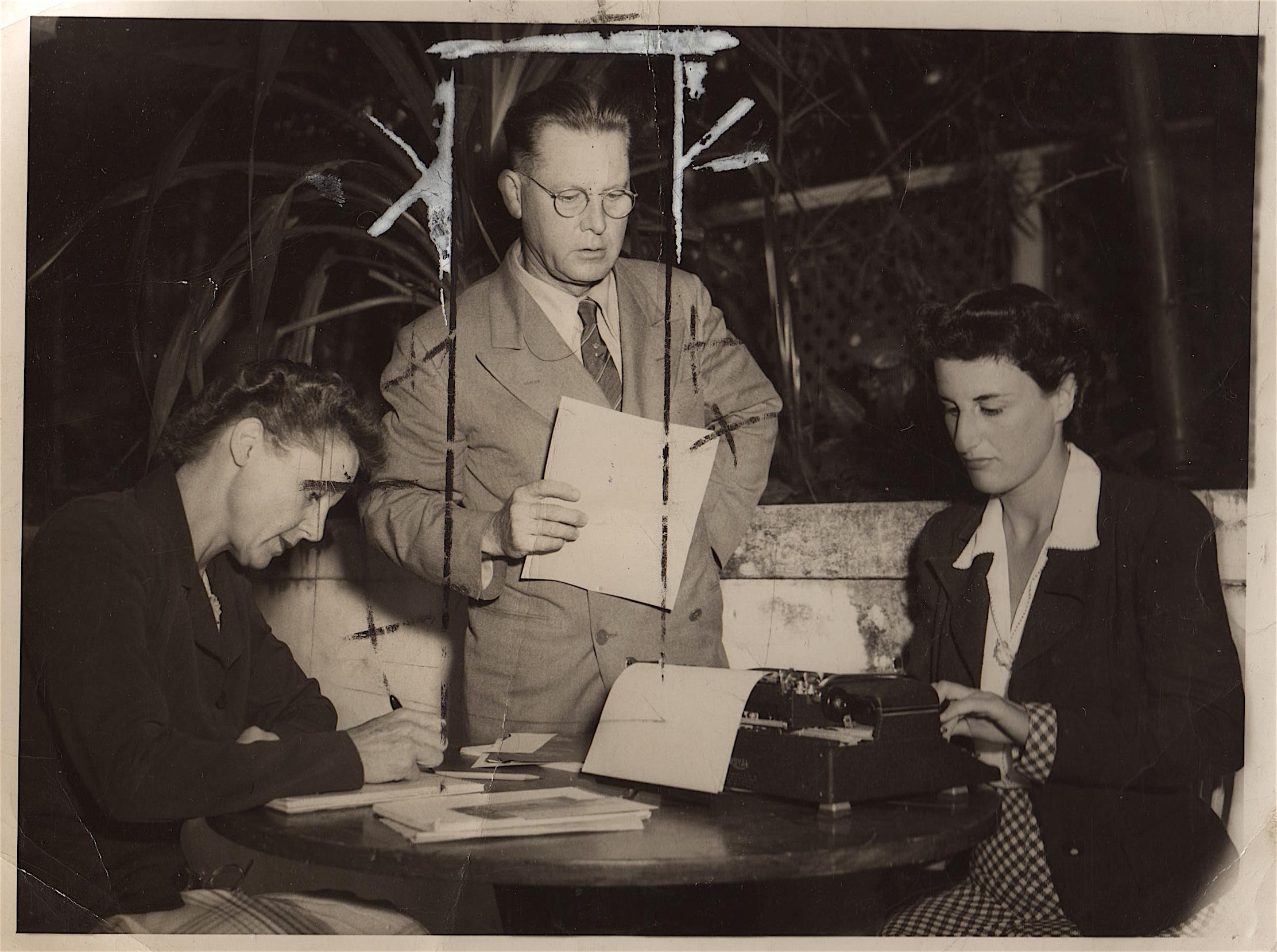
Erle Stanley Gardner 001When Erle Stanley Gardner( 1889 – 1970), the famous American crime novelist, began contributing stories to pulp magazines in the twenties, he used his own two fingers to type. However, realising that self-imposed targets of 1,200, 000 words a year were unlikely to be achieved in this primitive way, he took on what eventually became a ‘ team ‘ of secretary/typists. In this press photo of 1943 from the El Mundo archive we see two of them, Jean Bethel and Henriette Trilling, on either side of the ( ) year old novelist. The two women seem to be performing different tasks. Bethel is possibly taking notes on plots and characters for the novel that her partner is typing out from Gardner’s dictation, for future novels or for the travel books that the prolific writer also published. Gardner’s secretaries also acted as temporary corpses—assuming positions on the floor for added verisimilitude.

Over the years Gardner must have become very attached to Jean Bethel in particular. In 1968, following the death of his first wife, he took his ‘ faithful secretary’, then aged 66, as his second. At his death in 1970, aged 80, Jean became his literary executor and twenty years later, at 88, she was still administering his estate, which included a huge archive. [R.R.]