A Visit to Mars (concluded)

This, the third and last part of this strange account, is a follow up to an earlier jot.

January 15th. For the sake of those who, in spite of my gloomy experience on the whole, wish to make this voyage too, I should like to make the following observations on the equipment required for the expedition. A large quantity of provisions, as for an Arctic or Antarctic expedition for many years is a first requirement. It is quite easy to keep the provisions here owing to the permanently low temperature in the ground. If economically used, sufficient water can be obtained by melting hoar-frost.

Continue reading →

Samuel Fuller and 144 Piccadilly

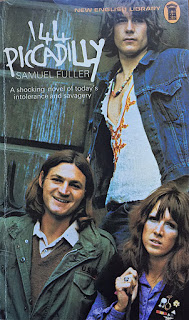
Found- a British paperback 144 Piccadilly (NEL, London 1973) a novel by the American film director Samuel Fuller. It concerns a group of London hippies who barricade themselves inside a decaying Mayfair mansion and resist all efforts to evict them. One cataloguer notes that the American edition rather obscures the fact that it was based directly on an actual event — “ripped from the headlines,” as Fuller might have put it. In September of 1969 a radical group known as The London Street Commune, formed to highlight concerns about rising levels of homelessness in London, took over a large house at the corner of Piccadilly and Park Lane (just across from Hyde Park); they occupied the building for six days before being forcibly evicted by the police. Fuller’s literary conceit was to insert himself into the situation, “playing” the narrator, a cigar-smoking American film director (in London for a BFI retrospective of his films) who gets involved with the squatters by accident. Unlike most of Fuller’s books, it’s not just a novelization of one of his own film treatments; as he tells it in his posthumously -published memoir, he actually had been in London when the occupation was taking place, had witnessed the initial break-in while out on a late-night walk, and with his “newspaperman’s nose,” had contrived to have a chat with the occupiers. “The disheveled squatters invited me to stay on,” he wrote ‘(if)…I hadn’t had prior commitments, a wife, and a flight back to the States the next day, I would have.” He subsequently got “damn mad” about the treatment accorded the squatters by the British media and the police, and knocked out a novel in which “an American film director very much like me participates in an illegal entry in London, then tries to bridge the generational gap by becoming the group’s mascot and witness. The fictional ‘me’ does what I was tempted to do but couldn’t, abandoning his hotel suite for a mattress on the floor with the flower children.” He never made a movie of the book.

Loosely inserted in the book is a typed postcard (27/11/71)  from Fuller “Am writing ‘Dead Pigeon on Beethoven Street’ which I’ll shoot here in Feb. My book 144 Piccadilly just came out… Am at Senats Hotel 5 Koln 1 – Unter Goldschmied”. Fuller has not signed the card but the words ‘Mit Luftpost’ are handwritten in red ink, presumably by the great man…  At the front of the book is the ownership signature of Phil Hardy, the recipient of the card- he wrote a book on Fuller published by Praeger ( N.Y. 1970)


Stewards at the Coronation of King George VI & Queen Elizabeth 1937

Found - a mimeographed 4 page typed set of instructions for stewards at the royal ceremony. It reveals the amount of detail and planning that goes into these occasions. It was found slipped into a book on George VI and must have belonged to a former steward. The mention at the end of fatigue and strain for this voluntary job is interesting. Stewards had to be at the stands at 5 a.m. wearing (in most cases) morning dress or uniform. Some were required even earlier. Still, refreshments came from Mecca Cafes Ltd (to be paid for by guests and stewards) and there were cigarettes, chocolates and sandwiches circulated by workers bearing trays. A phone service had also been specially installed...

The Coronation of Their Majesties King George VI.
and Queen Elizabeth.
Wednesday, 12th May, 1937

Instructions to Stewards.

1. Stand Stewards.

Each stand will be under the control of a Stand Steward, whose name will be indicated on the Steward’s pass. Stewards will report to the Stand Steward on arrival, will accept orders from him without reservation and will remain on duty until permission to leave is given by him.

2. Time of Attendance.

Stewards will be required to be at their stand, the number of which is indicated on the back of the pass, not later than 5 a.m. and should make themselves conversant with the general traffic facilities in order to ensure their attendance by this time. A certain number of Stewards on each stand may be required by the Stand Steward to be present at an earlier hour.

It is anticipated that in spite of the later hour of arrival which has been prescribed by the Police for seatholders, a large number will present themselves at the stands at a very early hour, and in order that congestion by seatholders and members of the public at the entrances to stands may be avoided it is considered necessary to arrange for Stewards to be present at that time indicated.

Continue reading →

An 18th Century joke

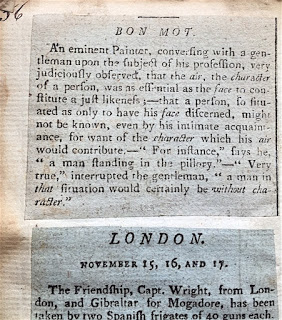
Found – a scrapbook of press-cuttings mostly from the Irish newspaper the Cork Gazette. This cutting entitled Bon Mot dates from about 1789. Most cuttings are about oddities, strange wagers (can a walking man cover 20 miles faster than a walking horse?) horrible executions, daring feats, obituaries, a letter from Dean Swift, marriages of royals etc., The following is a genuine 18th Century joke. If they had stand up comedians then this would presumably have them ROTFL.

An eminent painter, conversing with a gentleman upon the subject of his profession, very judiciously observes, that the air, the character of a person, was as essential as the face to constitute a just likeness: – that a person, so situated as only to have his face discerned, might not be known, even by his intimate acquaintance, for want of the character which his air would contribute. “ For instance”, says he “a man standing in the pillory.” – “Very true,” interrupted the gentleman “a man in that situation would certainly be without character.”

David Lodge on Edmund Randolph – forgotten Catholic novelist

Before he made the big time as a fully fledged comic novelist David Lodge was principally a literary critic who wrote the occasional novel. When I was taught by him at Birmingham University his reputation rested not on his four novels—Ginger You’re Barmy, The Picturegoers,  The British Museum is Falling Down, and Out of the Shelter, but on his doorstep-sized anthology of literary theory and his books and articles on mainstream twentieth century Catholic novelists.

Lodge’s article on the hardly known late Victorian novelist Edmund Randolph, which I discovered in a copy of the Aylesford Review for Spring 1960, belongs to the period when he regarded himself as primarily a writer on the history of Catholic novel, a subject he had chosen for his M.A. dissertation at London University. This research involved reading a number of ‘forgotten Catholic novelists‘of the nineteenth century. Clearly, he had not been impressed by their quality:
 
‘…Between the waves of the Oxford movement and the Decadence there lies a trough in which English Catholic novelists produced little besides sentimental pietistic romances and propagandist historical novels…’
 

L. R. Reeve – a Village Hampden, a Zelig

We have posted many portraits of the famous people that L.R. Reeve (1895? – 1980?) had met or seen. Sadly there are no more. He appears to have been a Zelig-like figure, a witness to many important events, an attender of meetings and addresses by the movers and shakers of his day. He was a great connoisseur of oratory and an excellent eyewitness. His writings proclaim his decency and lack of self importance; he was probably a good committee man, certainly a great observer, recorder, and witness. One of Thomas Gray’s Village Hampden…

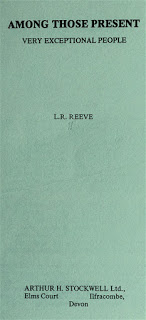
His book Among those Present appeared in 1974 published by Stockwell (a vanity publisher- L.R. Reeve probably had to pay for its publication- he had tried earlier to find an agent.) The preliminary notices in the book read:

AMONG THOSE PRESENT
VERY EXCEPTIONAL PEOPLE [title]
 

Educated at Goldsmiths’ College, London, L.R, Reeve very ably recounts his appreciation of, and interesting and revealing anecdotes about, some of the tutors, lecturers and exceptional people
he came to know both during his student days and in the course of his teaching career, many of whose names are now known in almost every household and whose influence him been felt far beyond the boundaries of the U.K.

AUTHOR’S NOTE


More than anything else the Second World War made us realize that there are thousands of men and women in our country whose ability is never appreciated until there is a national crisis. Then the real leaders and organizers emerge, and if any example is needed I can give evidence that County Hall, London, was more than a little surprised to find that many teachers, generally unknown, were able to adapt themselves to unforeseen crises; and this applied to members of every profession and occupation.
We know many people in high places are not natural leaders. They need the promptings, research, and the frequent advice of wise people, many of whom proceed through life unknown to anybody apart from relatives, acquaintances and friends. Few have reminded us of unsung heroes better than that remarkably intelligent poet Thomas Gray.
I should like to read more about men and women who are natural leaders. Their acquaintanceship would be a privilege, since their lives have done much to raise the standards of human dignity and happiness, and have left a rich heritage for mankind. Lady Violet Markham has written such an appreciation in Friendship’s Harvest, in which she refers to Dr Thomas Jones, CH., the Haldanes, Mary McArthur, John Buchan, and Robert Morant. Naomi Jacob has written a book in praise of some of her women friends.
My aim is somewhat different. I have tried to present men and women from all classes of society who possess some subtlety of personality which we call leadership, and who can inspire other people to actions unlikely to be undertaken unless prompted. I have known many who had not known me, but most of them I have seen, or heard, and some have sought information, and even advice from me.
With few exceptions my impressions are not intended to be comprehensive. They are simply • fleeting glances of some exceptionally interesting, influential, and inspiring men and women, whose lives will never be forgotten by those who knew them.
I am not suggesting my gallery of outstanding people is unusual as I am sure a multitude of adults have lived in a similar environment to mine. I must also emphasize that I have seen and known many fine people whom I have not mentioned, since their distinctive personal qualities have not been sufficiently strong, impressive, or compulsive enough to be publicly included in this type of appreciation.


Whistler Stories

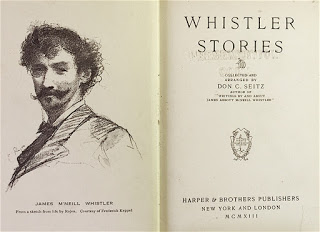
Found – Whistler Stories (Harper, New York 1913) put together by Don C Seitz. Many of the stories associated with the artist James McNeill Whistler are ironic jokes about his incredible self regard (‘…responding to an admirer who stated that there were only two great painters – Velasquez and himself. “Why drag in Velasquez.”’) or withering put downs. This exchange with Oscar Wilde is a good example of the latter:


Wilde asked the artist’s opinion upon a poem which he had written, presenting a copy to be read. Whistler read it and was handing it back without comment.
“Well,” queried Wilde, “do you perceive any worth?”
“It’s worth its weight in gold,” replied Whistler.
The poem was written on the very thinnest tissue-paper,
weighing practically nothing. The coolness between the two men is said to have dated from that moment.

The next story is a rare one – someone turns the tables on the great artist:

Whistler had a French poodle of which he was extravagantly fond.  This poodle was seized with an affection of the throat, and Whistler had the audacity to send for the great throat specialist, Mackenzie.  Sir Morell, when he saw that he had been called to treat a dog, didn’t like it much, it was plain.  But he said nothing.  He prescribed, pocketed a big fee, and drove away.  The next day he sent posthaste for Whistler.  And Whistler, thinking he was summoned on some matter connected with his beloved dog, dropped his work and rushed like the wind to Mackenzie’s.  On his arrival Sir Morell said, gravely:  “How do you do, Mr. Whistler?  I wanted to see you about having my front door painted.”

Lastly a tale that shows his self opinion was justified, although it took a few decades…

An American millionaire, to whom wealth had come rather quickly from Western mines, called at the Paris studio with the idea of capturing something for his gallery.  He glanced casually at the paintings on the walls, and then queried:
“How much for the lot?”
“Four millions,” said Whistler.
“What?”
“My posthumous prices!  Good morning!”

The Library of J-P Mayer

Found among the papers of  J-P Mayer (1903 – 1992) – this appraisal of his massive library by his friend F.R. Cowell. Peter Mayer was  Professor Emeritus at Reading University and author of books on De Tocqueville, Max Weber, the sociology of films,  and French political thought. He fled to England in 1936 having been a leading figure in the anti-Nazi movement in Germany. He then worked for Britain in the Ministry of Economic Warfare.His library was acquired by us last year, many of the high price items having been taken by Bonham’s auction house. This included a presentation copy from John Stuart Mill to Alexis de Tocqueville and  signed material from Friedrich Engels which made £100,000 plus each. Oddly we (Any Amount of Books, Charing Cross Road) also bought in 2009 a large part of the library of F.R. Cowell another man with a very large and interesting book collection. Both men went on book hunts together, Paris being (then) fertile ground. Mayer also bought heavily while in America. F. R. Cowell was a historian and author of Cicero and the Roman Republic, The Athenaeum, and Leibniz Material for London and many other works on ancient history, horticulture, economics and bibliography. In the accompanying letter (shown) he invites J-P Mayer to join him for a meal at his London club – The Athenaeum (February 1962). It appears that Mayer was trying to sell his library to ‘Boulder’ -presumably the University of Colorado. Evidently the sale never happened and the books stayed in his house in Stoke Poges for another 50 years. The house was near St. Giles church where Gray’s Elegy Written in a Country Churchyard is believed to have been written. It took 5 large vans to move the books. F.R. Cowell’s book collection just two…

Continue reading →

Fashionistas (1789)

[raw]

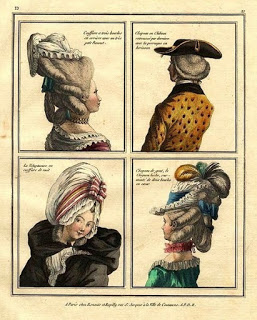
Found – a scrapbook of press-cuttings mostly from the Irish newspaper the Cork Gazette. This cutting dates from about 1789. They are mostly taken up with oddities, strange wagers (can a walking man cover 20 miles faster than a walking horse?*) horrible executions, feats, obituaries, a letter from Dean Swift, marriages of royals etc., This piece about current extreme fashions is an example of the  slightly sensational journalism of the time…

Fashion

This most whimsical of all human inventions has undergone, within these few years the most unaccountable changes imaginable, nor is she yet at rest but, with Protean wantonness, every day affirms the new form, leaving a gaping world in pursuit of her. One no sooner catches her, than she escapes, then presents herself under a different form, still more seducing and irresistible than the former.

One time she lets her head grow to the length of a cows tail, then cocks it – it sometimes flows loosely, and others nicely plaited and made into tresses – she soon prides in frizzing, and after that falls down by the ears, hanging like a pound of candles – her  present frolic is a crop, which for aught we know be soon metamorphosed into a shorn head.

Continue reading →

Spice Girls spice labels

[raw]

Sent in by a loyal jotwatcher this useful and amusing piece about the Spice Girls and Viz the cult British comic magazine. It probably dates from about 1996. Go easy on the nutmeg!

Spice Girls spice labels

Does anyone remember that issue of Viz that appeared at a time when the Spice Girls were at the height of their fame. This particular number featured cut-out ’n’-keep labels which could be stuck onto spice jars. Aping the designs of the famous Schwartz spice bottles, there was one label for four of the Spice Girls—‘Scary Spice’ was left out for some reason.  Was I the only person who actually cut out the labels and used them? I somehow doubt it. Anyway, I’ve still got them, although they are getting a bit grubby. Each label contains a description of each of the spices, together with a recipe contributed by one of the girls.

Victoria presents Basil.
There is no finer sight in a herb garden than a basil flower. Generally used to add colour a dish, Basil is completely tasteless, but compensates for this by being extremely flavourful. It can be bought in most supermarkets or stolen from posh people’s gardens.

Victoria’s recipe. Welsh rabbit.     Place your rabbit (or hare if in season) on the toast and cover  generously with cheese. Then toast until Welsh throughout. Add Basil to taste and serve

Toast
Cheese.
Rabbit
Basil

Continue reading →

A Visit to Mars (part 2)

Map of Mars (1894)

More from  the Dutch astronomer, Professor G. Van den Bergh  ‘A Visit to Mars ‘ a chapter in his The Universe in Space and Time (1935). In this account, which has weird parallels with the adventures of the Matt Damon character in the recent movie The Martian ‘a man, an inhabitant of the earth, succeeded in reaching Mars by rocket. He remained there a few years and evidently managed to keep alive, thanks to his good equipment and a large stock of provisions’. After a while this man returned to Earth, but was killed when his rocket crashed. It transpired that the man had kept a diary, but only a few pages could be rescued from the crash site, some of which were reproduced in the chapter. This continues an earlier jot.

Continue reading →

William Loring, academic, soldier and first Warden of Goldsmiths

Found among  the papers of the long defunct literary agency Michael Hayes of Cromwell Road S.W.5  - parts of a manuscript memoir by one L.R. Reeve of Newton Abbot, South Devon. Mr Reeve was attempting to get the book (Among those Present: Very Exceptional People) published, but on the evidence of the unused stamp Hayes never replied and  L. R. Reeve published the book himself through the esteemed vanity publisher Stockwell two years later in 1974.

L R Reeve had in a long life met or observed a remarkable selection of famous persons. He  presents 'vignettes' of 110 persons from all grades of society (many minor or even unknown) they include Winston Churchill, Dorothy Sayers,  H H Asquith, John Buchan, the cricketer Jack Hobbs, J.B. Priestley, H.G. Wells, Marconi, E.M. Forster, Duchess of Atholl, Marie Stopes, Oliver Lodge and Cecil Sharp -- 'it is unnecessary to explain that  many I have known have not known me. All of them I have seen, most of them I have heard, and some of them have sought information, even advice from me."

Continue reading →

Madge Gill and the Bournemouth crime

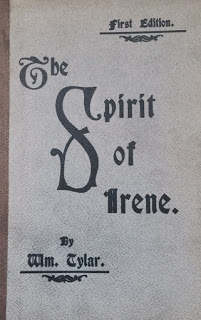
Found - a curious and very rare spiritualist book The Spirit of Irene Speaks published in Bournemouth in 1923. The title refers to a notorious murder in 1922 of a young cook, Irene Wilkins, who had travelled down to Bournemouth to London in response to a potential employer from an advertisement she had placed in a local paper. She had been met at the station in a large Mercedes and her body was found in a field the next day battered to death. Eventually a chauffeur was arrested, one Thomas Henry Allaway. An astute car designer had noted the car's registration number at the station and he was also recognised by a telegram clerk… The book claims that through 'psychometrics' (in this case the psychic tracing of the murderer through clairvoyant communications from an object from the murder scene) a medium had solved the case and there is a weight of convincing evidence in the book and suggestion of police co-operation. No account of the case found online mentions this aspect of the case.

However the book is notable for other reasons. It has a long plea at the beginning by Dr Abraham Wallace for the repeal of capital punishment as being irrational and unchristian and a further article on 'The Futility of Capital Punishment.' The endpapers of the books are designed by the cult outsider artist Madge Gill. She is mentioned in the text as having produced these 'automatic drawings'. She is called Madge E. Gill from London ('this lady through her mediumship obtains gorgeous oriental designs in marvellous colour schemes, and quite unusual in conception.  She also, under control, does the most beautiful embroidery and needlework…)

Madge Gill (1882- 1961) was a prolific outsider and visionary artist.  She was introduced to Spiritualism by an aunt when she was in her teens in East London. Later when she was about 40 she began creating thousands of mediumistic most done with ink in black and white. She claimed to be guided by a spirit she called "Myrninerest" (my inner rest) and often signed her works in this name. Many feature a young woman in intricate dress  often thought to be a representation of herself or her lost (stillborn) daughter, and female subjects dominate her work. Her drawings are characterised by geometric chequered patterns and organic ornamentation, with the blank staring eyes of female faces and their flowing clothing interweaving into the surrounding complex patterns.These endpaper drawings, different at both ends (rear endpapers pictured) do not have the female face…a book on her came out in 2013 by the musician and occultist David Tibet.

Rock and Roll Cookery

Found – an uncommon cook book called Cool Cooking. Recipes of your Favorite Rock Stars by Roberta Ashley ( Scholastic Book Service USA 1972). As it was published 40 years some of the stars are now dead (John Lennon, George Harrison, Eddie Kendricks, Wilson Pickett, Joe Cocker) or sadly forgotten (The Honey Cones, The Grass Roots, The Bells, Andy Kim, Odetta, The Delfonics, Rose Colored Glass, Mandrill) and Paul McCartney was still eating meat. He provides a pizza recipe with sausage and anchovies etc.,

Some recipes are long and complicated and some short to the point of minimalist. From Elton John (‘who doesn’t cook at all’) is a multi ingredient Shrimp Currry. Kris Kristofferson’s Tacos looks slightly difficult but he advises (unlike Nigella) ‘prepackaged taco shells’. George Harrison’ s Banana Sandwich requires bread and a banana with peanut butter optional -‘Slice  a ripe banana lengthwise and lay on a piece of bread. If you like, you can spread the bread with peanut butter.’ That’s it.

Another banana themed recipe comes from Carly (‘You’re so vain’) Simon. Carly ‘likes strange food combinations she creates spontaneously’. This concoction, she says, tastes great with yoghurt and mandarin oranges.

Carly’s Concoction
Chopped Walnuts
1 container cottage cheese
1 banana
honey ( as much as you like)
Mix the walnuts into the cottage cheese and sliced the banana over the top of this mixture. Pour honey over the whole concoction and serve.

Lastly John Fogerty ( Creedence Clearwater Revival) has a good egg recipe for a rock and roll breakfast.

Fogerty Scrambled Eggs
4 eggs
1/2 cup sour cream
salt and pepper
1/2 stick butter

 Beat  the eggs well and stir in the sour cream ; add salt and pepper and blend. Melt the butter in a skillet and pour in the eggs. Fry over a medium heat, stirring frequently, until the eggs are  solid. Serves 2.

Some tall tales

The veteran anthologist Peter Haining (1940-2007, pictured right) only managed to make a decent living by having a number of different projects on the boil at once. Although it has been estimated that he published around 200 books, not all of his ideas came to fruition. One that didn’t excite publishers was ‘Tall stories ---an anthology of boaster’s tales’, which he was hawking around in April 1991 as a potential Christmas book.

Haining’s introductory presentation to one publisher promised stories by ‘a veritable galaxy of star names ‘ in which ‘ fiction outweighed the fact ‘. Some of these stories would be presented by their authors as ’ ostensibly true ‘ while others would be ’ unashamedly fictitious’.

Some of the material that he intended to reproduce included Spike Milligan’s ‘Agent 008’, Lord Dunsany’s ‘The Electric King’, Baron Corvo’s ‘ How I was buried alive’, Charles Dickens’ ‘’The Wide-awake Club’, Tom Sharpe’s ‘ Disaster in the Deep Bed’, Fitz James O’ Brien’s ‘ How I achieved perpetual motion’, Stephen Leacock’s ‘ The iron man and the tin woman’, and G.K.Chesterton’s ‘ The Club of Queer Trades.’

I’d certainly publish a book which included those titles, but perhaps the titles were better than the stories.

Continue reading →

The Magus – ‘a bizarre and baffling film’ 1970

A contemporary piece about this ill-fated movie, which although often slated, most notably by Woody Allen ('If I had to live my life again, I'd do everything the same, except that I wouldn't see The Magus') has become something of a cult. The article was found in PHOTOPLAY (February 1970) a British film and pop music magazine. The long winding part about the plot has been mostly excised.

The Magus - a bizarre and baffling film which winds through a labyrinth of fantastic happenings. 

What is a Magus? According to the best dictionaries it is "one skilled in Oriental magic and astrology, an ancient magician sorcerer."

And so to our story:

Continue reading →

‘There will be no beautiful women on Mars’–and that’s official

[raw]

Speculation on whether there is life on Mars and what form it might take has been going on since the planet began to be seriously studied. Writers of fiction have let their imaginations run riot, with ludicrous results, but even scientists have been guilty of groundless speculation. Two items from the Peter Haining archive —an incomplete clipping dated 1924 from the Daily Express and a chapter from The Universe in Space and Time of 1935 throw interesting light on the subject.

Back in 1924 the Daily Express published a report by a certain Monsieur Camille Flammarion, ‘the famous French astronomer’, that ‘ the people of the earth will be both shocked and disillusioned if ever they become acquainted with the Martians’. “First of all”, he states, “there will be no beautiful women there. They may be beautiful according to Martian standards, but to us they will probably look frightfully hideous.” It’s all to with the ‘rarer’ atmosphere of the planet, apparently.

Continue reading →

Earthquake in England

Found in John Thomas's Earthquake in England (Unbelievable but True) -published by Blackwood's in 1938, this press cutting from the late 1970s from an unnamed newspaper.

Quakes can be our worry, too. Peter J. Smith

At 9.18 on the mining of April 22, 1884, Dr Alexander Wallace and his family were in their garden looking across at the roofs and spires of the town near by. Suddenly, with a roll of sound like "passing wagons", the buildings began to sway and chimneys crashed to the ground in clouds of dust. Dr Wallace saw his house rise and fall and heard ornaments hitting the floor. He felt sick and shaken, but the fence he grasped for support was rocking too. Less than six seconds later it was all over.

What Dr Wallace and his family had experienced was an earthquake. But they were not visiting Japan, California, the Mediterranean or any other of the world's known belts of destructive earthquakes. This was Colchester, Essex, where such things were unheard of.

In the town itself more than 400 buildings were damaged... the brunt of the damage was taken by villages closer to the shock centre to the east and south-east of Colchester. At Peldon, for example, no house or cottage escaped and 70 percent of chimney stacks were thrown down. Nobody was killed, but within an area of about 150 square miles more than 1200 buildings required repair.

The Colchester earthquake of 1884 was the most destructive ever known in Britain and was felt as far away as Exeter in the west and beyond York in the north. But it was not the first British earthquake; nor, contrary to popular belief, are such events uncommon.

Continue reading →

The Liberty League—a campaign against Bolshevism

This interesting cutting from the Haining archive tells some of the story of the short-lived Liberty League. Less than three years after the Russian Revolution had erupted, leading figures in public life, alarmed by the progress of its ideas in the West, got together to initiate a counter campaign that would challenge Bolshevism in the UK and throughout the empire. The new force for good was ‘The Liberty League’ and on 3rd March 1920 an open letter declaring its objectives and signed by H. Rider Haggard, Rudyard Kipling, Lord Sydenham, H. Bax-Ironside, John Hanbury Williams, Algernon Maudslay and  Lt –Col G Maitland- Edwards, was published in the Times. The signatories began by defining Bolshevism and its aims.

Bolshevism is the reverse of what mankind has built up of good by nearly two thousand years of effort. It is the Sermon of the Mount writ backward. It has led to bloodshed and torture, rapine and destruction. It repudiated God and would build its own throne upon the basest passions of mankind. There are some misguided people of righteous instincts in this country who believe in Bolshevism; there are others who have been influenced by secret funds. There are many who hope to fish in its bloodstained waters.

We, the undersigned, and those we represent, being assured that if it is allowed to conquer it will mean in the end the destruction  of individual rights, the family, the nation, and the whole British Commonwealth, together wit the handing over of all we hold sacred into the power of those who stand behind and perhaps have fashioned this monstrous organization...

Continue reading →

John Steinbeck and ‘The Wizard of Maine’

Found among a collection of modern first edition catalogues this offering from Bradford Morrow in a catalogue entitled John Steinbeck: A Collection of Books and Manuscripts, Formed by Harry Valentine of Pacific Grove, California (Bradford Morrow Bookseller: Catalogue 8/1980). Morrow has subsequently become a distinguished novelist.  Hopefully this was  bought by a library but it could also have gone to a wealthy private collector. It does not appear to have ever been published. Many such items, especially letters and association copies sometimes disappear completely, and the only record of the item is a catalogue entry…

Manuscript of Unpublished Novella

289. ‘The Wizard of Maine’. Original holograph manuscript written on 30 folio leaves and laid into original three-quarter cloth and marbled paper binder, of an unpublished novella by Steinbeck. Each sheet is written on recto only
in Steinbeck’s distinctively cramped and neat hand, and the length of the text amounts to well over 15000 words. The novella begins with the following passage:

In a time not so very long ago, an ancient creaking, complaining caravan squeaked and grumbled through the hamlets and towns of Eastern America. From Maine it went to the cool lakes of Wisconsin and, by-passing Chicago, too itself to the fabulous meadows of Kentucky. It smooth [sic] oak tongue and ancient harness were shared by a succession of horse rescued for a time from glue and fox feed factories. And it was a good life for these horse for the caravan did not go far nor fast in a day and it stopped where there was pasturage…

‘The Wizard of Maine’ is divide into six sections,and is the story of a travelling elixir salesman and magician who has set out from his home in Maine and travels across the country in hope of being discovered, so that he can perform his tricks on stage as a professional. Composition date for the manuscript is unknown, but would seem to date from the 1940s based upon the style of the binder housing the paper. The manuscript has numerous alterations and is in need of minor editing. It is, however, a highly diverting and typical Steinbeck story which should be published…Needless to say, Steinbeck manuscripts of this length and importance, which are still unpublished, are virtually gone from the market place. Enclosed in folio custom morocco slipcase. Further details available to interested parties. $27500.00

[RMJ – London]