Author Archives: Jot 101

Focus—a magazine for the alternative lifestyle

Utopian fiction— as purveyed by H. G. Wells, Ford Madox Ford and Aldous Huxley ; the vegetarian movement, calisthenics and other health –promoting practices, including naturopathy and hydrotherapeutics, and psychoanalysis—were all increasing in popularity among the chattering classes of England in the years that followed the end of WW1. And Focus,which advertised itself as ‘to the point in matters of health, wealth and life’, was one of the magazines that catered for this new demand. Focus cover June 1928 001
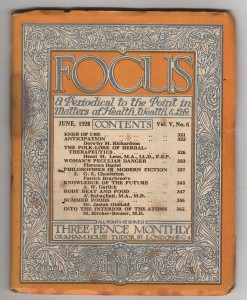
Rooting through the archive at Jot HQ we found two copies of this ‘little’ magazine ( it was only the size of a prayer-book) and one of the first things that struck us was the high proportion of adverts in them. In the issue for June 1928,  out of its sixty pages a quarter were adverts. And these ads told you a lot about the magazine’s readership. Perhaps the most interesting advert was for the famous Stanboroughs Hydro, near Watford. Here among 200 acres of parkland the Hydro offered cures of all kinds, including Electric Baths, Ionisation, Diathermy, Phototherapy, Artificial Sunlight, Massage and X –Rays. Incidentally, Stanborough is still there. Other adverts were for similar health farms , such as Uplands, the ‘Nature Cure’ retreat near Hereford. This establishment offered such regimes as the Exclusive Milk Diet and way-out psycho therapies, such as Auto-Suggestion by the Coue method. Focus also gave space for the alternative life-style gurus, such as Dr H Valentine Knaggs (1859 – 1954), whose self-help booklet, Blood and Superman,was less to do with the influence of Nietzsche and more to do with the purity of the blood stream in the attainment of the higher faculties. Other titles from Knaggs included The Mischief of Milk(1920), The Salad Road to Health (1919), and the Right and Wrong Uses of Sugar (1923). Such warnings seem amazingly prescient to us in 2019. But as if to prove that Focus 
was not the whacky reservoir of alternative medicine that some of its content appeared to suggest, the editor also included an article by the Swiss nutritionist who popularized muesli, Dr M. Bircher-Benner ( 1867 – 1939) entitled ‘Into the Interior of the Atoms, ‘ a survey of the latest discoveries in particle physics, and in particular the recent theories of Niels Bohr, which was  illustrated by an amazing diagram of the electron paths of a radium  atom.


But Focus was nothing if not eclectic. In the same issue we find a piece by  Patrick Braybrooke, who as well as being the father of Neville, who became a prominent literary figure in the neo-romantic movement of the 1940s, was also an authority on G. K. Chesterton, H.G.Wells and Thomas Hardy. In part six of his series of features on ‘ Philosophies in Modern Fiction’  Braybrooke examines the philosophy of Chesterton, which he sees as being inimical to a rational view of society, but which instead promoted an essentially humanitarian sense of wonder towards the ‘ picturesque, the glories of the old legends (and ) the glamour of the Middle Ages’. In this, Braybrooke suggested, he opposed ‘any superman ideas ‘.This invocation of the idea of ‘ superman ‘ was probably  a dig at the atheistic, ‘ progressive ‘George Bernard Shaw, whose play ‘Man and Superman’ dealt with the philosophical implications of Nietzsche . It is likely that Braybrooke saw Chesterton’s old school Catholicism both as a corrective to these notions and part of the movement towards the attainment of a simpler, alternative lifestyle which was underpinned in his case by religious faith. Continue reading

Neurasthenia cured by electricity

Used as early as 1829, the ‘ medical ‘ term neurasthenia to describe nervous weakness was quickly taken up in America forty years later when  neurologist George M. Beard formally introduced the concept of ‘ nervous exhaustion ‘.

neurasthenia advert 1921 001

With symptoms that included anxiety, headache, palpitations, high blood pressure and mild depression, neurasthenia became associated with the pressures suffered by  middle-class businessmen, politicians,  and others sold on the American Dream. Indeed, it was nicknamed ‘Americanitis ‘ and claimed President Roosevelt among its sufferers. William James, Proust, Wilfred Owen and Virginia Woolf were also neurasthenic. By the 1920s it had definitely become a fashionable condition among certain groups in Western society ( it was virtually unknown among the labouring classes, assembly workers and shop assistants) and its popularity engendered a whole industry of quack cures. In an earlier Jot we learned that the regular imbibing of a nerve tonic could banish neurasthenia. Mrs Woolf swore by lengthy ‘rest cures ‘. But in this advert from a January 1921 issue of the British magazine The Review of Reviewswe are shown how electricity administered through the Pulvermacher Appliance might be the answer.


But before the poor sucker, sorry, sufferer , was asked to shell out to The Pulverbacher Electrologial Institute ( established 1848)  of Ludgate Hill, London,  he/she was asked the following questions:

Are you nervous, timid or indecisive ?

Do you lack self confidence?

Do you dread open or closed spaces?

Are you wanting in Will Power?

Are you ‘fidgety’, restless or sleepless?

Do you blush or turn pale readily?

Do you shrink from strange company?

Are you subject to sudden impulses?

Do you crave for stimulants or drugs? Continue reading

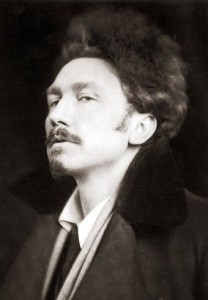
An early review of Pound’s Personae (1909)


340px-Ezra_Pound_by_EO_Hoppe_1920It’s often enlightening to read very early reviews of major writers, especially modernist writers. In 2019 we have the benefit of knowing how certain ‘ big names ‘ developed and influenced others, while the innocent reviewer of an early work has only the words on a page. A gifted reviewer may sense that a writer under review is destined for greatness, but most reviewers are hacks and care little. In the case of Ezra Pound, the anonymous review of his third collection, Personaethat appeared in The Literary Worldof August 15th1909, suggests that the reviewer was already an admirer of his first two collections, A Lume Spento(1908), which had been privately printed in Venice in a tiny edition of just 150 copies, but which Pound had persuaded the London bookseller Elkin Matthews to display in his window—and the follow up, A Quinzaine for this Yule—also in a tiny edition. A London Evening Standardreviewer described the former as ‘wild and haunting stuff, absolutely poetic, original, imaginative, passionate and spiritual’. It seems that the Literary World reviewer was of a similar mind:
 

No one can lay the charge of being invertebrate against Mr Pound. His poems are marked by a singular ‘ backbone ‘ and energy. He draws largely on old romance for his themes, but imbues every theme with a certain spirit of high-handed courage. The ‘ Ballad for Gloom ‘ is striking; ‘ Mesmerism ‘is a clever imitation of Robert Browning  at his jerkiest. We quote from a poem, ‘ For E.McC, that was my counter-blade  under Leonardo Terrone, Master of Fence’.


              Gone while your tastes were keen to you,

              Gone where the grey winds call to you,

              By that high-fencer, even death,

              Struck of the blade that no man parrieth;

              Such is your fence, one saith,

              One that hath known you.

              Drew you your sword most gallantly,

              Made you your pass most valiantly,

              ‘Gainst that grey fencer even death.


Personae 
was a commercial success and thereafter Pound’s literary career was assured. [RR]


A West African Diary (195) part three

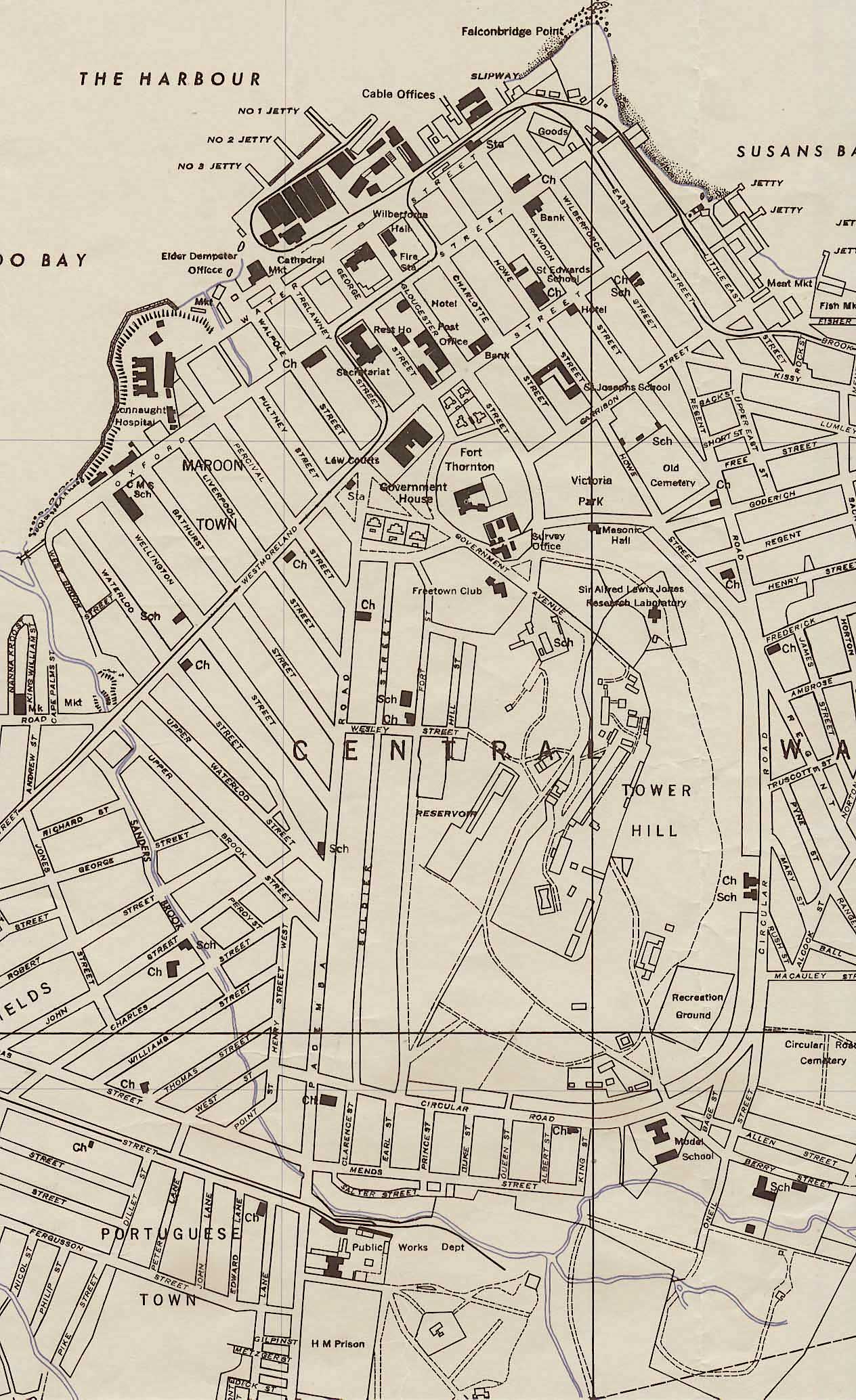
West African diary ghana mapOur visitor to West Africa (see previous Jots) in 1954 travelled by ship from Freetown to Takoradi on the Gold Coast ( now Ghana) in late February. On the 21stof this month he recorded his impressions of his fellow passengers.

At sea

Dinner  time. Is the African a snub? Observations of my fellow third-class passengers reveals it—because I boarded the boat at Freetown, and they from the UK, they are aloof. A Yoruba woman boasted to me that my journey from Freetown to Takoradi was short; and that I should go to England to experience the roughness of the bay. What arrant nonsense! Afternoon of us Africans are sweating profusely. An English woman—Rev! Paterson travelling to Ashanti to stay with Prempeh, king. Gave the sermon this morning. Although I did not attend I hear that she was very frank British Colonial policy. Racial strife in South Africa. Australia’s white only policy ; the erudite class of China and India; and the teeming thousands of these two countries. After supper discussion. Mr ( blank) a law graduate returning home to Nigeria told the story of a young Nigerian doctor who returned home with an English wife. His father did not know of the marriage and therefore resented it. During the party held in the honour of the new arrival, the father refused to mix with the young couple and drank alone. Pretty soon he walked up to his daughter-in-law and called her names. Her husband held her hand. She looked pleasantly on. The doctor’s mother had taken to her grandchild. Meanwhile the news of the Doctor’s marriage spread like wild-fire. And the town resented it. But the wife proved herself capable, and with the help of her husband she won all the women, young and old, on to her side.; old men too were soon admiring her qualities. She is the most popular woman in the town –an Ebo town.


By 2ndMarch he had reached his destination. On this day we find him witnessing the usual rowdy local elections.


March 2, 1954. Municipal Elections .

Ward 5.

I arrived on the scene at 6.30 a.m. The queue was large—polling starts at 7 a.m. Enthusiastic crowd. C.C.P. vans plough the whole area of ward 5. A van is playing Yoruba records in the Yoruba quarters ; a woman propagandist is really telling the women why they as women should vote C.C.P. The political machinery of the party is efficient—most of the men & women queuing are illiterate, esp. Hausa’s & Fantis…A C.C.P. propagandist speaking Hausa, shouting slogans …C.C.P. candidate’s name—Atta Housaine. Continue reading

A Victorian joke book

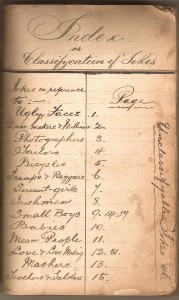
victorian joke book index page 001Found at Jot HQ the other day a small scrapbook containing pasted in humorous cuttings from magazines and newspapers that once belonged to the late prankster Jeremy Beadle (1948 – 2008). The date 1897 on the cover was very likely the year in which the compilation was begun, since many of the jokes and anecdotes are clearly of a later date. The high quality of much of the material strongly suggests that the compiler may have been a comedian of some sophistication who was prepared to devote a long period in search of the best gags.
 

The jokes are classified into several groups thus:

Ugly faces, dress-makers and milliners, photographers, tailors, bicycles, tramps and beggars, servant-girls, Irishmen, small boys, babies, mean people, love and love-making, mashers, teachers and scholars, country bumpkins, cats, dogs and other animals, singers and musicians, weddings and parties, married men & women, soldiers and the army, ‘tall’ stories, railways, ships & seasickness, conundrums, puns,   ‘new ‘ women, comic rhymes, watches and clocks, definitions, boosey jokes, doctors, shops and shopkeepers, bits of advice, deaf people, hotels and lodgings, actors and the stage, fat people, girls and their doings, ‘ catch ‘ jokes, football, hairdressers , churches & clergymen, mothers-in-law, prisons & prisoners, man & his doings, or unclassifiable jokes, hens and eggs, restaurant, Jews, jokes for twoperformers, swimmers, country yokels, fish tales, patriotic, sailors & ships, dentists.


Some favourites


George III wondering how the apple got into the dumpling is nothing to the small boy who, looking between two uncut leaves of a magazine, said” Mammy, how did they ever get the printing in there?” Continue reading

Contact Magazine 1950

Call it lazy journalism if you like, and we at Jot 101 do, but in all the obituaries of the great
publisher George Weidenfeld in 2016 there is no mention of the magazine Contact, which he edited from 1950. This is a glaring omission, since it is a showcase for the talents that this refugee from the Nazi Anschluss of Austria in 1938, shared in abundance with so many other émigrés from the Third Reich.


According to one obituary, having landed in the UK Weidenfeld soon put his knowledge of Germany and the German language to good use by enrolling in the BBC’s Overseas Service, though others say that he was recruited to the BBC Listening Station near Evesham, where his co-workers would have included British journalists like Geoffrey Grigson and Gilbert Harding and other German-speaking émigrés, such as the art historian Ernst Gombrich. In 1948 Weidenfeld joined up with Nigel Nicolson to form the publisher Weidenfeld and Nicholson with the express aim of launching a socialist magazine that would unite politics with the best of culture. There is no mention of the name of this magazine anyway on the Net, but Contactwas certainly not it, as there is no hint of any political agenda in the copy for September 1950 that we found at Jot HQ the other week.


What is obvious is that although the name of the publisher is absent from the title page of Contact, if we turn to page 56 we find that in an advert for three books published by ‘ George Weidenfeld and Nicholson’  the address of the editorial office of 7, Cork Street is the same as that of the editorial office of Contact. Why Weidenfeld should not want to be easily identified as both the editor and the co-publisher of the magazine is not immediately apparent. What is obvious is that he was keen to sign up some of the rising stars in British cultural journalism as contributors.


But not all were British. The ‘ provocative’ American columnist on the New Yorker, Emily Hahn, contributed an entertaining sketch on the behaviour of well-heeled American tourists in post-war London:


‘ They are afraid of boredom; they do not have their own kitchens and sitting rooms. They simply must find restaurants and places of amusement; they are homeless wanderers otherwise…Average English restaurants are not inspiring. Americans soon become aware of this fact. In Paris one eats with pleasure in French restaurants: in Italy one eats Italian food. But in London the wise American looks around for a restaurant which is not typically native… ‘
Continue reading

On the quality on certain nineteenth century paper


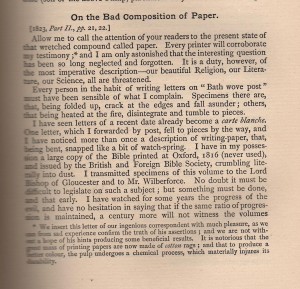
paper quality page 1 001Researchers in newspaper and magazine archives often complain about the horrendous quality of newsprint they encounter. Sometimes whole pages are brown and need to be handled with extraordinary care as they are turned, lest they crumble to dust— to the embarrassment of the researcher. The decline of paper quality seems to have begun towards the end of the nineteenth century and is attributed to the high acid content of the wood pulp used for printing cheap publications—mainly newspapers and periodicals, particularly adventure and school stories for boys, but also mass produced books issued in serial form.  The decay of newsprint appears to accelerate  with exposure to sunlight, which explains why single issues of newspapers and magazines are much more likely to turn brown and crumble than bound volumes.
 

The quality of cheap paper in the early nineteenth century could also be poor, depending usually on the type of publication. The paper used for popular magazines and cheap editions of books was likely to be of less quality than that used for fashionable three- decker novels, new poetry and books of travels, for instance. It may also be true that before the universal penny post was introduced in 1840 the paper used for letters was of lesser quality and also made deliberately lightweight to save on postage costs. This may explain why the letter referred to in this extraordinary communication to the Gentleman’s Magazinein 1823 tore so easily. The other references to paper quality and printing ink in this article, however, are surprisingly to anyone with a knowledge of book history. Particularly fascinating are the scientific explanations as to why the quality of some paper in this period was so compromised. Continue reading

Books do furnish a room: Philip Gosse on book collecting

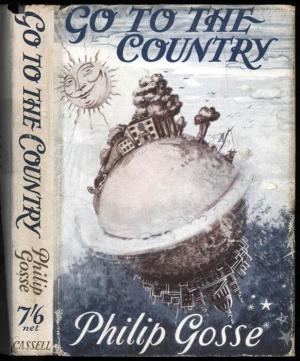
Gosse go to the country jacketThe twentieth century writer Philip Gosse  was one of those many British physicians    who changed direction into literature. Others, including Oliver Goldsmith, Thomas Smollett, John Keats, Samuel Warren, Robert Bridges, Francis Brett Young, and Somerset Maugham, took up poetry or fiction, but Gosse began with books on pirates. In the collection of essays entitled Go to the Country(1935) we learn that by the time he had given up medicine Gosse had managed to acquire a large country house called ‘Crossbows’ that was spacious enough to have threeguest rooms, which for a bibliophile like him ( his wife also collected) was the ideal environment. Moral: if you are a seriousbook collector make sure that you make enough money to acquire a home large enough to house your collection.


Gosse succeeds in making every less fortunate collector envious by writing glibly about all the space he owned in which to shelve his huge library, and then shocks us by mentioning that while a GP he was momentarily tempted to pocket perhaps the only book in the house of the patient he was visiting—a work entitled Fancy Mice for Pleasure and Profit.Gosse is good on the way books should be housed and displayed –scattered around on tables or on open shelves which allow air to circulate, rather than in caged bookcases, where damp and mildew are encouraged to thrive, although he later rather puzzlingly admits to owning ‘ three tall bookcases with glass fronts ‘ in which his rare association copies were housed.


Gosse’s four works on pirates grew out of his own mania for collecting books on this subject, which luckily for him was not one for which he had any rivals among collectors. Because of this he was able to buy nearly every edition of the two works published by the mysterious eighteenth century chronicler Charles Johnson, and by so doing brought out a Johnson bibliography. Continue reading

A West African Diary part two

freetown_1947In our first extract from the diary kept by an anonymous male visitor ( possibly of African heritage) to West Africa early in 1954 we left him looking around Freetown in February. We continue with his observations from the 13thof that month.


‘ People one pass in the street at 7.30 a.m. have pleasant odour. Had some paw-paw this morning. Did nothing spectacular this morning and afternoon. Went to the City Hotel this evening with Mr John and meet there a Swede seaman who had been in hospital. He is waiting for a ship to go home.


Feb 14.

I went to the City Hotel this morning for a cup of tea. From the Hotel veranda I saw a queer thing—a middle age European and wife entered their car; the wife sat in front with the driver, the husband sat in the back alone. Got a cable from Sam at 11 o/c A.M.


15 Feb.

Camara & I went to the City Hotel. There we were invited into the august comp. of Lawyer Mahoney, Markus Jones, Admin. Officer, who travelled on the Apapa with us, and a local newspaper man, and a building contractor. The discussions were very enlighting.


16 February.

I saw a distasteful scene this afternoon in a primary school near Victoria Pk. A teacher was caning juvenile with all the vigour he can muster. Its was discraceful . Advance 30/- to John.


February 17, 1954.

I met a Somali in Victoria Pk. We were both listening to the radio news . Finally we got to know each other . I learnt a lot from him. He is a Moslem. The Syrians and the Indians in Freetown do not respect nor trust the inhabitants . They would rather keep a stranger in the city. There are three million Syrians out of Syria. Continue reading

The Book of Total Snobbery


From the wondrous library of Jeremy Beadle. and signed by him in pencil, is a copy of The Book of Total Snobbery(1989)  compiled by Lynne and Graham Jones.Rowse pic

Mr Beadle has littered the text with various dates, but if the date ( 5 DEC 1906) alongside snobbish remarks made by the popular historian and alleged ‘ poet ‘ A.L Rowse refers to the Oxford don’s date of birth, it is wrong by several years. Be that as it may, Mr Beadle seems to have been amused or even shocked by what he read of Rowse.


It may be true, as the compilers and Rowse himself admitted,  that someof his  snobbish remarks were deliberately provocative, but what is not true is that the historian was’ a nice old bean ‘. To some, including the late Brian Aldiss, who was  a very nice and generous person, he was one of the more repulsive dons that he had to deal with while working as a bookseller’s assistant (see The Brightfount Diaries) in Oxford during the fifties. The Jones’s confirm as much. Rowse—at one time a Labour supporter it must be stressed—always held the common man in contempt:

‘I have genius ‘, he once remarked, ‘ordinary human beings are bloody idiots ‘. On another occasion he told a reporter from the Times‘ There’s the paradox, dear, not only am I first rate, I am an enormous best-seller as  well ‘. And there’s more:


‘I don’t live my life among ordinary human fools. I really am the most colossal   highbrow, my dear. I’m hardly human, you know’


‘My real mission in life is to teach clods to use their brains’


‘I’m really rather fortified by my contempt for contemporary society. I’m happy working creatively for myself. I’m not interested in what third-raters think of them’


‘The truth is that ordinary people are incapable of working without direction’.


The rather ironic aspect of all this is how the academic historians at Oxford felt about Rowse’s writings. Many devalued his work as being too ‘ popular ‘.


Incidentally, Rowse’s snobbery even extended to inhabitants of his native county. In a letter to me he argued that the acclaimed poet and critic Geoffrey Grigson wasn’t Cornish, despite being born in Pelynt, near Looe. He didn’t have Cornish blood, you see. It is true that both Grigson’s parents came from East Anglia, but you try telling someone born in Yorkshire that because his parents ( or one parent) hailed from, say Derbyshire, that he was by virtue of this, no Yorkshireman.

R.M.Healey

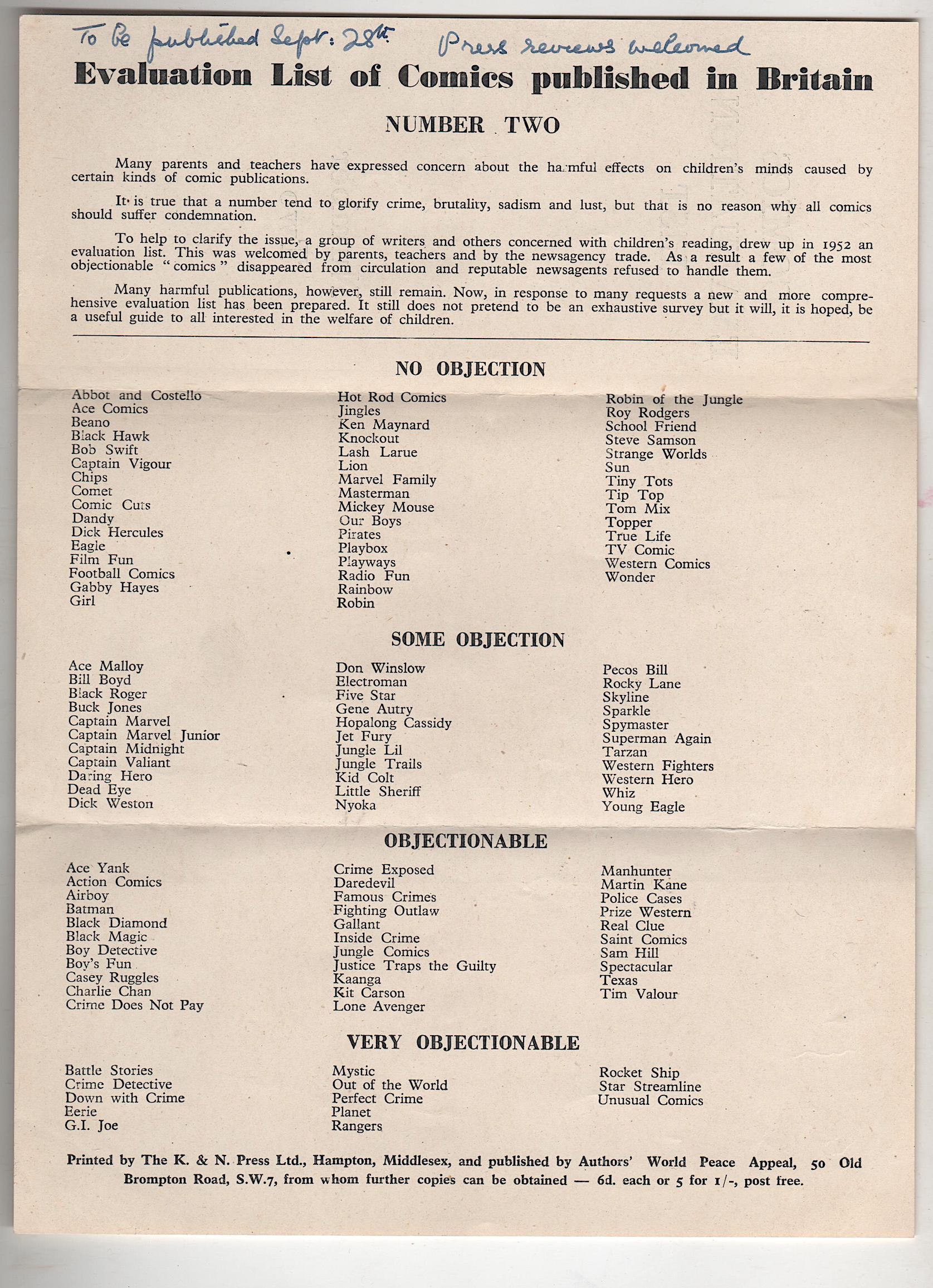
Censorship in Action—-The Comics Evaluation List, number two.

Comics evaluation list maIN PAGE 001Found among a pile of literary ephemera at Jot HQ is this single sheet folded twice and entitled ‘ Comics Evaluation List  Number Two ‘. According to a handwritten inscription at the head of the text this was evidently a proof of a document to be published, probably in September 1953. In 1952, in the words of the introduction ‘ a group of writers and others concerned with children’s reading’ had drawn up a list of comics that glorified ‘ crime, brutality, sadism and lust ‘. As a result of this first ‘ evaluation list ‘ some of these publications had ‘disappeared from circulation and reputable newsagents refused to handle them’.

This second list was to be a more extensive catalogue of offensive publications that nonetheless included those comics to which the board of censors had no objection. If we look at the publication details on the bottom of the list we find that it was printed for the ‘Authors’ World Peace Appeal’. Further investigation reveals that this was a British pacifist organisation launched in October 1951 which flourished in the immediate post-war period of Cold War incriminations where the horrors of the Holocaust and of Hiroshima and Nagasaki were still fresh in the public mind. In their Bulletin number 7 (n.d.) the writers mentioned in the Comics list expressed their views thus:-

‘We writers believe that our civilisation is unlikely to survive another world war. We believe that differing political and economic systems can exist side by side on the basis of peacefully negotiated settlements . As writers we want peace and through our work will try and get it, and we pledge ourselves to encourage an international settlement through peaceful negotiations . We condemn writing liable to sharpen existing dangers and hatred. As signatories we are associated with no political movement, party, or religious belief, but are solely concerned with trying to stop the drift to war,’  

Some of the names of the signatories to this declaration are printed. The writers included:

Edmund Blunden, Vera Brittain, Albert Camus, Alex Comfort, Rupert Croft Cooke ( see earlier Jot), A.E.Coppard, Christopher Fry, William Gerhardi, Joyce Grenfell, Aldous Huxley, C.E.M.Joad, Marghanita Laski, Doris Lessing, C.Day Lewis, Compton Mackenzie, Naomi Mitchison, Sean O’ Casey, Kathleen Raine, Herbert Read, Siegfried Sassoon, Edith Sitwell, Dylan Thomas, Sylvia Townsend Warner. Continue reading

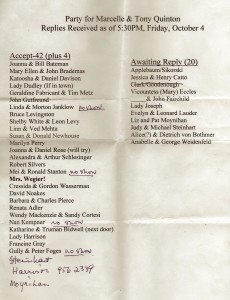
A Party for Tony and Marcelle Quinton

Quinton and Marcelle party list 001Found among papers at Jot HQ ( heaven knows where it came from ) is this printed list of the good and great ( some not so good) who were invited by a friend or friends to attend a party for the philosopher (Lord) AnthonyQuinton and his American-born wife Marcelle ( nee Weiger), a sculptor.
 

We don’t know who drew up the list or when the event took place, although it must have been in or before 2003, the year in which one of the invited died. Nor do we know where it happened, although one must assume that since most of the invited were Americans, the venue was in the US, most probably in the home of the host and hostess. This could have been in New York City, where the Quintons had one of their  homes. This philosopher had four homes around the world! Diogenes made do with a barrel, Wittgenstein with a bedsit furnished mainly with deck chairs.


Quinton taught philosophy at Oxford and is credited with having a rigorous intellect, but he was hardly a Wittgenstein or even an A. J. Ayer. The fact that he was a Tory and the intellectual force behind the political movement that propelled Margaret Thatcher to Downing Street, couldn’t have recommended him to the young who were reading PPE or PPP at his University in the 1980s. In the tributes that followed his death in 2010 friends and colleagues praised his bonhomie. Much of his clubbable personality came across when he presented the popular and long-running radio series ‘ Round Britain Quiz ‘, a truly challenging quiz show in which a  panel of high powered intellects ( as opposed to some of the nitwits that perform on ‘Celebrity Mastermind’ ) try to make connections between seemingly unrelated people, concepts and texts. Luckily, despite the general ‘dumbing down’ of broadcasting, the show has survived and, thank goodness, remains as challenging as ever it was. Continue reading

A visitor to West Africa in 1954

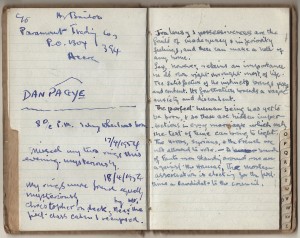
west african diary pages 001This fragmentary, though fascinating Diary, that occupies a section of a tiny Address Book, was found in the Jot HQ archives. It records a visit to west Africa in the first few months of 1954 by an anonymous male diarist whose remark that Africa’s dry season of Harmattan was ‘our winter ‘ suggests that he  may have been a native African or have had African heritage. He also mentions visiting his mother in Ghana. Moreover, a solo entry in the Address Book  dated two years before the Diary mentions ‘ English lessons ‘, and the erratic spelling and awkward grammar of the Diary entries are also strongly suggestive.

 

The diarist’s impressions of Sierra Leone and the Gold Coast ( which in 1957 gained its independence as Ghana)  must be read alongside the names and addresses that appear throughout the Address Book of people the diarist either encountered on his voyage to Africa, met while there or had previously jotted down as contacts to be visited. The diarist seems to have been a salesman of some kind keen to open new trading links between the UK and West Africa. For instance, there are allusions to ‘sorting out ‘samples, possibly of shirts, to show to potential clients and there is a reference to the ‘potentialities’ for Bavarian beer.  The diarist would not have been the first business man to have booked a voyage on the famous Elder Dempster ships that ran regularly from Liverpool to ports in West Africa, carrying goods there and returning with raw materials. On each voyage there would have been a limited number of places for passengers—perhaps two dozen or so. Our diarist appears to have stayed in Africa from late January until May before leaving for London and then for Sweden.


On his voyage out on the S. S. ‘Apapa’ he befriended some fellow passengers and started each day with a long run around the deck. In Africa he was entertained by local business men and dignitaries, and he recorded his impressions of these people as well as  social mores and political movements of the two countries he visited, while all the time expressing love for ( presumably ) his wife Mavis.


28th. January, 1954. Sailed today from Liverpool 4.30, sharing  Stateroom with a Mr Udoh, a business (man) who own the raffia shop in Manette St., London.

After high tea I took a bath. Mr Udoh played some records. Many Africans were shower-bathing. In bed at 10. Read till about 11.30.


29th Friday. The steward brought us tea at 6 a.m. breakfast at 8 consisting of chilled grapefruit and the grits.

Continue reading

In Honour of John Betjeman

Betjeman parody Fermor 1 001We found this very affectionate parody of John Betjeman torn out of a magazine (possibly the London Magazine) in our voluminous archives. It is by the eminent travel writer Patrick Leigh Fermor and appears to date from the fifties or sixties. Whoever tore it out obviously valued it as an item worthy of preservation, and indeed as parodies go, it is a pretty accurate imitation of the poet’s style.


Although the scansion is sometimes clunky ( or even downright bad) and the rhymes positively Byronic at times—risk it/biscuit; harmony/Abide with me—the piece is redolent of Betjeman’s inimitable , well, Betjemanisms, as it evokes a visit by bicycle to a parish church, which could be anywhere, but may possibly have been in Cornwall. As well as the expected allusions to ecclesiastical features—interiors and exteriors—and Anglican name dropping ( with the Catholic Pugin worked in)—we find the poem overloaded with evocative trade names ( Peak Frean biscuits, Ronuk polish, Raleigh and Rudge bikes, Dolcis, Lotus and Delta  shoes.


Because of his inimitable style Betjeman must be one of the most parodied of twentieth century writers. One of the best of these exercises appeared in Private Eyeduring the poet’s own lifetime, and we must assume that it was appreciated by its ‘ victim’. I learnt it off by heart and hope that I can recall it accurately:


‘ Lovely lady in the pew

Golly, what a scorcher, pheeew

What wouldn’t I give to do

Unmentionable things to you Continue reading

Extracts from a soldier’s journal kept while visiting the British Zone in Germany in late 1948

Screenshot 2019-02-09 09.49.46

Immediately after the end of WW 2 Germany was occupied by Allied forces and divided into 4 zones. The eastern quarter was given to the Russians and later became East Germany; the Americans occupied the south, the French had a tiny section to the south west, while the British were allotted most of the north.

It was exciting, therefore, to discover among a cache of ephemera at Jot HQ, a notebook issued to soldiers by the Stationery Office in which one soldier had recorded his brief visit to Altenau, a ski-resort in Lower Saxony in the centre of the British Zone, a few miles from the Russian Zone.

Little can be discerned from the brief journal, dating from the 6th to the 14th November 1948, concerning this anonymous soldier, who intersperses his entries  with postcards of local scenery, apart from the fact that he seems to have been on a furlough for these eight days. When he is not relaxing at the ‘Holiday Inn’ in Altenau, sipping port and reading, he is exploring the local countryside. One of his aims seems to have been to penetrate the border into Russian occupied territory. He certainly appears to have regarded the Russians with a mixture of fear and curiosity, born perhaps of the stories that emerged about their cruelty and barbarity towards the Germans, both during the war and immediately afterwards. He regards the Germans themselves with less fear, although doubtless aware that the resentment felt by them towards occupying forces might be a source of danger, particularly at night. For security reasons all soldiers in the British Zone were under strict orders not to converse with any of the natives—a rule which our soldier assiduously observes.

The journal shows considerable literary qualities, which suggests that the soldier, who may possibly have been born in the early 1920s, might have become a writer or journalist at some point in the future. Take the entry for Saturday 6th November:

Ober: 2.15 p.m.

The blue dusk hid everything but the lights of the town and the black masses of the hills.

Tourist-like I climbed down the carriage-steps on to the six-inch platform. Where were all the other tourists ? In utter solitude I crunched down to the sub-way.

A waiting- room, its atmosphere thick with the smell of German humanity. One large T.C.V. ---one small sergeant. Was I to be alone at Altenau? Utter & sublime solitude?

Continue reading

A Century of Best Sellers

Florence_L._Barclay

Florence Barclay

Part two—the obscure and the one-hit wonders

Part one dealt with the ‘big names’. Now, we are looking at the lesser fry who nonetheless were best-sellers between 1830 and 1930

G.W.M. Reynolds, The Mysteries of the Courts of London (8 vols, 1848 – 55).

Occasionally to be found in second hand bookshops, but rarely bought. In 1924 the TLSpronounced Reynolds as ‘ by far the greatest and the most fertile of a large crowd of authors who, in their fiction in penny weekly numbers and sixpenny monthly parts, reached a class of the early Victorian community untouched by both Dickens and Thackeray’.

Reynolds’ books were devoured by servants, seamstresses and mechanics, and according to the same TLS reviewer, ‘the circulation must have run into millions’.


Mrs Henry Wood, East Lynne (1861)

Mrs Wood, though not exactly obscure, belongs in the category of popular and bad. A bit like pot noodles. The critic H. W. Garrod found himself crying while reading a copy of East Lynne  in a railway carriage. When asked by a fellow passenger what the matter was he replied that he was crying because the book was so bad. By 1900 sales had passed the half million mark. Says it all, really.


Mrs Walton, Christie’s Old Organ(1875)

A religious rather than a lewd tale, now sought after as a result of featuring in the hilarious Bizarre Books.


Fergus Hume, The Mystery of a Hansom Cab (Melboune n.d, but c1888).

A legendary rarity in the annals of book publishing. It first appeared in Australia, but the publisher soon transferred his business to London and formed The Hansom Cab Publishing Company. The first Melbourne edition of 5,000 copies sold in a week; the first London edition of 25,000 went in three days. All traces of the first edition have vanished, according to Desmond Flower, which seems extraordinary. The earliest known copy, which is marked 100,000, was issued by The Hansom Cab Publishing Company, n.d. The book is still sought after. See abebooks.com Continue reading

Literary drinkers

roy_campbell

The actual book being discussed is entitled ‘More Literary Drinkers’, but as we at Jot 101 haven’t read Pete Bunten’s ‘Literary Drinkers’, we will start with this sequel.

Bunten assembles the usual suspects in alphabetical order rather than in their degrees of bibulousness, which in some cases is not why they are in his book. They are: the Brontes, Roy Campbell (left), J.P.Donleavy, Ian Fleming, John Fothergill, Oliver Goldsmith, W.W.Jacobs, Jerome K Jerome, D.H.Lawrence, C.S.Lewis and J.R.R.Tolkein,Norman McCaig, Julian Maclaren Ross, Thomas Nashe, Eugene O’Neill, Dorothy Parker, Joseph Roth, Shakespeare, R.S.Surtees, Graham Swift , and Evelyn Waugh.

The book is well written, as it should be, considering that Bunten, who is ( or was ) a schoolteacher, is a graduate in  English from Cambridge. And there are some amusing pen portraits. One of the best concerns the belligerent South African poet Roy Campbell, who comes across as a near-alcoholic, quite capable of downing 4 ½ litres of wine a day. Bunten is right to see him as a victim of his own determination to project himself as macho through reckless physical activity and alcohol. His fiancee’s father warned her against marrying a ‘dipsomaniac‘, but she ignored his advice and paid the price. The discovery of her affair with Vita Sackville West sent Campbell off on a lengthy bender, which seems to us the sign of an emotionally weak person, rather than a manly one. And is it manly, one asks, to physically attack an unarmed Stephen Spender and Geoffrey Grigson, who Bunten calls ‘ timid ‘,with a knobkerrie ?  To evade such a drunken assault, as Grigson did, after having learnt that Spender had already been hit by Campbell, is hardly the action of a timid person. Later, Anthony West commented on the encounter   with the gruff ‘ You should have kicked him in the balls ‘.In his brilliant Recollections (1984) Grigson recalls being  a witness to another example of  Campbell’s boorish behaviour.

Continue reading

A Century of Best Sellers

All quiet on the western front coverThe century was 1830 – 1930 and the compiler was book maven Desmond Flower, who also supplied an introduction. Flower’s booklet, which we found in Jot 101’s capacious storage facility, was published by the National Book Council in 1934. It’s a riveting read, encompassing as it does the hundred years in which there was the biggest reading public for fiction that ever existed in the UK.

Every one of the writers on the list of 94 authors wrote fiction, be it a novel of manners, an adventure or science fiction story, a detective story, or a satire or other type of comic fiction. No poetry ( if the list had covered the  century up to 1830 there would be a lot of this) , no memoirs, no true crime or travel literature. Just fiction. Much of this, despite the recent academic reassessment of Victorian popular literature written by women, could hardly be described as good, never mind, great literature. But as Flower remarks in his Introduction, ‘it is easy to be snobbish about books which we imagine to be bad literature.’ And as the critic H. W. Garrod has observed,’ There are a great many books in the world which are poor literature, but which afford none the less the means of agreeable and harmless recreation; and to brush them aside, to pretend that one does not like them, that they count for nothing in the sum of life’s conveniences, is to be first pedantic and then dishonest.’ Not sure the Leavises would agree with you, Henry, old son, but there you are.

Anyway, some of the names on this list might surprise a few. In some cases, perhaps only second hand booksellers would have heard of a handful of these writers. But let’s start with some of the big (or biggish) names. Continue reading

Maledicta—the International Journal of Verbal Aggression

Maledicta cover 001‘…Once a year he’d get the latest issue of Maledicta,a journal of scatological invective and insult, unashamedly incorrect, wilfully scurrilous, and pretty funny, and read me the highlights…’

Interview with Stanley Kubrick by screenwriter Michael Herr,published in Vanity Fair.


Maledicta : the International Journal of Verbal Aggression, edited since 1995 by the German-born chemical engineer-turned- philologist, Reinhold Aman, comes out of Santa Rosa, California. In the UK the nearest we have to it is the Profanisaurus section ofViz magazine, which has been edited for several years by the fictional TV presenter Roger Mellie ( ‘the man from the telly’). Both Viz and Maledictainvite readers to contribute scurrilous material, but while Mellie publishes scurrility usually made up by himself and his readers, Maledicta is a serious academic journal, despite the fact that in his frequent and furious attacks on the politically correct Aman  is liable to describe  prison authorities as ‘ sons-of-bitches ‘ and female opponents of free speech as ‘ militant lesbians ‘.


Maledicta occupies a unique position in the academic world as a place in which international bad language—graffiti, scatology, sexual and other popular jargon — is explored by academics and interested amateurs alike. For instance, in issue XII (1996) which we found at Jot HQ, one can find a disquisition on Domino Pizza jargon by an ex employee of the restaurant chain and a compendium entitled ‘Dutch Soldiers’ Latrinalia’ by a former Dutch soldier, alongside an analysis of medieval swear words by Dr Aman, a paper on the ‘ Lexical Categories of Homosexual  Behaviour in Modern Burmese ‘ by the head of the Himalayan languages project at Leiden, and a language analysis of Yoruba EEbu by a Nigerian professor of English. Continue reading

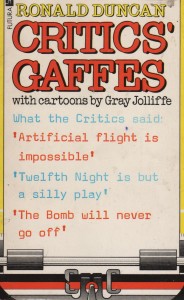
Critics get it wrong (again)

Some of the following pronouncements taken from Ronald Duncan’s Critics gaffes Duncan pic 001hilarious and sometimes shocking anthology, Critics’ Gaffes (1983), come from critics who supposedly know what they’re talking about. Others are the judgements of those who haven’t a clue.  Perhaps Geoffrey Grigson nailed it when he described the romantic novelist and radio presenter Melvyn Bragg as ‘a media mediocrity who couldn’t tell good literature from old gym shoes.’ Mind you, like the stopped clock which tells the right time twice a day, a few of the following verdicts have the ring of truth.

Theatre critic Robert Morley on Samuel Beckett’s masterpiece.

‘…it is my considered opinion that the success of Waiting for Godot’ is the end of the theatre as we know it’.

1956

Essayist and critic William Hazlitt on Lord Byron

‘He makes virtue serve as a foil to vices…the noble lord is almost the only writer who has prostituted his talents in this way.’

George Henry Lewis on Charles Dickens

‘Thought is strangely absent from his works. I do not suppose a single thoughtful remark on life or character could be found throughout the twenty volumes.’   (1872)

Aldous Huxley on Dickens Continue reading