

Here is passage from The Cellar Key (1933) by T Earle Welby* which everyone who dines out should commit to memory.
‘…The corks of the opened bottles have been carefully examined, and smelled, after cutting off the tops, which may seem mouldy without the rest of the cork or the wine in any but a sound state. A spoonful of each wine has been tasted, with an olive-cleansed palate. The host is satisfied: the guests will be.
But let the guests know, by inscription in the margin of the menu or by word of mouth, what wines are to be offered them. I appeal, in the divine name, to hosts and hostesses not to let a maid wander around a table asking, “White or Red?” White what? And red what? Is the choice between an honest white Graves and an equally honest red Graves, or between the former and Kangaroo Burgundy? In any event, why should such a choice be offered one? No vinously educated person can possibly want to drink red wine of any kind with the fish, or, having therefore chosen white, to be condemned to white for the whole meal.
However, the crimes against wine committed in the house are as nothing to those in which the unconscious criminal does his horrid deeds at a restaurant. To ask guests what they will drink is a stupid abdication of the position of host, a position with higher duties than that of paying the bill. They may know what they would severally take to drink, though in an average English party three-fourths of them will not; but, even if they do, they each will hesitate to avow a preference which might send the host beyond his estimate. It is for the host to choose, and in advance of the arrival of his guests. He knows, as his guests cannot, on what scale he had conceived of the entertainment; or, if he does not, he should have bidden his friends to some restaurant with which he was better acquainted. It is for him to take complete charge; to order both food and wine before his friends arrive ; to spare the party the evil ten minutes during which its members would otherwise gape at menu and wine- list…’
*See an earlier jot on Welby – author of the classic food book The Dinner Knell (1932). [RR]

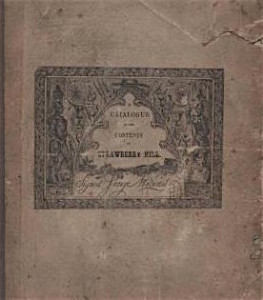 Found in a copy of John O’London’s Weekly for 18th April 1952 is a review of Collector’s Progress by Wilmarth Lewis ( 1895 – 1979) in which the author reveals that the combination of wealth and a collector’s obsession brought about the greatest collection of manuscripts relating to Horace Walpole in the world.


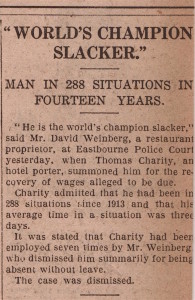 A clipping taken from the August 16th issue of the Daily Express for 1927, reported that David Weinberg, a restaurant owner, had been summoned to Eastbourne Police Court for the recovery of wages allegedly due to Thomas Charity, a hotel porter. Weinberg stated that he had employed Charity seven times before dismissing him summarily for being absent without leave. Weinberg called him ‘the world’s champion slacker’. When asked for his employment record Charity admitted that he had been in ‘288 situations since 1913 and that his average time in a situation was three days ‘. The case was dismissed.

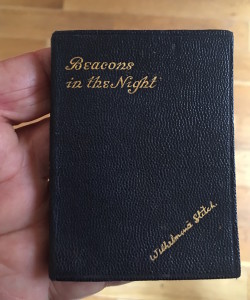 Found a fine copy of Beacons in the Night (Methuen, 1934) by Wilhelmina Stitch. A small book of simple, unsophisticated poetry. Wilhelmina Stitch achieved some popularity and sales in the first half of the 20th century. As a sentimental poet she was very much the Donovan to Patience Strong’s Dylan. She has no Wikipedia page unlike Ms Strong who has a lengthy and well tended entry. Some facts of her life are known and she turns up on a site


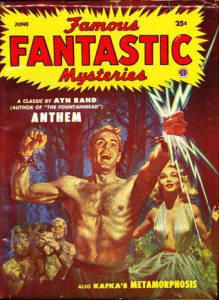 this amusing game that can be played using an iPhone or laptop. One player picks 3 people of seemingly equal fame and then all the players have to say (in order) who has the highest google rating i.e. number of hits. It is best when searching to put the full name in inverted commas – e.g. “Kevin Bacon.” Players score 1 point for naming the person with the most hits and an extra 2 points for naming all 3 in correct order. First to ten , at that point you can play again but one session is usually enough. Try Marcel Proust, Jorge Luis Borges and Vladimir Nabokov. The leader is Borges at 7.88 million, Proust at 4.68 and Nabokov at 3.3 million.
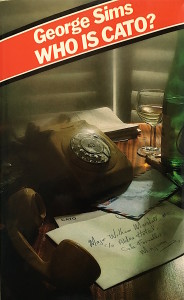 Found in a thriller by
 Found – Society Racket: A Critical Survey of Modern Social Life (Long, London 1933) by Patrick Balfour (Baron Kinross) – a journalist. At the time of this book he was ‘Mr Gossip’ at the Daily Express and the character Adam in Waugh’s Vile Bodies was probably partly based on him (Adam becomes ‘Mr Chatterbox’ at the ‘Daily Excess’.)