
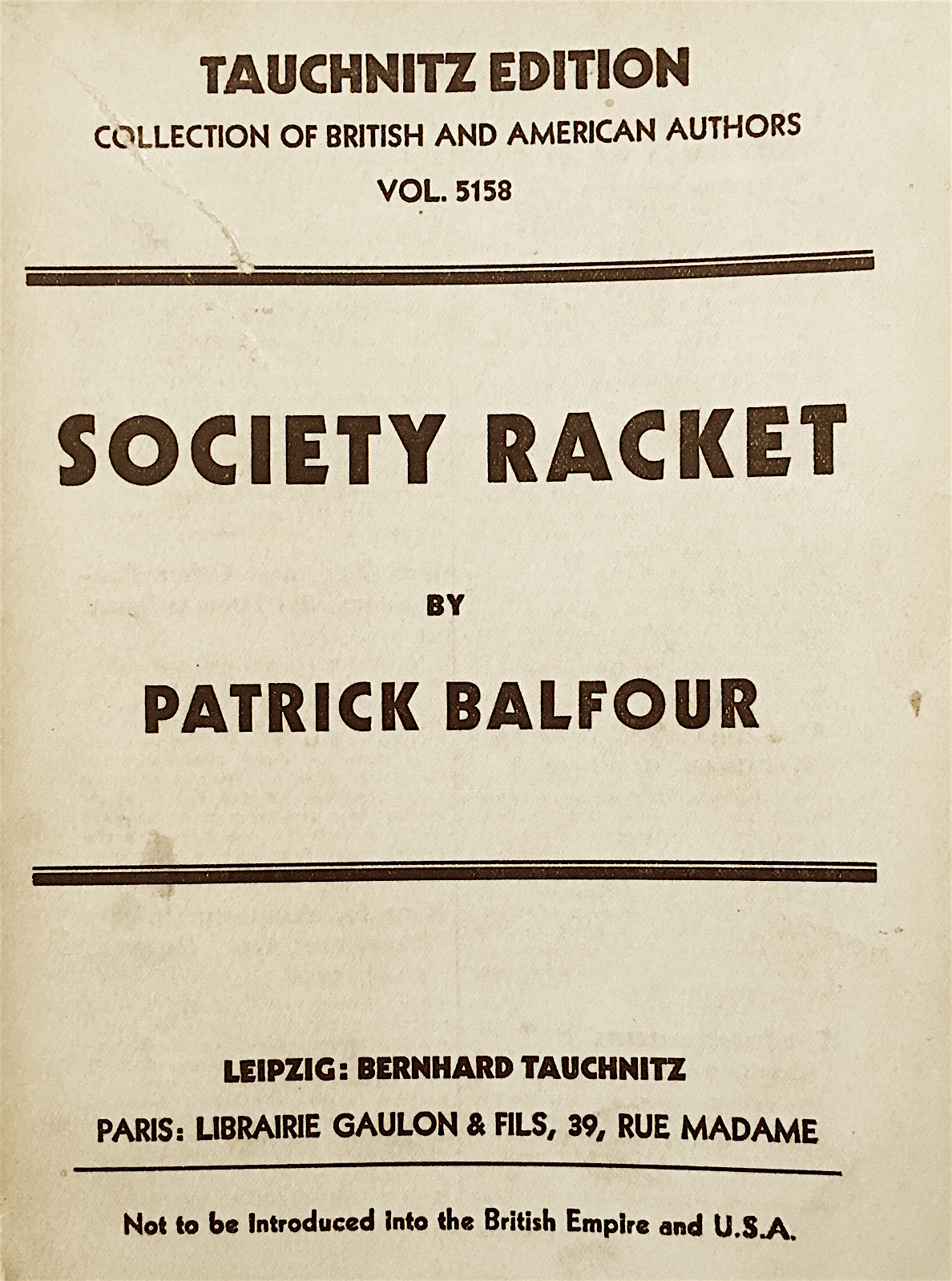
In an earlier jot we referred to a Schoolboy Party held at the Punch Club in 1932 which was attended by the cream of young society but there are many more such parties covered in the now rare book Society Racket: A Critical Survey of Modern Social Life (Long, London 1933). Patrick Balfour (Baron Kinross) was a journalist, at the time of this book he was ‘Mr Gossip’ at the Daily Express and the character Adam Fenwick-Symes in Evelyn Waugh’s Vile Bodies, who works for a while as ‘Mr Chatterbox’ at ‘The Daily Excess’ may have been partly based on him.
Balfour traces this style of party back to the ‘freak’ parties of the nineteenth century citing Lady Castlereagh’s parties where guests took chloroform. In the era before the BYT’s many parties were marked by extreme drunkenness among the young toffs and women were either excluded or fled to their rooms rather than risk an encounter with ‘drunken gentlemen.’ Balfour writes “..right up until the war, in the days of the Empire Promenade, young men used to behave drunkenly in public.’ By the late 1920s this was disapproved of. He notes that the themed parties started in a modest way with things like ’Treasure Hunts’ and ‘Midnight Chases’ as a reaction to the dullness of the sozzled, dowager-ridden previous generation.
They set the Thames on fire at Henley, they held a false surrealist exhibition of a hoax artist called Bruno Hat, the leaflet for which -‘Approach to Hat’ is now extremely collectable. Among the parties recorded by Balfour were a Circus Party, A Russian Party, A Baby party, A Wild West party and the famous ‘bottle and bath’ party put on by Brian Howard and Elizabeth Ponsonby. The two hired St. George’s Baths at the height of a heat-wave, so that their guest might swim between dancing and supping. This do caused a shock in the media, mainly because the music was provided by a ‘negro’ band. David Tennant gave a Mozart party where guest wore 18th century costume, there was a wild party in Royal Hospital Road in ‘fancy undress’…
In Vile Bodies Waugh writes: –“…Masked parties, Savage parties, Victorian parties, Greek parties, Wild West parties, Russian parties, Circus parties, parties where one had to dress as somebody else, almost naked parties in St John’s Wood, parties in flats and studios and houses and ships and hotels and night clubs, in windmills and swimming-baths, tea parties at school where one ate muffins and meringues and tinned crab, parties at Oxford where one drank brown sherry and smoked Turkish cigarettes, dull dances in London and disgusting dances in Paris – all that succession and repetition of massed humanity … Those vile bodies…”
Guernsey – a WW2 Press Diary
 Found – a small 44-page wire-stitched newsprint pamphlet (no date or printer specified) entitled “PRESS” DIARY of Island Life during the German Occupation 1940-1945. Probably printed in Guernsey in late 1945. It records life under German occupation in Guernsey through short news items. It is much concerned with the many changing rules and proclamations by the Germans regarding cars, tobacco, potatoes, curfews, penalties for plunder of unoccupied premises (death) also it records local crime, entertainment and privations. Cigarette rations were down to 20 cigarettes a week and 2 oz of tobacco. Many notices are brief – ‘’Rat Destruction committee advertise for dogs and ferrets.’ ‘Owners of private cars ordered to report.’ ‘Potato Board report that shortage of potatoes is due to hoarding.’ ‘First case against cyclists for riding abreast. Fined 2/6 each.’ ‘Germans order collections of old bicycle tyres, and tubes, rags, old paper, feathers, rubber, bones, leather and unbroken glass bottles’ ‘Appeal for old felt hats for making into slippers.’
Ships arriving with supplies are noted including the one ton of delicacies- milk, chocolate, cheese and sweets donated to the island’s children by the Swiss International Red Cross in April 1941. The Guille-Allès Library of Guernsey allowed residents 2 books at a time (raised from one.) There were many burglaries and break-ins reported and several profiteers and black marketers arrested and fined. One man arrested for breaking into a house and stealing and assaulting a woman received 12 strokes of the whip and 5 years in prison, a few were summarily shot. Continue reading
My wife is uncultured—can I improve her? (1938)
 Another ‘solution’ to ‘real life problems’ from the pen of the redoubtable ( and mysterious) R.Edynbry, who doesn’t seem to have published any book other than this little volume (Real Life Problems and Their Solution) of 1938 from Odhams Press, London.
I realized when I married that my girl had few brilliant mental attainments. She had no interest in literature, nor had she even a parrot-knowledge of the names of writers or the classic books of the past. She is a product f the film era, and I have come to the realization that I have married one who comes within the category of the lightheaded. She cannot be serious for more than one minute at a time, and I get no intelligent response to my suggestions. Do you think that, with careful handling, I could introduce her into the ways of thought; to good literature; to an appreciation of the best things of life—-wean her, so to speak, from the dross? The thought that I might be ashamed of her one day appals me. What do you advise ?
‘The best thing for you to do is to concentrate on some of your wife’s good qualities and help her to develop these to the full. It is extremely unlikely you will ever be able to ‘cultivate’ her in the way you wish. There is a very large class of women who take no interest whatever in what men call culture. Even when they do appear to be interested in art, literature or classical music, it is usually to further some scheme at the back of their minds. Or, as has been said by a wit,” When women talk of astronomy, they are thinking of the astronomer “.A love of good books and literature and the fine things of life is inborn and cannot be superimposed like a coat of varnish. A fact that many psychologists have noted is that when a young girl has had her interests centred mainly on the emotions, there is little prospect of intellectual things making any appeal to her. Continue reading
A contemporary critic responds to Wyndham Lewis’s ‘Blast’

The Vorticists at the Restaurant de la Tour Eiffel: Spring 1915 by William Roberts
On the eve of the First World War ‘ T.P. Weekly’s John O’London records his response to the recently published first issue of Blast.
July 2nd. —I find it is not necessary to resist extravagant gospels; they cancel each other. Yesterday Futurism, today Vorticism. I should like to know the precise moment at which one becomes a fogey when ism succeeds to ism. Mr Ezra Pound does not make this plain in his “Salutation the Third”, printed in Blast, wherein one reads:
These are they who objected to newness,
HERE are their TOMBSTONES.
They supported the gag and the ring;
A little black BOX contains them.
So shall you be also,
You slut-bellied obstructionist,
You sworn foe to free speech and good letters,
You fungus, you continuous gangrene.
I have seen many who go about with supplication.
Afraid to say how they hate you
HERE is the taste of my BOOT,
CARESS it, lick off the BLACKING.
Ezra’s boot it at least tangible, and inter alia it goes far to fulfil one of the declared aims of the Vorticists, “to destroy politeness “ – Continue reading
How to Waste Money at Christmas
 How to Waste Money at Christmas
1) Order in a lot of fruit that goes bad
2) Order in flowers you have no time to arrange
3) Buy handsome presents and have them put down
4) Give a big Dance when you can only afford a Games Evening
5) Economise on heating, and give everyone ‘flu ( see Doctors’, Nurses’ bills)
6) Economise on lighting ( and let people trip over stairs and break their ankles etc)
7) Give rubbishy presents and make lifelong enemies.
8) Overdo yourself and have to go into a Nursing Home.
Extract from The Perfect Christmas (1933) by Rose Henniker Heaton.
[R.M.Healey]500 Books with Interesting Inscriptions
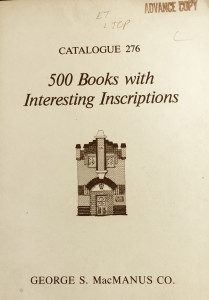 Found – a 1982 book collector’s catalogue from George S Macmanus of Philadelphia 500 Books with Interesting Inscriptions. Mostly modern American and British literature, it has many direct signed presentation from the authors and many association copies. There are the usual authors who are known to have signed a lot – Galsworthy, Masefield, John Drinkwater, Witter Bynner etc., but also uncommon signers like the great WW1 poet Isaac Rosenberg- a copy of his play Moses signed shortly before his death, a modest condition copy at $2500. There are some inscriptions whose significance is hard to fathom- Norman Douglas’s In the Beginning inscribed by him to the effete (and highly collectable) novelist Reginald Turner “To Reggie hoping he won’t follow Symira’s example in ‘every’ respect, from Norman Douglas.” Great condition $375. There are several Aldous Huxley 1920s novels inscribed to Anita Loos with minor condition problems in the $300 range and several Swinburne presentations at $1000 inscribed to the artist Burne-Jones. A decent buy at $1750 is George Orwells Eton leaving present. We have had dozens of these through over the years. Each boy was given a current smart cream-coloured edition of Poems by Thomas Gray. The presentation leaf reads: ‘Hunc Librum Erico A Blair’ and it is signed by the master ‘Cyrillus’ Alington. Potentially these ‘leaving present’ books exist for Cyril Connolly, Brian Howard, Aldous Huxley, Harold Acton, Henry Green and, possibly more valuable than even Orwell, Ian Fleming. Continue reading
The Old Codgers
 Found – a cheap paperback called The Daily Mirror Old Codgers Little Black Book (Wolfe, London 1975.) The book is billed as ‘100s of funny, curious and strange facts from the world famous Live Letters column…’ The Old Codgers column, where readers wrote in to get answers on all manner of things, had begun in 1936, apparently the idea of the newspaper’s proprietor Hugh (later Lord) Cudlipp. It finished in 1990 by which time The Mirror’s thrusting new editor Roy Greenslade considered its old fashioned and said it was “putting off the younger readers we are trying to attract.”
An article at the time in one of the broadsheets said that while the world went through ‘convulsive’ changes the Codgers remained in ‘a pre-war era redolent of flat caps, allotments,racing pigeons and Woodbine cigarettes…’ There was a bit of protest when it was axed but considering that the Codgers were receiving a 100 letters a day it was fairly muted. They often referred to their legendary Little Black Book that claimed to contain ‘all information known to man.’ In the days of the web most of the questions that readers sent it could now be very quickly answered. Google is now ‘the little black book.’ The questions were often sent it to settle arguments ‘down the pub’. The most common question in the latter period of the Codgers was whether Stan Laurel was Clint Eastwood’s father. The Codgers research showed he was not. Below are two fairly typical Codgers answers to questions on ‘Slippery Wednesday’ and the origin of the phrase ‘Mad as a hatter.’
‘Slippery Wednesday’ is another day that has stuck in older memories because of its dire conditions. A former horse carman recalled how he had to put sacks on his horses hooves and his own feet to get about, and that pedestrians were ‘going down like ninepins’, because of the ice. But he couldn’t remember the exact date, only that it was a Wednesday in the 1920s. We were able to tell him that it was December 21, 1927 when severe frost on overnight rain caused chaos in London and other parts of the country, resulting in thousands of street accidents.
‘Mad as a hatter’ dates from the days when hats were made of felt which was processed by having mercury rubbed over it. The unfortunate men who did the job got mercury poisoning which caused their limbs to shake and contorted their features so that they looked crazy.
The Right and Wrong People to invite to a Christmas party
 Two extracts from The Perfect Christmas (1933) by Rose Henniker Heaton.
Right people
Cheerful People
Lots of Young People
The guest with a car
The Enterprising Girl
The Elderly Woman who can tell fortunes
The Elderly Man (if red-faced and jolly).
The Handy-Man (issue invitation early, as he is in great demand).
Anybody good with children.
The Unselfish Friend.
Wrong people
The Bone-lazy.
The Egoist.
Mischief-makers.
Spoil-sports.
The Greedy and the Selfish.
Mean People (who suffer tortures at Christmas).
People who always feel “out of things.”
[RR]
A Cod Medieval Menu
 Found, part of a menu for the Chelsea Arts Club Ball, which was held at the Albert Hall, March 4th 1914:
Some clear Soupe—warme, ‘tis for one ande alle.
Ye Baron of Beefe, roasted ande tender
Ye Wilde Boare, hys Heade—a dishe for ye Kinge
Large Surrey Capons withe Truffles—no bones argale, eate fearlesslie
Ye Tastie Ham spyced as atte Yorke
Ye Venyson Pasty—tastilie cooked
Chykens, plump ande temptinge—trye them.
Ye Kindlye Oxe , hys Tongue
Agayne Chykens mayde toothsome by Galentyne
Dishe Pastys with Pidgeons —ryghte sustainynge
Beefe cunninglye cooked with spyces—try it
Raised Pastrys with Bubleyjocks, as they doe them in Yorkeshire—ryghte good
And thene some green stuffes with Dressinge .
AND THENE COME YE SWEETES GOODE FOR ALLE MEN ANDE MAYDENS
This year, this famous society Ball, in which fancy dress was de rigueur, must have had medieval England as its theme, although the drawing by Alex Jamieson (pictured), which sold in 2014 at Bonhams, does not suggest this. Contemporary reports record this Ball as being particularly weird and wonderful. Just a few months later many of the male party-goers would have found themselves leading troops into battle in the Flanders mud. Too many, alas, would never dance again. [RH]
Bishop Bury: a 14th century bibliomaniac
 Bishop Bury of Durham spent so much money on books that he lived in dire poverty and debt and when he died all that could be found to cover his corpse was some underwear belonging to his servant.
The facts regarding his library are mind blowing. According to W.M. Dickie, who wrote a paper on Bury and his magnum opus , the Philobiblon, in The Book Handbook (1949), he had more books than any bishop in England. Five wagons carried them away, which suggests that the number of volumes was more than 1,500. This compares with the Sorbonne’s 1,722 in 1338, the 380 volumes at Peterhouse College, Cambridge, in 1418 and the 122 housed in the University Library there in 1424.
In his Philobiblon Bury writes of wishing to found a college in Oxford and to endow it with his library, but no college is named. Some historians have maintained that the library was bequeathed to Durham College, but there is no evidence that the college received any such endowment. The sad truth is that this wonderful library was probably broken up and sold off to pay Bury’s huge debts.
The Philobiblion is revealing as to how many of Bury’s books were acquired:
“We were reported to burn with such desire for books, especially for old ones, that it was more easy for any man to gain our favour by means of books than of money. Wherefore since support by the goodness of the aforesaid Prince (Edward III)…we were able to requite a man, well or ill, to benefit or injure mightily great as well as small, there flowed in instead of presents and guerdons, and instead of gifts and jewels, soiled tracts and battered codices, gladsome alike to our eye and heart…In good will we strove so to forward their affairs ( the affairs of donors of books) that gain accrued to them, while justice suffered no disparagement”
In this way Bury, when Keeper of the Privy Seal, was given four books, namely Terence, Vergil, Quintilian and Jerome against Rufinus by Richard de Wallingford, Abbot of St Albans, who also sold to Bury for fifty pounds of silver, thirty-two other books, of which he gave fifteen to the refectory and ten to the kitchen (presumably at Westminster Abbey), an act which was later condemned by Thomas Walsingham, former scriptorarius at the Abbey. The Abbot’s motivation in securing such an astonishing bargain for Bury was to promote the interests of his monastery at Court and indeed Bury helped him secure a royal charter giving the Abbot the exceptional right of imprisoning excommunicated persons. When Bury became Bishop of Durham in a fit of remorse he restored some of the books to St Albans. And following his death, Wallingford’s successor at the Abbey secured other volumes at a discounted price from Bury’s executors. One of these, John of Salisbury’s Policraticus—now in the British Museum—bears an inscription recording its sale to Bury and its repurchase in 1346 from his executors. Only two other manuscripts are known to have belonged to Bury. One is in the British Museum and the other is in the Bodleian. Both are from St Albans. Continue reading
Grooming by letter? Innocent pre-web days…
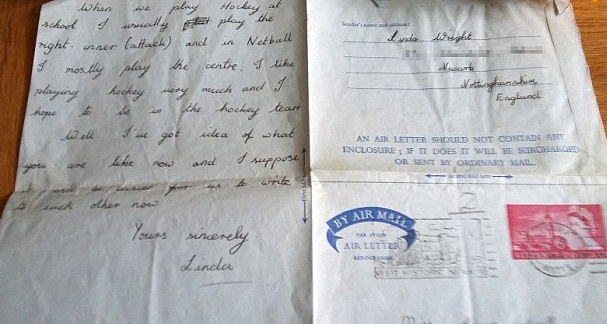 What do you think of pen friendship? My daughter has been introduced, through a club, to a pen friend in France, and so far the letters received from the French girl are quite nice in every way. But I have been studying them recently, and, here and there, have noticed remarks which might conceivably indicate that the writer is a woman and not a girl. There is nothing undesirable whatever in these letters, but I have heard so much of the clever and cunning ways certain types of foreigner have of insinuating themselves in the minds of girls, that I am somewhat in doubt as to whether this correspondence should be allowed to go on. Perhaps you will kindly give me your views on this matter.
There are several reputable agencies in this country for putting correspondents in touch with foreigners. One of their expressed aims is to promote international goodwill. Often an interchange of visits results from the pen friendships thus formed., In so far as this correspondence furthers the exchange of views of general interest –for example, young people tell of their families, schools, occupations and excursions—they serve an excellent purpose and can be very educative. The idea is to link up correspondents of about the same age and standard of living.
If your daughter was introduced by a reliable source you have little to fear. It is usual for correspondents to exchange photographs at an early stage; if this has not yet been done, you might request this favour. Then, unless her correspondent is intending to deceive, you will be able to form a pretty good estimate of her age. In any case, you will do well to supervise the letters both ways. In the event of your daughter wishing to accept an invitation to visit France, you should first take up references —through the club or privately—which would leave no doubt as to the absolute trustworthiness of her prospective hosts.
An extract from Real Life Problems and their Solutions (1938) by R. Edynbry
[R.R]
Poets as plagiarists
 The plagiarist today runs the risk of being sued by an artist, whether novelist, poet, composer or dramatist –or by the artist’s estate. However, in the case of poetry, it has always struck me how easy it must be for anyone entering a poetry competition to filch some particularly impressive lines from a forgotten slim volume or a short-lived little magazine. If the victim of the theft is dead there is only the slimmest possibility that the estate would discover it .
But when the theft is made from a comparatively obscure literary work many hundreds of years old and in another language the chances of the thief being detected in his or her lifetime are very thin indeed. Most literary thieves of this type are exposed many years after their own deaths. The whole issue is discussed in Literary Coincidences ( 1901) by W. A. Clouston, a folklorist and expert on oriental literature well qualified to address this matter.
One of the worst offenders seems to have been Lord Byron. In his Hebrew Melodies we find this first verse of ‘To a Lady Weeping ‘
‘I saw thee weep—the big bright tear
Came over that eye of blue;
And then methought it did appear
A violet dropping dew;’ Continue reading
Edward Thomas on Nietzsche
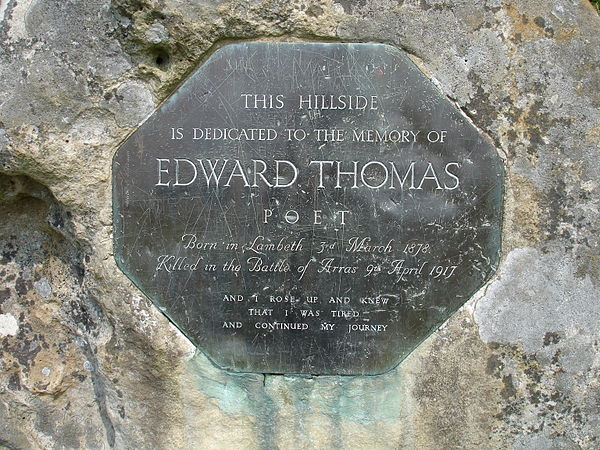
Edward Thomas Memorial Stone near Steep
Found in the June 1909 issue of Bookman is a generally favourable review of M.A.Mugge’s Nietzsche: his life and work together with translations of the philologer-turned- philosopher’s various works.
Rather surprisingly, perhaps, the reviewer is the poet and miscellaneous writer, Edward Thomas, not known ( at least in his own writing ) as an admirer of the anti-Christian proponent of the ubermensch philosophy, though he was undoubtably, like Nietzsche, an anti-Nihilist.
Nietzsche’s distrust of historicism, and delight in the ‘ moment’ is echoed by Thomas, who sees the philosopher more as an ‘exquisitely sensitive poet and man of culture ‘ than as a rationalist. When Nietzsche declares that “ one who cannot leave himself behind on the threshold of the moment and forget the past, who cannot stand on a single point, like a goddess of victory, without fear or giddiness, will never know what happiness is ‘, Thomas adds ‘ nor wisdom, nor beauty’.
Thomas goes on to say that when Nietzsche set up the Greeks as a model, he was choosing ‘ an utterly unhistoric people, knowing no tongue but their own ; and not only the Greek, but every man who achieves a great thought or act, he calls ‘unhistorical’, because in the power and the glory of the creative moment he forgets all that he knows, just as a beautiful living thing forgets all that makes it so in a beautiful attitude or gesture ‘. [RR]
Food and Dress on a U.F.O.
 Found – a pamphlet by George King a writer on UFOs and spiritual matters. It is called The Flying Saucers. A report on the flying saucers their crews and their mission to earth (Aetherius Society London 1964). It deals partly with practicalities like their monetary system (they don’t have one: ‘Every living thing has what it needs’) and their mode of dress (basically a perpetual ‘onesie’) and diet.
DRESS. The reason for the “seamless one-piece suit” which all observers of these people have remarked about, is now clear. When the Martian or Venusian comes to Earth, it is not the actual physical properties of our atmosphere of which they have to be careful. They are all adept in correct breathing methods. They could not be as advanced as they are unless this were the case. All enlightened men, either on Earth or from the other Planets, have several things in common. One of the most pronounced is the knowledge and ability to exert conscious control over the flow of the Universal Life Force through their nervous systems and subtle bodies by correct breathing. (See (See “Your Higher Self through Yoga”) It is the bacteria in our atmospheric belt against which the Space Visitors have to take precautions. The “seamless one-piece suits” protect them from the harmful effect of this bacteria. These suits are so designed as to give off a particular musical note, which drives away all bacteria from a certain area around themselves. The note or sound vibration, is quite inaudible to the human ear, possibly because of its high frequency. The benefit gained by the adoption of such a protective measure is easily understood. A Space Visitor could stand on Earth and hold a conversation with an inhabitant and be fully protected -9- from, what could be to him, foreign bacteria, without interfering with the bacteria which is necessary to the other. It has been said by the Master Aetherius that it is possible to bring into being a similar kind of “seamless one-piece suit” which would protect the wearer while surveying the bottom of the ocean. The properties deemed necessary to afford such protective measures can be incorporated into the suit at the time of manufacture. Some of these suits are materialized by thought by their wearers. In other words, this type of dress undoubtedly forms a kind of personal protective screen around the wearer. (See Cosmic Voice) Continue reading
Dr Marx would not have approved
 The removal of the British Library from Bloomsbury to St Pancras seems to have ushered in a new, more relaxed, attitude towards the rules governing who can acquire a reader’s card, according to a Guardian article of 2005. In it the Reading Room is described as being crowded with undergraduates, anxious, no doubt, to obtain an advantage over their peers. Under the rules prevailing in 1938, and which are contained in a Guide to the Use of the Reading Room, a copy of which we found recently in a box of ephemera, restrictions which perhaps Karl Marx might have recognised, were doubtless drawn up to limit the number of readers using the famous Rotunda. There is a distinctly schoolmasterly tone to the following advice:
The Reading Room is in fact, as well as in theory, a literary workshop and not a place for recreation, self improvement or reference to books which are obtainable elsewhere…
No person will be admitted for the purpose of preparing for examination, of writing prize essays, or of competing for prizes, unless on special reason being shown; or for the purpose of consulting current directories, racing systems, lists of unclaimed moneys , or similar publications.
‘Racing systems’ and ‘lists of unclaimed moneys’. How redolent of the seedy world of Brighton Rock, which appeared a year later.
There is also a touch of ‘Greeneland’ about the advice offered to those prospective Readers seeking a testimony :
The Trustees cannot accept the recommendations of hotel-keepers or of boarding- house or lodging-house keepers in favour of their lodgers… [R.R.]
How should an escort conduct himself?
 Some advice taken from Real Life Problems and their Solution by R. Edynbry, published in 1938 by Odhams Press.
I have recently made the acquaintance of a very refined young lady who, I feel, is vastly superior to myself in many ways. I must confess, I am more than a little in love with her, and I should be awfully sorry to do anything which should lower me in her estimation. I believe, if I asked her, she would consent to walk out with me; but before taking this step I should like to know some of those little courtesies which every man is supposed to know. Not that I am entirely ignorant, but I am aware some of these things have to be learned, and that mistakes are easily made.
‘There are a few rules which should be observed when walking with a lady in a public thoroughfare. Don’t allow your companion to walk on the outside of the path next to the gutter; always take that position yourself. If you want to smoke ask her permission first, but, better still, wait until she suggests it to you. When raising your hat in a salute, remove your pipe or cigarette from your mouth, and lift your hat off your head. If you happen to meet a funeral, also raise your hat. If you take a bus or a taxi, allow the lady to get in first, but you must be ready to help her step down at the end of a journey. When meeting her by chance in the street, don’t keep her standing, but accompany her in the direction she wishes to go.
Should this young lady invite you to meet her people, don’t remain seated while a lady or elderly person is standing. If you have been asked to tea do not stay on until supper- time unless you have been specifically asked. Take off your hat in a private lift if ladies are present, but retain it you wish in a shop or office lift. Dress neatly and never wear anything gaudy or likely to attract attention. Don’t mix the colour of coat and trousers from different suits. A last tip. Don’t do all the talking yourself. By proving yourself a good listener, and by asking intelligent questions, you should easily keep your place in her esteem. ‘
Beresford Egan on Beardsley

‘Fleurs du Mal’ (1927)
Found in Beresford Egan’s Epitaph, a Double-Bedside Book for Singular People (Fortune Press 1943) this piece by him on Aubrey Beardsley. Beresford Egan was always compared to Beardsley and was probably a little fed up with it. In appearance and temperament he was nothing like the 1890s aesthete. His technique was also somewhat different, as he explains. Apart from his illustrations and books he also worked as a film actor and he can be glimpsed in Powell and Pressberger’s masterpiece A Canterbury Tale.
Beresford writes:
But poor, dear Aubrey! What of him? His shadow has overcast my life, as it has overcast the lives of others in the realm of black and white. Aubrey Beardsley died in the “arms of the church” and fell into the claws of the literary vultures. His bones have been picked bare, but his legendary spirit will continue to haunt us, until a critic is born who can see further than ‘The Yellow Book’.
Beardsley – that name has become a critical cliche. Who, among the black ink brotherhood, has not been compared with him? – except, of course, the followers of the “crosshatch” school still performing in ‘Punch’. There appears to be no overshadowing master of this technique: not even Tenniel, Charles Keene, nor Lindley Sambourne. The “crosshatchers” are never charged with plagiarism, although I have seen many an exponent whom one might justifiably accuse of being cast in the Harry Furniss (forgive the pun). Continue reading
World War 1 – the last hours
 This short piece was sent in by by an anonymous jotwatcher, for which much thanks. It shows a typed military communique about the end of hostilities in World War 1 that was kept by his great, great grandfather and handed down through the family. It reads:
After telling the troops, my great great grandfather folded up this piece of paper and put it in his pocket nearly 100 years ago. It’s been handed down since. It marks the end of the First World War:
Translation:
1) Hostilities shall cease along the entire front at 1100 hrs on November 11th (French time)
2) Until further orders, troops shall not move forward of the line seized by this hour and date. Report exactly the position of the line.
3) All communication with the enemy is forbidden until receipt of instructions by the army commander.
A real piece of history! Now raising a massive gin and tonic to those who gave their tomorrow for me to enjoy my today and I’m surrounded by people I love. Don’t forget to remember.
‘The Morons’ Dining Club
 Found in the ‘Eating Places’ column in the May 1927 issue of the highly regarded American left-wing literary magazine, The New Masses, is this advert for a club called ‘The Morons’. According to the SOED (1965) the term moron comes from the Greek for foolish and was coined in 1913, presumably by a psychologist, to describe a person whose ‘intellectual development’ had been arrested.
In medical textbooks the term, along with ‘cretin’ and ‘idiot’, was still applied to a category of the mentally deficient up to the 1960s, after which time such nomenclature became otiose. It is difficult to say when exactly the word moron was freed from its scientific meaning to become the slang term so familiar to us today. It may have already been assigned slang status by 1927, when hostess Winnifred Harper Cooley, placed her advert. It is possible that the dining club borrowed the word from a derogatory reference to suffragists as ‘morons’.
The Net has nothing to tell us regarding the foundation of The Morons, but from the advert we can perhaps guess that the fortnightly meetings of this ‘ most brilliant dining club ‘ took place using a rota system in the homes of members, or even permanently at Cooley’s own New York City home. It is unlikely that any restaurant would have tolerated the raised voices and table-banging that might accompany the airing of ‘radical subjects’. Continue reading
Book prices in 1909 and 2016
It is interesting to see how the values of certain books have risen
—sometimes amazingly—or fallen— in real terms (taking inflation into account)over a long period. The following twelve titles, advertised for sale at a discount in a full page advert taken out by Edward Baker’s Great Bookshop in John Bright Street, Birmingham, in an issue of the Bookman for June 1909, represent a selection of some of those works that have risen most in value by today’s standards.
Because the bookseller of 1909 describes them as ‘ in new condition’, the retail values sampled from Abebooks today are for those books graded as being in very good or excellent condition. In all cases the 1909 discounted prices are recorded side-by-side with those taken from Abebooks.
Inigo Triggs, Art of Garden Design in Italy (1906) 21s. £480
Rev. J.M.Bacon, The Dominion of the Air (1902) 2s. £92
Edward Clodd, Tom Tit Tot (1898) 2s. £87
Complete Works of Edward Fitzgerald £3 3s. £100
Octave Uzanne, Fashions in Paris (1901) 6s.6d. £180
R.N.Hall, Great Zimbabwe (1905) 6s.6d. £150
Morrison’s Lonely Summer in Kashmir (1904) 4s 6d £167
A.E.Waite(ed), Hermetic and Alchemical Writings 21s. £1,046
of Paracelsus the Great (1894)
C.V.A Peel, Somaliland (1900) 4s £2,092
Pitt-Rivers, Antique Works of Art from Benin (1900) 5s. £95
Sweet and Knox, On an Mexican Mustang through Texas (1905) 3s. £125
Schilling, In Wildest Africa (1907) 12s. £343
[R.M.Healey]