Bill Lofts – the journey of a collector and researcher

More material from the Haining archive, this by his friend and colleague W.O.G. ('Bill') Lofts. Some of it is covered by Bill's piece on market places. As a researcher pre-internet he haunted the British Museum and saw himself as a kind of knowledge sleuth (hence the title).

INVESTIGATIONS UNLIMITED
by W.O.G. LOFTS

  Like most normal children I started reading the coloured nursery comics at an early age:    'Chicks Own' and 'Tiny Tots', for example. With their hyphenated script underneath they helped us a great deal in learning to read. W. Howard Baker recently - and without any prompting from me related how it taught him to read in his home in Cork, Ireland. Later I went on to the older, 'Rainbow', 'Tiger Tim's Weekly' category, and later still to the black and white comics such as 'Chips’, 'Comic Cuts', 'Larks', 'Jester' and 'Funny Wonder'. I think my favourite was 'Larks'. That had Dad Walker on the front page, and was drawn by Bert Brown whom I was to meet many decades later, and whose originals I greatly treasure.

Continue reading →
A Dealer’s Tale

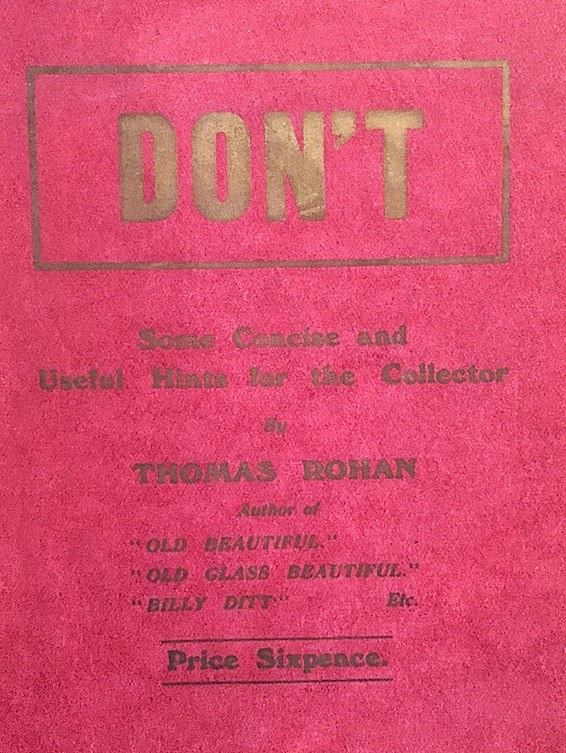
In a recent posting Quinney's we reprinted Thomas Rohan's advice to antique collectors. In this short work Don't: some concise and useful hints for the collector. Thomas Rohan Bournemouth, [1933] he also finds space to include the following dealer's tale. Dealers are fond of anecdotes, mostly of amazing finds and amazing bargains and mark ups ( '..found it in a junk shop for £5, Sothebys later sold it for £45000..' etc.,) but this a little different from the usual 'I had it away' story and even has elements of myth and legend...

Extracts from a Talk I gave to the Alton Society 

Many incidents I can tell from the niches of my memory relating to beautiful things. One extraordinary tale I will tell relating to a bureau bookcase. This happened some years before I became a dealer. I was in the habit of visiting various towns in Kent and Surrey during the week-ends. I always was on the look out to see beautiful things, and if I stayed in a town I always enquired of any place where antique furniture was housed - this, you must remember was nearly fifty years ago, before the country was scoured for the voracious American. While staying at a cathedral town in Kent, I was told of a farmhouse about two miles out, stocked with, as it was called, "old stuff". The place was called Priestly's Farm, an old Georgian white house on the main road, with barns and out houses: I could not miss it. I was further told that Joe Priestly was a very genial man. I certainly did find him that: he was a typical yeoman farmer of florid face and sandy whiskers and hair. He gave me a cordial welcome to look at his old furniture: some of it had been there for four generations. I certainly was struck with a set of fine Chippendale chairs, six, and two carving chairs, and a fine bureau bookcase. All the furniture was in its original state, the old mellow colour. I was admiring the bureau bookcase, and saying how I should like to possess it. the farmer smiled and shook his head. "Not all the money you could mention could buy that piece from me. The reason I will tell you, sir, if you will sit down. Have a glass of my cider?" He went out and brought in a jug of cider and two glasses, and we say down. This is his story: -

Continue reading →

A Ship’s Library – Kinfauns Castle

Kinfauns Castle (Ship's Nostalgia site)

Found - a list of the entire inventory of a ship's library - Donald Currie & Co's Royal Mail Steamer "Kinfauns Castle"(South African Service). An interesting list, possibly intended to be comprehensive. There is a curious amount of William Black, then at his height, a sort of Victorian Dan Brown (so popular that in America his works were bootlegged.) Likewise there are 3 works of Norman Macleod, editor of the immensely successful Good Words and now so forgotten than he is not even known for being forgotten - although Sutherland covers him well in The Longman Companion to Victorian Fiction. He is  part of a slight Scottish bias to these books (the list was printed by David Bryce & Son, Glasgow.) There is little for children, not many thrillers and not a lot of humour, although Twain and Brett Harte both make the list. Conspicuous by their absence are Trollope, Gibbon, Poe, Milton, Fielding, Wilkie Collins, Swinburne and R.L. Stevenson. Children had to make do with Froggy's Little Brother and possibly German Popular Stories. There is very little religion and no Holy Bible, possibly shipping magnate Donald Currie thought there was enough of that on land or that most people would have a bible if they needed one. The Kinfauns Castle started sailing in 1879 and this is probably from early in its life (it seems to have still been afloat in the late 1920s.) The list was pasted into book 10 Carlyle's Heroes and Hero Worship, attractively bound in full green leather lettered gilt at the spine with the words 'Castle Packets' at the foot -possible all the  library was bound thus..

Continue reading →

Antique Collecting advice from Quinney

Found- a small, rare pamphlet Don't: some concise and useful hints for the collector by Thomas Rohan (Bournemouth: A. Rohan, 1933). Rohan was a dealer in antiques and wrote many books on the subject (Old Beautiful, Confessions of a Dealer etc.,) He is said to be the original of Quinney the antique dealer hero of the novel and play (and movie) Quinney's by H.A. Vachell. At one point there were 5 antique shops in Britain called Quinney's and there is still at least one. His hints for collectors are still of use:

DON'T. 

So many just for the want of thought go wrong in collecting, commiseration is of little help, after the event, so I thought just a few concise words of advice, set forth in brief paragraphs would be of help. Recently a gentleman said to me, 'I shall never forget what you said at your first talk to the Alton Art Society - never purchase anything however old it is, if it has not been beautifully made - Age will not add value to bad craftsmanship.' I suppose I have made this remark hundreds of times. 

DON'T buy anything unless you can always live with it.

DON'T be in a hurry to purchase anything, however pleasing momentarily to the eye - meticulously examine the article whether it be furniture, china or glass.

Continue reading →

G. K. Chesterton on trade

Chesterton is a bit rough on trade and traders - in The Universe According to G. K. Chesterton: A Dictionary of the  Mad Mundane and Metaphysical (a posthumous compilation by Dale Ahlquist published by Dover Inc., 2011) he defines the verb 'trade' thus:'To buy things for less than their worth and sell them for more than their worth.' Harsh but fair - but now slightly  inaccurate, in these straitened times when prices are so easily checked, the person asking more than true value (whatever that is!) may find few takers. As an old trader once quipped: 'the right price is the wrong price…'

On traders themselves GKC seems to have it about right:

Men who cannot do anything else except exchange; who have not the wits or the force or fancy or freedom of mind or the humour and patience to bring anything into existence; who can only barter and bargain and generally cheat, with the things that manlier men have made.

The world of eBay and the car boot sale foreseen...He wrote this in GK's Weekly in 1933.

Quest for Jack Mann 2

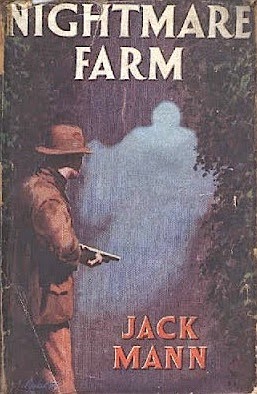
This the second part of this quest by the great researcher Lofts from circa 1975…there is a piece on Mann at Wikipedia, giving his real name as Charles Henry Cannell and with more up to date information and an earlier birth date (1882). Last year a biography appeared The Shadow of Mr Vivian: The Life of E. Charles Vivian (1882-1947) by Peter Berresford Ellis.

On the Trail of the Mysterious "Jack Mann". By W. O. G. Lofts.

The mysterious "Jack Mann" seems to be in the news again of late, especially with the excellent news that Bookfinger have started to republish his novels. The first entitled 'Grey Shapes' being excellently revised by Lillian Carlin, a few issues of this magazine ago.

I use the expression 'mysterious' relating to "Jack Mann" in the sense, that it was only recent I was able to satisfy myself regarding his real identity. At least here in England his real name has been a matter of much conjecture for many years. He suddenly appeared in the world of fiction in 1933, when he wrote two novels for the publishers Wright and Brown. This firm who had offices in Farringdon Avenue, London, just off the mighty Fleet Street was run by two elderly gentlemen a Mr Wright and Mr Brown. Apart from their popular fiction books being sold cheaply to the public and libraries, the owners were also extremely popular with Sexton Blake pulp writers. These authors simply changed the name of Sexton Blake and his assistant Tinker to some other names, and their whole original Blake stories were published as 'new; to the unsuspecting public.

Continue reading →

Quest for Jack Mann 1

From the Tartarus site with thanks (1937)

Found among the papers of the writer Peter Haining, this piece (the first of two) by the writer and expert on popular fiction and juvenile literature W.O.G. Lofts. It is on the elusive writer of supernatural fiction Jack Mann (real name E.C.Vivian (but also known as Charles Henry Cannell, A.K. Walton, Sydney Barrie Lynd, Galbraith Nicholson and  Barry Lynd.) As Jack Mann his books are highly collectable and some of considerable value. Lofts starts off by tracing his daughter...

Report by W. O. G. Lofts  

Jack Mann, 

Report of Visit to Mrs. K. Ashton. Monday July 7th 1975.

Frank Vernon Lay and myself arrived at Mrs. Ashton's flat at 7pm sharp which is situated in a Mews off Beaumont Street, London. Mrs. Ashton was about 60 well groomed, and obviously well educated. Unfortunately the meeting on the whole was a great disappointment as we were not there more than 15 minutes. Mrs. A who was born during the First World War, knew nothing about E. C. V's  Hutchinson (publishing) activities. She had no copies or records of the magazines and was not very expert (in my opinion) of his stories. The majority of her family papers were destroyed during the last war. The facts gleaned that elucidated several things however were interesting.

Charles Henry Cannell, was his real name, and he was the son of a Norfolk farmer. He had a serious dispute with him early in life, and so changed it. His mother did not remarry, and he had no brothers or nephews, only two sisters whom he did not keep in contact with. He served in the Boer War, but she did not think in the Great War. In the last was he was an Air-Raid warden. An early writing venture was "Books for the Bairns' edited by William Stead (very juvenile material) and he also working in collaboration with the author J. D. Beresford - material not known. He wrote some Westerns for Ward Lock under the name of Barry Lynd., and also other material for 'Wind and Water' magazine. E. C. V. certainly and without question was JACK MANN, and he wrote the stories entirely by himself. His agent was not concerned in this and probably he (the agent) felt disgruntled and this was the reason why he was not interested to talk about it. Mrs Ashton could not throw any light on the large number of books that came on the market though curiously this was the same time she moved from London to North Wales. Its more than likely they were originally her own father's autographed copies (and from her mother's) and she did not want to admit it. She seemed to me vague in places (e.g. the nickname her father called her mother inscribed in books) but did promise to look through all the papers when she had time. We had a glass of sherry and then left!

Sexology – Confession, Jealousy, Marriage

Sexology : The Magazine of Sex Science was a magazine founded by Hugo Gernsbach ('the father of Science Fiction') and seems to have flourished in the 1930s. It had many anatomical diagrams and articles about 'female inverts', pregnancy, infibulation, venereal disease etc. It probably sold well. 80 years later it appears highly dated and sexist but the  question of 'confession', jealousy and former partners, covered  in this article, is inherently problematic - Julian Barnes deals with it in his 1982 novel Before She Met Me and in an interview he referred to John Lennon having problems about former lovers of Yoko Ono. The story towards the end of the lawyer with the revolver and poison tablets is straight out of Hitchcock..We had another posting from Sexology on 'Homosexuality and its Cure' last year.

Sex Confessions of Wives

"I simply must make a clean breast of it, and tell • my husband." Here is an expression which, I am sure, must have been heard many times by every physician. What is there in the feminine make-up which insists that they bring drama–even tragedy–upon themselves? I know of so many homes that have been blasted and lives wrecked, through a wife’s insistence that she “unburden her soul,” that I hardly know where to begin.
  An explanation for this feminine characteristic takes us back across the centuries. The annals of history reveal quite plainly that all such ideas of bringing the old skeleton out of the closet date from the beginning of masculine dominance. The sacred archives of many lands disclose what may be a very astonishing fact to the regal male of today; namely, that he was not always the ruler. Goldenweiser asserts:
Continue reading →

J. J. Bell

From the papers of L R Reeve* this affectionate portrait of a minor character in British education. He does not have a Wikipedia page and is unknown to the DNB, but WorldCat record books on history especially a few text books in the Piers Plowman Histories series which were in print from 1913 - 1957. The other author involved in the series and covered by Reeve was also from Goldsmiths - Ethel Howard Spalding

J. J. BELL

I cannot possibly take an objective view of the late J. J. Bell; for his presence in any circumstances always exhilarated me, and other people seemed to be similarly affected, because there was invariably a rustle of anticipation whenever he joined an assembly. He was not a conscious showman, yet his demeanour was that of a laughing cavalier, a manner perfectly suitable, as he was morally and physically one of the bravest men of his generation.
  For some years before 1914, he was a lecturer at Goldsmiths' College. At one period he had to face an exceptionally high-spirited and restless group of young men. During one lecture his students were particularly troublesome.
  "You are a lot of rebels and hooligans!” he finally shouted, as he walked out of the lecture room.
Continue reading →

The Dutch Sensitivists

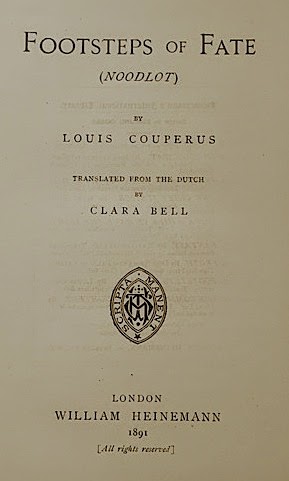
An excellent introduction by Edmund Gosse to Louis Couperus's 1891 novel Footsteps of Fate ('Noodlot') translated from the Dutch by Clara Bell. Gosse corresponded with Couperus but he wrote well informed  introductions similar to this to every book in Heinemann's long series of European novels. They show great scholarship and an enthusiasm for the emerging movements in writing in the last decade of the 19th century. While Britain had its aesthetic 1890s movement and the Celtic Twilight and the French their decadent writers the Dutch had the 'Sensitivists'…There are interesting references to the Dutch Browning (the poet Potgieter) also resident in Florence and also to Netscher the Dutch George Moore, a singular honour.

THE DUTCH SENSITIVISTS

In the intellectual history of all countries we find the same phenomenon incessantly recurring. New writers, new artists, new composers arise in revolt against what has delighted their grandfathers and satisfied their fathers. These young men, pressed together at first, by external opposition, into a serried phalanx, gradually win their way, become themselves the delight and then the satisfaction of their contemporaries, and, falling apart as success is secured to them, come to seem lax, effete and obsolete to a new race of youths, who effect a fresh aesthetic revolution. In small communities, these movements are often to be observed more precisely than in larger ones. But they are very tardily perceived by foreigners, the established authorities in art and literature retaining their exclusive place in dictionaries and handbooks long after the claim of their juniors to be observed with attention has been practically conceded at home.

Continue reading →

Bear in a cave – a hunter’s tale

Found in an unpublished  typescript -a real life account of big game hunting in India- the author was almost certainly Lieutenant Colonel J. W. Wray. The manuscript was in an envelope with 3 other chapters addressed to him at 'The Croft, Guildford' and he is known to have written With Rifle and Spear : reminiscences of Lt.-Col. J.W. Wray. COPAC gives his dates as 1851-1924 and record this book as being published by The General Press, Ltd.,. They estimate the date as 1925. Certainly these accounts mention rifles and spears, Wray was a dedicated game hunter. The manuscripts came from a couple of very old soldiers - Basil and Russell Steele.

No copies of the book are available and it has not been digitised, apart from an earlier chapter at Jot. Web archives reveal he was in the 108th Foot Regiment and he was a member of the Northumberland and Northern Counties Club. Punch mentions him and his wife in 1916 - the victim of a Pooter like misprint: 'Mrs. Wray entertained the recruiting staff, numbering £21, to tea at Brett's Hall, Guildford, on Thursday.' They add 'Sterling fellows obviously'.

BEAR SHOT INSIDE HIS CAVE

    In one of my previous Chapters I have described the following up of a wounded bear into his cave and finding him dead in there. I knew before I went in that he could not possibly be alive, and I merely went in to make sure of this before allowing any of the beaters to go in and drag him out.
Continue reading →

Catalogue chat / Time Slip

Poster for Tom's Midnight Garden
(Leeds Children's Theatre)

Found in the Peter Haining hoard a rare book catalogue from about 1990 with an introduction ('Chat Dept.') by the cataloguer. This was J. J. Rigden (Books) of Kent, dealing mostly in fantasy-- if still around he would be pushing 90. These 'chats' by dealers are much prized. A dealer once told me that when he omitted them sales went down and there were protests…this one is a classic of its kind:

The onset of autumn.. the approach of Christmas.. the inevitable rise in postal costs.. This leads us nicely on to a point we must make clear. We always despatch your parcels by the cheapest possible rate. Since we live in a mad world, this sometimes means first class letter rate, rather than a parcel rate.

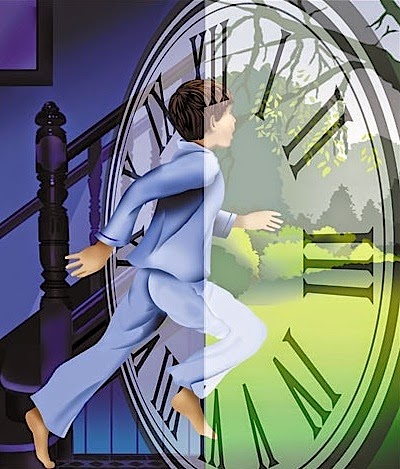
Over a wet Bank Holiday weekend, we watched a children's fantasy on T.V. Time Slip always a popular subject, now incorporated with sci-fi. Many famous authors have written around this theme, both adult and children's. My first remembered introduction to it was listening in the 1930's to Saturday Night Theatre. The B.B.C drama players put on some wonderful plays J. M. Barrie's "Mary Rose" made a great impression on me. My first introduction to Barrie apart front eh magical Peter Pan of course. Another play that filled me with horror was W. W. Jacobs "The Monkey Paw". Two themes that occur over and over again in children's stories, time slip and three wishes. Always in the three wishes stories the last wish has to be used to 'undo' the first two! (Well, I say "always".. someone will come up with a three wishes story that proves me wrong!) If time slip is a theme that interests you, have you read Alison Uttley's 'Traveller in Time', Lucy's Boston's 'Green Knowe' stories, Jane Curry' s' The Daybreakers', 'Moondial'.. I think this was by Helen Cresswell, quite recent so to in the reference book). These are some of the lesser known titles on this theme. Tom's Midnight Garden everyone known about. Stories so much more believable than the film just shown.. 'Back to the Future'.

Continue reading →

The Secret Places III & IV

Two more chapters of The Secret Places (Elkin Mathews & Marrot London 1929) - a chronicle of the 'pilgrimages' of the author, Reginald Francis Foster (1896-1975), and his friend 'Longshanks' in Sussex, Kent and Surrey. See our posting of the first chapters for more on Foster and this book..

Continue reading →

The 25 most beautiful words

A press cutting from an American newspaper from 1911  found in an old lexicon. It reads:

A contest to decide the twenty-five most beautiful words in the English language, conducted by the West Fifty-seventh street Branch of the Y. M. C. A., this week was won by John Shea, a lawyer, of 416 Broadway. The prize was a flexible leather standard student's dictionary. Twenty-one of the twenty-five words submitted by Mr. Shea were accepted. "The words accepted are melody, splendor, adoration, eloquence, virtue, innocence, modesty, faith, joy, honor, radiance, nobility, sympathy, heaven, love, divine, hope, harmony, happiness, purity and liberty. Three of the words rejected were grace, justice and truth. 

This story seems to have been syndicated as another paper of the time explains that 'grace' and 'justice' were stricken out because of the harshness of the 'g' in grace and the 'j' in  justice and the word truth was eliminated because of its metallic sound.100 years later in a less religion centred world it would be a different list - love and happiness, heaven, hope and liberty might still make it…(also truth and justice might be allowed back.) However melody, splendor, adoration, eloquence, virtue, innocence, modesty, faith, honor, radiance, nobility, sympathy,divine,  harmony and purity might not..

Henry Philpotts—that devil of a bishop

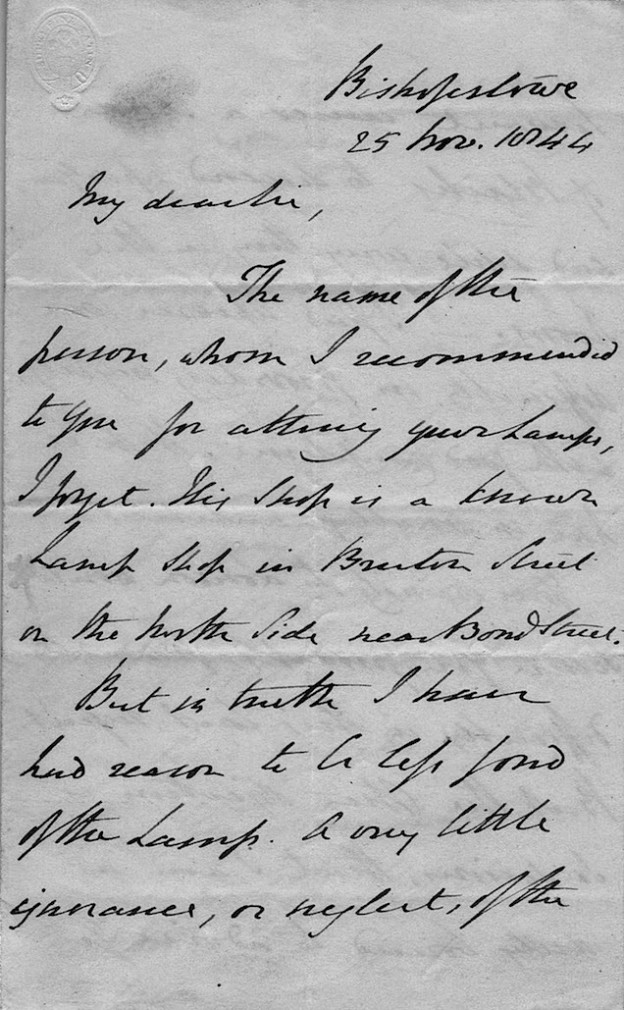
If the baby-eating Bishop of Bath and Wells out of Blackadder was a grotesque fiction—the reign , centuries later, of Henry Philpotts, one of whose letters is reproduced here,  is something we might associate more with  tyrannous Tudor bishops than with their supposedly anodyne Victorian successors.

Philpotts (1778 - 1869 ) was Bishop of Exeter between 1830 and 1869—the longest episcopacy since the 14th century. One of 23 children of an innkeeper, he is said to have been elected a scholar of Corpus Christi College, Oxford, at just 13, and  graduated five years later. In 1802 he was ordained and by 1809 had held four livings, cementing in that time  a lucrative connection with the diocese of Durham, where he became a Canon. Some idea of his aggrandising nature may be gained by the fact that after his election to the bishopric of Exeter in 1830 he asked that he be allowed to retain his former living of Stanhope, Co Durham which, due to the value of church land in such coal-rich territory, was then worth the enormous sum of £4,000 p.a.—amazingly £1,000 more than his new bishopric. This happy arrangement was refused, but Philpotts was permitted to keep a residentiary canonry at Durham, which brought with it a similar sum to that which he had lost, and which he retained until his death. The distance between Durham and Exeter is around 350 miles, which raises the question as to how often he, as Bishop of Exeter, was able to satisfactorily fulfil his obligations as a residentiary canon at Durham.

Continue reading →

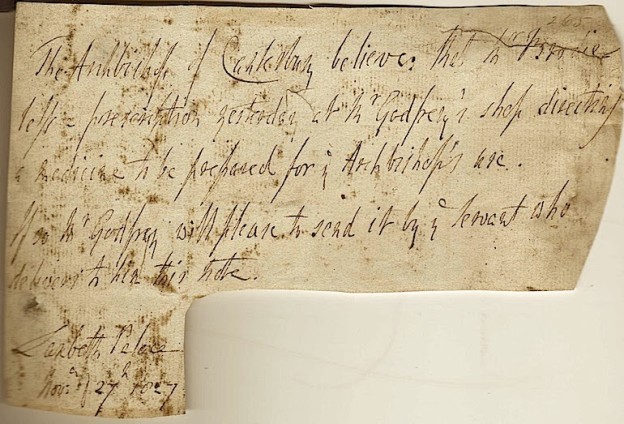
A request from the Archbishop…

Found by relentless jotter RR, this rare manuscript scrap from his collection.

The Archbishop of Canterbury believes that Mr Brodie left a prescription yesterday at Mr Godfrey’s shop directing a medicine to be prepared for ye Archbishop’s use. If so, Mr Godfrey will please to send it by ye Servant who delivereth this note.

Lambeth Palace Nov: 27th 1827

RR writes:- The Archbishop in question was Charles Manner-Sutton—by all accounts a rather conservative prelate who led the Church for 23 years at a time of great social and political upheaval. As someone who claimed direct descent from King Edward III, and therefore from William the Conqueror, it has been said that he is arguably the most aristocratic of England’s Archbishops of Canterbury, and therefore quite likely the sort of posh cleric who might use a word like ‘delivereth ‘in a letter to a tradesman. However, an analysis of the handwriting suggests  that he would have dictated his request to a flunkey.

At the time, the Archbishop’s health was not good and he died eight months later, in July 1828 aged 73.

Note: written requests for medicine from Archbishops of Canterbury to ordinary shopkeepers  are extremely rare.

The Reverend John Scott Lidgett (1854-1953)

Another jotting from the L.R. Reeve collection on the educationalist the Reverend John Scott Lidgett (1854-1953). A marvellous man, described here as a 'little packet of dynamite,' and author of 15 books. Reeve has a good story also about "the best-dressed woman in Rotherhithe…"

JOHN SCOTT LIDGETT

Where did I get the news that the late Dr Scott Lidgett was chairman of the centre for Psychotherapy, Epsom, at the age of ninety-six? All I remember is that I found the information jotted down in one of my scrapbooks. It may be true because he lived to the age of ninety-nine, and at ninety when a young journalist from the Kentish Mercury called at his home for an interview and congratulations, he was certainly in full command of his mental powers.
  At the end of the visit the young newsman expressed the hope that he might call again when the veteran reached his century. "It could be”, retorted the eminent divine, "you look as if you might live another ten years". The remark was typical, for Dr Lidgett, one of the most distinguished nonconformists of his generation, a little packet of dynamite, was a decidedly witty man; and every time I saw him, his expression never showed a trace of emotion, for his self-control was so significant to any observer of human nature that one felt that no situation would make him lose his colossal nerve. Moreover, as some of his minor duties were to be a manager of several schools, stories galore were told of his visits. Two remain in my memory: at one school on Prize Day the headmaster, during his report, declared that the year's successes were not due to himself but to his staff. His face dropped when Scott Lidgett, presenter of prizes, said he accepted the headmaster' s announcement.
Continue reading →

The name is Bond…Sexton Bond

From the Peter Haining papers, this typed manuscript  by the great researcher and expert on British comics and periodicals W.O.G. ('Bill') Lofts (1923-1997). It is interesting that Fleming got even close to writing a Sexton Blake, a bit like J.K. Rowling deciding to do a new Secret Seven adventure (actually not a bad idea..)

Sexton Blake and James Bond

I must confess that I greatly enjoyed the James Bond novels by Ian Fleming. Alas, there were only about sixteen of them as he died a premature death in 1964. Since then a number of other writers have penned them, but never read as well as the creator.

The first in 1955 was entitled 'Casino Royal' when the author an ex-M.I.5 man, certainly was authentic in every detail. The films that commenced in 1963 with 'Dr. No'*. I also greatly enjoyed, especially those featuring Sean Connery. Roger Moore his successor was just as good, though even more suitable to the Saint character, with his type of humour.

Continue reading →

Sir Fred Mander

From the Reeve* collection this study of  Sir Frederick Mander (1883 -1964) headmaster and trade unionist and the General Secretary of the National Union of Teachers (NUT) from 1931 to 1947. He was an important figure in British educational history but there is no photo of him available. He may be in this photo of members of the National Association of Head Teachers taken in Leamington Spa in the 1950s. Teachers are not movie stars and most searches bring up a British moustachioed character actor called Miles Mander who was born in 1884…Reeve is good on detail, especially speaking style - it is useful to know that occasionally Sir Fred 'murmured at the end of a sentence.'

SIR FRED MANDER

The late Sir Fred Mander was at one time a highly successful headmaster in Luton. During that period of his life he was popular with children, staff and parents; the school was throbbing with life and happiness, and when he resigned to labour in a wider sphere, Luton lost a splendid headmaster, although he still continued to exert a great influence in other branches of life in his own town.
Continue reading →

A genuine bogus Colonel…

From the Peter Haining papers, this typed manuscript  by the great researcher and expert on British comics and periodicals W.O.G. ('Bill') Lofts (1923-1997). The type of the bogus colonel (and, more commonly, the bogus major) is well known from 1950s British films but here is the real thing - a rather pathetic tale where Lofts' losses were low and the Colonel appears to have been a reader of Henty…

Colonel Whithington-Spooner

The letter addressed to me was in bold flourishing handwriting, and the address was 'The Lodge' Cranbrook near Epsom, Surrey. I don't know why, but I slightly suspicious of the person at first sight, but briefly the letter read as follows…

Continue reading →