Beware—-Lady Decorators at Work !!

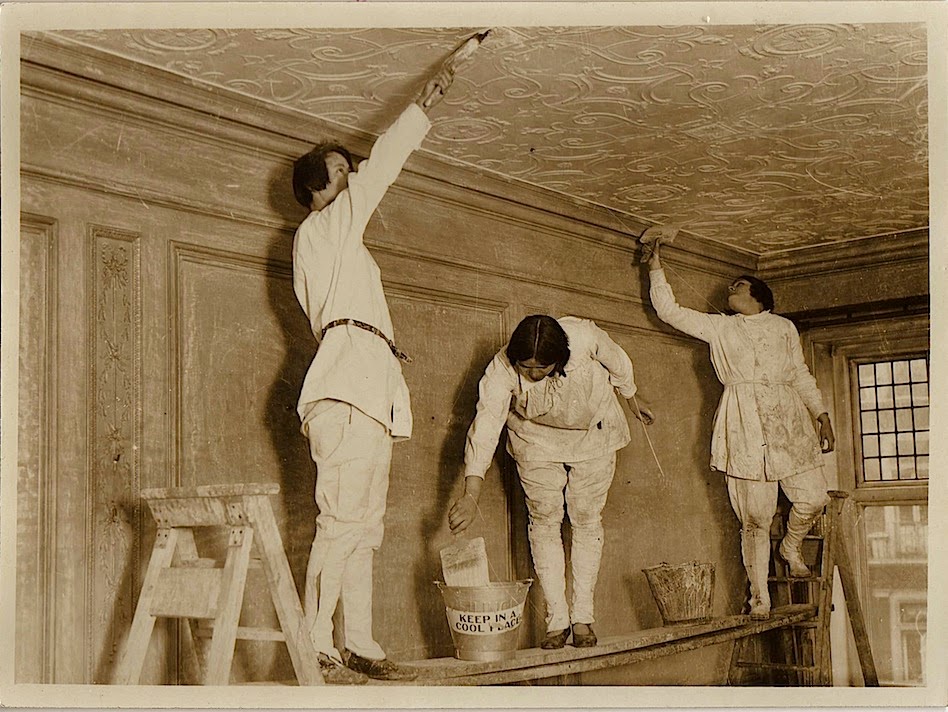
Here is one of four press photographs from the Photopress agency showing the same group of female house decorators performing various tasks. The other photographs depict two decorators limning Georgian panelling in a ‘West End mansion ‘, painting exterior window frames at the rear of another Georgian house by means of a ladder, while a third shows paint being mixed. This particular shot of three painters white washing a plaster ceiling while standing on two very precarious looking duckboards would probably horrify our Health and Safety jonnies. Back in the early 1930s, when these photos were probably taken, Risk Assessment Reports were sixty years into the future.
A slightly  sexist comment typed on the back of the Georgian panelling photo by some agency worker is worth examining:

WOMAN DECORATORS BUSY ON THE JOB
Many of the big houses and mansions in the West End are now in the hands of decorators. At some of the houses woman decorators are busy on the job of working with effecientcy (sic) that expert decorators would find hard to beat.

Life and death in a Georgian workhouse ( A real life Mr. Bumble)

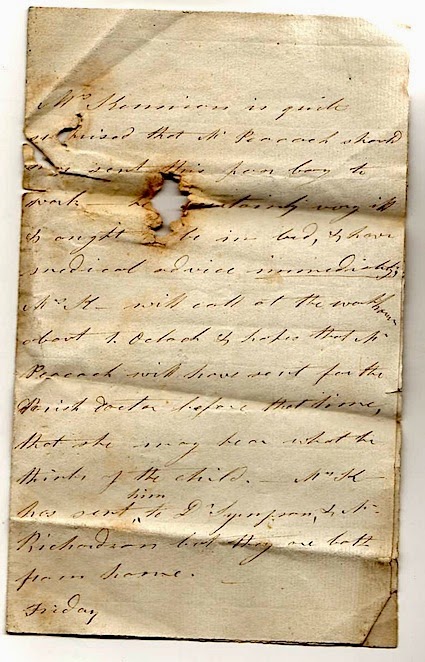
Here is a letter picked up years ago in London among a box of ephemera. It is undated, though the watermark is 1821. It is addressed to ‘Mr or Mrs Peacock’:

Mrs Kennion is quite surprised that Mr Peacock should have sent this poor boy to work. He was certainly very ill & ought to be in bed & have medical advice immediately. Mrs K will call at the workhouse about 1 o’clock & hopes that Mr Peacock will have sent for the Parish doctor before that time,that she may hear what he thinks of the child. Mrs K has sent him to Dr Sympson & Mr Richardson, but they are both from home.
Friday.

A bit of Googling revealed that the action took place in Harrogate, then just beginning on its journey to becoming the most select watering place in the north of England.  In June 1822 Henry  Peacock, formerly the master of Aldborough and Boroughbridge workhouse,  arrived, with his wife Elizabeth, as the master of Harrogate’s workhouse in Starbeck. Evidently aiming to make an impression with the employers by saving money, the couple soon managed to reduce the average cost of keeping a pauper by establishing what was basically a vegetarian diet. This regimen could have contributed to the poor health of the boy in question. It would probably not have included many, if any, fresh vegetables, and may, like that of the hero of Oliver Twist, which was set in the 1820s, have consisted mainly of gruel.

Continue reading →

The Rings of Baron Corvo

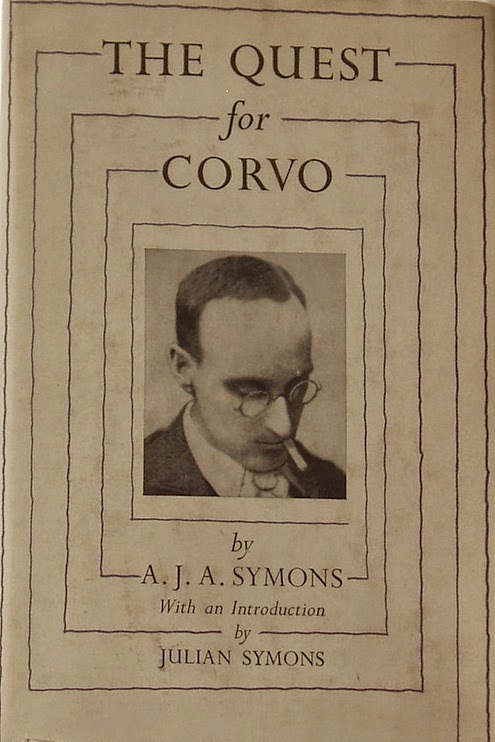
Biography of Baron Corvo
by 
A.J.A. Symons

An interesting side note on the appearance of the great cult writer can be found in this speech by C.H.('Harry') Pirie-Gordon (1883-1969) co -author with Baron Corvo  of The Weird of the Wanderer (by Prospero & Caliban). Baron Corvo was also known as Frederick Rolfe. The speech was delivered at the first banquet of the Corvine Society in June 1929 16 years after Corvo's death. Caliban speaks:

"His Archblessedness the Grand Master has referred to the Baron's sub fuse (sic) and sometimes revolting vesture. I cherish happier memories of his sartorial appearance. While he was our guest, sometimes he appeared in the purple habit designed and devised by himself for the Order of Chivalry, of which we were both members, a habit sumptuous and amaranthine: at others, when dining with the doubtless bucolic society, which marvelled at his conversation and his lore, he would wear a dinner jacket of soft bluish-grey velveteen, with his clerical collar and silk stock, while on his fingers would appear one or more of the massive silver rings which he had designed for himself. These he kept, when not in use, in a box of powdered sulphur in order that they might constantly be black: two of these were the famous anti-Jesuit rings, to which he alludes in one of his stories. They were of immense thickness, and each was armed with a spur rowel, so set in the thickness of the ring as to be capable of revolving. He used to explain that if a man, wearing these, were to meet a Jesuit, he could dash one of them across the Jesuit's forehead, and escape while the holy man was blinded by his own blood pouring from the wound scored across his forehead. Another ring he had, which he gave to me, made of electron, which he explained as being an amalgam of gold and silver in equal parts. This was engraved with a Crow..."

The diners who throughout the meal had drunk larger and larger libations finally toasted the Baron in Corvo Gran Spumante and then "the meeting did not so much end as deliquesce..."

Stephen Graham—a prince among Soho tramps

Just a few minutes walk from Leoni’s Quo Vadis is Frith Street, now famous as the home of Private Eye, but for a century or more  the haunt of Soho journalists, writers and other near- do- wells, including Stephen Graham, who from 1912 to his death in 1975, lived in a flat at no 60, a handsome Georgian town house. In the days before adventurers in dangerous lands were accompanied by a TV crew, Stephen Graham, who described himself as ‘tramp’ before that word had gained unsavoury associations, explored a number of exotic lands, including Russia, on which he became an expert, recording his impressions in books and articles, until he could no longer finance his expeditions.

The letter, which was discovered among a batch of other unrelated correspondence, belongs to his most productive period, is written from Frith Street and is dated 4th December 1926. In it he invites a Miss Morley to an after-dinner ‘mixed party of various acquaintances who will sit around the fire & talk.’ He also invites her to bring along her copy of his recently published London Nights for him to sign.

In his latter years Graham’s reputation fell into decline, and there is a depressing description of him in poverty and disarray in his flat. He died at an advanced age in comparative obscurity in 1975, but today, however, thanks possibly to the popularity of TV travelogues and cheap holidays to exotic lands, there is renewed interested in his work. Two major online sites are devoted to him, and Abebooks shows that his books are beginning to be collected once again. A biography by Michael Hughes has just been published Beyond Holy Russia: The Life and Times of Stephen Graham. [RMH]

Fascists “Uppish” Again (Tom Driberg)

Found - this cutting from the Oxford Mail - Thursday 4th February 1943 detailing an incident straight out of Foyle's War. While World War II was raging, back in England pro-Nazi 'hooligans' were getting 'uppish.' A good demonstration of fair play and free speech - but 'much to be deplored.' Tom Driberg, now the subject of several biographies, was an openly gay, Communist sympathiser and a lifetime opponent of fascism. Churchill said 'he is the sort of person who gives sodomy a bad name..' Peter Wright of Spycatcher fame said he was a double agent...

Tom Driberg

Fascists "Uppish" Again - M. P.

Mr. Driberg (Ind., Maldon) asked the Home Secretary in the Commons today if he was aware that an organisation which advocated peace by negotiation with Hilter, and distributes pro-Nazi, anti-parliamentary and anti-Semitic propaganda, was proposing to hold a public meeting at a London theatre in the near future, and whether he would take steps to prevent the holding of such a meeting as likely to provoke a breach of the peace.

Mr. Morrison said that while watch was being kept on the activities of this organisation, his present information did not suggest that this meeting was likely to attract so much public interest that serious disorder was to be apprehended, and it would be premature for him to decide at this early date whether there were ground to prohibit the meeting, under Regulation 39E.

Mr. Driberg: Will you bear in mind that only last night there was a deplorable exhibition of hooliganism at Finsbury, where a memorial of Lenin was broken up and tarred and placarded with Fascist slogans?
Will you bear in mind that these people do seem to be getting rather uppish again and require a sharp check?

Mr. Morrison: I will certainly look into that incident to which you refer. If true, it is much to be deplored.

Snapshot of W.E. Gladstone

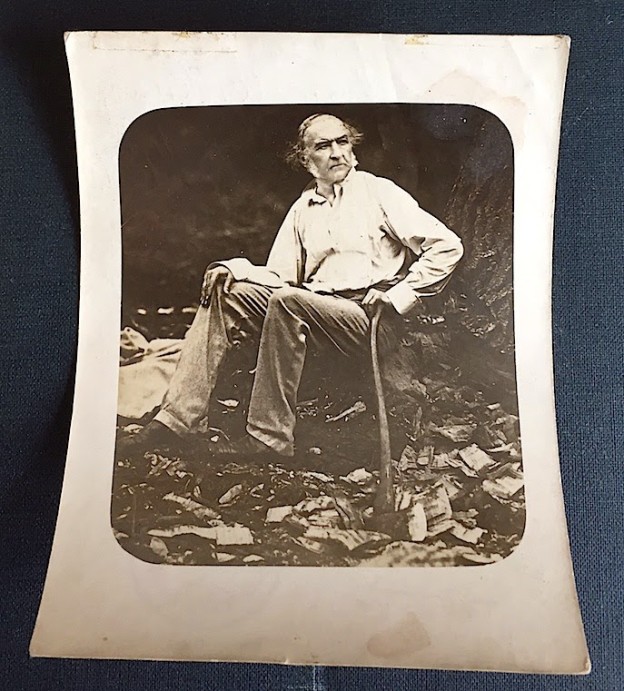
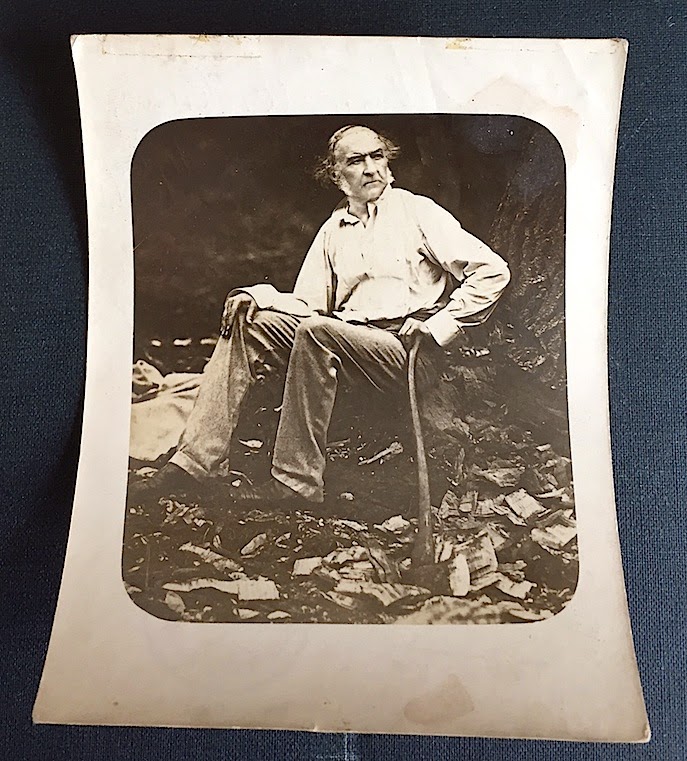
Found - a snapshot of W.E. Gladstone (1809 - 1898) the original 'Grand Old Man' (G.O.M.) at his country seat Hawarden Castle.  He was Prime Minister 4 times, resigning finally at the age of 84. At the time of this shot (1877) he was out of office. Written on the back of the photo (found in a book by  W.N.P. Barbellion) is 'Gladstone Centenary, December 29th 1909' (crossed out). Unique photo of late Rt. Hon. W.E. Gladstone taken at Hawarden in 1877.' Under this is a stamp 'E.J. Lavell 115 Bedford Hill, Balham S.W.' This is presumably the shop that processed the photo. An online image search reveals another fuller shot (on flickr) from the same session  revealing that the implement to his right is an axe and showing his straw boater on the ground beside him. There is  a note stating that he was relaxing after chopping wood.

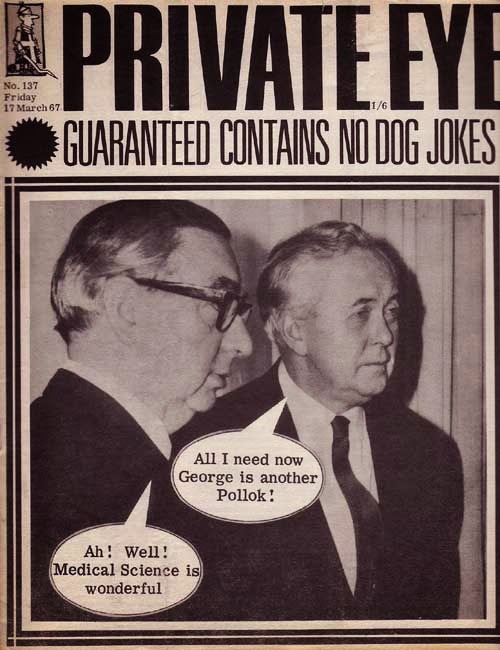
The Worst Government for 100 years?

This rant on Harold Wilson's Labour Government came from the Wells (Somerset) Conservative Association. It was a one page flyer printed in blue ink and had first appeared in The Daily Telegraph. Anthony Lejeune, a highly competent journalist and author is not gifted with a Wikipedia page but there are traces of his career from a search on the site. He wrote a history of London clubs and has written about Arthur Machen and Fr. Brocard Sewell. He has written about Ernest Bramah in The Tablet which may mean he is a Catholic and almost certainly a book collector…the piece (very slightly  truncated) is very much of its time (circa 1966). Politicians are no longer condemned for wearing the wrong clothes at parties.

The Worst Government for 100 years? by Anthony Lejeune.
Do you remember George Brown on television, flanked by leaders of industry and the trade unions, flourishing his fatuous Declaration of Intent? Do you remember the commentators solemnly telling us that this marked a watershed in the history of British industrial relations? And do you remember any of those commentators apologising to us since for having been taken in by so naive a piece of nonsense? I don't.

Do you remember the National Plan?
I got into trouble with the BBC for treating it, the week it was published, with the disrespect which it soon proved to deserve. I'm still waiting for an apology or even an admission that I was right.

Continue reading →

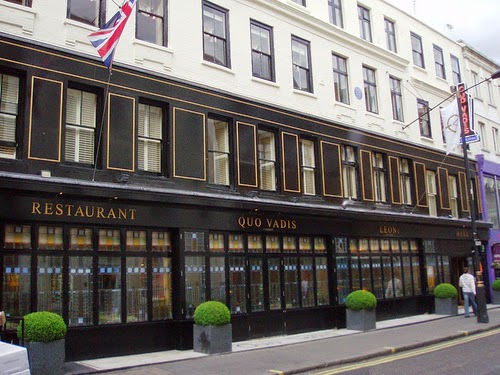
Leoni’s Quo Vadis restaurant: ‘no better place in the world to dine or lunch’

Leoni printed this praise from the film actress Evelyn Laye in a tiny promotional booklet reprinted to coincide with the Festival of Britain in 1951.The year before, journalist, S. Jay Kaufman, a veteran American, in a letter to Leoni, revealed that from 1911 to July 1914 no 27, Dean Street, Soho, which under Pepino Leoni became the Quo Vadis restaurant in 1926, had been home to himself and the painter Horace Brodsky. Back then, Kaufman explained, the domestic arrangements might have been pretty basic, but the good company had made up for this:

'The cuisine ? Ours! The charwomen ? Ourselves! And to this Adam house came Harry Kemp, John Flanagan, Augustus John, Jacob Epstein, J.T Grien, Lillian Shelley, Nelson Keys, Lily Cadogan, David Burton, Louis Wolheim Arnold Daly, Sir Charles Cochran , Leon M Lion, Constance Collier, Granville Barker, and Frank Harris…’

Continue reading →

The Ponsonby-Baring Language

Maurice Baring with his
pet budgerigar 'Dempsey'

This private language, known as 'The Expressions,' was used by the writer Maurice Baring (1874 -1945) and his family and friends. It was started by his mother and her sister, Lady Ponsonby, when they were very young and developed over two generations. It is mentioned in Emma Letley's biography of Baring and there are a few pages on it in Sir Edward Marsh's A Number of People (London, 1939.) Marsh writes: '..in the course of two generations (they) had developed a vocabulary of surprising range and subtlety, putting everyday things in a new light, conveying in nutshells complex situations or states of feeling, cutting at the roots of circumlocution. Those who had mastered the idiom found it almost indispensable, and my stable-companion at the Colonial Office, Conrad Russell, when asked if he knew anyone who knew the Baring language, answered: 'I spend all my days with a Baring monoglot.' One or two words have already passed into the language: 'Pointful' (the opposite to 'pointless') which Desmond MacCarthy constantly uses in his critical writings, is of Baring origin…'

Some of the words are a little site-specific but could still have their uses (e.g. 'a Shelley Plain' for the sighting of a famous person*) others like 'loser' seem quite current, although M.B.'s 'loser' is more of a cad than a failure. Here is a glossary based on Letley/ Marsh:

Continue reading →

The Laying of the Atlantic Cable (1866) in verse

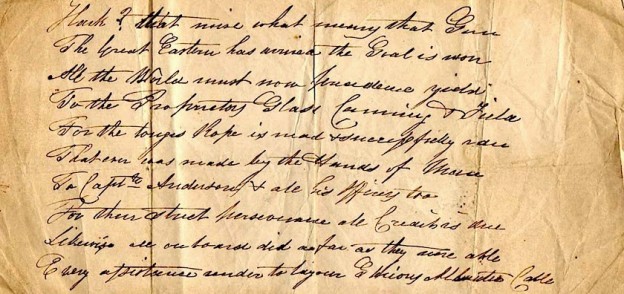
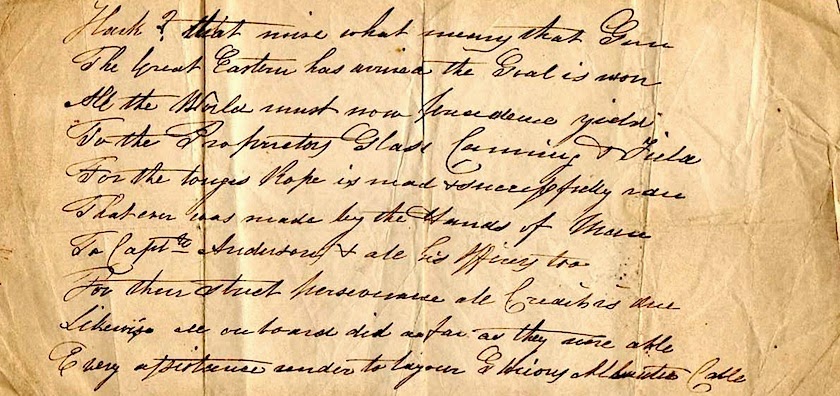
This scrap of doggerel, found among a collection of holograph letters, has no name attached. It is bad enough to be by William McGonagall, the second worst poet who ever lived (the first being Amanda Ros), but is dated at around 1866, which must surely be too early for him.

Hark ? that noise, what meaning that Gun
The Great Eastern has arrived, the Goal is won
All the world must now precedence yield
To the Proprietors Glass, Canning and Field
For the (longest) Rope is made & successfully ran
That ever was made by the Hands of Man
To Capt. Anderson & all his officers too
For their strict perseverance all Credit is due
Likewise, all on board did as far as they were able
Every assistance render to lay our Glorious Atlantic Cable.

The first transatlantic telegraph cable manufactured by Glass and associates was laid in 1858 from Western Ireland to Heart’s Content, Newfoundland, with Cyrus Field as entrepreneur.  Unfortunately, the poor quality of the cable meant that it functioned well for only a few weeks and was irretrievably damaged in September of the same year when too much current was passed through it. Undaunted, Field and associates raised more money and in 1865 Brunel’s huge ‘Great Eastern’ steamship, was commissioned to lay a new improved cable along the same route. Under Captain James Anderson and with Canning as chief engineer, the ship sailed westwards from Ireland, but after 1,062 miles the end of the cable was accidentally dropped into the sea, where it sank to the depth of over two miles. The mission was abandoned and the Great Eastern sailed back to obtain a new cable. This was duly laid in July 1866, to universal acclamation .The poem seems to celebrate this astonishing feat of seamanship and engineering, but it may have been composed a few months after this initial success, when thanks to the 'strict perseverance' of Anderson and his officers the lost first cable was somehow retrieved from the depths of the Atlantic, spliced to a new cable, and the whole laid along the same route to Newfoundland. Thus, by September 1866 two working transatlantic cables were in operation.

The new communications link to America was an astounding boon to commerce, diplomacy and the military—reducing the time taken to send and receive messages from ten days to a few minutes.  [R R]

Marlowe in Abadan

Another humorous piece from the papers of  'EVOE' i.e. Punch editor E.V. Knox. A Kit Marlowe parody…

MARLOWE IN ABADAN

 "Our methods of dealing with Persia have scarcely been those of Tamburlaine the Great," I wrote; and then (remembering a recent dramatic performance) I thought "How very strange if they had been." Something, I suppose, after this sort.

Enter, from underground holes, MR. MOUSSADEK and the BRITISH FOREIGN SECRETARY, with great voluted swords.

Continue reading →

My Epigram

Some more humorous writing from the papers of E. V. Knox ('Evoe.") He was, for a while, editor of Punch (1931 - 1949) and this may have appeared there although there is no trace of it online...

MY EPIGRAM

  For long it was a fugitive dream. I would catch sight of it, as one sees, or seems to see, a wild animal far down a forest clearing, or might it be a woodland nymph or faun? Or perhaps I would trace it written in the colours of the sunset, or in the morning among the folds of mist as they cleared from the chimneys on the mountain tops.

Continue reading →

C. B. Fry—Renaissance man

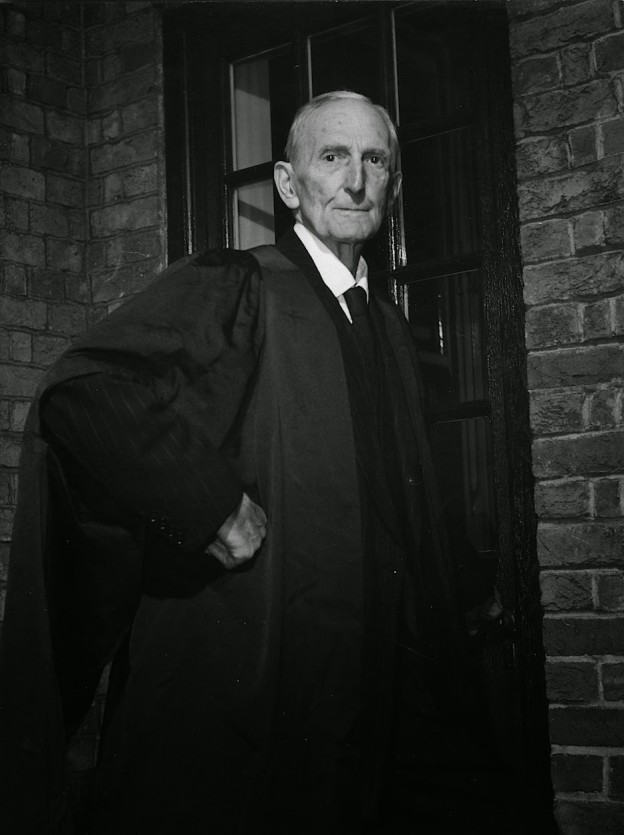
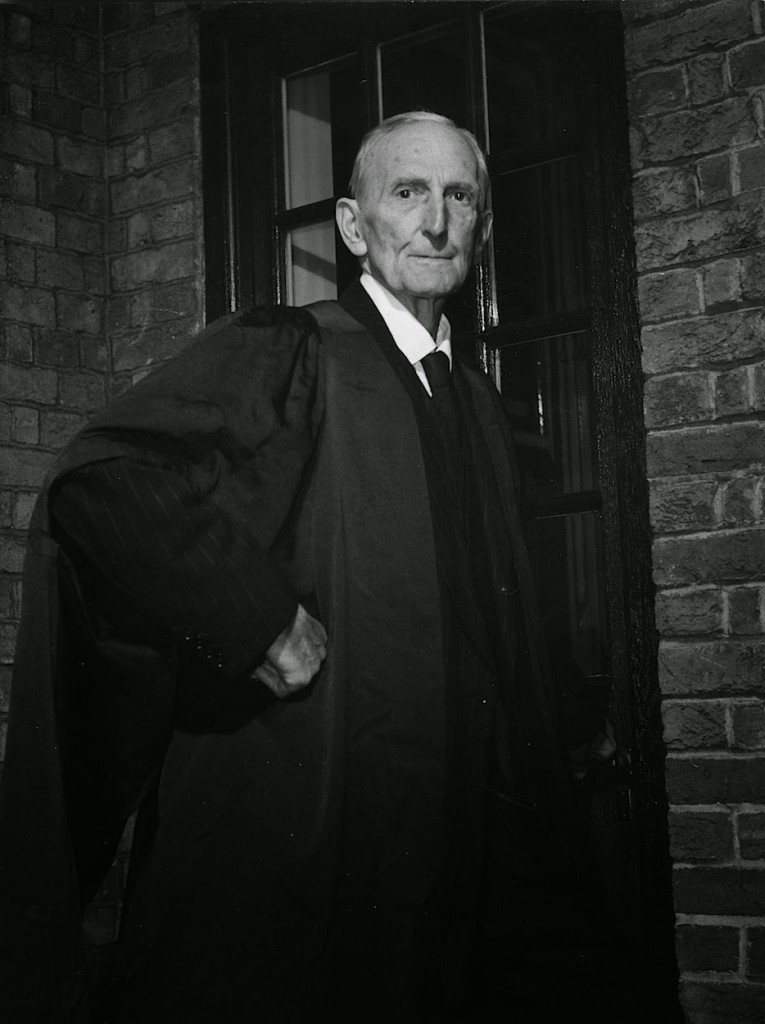
There are many photos of C. B. Fry (1872 – 1956)---an athlete who also  represented England at football and cricket,  Classical scholar, teacher, politician., journalist and author --- on the Net, but you won’t find this one. It comes from a batch of press photographs dating from the forties and fifties. Fry is shown wearing his basic B.A.gown, gained many years earlier after a horrendous performance in his Finals at Oxford, where he was awarded a fourth class degree ( incidentally, I know of only one other famous man who gained such a terrible degree and that’s John Ruskin). The great man finished his teaching career way back in 1898, so perhaps he is revisiting Repton, where he was a pupil, or Charterhouse, where he once taught, in order to receive some sort of honour. I think the photo is rather good, conveying as it does that combination of fierce intelligence, physical toughness and commitment that made the man, in the words of John Arlott, 'the most variously gifted Englishman of any age'.

National Treasure Stephen Fry claims C.B. as a kinsman, but does he offer much or any evidence for this? Not having read any of his memoirs, I cannot judge, but there does seem to be something of the younger’s man’s nose in the great sportsman’s own, if this photo is any guide. Both C.B. and Stephen also have mental illness in common. The former’s disastrous showing in the examination room was put down to a derangement that followed his efforts to pay off huge debts--- and at various times during the rest of his life he became incapacitated by similar bouts of mental illness. Mental problems often run in families. Was this true in the case of Stephen’s own bipolar disorder?

Incidentally, C.B.’s party trick, which he claimed to perform up to his seventies, was to leap backwards from a standing start onto a mantle piece behind him. Now that’s something I’d like to see Stephen Fry perform. [RMH]

Lament for a Country Vet

Found - amongst a collection of Suffolk ephemera - this one page poem about a late lamented vet who died in the year of the Titanic and, according to records, was born in 1847. Little is known about him, but the poet W. S. Montgomery, the 'Blind Organ Grinder of Westleton' appears to have been an itinerant local poet and some of his poems and a short note* about him can be found in Barrett Jenkins book from the 1990s - A Selection of Ghost Stories, Smuggling Stories & Poems Connected with Southwold.

In loving memory of Edgar Willmott Wright, M.R.C.V.S.
For many years Veterinary Surgeon at Yoxford,
Died Friday, July 26th, 1912.

Interred at Yoxford Cemetery, Monday, July 29th.

Continue reading →

C.M.Westmacott—a blackmailer of the Regency

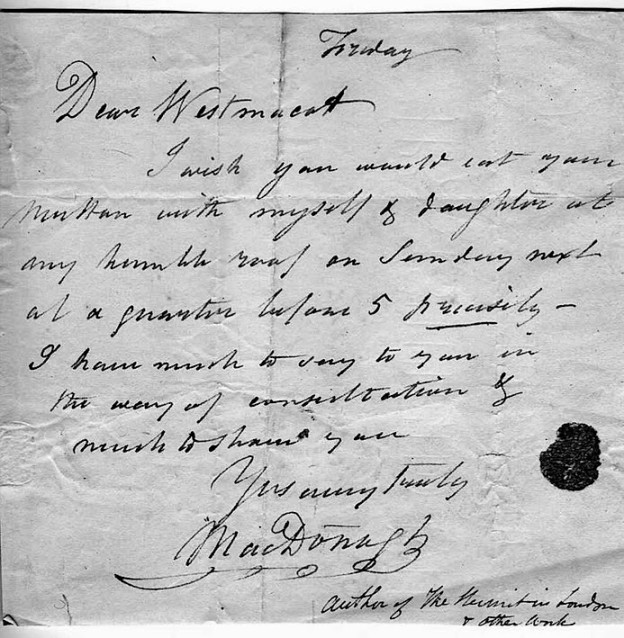
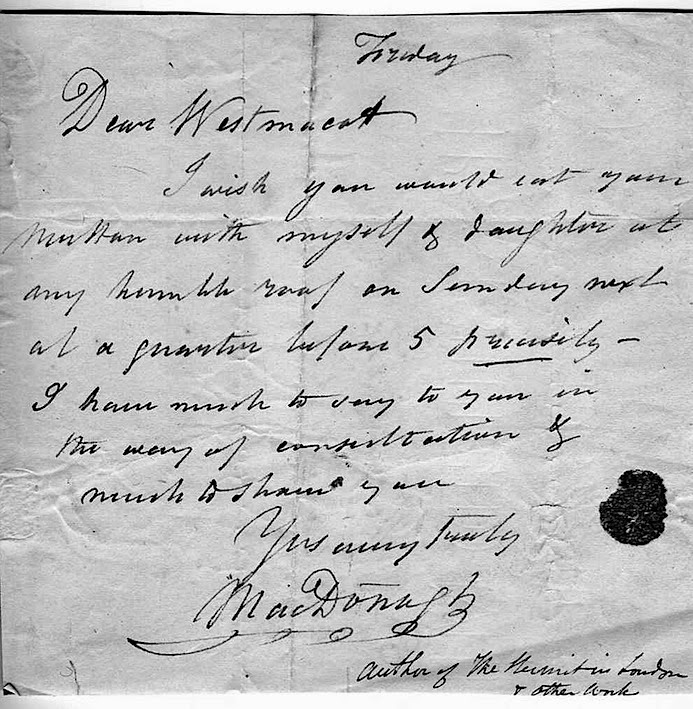
This scrap of a letter, on paper watermarked 1824, was discovered a few years ago in a pile of autographs. It had been sent by the rather obscure W.B.MacDonagh, author of The Hermit in London to Charles Molloy Westmacott, editor of the notorious Age newspaper, and author of the London Spy, and proposed a meeting to discuss business.

Continue reading →

E.H. (Ethel Howard) Spalding

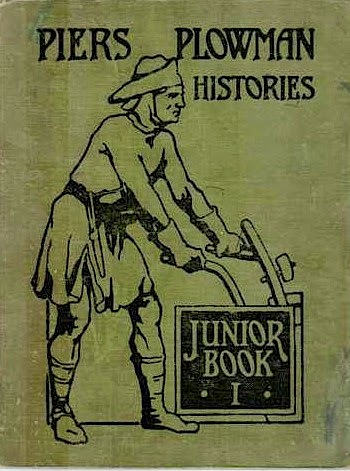
From the papers of L R Reeve* this affectionate portrait of a minor character in British education. She does not have a Wikipedia page and is unknown to the DNB, but WorldCat record many books on history and education by her, some of which were continually reprinted into the 1960s. Her first book The problem of rural schools and teachers in North America (London : Stationery Office) was published in 1908 and she is noted as revising a book in 1960, so one could speculate her dates were something like 1880 - 1965. Her text books Piers Plowman Histories were in print from 1913 - 1957.

Miss Spalding

Miss Spalding was a most astonishing historian who still makes me feel google-eyed when I remember some of her activities.

In appearance she seemed so fragile that one would think a gentle summer breeze would blow her over. Yet when she lectured at Goldsmiths' College, London, cheeky men students, immediately after ragging unmercifully an instructor in physical training, would sit in her presence during a history lecture hardly daring to flicker an eyelid. Should, however, an unusually presumptuous newcomer take a chance, a slightly sarcastic smile and a softly spoken snub would make a blushing, wriggling mortal wish he were miles away from such and unexpected agony; and the tributes to Miss Spalding's uncanny disciplinary power can be heard even to this day when elderly men meet at college reunions.

Continue reading →

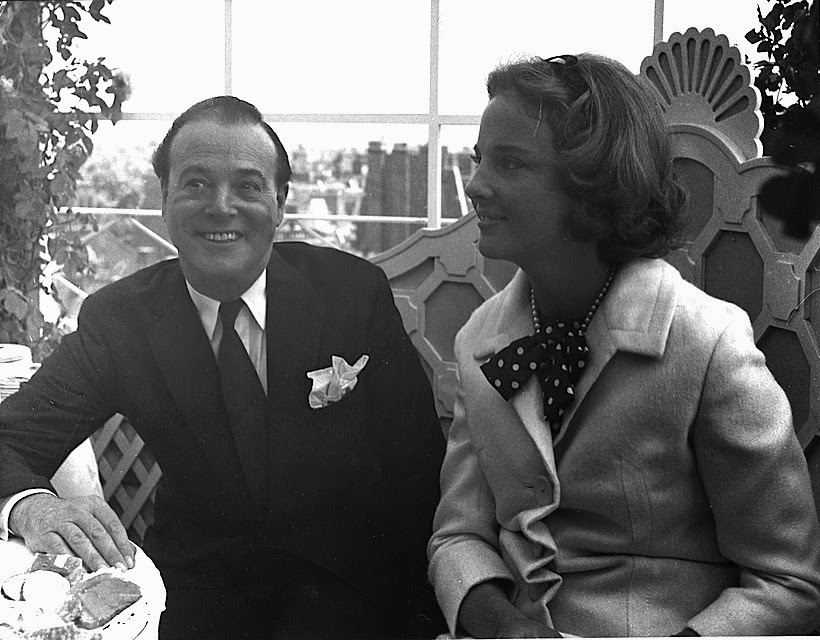
Oliver Messel and ‘Bobo’ Sigrist in the famous Suite he created

It’s got a toilet seat shaped like a scallop shell, a grand double bedroom and more rococo swags, flat columns and baroque touches than a wealthy thespian could wish for. It’s where Elizabeth Taylor and Richard Burton spent their honeymoon in 1964.No wonder American A listers, like Sylvester Stallone, Tom Cruise and Michael Jackson, have demanded it. We are talking about the Messel Suite, which is all yours for a mere £2,950 a night.

This photo, retrieved from a pile of press shots issued by the Dorchester itself, shows its creator, Oliver Messel, arguably the greatest stage designer from the thirties to the sixties, sitting alongside the twenty-two year old Frederika ‘Bobo’ Sigrist, heiress to the Hawker-Siddeley fortune. It was taken on 28 June 1962 on the occasion of her mother’s marriage to British public relations chief Sir Berkeley Ormerod.

Messel and Sigrist, in an artfully arranged pose, may first have met through their shared association with the millionaires of Mustique. Messel lived in a Barbabos beach house named Maddox, which he had totally transformed and decorated to his own designs , while Sigrist  was part of the Bahamas jet-set. A year after this photo was taken, she married Irish film producer Kevin McClory, who was responsible for the James Bond films.

Messel went on from creating stage sets and hotel suites to become one of the most sought after house designers in the Caribbean. Between 1960 and his death in 1978 he designed around 30 homes on Mustique, of which at least 18 have been completed. The V & A houses a large collection of his stage and other designs. [R R]

Hugh Crichton-Miller (1877-1959)

Found among the papers of L R Reeve* this appreciation of the life of Dr Hugh Crichton Miller Scottish psychiatrist and founder of the Tavistock Clinic.

Tavistock Clinic**

DR HUGH CRICHTON-MILLER

  My appreciation of the late Dr Hugh Crichton-Miller is not in chronological order so I begin with an unusual admonition made in the middle of one of his talks to an audience of highly intelligent and respectful graduates: If you can't study the subject deeply leave psycho-analysis alone'.
His advice has never left my memory for two reasons: the very level-headed doctor was one of our greatest authorities on medical psychology, and a few weeks later the matron of a nursing home, having asked my opinion of the new psychology informed me that treatment was beneficial to half the patients concerned and disastrous to the others. Hence I was warned and I feel to-day that the warning is more imperative than ever before, not only to myself but to the increasing number of people concerned.
However, as psycho-analysis is not on my own terms of reference I refer to my next view of the specialist on the platform in Wimpole Street, when he so ably interpreted Dr Montessori's address. I have mentioned him in my reference to Montessori elsewhere so turn to my third episode when I heard him at the seaside.
  
Continue reading →

Hallucinations of Shakespeare

When English tourists abroad are accosted by foreigners on trains it is now more likely to be about Manchester United or Downton Abbey. According to the writer Maurice Baring, in his time it was often about Shakespeare, as in this intriguing account in his Lost Lectures (London, 1932):

Over and over again it has been my fortune to be told about English literature by foreign high-brows in trains, and to be initiated in the secrets of the literature of my country. I once met a Serbian professor who told me that he had written a book about Shakespeare. He spoke French (not Shakespeare—the Serb). Shakespeare was a well known case, he said, of self-hallucination. He knew, because he was a mind doctor. Hamlet was a well-known case of a man who thinks he sees ghosts.
“But”, I said, “the other people in the play saw the ghost.” “They caught his infection,” he said.
“But they saw it first,” I objected.
“It was Suggestion,” he said; “it often happens. The infection comes from the brain of the man who thinks he sees a ghost before he has seen the ghost, and his coming hallucination infects other brains. Shakespeare hallucinated, or he could not have described the case so accurately. All his characters hallucinated—Macbeth, King Lear, Brutus (he saw a ghost).”
I said enough things had happened to King Lear to make him go mad. “Not in that way,” he said. “Ophelia is mad; Lady Macbeth is mad; Othello is mad; Shylock is mad; Timon of Athens is very mad; Antonio is mad; Romeo is mad. The cases are all accurately described by one who has the illness himself.”
“Was Falstaff mad?” I asked.
“Falstaff,” said the doctor, “is a case of what we call metaphenomania.
He was a metaphenomaniac; he could not help altering facts and changing the facets of appearances.”
“What we call a liar?” I suggested.
The doctor said that was an unscientific way of putting it, but it was true. Then he got out.

The Dynamiter – first punk mag?

At a revolutionary printing office*

Found - a review in a 'monthly magazine of bibliography' Book Lore (1886) of  a new magazine The Dynamiter : a record of literary bombshells, books old and new, flung into the camp of the orthodox [London : Printed and published for the proprietor by Thomas Shore**, Jun.,] WorldCat shows that it  went to just one issue. The only copy in world libraries is at the British Library in Euston. Amazon list it as 'currently unavailable' assigning it the ASIN number ASIN: B0000EF989. The publisher, and probably the author, seems to have been a minor John Camden Hotten style publisher of the curious, seditious & the scabrous. WorldCat lists another work almost certainly by  by him:

Men V. Machinery. Suggestive Facts and Figures, urging National Control of National Powers of Production. By Thomas Shore. With Preface by H. Halliday Sparling. 20 pp., price 2d. 

Continue reading →