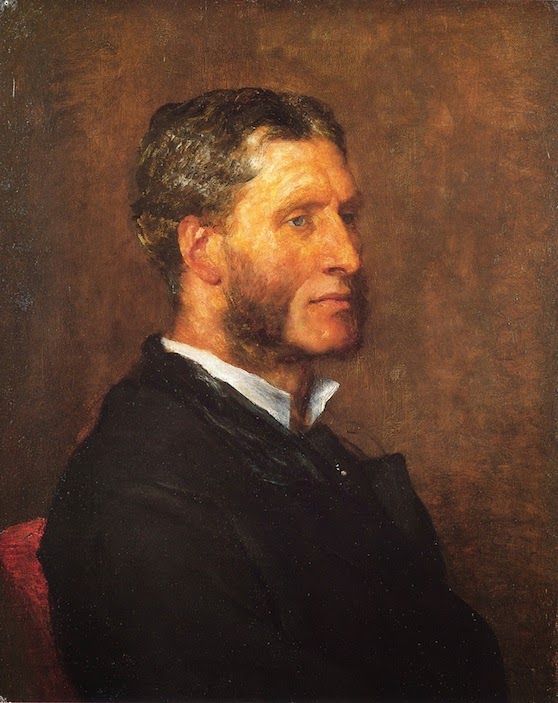
W.H.R. Rivers

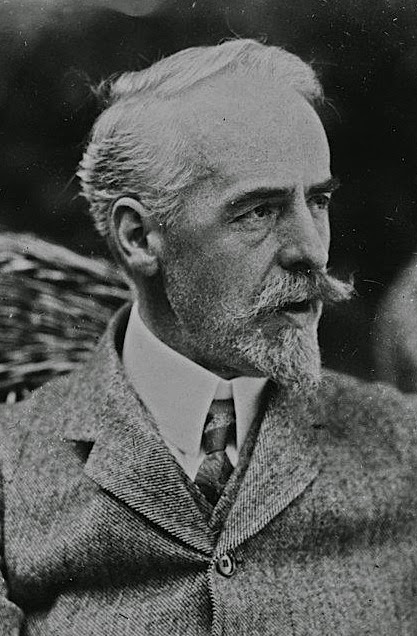
Sometimes now known as 'The Psychiatrist of The Ghost Road' W.H.R.Rivers has a formidable reputation and holds a pivotal place in the development of neurophysiology, psychiatry/ psychology and anthropology - but he is probably most widely known for his wartime association with Siegfried Sassoon and Robert Graves and is featured in Pat Barker's 1995 Booker prize winning novel The Ghost Road. L.R. Reeve* some of whose encounters with famous people we are posting, actually never met him but saw him lecture and, sadly, missed a chance to meet him '…after he had addressed an audience at Cambridge he invited the London contingent to his rooms at St John's College for coffee and discussion. Some of us, I among them, wanted to return by the next train and reluctantly refused. What a chance I missed!' Nevertheless he has a good account of him:

W.H.R.RIVERS

Dr Rivers (1864 - 1922) was one of those rare men who call forth the best generous impulses of anyone with whom they come in contact. No extreme selfish extrovert, no criminal, nobody I should think, could resist his unconscious charm; and he himself, like Harold Nicolson, couldn't hate anybody.
  
Continue reading →

H.H. Asquith (Earl of Oxford & Asquith)

[More from the papers of L.R. Reeve* who writes:] I remember, somewhere around 1907, reading a wrong prognostication in a Manchester newspaper, the 'Daily Despatch', about Lloyd George, Grey, Runciman, McKenna, Birrell, Samuel, Haldane, Morley and Winston Churchill.
  
Nine names of nine outstanding men who, under Henry Herbert Asquith, formed one of England's strongest cabinets ever known. The cabinet was so powerful, said the prophetic journalist, that Asquith might never be able to control so formidable a group of parliamentarians. We all of course know that he did, and that by 1914 some far -reaching acts of parliament had been passed by the government.
  
  One of the early acts, causing the lengthy, bitter 'ninepence for fourpence' controversy and angry snarls about stamp-licking can never be forgotten by octogenarians, and I cannot believe that widespread antagonism towards individual members of parliament today is as vindictive as that of my young days; and as yet parliament hasn't witnessed the unprecedented scene encountered by Asquith when he rose to speak on the bill abolishing the veto of the House of Lords. For nearly an hour he stood almost unheard against the continuous roar of anger from the opposition. Finally he sat down defeated by the pandemonium. Later the incident was known as 'the Pothouse Brawl'.

Continue reading →

John Hayward—‘the most malicious man in London’

This photo, which is inscribed on the reverse, 'Rose Macaulay (centre) and John Hayward' was found amongst a large collection of press photographs that included a number of other shots of celebrated British cultural figures from the forties and fifties. Judging from the physical condition of the identified figures, it must date from the mid fifties. Hayward had suffered from muscular dystrophy since his twenties and eventually became wheelchair- bound. I suspect that the other two individuals in the shot were his ‘carers’, although observant Jotwatchers may know better. Even though Hayward was said to be light in weight, I can’t imagine the spindly Rose  having the energy to propel him across the grass. Incidentally, does Rose come into the category of Very Tall British Female Novelists**, along with Virginia Woolf ?

The photo makes Hayward, with his thick lips and mischievous mien, resemble top notch Modernist Wyndham Lewis. Nor were these facial features the only attributes they held in common. Both were disabled, though Lewis only became blind in his late sixties. Both were close to T. S. Eliot, though the much younger Hayward was more of a literary groupie than the intellectual equal of the poet, though his various editions of poetry gave him a certain cachet.  In 1926, while still an undergraduate at Cambridge, he had met Eliot for the first time. They got on well and Hayward developed the friendship with letters and invitations to the lonely Eliot to visit him at his home. In 1946 the two men moved into a flat together, with Hayward as the great man’s companion and amanuensis. For many years his closeness to Eliot, and his extraordinary ability to amuse all who came into contact with him meant he became a popular guest at literary parties, where his waspish tongue (which Lewis also had) was much in demand. One friend called him approvingly ‘the most malicious man in London’.  On Saturdays Eliot could be seen wheeling his friend around London, but the poet‘s late marriage ended the relationship and Hayward was obliged to vacate the flat in 1957. A year later Rose Macaulay died. Eliot died in 1965 and Hayward followed him eight months later. [RMH]

According to CelebRiot she was 5 foot 7 inches but this is a site more about Lady Gaga than V.W. so it may be inaccurate. Tall for a woman but not "Very Tall."

A.L.Rowse and Lady Cynthia Asquith —a ghostly company

This two page letter from professional Cornishman, popular historian and alleged poet, Alfred Leslie Rowse, to ghost story compiler Lady Cynthia Asquith, came to light when I was sorting out a bunch of old letters recently. Dated March 29th and written with a ball point pen on All Souls College notepaper, its date would be 1951 or not long after. This is because in the letter Rowse thanks Lady Cynthia for remembering that he enjoyed ghost stories, by sending him a copy of her 1951 anthology, What Dreams May Come (though the book is not mentioned by name).This collection contained a number of her own stories, some of which Rowse singles out for special praise, as being not particularly ‘ghoulish‘, but instead ‘far too delicate and subtle and so beautifully written‘.

…I greatly appreciated the ‘ Olivia’ -like theme and atmosphere of ‘ The Lovely Voice’, the ‘Jane Eyre’-like ending of ‘The Playfellow’ , the conjured-up  Dickensian atmosphere of ‘ The Corner Shop ‘. But the masterpiece, I thought, was the last. ‘God grante that she lye stille’ —a perfect story bewitchingly evoked. ( I think my choice betrays too my especial response to the historical & nostalgic ).

Rowse also mentions that on one occasion he took another prolific writer of ghost stories, Elizabeth Bowen, to Ireland with him and that he felt that her novel, The Last September (made into a film starring Michael Gambon 1999), was ‘ the best of her books in some ways’. With the letter Rowse sent Lady Cynthia a second hand copy of one of his own collections of ghostly tales —probably West Country Stories (1945).

Incidentally, Rowse once replied to a letter I sent him about fellow Cornishman Geoffrey Grigson by arguing that the latter, though a native of the county, was not a true Cornishman because his father came from Norfolk. I considered responding with an invitation for him to apply his theory to people born in Yorkshire, but I decided against it. [RMH]

Wickham Steed

Wickham Steed
(Bibliotheque Nationale Francaise)

[L.R. Reeve* writes:] Somewhere in the world of books there must surely be a biography of the late Wickham Steed. He would have been an eminent man if only for his vast knowledge of foreign languages: a knowledge which could be acquired only after months and years of intense application to his studies and excellent hours.

  One wonders whether his obvious passion for other tongues began at the Sudbury Grammar School. Did he learn from an enthusiastic and efficient French teacher, or was his enthusiasm inborn in spite of an apathetic form master?  No matter. His enthusiasm and obvious genius could never develop so remarkably without both inherent ability and uncommon will power. No indolent man could have achieved so much. His long arduous apprenticeship abroad began, I fancy, at the Sorbonne, in Paris. When he spoke to a large audience on foreign languages at Essex Hall, Strand, he told us of a Parisian who informed him that he spoke French like a Frenchman: a testimony which all students would like to hear.

  Many English people obtain employment in foreign countries in order to reach a working knowledge of a certain tongue. A friend of mine served behind a counter in Paris; but most professional men of course aspire to a university, for it is there they learn the grammar, the correct accent, and study the refinements and culture of a beautiful language in a beautiful city. To be in Paris itself, is, I should think, an inspiration to study and learn as much as possible of an historic centre of learning, and as for its beauty on has only to examine a view from the top of Notre Dame to appreciate the genius of man to design and build a city carefully planned by architects of vision so long ago.

Continue reading →

Nicholas Murray Butler

Found among  the papers of the long defunct literary agency Michael Hayes of Cromwell Road S.W.5  - parts of a manuscript memoir by one L.R. Reeve of Newton Abbot, South Devon. Mr Reeve was attempting to get the book (Among those Present: Very Exceptional People) published, but on the evidence of the unused stamp Hayes never replied and  L. R. Reeve published the book himself through the esteemed vanity publisher Stockwell two years later in 1974.

L R Reeve had in a long life met or observed a remarkable selection of famous persons. He  presents 'vignettes' of 110 persons from all grades of society (many minor or even unknown) they include Winston Churchill, Dorothy Sayers,  H H Asquith, John Buchan, the cricketer Jack Hobbs, J.B. Priestley, H.G. Wells, Marconi, E.M. Forster, Duchess of Atholl, Marie Stopes, Oliver Lodge and Cecil Sharp -- 'it is unnecessary to explain that  many I have known have not known me. All of them I have seen, most of them I have heard, and some of them have sought information, even advice from me." Reeve states that the unifying qualification all these people have is '… some subtle emanation of personality we call leadership, and which can inspire people to actions  unlikely to be undertaken unless prompted by a stronger will."

Reeve was a teacher throughout his life and deputy head of 3 London schools, headmaster of Loughborough emergency schools, ex-president of London Class Teachers Association  and very early member of the British Psychological Society (55 years)... I calculate he was probably born in about 1900. His style is markedly unexciting but he has much information unavailable elsewhere.. He sent 6 typed manuscripts to (from the smell) the chain-smoking agent Hayes...This is L R Reeve's admiring take on Nicolas Murray Butler (1862 -1947) an American philosopher, diplomat, and educator. He was a somewhat divisive figure and not universally liked. One notable critic of Butler was Beat poet Allen Ginsberg. While attending Columbia, Ginsberg scrawled the words "Butler Has No Balls" on his grimy dorm window. This must have been just before Butler died and it seems to have lead to the poet being chucked out of college.

Continue reading →

A real match for the Axis

Found, if I recall, among bric-a-brac, in a job lot at an auction in the east of England, is this ‘striking’ packet of matches, only three of which have been used. As there are a number of US air bases in this part of the world, it may have once belonged to an airman who eventually settled here. Presumably, the date of manufacture by The Match Corporation of America in Chicago would be sometime between 1941 and 1945 and it is certainly possible that the US Air Force brought over to England large numbers of such packets for the use of their staff.

Advertising propaganda urging patriots to buy War Bonds dates back to the First World War, but I haven’t yet discovered any satirical British advertising on everyday objects, such as matches or cigarette packets, that dates from a hundred years ago . If any Jot 101 readers know of some, we would welcome further information. [RMH]

Cloudesley Brereton (1867 – 1937)

Poems by Brereton with
design by Sturge Moore

Found among  the papers of the long defunct literary agency Michael Hayes of Cromwell Road S.W.5  - parts of a manuscript memoir by one L.R. Reeve of Newton Abbot, South Devon. He was attempting to get the book (Among those Present: Very Exceptional People) published, but on the evidence of the unused stamp Hayes never replied and L. R. Reeve published the book himself through the esteemed vanity publisher Stockwell two years later in 1974.

Stockwell books are necessarily rare - there is one copy on sale in the world at a stratospheric $350 in America but WorldCat records 16 copies in major libraries. L R Reeve had in a long life met or observed a remarkable selection of famous persons. He  presents 'vignettes' of 110 persons from all grades of society (many minor or even unknown) they include Winston Churchill, Dorothy Sayers,  H H Asquith, John Buchan, the cricketer Jack Hobbs, J.B. Priestley, H.G. Wells, Marconi, E.M. Forster, Duchess of Atholl, Marie Stopes, Oliver Lodge and Cecil Sharp -- 'it is unnecessary to explain that  many I have known have not known me. All of them I have seen, most of them I have heard, and some of them have sought information, even advice from me." Reeve states that the unifying qualification all these people have is '… some subtle emanation of personality we call leadership, and which can inspire people to actions  unlikely to be undertaken unless prompted by a stronger will."

Continue reading →

D.H. Lawrence & Rananim – the lost plans

In our researches in the Glenavy papers in various books and online we came across  traces of D.H. Lawrence's plans for a Utopian community to be called Rananim. At one point it appears that Lady Glenavy had Lawrence's actual plans for the community…

Painting by D.H. Lawrence

22/1/17 Lawrence wrote to Baron Glenavy (Gordon Campbell):

I hope, in the long run, to find a place where one can live simply, apart from this civilisation, on the Pacific, and have a few other people who are also at peace and happy and live, and understand and be free…

A little later he wrote to Gordon Campbell :

You see for this thing which I stutter at so damnably I want us to form a league - you and Murry and me and perhaps Forster - and our women - and any one who will be added on to us…as long as we are centred around a core of reality, and carried on one impulse.

Earlier (1915) he had written to E.M. Forster:

…in my island I wanted people to come without class or money, sacrificing nothing, but each coming with all his desires,  yet knowing that his life is but a tiny section of a Whole : so that he shall fulfil his life in relation to the Whole. I wanted a real community, not built out of abstinence or equality, but out of many fulfilled individualities seeking greater fulfilment. But I can't find anybody. Each man is so bent on his own private fulfilment…'

Campbell's wife, Lady Beatrice Glenavy writes in her memoir Today We Will Only Gossip (Constable 1964):

About 1915..Lawrence  begin to formulate his ideas about  an Isle of the  Blest which he had named Rananim, a name which he got out of one of *Kot's Hebrew songs.  He had written out a long draft of the constitution of this island and given it to Gordon to study, hoping to get him interested and involved, believing him to have the organising capacity and the capital to work the scheme. Gordon put the papers away and they were forgotten till after Lawrence's death when Gordon met Aldous Huxley in London and they spoke of Lawrence and Gordon remembered the plans for the island which his practical mind had not taken seriously.  Huxley was very interested and said these papers were of great importance and interest. When Gordon returned home he looked for them in the place where he thought he had put them, but they were not there. We searched the house and we almost tore it to bits in an effort to find the document, which consisted of several sheets of paper covered with Lawrence's own beautifully careful writing. They were never found and their disappearance remains a mystery.

Kot = the writer S. S. Koteliansky a core member of the Bloomsbury group. This Hebrew musical version of the first verse of Psalm 33 ('Rejoice in the Lord, O ye Righteous') is preserved in his papers.

A Sitwell Parody

Edith Sitwell by Roger Fry

Not sure where this came from but it is most likely to be from the voluminous papers of 'Evoe' - i.e. E. V. Knox. The poem parodied Colonel Fantock (from Troy Park, Duckworth 1925) is actually one of Edith Sitwell's finest, but 'Evoe' has picked up on her and her brothers' snobbery, haughtiness and pretentions. The full  original poem can be found here. It contains some beautiful lines and has elements of tragedy, or at least pathos:

I was a member of a family
Whose legend was of hunting -- (all the rare
And unattainable brightness of the air) --

The parody dates from the early 1950s when it seems the Sitwells had become ubiquitous in British cultural life, possibly to a slightly  annoying extent in the way that some British celebrities (with vast tribes of twitter followers) are 60 years later.

Continue reading →

Partying with Royals in London (1930)

Lord Glenavy with his
 children Patrick and Biddy

This is a continuation of a jot from March 2014 featuring  a good letter, over 20 closely written pages found among some papers bought in Ireland.  Indiscreet, gossipy ('The Prince  of Wales was blotto..') from the inner circles of power and privilege in 1930 and like something out of Waugh's Vile Bodies. The recipient was Beatrice Elvery, Lady Glenavy (1881 - 1970). Irish artist and literary host, friend of Katherine Mansfield and friend of Shaw, Lawrence and Yeats. She modelled for Orpen and painted 'Éire' (1907) a landmark painting promoting the idea of an independent Irish state. The letter is from her husband Charles Henry Gordon Campbell, 2nd Baron Glenavy (1885–1963) politician and banker in England and Ireland. This is from the last two pages, the letter ends on a scrap of 'Irish Free State Delegation' paper.

I had to go to a party at  Buckingham Palace, they were much the same people as at Londonderry (an earlier party)   but Kipling and Barrie instead of Elinor Glyn and Mrs Stevens. Lady Jowitt was all over us to go to another cocktail party but I rather shrank from meeting Mary Hutchinson. I met Plucky's mother in law, Lady Melchett. The Prince of Wales is a wretched looking old-young man who would be quite insignificant if he hadn't large eyes of a brilliant blue. The Queen's bosom reaches form her chin to her pelvis and anyone talking to her has to stand about five feet away. The Duchess of York is quite simple and pleasant looking;  Winston Churchill remembered me and got into a conversation about the Xmas day I spent in his room at the Ministry of Munitions which attracted quite a crowd.

Continue reading →

An unpublished Titanic poem (May 1912)

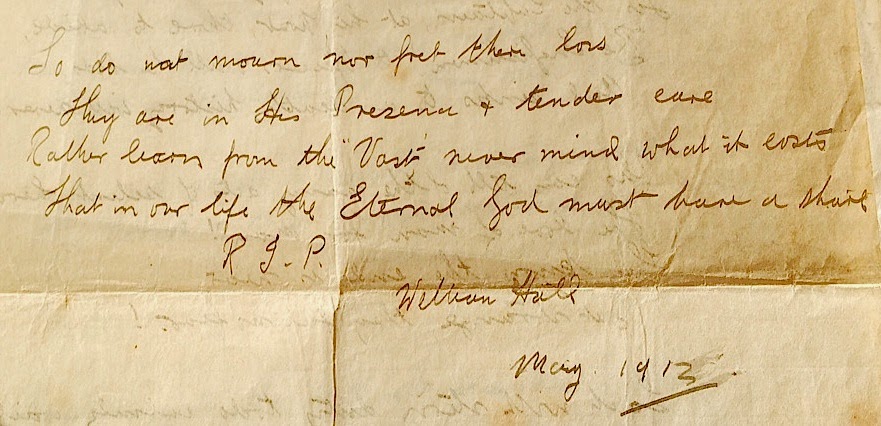
Found among a lot of miscellaneous papers, some religious - this poem by one William Allen about the Titanic disaster. It is dated May 1912, one month after the tragedy. The name William Allen is associated with the Titanic because it was the name of the father of one of the survivors, Ada E. Hall. The family was from Hackney, London and Ada was emigrating to America (along with her brother in law the Reverend Bateman who drowned*). She is in the Encyclopedia Titanica and in a lengthy article on her in the  Baltimore Sun it states: "Nearer My God to Thee" was the last song Ada heard from the band that was playing on the deck of the RMS Titanic after she boarded a lifeboat and was lowered to the waters below." This hymn is mentioned in the poem and there are a few details that may have come from an eyewitness (i.e. his daughter) rather than from press reports. William Allen is a common name so none of this is conclusive. The poem is heartfelt, competent and deeply religious:

T'was the eve of the day of rest
That the mighty Leviathan
Ploughed her way through the ocean's
Sleeping breast.

List  to the throb of her stately tread
Mark her proportions
From anchor to lofty head
Its harmony sublime.

Continue reading →

I once met…Luise Rainer

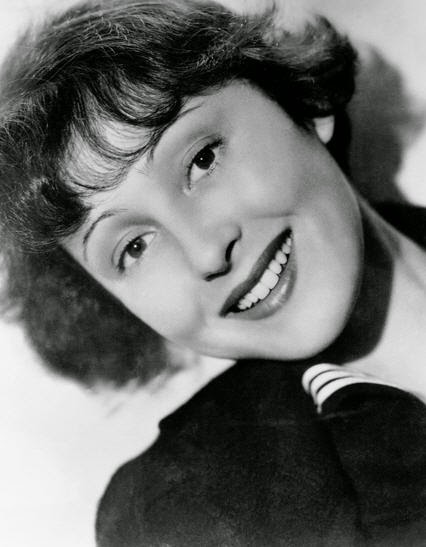
Sad to hear of the death of the film star Luise Rainer at 104, but as we (often) say in England, she had  'a good innings'. I met her in the mid 1990s when she must have been in her late 80s. Myself and the esteemed rock musician and bookseller Martin Stone travelled to her villa in the Italian part of Swizerland to buy some of her books. I recall she picked us up at the station in a smart and powerful car and took us along  winding, perilous mountain roads at considerable speed. Something of a white knuckle ride. She was full of energy and amusing chat. She told us that life was not very social in this part of Switzerland. When she had arrived she gave two enormous parties for everybody interesting in the neighbourhood. She had done this before at other houses in her long life and usually after these events you just sat back and waited for invitations to come in and your social life was 'sorted.' Sadly, she did not hear a word from anyone, apparently this was not untypical of the Italian Swiss. Lots of old friends had come to stay however. She told us  of a 100 year old British peer who had stayed for a month or two. Because of his great age she had hired a local nurse to look after him and Luise was rather surprised that he later willed this nurse a large sum of money!  We saw some good books including several presentation copies (a first of House of Incest by Anais Nin signed and presented to one of her husbands comes to mind). She was considering a move to London and asked me about  prices in the Knightsbridge area. I am sure she found London a lot more fun than the Alps…

She was a great beauty in youth and this could be seen even in old age. Luise had some good art on the walls and some sculpture. I recall a Sonia Delaunay and a Marie Laurencin. I guess she must have moved shortly after. In February this year I tweeted a happy 104th birthday to her and mentioned our trip to see her near Lake Como. I was amazed to get this tweet back from her "..would love to see photos of that trip if you have any…?" Sadly we took no photos, this being slightly  before the smart phone era. R.I.P. Luise, a truly great star!

Martin Stone wrote in with this (I had forgotten entirely about the snake!) :

That trip to see her did seem to leave a strong impression,didn't it? Sitting on the terrace with the lake far below, she announced she was leaving to live in London."But why go from here?"one of us said,"this is paradise.""Oh,I've had enough of Paradise",she said,"now I'm ready for Hell".

Do you remember the snake in the basement that we refused to dispose of for her? I thought that might have blown the deal...I also remember several Egon Schiele paintings/drawings and a sensational medieval triptych spotlighted- I think you tried to buy them with the books,and she said "No,Sotheby's Geneva next month! " Great lady.

An Alice B Toklas memento (age 8)

Found - a rare piece of ephemera from the very earliest years of the life of the writer (and cook) Alice B.Toklas. A gilt edged and gold printed card, found in San Francisco from where her American family came. This is an invitation to her grandparent's 50th wedding anniversary at Kempen (Prussia) in Poland. Her grandfather was Simon Wolff Toklass born in  1814 in Kepno, Poznan, Wielkopolskie, Poland and her grandmother born a year later in the same town was Amalie Gnadenfeld. Their son, Ferdinand Toklass, born 1845 in Kepno was by 1880 living at 1880 922 O'Farrell St, San Francisco, California, USA and seems to have dropped one of the s's from his name. He had married one Emma Levinsky in the early 1870s and they had a son (Clarence) in 1872 and a daughter Alice Babette Toklas on 30 April 1877 in San Francisco. The father working for a relation, Max Toklas, as a bookkeeper at Brown & Co, clothing manufacturers of 24 Sansome St, San Francisco. The trip to Poland is mentioned in Linda Simon's well named The Biography of Alice B. Toklas (University of Nebraska 1991.)

Early in 1885, Emma and Ferdinand departed for New York with their eight-year-old daughter, en route to Poland for the Golden wedding anniversary of Ferdinand's parents…they landed in Hamburg…[and] went on to Kempen where the Toklas family was gathered for the celebration. Alice found her grandmother tall, elegant, and poised, and her grandfather quiet and gentle, despite family stories of his escapades in Paris uprisings in 1848.

Linda Simon writes of Alice's grandfather that '…after his escapades on the barricades he was forced home to Poland' where he painted and 'contented himself with excessive patriotic doggerel'- so writing was in the blood.

Healthy Clothes, Healthy Food

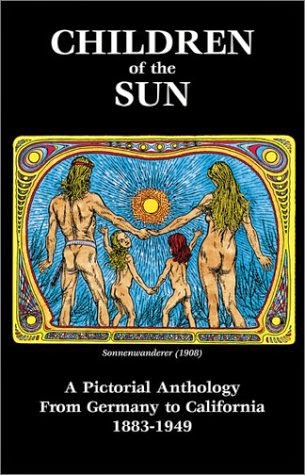
Found - in Benjamin Lust's Return to nature! The true natural method of healing and living and the true salvation of the soul (Naturopath, N.Y. 1904) this advertisement for healthy food and healthy clothes. It was reprinted in Children of the Sun (Nivaria Press, Ojai, 1998) with a cover from a Fidus illustration. Benedict Lust and his  fellow Naturopaths were advocates of healthy food (especially raw food) and healthy , porous 'reform' clothes, precursors to 'Aertex.'  The book advertised their health underwear as being 'made of the best Maco with Chinagrass ribs …the cheapest and most practical for adherents of the Just, Kneipp and other Natural Healing Methods. The Rippenkrepp Health-Underwear holds a great deal of air, offers the best protection for colds, does not lose its porosity, does not shrink in the wash, only the linen-threads come in contact with the skin, at the same time being much more durable than the real linen.' The full page advert reads:

AMERICAN DEPOT— NATUROPATHIC HEALTH STORE 
for Jungborn Articles and Supplies. 

To meet the manifold wants and numerous desires of the public, I opened a "NATUROPATHIC HEALTH STORE" for "Jungborn Articles and Supplies.  I shall endeavor to attend promptly to the wishes of my customers, and ask for confidence and support at such enterprise. My principle is to sell only HIGH GRADE ARTICLES of finest quality and at reasonable terms. These articles are especially recommended for the new, true and natural method of living by ADOLF JUST, Ilsenburg at the Hartz Mts., Germany.

Continue reading →

A Bibliomaniac of the Boulevards 2

Jules Bollly (merci)

The five volume  auction catalogue of Boulard's vast collection showed up in auction at Christies New York in 2005. It made $5750. It does not appear to have ever left the book trade - possibly book dealers are almost the only collectors for them - and the exact same set is now on sale online at $20000. Christie's catalogue entry is below. It should be noted that Boulard was also a distinguished translator - the French Wikipedia list many of his works (they put the size of his book collection at a mere 500,000.) He translated works from English (including much Dr. Johnson) Italian, German and Latin and also translated from French into German. During the revolutionary period publisher's note him as 'Citoyen Boulard.' Lawrence S. Thompson in his Notes on Bibliokleptomania, without much evidence, writes that Boulard "...had 'itchy fingers' whenever he saw a volume that could not be bought and excited the acquisitive instincts in him." Another interesting note of Thompson's is that '…when the collection was auctioned off in 1828-1833, it played havoc with the Paris market.' One wonders how long it took to recover and if such a thing could happen again in these less resilient times (for books) - if another Boulard style estate emerged out of Los Angeles or London with half a million good books the effect could be seismic…especially if, as happens, yet another collection emerged shortly after.   Nodier (that man again - note his mention of underbidding) gives this eyewitness account of the perils of bibliomania:

Continue reading →

A Bibliomaniac of the Boulevards 1

Max Sander's article Bibliomania, freely available from Northwestern University School of Law Scholarly Commons, yielded the gripping tale of the murderous monk/ bookseller Don Vincente (see recent jots) . He talks of other crazed collectors including the English bibliomaniac Richard Heber who filled 8 houses with books, but for all his acquisitiveness was a discerning collector. The sale of his books took 184 days. The following collector, Boulard, was very much of a quantity man and may have accumulated more books than any individual in the history of the world - 800,000 by some accounts and half that by others… the sale of his books took 248 days.150,000 were sold as scrap. Sander writes:

Continue reading →

A Bibliomaniac Serial Killer 2

Charles Nodier

Last part of this thrill-packed  piece on murder, mayhem, obsession, vengeance and book collecting. Slight doubt is cast on this (incredible) event. The story has inspired a wealth of articles and books from Flaubert right up to Basbanes. However, in 1928 a book appeared in Spain written by bibliophile and author Ramon Miquel I Planas (1874-1950) seeking to rectify the story of Don Vincente and arguing that the anonymous article in  La Gazette des Tribunaux (Paris 1837) which had informed the world of the murders had no basis in fact. **Planas argued that the article had been written by French occultist (Priory of Sion) author and librarian Charles Nodier, (1780-1844), most known for his influence on the French Romantics. He found that Don Vincente’s crime does not appear in any local newspapers of the time, that there was no monk by the name of Fra Vincentes at Poblet at the time of its closure, and that the local ‘colour’ does not ring true. Planas's theories have also been later disputed..but if Nodier was  the original author, it should be noted that it was rumoured that he had killed a man for outbidding him at auction during one of his trips to Spain.

The account, indeed, does have a slight air of legend about it - especially the part about each victim returning with alacrity  to the shop to report a missing leaf…booksellers will tell you that often  a missing page is not discovered for years. What does ring true is the murderous anger of the person outbid (almost as deadly as the ire of the person who has been relentlessly bid up to way beyond the price that they had intended to pay. Pace Nodier.) The fetish / obsession about uniqueness is also familiar in rare bookselling lore..The bookseller  'unwilling to part with all but the cheapest of his stock' and who keeps every good book he ever gets (or prices them so high that only a very rich madman would buy ) is also an all too familiar type in life and legend and one who is still with us online and in the cloud…

** This part is in the debt of the ARCA Crimes against Art blog where there are more info and links/ footnotes on the case.

A Bibliomaniac Serial Killer 1

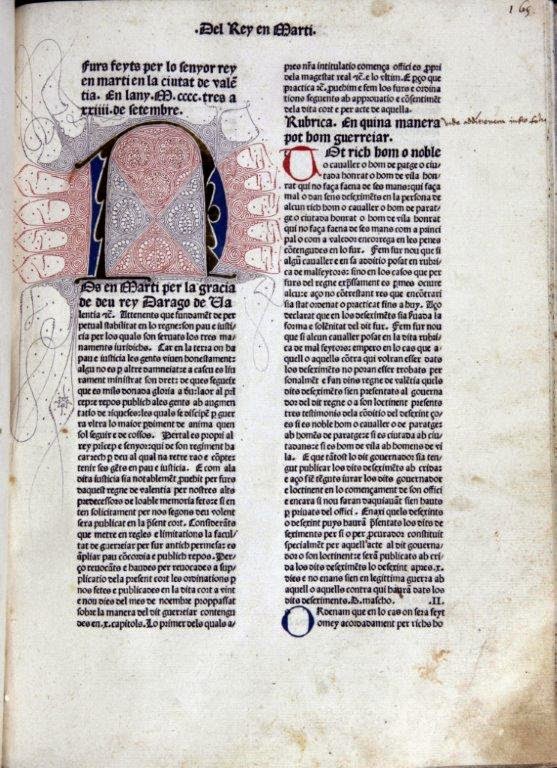
Furs et Ordinaciones, Valencia 1482

This is an oft told tale of book madness and murder. It has elements that ring true and also mythic elements. It inspired the young Flaubert's 1838 novella Bibliomania. This version comes from the unrecorded scholar Max Sander's article Bibliomania,   freely available from Northwestern University School of Law Scholarly Commons. It was published in a criminal law journal in 1943. Sander, a 'scholar specialising  in bibliographical-iconographicaI research work' gave his address as The Huntington Hotel, Pasadena, California. See part two for an update and queries on this story...

...As a young man, Don Vincente was a monk in the Cisterciens cloister Poblet near Tarragona, and because of his passion for books he was made keeper of the cloister's valuable library. During a political disturbance of the time the cloister was pillaged, and there was good reason to believe that Don Vincente had been familiar with the plunderers. It was hinted that he had shown them the place where the cloister's gold and silver treasures were hidden, in order to secure precious books for himself. Be that as it may, he went to Barcelona and opened a bookshop with a remarkable stock of rare books, which was patronized by all collectors although he almost never sold a really important item. His frugal livelihood and small business expenses could be covered by selling cheaper stock. He was never seen reading a book; only to own them and look at them, to turn over their leaves was of interest to him. When he had a chance to buy a precious book, he was obliged to sell something more substantial from his beloved stock, but even then the buyer almost had to wrench away his acquisition before Don Vincente reluctantly parted with it.

Continue reading →

Matthew Arnold letter – a football injury

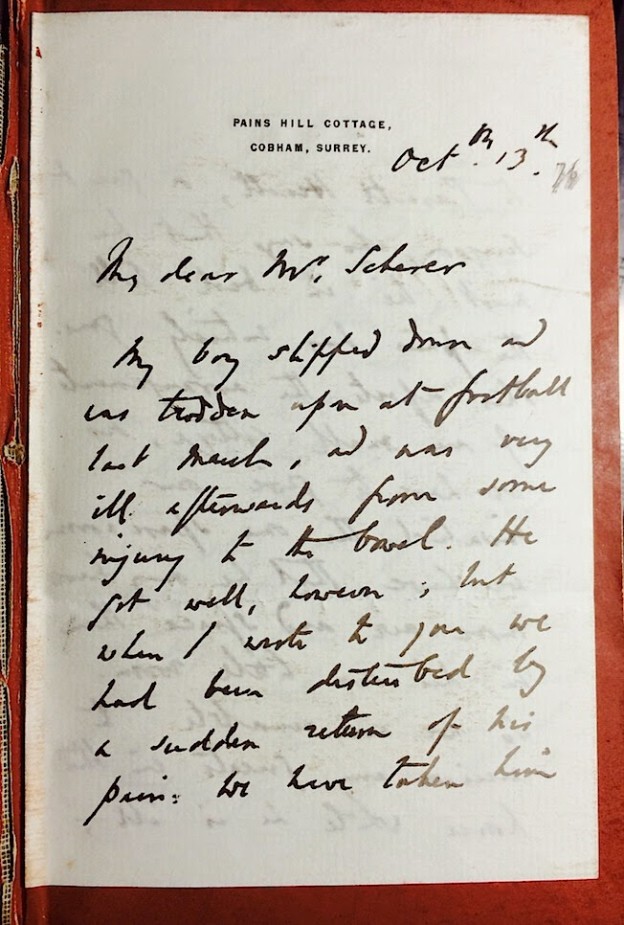
Found tipped into the front of Poems of Matthew Arnold (London, 1853) an unpublished  handwritten signed letter from the poet to his French friend the writer and anglophile Edmond Schérer.

PAINS HILL COTTAGE, COBHAM, SURREY*. Oct 13th '76

My dear Mr. Scherer

My boy slipped down and was trodden upon at football last March, and was very ill afterwards from some injury to the back. He got well, however, but when I wrote to you we had been disturbed by a sudden return of his pain.  We have taken him to Prescott Hewitt** a great surgeon, who says that he must lie in bed till the pain has entirely gone,  this upsets the arrangements of a small cottage, as we have to give our invalid the one spare room we have, that he may have more air  and  space than in his own little room.  So we are unable to receive any guests in the house while he is ill, and therefore I was obliged, to my very great regret, to put you off.  I fear it will be still a week before we cease to be a  hospital but – do let me know what you are doing and how long you stay in England.  I cannot easily give up the hope of seeing you here. At any rate I shall meet you at the Athenaeum, I trust;  for next week I begin inspecting*** again and shall be in London every day. I have so much to say to you and to hear from you. Most sincerely yours Matthew Arnold.

* Printed at head of notepaper. This was in the beautiful private landscaped park Painshill Park and Arnold rented the cottage from 1873 to 1888.

** In Dickens's Dictionary of London, by Charles Dickens , Jr., (1879) under 'Doctors' Prescott G. Hewitt is noted as Consulting Surgeon at the  Evelina Hospital for Sick Children (Southwark Bridge Road.)

***Matthew Arnold  was appointed, in April 1851, one of Her Majesty's Inspector of Schools, a job which he worked at until 1886. He once described it as 'drudgery.'