The Briar Rose — exhibited August 1890

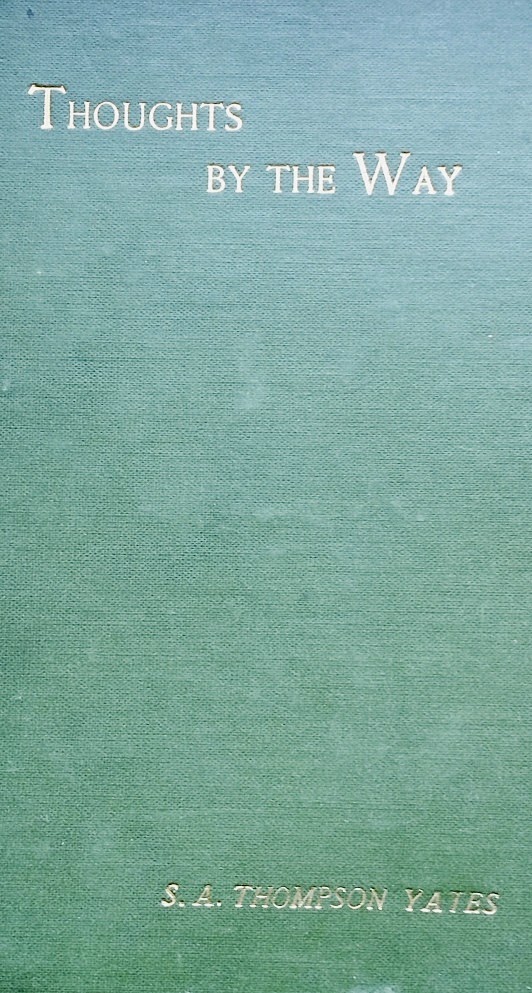
Found in a slim volume of verse from 1891 'printed for private circulation' - this poem about The Briar Rose - a series of 4 related paintings by the Pre-Raphaelite artist Edward Burne Jones. These were first exhibited at Agnew's Gallery in Bond Street, London in 1890. The paintings depict a moment in the story of Sleeping Beauty, the title of the series coming from the version presented by the Brothers Grimm in their collection of 1812. The book was called Thoughts by the Way / Sicily by S.A. Thompson Yates. He was the son of Henry Yates Thompson (1838 -1928) a wealthy British newspaper proprietor and collector of illuminated manuscripts. He was known as the Reverend S. A. Yates Thompson and was the brother of Henry Yates Thompson also a major book collector.

After seeing Mr Burne-Jones picture, 'The Briar Rose.' (August 1890)

Love comes at last with sad and serious face,
A pale, armed youth with sharpened sword in hand,
To pierce the briar-rose hedge, which can withstand
The arms of hate or lust. It is disgrace
To let such through. But, that true love's embrace
Should give all life again, the burly band
Of sleeping sentinels will not demand
The watchword, as should guardians of the place.
Here all are sleeping. King and council sit,

In years and wisdom ripe; next maidens
While busy with their housework. All, asleep,
Await the kiss of love, which, as is fit,
The warrior gives, yet sadly, half afraid
To rouse the loved one from her slumbers deep.

Margaret Mackenzies Tea Rooms in Florence

Found in a Tauchnitz edition of Barry Pain's Stories in Grey (Leipzig 1912) this bookmark advertising an English tea room in Florence at 5 Piazza Strozzi. It served 'Light Luncheons, Home Made Bread' with 'Best Teas on sale as used in Tea Room.' It also provided  English and American newspapers, a telephone and 'Writing Tables for use of customers' and may have flourished around 1920. The internet shows no trace of Miss Mackenzie's possibly short lived enterprise. Contemporary Baedeker's may mention it...The only clue is that the address was slightly later that of a publisher T de Marinis & Co who in 1925 published a book of  reproductions of illuminated manuscripts with English text. It was published jointly  with Bernard Quaritch of London.

Christmas advice from 1932

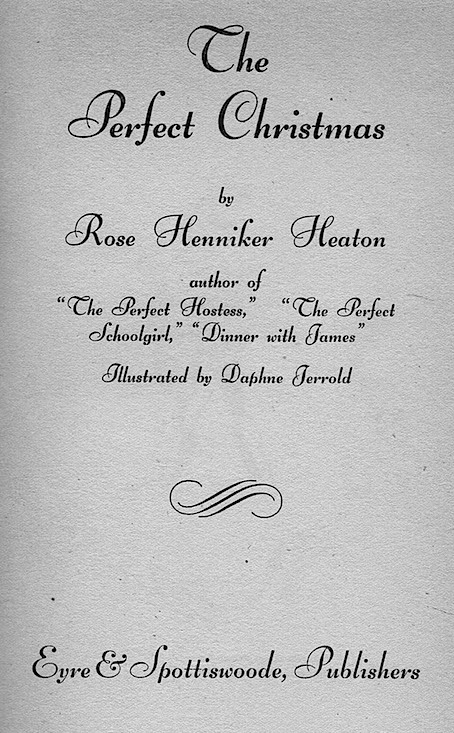
The Perfect Christmas by Rose Henniker Heaton was a companion volume to the same author’s Perfect Hostess and Perfect Schoolgirl. Published in 1932 by the eighty something Australian-born widow of an illustrious Conservative MP, its distinctly barbed humour has hardly dated. In addition to the many jokes and riddles (one of which defeated Professor Einstein) are some handy hints. The following still has value today.

How to Ruin Christmas

Grumble at everything and everyone.
Moan at the mention of presents.
Scramble wildly at the last moment for people you dislike, rather than be left alone.
Do nothing for anyone, and expect everyone to wait on you.
Eat too much, and drink far too much. 
Spend too much, and grumble while spending it.
Spend too little, and grudge even that.
Leave everything to the last, and sit up until 4 a.m., tying up parcels, and decorating madly.
Start a family quarrel. 

[RMH]

What to do with Rubbish Christmas presents

Once again, Rose Henniker Heaton, our no nonsense Australian hostess from 1932, comes up with some timely suggestions as what we should do with that ghastly piece of raffia from the Village Craft Fair or that horrible vase from the High Street charity shop. Take it away Rose.

Never,  never, never give away as presents rubbish or monstrosities you have bought at bazaars.

“That will do for old Aunt Susan”, you say as you look loathingly at a plush handkerchief sachet; or, “The very thing for Uncle Albert “, as you seize a dust-catching newspaper stand.

The only thing to do with rubbish is:

(A) Put it in your Ideal Boiler
(B) Send it to a Jumble Sale
(C) Give it to the Rag and Bone Man on his next visit

Note.--if anyone sends you rubbish as a Christmas present, put it in the fire, and send a telegram of thanks. If that doesn’t make them feel ashamed, I don’t know what will:

Ex---“Thousand thanks for shell pincushion stuck on pill-box.”

or,

Reply paid: “Gilded pinecones safely received; what are they for?”

Note---Present giving is not a question of money but of common-sense.

[R.M.H]

Interview with Robin Cook aka Derek Raymond

Found - loosely inserted in a copy of his novel A State of Denmark this typescript of an interview with Robin Cook aka Derek Raymond. At one point he says he is 60 which dates it at 1991. It does not appear to have been published. Many of the typos have been cleared up. It was probably transcribed from a tape recorded in a noisy pub with a break in a Chinese restaurant and back to the pub. Robin Cook, cult novelist and author of The Crust on Its Uppers was also known as Derek Raymond. He had to change his name as it was the same as the best selling author of schlock medical thrillers (Coma etc.,).

Dead man upright. Chap still walking around who really oughtnt to be.
Bit like your nameless policeman.
Yea, lots of policemmen like that esp the busted ones. All driving minicabs. What can you do after being a bent policeman? and you know London well what can you do next/
Dont do research with police. Had lunch once . Id rather do it from imagination. Better relations with French police. How to beat people up with a telephone book.
Known a lot of busted ones in my time, disciplinary reasons, sex casess, bisexual ones.
Back in West Hampstead. Been there a year until I finish the book.
Memoirs out next month
BBC series. Kenneth Trodd. Scriptwriter is a man called William Golding. The man in charge is Kenneth Trodd. First met him years agao back in 1962 when he wanted to make a film of Crust on its Uppers, used to have endless talks. He did singing tec with Dennis Potter. So its in as good hands as it could be. Three 50min episodes, they will draw on all 4 books.
Continue reading →

Antonia Kelly World War 2 poet

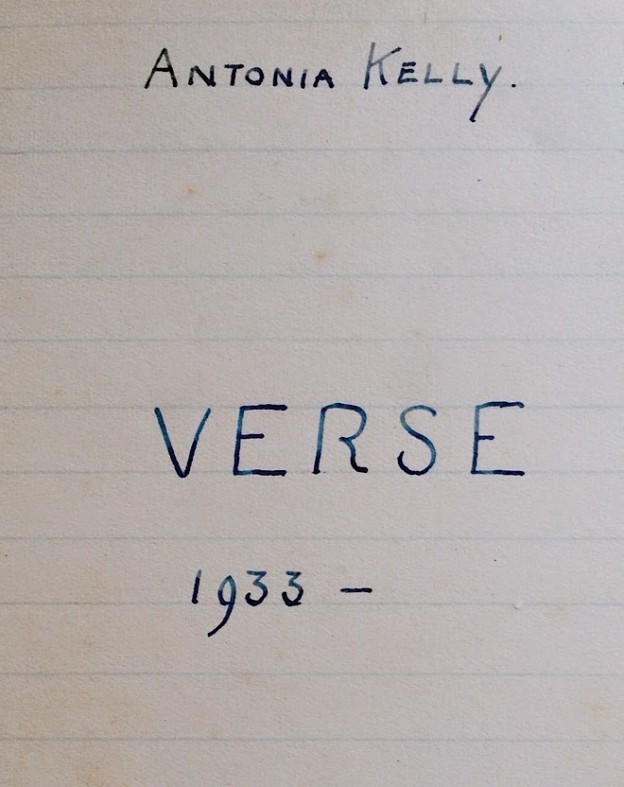
Found - an album of poems among books and ephemera from the St. Clair Erskine family - sons of Lord Rosslyn (1869-1939) whose Calcot Park and Hunger Hill visitors book we covered recently. These were written by Antonia Mary Kelly (1920? - 1965) of Irish descent and the daughter of Admiral Sir John Donald Kelly. She married David Simon St. Clair-Erskine in 1948 and divorced him in 1958. They had one son. There is  a small amount information about her online, mostly garnered from gossip columns and peerage sites. In 1938 at the age of 18 she launched a warship (destroyer) called 'The Kelly' and she seems, on the evidence of these poems, to have worked at the Foreign Office during World War 2. There is a photo of her (below) on her wedding day in The Sketch 1948; she wore hyacinths in her hair, the best man was the Hon W.K. Davison and the priest was Father J. Bevan (indicating a Roman Catholic service) at the Brompton Oratory.

Her poems written between 1933 and 1947 are mostly highly competent, some are passionate love poems. Many are amusing or satirical and some quite worldly for a young woman of the time - at 16 she wrote these 'Lines Written during a Meagre & Modernist Dinner Party' :

Continue reading →

Royal Charter wreck – the gold ring on the beach

This poem about the Royal Charter disaster is printed at the back of An  Authentic Account if the Wreck of the Royal Charter Sream Clipper on her passage from Australia to Liverpool , October 26th 1859 with an Interesting Additoion of Subsequent  Events and Incidents Written During a Residence at Moelfra, the Scene of the Catastrophe (Dublin 1860.) The poem was inspired by an account of the finding of a gold ring on the beach at Moelfra  'by one of the peasants living in the vicinity of the wreck.'  With help from the local vicar the ring was restored to the father of the drowned owner - a Mr. Corry Fowler of Dublin. The ring had been worn by his son in memory of his departed sister whose name was inscribed on it. The poem is by a niece.

Lines on a Ring cast on shore five months after the wreck of the Royal Charter.

Continue reading →

‘Lines on the Loss of the Royal Charter’

At least 800 lives were lost in the seas around the shores of Britain in the violent storms on the night of 25-26 October 1859. 223 vessels were wrecked: the biggest disaster of all was the loss of the Royal Charter off the coast of Wales, in which almost 450 people died. The ship was returning from Australia and the passengers included many gold miners, some of who had struck it rich at the diggings in Australia and were carrying large sums of gold about their persons. A consignment of gold was also being carried as cargo; it was insured for over £300,000 - about half a billion pounds in todays money. Many of the passengers were killed by being dashed against the rocks by the waves rather than drowned. Others were said to have drowned, weighed down by the belts of gold they were wearing around their bodies. The survivors, 21 passengers and 18 crew members, were all men, with no women or children saved. This poem on one side of a small  card was probably sold for a halfpenny or farthing just after the disaster. The address 'Trafalgar, Neyland' is nearby in Milford Haven, Pembrokeshire. Of Maria Roberts nothing is known…

We also have a more accomplished poem about a gold ring washed up on the beach (to follow) but this poem was probably composed very shortly after the fateful night:

Continue reading →

Some curious changes in book titles

Found - an article by Ellery Queen -Some curious changes in book titles in the omnibus Carrousel for bibliophiles, a treasury of tales, narratives, songs, epigrams and sundry curious studies relating to a noble theme by William Targ (Duschnes, New York 1947.) The book is a late example of one of those bibiophilic tomes that were published in such numbers at the end of the 19th century (Love Affairs of a Bibliomaniac, Autolycus of the Book-Stalls, Shadows of the Old Booksellers, The Souls of Books, Book Song, Behind my Library Door, The Romance of Book Collecting etc., etc.,) and are now almost unknown. Queen's article is about changes of title of British editions of (mostly) detective fiction when published in America.

Thomas Burke. The Pleasantries of Old Quong (Constable 1931) became A Tea-Shop in Limehouse (Little Brown 1931)

W. W. Jacobs. Sea Urchins (Methuen 1899) became More Cargoes (Copp, Clark 1899)

R.Austin Freeman. Dr. Thorndyke's Casebook (Hodder 1923) became The Blue Scarab (Dodd, Mead 1924)

Continue reading →

Michael Holliday, British crooner

Snapshots of British 1950s Michael Holliday (1924 - 1963) found in a junk shop in Leiston, Suffolk. His version of the Burt Bacharach song 'The Story of My Life' reached number one in the British charts in 1958 and is still sung. His style of singing was influenced by that of Bing Crosby, who was his idol, he was even known as 'the British Bing Crosby'.

A biography with the punning title The Man Who Would Be Bing, written by Ken Crossland, was published in 2004. He is seen in these shots in happy times, enjoying the fruits of his success. Sadly he had an ongoing problem with stage fright, and had a mental breakdown in 1961. He died two years later, from a suspected drug overdose. Sic transit gloria mundi.

Continue reading →

A call to the ‘Revolution of the Spirit’ by The Grand Duke of Russia

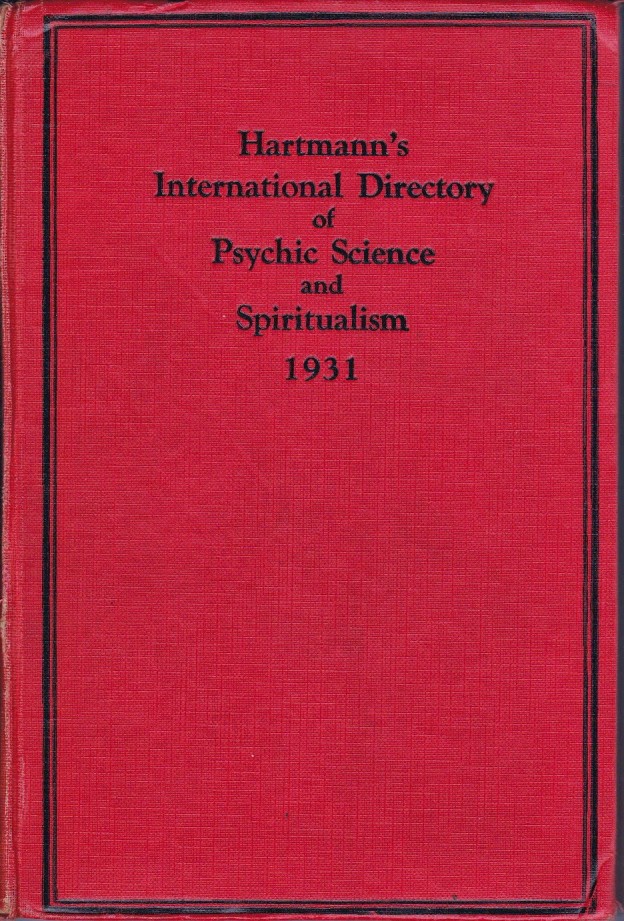
Found in Hartman's  International Directory of Psychic Science and Spiritualism  for 1931 this proclamation from Grand Duke Alexander Mikhailovich of Russia - then a refugee from the Russian revolution and staying at the Ritz Carlton Hotel in New York. He appears to have been giving lectures on spirituality and spiritualism in America.

The book itself comes from a time when 'psychic science' was at its height and many famous names were involved. Among others the directory lists Oliver Lodge, C.K. Ogden, Count Louis Hamon ("Cheiro), Swami Yogananda, G.R.S Mead, Hannan Swaffer, Anna Wickham, Henri Bergson, Lady Jean Conan Doyle (with an address in Queen's Gardens W2 - her husband Arthur, very much a believer had died in 1930) Eric Dingwall, Earl Balfour etc.,

Continue reading →

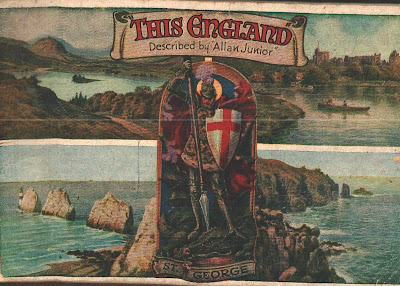
This England

Found -- This England, a patriotic pamphlet from the late 1920s in the Golden Thoughts series. "A Pictorial Memento of the scenic loveliness that lies within the land which the King calls 'our own dear home' as described by the poet Allan Junior."

The four images on the cover show England as an island of lakes and seas - 'this island race.'  A jingoistic magazine of the same name has carried on publishing into this century. The title comes from Shakespeare's King Richard II: "This royal throne of kings, this sceptred isle... This blessed plot, this earth, this realm, this England."

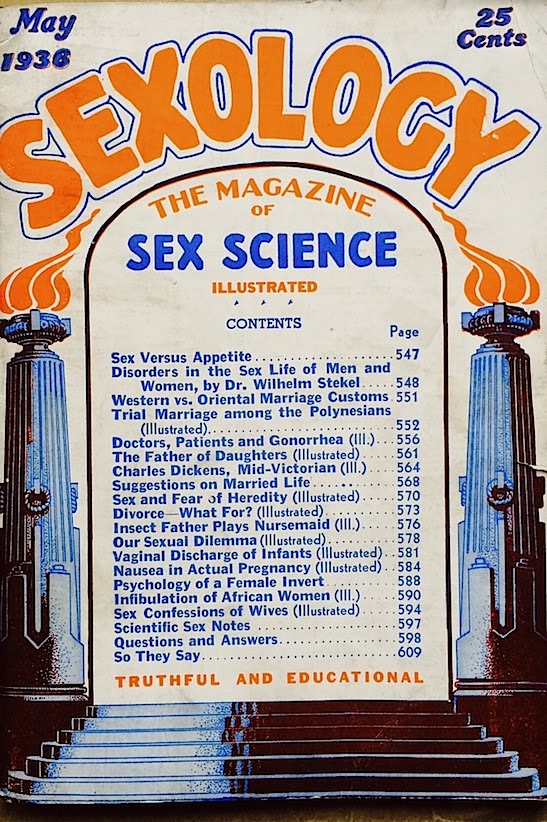
Homosexuality and Its Cure (1936)

Sexology : The Magazine of Sex Science was a magazine founded by Hugo Gernsbach ('the father of Science Fiction') and seems to have flourished in the 1930s. It had many anatomical diagrams and articles about 'female inverts', pregnancy, infibulation, venereal disease etc. It probably sold well. This letter is in the 'Questions and Answers' column and has to be assumed to be typical of its time, regarding homosexuality as a sickness to be cured by determination and the love of a good woman. Autre temps, autre moeurs. What is slightly strange is that the 'doctor' providing the answer suggests physical violence if the other man persists in his attentions - 'beat him up.' Odd advice from a doctor. The reference to drink - 'you got drunk and became intimate' may refer to other matter in an abridged letter or simply be an assumption…again, curious.

Continue reading →

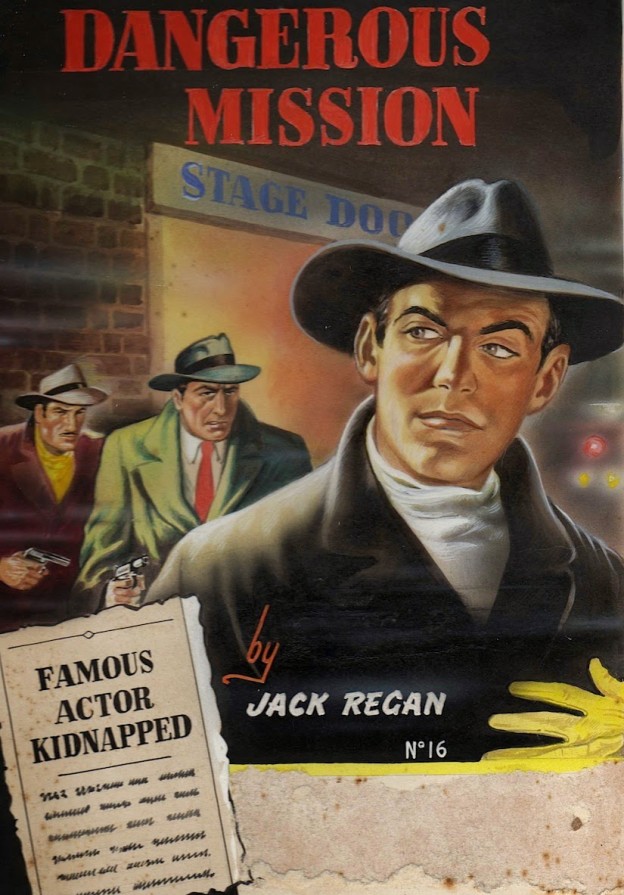
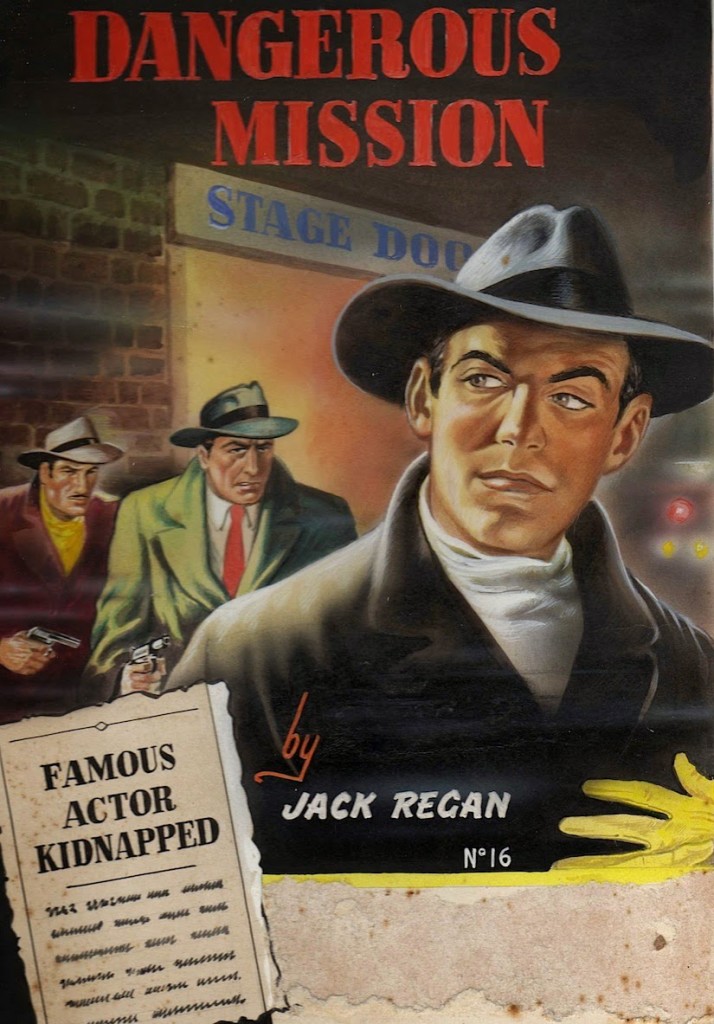
Pulp fiction art

This original artwork was one of three covers created for a number of 1940s pulp magazines published by a British company. The series was called the ‘Headline series’ because each story was built around a newspaper headline-- to be found sketchily depicted at the bottom left hand corner of each cover. The other two pieces of artwork were for Road to Nowhere and Road to Revenge—both stories by someone called Max Foster. There seem to have been at least 20 tales in this particular series.

In the ultimately futile three hundred year old debate that has raged regarding ‘high ‘ and ‘ low art’, such ‘ low’ art as these pulp fiction covers, is often derided for the poor quality of the  draughtsmanship, whereas the simple truth is that for pure draughtsmanship, as opposed to piercing originality or ‘ vision’, this art is often more impressive than that of many ‘ high’ artists. Next time you visit Tate Britain wander around the many rooms devoted to Turner and study the groups of figures that inhabit the foregrounds of his huge oil landscapes. You might be surprised at how inept our greatest painter could be at depicting the human figure.

Then return to the work of ‘low’ book illustrators and marvel at how well most of them could draw. [RMH]

Fat Mary’s brother, a royal sex scandal and a precedent created

As a follow-up to a very recent Jot on Princess Mary of Teck, whose biography was called The People’s Princess, here is a short letter from her brother, found amongst a pile of old letters acquired a few years ago.

 Prince Francis of Teck seems to have followed the age-old career path of minor royalty—public school, Sandhurst, and action abroad -- only this particular royal seems to have been a philanderer and gambler. He had an affair with the beautiful Ellen Constance, wife of the 3rd Earl of Kilmorey, and this together with his ruinous gambling got him sent to India. In the letter, dated March 20th 1893, written when Francis was a lieutenant in the 1st Royal Dragoons, he thanks someone called Mowbray for sending him an ‘ excellent photograph’ but regrets that due to an ‘ exam’ that he is obliged to take on the 4th May, he cannot accept an invitation to visit him. This exam may have been for the rank of captain, and though he probably failed it on this occasion, he was promoted the following year. After India he served in Egypt, and later saw action in the Boer War, eventually retiring in 1901 with the rank of major.

In 1910 Francis died suddenly at Balmoral of pneumonia, aged 39.When his will was read it was discovered to his family’s horror that he had bequeathed to his mistress Ellen the famous Cambridge emeralds, which were part of the family jewels. It was then left to his sister, now Queen Mary, to have this will sealed, thus creating a legal precedent. Previously, royal wills could be publicly examined. The Queen also  negotiated to buy back the emeralds, reportedly paying £10,000 ( around £600,000 today ) for them. Mary then wore them at the coronation of her husband in 1911.

A few years ago actress Sarah Miles claimed that not long after this letter was written, Francis fathered an illegitimate son called Francis Remnant, who became her maternal grandfather. This makes the beautiful Sarah second cousin of the present Queen.

Early Books on Television: 1926 – 1939

British techies will boast that the origins of television can be traced to a room above a shop in Hastings ( blue plaque ) where John Logie Baird constructed the first TV receiver—generating moving images on a mechanical principle. Americans, however, will argue that their man, a certain C. Francis Jenkins, who was also involved in cinema technology, was doing almost the same thing six months earlier in 1923. Unfortunately, neither of these pioneers can be said to have invented the television that we tune into today. Most of the credit for that probably belongs to Philo Farnsworth, the farmer’s son from Utah who in 1927, aged 21, produced the first electronic image. So, whatever way you look at it, the Americans invented television, just as they invented rock music.

Most of the collected works on early TV appeared before 1930. The first book on TV alone was Alfred Dinsdale’s well-known Television, or Seeing by Wireless (1926). A book that although not uncommon is sometimes seen at prices into 5 figures. The second significant work, which appeared a year later is Television for the Home by Ronald Tiltman, whose frontispiece show the author being televised by John Logie Baird himself. If you hanker for a Dinsdale and can’t afford his Seeing by Wireless you could target a copy or a run ( if you can find one ) of his genuinely rare Television Journal (6d a month), whose July 1929 cover rather hopefully looks ahead to a time when the family might gather around the box of light on a winter evening--an extraordinary image for 1929, when radio was still in its infancy and TV broadcasting was several years away.

Continue reading →

Nixon at the BBC (Face to Face)

FACE TO FACE PROGRAMME

Found among the papers of Hugh Burnett,producer of the Face to Face series of television interviews with John Freeman shown between 1959 and 1962, this amusing slightly tongue-in-cheek memo to BBC friends sent out well after the event in 1973. The show was and is (6 set DVD available) memorable for the probing style of its charismatic interviewer John Freeman (more than once causing interviewees to break down..) and also for the importance and variety of its guests. They included Lord Birkett, Bertrand Russell,Dame Edith Sitwell, Lord Boothby, Nubar Gulbenkian, Adlai Stevenson, John Huston, Carl Jung, King Hussein of Jordan, Tony Hancock, Henry Moore, Dr Hastings Banda, Augustus John, Sir Ray Welensky, Stirling Moss, Evelyn Waugh, Gilbert Harding, General von Senger und Etterlin, Lord Reith, Simone Signoret, Victor Gollancz, Adam Faith,Otto Klemperer, Dr Martin Luther King Jr, Jomo Kenyatta, Sir Compton Mackenzie, John Osborne, Cecil Beaton, Danny Blanchflower and, of course, Richard Nixon, then (1959) the Vice-President…

Continue reading →

The People’s Princess

The phrase 'the people's princess'  was not made up by Alastair Campbell for the famous Blair soundbite on the day Diana died but, rather, recycled… This 1984 book found in a box of slow-selling royalty books shows the original 'People's Princess' - Princess Mary Adelaide, Duchess of Teck (1833- 1897). She was not quite as good-looking as Diana (indeed she was also known as 'Fat Mary') but like Diana she had a knack for popularity. She was also one of the first Royals to patronise a wide range of charities. She is the current Queen's great grandmother. Elizabeth II seems to have thrown off the Hanoverian look…(although Lucian Freud's small portrait has some suggestions of it.)

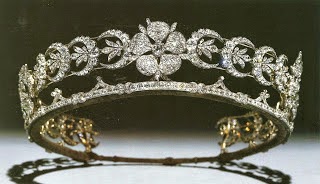
An interesting piece of tiara trivia… the lavish two tiered tiara that was created for Princess Mary has made its way down the family via the Queen Mother to the Duchess of Cornwall (i.e. Camilla). It has been modified but  was originally a 'diamond diadem' featuring three wild roses separated by 20 crescent shapes and was assembled from various jewels Princess Mary inherited from her aunt, Princess Mary, Duchess of Gloucester.

Charles Pearson & James Watt association

Discovered in 1998 on a market stall off Brick Lane is this copy of the exceedingly rare Substance of a Address by Charles Pearson at a Public Meeting (1844). The book is scarce enough (none on Abebooks, nor likely to be in the near future), but my copy also bears an inscription from the author to James Watt, son of the famous Scottish engineer.

Watt (1769 – 1848) who, like his father, was an engineer, but was also a radical political activist in the turbulent 1790s, has his own Wikipedia entry, but there is no mention in it of Pearson. Nevertheless, the two men had much in common. While in France Watt’s support for the French revolutionaries and his friendship with Joseph Priestley, got him condemned in the British Parliament and he remained in self-imposed exile until he felt it was safe to return home. A generation younger, Pearson, as the radical Solicitor for the City of London, was the champion of parliamentary reform who defended radicals in court. He also was in favour of the disestablishment of the Church of England, opposed the system of packed juries and fought commercial monopolies in London. A year after his Substance on an Address appeared, he published a pamphlet which called for an atmospheric railway that would follow the ancient Fleet ditch to Farringdon. This was rejected and I seem to remember that Punch had great fun with the idea. Other railway schemes supported by Pearson were also rejected, but at last in 1854 the Royal Commission accepted a proposal to build an underground railway, using the ‘cut and cover ‘method, from Praed Street to Farringdon. Work began in 1860 and within three years the new line was completed. The world now had its first underground railway. Unfortunately, Pearson had died while the work was still in progress and he never got to ride on the first train.

It would be nice to think that Watt, the consultant engineer behind the building of Fulton’s North River Steamboat of 1807, and the marine engineer who in 1817 was responsible for the first steamship to leave an English port, had something to do with Pearson’s atmospheric railway of 1845. It seems very possible, especially as Watt’s expertise was in steam power and pneumatics. In addition, Pearson’s address of 1844 tackles many of the issues that would have been close to Watt’s radical heart and the younger man would have taken great pleasure in presenting a copy of his book to the septuagenarian former firebrand.

One question remains. Watt died at his home, Aston Hall, near Birmingham, in 1848. So how did his book end up on an East End junk stall in 1998 ?

Arthur Augustus Tilley francophile and academic

Found in a copy of The Romantic Movement in French Literature - Traced By a Series of Texts (C.U.P. 1924) this obituary of A.A. Tilley by his co-author H.F. Stewart - also a distinguished Cambridge academic and francophile, but so far rather neglected on the web. It appeared in The Cambridge Review 6/3/1943. It is a model of its kind and gives a glimpse into a vanished world..

Obituary

Arthur Augustus Tilley - December 1, 1851 - December 4, 1942.No one who visited Arthur Tilley in the evening of his long life but must have felt himself standing on hallowed ground, in the presence of a veteran who, having fulfilled his course, was quietly, serenely, awaiting his call. "Le vent de l'éternité le frappait au front." Not that there was anything pietistic about his conversation. He would speak with grave simplicity of things deep and high, and pass easily to current events upon which he commented with shrewdness and vigour, or to the sometimes affectionate, sometimes caustic, review of men and their doings in the past. And what a range, and how varied, his memory covered! He was the favourite nephew of Anthony Trollope, whom as a boy he adored and as a mature critic he greatly admired. He had known everyone worth knowing i the University for 70 years, and his recollections were sometimes starling. A propos of a picture card of the Puy de Dôme he said to me the last time I saw him, "I took Bradshaw up there; I shouldn't have done so if I had known his heart was bad."

Continue reading →