Zeppelins over literary London

A correspondence on Zeppelins in the letters column of the Times Literary Supplement  prompted a visit to a local Suffolk church where 17 German airmen were buried after crashing their Zeppelin in 1917. The letters have the slightly leaden header 'Led by a Zeppelin' and concern a remark of Katherine Mansfield's about how she was so attracted to the sound and sight of a Zeppelin during a raid on Paris that '…she longed to go out and follow it…' This reminds the correspondent of G.B. Shaw's reaction to a Zeppelin over Potter's Bar in October 1917 -'…  the sound of the engines was so fine, and its voyage through the stars so enchanting, that I positively caught myself hoping next night there would be another raid…'

This letter (from the American writer Stanley Weintraub) prompted a riposte about the metropolitan bias of the T.L.S. letters from Suffolk beer baron Simon Loftus (26/9/2014). He notes that Zeppelin raids were relatively common on the East Coast - "...towns such as Great Yarmouth, Lowestoft and Southwold were bombed more or less ineffectually by these strange  Leviathans of the skies…" He then alludes to the Zeppelin shot down near Theberton, noting that pieces of the aluminium structure, salvaged from the wreckage were auctioned in aid of the Red Cross. The 17 German airmen were buried in the peaceful graveyard at Theberton. Also buried there is the author of Arabia Deserta Charles M. Doughty. The airmen's  bodies have since been moved to a central burial ground in Staffordshire, although a memorial can still be seen in the cemetery across the road from the church.

Continue reading

Poet sees the Loch Ness Monster

Found -- this newspaper cutting on the Loch Ness Monster. It is a letter from the poet Herbert Palmer (cited in an earlier Jot when he was writing about C.S. Lewis and women.) The cutting is undated but is probably from the late 1940s. The press source is not noted,but it was found in in a 1937 edition  of Frazers' magisterial work The Golden Bough, part of a large collection of books from the writer on political philosophy Professor J-P Mayer, whose collection looks set to provide more jottable items...

THE LOCH NESS MONSTER

Herbert Palmer, St. Albans.

Sir,- The Loch Ness Monster, it seems, has been described as a huge creature with a long neck and a small head. I would suggest that it is the same creature which I saw in the upper waters of the Tay when I was fishing there in 1930, and described by me on pages 183-184 of my book, The Roving Angler, published in the spring of 1933. I saw something very clearly and definitely; but perhaps only the head and the neck, though I was under the impression that I had seen great part of the body. I have thus described what I saw: "Two hours afterwards a creature which looked exactly like a calf reared itself three-quarters out of the middle of the Tay, and then sank back with a light splash… It had the head, neck and shoulders of a calf".

It looked to me like that - a creature with a small long head and a rather long neck broadening to what appeared to be the shoulders. It bore no resemblance to an otter or seal, for the head was another shape. The colour was brown. What I saw may very well have been the head and neck of a gigantic lizard-like creature rather than the head and neck and part body of a calf. There may be a family of water monsters in the Highlands of Scotland. On the other hand, my perfectly true story may have given rise to an invention. One has only to see a strange thing once, talk or write about it, and a lot of other people imagine afterwards that they also have seen the same sort of thing, brooding on it until they grow quite confident about it'.

36 hours in the water with a lion

When I read the caption stuck on the back of this press photo of a certain Otto Kemmerich I was a bit taken aback, to say the least. According to the reporter,’ the famous German swimmer, accompanied by his trained lion ”Leo” have swum for more than 36 hours in a tank at the Circus Busch at Hamburg’. It was also reported that Kemmerich was planning to swim 50 hours without a break, also with his ‘pet’ and hoped to swim the Channel with Leo.

A bit of internet investigation revealed that the feat took place in April 1928 and that Leo wasn’t a feline at all, but a sea-lion, which suggests that the incompetent journalist had never heard of a cat’s dislike of water and had obviously never been shown any action shots of Herr K together with his  pet. In fairness to ‘SSS’, the idiot in question, something may have been lost in translation from German to English, but surely any decent journalist must read back what he or she has written before releasing it to the world.

If the caption survived the sub-editor’s rigorous scrutiny there must have been red faces all around the press rooms of  the papers that carried the story. Personally, that image of a fully grown lion swimming for 1 ½ days in a tank with a very edible human alongside him will remain with me for a long time.

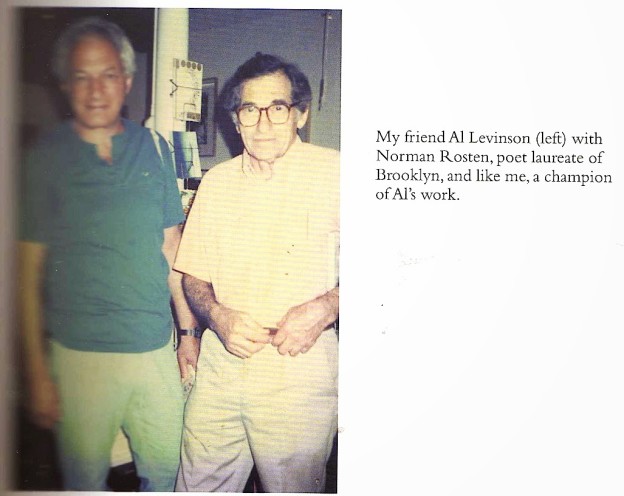
Alfred Levinson–the eighth Python?

Few, if any, devotees of the legendary TV show and films are likely to grant the American novelist, poet and playwright Alfred Levinson even honorary status, despite the fact that, as a friend of Michael Palin, he seems to have been a semi-permanent fixture at various Python events, notably a recording of The Life of Brian, where he played the Voice of God and was jokily appointed ‘religious advisor’ to the film.

Levinson was a huge Python fan when, in February 1975, he first met Palin at a dinner given by Michael Henshaw, the ‘cool accountant’ to Palin and also such literary stars as William Burroughs, David Hare, Alan Sillitoe, Fay Weldon and Simon Gray. They hit it off immediately—the creative writing tutor and the wannabe novelist—and almost immediately begun a long-distance correspondence, with Levinson alternating between his home in Sag Harbor and addresses in London. Palin saw him as ‘a sort of Earth Father figure in his fifties, solid, smiling, sensible, dependable’, and in his diary looked back at the correspondence with great pleasure:

Continue reading

Who is the Nobelist of them all?

Found - a press-cutting of a letter written to the British medical magazine Pulse (' at the heart of General Practice since 1960.') Not dated, but probably from the late 1970s. It concerns the controversy over the discovery of insulin and was in response to an article "Who is the Nobelist of them all?'. On the following evidence it is possible that Banting is the man…

Nobelist?

Sir,-  may I add this footnote to your absorbing  "Who is the Nobelist of them all?" (PULSE, October 29) : 

Banting and Best  discovered insulin in J.J. Macleod's laboratory when the professor was away on holiday in Scotland. On his return, Mcleod published a paper on the discovery of insulin mentioning that a Doctor Banting had lent a hand.

Banting  was furious and never spoke to Macleod again. When the Carolinian Institute offered the Nobel Prize to McLeod and Banting, he refused until the names of been reversed. He asked for Best to be included, and since the institution turned this down he gave him half his share of the prize money. – Yours, etc, Dr H. Pullar-Strecker, Isleworth.

There is a good article at Wikipedia on Insulin which backs all this up and adds that J.J. Macleod also split his share with another colleague James Collip.

Banting and Best 1924

Hector Whistler

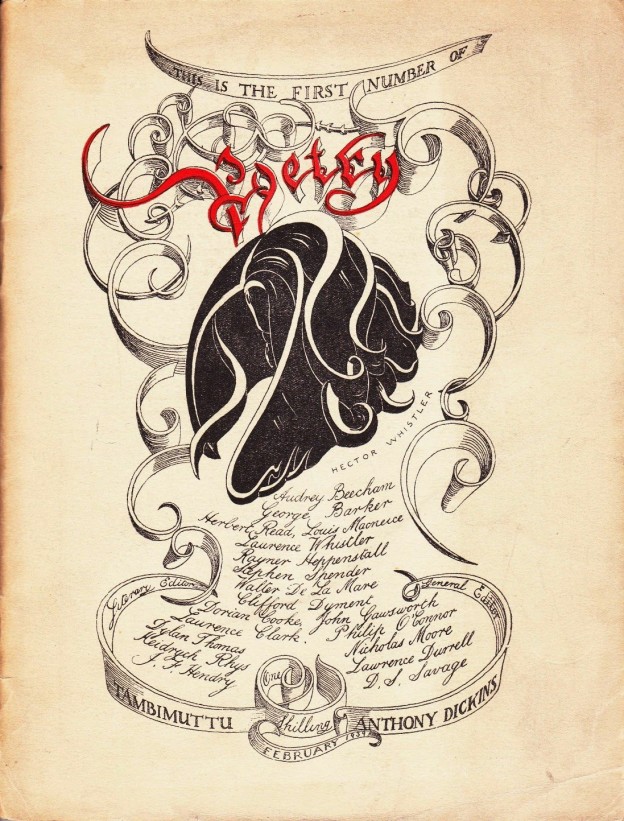
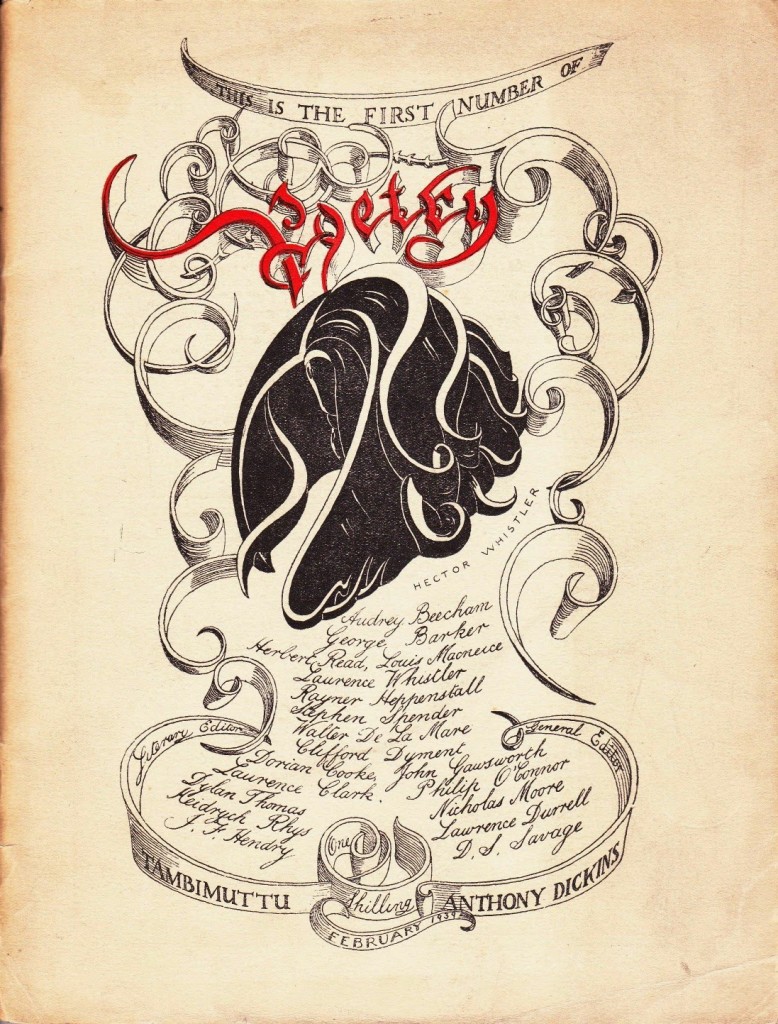
Co-editors Anthony Dickins and Tambimuttu, who Geoffrey Grigson appropriately nicknamed ‘Tutti-Frutti’, made an unusual choice when they asked the thirty-four old Hector Whistler to illustrate the debut issue of Poetry early in 1939. Trained at the Slade and the Architectural Association schools, the multi-talented Whistler, who was related to American genius James McNeill Whistler and was cousin to both Rex and Laurence, was better known as a muralist, having, five years earlier, executed some rather unusual wall paintings at the council-owned Aero Café on the Marine Esplanade in Ramsgate.

Alas, the murals, which were supposed to be temporary anyway, were obliterated along with the whole Lido complex on Ramsgate’s waterfront, some time ago, and unlike the more celebrated Vorticist wall decorations by Wyndham Lewis in La Tour Eiffel restaurant, off the Tottenham Court Road, which also disappeared, there doesn’t seem to be any record of what they looked like. The curious art lover will just have to look up Whistler’s other decorations for books to imagine what holidaymakers and the residents of Thanet lost when the despoilers moved in. [RMH]

A Son of Belial (Balliol)

Found in one of our old catalogues this curious satirical work by Martin Geldart describing the hell of his undergraduate years at Balliol College, Oxford.

Martin Geldart (writing as 'Nitram Tradleg') A SON OF BELIAL. Autobiographical sketches by Nitram Tradleg.  (Trubner, London 1882). 8vo. pp viii, 250. Autobiographical 'sketches.' Geldart was at Balliol with Gerard Manley Hopkins who is mentioned several times in the text as 'Gerontius Manley.' A witty satire of Balliol life,  in which Geldart refers to Hopkins as my 'ritualistic friend.'** Hopkins wrote to his mother that Geldart was 'the ugliest man I have ever laid eyes on', although he had been a friend and even stayed with Geldart's family in one Oxford holiday. The phrase 'Sons of Belial' was apparently used by Newman to refer to the orgies that took place at his college on Trinity Monday. Rev. Edmund Martin Geldart, M.A., disappeared from the tidal boat from Newhaven to Dieppe in 1889, aged 41. Apart from this book he wrote several works relating to the language and literature of Modern Greece, on which he was an acknowledged authority.

It appears to have been a slightly used copy and sold (not rapidly) for £120 in 2002.

** "Gerontius Manley and I had many talks on religion. He was quite at one with me on the hollowness of Protestant orthodoxy, but he had a simple remedy-the authority of the Church. The right of private judgment must in the long run inevitably lead to Rationalism."

Sons of Belial is now the name of a 'progressive death metal' band from the UK, aiming their music at  fans of Tesseract, Monuments, Ion Dissonance, Animals As Leaders. Album cover below...


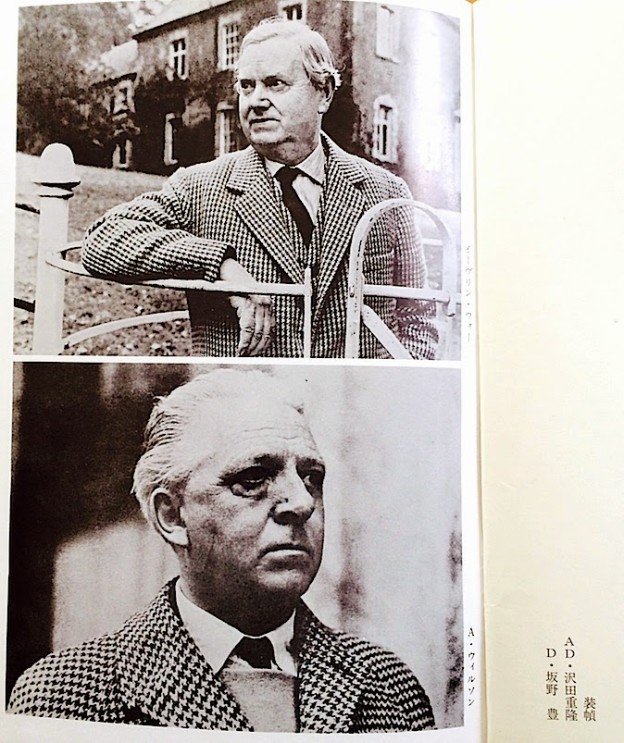
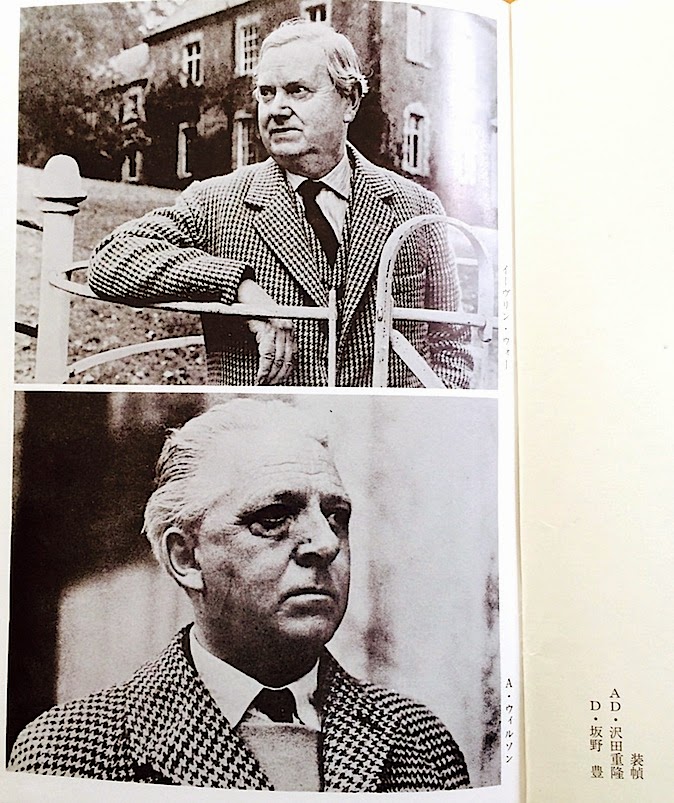
Angus Wilson and Evelyn Waugh – the tweed connection

Found - this enigmatic pair of pictures in a 1980s Japanese book on English literature. The book was in a box of foreign language books from the estate  of the novelist Angus Wilson. The inscription in Japanese is probably to him from an academic that he had met on one of his lecture tours to Japan in the 1960s. He had befriended Yukio Mishima while there and the great samurai stayed with him at his Suffolk cottage on a trip to England.

The notable item in the photo is that Evelyn Waugh and Angus Wilson appear to be wearing the same brand of tweed...it is possible that at the time in Japan it was assumed that all English novelists wore nothing but tweed..The connection between the two men,however, is slightly  deeper. Waugh was a great admirer of Wilson, especially his novel The Old Men at the Zoo which he vigorously defended in a long letter from his country pile Combe Florey to The Spectator in 1961, after it was attacked by their critic John Mortimer. Which novelist wore the tweed first is (so far) unknown.

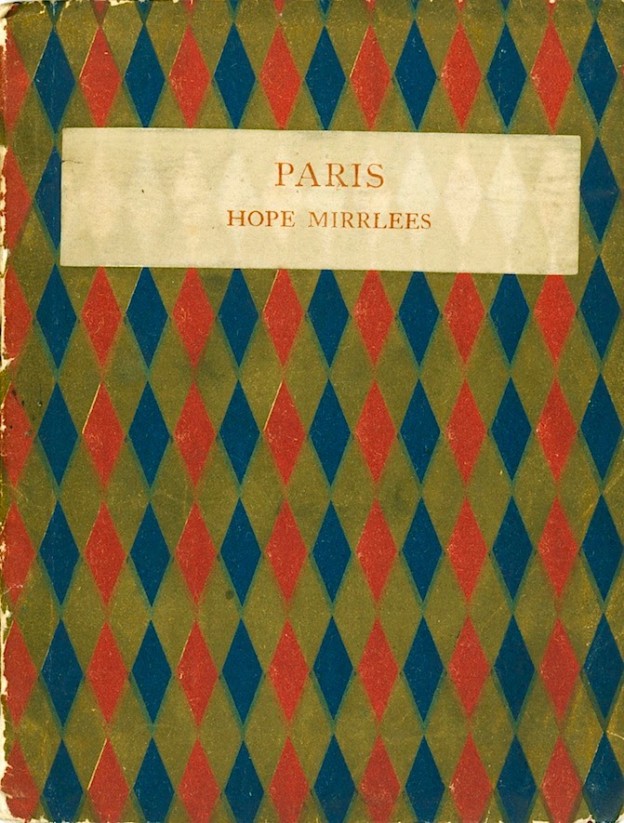
Hope Mirrlees ‘Paris’ 1919

Hope Mirrlees. Paris. (Leonard and Virginia Woolf at the Hogarth Press, Richmond 1919-1920)

The rediscovery of the Scottish writer Hope Mirrlees (1887 – 1978) may be principally due to the merits of her one masterpiece, the long poem Paris, which the Woolfs published in 1920. Only 175 copies of the 600 line poem were produced, which means that it now belongs with Pound’s early privately printed work as a true rara avis of modernism. In 2011 a dealer had a superb copy for $8,000 which has now sold. Predictably, critics today use the modish term 'psychogeographical' to describe the poem, which is a daring, impressionistic tour in French and English through the French capital and has been described as the 'missing link between French avant-garde poetry and The Waste Land.' The stylistic parallels are obvious, and the influences of Pound and other Imagists, are noticeable too:-

Continue reading

Artists as foreign spies

It is a fact that many signposts were temporarily removed, especially in rural areas, during the Second World War, and that countrymen were advised to report sightings of suspicious foreign looking and foreign sounding individuals in their district. What is not generally known, I suspect, is that an artist plying his or her trade as a landscape painter could have come under the gaze of local busybodies, including members of the Home Guard, who may have reported them to the authorities.

Continue reading
A statement from Chaplin via Raymond Williams

Found in a copy of Preface to Film (Film Drama Limited, London  1954) this statement by Charlie (Charles) Chaplin. An interesting and rare book by two notable figures from the 1940s - Michael Orrom and Raymond Williams. The dust jacket art is by Michael Stringer, an illustrator mainly associated with natural history books. Williams was an important academic, novelist and member of the 'New Left' and Orrom , also a man of the left, became a documentary film maker. Chaplin's statement first appeared in the magazine The Adelphi in 1924, this is probably its first appearance in a book. Orrom and Williams' book advances new film theories: the blurb states: 'The main belief of the authors is that naturalism, as a dramatic method and technique in the film, is not finally satisfactory...' There is one change in Chaplin's statement from the 1924 version, possibly a misprint - 'terrifying' becomes 'terrific.'

I prefer my own taste as a truer expression of what the public wants of me than anything that I can fathom out of the things that I observe either in my own work or in that of others who are unmistakably successful.

I have heard directors, scenario writers, and others who are directly concerned with the shape that the motion picture shall take, argue under the shadow of this great fear of the public. They begin with a good idea, then they lose courage and deceive themselves. The consciousness of what the public will want is for them so terrific [terrifying.]If they do something that is a little different because they have forgotten while filming the episode that there is such a thing as an audience, they are in doubt about it when they stop to consider. It is difficult to consider the public secondarily, but unless the person making the picture can achieve that state, there will be no originality in his work. [Charles Chaplin]

Tales from the Second Hand Book Trade 7

A few last stray tales of strange house calls, some straining belief…  A dealer is called to a house full of books in North London. When he arrived he realised there was a noisy afternoon party going on that had developed into an orgy and he swears he had to tread on the odd buttock as he made his way to the desirable book collection. The call had come through his ad in Time Out and he noted many of the participants were not young. Being a dealer he did not make an excuse and leave but made a good offer and returned to clear the books after the last reveller had left.

Legendary book scout Martin Stone swears he bought a great collection of modern firsts from an adult bookshop in Liverpool after the owner was shot dead one lunchtime by a crazed gunman. There were a dozen new copies of Clockwork Orange - first editions, fine in fine jackets - the trouble was that most were slightly flecked with the late owner's blood.

At another house the owner of the books, a Rachman type landlord, refused to part with some of the books after accepting the money in cash from a mild mannered book dealer. Half of the books had been loaded into to the waiting Volvo when he cried 'you've had enough.' During an argument he struck the dealer's brother, an unwise move as said brother had a fiery Irish temper. The altercation became heated, further violent blows were exchanged and the police were called by one of his tenants. None of his rather cowed tenants would witness against their landlord and they never got the other half of the books that they had paid for. One of the police remarked 'I thought bookselling was a quiet sort of job.'

Another dealer (actually the same chap who bought books during an orgy, and now a very upmarket antiquaire) found himself getting arrested during another house call. His patch was South London - which explains it. He was at the apartment of some fallen posh boys, like something out of the movie Lock Stock and Two Smoking Barrels. He was up a ladder looking at some pretty decent leather bound sets (not just Scott, but Wilkie Collins, Hardy, Le Fanu, Austen etc.,) the last gasp of a country house library. Suddenly the police burst in and arrested the half dozen upper class layabouts and hauled them off with our friend - who was ordered to come down off the ladder and shut up. He protested vehemently about having nothing to do with it all. Later that day he was released with an apology, his father being some kind of Q.C. Apparently the lads had been importing hashish from Morocco. He never got the books.

The Ghost Man – a blurb from the 1930s

Found in the massive and unending Donald Rudd collection of detective fiction -a Gerald Verner thriller The Ghost Man (Wright and Brown, London 1936) in its sensational jacket. Gerald Verner was the pseudonym of John Robert Stuart Pringle. He had over 130 books published under four names during his lifetime and was hugely popular with his audience and a favourite of the Duke of Windsor, who was presented with an especially bound set of 15 of Verner's thrillers. He attempted to take over the mantle of the prolific (and wealthy) Edgar Wallace after his death in 1932. The jacket has elements of Wallace, even down to the style of the logo. The blurb on the inside flap reads:

Who was the man called Conner, bank robber and murderer, who was hanged at Wandsworth Prison? What connections did he have with the murderer of the Shabby Peddler in the garden of Janet Lacey's country cottage? Why did he search the place so thoroughly before he was killed? And what was the significance of the stanza from the Rubaiyat of Omar Khayyam? Mr Gerald Verner's new mystery is  so full of excitement, his plots so ingenious, mysterious, and so subtly unfolded that it will be impossible to put the book down until the last word has been read.

The book is not listed by Bleiler (Supernatural Fiction) or George Locke (Spectrum of Fantasy)which would indicate the ghost is rationally explained. It is, however, an Omar Khayyam item..

World War 2 free book campaign

Found - a stamp in the front of a book reading: 'Dear Friend, This book comes to you with every good wish from the people of Leicester. May it help you to spend happily some of your hours off duty. GOOD LUCK. From The City of Leicester.'

It was in a copy of Brahms and Simon's A Bullet in the Ballet (Joseph, London 1937.) This was probably part of  a campaign to give off-duty service men and women a free book to read in the latter days of World War 2 - and also to welcome them to towns near their bases. There is slight evidence from online research that this was a British Council initiative. Possibly it was aimed at American troops...

Two books appear in online libraries bearing  this stamp. The first is Lord Raglan's The Science of Peace (Methuen, London 1933) with a similarly stamp but from 'Tunton' (probably a misprint for Taunton). This was at  the Royal Anthropological Institute. The other was a 'Bacon-wrote-Shakespeare'  book that had made its way to the Kirov Order of Honour Universal Regional Scientific Library in Russia. The stamp there is from the Borough of Dagenham. The book was Sir Edwin Duhring-Lawrence's Bacon is Shakespeare (Gay & Hancock, London 1910). Good reading for the war weary soldier...

Blurb – the beginnings

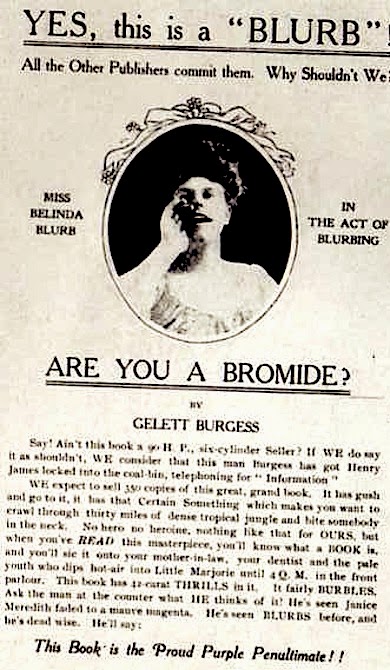
The American humourist and illustrator Gelett Burgess is not much known in the UK. However, his very witty take on clichés and platitudes, Are You a Bromide ? (1907), deserves a place in the pantheon of classic US humour. Not only does it differentiate between Bromides and Sulphites—the former referring to someone set in their ways who uses trite sayings, while the latter are original thinkers with perceptive things to say, but it spawned the term ‘blurb’, which, of course, is still used today to describe a publisher’s puff for a new work.

The problem is that this word only appeared on the dust-jacket of Burgess’s book, which meant that—dust-jackets being discarded back then, as they still are, by all types of libraries, but not, thank goodness, by dealers—the term probably didn’t catch on as quickly as it should have done. And if it hadn’t been for scholars of book history, like dust-jacket supremo, Thomas Tanselle, the wrapper for Are You a Bromide might never have been brought into the light of day. Certainly, it was more innovative and amusing than most of this period. While the typical wrapper might   feature a slightly modified reproduction of the title page, with perhaps some modest art work, Burgess’s is more like an advertising poster for the book. Hence it demonstrates precisely what a ‘blurb‘ was by giving an example of it. Clever stuff! [R.R.]

Radiesthesia—–the swing of the pendulum

Radiesthesia---or dowsing, as it is more familiarly known-- has become trendy again. With devotees such as The Duchess of York, Jerry Hall, Cherie Blair and ahem… Dr Radovan Karodicz, who could fail to be curious about this ancient art of self-exploration? Indeed, the well know poet, psychiatrist, alleged war criminal and Santa Claus lookalike, was actually making a living out of radiesthesia, among other 'alternative therapies' , when he was captured in 2008.

This 1950 first edition of Elementary Radiesthesia, a 48 page pamphlet by devoted dowser, naval officer and veteran of two World Wars, F.A.Archdale, was discovered in a pile of similar oddities that once belonged to the fantasy and penny ballad collector Leslie Shepherd. Printed in Christchurch, Hants, it was published by the author from his home, just down the road in Bournemouth, and sold, according to the sticker inside its front cover, by The Psychic News Book Shop at  140 High Holborn.

The foreword was provided by another local Hampshire bigwig , this time from Barton-on-Sea, one C. L .Cooper-Hunt, M.A.,M.S.F., PsD.,MsD.,D.D., who called himself  ‘Radiesthetic Consultant and Late President of the Radionic Asssociation of Great Britain’. Just what the middle seven of these letters meant in 1950 is beyond me-- I suspect they are made up, like his Doctorate in Divinity. Cooper-Hunt was a very active lecturer in the Bournemouth area, where, in giving talks, he added Major to his name. One thing is certain --- he had been an Army Chaplain (third class) in the Great War.

Continue reading

John Osborne observed in 1959

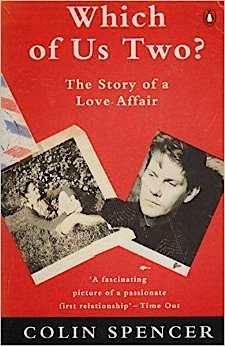
Reading Which of Us Two? The Story of a Love Affair (Viking, London 1990).It is the record of a 'youthful, illicit and intense' relationship between John Tasker (1933 – 1988) the theatre director and Colin Spencer (born 1933) artist and writer. Spencer uses a  collection of letters the lovers wrote to each other (his were returned after John Tasker's death) and considers the relationship and why he 'murdered its future'. Spencer makes acute and amusing comments on literary figures including John Osborne (whose library we bought last year). This entry was starred by Osborne in his copy:

17.iii. 59. Yesterday I began drawing the great Mr Osborne, tall, thin, spectral: in black skin-tight trousers that showed a cute bottom and a huge lunch. And camp, my dear – not 'arf.  And the musical, my dear, cor that's a queer dish too, everybody changes their sex halfway through and deliciously lovely Adrienne Corri grows hair on her chest. Most peculiar: he was moving about so much, it's only the second week of rehearsals...though I did some lightning things with a brush, it just won't do so I'm going back after Easter and try some more. He has a curiously camp voice and he appears to stare at one with his teeth...

Colin Spencer says of this letter:

The John Osborne musical was of course The World of Paul Slickey, soon to become the only commercial failure of his early years. [We]admired Look Back in Anger, our generation felt that Osborne encapsulated the rage we all felt over the limitations of the British theatre.Yet like so much of the later Osborne the play now seems an hysterical diatribe, the characters thin and invalid,the plot negligible..it was brilliant journalism.. masquerading as theatre.

Djuna Barnes ‘The Ladies Almanack’ (1928)

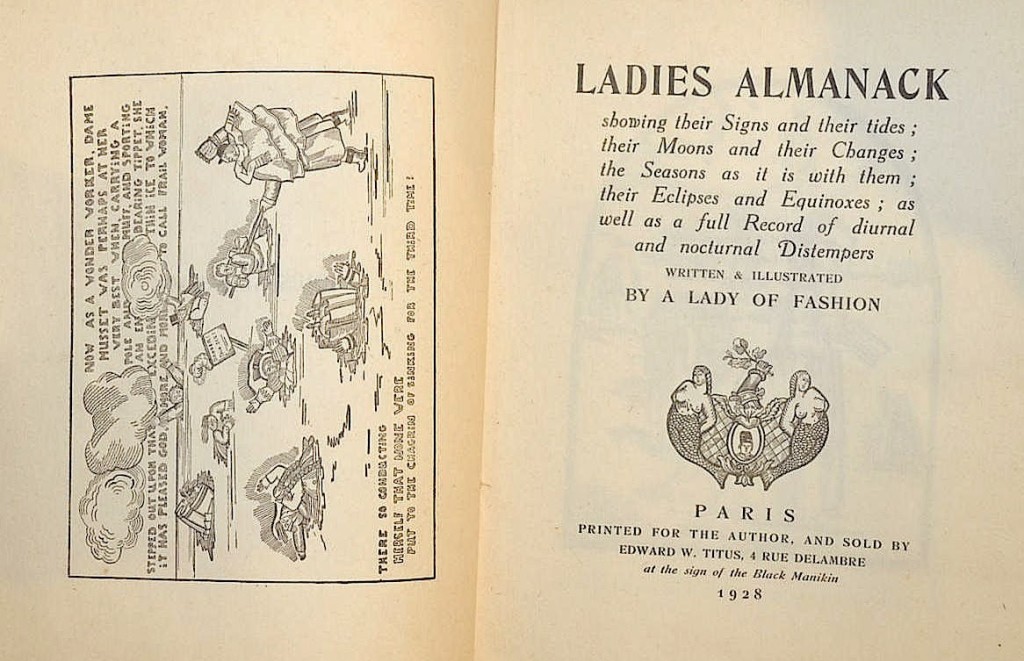
Found in one of our catalogues from 2002 a very limited and exquisite edition of Djuna Barnes's The Ladies Almanack. It was found by Martin Stone in Paris and was catalogued by him for us. It sold fairly easily to a high end London dealer for £5000.

Djuna Barnes 'The Ladies Almanack' (Privately published, Paris 1928)

Small 4to.  pp 80. Illustrated. Number 4 of  10 copies on Verge de Vidalon with illustrations hand coloured by Djuna Barnes. The  complete first edition  was 1050 copies  In full vellum wraps with highly attractive hand coloured cover. Signed on the limitation page in Djuna Barnes hand as 'A Lady of Fashion' and also on fep presented  to Lady Rothermere signed  'Djuna Barnes, Paris 1928.' Lady Rothermere was married to the press baron Viscount Rothermere (Lord Harmsworth) and was  the patron of various writers most notably T.S. Eliot who was able to give up his bank job due to her financial assistance. 'Ladies Almanack'  was printed by Darantiere in Dijon and has a curious publishing history - it was originally to be published by Edward Titus at the Black Manikin Press in Paris. However when Djuna Barnes found out how much Titus was charging her she decided to publish and distribute the book herself with financial help from Robert McAlmon. The name Edward Titus is blacked out on the title page in all copies. The ordinary edition was $10, the hand coloured one of 40  $25 and the ten hand coloured and signed copies were $50 a sizeable sum in 1928. The work, a celebration of female sexuality and a rebuke to heterosexual patriarchy, portrays in disguised form, many of the cultural and artistic elite of the Parisian avant garde of the time- epecially the Lesbian circle which was gathered around Natalie Clifford Barney - Janet Flanner, Romaine Brooks, Solita Solano, Dolly Wilde ('Doll Furious') Lady Una Troubridge ('Lady Tilly Tweed-in-Blood') and Radclyffe Hall. Janet Flanner called her 'the most important woman writer we had in Paris.' In fine  fresh condition - an exemplary copy of this beautiful expatriate book; in tirage de tete the black orchid of Lesbian literature.

Laurence Ambrose Waldron

Found in a collection of other examples, this is rather dull little bookplate, considering it came from the library of Laurence Ambrose Waldron (1858 – 1923), one of Ireland’s great and good in the first two decades of the twentieth century-- a patron of the Arts, a Nationalist politician, public benefactor, and ardent book collector with a library of several thousand volumes.

The conventional design of the bookplate is even more bewildering when we consider that Waldron was such an Arts and Crafts enthusiast, that in the early 1900s he built a mansion, which he christened ‘Marino’ in this style at Ballybrack, just outside Dublin. He later commissioned the Beardsley-influenced cult illustrator Harry Clarke to create nine exquisite stained glass illustration of Synge’s Queens (below) for his new library there. In 1998, after having not been seen since 1928, these were sold by Christies for over £300,000.

The only possible explanation seems to be that Waldron had the bookplate printed some time before his enthusiasm for Arts and Crafts and Clarke took off. As he succeeded his much more conservative father (also called Laurence) at the age of 17  in 1875, the design was probably made between this date and the building of ‘Marino’. [RH]

Bookplate of Waldron's father *
*Many thanks Mullen Books

An emblematic title page fully explained

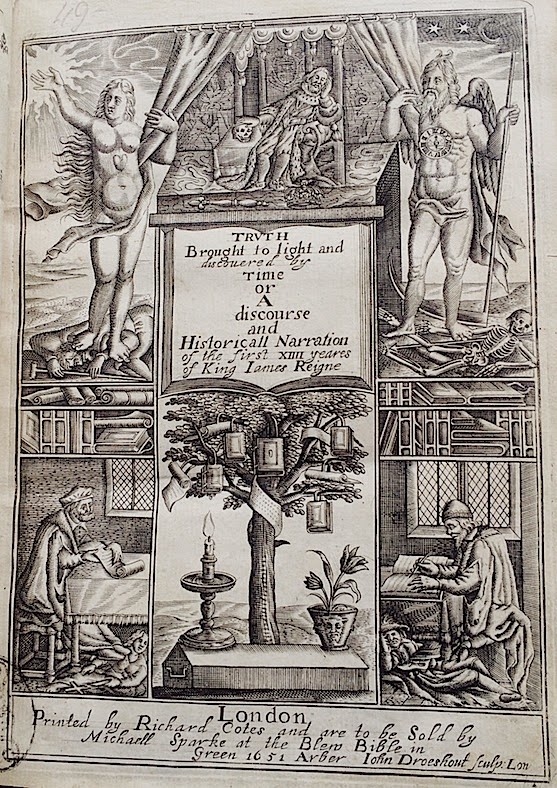
Found - this emblematic title page by John Droeshout in TRUTH BROUGHT TO LIGHT AND DISCOVERED BY TIME, or, A discourse and Historicall Narration of the first XIIII yeares of King James Reigne.[London, Printed for Richard Cotes and are to be Sold by Michaell Sparke at the Blew Bible in Green Arber, 1651.]

The book relates the history of the early years of the reign of James the First,the history of the divorce of the Earl and Countess of Essex, the divisions between the Scottish and the English, 'the lascivious courses at court' the arraignment of Sir Jervase Yelvis and an account of the murder of Sir Thomas Overbury. It also "reckons the revenue of the crown, gifts, pensions, disbursements ; and contains the commissions and warrants for the burning of two heretics." The 1870 catalogue of the Prints and drawings at the British Museum describes the title - page thus:

The print represents Truth, a naked female, who tramples on the body of a person with a crutch ; and Time, who tramples on a skeleton, drawing back curtains so as to show James the First seated, as if sleeping, on a throne beneath a canopy of state, his right hand on a skull. Below these are two other compartments : one side represents Memory as an old man, seated in a study with a scroll ; at his feet a female figure reclines and holds a cross. On the other side is History, seated in a study, with books on the shelves of a library, and writing in a book ; at his feet lies Sloth, a sleeping man. Between the latter two designs is a tree which is rooted in a coffin, on which stands a candlestick with a lighted candle in it, and a flower-pot on which is a satyric mask containing a blooming flower ; hanging from the branches of the tree are books and scrolls.

Continue reading