I nearly met….Mick Jagger

This is a new category -'I nearly met.' It could be very useful to future writers and biographers gathering info. Take it away Robin:

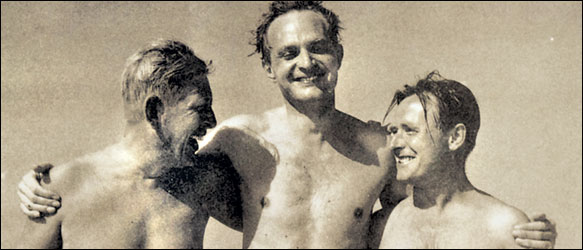
In fact, I nearly met him twice. About thirty years ago I was reliably informed that back in the late fifties, long before the Stones had been born, he and some mates used to practice in the front room of the home of our  neighbours, the Barton’s, in Woodland’s Park, a new housing estate in Joyden’s Wood, between Bexley and Dartford. I must have been about six at the time. The Bartons were our friends, but I knew nothing of rock music, or R & B, as Jagger and Richards would have called it.

Continue reading

Teenage Testament 1960

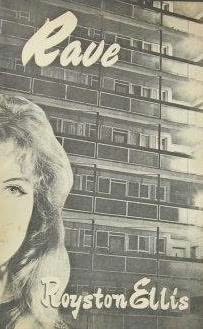
Found among some papers bought from the late John Rolph, a memorable man, publisher with the Scorpion Press and latterly a bookseller in his rambling shop at Pakefield, Lowestoft. He had published several Royston Ellis poetry pamphlets including the great-looking Rave (1960). Ellis's statement, written when he was 18 is a cri de coeur from teenland--the teenager at the time had only just been invented, before that in what is now known as 'the age of deference' you went uncomplainingly from boy to man, from girl to woman, wore sensible clothes, plastered down your hair and behaved yourself. The document  is a carbon copy with a note by JR 'given to me by Royston 1960.' It appears to be unpublished.

                                 Teenage Testament

With the on-coming Spring the teenage has burst into bud once again. But this year there is no getting rid of it with weed killer. Teenagers look like being the prize blooms featured in every newspaper, magazine, television programme and family discussion.

Throughout the country youngsters are being interviewed for their views on life, love, manners, religion....In fact, everything that will give the outsider an idea of what makes teenagers tick. A so-called typical teenager romps into the public eye and is immediately condemned and criticised by earnest religious bodies as being 'not a fair representative'. A learned youngster states his views and straightaway teenagers accuse him of being out of touch.

Continue reading

The Table Talk of T.S. Eliot

Eliot was at a fashionable dinner party of London intellectuals where the conversation was rather stilted because everybody felt they had to say something profound in front of the great man (who said very little.) Eventually after an awkward silence the wife of an academic complained about her high electricity bills. The other guests were a little shocked that such trivial matter was being discussed, however Eliot suddenly came to life. "Are you on the night tariff?" he asked the woman and proceeded to discourse knowledgeably about reducing household bills.

Another instance where Eliot succeeded in flummoxing high minded intellectuals was at the Wednesday Club in 1956 - the writer Paul Bloomfield reported the following. Asked for his favourite passage of English prose, the great poet at once replied, assisting his performance with the appropriate gestures:

'Well,' cried Boss McGinty at last, 'is he here? Is Birdy Edwards here?' 
'Yes,' McMurdo answered slowly, 'Birdy Edwards is here. I am Birdy Edwards.' 

After a bemused silence, in which none knew, or cared to admit they knew, the source, Eliot pleasantly revealed it: Conan Doyle's The Valley of Fear.

Mein Skunk

Found in an old Australian newspaper:

Maurice A. Hammoneau, of Brook-lyn, N.Y., bookbinder extra-ordinary,puts bindings on books to harmonise with their subject matter. Thus Hammoneau will encase a volume on reptiles in snake-skin, or dress a book on music in ivory piano keys. For Hitler's Mein Kampf, Hammoneau chose skunk skin.-Sideshow, N.C. Canberra Times, Monday 29 April 1940

On the Hitler skunk theme a novelty firm produced a complete ceramic trio set featuring the Hitler Skunk, Mussolini Pig and Tojo Rat. These are shown in the 1944 catalogue of Johnson Smith and Co.

“Some of the groups into which mankind is divided…”

An interesting illustration from an Odham's home learning book from circa 1938 Everybody's Book of Facts. The illustration is by modern standards somewhat racist, even xenophobic. Why the English woman is wearing a cocktail dress whereas all other nations are in traditional or peasant costume is a mystery.To be consistent the English illustration should have shown a farmworker in a smock with a  crooked stave. Even in the late 1930s this illustration would have raised a few eyebrows or at least a laugh...the author one F.L Bradley is 'quite interesting' on the subject of the location of the 'cradle of civilisation' suggesting  the Gobi Desert in Turkestan, farther Pomerania,Java,Brazil, Scandinavia, Honduras, South Africa, the Congo, Ceylon, North America 'and even the Arctic.' He notes 'the place most favoured by modern scholars is Mesopotamia, the present day Iraq, for it is there the oldest remains of stone buildings have been found, and not far off in the Caucasus the first metal work...' He concludes:

Eduard Stucken is of the opinion that the cradle is to be located, not in Mesopotamia, nor in the legendary continent of Atlantis, but in a sixth continent, that of Oceania, which has been broken up into the present archipelago of Polynesia, Micronesia and Melanesia by vast upheavals of Nature. The inhabitants of the east coast of this shattered continent are thought to have found a second home in America (there was possibly sea-borne commerce between the empire of the Incas and Polynesia), while the inhabitants of the west coast took ship for farther India, Mesopotamia, and Madagascar. Not only the affinity of language between the Egyptians, the Sumerians,the Polynesians, and the South Americans, but also the custom of building pyramids have been cited in support of this theory. Words which were written on tablets in cuneiform script 6,000 years ago are still used in the Antipodes.

To give but one example, the Sumerian word kud means to part, the Maori word koti means to cut, the Peruvian word kutu means to break a thread with the teeth, and the Mexican word kokota means cutter.
The former inhabitants of Oceania who had fled from their homeland may originally have settled in Siam or in the Sunda Islands. That the Sumerians and the ancient Egyptians were particularly noteworthy seamen has not been established, but the fact that many Sumerian words are still used in America and Polynesia compels one to look for other links. Another point to be noticed in this connexion is that finds have been made on the Peruvian coast which are reminiscent of ancient China. Incidentally the Sumerians were acclaimed as the forefathers of the Turks at the Pan-Turkish Congress held at Stamboul in 1936. It may be that the cradle of civilization was in the Tarim basin in Central Asia, where Sven Hedin, the eminent Swedish traveller, has located an age-old centre of culture in what is now a desert. Possibly, when inner Asia began to assume its steppe formation before the dawn of history, the Turkish and Mongolian peoples spread from here to all points of the compass.

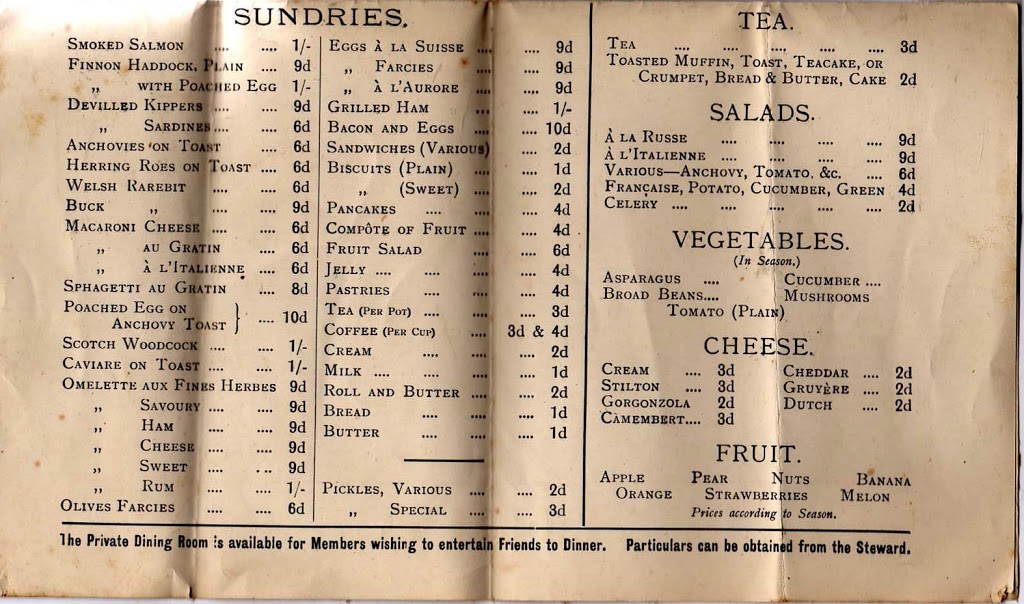
A menu from 1913

This menu was found among the archives of the London businessman Ernest B. Rubinstein, an amateur playwright and theatre critic in the early decades of the twentieth century. Rubinstein was also the father of Patricia Rubinstein (1915 -2003), who later wrote acclaimed children’s school fiction under the pseudonym Antonia Forest.

It was through her father’s interest in the theatre that the young Pat became familiar with English Drama, particularly Shakespeare, to whose plays, among others, Rubinstein took his daughter. Theatre came to play a significant part in Forrest’s fiction, and it is likely that the Marlow family of her books took their name from the author of Dr Faustus.

The Rubinstein archive also contains a number of theatre programmes, many devoted to much lighter drama and operetta, which suggests that the Rubinsteins were regular West End theatregoers. As the accompanying menu offers a 'Theatre Dinner' among its modest, rather than sophisticated fare, it is likely that such  dedicated playgoers as the Rubinsteins were more interested in fine drama than fine dining . Although the restaurant is not named, it may have been one of the many cheap eating places that catered for the less well heeled theatrical crowd, including, presumably actors and singers, which would have been another reason why the stage struck Rubinstein could have chosen it. The restaurant may possibly have been a Lyons Corner House, a chain of cheap restaurants that started up in 1907.

It is interesting to note how fashions in eating have changed in a hundred years. Although most of the dishes would still be available now, though perhaps not on the same menu, others have disappeared entirely. Anyone for 'poached egg on anchovy toast' or what about 'scotch woodcock' ? I was surprised not to find oysters, which were still cheap back then, but we do see 'caviare on toast' for a shilling, which can’t be  bad. However, the five course 'Theatre Dinner' for a mere sixpence more is an even better bargain. Some things, however, don’t change. Eating-house owners still make their biggest mark-ups on cups of tea—in 2013 I reckon an outlay of £4 on tea would generate a gross profit of around £80.In 1913, a pot at 3d (1.5p),would make a commensurate mark-up. [RMH]

The Day of the Rabblement (James Joyce) 1901

Apart from the unfindable juvenilia Et Tu Healy (possibly called Parnell) this is Joyce's first work. It was published in an 8 page pamphlet shared with his friend and fellow student Francis Sheehy- Skeffington, after his and Joyce's articles were turned down by the college magazine at University College, Dublin. Joyce, with whom he also attended school, considered Skeffington “the cleverest man at University College” beside himself (Ellmann 61). The bit at the end of Joyce's even tempered rant about a 'third minister' is said to be a clear reference to himself. It is also worth noting that Joyce translated the Gerhart Hauptmann play Michael Kramer and that Yeats thought it a poor translation. His poem The Holy Office (1904) continues his attack on the Irish theatre, amongst other things...

No man, said the Nolan, can be a lover of the true or the good unless he abhors the multitude; and the artist, though he may employ the crowd, is very careful to isolate himself. This radical principle of artistic economy applies specially to a time of crisis, and to-day when the highest form of art has been just preserved by desperate sacrifices, it is strange to see the artist making terms with the rabblement. The Irish Literary Theatre is the latest movement of protest against the sterility and falsehood of the modern stage. Half a century ago the note of protest was uttered in Norway, and since then in several countries long and disheartening battles have been fought against the hosts of prejudice and misinterpretation and ridicule. What triumph there has been here and there is due to stubborn conviction, and every movement that has set out heroically has achieved a little. The Irish Literary Theatre gave out that it was the champion of progress, and proclaimed war against commercialism and vulgarity. It had partly made good its word and was expelling the old devil when after the first encounter it surrendered to the popular will. Now your popular devil is more dangerous than your vulgar devil. Bulk and lungs count for something, and he can gild his speech aptly. He has prevailed once more, and the Irish Literary Theatre must now be considered the property of the rabblement of the most belated race in Europe.

Continue reading

I once danced with…Lord Weinstock

We were sent this interesting reminiscence by a jotwatcher (thanks JWB). He points out that our 'I once met' posts depend on one having met a famous person. Many people have never met anyone famous - but almost everybody has met someone with a good story about someone well known that they had met - the 'I danced with a man, who danced with a girl, who danced with the Prince of Wales' phenomenon.* This greatly opens up the field so please  send more in...

I was at university with a guy who became an acclaimed professional cook. At one point in the late 1980s he was cooking for Lord Weinstock at his country mansion in Wiltshire. Lord Weinstock (1925-2002) was a billionaire entrepreneur and built the General Electric Company into one of Britain's leading industrial conglomerates. He remembers Lord W (a sort of Alan Sugar of his time but with much increased  sophistication) leaving for work some days in a private jet and then seeing him on the news addressing politicians in Europe and then seeing him chauffeured back up the drive in time for supper. He had a fine wine cellar and  was especially fond of Cheval Blanc vintages which he would drink with ice. I said this seemed like a faux pas and a waste of wine (red and £600+ a bottle)  but my culinary pal said that in matters of taste there were no rules and he couldn't possibly comment…

*What did he say? 'Topping floor!'

Ecological disaster in fiction

M. P. Shiel. The Purple Cloud (1901). Poisonous gas.
Arthur Conan Doyle. The Poison Belt (1913) The Earth passes through a poisonous ether.
J. J. Connington. Nordenholt's Millions (1923) Agricultural disaster
S. Fowler Wright. Deluge (1928). Flood.
Philip Wylie. When Worlds Collide (1932). Dying sun on collision course with Earth. (Film: When Worlds Collide, 1951). Also a rock band...
John Wyndham. The Day of the Triffids (1951) Venomous Plants.
Isaac Asimov. Caves of Steel (1954) Overpopulation.

William F. Nolan and George Clayton Johnson. Logan's Run (1967). Overpopulation; destruction of those over 30.
Lee Tang. The Wind Obeys Lama Torus. (1967). From India. Overpopulation.
John Brunner. Stand on Zanzibar. (1968). Young adult novel on overpopulation.
James Blish. A Torrent of Faces (1968) World ravaged by over population.
Fred and Geoffrey Hoyle. The Inferno (1973). Cosmic radiation
David Brin. Earth. (1990). Black hole.
Margaret Atwood. Oryx and Crake. (2003) Genetically engineered virus.
Cormac McCarty. The Road. (2006) Unexplained devastating cataclysm.

John Christopher. The Death of Grass (1957). Ecological disaster due to a mutated virus killing cereal crops.
Robert Silverberg. Masters of Life and Death (1957). Overpopulation.
J. G. Ballard. Billennium (1962) population
J. G. Ballard. The Drowned World. (1962). Flood.
Kurt Vonnegut, Jr. Cat's Cradle (1963) Ice-9
J. G. Ballard, The Drought (aka The Burning World) 1965.
Harry Harrison. Make Room! Make Room! (1966). (Film: Soylent Green, 1973). Overcrowding, dystopia -set in 1999.

I once met….. Stephen Spender

This was just before he died. He was laid up in bed with a broken hip, much to my surprise, because I don’t think I’d been forewarned. Anyway, following the piece he’d contributed in 1985 to my festschrift to mark Grigson’s 80th I was now writing a biography and had written to Spender more than once about his sometimes uneasy relationship with the poet and critic. I’d visited the wonderful Harry Ransom Center in Austin, among other places, and one of the items I’d unearthed had been an excoriating squib written by his one-time friend, which as far as I knew, had never been published. Just as well, really, since had it been, it is unlikely that Spender would have cooperated at all. I’d also discovered that a mutual friend had seen  Grigson put out a cigarette on a photograph of Spender’s face.

W. H. Auden,Stephen Spender & Christopher Isherwood on Fire Island,1947

As I moved towards St John’s Wood that afternoon I asked myself if I could honestly mention these two pieces of evidence of Grigson’s dislike of him –one a fact of which I carried no proof, the other, possibly apocryphal , and even malevolent. As I sighted what I knew must be Spender’s home—a very handsome Regency villa covered with wisteria and sporting wrought ironwork — the nerves began to play up. I was about to meet a man of 89--the last surviving (unless you count Edward Upward ) figures of the Auden generation. Was it wise to open wounds that had never fully healed ? I decided that I could not risk it—not in Spender’s own home. The cigarette butt and the squib would play no part. I would have to tread softly.

The interview went pretty well. Spender was friendly and polite, though hardly enthusiastic about his old friend. I felt as if he was holding back, although his memory might have been poor. Perhaps assuming that I was aware of Grigson’s mixed feelings towards him, he did bring up an example of  his fellow poet’s brutal honesty—a hostile review by Grigson of a book by or about Cecil Day Lewis (I cannot recall which) published when the latter was terminally ill.

Before I left the house I kept my ears pricked for the sound of Edna Everage—Barry Humphries had married Spender’s daughter—but alas, could hear nothing that sounded Australian.

Spender died a month or so later.[RH]

I Am Jonathan Scrivener

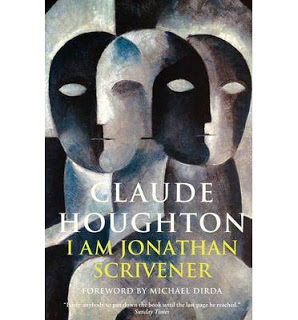
Valancourt Books have valiantly republished Claude Houghton's forgotten bestseller I Am Jonathan Scrivener (1930). This prompted us to dive into the fathomless archives where somewhere we have the manuscript.

“So remarkable in truth is this novel that I cannot understand why it is not universally known and admired.” - Hugh Walpole (1935)


“I Am Jonathan Scrivener remains a tantalizing, highly diverting philosophical novel of rare elegance and wit.” - Michael Dirda (2013)

Valancourt sum up the plot thus:

James Wrexham is thirty-nine, lonely, and stuck in a dead-end job when he comes upon an advertisement for a position as secretary to Mr. Jonathan Scrivener. Much to his surprise, he is hired at a lavish salary despite never even meeting Scrivener, and he is told to take up residence at once in the flat of his new employer, who has suddenly disappeared. Mystified by Scrivener’s strange conduct and desperate to learn something about him, it seems Wrexham will get the answers he seeks when Scrivener’s friends begin to visit the flat: Pauline Mandeville, an ethereal beauty, Francesca Bellamy, a widow who may be responsible for the death of her husband, Andrew Middleton, a disillusioned alcoholic, and Antony Rivers, a handsome playboy. But as each of them unfolds his story about Scrivener, it seems that none of them are describing the same person, though all are obsessed with finding him. Why has he hired Wrexham, and why does he seem to have thrust this unlikely group of people together? Is Scrivener engaged in an inscrutable experiment, or could he be laying some kind of trap? 

Continue reading

Badinage

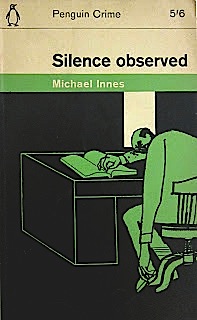
'Badinage' - sent in by an old jotter (who once met Marty Feldman) who notes that even in 1961 the old thought that young people had no conversation... From Michael Innes detective novel Silence Observed about a forger intent upon  forging forgeries of great literary forgeries. Echoes of Major Byron etc., Inspector Appleby, having briefly referred to La Dolce Vita, his interlocutor 'old buffer' Sir Gabriel Gulliver says:

"I tell you I've never spent a winter in Rome."

"You'd find it overrated, I don't doubt. Better just to read about it in a nostalgic way in Edwardian novels. The reality would be disenchanting. I understand there's a great deal of snow, and that the natives have never studied to accommodate their lives to it. Moreover in Winter Rome is full of Romans, just as in Spring London is full of Londoners. And you know how tiresome that is. No capital city is tolerable except when voided of its inhabitants."

Sir Gabriel Gulliver received this with appropriate amusement. Entering the smoking room, he dived into a corner to ring a bell…" Nice of you," he said, "to talk to an old buffer in what you conceive of as his own antique conversational mode. A good many of you youngsters, you know, have no conversation at all…'

Second-hand Bookstalls in Paris (1890s)

From Dickens's Dictionary of Paris. The book is anonymous but a note in an old bookseller's hand informs us that it was written (partly) by the son of Anthony Trollope. This edition  was published about 1896 and there are advertisements for hotels giving their phone numbers.The book is listed at the British Library as being by Charles Dickens jnr.,

The bookstalls by the Seine are still much in evidence and an occasional source of rare finds. The other stalls dotted around Paris have mostly gone but many lingered on into the 1960s and some may still be there.

The only mention of English books is a stall at Rue Daunou. This street was shortly to have other English language associations - as in 1911 (at number 5)  it became the site of Harry's New York Bar where famously James Bond went on his first visit to Paris aged 16. Ian Fleming writes (possibly this happened to him?) "..he followed the instructions in Harry's advertisement in the Continental Daily Mail, and told his taxi driver 'Sank Roo Doe Noo'...that had started one of the memorable evenings of his life, culminating in the loss, almost simultaneous, of his virginity and his notecase".

Continue reading

I once met…Dave Robinson

Sent in by a faithful jotter...an encounter with the mighty Dave Robinson of Stiff Records

It was the summer of 1979 and Stiff artistes—Wreckless Eric, Jona Lewie, and of course the Queen of Stiff, Lene Lovich, seemed to be everywhere. My neighbour in North Hertfordshire supplied marble fittings to the rich and famous. I occasionally helped him deliver these adornments locally. But this time we were going further afield---into trendy Battersea, where, according to my neighbour, a pop mogul called Dave Robinson wanted a marble bathroom delivered.

We arrived at the address, a large Victorian house which was in the process of being gutted. There were various people chatting in what looked like the sitting room. I didn’t recognise anyone who resembled Lene, but Eric, Ian Durie or Jona may have been there, as indeed could have been various members of Madness, who had yet to conquer the charts. At the time I don’t think I’d heard of Dave Robinson, but he was certainly present, and after we had struggled up the staircase with the various unwieldy stabs of marble, he duly signed the paperwork and we were off home.

My marble fittings neighbour was a crusty Tory in his early fifties, who, on the way back confided to me that he  thought Mick Jagger might dress smartly if he had wanted to impress someone like him. I think he was faintly proud that someone prominent in pop music had bought a bathroom suite from him. As for Mr Robinson, I sometimes wonder what he is doing now, 27 years on from the demise of his famous label. Can he still afford to live at that smart address in Battersea and if so do Suggs and Lene (who, incidentally is still touring) sometimes pop in for a chat.

Rushdie blurb for T.C. Boyle

Salman Rushdie (billed here as winner of the 1981 Booker Prize) blurb on the back cover of the jacket of T. Coraghessan Boyle's Water Music (Gollancz, London 1982):

"Water Music goes over the top and also round the bend. It is a book in the worst possible taste, serves no useful purpose and is crammed with disgusting, filthy ideas. Its title will make Handel turn in his grave. It stinks of gin and Africa. It also bubbles, or should I say Boyles, with life, language, comedy, energy and other forms of weirdness.Gulp it down, it beats getting drunk."

Harry Crosby remembered (1930)

Harry & Caresse Crosby

A personal note by Stuart Gilbert published in transition (Paris, June 1930) 6 months after Harry Crosby's suicide. Gilbert was a literary scholar and translator - he assisted in the translation of  Ulysses into French and was also a friend and correspondent of Joyce. This affectionate memoir of Crosby was not (until now)  available on the web.

“Let us suppose, ” Montaigne has written, “ that a plank is fixed between the twin towers of Notre Dame Cathedral, quite wide enough for a man to walk along it; however great may be our philosophical wisdom, however staunch our courage, they will not embolden us to walk that plank as securely as we should, were it resting on the ground.”

The mere thought of that dizzy walk in air between the skyey towers, above Our Lady’s pinnacles, was enough, a later writer tells us, to make some of Montaigne’s readers blanch and sweat with fear. And yet how jauntily you and I parade that selfsame plank when it is laid out on the pavement of normal experience, little plainmen who rarely lift eyes above the shop windows and studiously avert our gaze from the insistence of the sun!

Continue reading

I once met….Kenneth Griffiths

Younger movie goers may remember him as the irascible elderly wedding guest (‘ Don’t you think I know my own brother ?’ ) in Four Weddings and a Funeral but cineastes would prefer to see him as the enfant terrible of the British film industry, if you can call a man in his seventies, a child. Perhaps maverick is a better word. He wanted to make films of deeply controversial figures in history but often ran up against the usual stuffed shirts. He asked awkward questions about Britain’s imperial past, and about the British in Ireland. I had been invited to talk to him about his Boer War collection, but we ended up chatting about the time when the IRA came to tea.

He lived in a four story stuccoed Victorian house in Barnsbury called ‘Michael Collins House’. Griffith’s Boer War archive was huuuuuge. Said to be the largest of its kind in private hands, it occupied all four floors. Apparently Griffith’s interest had started when he worked in a stamp shop for a while and became interested in Boer War postmarks. It developed apace in 1952 when he went to South Africa to act with the Old Vic company and was taken around the battle sites by a friend.

In amongst the Boer War material were hundreds of books, pamphlets, prints and letters relating to the British radical tradition. Although a Protestant, the history of Irish nationalism was an abiding passion, which led to death threats from the UVF. He showed me the receipt he received for the postcard he sent to Bobby Sands before he died. In his 'Gladstone Corner' I saw a piece of one of trees that the great man used to cut down. When some IRA leaders came to tea one of them noticed a photo of Queen Victoria and remarked that she was 'a very interesting old lady'. However, the visitor 'was very uneasy with me from then on...' said Griffiths. [RMH]

Dressing Vorticist (Violet Hunt)

Extract from The Flurried Years - Violet Hunt's account of her life between 1908 and 1914.

A languid airless summer, rife with Law and Cubism, spent at Selsey with Princess Maleine as sole guest and play-secretary. Her husband flitted backwards and forwards in his car, now recalling her, now giving her a new leave of absence. Joseph Leopold*, playing golf,eating little contraband crabs, writing poems, and helping me with my novel, and taking a car into Chichester on Sundays to attend Mass in his own church, contrived to wile the summer away. He wrote Impressionist ; she painted Futurist; in dress, we two women went a step farther and dressed Vorticist, which was newer than Futurism, than Cubism, than Impressionism, old-fashioned almost by now, but which Joseph Leopold was still practising in his cunning vers libres.

The very clothes we rejoiced to wear made us feel like it ; they coarsened us, I think. Non-representational art makes for hardness, enjoins the cynicism that likes to look upon the crudenesses, the necessaries of life merely — the red of beef, the blue of blouses, the shine of steel knives in a butcher's shop. Better, said Wyndham Lewis, than a dying stag or a virgin in Greek dress picking daisies. But this kind of art died in the war, being relegated chiefly to the camouflaging of ships. A faint echo of it is to be seen in modern jazz.

Continue reading

Frank Rutter / McKnight Kauffer etc.,

Stumbled across the art writer Frank Rutter's rare little work Revolution in Art (Art News Press, London 1910) and noticed it was presented to E. McKnight Kauffer the poster artist (pic above). An interesting association as Rutter was a great supporter of the poster. He wrote:

The whole nation is much less affected by what pictures are shown in the Royal Academy than by what posters are put up on the hoardings. A few thousand see the first, but the second are seen by millions. The art galleries of the People are not in Bond Street but are to be found in every railway station.

Wikipedia in its lengthy bio of Frank Rutter has this poster by the Brothers Warbis from 1915 "Why bother about the Germans invading the country? Invade it yourself by Underground and Motor-Bus."

Rutter was a great supporter of the new art from Cezanne, Van Gogh, Picasso etc., and his 1910 work has this fervent dedication:

To Rebels of either sex all the world over who in any way are fighting for freedom of any kind I dedicate this study of their painter-comrades.

The title is a reference to Gauguin's statement "In art there are only revolutionists or plagiarists.'

Beggars’ Marks and Mendicant Hieroglyphs 1860

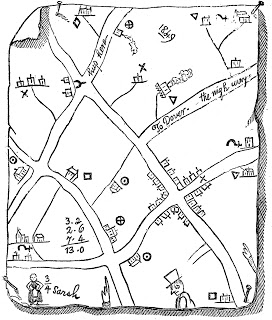
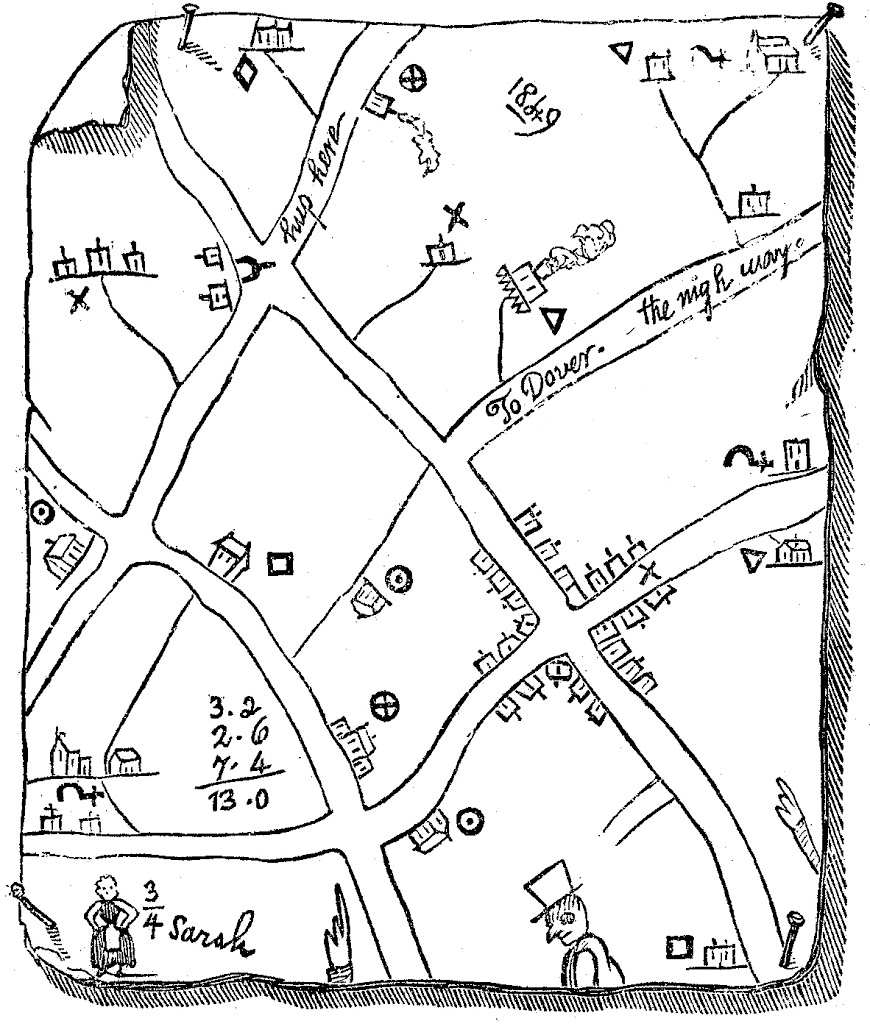
A CADGER’S MAP OF A BEGGING DISTRICT.
EXPLANATION OF THE HIEROGLYPHICS.

No good; too poor, and know too much.

Stop,—if you have what they want, they will buy. They are pretty “fly” (knowing).

Go in this direction, it is better than the other road. Nothing that way.

Bone (good). Safe for a “cold tatur,” if for nothing else. “Cheese your patter” (don’t talk much) here.

Cooper’d (spoilt) by too many tramps calling there.

Gammy (unfavourable), likely to have you taken up. Mind the dog.

Flummuxed (dangerous), sure of a month in “quod,” prison.

Religious, but tidy on the whole.