Author Archives: Jot 101

Tea Room Management

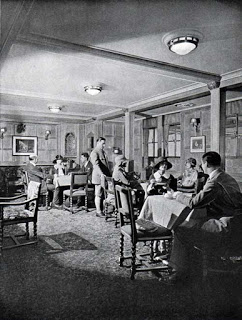
From - The Fingerpost: A Guide to Professions for Educated Women, with Information as to Necessary Training. (Central Bureau for the Employment of Women. 1906.) A useful guide to the practicalities and economics for women considering opening a tea room at the dawn of the 20th century. A persistent dream, in one Agatha Christie story (Miss Marple?) a woman is willing to bump off several relatives to get the money to open a tea room..

Tea-Room Management. Gertrude Limb.

In choosing a suitable place for a tea-room, it is wise to bear in mind two things: position, and the number of residents and visitors who may by customers. Even if an extra outlay of capital is required, I am convoked that it is well spent on a good position. The old adage, "Out of sight, out of mind", is especially applicable to a tea-shop. Then it is "the number that pays," and it is best t choose a place favoured by tourists as well as residents, and if it is place by the sea where boards call, so much the better.

To open a tea-shop without previous experience and training will in all probability spell failure, for to be able to make tea charmingly in one's own drawing-room does not necessarily mean that one has all the many gifts necessary for success in business. Embryo pupils write to me - "I am considered attractive socially." "I have made cakes at home for year." "I have good taste, with a correct eye for form and colour," and probably when the socially attractive pupil enters she has no idea that flower glasses require to be washed, that coffee must be ground, that chairs and tables must be policed, and, for the girl who has made cakes at home, she has yet to learn that cake making as a business is a very different matter.

Then how many girls who think they can run a tea-shop can keep the simplest accounts correctly?
Continue reading

Color TV in 1953 !!

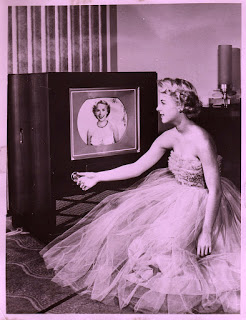
Found in the fascinating El Mundo photo archive is this shot of a ‘pretty girl tuning in a colorcast on a color video receiver ‘before the assembled American press on 17th December   1953. This was a prototype; commercial broadcasting in color began the following year. I don’t know when TV reached Argentina, let along colour TV, but British viewers were only offered colour in 1967, nearly 14 years after it had been unveiled in the States. Apparently, colour had been in development across the Atlantic from the earliest days of TV but due to technical and other problems, the service was delayed for many years.

My own family were initiated into the TV age in 1951—before the Coronation—when my mother was given a leaving present of a new sixty guinea Bush receiver by a grateful employer. But if someone had told us in 1954 that in America families were gathering around what appears to be a 16” screen (ours was a tiny 10 inch one) to watch programmes in colour, we would have thought it incredible.

Of course, the very earliest TV screens in the UK were even smaller—I mean the ones receiving programmes from c 1934 – 1939. I was obliged to do research on early broadcasts while working on a book about Geoffrey Grigson a few years ago. He, John Piper and John Betjeman were popular TV broadcasters (mainly on art) in the late thirties.

Incidentally, why has no-one published a social history of this early TV era in Britain ? It would be fascinating.

[R.M.H.]

The most nourishing soup

A pot of Rumford’s Soup from the basic recipe: pearl barley and dried peas, water, salt, some vinegar (no potatoes). Thanks to Gestumblindi.
Found - an 'extract' from a book about food with a recipe for pearl barley soup. This piece appears in various forms throughout the 19th century but derives from work with the poor by Benjamin Thompson (Count Rumford)  when he was army minister in Bavaria in the 1790s. Rumford was an American ennobled by the courts of Europe because of his pioneer discoveries in cooking.The soup is sometimes known as Rumford's Soup. He wrote:

The difference in the apparent goodness, or the palatableness, and apparent nutritiousness of the same kinds of food, when prepared or cooked in different ways struck me very forcibly and I constantly found that the richness or quality of a soup depended more upon a proper choice of the ingredients and a proper management of the fire in the combination of those ingredients, than upon the quantity of solid nutritious matter employed ;— much more upon the art and skill of the cook, than upon the amount of the sums laid out in the market.

I found, likewise, that the nutritiousness of a soup, or its power of satisfying hunger, and affording nourishment, appeared always to be in proportion to its apparent richness or palatableness. But what surprised me not a little, was a discovery of the very small quantity of solid food, which, when properly prepared, will suffice to satisfy hunger, and support life and health ; and the very trifling expense at which the stoutest and most laborious man may, in any country, be fed.

Continue reading

Amateur Journalism and Vanity Publishing (1880)

Found - Journals and Journalism (with a guide for literary beginners) published by the Leadenhall Press (London 1880.) The author is stated as 'John Oldcastle' - a pseudonym of Wilfrid Meynell (1852-1948) who became a newspaper publisher and editor. It is likely that the book appeared because at the time journalism was all the rage, like photography in the 1960s or developing apps now…It is full of good advice, occasionally caustic in tone, and starts out with a warning to 'amateurs'. The final part of this extract from the first chapter deals with vanity publishing scams, and refers to an amusing scandal when one scammer sued another. These 'bubbles' were then common and are still with us on the internet. The entire text can be found at Brewster Kahle's incredible expanding Internet Archive.

Even more fatally amateurish is the practice, not uncommon with beginners, of addressing a more or less gushing note to an editor, disclaiming any wish for remuneration, and intimating that the honour of appearing in his valuable paper is all the reward that is asked. A contribution that is worth printing is worth paying for; and to an established paper the trifling sum due for any ordinary article is a matter of no consequence whatever — a mere drop in the bucket of printing and editorial expenses.In the case of a new paper, not backed by much capital, it is different.Gratuitous contributions may there be welcome ; but such a paper will hardly live; nor, if it did, would there be much prestige attached to an appearance in its pages. Besides, the offer of unremunerated labour to an experienced editor will often, and legitimately, be resented. He feels that an attempt is being made to bribe him, and, however absurd the bribe, the idea is not pleasant. There is, in a word, only one fair and sufficient test of capacity in literature as in the other arts, and that is the test of competition in the open market. Our old friends Supply and Demand ...are the only trustworthy umpires in the matter...

As to the style of amateurs, though we have just spoken of freshness as their possible characteristic, the curious fact is that, contrary to natural expectation, they generally write more conventionally than the hacks of journalism. The amateur sets himself too energetically to keep the trodden ways ; he is too timid to allow any originality which he may possess to assert itself; and it is only when he is familiar with the necessary laws that he gives himself a desirable ease and liberty in non-essentials.

Finally, let amateurs beware of " amateur magazines," and of agencies for the profitable placing of literary work. These are generally bubbles — bubbles that will burst as soon as they are pricked with a silver or a golden pin. Some years ago an action was brought by one of these amateur associations against another ; and a number of dreadful young men of nineteen, with long hair, and spectacles, appeared in court as plaintiffs and defendants. No doubt the original promoters of such an organisation traded to good purpose on the credulity and ambition of the provincial and the young, beginning with a profession of philanthropy, and ending with a request for a subscription. They soon had their imitators, however ; the monopoly was broken, the spoils divided; and what with the exposure resulting from their internal dissensions, and the bitter individual experience of the thousands who lent willing ears and purses to their allurements, we may hope that their occupation is now gone.

The Suicide of Henry Symons—-bookman of the British Museum

“There is a Museum story that when a member of the staff committed suicide in this room ( the Cracherode) by shooting himself his superior’s first reaction was : ‘Did he damage the book bindings ?”

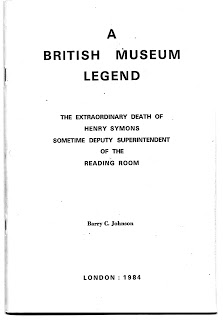
It sounds like one of those apocryphal remarks that are handed down from employee to employee through the decades in great institutions , but according to Barry C Johnson, author of a booklet entitled, A British Museum Legend (privately printed 1984), it was probably a genuine expression of concern by the Keeper of Books for his valuable  charges. The suicide in question had taken place in 1922, but as Johnson remarks in his account of the events leading up to the tragedy, no-one he spoke to about the event could recall the name of the unfortunate Assistant Keeper.

His name was, in fact, Henry Symons, and it would seem that he was a well liked and respected figure both at work and at home, though contemporaries agree that he was very reserved and essentially a loner. His low profile at the BM combined with the fact that he doesn’t seem to have published anything of note, or left any personal diaries and only a few letters, made the job of Johnson as biographer, a challenging one, though his own post at the BM, doubtless proved of great value.

Continue reading

Live poetry 1967 (Pete Roche)

Found - a 1967 Corgi paperback Love, love, love: the new love poetry. It was edited by Pete Roche the subject of a recent jot where he wrote disparagingly of the Cavern Club (1964). Three years later in the height of the Hippie era we find him editing this attractive book with psychedelic covers by Haphash and the Coloured Coat. His introduction celebrates the revival of 'live' poetry - which is still going strong. There follows a poem by him, other contributors included Adrian Henri, Adrian Mitchell, Roger McGough, Carlyle Reedy, Libby Houston, Spike Hawkins, Brian Patten...

… the recent increase in the popularity of poetry readings, particularly among younger people. The success in this respect of the Liverpool poets (all of whom are included here) and of what has been called The Great Liverpool Experiment have already been well documented. But this new interest in oral poetry is by no means confined to Merseyside: the readings organised by Tom Pickard in Newcastle, by Alan Jackson in Edinburgh, by Mike Horovitz and Pete Brown in London and the growing number of readings in other towns and cities throughout the country - all bear witness to the increasing demand for living poetry, poetry that talks to people in the direct and comprehensible way. It is no coincidence that virtually all of the poets in this book, when discussing their work, are quick to stress the value of these live performances. 

And it is this quite novel situation - young poets reading their work to predominantly young audiences - that is giving the poetry of the mid-sixties its distinctive character, is investing it (whatever faults in technique one may find in  individual poems) with a vigour and a feeling for the realities of life that have been absent from English poetry for too long. 

Continue reading

1846 Diary of J.W.Penfold—inventor of the octagonal pillar box

Any Jotters who in their childhood tuned into Danger Mouse, which is about to be revived, must know that his sidekick was called Penfold. It would seem that this character was named after the Victorian architect John Wornham Penfold (1828 - 1909), who is perhaps best known today as the inventor of the octagonal pillar box, several examples of which can still be found in Cheltenham.

But here we have a copy of the Punch Pocket Book for 1846 (discovered many years ago in an antique shop) that once belonged to the future architect and designer, then aged just eighteen, while he was working as a lowly assistant draughtsman in the London office of the renowned architect and illustrator Thomas Talbot Bury (1809 -1877) and his partner Charles Lee (1803 – 1880). At this time Penfold’s duties were various, and included surveying at proposed sites, researching legal documents, studying plans, often of proposed railways, and copying and preparing plans and delivering them with other related material to clients and lawyers. The Diary, also records Penfold’s churchgoing, social life, including visits of friends and relations, dining out, trips to the theatre and concerts, excursions to art galleries and museums, and visits home to his home town of Haslemere. Here  then  is a rare glimpse into the world of a trainee architect in early Victorian London at a time when  the ‘Railway Mania ‘ was raging across England and the metropolis was rapidly expanding.  Not surprisingly, most of the more interesting entries in the Diary illustrate the way in which these developments relate to Penfold’s work. Here are some examples:

January:
Wednesday 14th.Took letter to B. Williams, Waterloo Place & to Humby, Carlton Chambers. Copying Plan of Sewer under Richmond Railway on Mr Leader’s land & Beck’s Bill to W. Clay.

Monday 26th. …went with Sydney to measure across Westminster Bridge road where the south east extension is to cross by Miss Carr’s property. Inking in tracing of South Eastern Extension Ry.

Continue reading

Stella Gibbons parodies modernist poetry (1921)

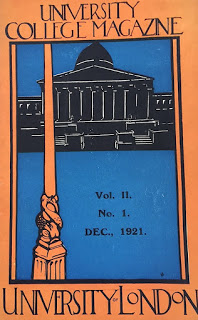
Found in a  University of London College magazine from December 1921 this poem/ parody by the novelist Stella Gibbons. She was 19 at the time and had just begun a two-year Diploma in Journalism at UCL. The course had been established for ex-servicemen returning from the First World War, but attracted several women, including another future novelist - Elizabeth Bowen. After a spell as a caustic book reviewer at The Lady her first book (poetry) was published in 1930, and in 1932 her masterpiece Cold Comfort Farm appeared. This, too, was a parody (of the current 'loam and lovechild' school of rural novelists.) The writers parodied are mostly somewhat forgotten: Mary Webb, Sheila Kaye-Smith, Eden Philpotts - although D.H. Lawrence and Thomas Hardy did not escape her mirth. In this piece modernist poets (T.S. Eliot and Ezra Pound?) are mocked..

The Marshes of My Soul
(With  apologies to the latest School of Decoratively- Melancholy Introspectives.)

I.
Brackish …brackish,
The Pools of Weariness, flung in a glimmering chain
Reach the horizon.
And my thoughts, like purple parrots
Brood
In the sick, light trees 
Blowing above those shallow pools
In whorls and whorls
Noiselessly 
Printing a monotonous pattern upon the heavy air
Like watery curves upon the silken robe of a dying Mandarin.

II.
I am a peg, pinning up
Nebulous shadows of half guessed moods
Along the clothesline of "Let's-be-Clever."
Sometimes (ah - rape of the Muse by the cold fingered--) 
Doubt takes me.
I wonder
If all these mists and moods and parrots mean 
Much?

The Cavern – a view from 1964

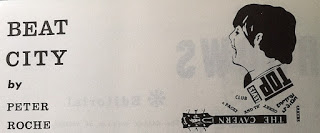
Found in Arrows 87 (Summer 1964, edited by Roger Ebbatson) this amusing piece about 'Beat Music.' The magazine was produced by Sheffield University Union and had poems articles, graphics etc., This article was by Peter Roche a poet who was affiliated with the Liverpool Scene. He edited a 1960s anthology Love, Love, Love (The New Love Poetry) and is to be found in various poetry collections and anthologies. He was also a friend of John Peel and Cream lyricist Pete Brown.The article shows how, at the time, The Cavern (the club where the Beatles played and were discovered) was not universally loved...

Beat City by Peter Roche

Let me tell you all  a fairy story. Once upon a time, in a  city far away across the hills to the west, there was an old warehouse, in an alley off a side street. And underneath this warehouse was a cellar, where the local groups used to play their music far into the night. And people who lived on the banks of the river used to go to this cellar, because it was somewhere to go when the pubs had kicked out and you were half cut and there was nowhere else to go, and anyway there was a fair old chance of picking up a judy there. And everyone was fairly happy, minding their own business and having the occasional punch-up.

Continue reading

The sex life of Marie Corelli—-a revealing letter

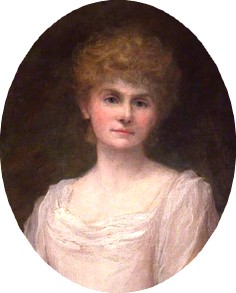
Marie Corelli (thanks Timprasil)
It cannot be denied that Marie Corelli (1855 – 1924) was an enormous success as a writer of science fantasy and romance. She sold more books than H.G.Wells, Arthur Conan Doyle and Rudyard Kipling put together and her fans were as loyal as the literary critics were dismissive.

But was she a lesbian, as many modern commentators have alleged, or did the fact that for forty years she shared her life with a certain Bertha Vyver, an irrelevancy? It has been rightly pointed out that it would be ridiculous to ascribe any homosexual leanings to Sherlock Holmes and John Watson based merely on the fact that they shared a flat in Baker Street. And the same could be said of many literary figures, both real and fictional. In the case of Corelli, it could also be argued that she was passionately attached to the painter Arthur Severn for many years, but that her feelings were not reciprocated.

Continue reading

Eviction of Adam and Eve

Found in Arrows 87 (Summer 1964, edited by Roger Ebbatson) this amusing piece about Adam and Eve. The magazine was produced by Sheffield University Union and had poems articles, graphics etc., This squib was by Peter Mottley (1935-2006) who became an actor, director and playwright.

Eviction by Peter Mottley.

Dear Mr. Adam,

I am instructed by my client to serve the enclosed eviction order concerning the property you now occupy.

He feels that he is justified in this action in view of your recent behaviour, which constitutes a breach of the terms of your lease.

You will remember the Clause 4 in your lease permitted you full access to the garden on condition that you undertook 'to dress it and keep it', and that my client generously allowed you to take for your own use any of the fruits and flower which grow there. However, he specified quite plainly that you were not under any circumstances to touch the prize-winning fruit tree in the south-east corner. This clause has been broken quite blatantly by your wife, who has freely admitted taking fruit from this tree. Her excuse, that she thought it would be all right, is considered by my client to be inadequate.

Continue reading

Son of the Sixties

Found - in Axle, a short lived magazine, from June 1963 this amusing and intriguing portrait of a sixties type (or archetype.) It was written  by Ken Howard and Alan Blaikley the editors of the magazine. These 2 men, 23 at the time, went on to become successful pop music composers - hits included Dave Dee's Xanadu..In 1970 they even wrote a song for Elvis ('I've lost you'.)The reference to 'Dexadrin' is obscure- can find no trace of such a magazine, possibly ingested rather than read...

Son of the Sixties

Build: Tall; slim; muscular without exercise. Complexion: clear; permanently bronzed without sun or Man-tan; never sweats...Seldom laughs (but rare smiles are planned and dazzling - he was born in natural fluoride area). Hair: Black; well-combed, no dressing; styling suggests but never quite descends to more obvious fashions of the day (Frost, Como, etc.) Clothes: by John Michael and Marks and Spencer. Can wear white shirt for whole week. General appearance: Air of masculine competence cunningly offset by one or two ambiguous touches (name-bracelet, St. Christopher chain, pastel denim shirt); usual expression, mixture of Come-Hither and Come-Off-It; can appear alternately boyish and authoritative, a trump combination arousing maternal and subject feelings in women simultaneously, rendering him irresistible. Looks at best after all night party. Background: only son of fashionably separated parents (White Russian mother, Franco-Jewish father) whom he visited alternately in school holidays; discreet fostering of their sense of guilt won him ample allowance and Porsche at 18. Education: Attended Bedales where he swam on summer nights in nude and was encouraged extracurricular activities; he in turn encouraged extra martial activity of master's wife who fondly imagined she had done the seducing. Always the centre of any group, without responsibility of actual leadership...Scraped 3 G.C.E. passes and entered St. Martin's Art School where... he gained undistinguished diploma. Occupations: rejected father's suggestion that he should 'work his way up from the bottom' (in three years) in his costume jewellery business. After spell as bar steward on Azores run where he cut dashing figure in whites, found (with friend of girl friend's help) tailor-made niche as London P.R.O. for obscure but loaded mining venture in Pretoria which enables him to indulge twin ambitions of luxurious living and complete independence. Residence: From liberal expense account was able to set up basement flat in renovated Earls Court terrace, where he frequently throws lavish (but informal) parties that are unexceptionally tremendous successes and are usually raided. (But he has a way with The Law). Clubs: Discotheque, Le Gigolo, Muriel's National Film Theatre, La Poubellle, Rockingham, Ronnie Scott's (offer drinks at, but has never joined The Establishment). Takes: The Observer, Peace News, Dexadrin. Glances at: The Times, Daily Express, Izvetzia, Private Eye, Encounter, Town, Playboy, Paris-Match, Sight and Sound, his horoscope. Went through novel and poetry reading stage at 15; still studies reviews quite carefully. Listens to: Today (2nd edition), Pick of the Pops. Watches: Panorama, Tonight, Compact (for laughs and because he knows some of the cast very intimately), Points of View. Outlook: Intellectual inferiors regard him as unassumingly highbrow, while academics find his 'untouched originality' refreshing. Remarkably adaptable, is equally at home in company of Soho villains and company directors, pop singers and clergymen. Mixes everything from sex to drinks and generally likes neither straight. Believes in experience (hash-smoking, etc.) as a right rather than as anything wildly off-beat, but demands best in everything. A self-confessed dilettante, seeks to avoid type-casting; likes to confound admirers of both sexes by appearing in public with wholly atypical companions. An agnostic, takes pleasure in arguing case for Christianity and was cynical at attempts at compromise in Honest to God. Politics: Wouldn't vote in next election even if he were 21. Occasionally supports Committee of 100 demonstrations, but no longer marches ... Future: Middle-age. And then…?
(Excerpt)

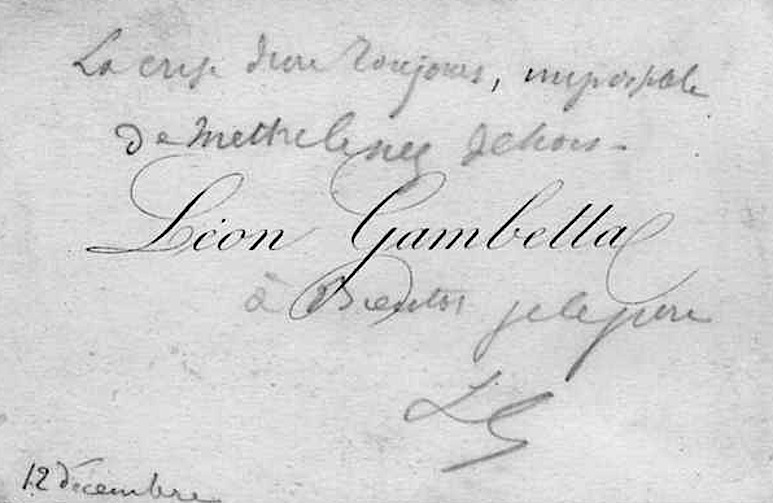
Leon Gambetta’s crisis

Leon Gambetta—‘ the grand orateur et homme d’Etat’.

So reads the printed label stuck on the back of this carte de visite by a French dealer sometime early in the twentieth century. It is indeed a ‘ curieuse piece ‘, as the dealer avers. Gambetta has addressed in pencil, above his printed name, the following remark to an unidentified friend or colleague:

‘Le crise dures toujours, impossible de mettre le nez dehors…’
(The crisis is lasting for ages, impossible to stick ones nose outside…)

Historians might debate what crisis Gambetta is referring to. There were doubtless several in the tempestuous political career of one of France’s greatest heroes. But the date of 12th December that Gambetta adds at the end of his message might offer a clue. In Paris from 23rd November to 15th December 1877 the improbably named President McMahon presided over a ministry that excluded all ‘parliamentary hands‘ like Gambetta and his democratic colleagues. During this period it was felt that MacMahon was planning a coup d’etat and this crisis came to a head around December 10th and 11th. The idea was to deny power to Gambetta, who may have felt that his life was in danger during this time. Excluding Gambetta worked for a few years, but eventually, in 1881, he was asked to form a ministry. This lasted for just 66 days.

Around late November 1882 Gambetta was shot in the stomach, but this was an accident. However, it may have contributed to the stomach cancer that eventually claimed his life, on 31st December 1882.

[R.R.]  

Hermann Sudermann—bearded wonder

 This is unusual, but perhaps not for its time. Back in 1906, when this postcard was sent from Berlin to a certain Seigfried Keiller, who was living in the Jewish ghetto of Gartenstrasse, Breslau, it would seem that celebs trusted the postal service to deliver signed photos of themselves safely. Not a likely prospect today!

Hermann Sudermann (1857 – 1928), a hugely successful novelist and dramatist in his day, was that celebrity, as one can see from the bottom of the card, where his scrawl of a signature appears just above his printed surname. We don’t know exactly when the card was printed, but he looks to be around his mid or late forties.  At the time Sudermann was at the height of his popularity. A German nationalist and an admirer of Nietzsche, his plays and novels found a ready audience, not only in his native land, but also in Japan and Britain, where, for instance, the English version of his drama Heimat, which played with the notion that the artist should be able to lead a freer moral life than the bourgeoisie, attracted actresses like Sarah Berhardt and Mrs Patrick Campbell. His plays also formed the basis of more than thirty films worldwide.

Sudermann died in 1928, but as someone who promoted nationalism and romanticized ideas of ethnicity, his popularity lasted right up the Second World War. However, with the defeat of Hitler and the cultural re-evaluation that accompanied the rebuilding of Germany, his work became distinctly unfashionable and today he is an almost totally forgotten figure.
     
Incidentally, it is interesting to speculate why Sudermann came to send a signed photo of himself. It is possible that Keiller attended a performance of one of his plays in the presence of the dramatist and that he approached him for an autograph. Sudermann may then have promised to do better than supply a signature and afterwards dispatched the signed postcard. Such a scenario seems more likely than the notion of Keiller looking up Sudermann’s address and number in the Berlin phone directory. But you never know!

[R.M.Healey]

Donald Davie & the poetry scene (1963)

Found in a copy of New & Selected Poems by Donald Davie (Wesleyan University Press, 1961) a handwritten letter from the author. A good newsy letter that gives a snapshot of the  Oxford and transatlantic poetry scene of the early 1960s. It is to Fred Hunter founder of Independent Radio News, teacher of journalism and something of a poetaster and friend of many of the Sixties and Liverpool poets. He also had a poetry record label (Stream Records) which in 1967 put out an L.P. of the American poet Dorn reading from his North Atlantic Turbine. The letter reads:

[Gonville and Caius College, Cambridge]. June 18th 1963.

Dear Mr. Hunter,

I was touched and pleased to have your request from yourself and Mr. S. Raut Roy. I have today dispatched the books to you - don't send them on to India before taking out your own two copies!

I know Jonathan William, by name of course and I believe he was lately entertained by my young colleague Jeremy Prynne, to whom I am chiefly indebted for my knowledge of the Projective Verse poets, who seem to me to represent the only plausible growing-point for Anglo-American poetry. Olson I esteem chiefly as a theorist, Duncan's work I hardly know, but Creeley's I admire very much. We would link with him Edward Dorn whose very distinguished collection in typescript we are at present (Prynne and I) trying to place with a London publisher - but with predictably little success. 

I am having great difficulty about completing a new collection of poems which will represent in some degree the sympathy I feel for some of the Projective Verse methods. But this business of doubling up as poet and don is quite hopeless! 

Again, I'm grateful.

Yours sincerely, 
Donald Davie

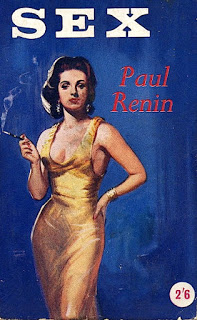
Paul Renin ‘Sex’ (1928?)

1950s issue, Many
thanks John Fraser.

Here’s a bit of a puzzler. Coming from the archive of Peter Haining and bearing annotations by him, this is a photocopy of a blurb for a book 'in preparation' entitled Sex, which is described as 'Paul Renin’s Latest, Greatest and Most Courageous Novel !' Now here’s the thing. Such a novel by Paul Renin—the pseudonym of someone called Richard Goyne (1902 – 57), who also wrote crime novels—did not seemingly appear, according to Abebooks, until 1951.

The copies available on Abebooks are described as the first U. S. editions from the publisher Archer of a romance concerning a 'sixteen year old runaway Girl in the South Seas' . However, the blurb announcing the forthcoming appearance of Sex is clearly in a typeface of the 1920s, which Haining’s annotation identifies as dating from 1928. This, of course,  was the year in which Lady Chatterley’s Lover appeared, and the blurb writer seems keen to emphasise that Sex was, like Lawrence’s novel, a mould-breaking literary event.

What of the parents who—for reasons of “delicacy” or hectic pursuit of their own gay lives—allow their children to grow up in perilous ignorance?

What if those boys and girls who, so neglected, are lured from the fireside” by distant, seductive callings” to learn “romance“ and its moods for themselves in “the little corners of the city where night steals early and danger lingers always” ?

There are the human, poignant problems with which Paul Renin is most fitted to deal. In Sex he tells a daring and a wonderful story. Of romance, of passion, of weak lovers old and young. Of great emotions and greater need. In Sex PAUL RENIN SPEAKS OUT FEARLESSLY.

We have not examined a copy of the 1928 book, if indeed it was published in this year. If its publication was held back until 1951, it may have been because the censors –perhaps provoked by the blurb—took action to prevent its appearance.. [RR]

The 1928 issue may not have happened (i.e. the book was a 'ghost') - an extensive search through WorldCat, Copac and the might Karlsruhe database reveals no edition earlier than 1942. This was published by pulpmeister Gerald Swan who was discussed in an earlier jot on London's markets.

A charitable action from Richard Arkwright—the richest shareholder in Britain

Every schoolboy knows about Sir Richard Arkwright, the pioneer factory owner from Derbyshire whose invention of the water frame contributed hugely to the Industrial Revolution. Well here’s a scrawl from his son, Richard Arkwright junior (1755 – 1843), who took over the business and proved to be an even greater industrialist than his father had been. On the latter’s death he sold some the factories he had inherited and ploughed back the capital into property, shares and a bank. At his death his fortune was estimated at £3m, making him the richest man in Britain outside the landowning classes.

The letter, which is dated 20 February 1837 and is addressed from the family home of Willersley Castle,
just down the road from Arkwright senior’s Cromford Mill, asks an unidentified correspondent to attend to a cripple, Eliza Freer, who is related to someone known to him.  Let Richard himself explain:

Continue reading

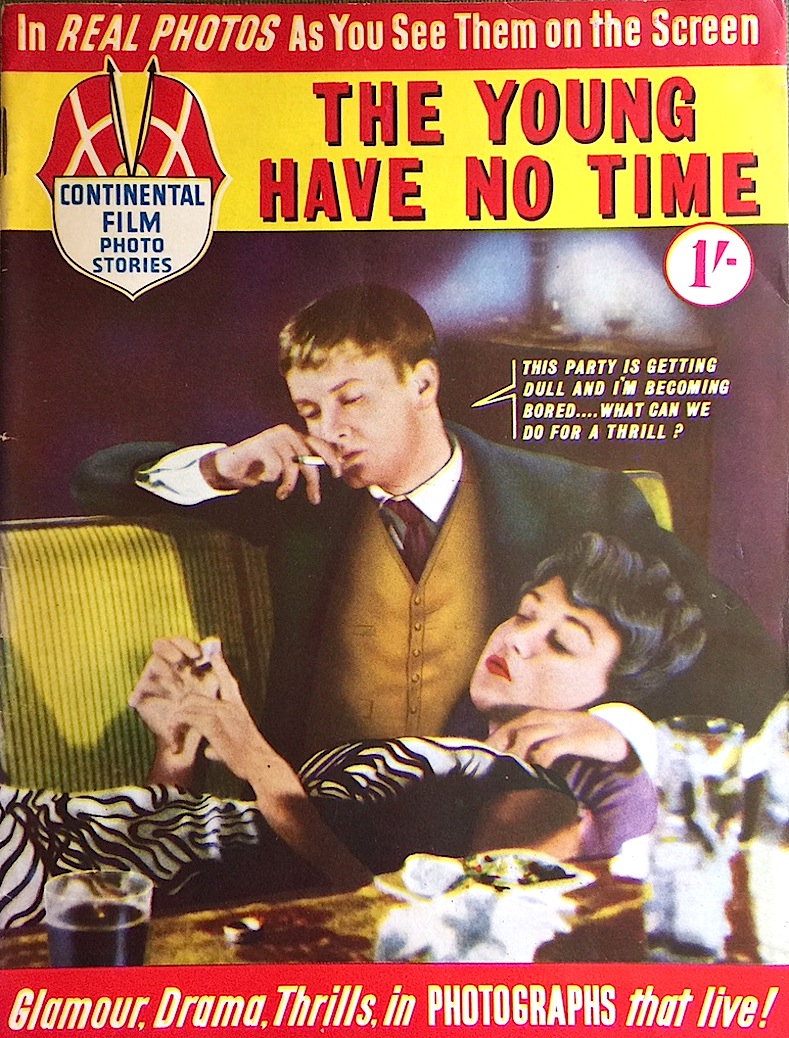
‘The Young Have No Time’ – a fumetti (1960)

Fumetti is an Italian word (literally 'little puffs of smoke' in reference to speech balloons) which refers to all comics. In English, the term often signifies photonovels or photographic comics, a genre of comics illustrated with photographs rather than drawings. These were often taken from movies or television. Photonovels were  popular on the continent, especially in Italy and further afield in Mexico. They had a life in England, especially in romantic stories for young girls. This photo novel which appears to be from 1960 was in a series designated 'Continental Film Photo Stories.' It is taken from the Danish movie Ung Leg a tale of wealthy/ elite youth in post war Copenhagen. While promising (from the cover) a sort of Leopold and Loeb plot of senseless/ existential murder it does not get more daring than a game of 'chicken' on a railway line. A Pan paperback film tie-in novel by Johannes Allen, Young Love, appeared in 1966. The film The Young Have No Time was also directed by Johannes Allen.

“GOING! Going! Gone!”

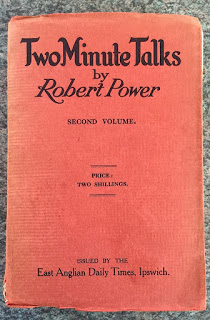
Found – an obscure work by Robert Power, a forgotten journalist. In the 1920s and up to the early 1950s his short ‘thought pieces’ were syndicated in the UK and as far as Australia. This tradition of coffee break columns is still with us – now it’s Robert Crampton rather than Robert Power but it may not continue much longer…There is no real equivalent online. This is from his Two-minute talks (Vol 2)  S. W. Partridge (London,1925) and still has some relevance in the time of eBay. Other ‘talks’ have titles such as ‘Poppy Friendships’, ‘Blistering Tongues’, ‘In the W.P.B.’, ‘Rich Poverty’, ‘Are you Popular?’, ‘Poachers’ and ‘Rubbernecks.’

"GOING! GOING!"

"GOING! Going! Gone!" cries the auctioneer and brings down his mallet with a sharp rap to declare that opportunity to purchase has passed for all save the highest bidder.

The auctioneer emphasises the desirability of the goods he offers. In seductive language he paints the picture of a bargain that must be seized at once. Prudence struggles with desire in the mind of the keen bargain hunter, but time is limited, and if he lingers in indecision too long, the descending hammer puts a period to his vacillation.

Continue reading

Cafe Bizarre – Beatnik club

Found- a rare piece of Beatnik ephemera, a card from New York's Cafe Bizarre with the phone numbers and name of Rick Allmen who started the club in 1957. The Cafe Bizarre was one of the better known clubs to capitalise on the beatnik phenomenon, and the venue for many counterculture poets and musicians of the period. Musitron Records even recorded an album of Beat festivities at Cafe Bizarre in the late '50s. (In the post-beatnik-era Andy Warhol discovered The Velvet Underground there.) Another band who played there was the Lovin' Spoonful who described the place as a 'little dump' (1965 -post its Beatnik Glory).They played 3 gigs a night and were paid with tuna fish sandwiches, ice cream and occasionally peanut butter and jelly sandwiches. More can be found at Rock and Roll Roadmaps.