Author Archives: Jot 101

Pickpockets

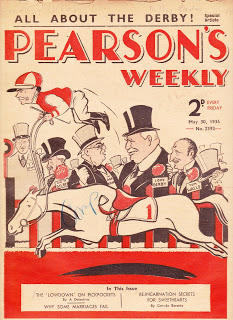
Found in the Haining collection - this article from 1936 on pickpockets. The author Louis Mansfield has much advice,most still relevant. The bit about a 'dip's' long, tapering fingers may be fanciful but certainly it is not a profession for one with fat fingers...

PEARSON'S WEEKLY, May 30, 1936

THIS IS DERBY WEEK, SO

WATCH YOUR POCKETS!

Pickpockets will be busy among the crowds. It is their best time of the year. Louis C. S. Mansfield, detective and crime investigator, lets you into secrets of the "dip's" profession – and they have some good ones. You have been warned!

TAKE HIS ADVICE–

  I have worked against pickpockets for years. Here's my advice to you if you want to return home with your notecase.
  Be careful when you see men carrying, and not wearing, their overcoats, or holding newspapers which are open–not folded.
  Grab your wallet quickly if a stranger starts brushing paint or dust off your coat.
  If somebody hits you on the back and says "Sorry," look for a touch in front–because you won't feel it.

Continue reading

A musical genius in Tottenham Court Road

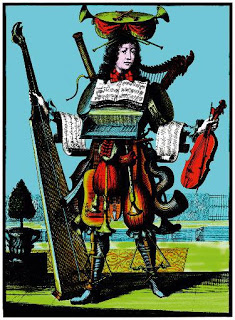
This account of an amazingly talented musician (reminiscent in some of his skills of Percy Edwards) occurs in various forms in trivia collections of the 19th century. This version is from the 20 volume Percy Anecdotes published by Berger in London in 1852.

It is related of a gentleman who resided in London some years ago, that he possessed such extraordinary musical talents, that he could play upon two violins at one time, and imitate the French horn, clario- net, organ, and trumpets, in so astonishing a manner, as to make them appear a whole band, with the sound of different people singing at the same time. The pieces of music which he played were principally from Handel's oratorios. His imitative faculty was not confined to musical instruments. He could imitate a carpenter sawing and planing wood, the mail coach horn, a clap of thunder, a fly buzzing about a window, a flock of sheep with dogs after them, a sky-rocket going off, the tearing of a piece of cloth, the bagpipes, and the hurdy-gurdy. He generally finished his performance with the representation of beating a dog out of the room, which was accounted the most difficult, and, at the same time, the most natural imitation of all.

In The Entertaining Companion (1805) the same story is told with further information. It states the man is 'now living in Tottenham Court Road' and is an 'extraordinary genius in the musical  line, a person of independent fortune who has the most wonderful powers of voice of any man in the kingdom yet he is under 5 feet high…' The account concludes -'...what a pity it is, that his abilities were not given to a poor man; for such a one might have made a fortune by them.'

An Address to the people of Suffolk on incendiary fires

Found in the Haining collection - a mid 19th century pamphlet An Address to the people of Suffolk on incendiary fires. No publisher, author, date or place of publication is given. WorldCat notes that there is a copy in the Goldsmiths'-Kress Library of Economic Literature, (no. 34328) and says the author was probably  Lord Thurlow - a Suffolk peer (Edward Hovell-Thurlow) and estimates a publication date of 1845. Evidently Suffolk was plagued by arson at this time. An impassioned plea, unashamedly patrician in tone, to stop this outbreak. It appears to be addressed mainly to farm workers and may have been spoken to a gathering and/or published in local newspapers. The account of the violent and seditious behaviour of people at the fires is fascinating and alarming...

Continue reading

A rare souvenir of London’s Great Wheel

The Great Wheel, which was built for the Empire of India exhibition at Earl’s Court in 1895, and was the ‘London Eye’ of its time, is pretty well documented. Postcards showing various aspects of it can be had quite easily, as can medallions, which were struck periodically throughout its career, right up to 1907, when it was demolished. But what we have here is something quite rare—on a number of levels. Firstly, it is a large photographic image of the wheel—four times the size of a postcard—which was mounted on board and sold –presumably to be framed and hung—by the famous  commercial printers of posters, stamps and banknotes, Waterlow and Sons Ltd. And there on the lower right hand corner is the signature of the Wheel’s ‘constructor ‘ Walter B Basset ‘, which may be original, but could equally be a facsimile. Lastly, we can date the photograph because it depicts the Wheel looming above the temporary constructions in painted wood and ironwork—some especially imported from India-- that comprised the Exhibition, which was the brainchild of Imre Kiralfy, a producer of burlesques and spectacles.
Interestingly, in the background can be glimpsed  the warehouses that stored the forage for the horses that transported goods of London largest department store, Whiteleys, while in the bottom left hand foreground can be seen a very early example of an elaborate electric floodlighting system for the Exhibition. If the signature is a facsimile then this mounted photograph could well have been a bit of opportunistic merchandising by Basset, who remains a very significant figure in the history of the amusement industry. Born Walter Basset Williams in 1864, the scion of an ancient Devon family, whose seat was Watermouth Castle, he entered the Royal Navy but left in 1882, possibly due to ill health, and instead took up engineering with the well established Maudslay Sons and Field, which specialised in steam-power. Here he did well and by the age of just 27 had become managing director. In 1894, inspired by the pioneering example in Chicago, he begun to build his first steam-powered Ferris Wheel at Earl’s Court, which when completed stood 300 feet high and contained 30 carriages, each of which could carry 30 passengers. It was an immediate success, but its popularity waned over the following years and in 1907 it was dismantled and the metal sold for scrap to the same company which 46 years later was to buy the Skylon at the Festival of Britain and produce cigarette cases from the scrap metal.

While the Wheel was still operating, however, Basset built other Ferris Wheels at Blackpool and Paris, but neither were a financial success, and when Maudslay went bankrupt in 1899, he set up his own business, The Basset Nut and Screw Company, in Belgium. In the end the destruction of his prized project at Earl’s Court may have been the last straw for a man in poor health, for in May 1907 he died, aged just 43, at the family home in Devon.  Thankfully, the Vienna Riesenrad survived its creator and is now one of the city’s greatest attractions—it featured in the films ‘The Third Man’ and ‘The Living Daylights’.

[R.M.Healey]

Frances Willard—nineteenth century American feminist extraordinaire

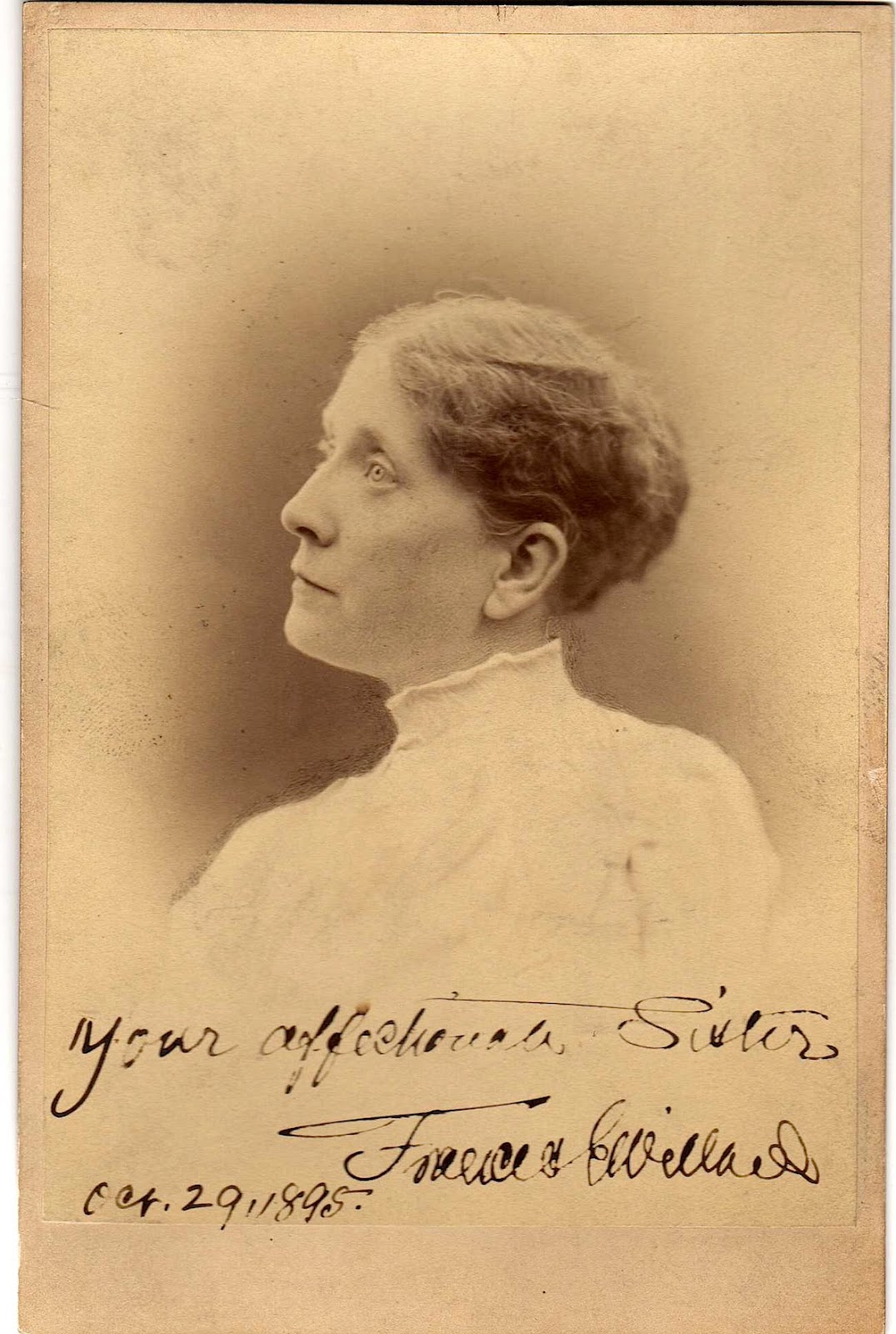
Here is a signed photo of that amazing woman, Frances Willard ( no relation of Dolf !!), an icon of American feminism, who almost single – handedly organised the suffragist movement in the States from the mid nineteenth century until her comparatively early death (probably partly from sheer hard work) in 1898 aged 58. As a committed proto-Socialist and president of the Woman’s Christian Temperance Movement (WCTU) for 19 years she lobbied on an enormous range of progressive social issues, including the voting rights of all women over the age of 21, federal aid for education, free school lunches, unions for workers, an eight-hour working day, municipal sanitation, national transportation, anti-rape laws and protections against child abuse. On the issue of female suffrage she argued that women could only be safe from male violence in their own homes if they were seen as ‘companions and counsellors of men’ rather than their playthings.
Willard made several tours of the UK to promote her ideals and it was probably on one of these appearances in October 1895 that she signed as ‘your affectionate sister’ this mass-produced photo of herself. Three years later she was dead. [R.R.]

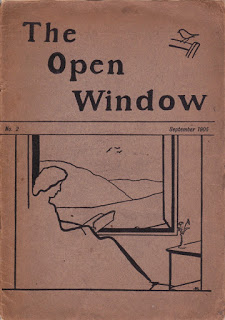
The Open Window 1905

Not sure where this came from or what it was. It appears to be a literary magazine but is not the literary magazine  The Open Window published in London by Locke Ellis  from 1910 onwards with contributions by Edward Thomas, E.M. Forster, George Bourne, Katherine Mansfield,  Maxwell Armfield, Douglas Goldring, W.H. Davies, Geoffrey Whitworth, Lord Dunsany, John Drinkwater, Walter de la Mare and Vivian Locke Ellis etc., The article, of some competence, quotes among other George Borrow, Kipling, W.E. Henley and F. Marion Crawford...

On the “Joie de Vivre.”

There could hardly be a more fitting time to say something about this primitive impulse than now, when maps and guide-books are taken down from shelves; when bicycles, botanical vascular, and geological hammers are brought out from their places of concealment, and we lift up our eyes to the hills.
  The true “joie de vivre” I take to be the satisfaction of an instinct for communion with Nature, an instinct which, implanted in the bosoms of our ancestors during the long ages before cities were existent, has not yet died completely away in their more artificial descendants, and which, at certain periods, seizes upon some of us with an almost irresistible power.
  After living during many months in dingy offices or class-rooms, poring over musty tomes, and hearing through our windows nothing but the lugubrious cry of the coal man, the discordant tinkle of the barrel-organ, or other of the multiform phases of the “brouhaha des rues”–sounds having relation to nothing more than the distracting life of this “man-made” town–suddenly some small note may be heard, or an odor of spring may be felt, or a green blade seen growing in a cranny of the wall–some sight or sound, small in itself, but mighty in the mental effect it  evokes; for, in a moment, this ancient primaeval instinct grips us by the heart-strings, and we resolve–to take a holiday.
  In Marion Crawford’s “Cigarette Maker’s Romance” there is a wonderful passage describing the annual wild rush of the reindeer to drink the salt water of the Arctic Sea. As their blood cries out for the essential chloride, so in spring does that of the city-dweller for the ozone of the hills.
Continue reading

Gunmen in Piccadilly (Edgar Wallace)

Found in the Haining archives - this slightly scaremongering article by Edgar Wallace from Nash's Pall Mall Magazine in March 1931. Edgar Wallace (1875-1932) was the adopted son of a Billingsgate fish porter in London, and largely self-educated - the newspaper boy who became one of the most famous writers in the world. He sold millions of books, but he was plagued by debts due to an extravagant lifestyle. He left Britain for the United States in 1931, only to die in Hollywood in 1932, aged 56, after writing the original story for King Kong. His body was returned by ocean liner in honour, only to be reunited with an ocean of outstanding bills.It is said all his debts were paid off in a few years from massive book sales. This article was copyrighted from America and one can imagine him churning it out in Hollywood to pay the bills. The title belies the content which is about criminal gangs anywhere in Britain- even art thieves. A BBC radio programme earlier this year by thriller writer Mark Billingham on Edgar Wallace (The Man Who Wrote Too Much?) suggested he was somewhat forgotten. He may not be much read anymore but his books are still collected throughout the world…

Continue reading

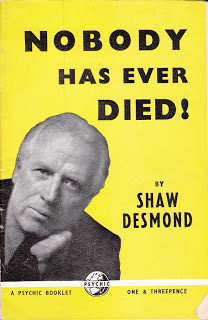
Nobody Has Ever Died II

The second and last part of this booklet by Shaw Desmond (1877-1960). (see first part here.) He was an Irish novelist, poet, founder of the International Institute for Psychical Research in 1934, and author of many works on the afterlife and several Scientific Romances- some dystopian and possibly influenced by Olaf Stapledon. He appears as himself in Haunted Palace(1949), a documentary, directed by Richard Fisher, in his role as a ghostbuster. There is more on Desmond at the at the SF Encyclopedia.

VI.
STORIES FROM MY CASE-BOOK

It is impossible in a little booklet of this kind in every case to give the minutiae of authorities, places, times, people present and conditions of phenomena described and other references, but the reader wose interest has been stimulated to further study is advised to refer to the author's books and to those of others. The books of Geraldine Cummins, in particular, will be found of the utmost value, especially her Scripts of Cleophas and their kindred volumes, which can, with the author's, be obtained at any good library.
  The following experiences from my case-book and from other records may be relied upon. They run the gamut from tragedy to comedy. They are of the stuff that helps to make psychic history.
  Some years ago I was travelling on one of my American lecture tours in my Pullman, from San Diego to San Francisco. In the night, I was awakend by a most powerful influence which kept on "calling out," so to speak, the name of Annie Flynn.
  This spirit influence brought to my memory a lady of this name I had known thirty years before in Ireland, and with whom I had since lost all connection. Annie had been a lovely girl of the typical Irish model, with blue eyes and black hair, tall and of a certain queenliness which had remained in my thought.
Continue reading

The Secret Places XVII & XVIII

Two more chapters of The Secret Places (Elkin Mathews & Marrot London 1929) - a chronicle of the 'pilgrimages' of the author, Reginald Francis Foster (1896-1975), and his friend 'Longshanks' idly rambling in Sussex, Kent and Surrey. See our posting of the first chapters for more on Foster and this book, including a contemporary review in The Tablet.

Continue reading

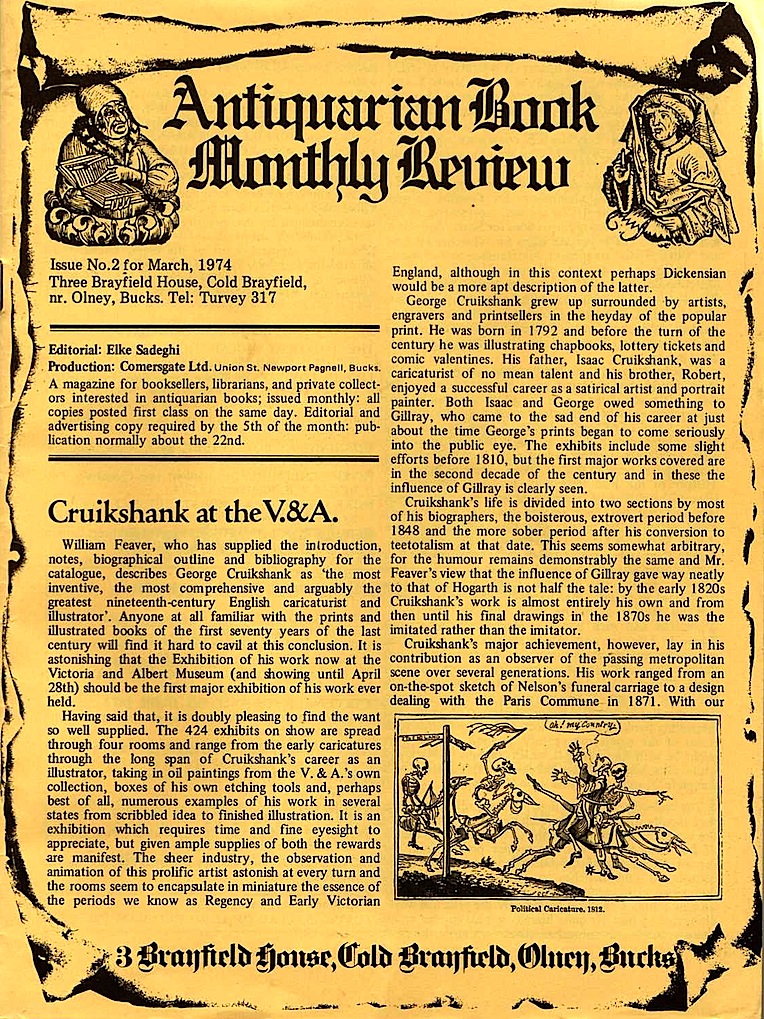
ABMR – The Antiquarian and Book Monthly Review

There are now no popular magazines in the UK covering the field of rare and antiquarian books. Just seven years ago there were two—Rare Book Review and Book and Magazine Collector –and I wrote regularly for both of them. First to fold was Rare Book Review, a very glossy and well designed affair financed by a wealthy dealer. Previously this had been known for many years as the Antiquarian Book Review, and before this as the clumsily-titled Antiquarian Book Monthly Review, an early issue of which we have here.

When we consider how well designed and glossily produced magazines covering other fields in the arts –such as fashion and the fine arts—it is astonishing how unglamorous this particular magazine must have appeared to the eye of someone familiar with, say, Vogue,  the Burlington Magazine, or Country Life at that time. To arrive at something that could compete in visual terms with these titles it took over 40 years and oodles of dealer's dough. It isn’t as if there had never been glossies that had dealt with aspects of the antiquarian book trade---The Bookman, a product of the twenties and thirties, being the most notable.

The idea for a new popular magazine distinct from the academic Book Collector and the dryasdust Clique, which was then just a list of books for sale and wanted ( it has since extended its range and appeal) came from the antiquarian  book dealer, Paul Minet, who operated from Chicheley House, Bedfordshire. Minet ( 1937 – 2012) provided most of the copy, as he was to do for many years after, but the editing was left to one of his employees, the recently married Elke Sadeghi, then in her early twenties, who was also helping to compile his catalogue of Chicheleana, and was working from Minet’s home and her own flat in the Georgian Brayfield House, near Olney. A local printing firm called Comersgate, based in Newport Pagnell, was chosen and the first issue appeared early in 1974. It is easy to forget that before the advent of digital publishing, which now makes it possible for amateurs to produce magazines and booklets of a professional standard for next to nothing, that back in the seventies a magazine produced cheaply on bog-standard paper by a non-professional art editor would tend to look like this 1974 issue of Antiquarian Book Monthly Review, with its yucky light orange cover, title in Gothic script, and clunky page set-up.

The content was unpromising too, consisting mainly of an exhibition review, some book chat, extensive book lists and a piece on recent science fiction that clearly has nothing to do with ‘antiquarian’ books. There was nothing to suggest that this venture would come to anything. We know that it did, and its eventual success seems to have had something to do with the good intentions of dedicated people like Minet, Sadeghi and her successors as editors, but perhaps more importantly, with the goodwill shown in the letters page, which is dominated by messages of encouragement from dealers and collectors alike, who clearly welcomed what the new enterprise represented.

Sadeghi was eventually replaced as editor and left publishing to start a family with her husband, Dr Majid Sadeghi , who became an internationally acclaimed expert on automotive design and anti-crash impact technology at Cranwell. Around 2002 she became a bookbinder and still practices her art from North Crawley, near Newport Pagnell.

Collectors and dealers now hope that Rare Book Review, the splendid child of Antiquarian Book Monthly Review, will somehow, with the help of another wealthy sponsor, be resurrected.
[R.M.Healey]

Nabokov’s first book

Found in - Vladimir Nabokov: a Descriptive Bibliography by Michael Juliar (Garland, N.Y. & London 1986) this description of Nabokov's first book.

A1 [UNTITLED]

A1.1 First edition, in Russian: 1914

Title-page: Untitled. Privately printed. 1914./
binding: Brochure or folded sheet, possibly in violet paper cover.
Contents: One poem.
Note: Non-extant. There is speculation that this item never existed and that Nabokovian memory is in error.
We may never know for sure.

Online, an article Vladimir Nabokov and William Shakespeare by Philip F. Howerton is quoted where he writes '...in 1914 he published his first work, a small book of poems in a lilac folder. It carried an epigraph from Romeo and Juliet.' Whether Howerton had seen the book or this is some other work is not quite clear but the colours (violet / lilac) would indicate it is VN's first work - A1 in the canon.

The whole thing is reminiscent of the enigma around Joyce's first book Et Tu Healy (possibly Parnell) which we dealt with in some depth at the late Bookride. There are no copies known of this book said to have been written by Joyce when he was 9 and published by his proud father in 1891. With some authors their first book is known in only a few copies - Machen's Eleusinia (1881) in only one copy (according to Ahearn*) and Byron's Fugitive Pieces (1806) in just 3 copies and William Carlos Williams Poems (1909) (according to Ahearn again) exists only in 2 copies in the first state**. It goes without saying that these are all of extremely high value…

* Allen and Patricia Ahearn. Book Collecting. (Putnam's NY 2000)

** You need a comma in line 5...

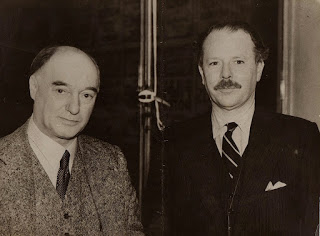
Harold Nicholson and Desmond McCarthy—the terrible twosome

Maybe I haven’t looked hard enough, but the only photos I’ve seen that feature Harold and Desmond have also included other Bloomsberries, notably Vita Sackville West. I’m not a fan of Bloomsbury and could only bear to watch ten minutes of one episode of the current TV drama, Living in Squares, but I don’t think either man was part of the Virginia 'n Duncan inner circle, as it were, and I don’t think the two were great friends. But there must be some reason why they were snapped together. Perhaps it was another bookfest organised by the Times or Sunday Times, as was the case with the Read and Spender press photo. This one, from the Graphic Photo Union,  bears identifications in pencil on the reverse . Desmond died in 1952, aged 75, a year after being knighted for services to the critical essay and the amusing anecdote, so the photo was probably taken around the mid 1930s.

Some of the most entertaining and scathing remarks on MacCarthy and Nicholson can be found in Virginia Woolf’s published Diaries. I have the volume for 1931 – 36. Here, for instance, are her views on Desmond:

Thursday, 3rd September 1931
‘…Oh, I was annoyed at Desmond’s usual sneer at Mrs Dalloway---woolgathering. I was inspired to make up several phrases about Desmond’s own processes, none of which, I suppose, will ever be fired off in print. His worldliness, urbanity, decorum as a writer; his soft supple ways. His audience of teaparty ladies & gentlemen. His timidity. How he wraps everything in flannel…His perpetual condescension.His now permanent stoop in the back. His aloofness---in the bad sense. I mean, he never takes a nettle by the leaves: always wears gloves…’

And Nicholson:

August 12, 1934
‘…Vita thinks Harold is getting soft & domestic, because he talks of grandchildren & wants to have a butler to brush his clothes & a spare room…’

[R.M.]

Young England – the worst play ever?

Found - a 1935 theatre programme for Young England, a play by Walter Reynolds often cited as the worst play ever. Nevertheless it was a great success and some people saw it 20 times. We covered it pretty thoroughly at a posting at bibliophile site Bookride. We had found a copy of the book and catalogued it thus:

Young England is a now uncommon book  and of interest to theatre collectors and connoisseurs of the odd and the zany. Reynolds appears to have been a sort of Amanda Ros of the theatre--so very bad that he is good. Young England (Walter Reynolds) Gollancz, London 1935.  8vo. pp 288. Frontis portrait, 5 plates. A play in two periods. This play had an unlikely success in the 1930s rather similar to the fictitious 'Springtime for Hitler.' It was so appallingly bad that audiences came along in their droves for over 300 nights to shout amusing remarks and generally revel in its ghastliness. The frontis portrait of the Reverend Walter Reynolds shows a stern Scottish type who apparently would walk up and down the aisles of the theatre during performances telling people to be quiet. Quite scarce.'

What emerges from contemporary reviews is that the actors in this terrible play co-operated with the audience and adapted lines and action according to shouts from the audience, some of whom were fuelled by cocktails which were so popular in the 1930s…In one performance the villain, when led away by the police, pauses to say "Foiled!" He was almost licked one night when the crowd shouted not only "Foiled!" but "Baffled!" "Beaten!" "Frustrated!" "Outwitted!" "Trapped!" "Flummoxed!" He waited until the wits were through, then hissed: "Stymied!"

The programme includes "…a short letter from the author of Young England to his old friends, the theatre-going public."

Continue reading

A begging letter from a debtor’s prison

Begging letters from debtors don’t usually survive, although there are at least three reasons why they might. Perhaps the writer was a well known person who at the time was down on his luck and counted on a friend or person of means to help him out. Alternatively, the writer could later have become famous or even notorious and the letter would be regarded as a souvenir or talking point. Of course, the writer could have been neither famous nor notorious, and the retention of a begging letter was a means of recording a favour that one man owed to another.

This particular letter is from someone who signs himself M. Eurius Beaubrier, and is addressed to a Henry Clarke. Although preliminary research has revealed nothing of the writer, who may have been French, the handwriting is that of an educated man and the tone is rather pathetic. The letter suggests that both he and Clarke, who is also hard to identify, had dealings before.

Continue reading

Sir James ‘Golden Bough’ Frazer & his wife Lilly—a devoted couple to the very end

Few wives in literary history can have been as devoted to their famous husbands as Lilly Frazer was to the great anthropologist James Frazer, author of The Golden Bough.

Born around 1854 in Alsace, Elisabeth Adelsdorfer came to England after she had married an English mariner named Groves, with whom she had two children.  When he died she found herself the mother of two teenagers and turned to writing in order to support them. Although having little or no knowledge of the subject she somehow persuaded editors at the Badminton Library to give her a commission to write a book on the history of dancing. In 1894, while researching the subject of dance among the primitives she sought the help of James Frazer (1854 – 1941), then an obscure Cambridge don, and the author of the first part of The Golden Bough (1890). The couple were married in 1896, not long after Lilly’s Dancing appeared.

Realising that her husband was unlikely to promote himself as a writer, she decided that she would do everything in her power to organise his life and raise his profile. She vetted those who sought his advice and organised a panel of translators to make his work better known in France. She even translated some of his writings herself. Moreover, in Cambridge she began her mission to improve the teaching of foreign languages in schools, was the first to use the phonograph in education, and wrote stories and short plays in French for use in the classroom.

Frazer’s growing international reputation, thanks in no small part to the efforts of  Lilly, was crowned by the award of a knighthood in 1914, which was also the year in which the couple moved from Cambridge to London. Frazer’s new fame and increasingly prosperity enabled the couple to travel widely in Europe following the end of hostilities. However, the two letters from Lilly featured here date from a period of crisis in Frazer’s health, when he was in danger of losing his sight. They were written to a Cambridge colleague, Canon McCulloch, from the Allan Water and Spa Hotel in Stirlingshire and date from July and August 1931. In the first letter, Lilly explains her husband’s plight to the Canon:

Continue reading

Dame Dorothy Brock, O.B.E.

Found among the papers of L.R. Reeve* this affectionate portrait of Dorothy Brock much admired educationalist and the headmistress of the Mary Datchelor School in Camberwell for 32 years.

DOROTHY BROCK

Dame Dorothy Brock, O.B.E., was at one time Headmistress of the Mary Datchelor School, in Camberwell. Her pupils were very fortunate indeed to be learning under the direction of one of the best speakers in London, and much as I admired the platform genius of the late Mrs E. M. Burgwin of Brixton, I am fairly sure that if it were possible to have a choice of listening to one of them on the same evening I should choose Miss Brock.

It may be that her successor was, or is, as excellent a teacher as her immediate predecessor, and as charming a personality, for probably the appointment was open to all the leading women of Great Britain, but whatever the name of the fortunate successor, she had one of the hardest tasks in the country when she stepped into Dr Brock's shoes, and one would like to know how the traditional pioneers of public schools for girls, Miss Beale and Miss Buss, would stand up to such an appointment.

Continue reading

Edward Balston—the man in love with Eton College

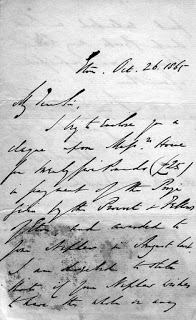
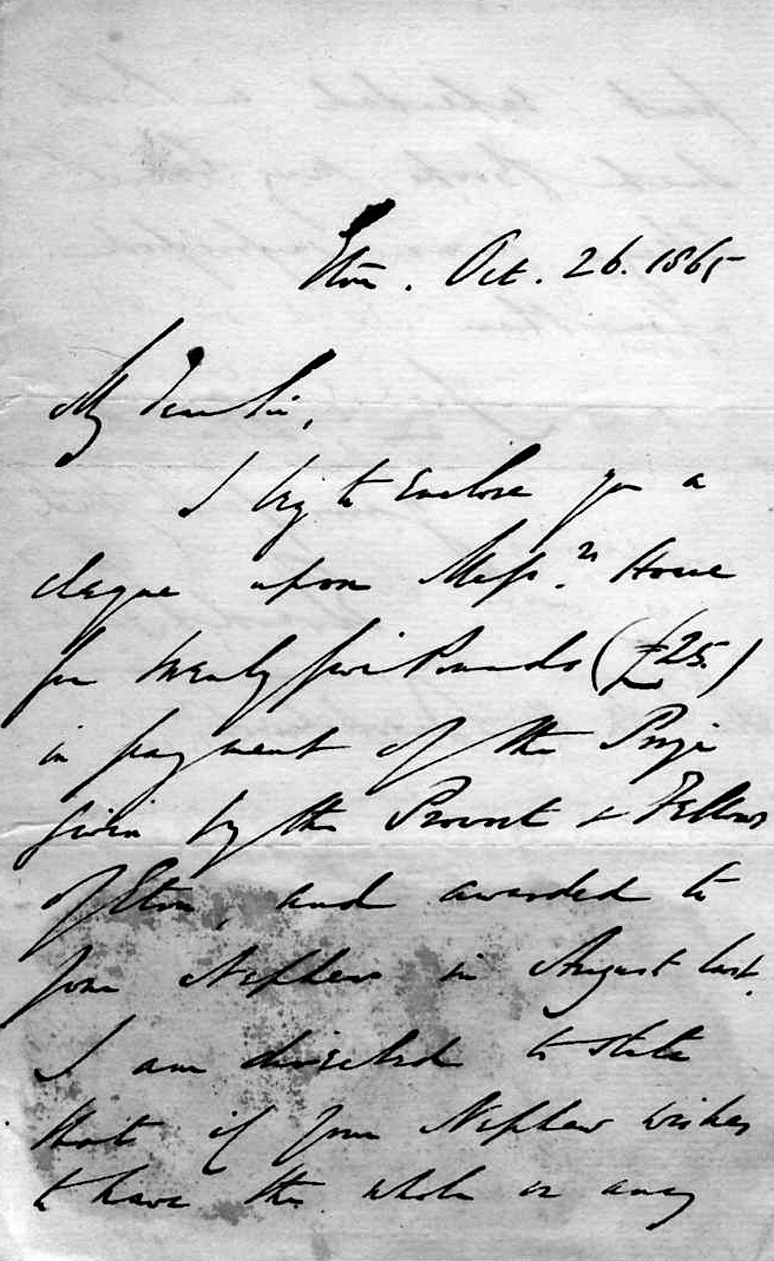
It’s bad enough to learn that nineteen British prime Ministers attended Eton College without learning recently, as I did, that one Eton man was so enamoured of the benefits of a classical education that he seriously suggested that Latin and Greek were the only subjects that should be taught in the classroom.That man was not, incidentally, Boris Johnson, but Edward Balston.

Balston—the son of William, that famous papermaker familiar to all students of palaeography—attended Eton in the 1820s and early 30s and then entered  King’s College, Cambridge in 1836. Awarded the Browne Medal for Latin verse every year from 1836 to 1839, he was unusually elected Fellow of King’s in 1839, two years before he  graduated, though why it took him five years to gain his B.A. is not adequately explained. In 1842 he became a priest.

Balston loved Eton so much that he couldn’t wait to return there. In 1840, before he had even graduated, he became an assistant master at his alma mater. Twenty two years later he was chosen as Head. In July 1862, not long after his appointment, Balston came up before the Clarendon Commission on Education. On hearing his views on the primacy of classics in the classroom Lord Clarendon was appalled:

Continue reading

‘Nobody has ever died’ – A psychic manifesto I (1946)

Found in the Coleman collection this striking pamphlet. The collection consisted of 3000+ books and booklets on parapsychology, spiritualism and the occult accumulated by a zetetic Bedford scientist determined to disprove all aspects of the paranormal. This pamphlet by Shaw Desmond from 1946 is actually quite late in the day for spiritualist and psychic publications. They were at their height in the early 1930s. There is a theory that they blossomed in the 1920s with the business of putting grieving parents in touch with their dead soldier sons…In the age of Dawkins these pamphlets are still published but the flood has (sadly)  become a  small stream. Shaw Desmond (1877-1960) was an Irish novelist, poet, founder of the International Institute for Psychical Research in 1934, and author of many works on the afterlife and several Scientific Romances- some dystopian and possibly influenced by Olaf Stapledon. He appears as himself in Haunted Palace(1949), a documentary, directed by Richard Fisher, in his role as a ghostbuster. There is more on Desmond at the at the SF Encyclopedia.

Continue reading

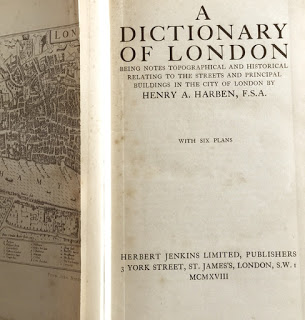
Henry Harben and his ‘Dictionary of London’

Henry Harben's Dictionary of London is a detailed gazetteer of over 6000 street and place names in the City of London; their location, origin and changes. Henry Harben died in 1910 and his work was published posthumously in 1918. Unfortunately Harben died before being able to complete the extension of his work to cover Westminster and Southwark. He is unknown to the DNB and Wikipedia, although there is a cricketer and an industrialist who share his name. Our man's full name was Henry Andrade Harben. This well researched piece about him was found in the front of a copy of his dictionary in the collection of Ralph Hyde, a great scholar of London history and topography.

Harben's Dictionary (of just 'Harben' as it tends to be called) is one of the most useful London reference books ever to have been complied and published, yet scarcely anyone has heard of it. Copies of it surface very rarely. When a copy does, dealers charge the earthier for it, selling it to a few who are in the know*.

Continue reading

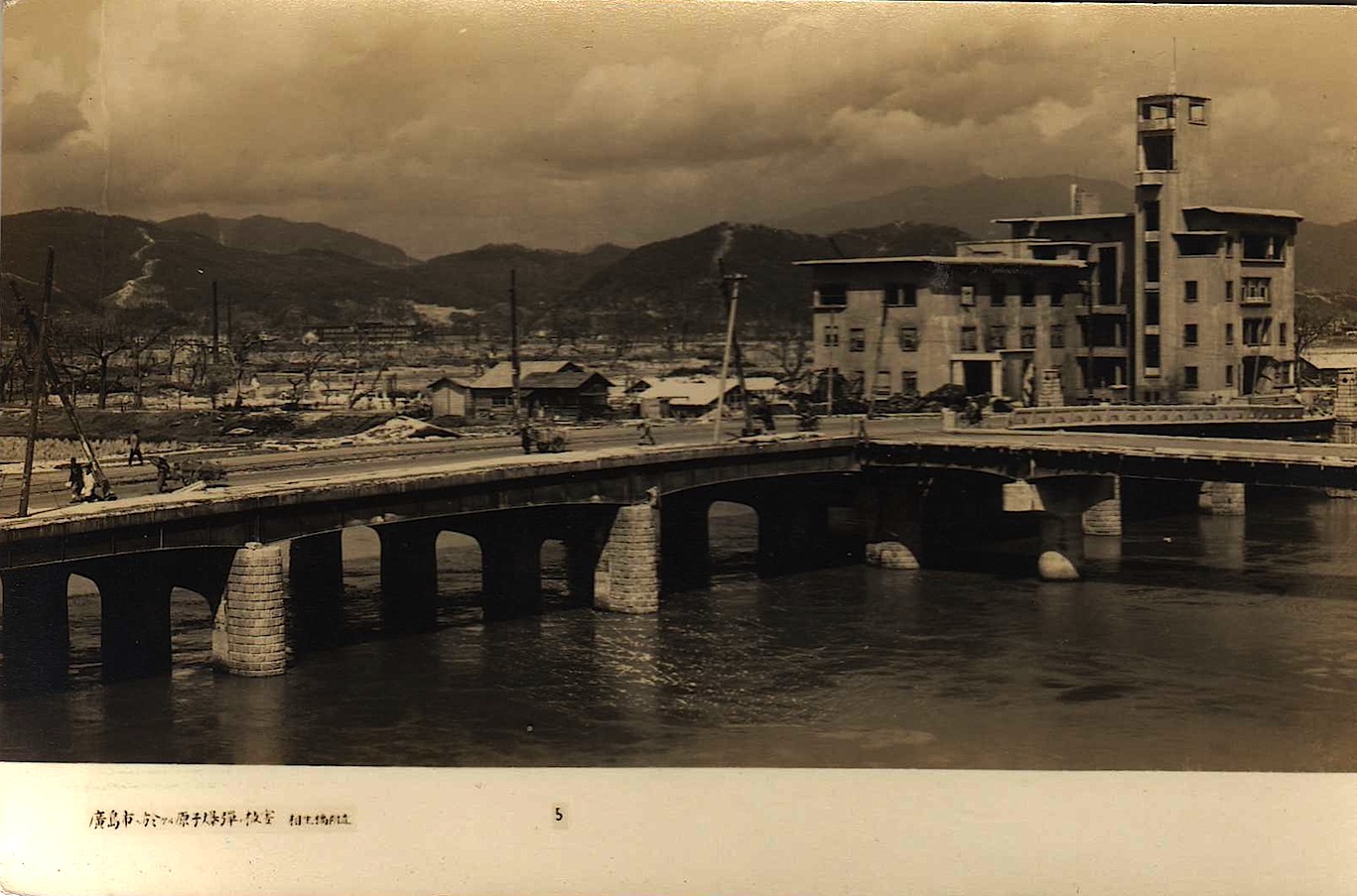
Hiroshima and Nagasaki seventy years on–a naval officer’s visit to Japan in 1946/1947

To mark the terrible events of seventy years ago in Hiroshima and Nagasaki, here are some postcards bought by my late father while visiting Japan, late in 1946 or early in 1947, as a commander in the Royal Navy. They were found interleaved in the first volume of a two volume guide book entitled We Japanese, first published in December 1934 and June 1937,by H.S.K Yamaguchi, the managing director of the exclusive Fujiya Hotel at Miyanoshita, situated in the mountainous region of Hakone, eighty miles SW of Tokyo.

The first and second volumes of this four hundred page guide to ‘many of the customs, manners, ceremonies, festivals, arts and crafts of the Japanese’ were reprinted in October and December respectively. A third and final volume appeared in 1949. My father probably bought his copies while staying at the hotel, which was established in 1878 by a member of the Yamaguchi family, and today advertises itself as the oldest ‘Western-style’ hotel in Japan. He wouldn’t have met the guide’s author, who had made great improvements to his hotel in the thirties, because he had died in 1944, but he might have rubbed shoulders with some of its famous guests. During the war one of these was the loathsome ‘Butcher of Warsaw’, Joseph Meisinger, but he had been captured by the Allies in September 1945. At other times celebrities staying at this exclusive hotel included Archduke Franz Ferdinand, Charlie Chaplin, and the Emperor of Japan himself. In 1978 Yoko Ono took John Lennon here.

Today, at £133 pp per night, the Fujiya Hotel no doubt trades on its exclusive reputation, but it is still cheaper than a less famous rival nearby. If you do decide to visit it, the receptionist may let you consult the final issue (1950) of the guide to Japan that my father bought nearly seventy years ago. [RMH]