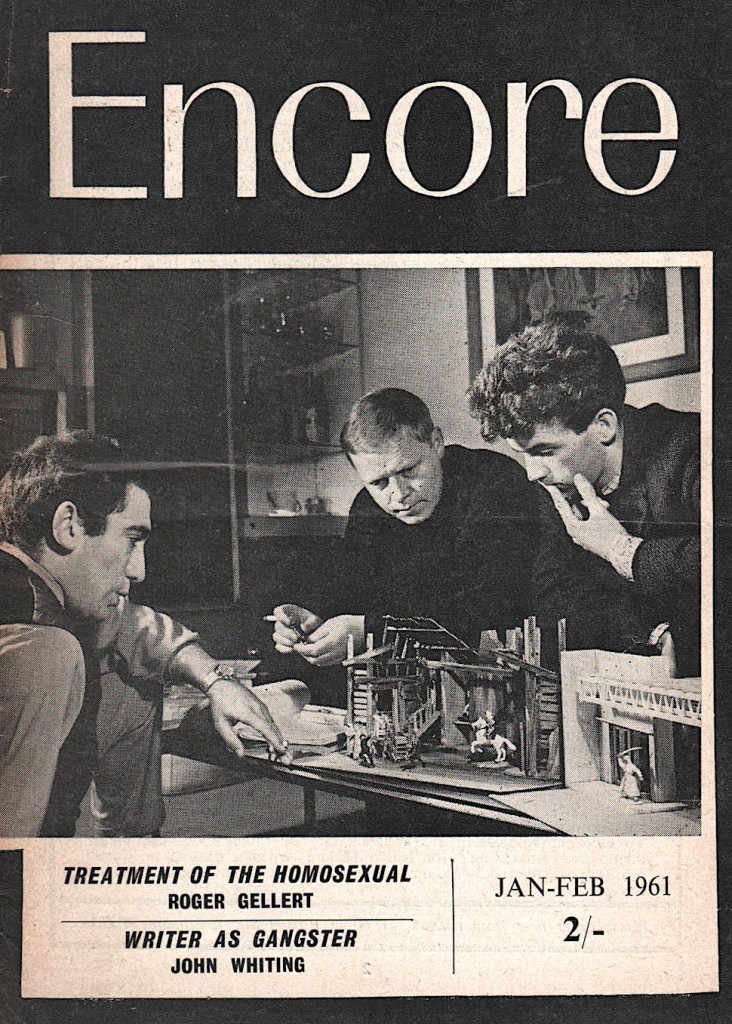
 Six years before homosexual acts between consenting adults were legalised Encore, the ‘little magazine’ devoted to contemporary theatre, published in Jan-Feb 1961, a perceptive item by ‘Roger Gellert’ entitled ‘A Survey of the Treatment of the Homosexual in some plays’. Gellert was the pseudonym of the one-time Third Programme announcer John Holmstrom, who left the BBC to become a playwright and theatre critic, only to return as an announcer on Radio Three and a contributor to Test Match Special.
Encorewas just the sort of publication that you might expect to find such a radical item. It advertised itself as ‘ the voice of vital theatre ‘ and was edited by Clive Goodwin (1932 – 78 ), who in the previous year had also published essays on Arden, Pinter, Arthur Miller, Ionesco, Wesker, Negro Theatre and ‘ Billy Liar’. Goodwin, incidentally, was an actor and writer who was married for a short while to the tragic pioneer of Pop art, Pauline Boty.
Gellert’s approach to a subject that was still a ‘ problem ‘ for theatregoers in Western culture was to emphasise that to the ‘ bisexual ‘ Shakespeare, to Marlowe and the Restoration dramatists, homosexuality was regarded as something to be accepted and laughed at, rather than condemned as immoral. Then, after two hundred or more years of ‘ silence’ on the subject, the whole issue, according to Gellert, was resurrected with the staging of Mordaunt Shairp’s play of 1933, The Green Bay Tree, in which the audience is invited to laugh once more, this time at the extraordinary camp utterances of the gay protagonist, Mr Dulcimer, a sort of aesthete of the Oscar Wilde type, who grooms an innocent boy for his own amusement , but is shot dead as punishment for his decadence.
As Gellert argues, The Green Bay Treeis a shallow ‘entertainment ‘rather than a serious comment on the plight of homosexuals in society. That more sympathetic attitude emerged in the post war years with such plays as William Douglas Home’s Now, Barabbas, in which a rather pathetic ex-schoolmaster serving time for sex crimes pesters a young prisoner. Gellert also credits Arthur Miller’s View from the Bridge,Philip King’s Serious Charge, Lilian Hellman’s The Children’s Hourand Robert Anderson’s Tea and Sympathy, for airing serious issues around homo sexuality, though he accuses the latter of doing so at a ‘ very shallow level’. Continue reading
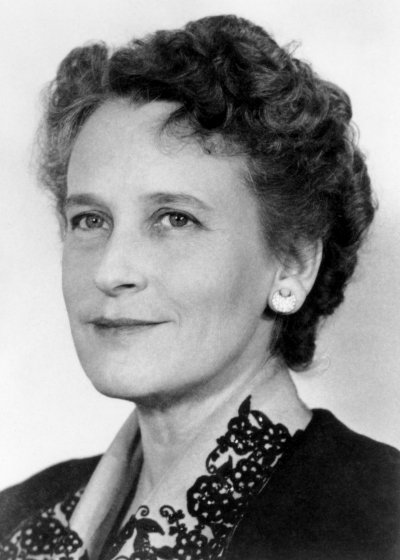
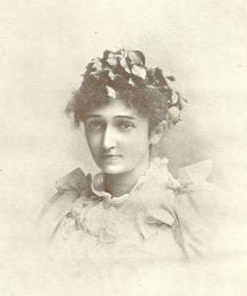 found on her lap following her suicide, aged just thirty, in December 1905. When discovered she was sitting in a comfortable chair dressed in a silk evening gown with fresh flowers in her hair. By her side was an empty bottle of phenol (carbolic acid), the poison of choice (bleach was another) for many suicides in the UK at that time, due to its availability and quick, but painful, action.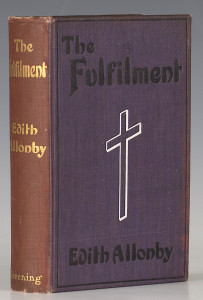
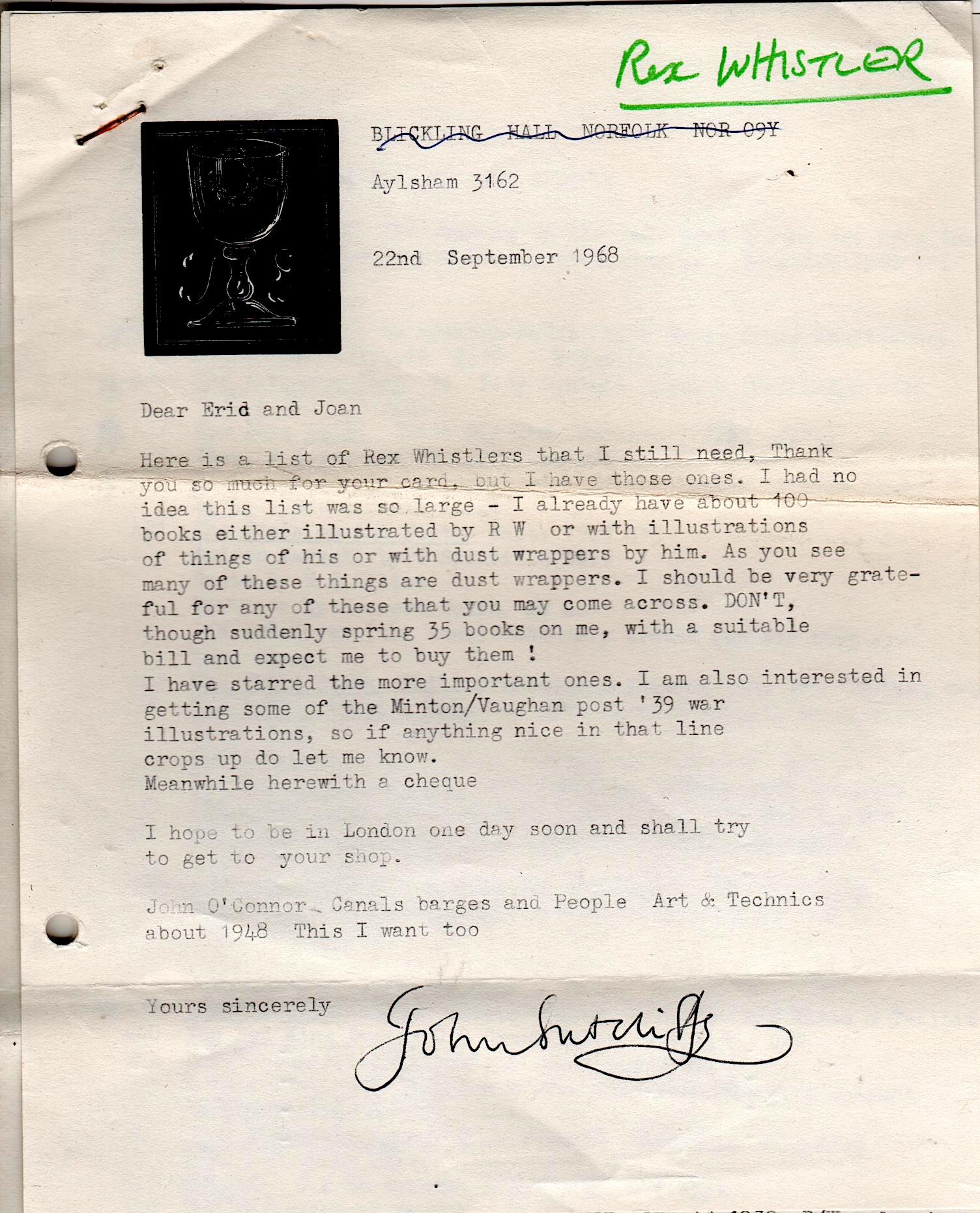
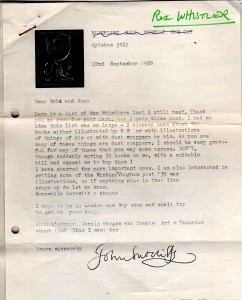 That’s the English Rex rather than the American James McNeill. This covering letter, which was rescued from the archives of the booksellers Eric and Joan Stephens, was sent on 22 September 1968 from the National Trust property Blickling Hall, Norfolk, by the artist and Rex Whistler fan, John Sutcliffe. This letter bears a characteristic scraper board design by Whistler as a sort of letterhead. That’s how much Whistler meant to Sutcliffe.
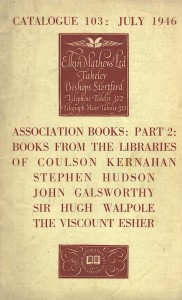 was issued by the well-established book dealer Elkin Mathews Ltd in July 1946, just a year or so after the close of the Second World War.
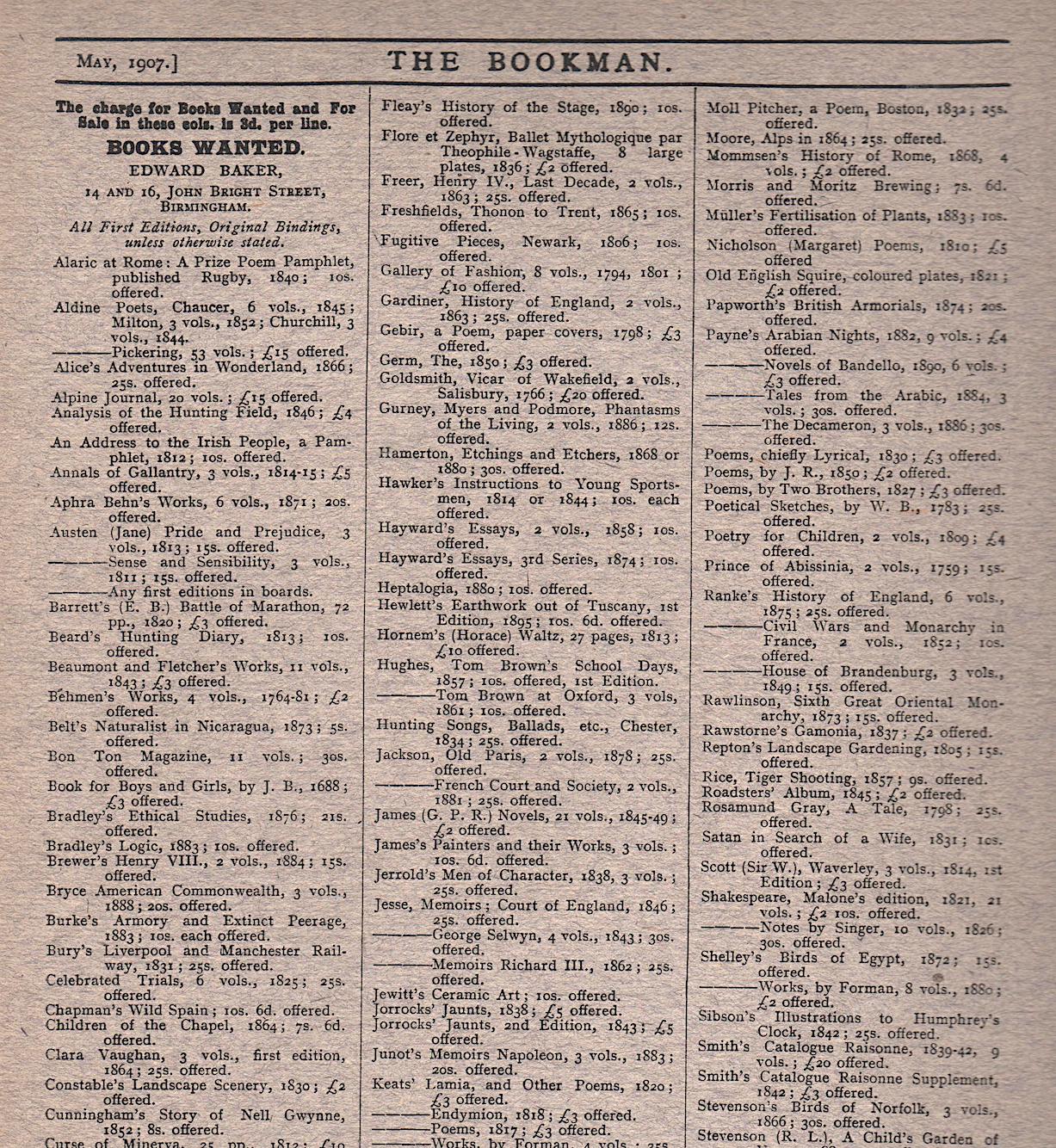
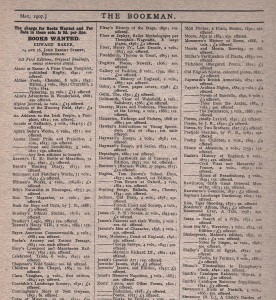 Before we report on the bargains available in May 1908 at Edward Baker’s Great Bookshop in John Bright Street, Birmingham (contrast it with Birmingham City Centre today, where there is not a single second hand bookshop ), let us examine what Mr Baker was prepared to give for top-end first editions in 1907 as advertised in The Bookman for May of that year.
 magazine Tomorrow, which was devoted to ‘parapsychology, cosmology and traditional studies’. In it a review of Aldous Huxley’s Doors of Perception, which had originally appeared in Asia ten years before, reopens the dispute as to whether an artificially induced state of transcendence is equivalent in quality to a similar state achieved through a religious experience.
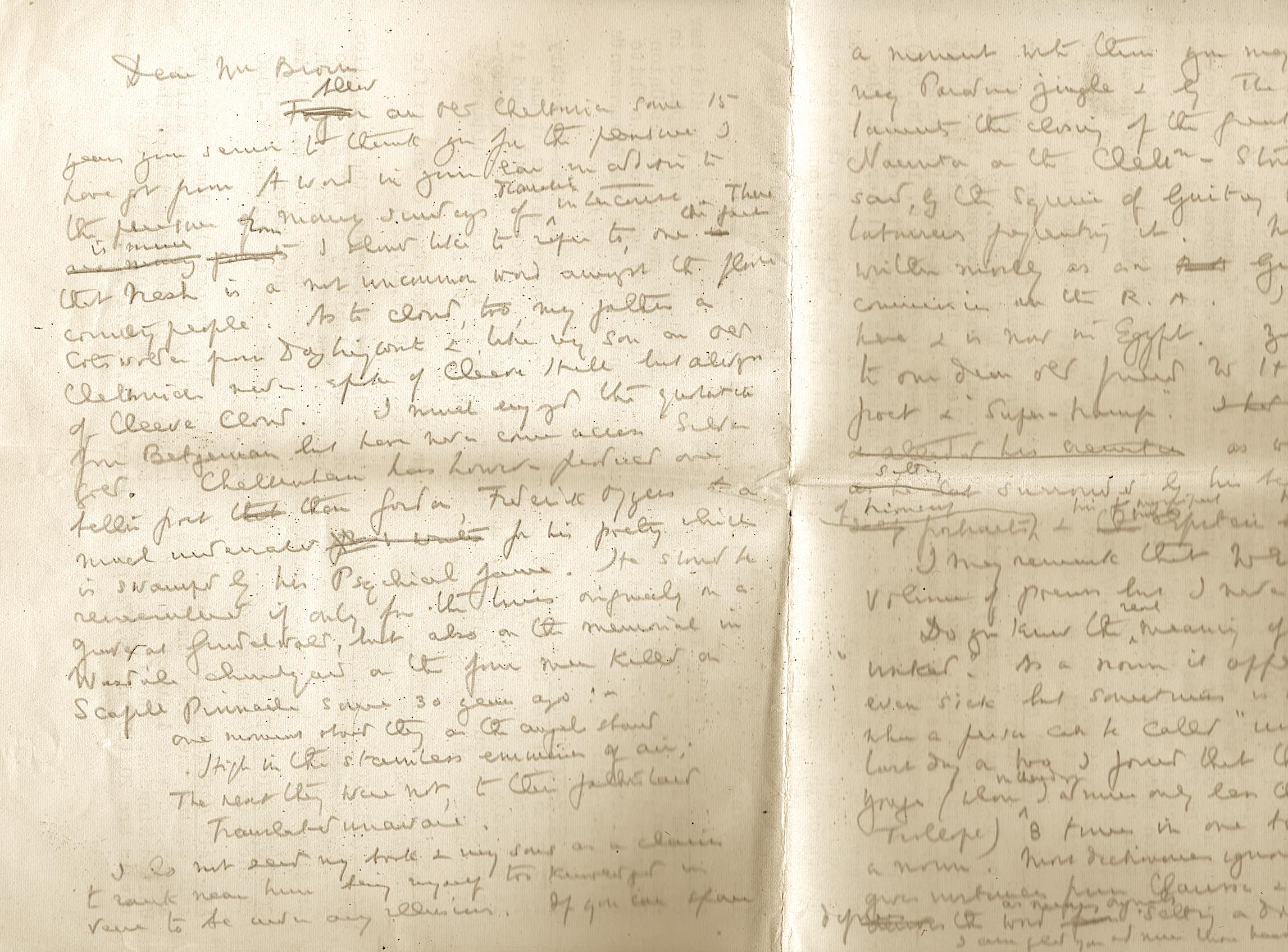
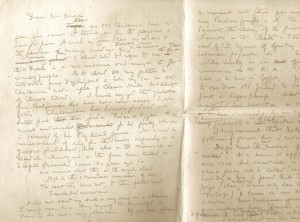 Found in a pile of papers around a year ago at Jot HQ is this draft of a barely decipherable ( hence the gaps and possible misreadings of words ) and incomplete letter written in pencil on the back of a typed Roneoed page headed ‘ The Association of British Chambers of Commerce/5thOctober, 1942/Parliamentary Bulletin No 462A/Information by question and answer. The draft letter is addressed to ( Ivor ) Brown, author of A Word in your Ear( 1942), a book that explores the history of certain words. The writer cannot be identified from any clues in the letter , though what clues there are might open up paths for Jot fans who are familiar with Cheltenham and the Cotswolds. Any with information are welcome to write in.
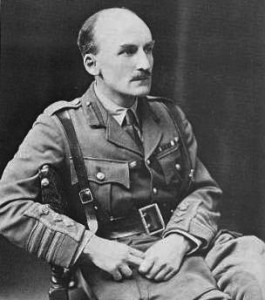 international expert on the use of tanks in warfare who was a strong influence on the German tactician Guderian, but also a Nazi sympathizer who met Hitler, and the only top-ranking officer in the British Army who in 1939 was not invited to join the fight against the Fuhrer. Nicknamed ‘ Boney ‘ by his peers presumably for his combative mien and brilliance as a strategist, and indeed height ( he was only 5’ 4”) Fuller was disliked by many for his high-handedness and argumentative nature. But some of this unpopularity may also have had its origin in his devotion to the occult, on which he wrote articles and books, including a study of Aleister Crowley. Indeed we at Jot 101 first came across his name in the April 1926 issue of The Occult Review, where he contributed a long article entitled ‘ The Black Arts ‘.
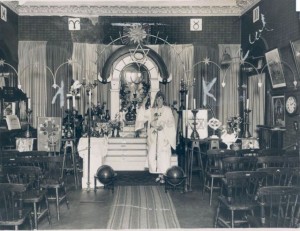 there had been converted to a place of worship. But not any place of worship. Around 19


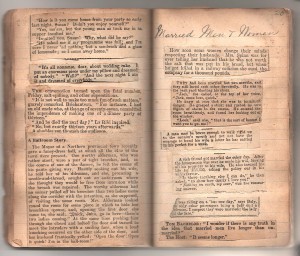 In an earlier Jot we selected at random some pretty witty items from an Edwardian comic’s gag book composed of clippings from newspapers and magazines. Here are some more. Astonishingly, most sound so very modern in their style of humour. None of them contain puns.
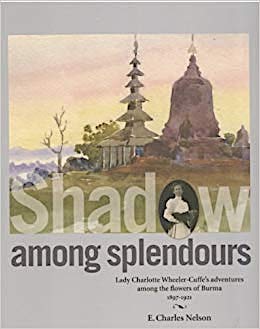
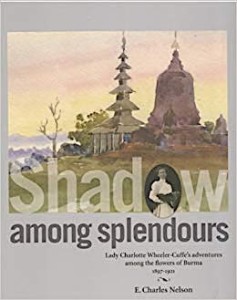 During her twenty-four years in Burma with her husband, an engineer in government service, Lady Charlotte Wheeler-Cuffe (nee Williams) became an intrepid plant-hunter, whose discoveries included various species of rhododendron. On her husband’s retirement in 1922 the couple retired to his ancestral seat at Lyrath, near Kilkenny, and it was here that Lady Charlotte planted some of the exotic plants she had gathered over the years. While in Burma Lady Charlotte had corresponded with friends, including another keen plantswoman, Baroness Prochaya, who also lived at Lyrath and professional botanists, one of whom was Frederick Moore, head of the Botanic Gardens at Glasneven, near Dublin, and on her return to Ireland it would seem that the correspondence continued.