Nixon at the BBC (Face to Face)

FACE TO FACE PROGRAMME

Found among the papers of Hugh Burnett,producer of the Face to Face series of television interviews with John Freeman shown between 1959 and 1962, this amusing slightly tongue-in-cheek memo to BBC friends sent out well after the event in 1973. The show was and is (6 set DVD available) memorable for the probing style of its charismatic interviewer John Freeman (more than once causing interviewees to break down..) and also for the importance and variety of its guests. They included Lord Birkett, Bertrand Russell,Dame Edith Sitwell, Lord Boothby, Nubar Gulbenkian, Adlai Stevenson, John Huston, Carl Jung, King Hussein of Jordan, Tony Hancock, Henry Moore, Dr Hastings Banda, Augustus John, Sir Ray Welensky, Stirling Moss, Evelyn Waugh, Gilbert Harding, General von Senger und Etterlin, Lord Reith, Simone Signoret, Victor Gollancz, Adam Faith,Otto Klemperer, Dr Martin Luther King Jr, Jomo Kenyatta, Sir Compton Mackenzie, John Osborne, Cecil Beaton, Danny Blanchflower and, of course, Richard Nixon, then (1959) the Vice-President…

Continue reading

The People’s Princess

The phrase 'the people's princess'  was not made up by Alastair Campbell for the famous Blair soundbite on the day Diana died but, rather, recycled… This 1984 book found in a box of slow-selling royalty books shows the original 'People's Princess' - Princess Mary Adelaide, Duchess of Teck (1833- 1897). She was not quite as good-looking as Diana (indeed she was also known as 'Fat Mary') but like Diana she had a knack for popularity. She was also one of the first Royals to patronise a wide range of charities. She is the current Queen's great grandmother. Elizabeth II seems to have thrown off the Hanoverian look…(although Lucian Freud's small portrait has some suggestions of it.)

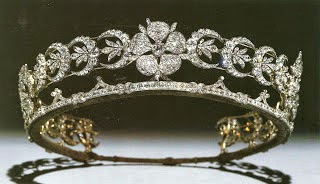
An interesting piece of tiara trivia… the lavish two tiered tiara that was created for Princess Mary has made its way down the family via the Queen Mother to the Duchess of Cornwall (i.e. Camilla). It has been modified but  was originally a 'diamond diadem' featuring three wild roses separated by 20 crescent shapes and was assembled from various jewels Princess Mary inherited from her aunt, Princess Mary, Duchess of Gloucester.

Charles Pearson & James Watt association

Discovered in 1998 on a market stall off Brick Lane is this copy of the exceedingly rare Substance of a Address by Charles Pearson at a Public Meeting (1844). The book is scarce enough (none on Abebooks, nor likely to be in the near future), but my copy also bears an inscription from the author to James Watt, son of the famous Scottish engineer.

Watt (1769 – 1848) who, like his father, was an engineer, but was also a radical political activist in the turbulent 1790s, has his own Wikipedia entry, but there is no mention in it of Pearson. Nevertheless, the two men had much in common. While in France Watt’s support for the French revolutionaries and his friendship with Joseph Priestley, got him condemned in the British Parliament and he remained in self-imposed exile until he felt it was safe to return home. A generation younger, Pearson, as the radical Solicitor for the City of London, was the champion of parliamentary reform who defended radicals in court. He also was in favour of the disestablishment of the Church of England, opposed the system of packed juries and fought commercial monopolies in London. A year after his Substance on an Address appeared, he published a pamphlet which called for an atmospheric railway that would follow the ancient Fleet ditch to Farringdon. This was rejected and I seem to remember that Punch had great fun with the idea. Other railway schemes supported by Pearson were also rejected, but at last in 1854 the Royal Commission accepted a proposal to build an underground railway, using the ‘cut and cover ‘method, from Praed Street to Farringdon. Work began in 1860 and within three years the new line was completed. The world now had its first underground railway. Unfortunately, Pearson had died while the work was still in progress and he never got to ride on the first train.

It would be nice to think that Watt, the consultant engineer behind the building of Fulton’s North River Steamboat of 1807, and the marine engineer who in 1817 was responsible for the first steamship to leave an English port, had something to do with Pearson’s atmospheric railway of 1845. It seems very possible, especially as Watt’s expertise was in steam power and pneumatics. In addition, Pearson’s address of 1844 tackles many of the issues that would have been close to Watt’s radical heart and the younger man would have taken great pleasure in presenting a copy of his book to the septuagenarian former firebrand.

One question remains. Watt died at his home, Aston Hall, near Birmingham, in 1848. So how did his book end up on an East End junk stall in 1998 ?

Arthur Augustus Tilley francophile and academic

Found in a copy of The Romantic Movement in French Literature - Traced By a Series of Texts (C.U.P. 1924) this obituary of A.A. Tilley by his co-author H.F. Stewart - also a distinguished Cambridge academic and francophile, but so far rather neglected on the web. It appeared in The Cambridge Review 6/3/1943. It is a model of its kind and gives a glimpse into a vanished world..

Obituary

Arthur Augustus Tilley - December 1, 1851 - December 4, 1942.No one who visited Arthur Tilley in the evening of his long life but must have felt himself standing on hallowed ground, in the presence of a veteran who, having fulfilled his course, was quietly, serenely, awaiting his call. "Le vent de l'éternité le frappait au front." Not that there was anything pietistic about his conversation. He would speak with grave simplicity of things deep and high, and pass easily to current events upon which he commented with shrewdness and vigour, or to the sometimes affectionate, sometimes caustic, review of men and their doings in the past. And what a range, and how varied, his memory covered! He was the favourite nephew of Anthony Trollope, whom as a boy he adored and as a mature critic he greatly admired. He had known everyone worth knowing i the University for 70 years, and his recollections were sometimes starling. A propos of a picture card of the Puy de Dôme he said to me the last time I saw him, "I took Bradshaw up there; I shouldn't have done so if I had known his heart was bad."

Continue reading

Simon Watson Taylor: surrealist, pataphysician & cabin steward

The death in 2005 at the age of 82 of aged hippy and anarchist Simon Watson Taylor went almost unnoticed in the Arts pages and it was left to his friend and former house-mate George Melly to supply an obituary in the Independent in which he pointed out the major contributions of the writer and translator of Alfred Jarry to the Surrealist and Pataphysics movements in Europe during the fifties and sixties. On a personal level, Melly also alluded to his friend’s ‘acid humour ‘, his delight in confronting and dispatching the pretensions of the bourgeoisie, and a determination to remain free of encumbrances. At one point in his early life we are told that he took a job as an airline cabin steward in order to travel the world.Indeed, among all his friends who had some way embraced aspects of the bourgeois life- style, Melly claimed that Watson Taylor stood out as a man ‘truly free’.

Continue reading

‘Come on, Daddy O.’

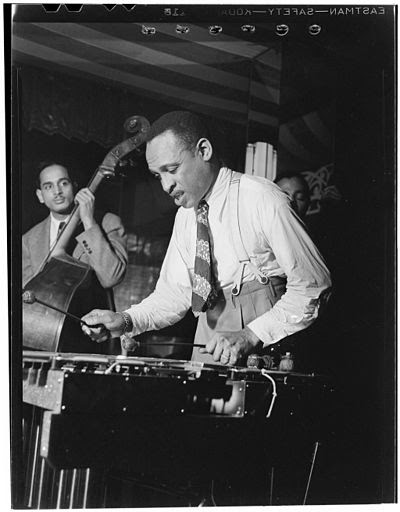
It was the first visit of Jazz legend Lionel Hampton to England and one of his gigs was seemingly at Hanley Town Hall in north Staffordshire, according to G. A. Roberts, who captured the occasion in an article that appeared in the December 1956 issue cum grado, the student magazine of what was soon to become Keele University.

Photo by William Gottlieb

According to Roberts, the band played one number without Hampton and when the great man was introduced to the audience there was a:

Deafening  roar from the audience, deafening noise from the band. A lean light grey suited  negro ran onto the stage acknowledging his reception. With a wealth of gesticulation, he stopped the band and then led them into another hectic number—loud, driving, swinging. We were away---from the beginning, Hampton’s tactics were clear ---he was going to produce such a dynamic, hypnotic, driving, compelling, metronomic beat that the audience would be goaded  into a frenzy of excitement and enthusiasm…but twice on the evening Hampton sacrificed sheer beat for artistry.
He used the vibroharp to produce sounds of real beauty which even the band could not drown ; caressing the instrument so that its strange tones filled the echoing hall. But then, as though ashamed of his lapse of taste, he returned to the repetition of fast mechanical tunes. The audience loved it…

Continue reading

Titanic Sheet Music

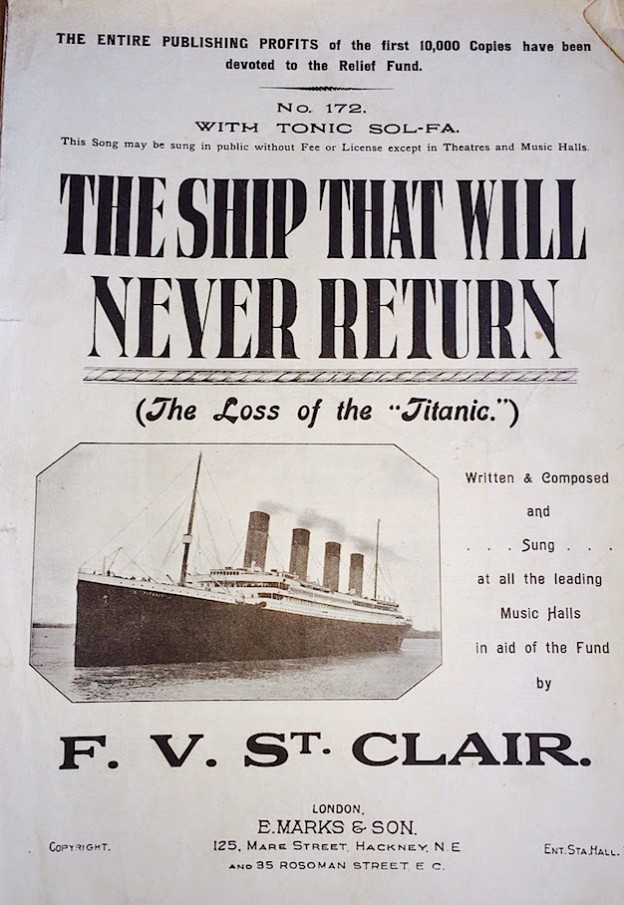
Found among a pile of sheet music 3 Titanic items. They incorporate several mythic (but not necessarily untrue) stories around the disaster-- Captain Smith is said to have spoken the words 'Be British'  (possibly his last) to his men and the 8 members of the ship's band carried on playing as the ship sank (possibly there last number was Nearer My God to Thee.) Some accounts say that the band played on until they were waist high in water. The sheet music for Be British came with a set of illustrative coloured lantern slides that could be bought or hired from the publisher. The lyrics include these lines, worthy of poet laureate Alfred Austin himself:

Continue reading

Books in Shakespeare’s plays

Browsing Ayscough's An Index to the Remarkable Passages and Words made use of by Shakspeare ; Calculated to Point Out the Different Meanings to Which the Words are Applied (Thomas Tegg, London 1827) I checked out its dozen or so entries under 'books'. It is fairly comprehensive (Samuel Ayscough was known as 'The Prince of Indexers') but at about 500 pages is not  a 'concordance' and  its intention was somewhat different, as stated in the title. Henry IV (Part 2) seems to be the play with the most bookish references

Books

Burn but his books. Tempest, Act 3, Scene 2.
Drown my books.  Ibid, Act 5, Scene 1.
The gentleman is not in your books. Much Ado About Nothing, Act 1, Scene 1.
Tire the hearer with a book of words. Ibid, Act 1, Scene 1.
These trees shall be my books. As You Like It, Act 3, Scene 2.
I have unclasp'd to thee the book of my secret soul. Twelfth Night, Act 1, Scene 4.
By what time shall our book, I think be drawn. 1 Henry IV, Act 3, Scene 1.
Continue reading

How to Buy Books 1892 and 2015

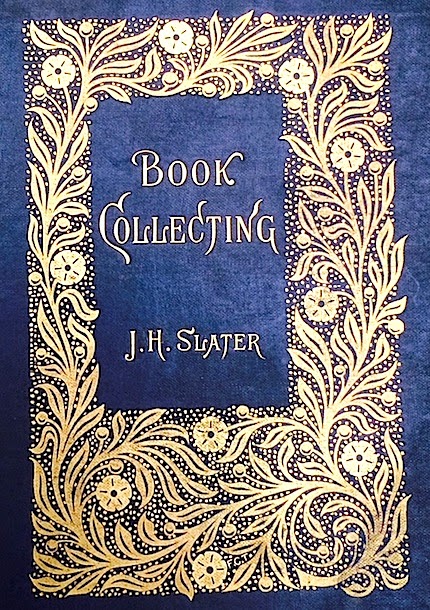
J.H. Slater's Book Collecting - A Guide for Amateurs (Swan Sonnenschein, London 1892) concludes with a still useful chapter - 'Books to Buy.' The author regrets that there is no device (vademecum) 'capable of being carried in the waistcoat pocket which will enable him to spot a rarity at a glance...' This was just over 100 years before smartphones which, to some extent, now fulfil this very purpose (and if the book has a barcode there are also applications that will emit a noise telling you to buy.) The reference to the need for a register of 'scarce but mean-looking' English books (now known as 'sleepers' and which every good book scout or 'runner' has in his or her head) concludes with a florid latin quotation concerning glory..

Slater starts by mentioning the pathologically acquisitive bookseller Naude and the rich bibliomane Heber...

But Naude had the wealth of Mazarin at his back, and free licence to purchase as and where he would at the Cardinal's expense, while Heber was rich beyond the dreams of avarice;the modern book hunter, whose means we will suppose are limited, must discard the yard measure and the scales, and rely on his judgment, taking care to get the utmost value for his money. He will have to make up his mind to buy or not to buy on the spur of the moment, for while he is consulting his books of reference at home, a golden opportunity may be missed. This is his capital difficulty, and one which it will take years of experience to surmount, for there is no vade mecum capable of being carried in the waistcoat pocket, which will enable him to spot a rarity at a glance ; nothing, in fact, which can compensate for a lack of practical knowledge.

Continue reading

Boozing with the Victorian Society in Crouch End, Hornsey and Harringay

Found in a box of books is this photocopy of a typewritten guide to a ‘pub crawl’ (walk no 41) of various late Victorian ‘gin palaces’ in North London arranged by the Victorian Society on 16th September 1966. The guides were two architects-- Roderick Gradidge and Ben Davis—both of whom had designed interiors for Ind Coope. Judging by their descriptions of the pubs they planned to visit, both were also passionate and knowledgeable fans of late Victorian architecture and design. The grand plasterwork of the ceiling cornices and Art Nouveau stained glass is pointed out as being of special interest. But the two men also emphasised the ways in which Victorian pub architects tried to make   their interiors both glamorous and homely as a way of getting their (mainly) lower middle class drinkers (mention is made of Mr Pooter’s ‘raffish’ friends) to spend hours away from their more humble abodes, much (we might add) in the way that the designers of Music Halls and northern shopping arcades  (one thinks of Frank Matcham ), and grand hotels, were doing in the same era. Here are the guides admiring the combination of grandeur and intimacy found in the Queen’s Hotel, Crouch End (below):

All the way round there were through views, glimpses of the other bars, and as a result one was able to feel that one was standing in one part of a single large space, large enough to tolerate the considerable height without become vertical. Since the space was so well subdivided…one could feel secluded in a sufficiently small and enclosed space, but since the proportion of the greater space was horizontal a feeling of repose was retained which could not have belonged to tall, restricted vertical rooms. This method of subdividing an area into small bars by means of partitions, which were half-glazed  with semi-obscured glass, and were not much above six feet high, was peculiar to Victorian pubs, and goes a long way to explaining the incomparable drinking atmosphere they provide...

Continue reading

Saturday Book 10th Anniversary – a blurb & Gurdjieff

The Saturday Book (1950) 10th Anniversary edition has this quite modern sounding interview/ blurb printed on the inside flaps of its jacket. It was edited by Leonard Russell who probably wrote it. There is a 1000 to one chance it was written by George Orwell a one-time contributor and no stranger to advertising techniques..

Inside flap reads:

Saturday book
Q. and A.

Q.Ten years is a long time, isn't it for a publication of this kind?
A.There is no other publication of this kind.

Q.No imitations, then?
A.They have all perished - crushed to death by the weight of our reputation.


Q.Ah! And is this tenth anniversary number the best ever?
A. Certainly. It is axiomatic.

Q.How would you describe it in a nutshell?
A.Conservatively, as a master piece.

Q.H'm, any particular favourites among this year's contribution.
A.Let's see - there's Osbert Sitwell, Bertrand Russell, Kenneth Walker, Fred Bason, Olive Cookand Edwin Smith, John Hadfield, Walter de la Mare, F. Spencer Chapman.

Continue reading

Eleanour Sinclair Rohde & Aromatic Plants etc.,

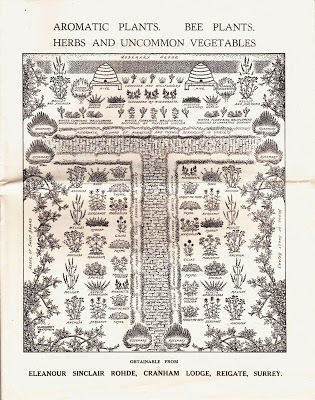
Found -- this pamphlet from the 1930s put out by Eleanour Sinclair Rohde (1881 -1950.) As Wikipedia notes, she had a fairly standard house but an enormous garden where it appears she sold plants (mostly aromatic -with ESR it was all about scent) by mail order and possibly to visitors. She was the author of several now sought after works on gardening, especially The Scented Garden (1937) and A Garden of Herbs (1920). In World War 2 she published a useful work that was reprinted several times The War-Time Vegetable Garden (1941).

AROMATIC PLANTS, BEE PLANTS AND HERBS.


The finely shredded leaves of all plants marked * are a wholesome addition to salads and turn a dull salad into an interesting one.


Continue reading

Faux armorial bookplate – an enigma

Found - a bookplate or possibly heraldic design for a coat of arms. Among some bookplates and ephemera but printed rather than engraved, perhaps clipped from a printed item (nothing on the back) and measuring six inches square. Possibly a jokey faux armourial design for a bookplate. I have seen other comic designs on these lines.  The words 'Thingummy ad Nauseam' point at its satirical intention.

I am not sure when people started saying 'Thingummy' for people whose names they had forgotten, or for people who were annoyingly ubiquitous but this design is almost certainly from the 20th century. Bookplates often sum up the interests and pastimes of the collector - in this case it would be drawing, possibly ornithology, deer stalking, coffee drinking, Olympic sports... The flying carpet might indicate an interest in travel, possibly eastern...the bird (a white ostrich or an egret?) wearing specs and holding a pen could mean an interest in literature - along with a wastepaper basket full of discarded papers. The design to the right of the cup could be part of a jigsaw puzzle..

Eric Parker, Country Writer, Bird Lover & Sportsman

This press-cutting of an obituary was loosely inserted in a copy of Highways and Byways in Surrey (Macmillan, London 1919). It is dated 14/2/55 and was probably cut from The Times. He is so far unknown to the all knowing Wikipedia despite having written many books. A recent article about him  in The Guildford Dragon News is headlined Eric Parker, Who He? In the second hand book world however he is not forgotten on account of his many books, still mostly quite saleable...

Writer on Sport and Countryside

Mr. Eric Parker, a well-known writer on field sports and the countryside and an active campaigner for the protection of wild birds, died at his home near Godalming yesterday at the age of 84. He was editor of the Lonsdale Library and a former editor-in-chief of the 'Field'.

Continue reading

I don’t want to be alone (or I was Garbo’s double)

The real Garbo left. Thanks GarboForever.com

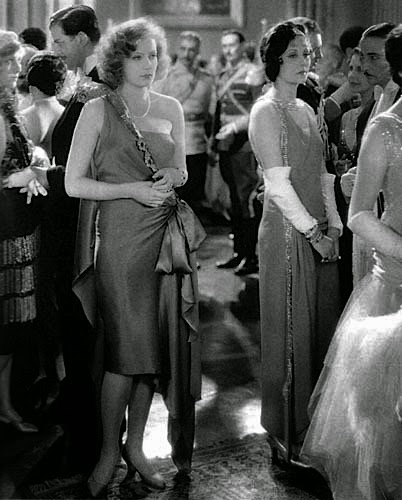
General Montgomery, Idi Amin and various Japanese emperors had doubles, and so it seems did the screen siren Greta Garbo. Her name was Jeraldine (or Geraldine) Dvorak and the revelation first appeared in a magazine in September 1931.

Today, we would call them body doubles and when they are used it is usually to undertake dangerous stunts. Seldom, if ever, are close shots taken of them and even when long shots are used it is only for a second or a fraction of one. Most shots of body doubles are taken sideways or from the back, most memorably as in the case of the seduction scene in The Wicker Man, when we are treated to the attractive backside belonging to the double of Ursula Andress.

The photos show that the resemblance of Dvorak to Garbo was astonishing and only differed in one small respect—the colour of their eyes, which in the era of black and white movies would not have mattered anyway. In the car smash scene in Woman of Affairs Dvorak, and not Garbo, was lifted from the wreckage; and Dvorak also acted in the snow scenes in Love. She could supply a passable Swedish accent and even sang in place of the star in Romance. We know that Garbo was no singer, but why she couldn’t be bothered to act as an injured car passenger or get her shoes damp is not explained in the article. Later sources suggest that she might have been pregnant at the time. Nor was Dvorak required only for long shots. On one occasion a cameraman got away with a ten foot close-up of her face!

So confident were the studio chiefs in Dvorak’s ability to stand-in for the star that on one famous occasion they arranged for her to impersonate Garbo off-screen as well. Garbo disliked film premieres and so at the premiere of a film in which she had starred alongside John Gilbert, Dvorak was commanded to accompany the male lead. In the theatre she found it hard to respond naturally to the audience acclaim that was obviously meant for Garbo, so she just wore a fake smile throughout. Nor, to everyone’s relief, did she attempt to sign any autographs. Thankfully for all concerned the evening went off without a hitch and Dvorak was duly congratulated for her best performance yet.

Like all stand-ins Dvorak yearned to be appreciated for herself, but alas she was to remain either a Garbo or Dietrich double or to take on bit parts as models or party guests. She doesn’t seem to have acted much after the late forties and died a forgotten figure in 1985.

Camp Out This Year!

A great camping book from about 1911, positively evangelical in its emphasis on the joys of life under canvas. The author is not to be confused with the US writer Henry William Gibson whose Camping for Boys came out in the same year. That Gibson is said to be responsible for the American Summer Camp movement which did not take off in Britain. J.Gibson's cookery books for scouts are highly prized..


Continue reading

Why do children ask questions?

 Found in Intellectual Growth in Young Children by Susan Isaacs (Routledge, London 1930) this collection of children's questions. Susan Sutherland Isaacs (1885 - 1948) was an educational psychologist. Basically she bellieved that children learn best through play. For her, play involves a perpetual form of experiment..."at any moment, a new line of inquiry or argumemt might flash out, a new step in understanding be taken". This is where the chapter on questions comes in. It was actually written by her husband Nathan Isaacs (1895 - 1961). He was a metallurgist but collaborated on her later work. The piece after the selection of questions goes some way towards explaining their significance.

 Why do ladies not have beards? 

 Why are the funnels (on a boat) slanting?

Continue reading

Colossus – the first true electronic computer

Found - in a paperback novel from the 1980s this press cutting. It is from a glossy magazine (possibly Electronics World) and is a letter from one G.O. Hayward. This is the war hero Gil Hayward who had worked at Bletchley Park and was given a medal by the Prime Minister in 2010 and died a year later aged 93. He had worked on the "Tunny" decryption machines at  at the Post Office Research Station at Dollis Hill, North London, and later at Bletchley Park. These were used to break the code of even higher grade secret messages than the Enigma machine. Towards the end of the war, up to 15 of the Tunny machines were in use at Bletchley Park, providing Allied leaders with around 300 messages from the German High Command a week. Among other things, Tunny provided key intelligence for D-Day. The Colossus computer was developed from it...

His Telegraph obituary notes that he was interested in electronics from an early age - "On his own motorcycle.. he built an indicator which integrated a clock with his speedometer and indicated his average speed.

Continue reading

A flyer from the Platonist Press

Found - a publisher's flyer loosely inserted in a copy of Kenneth Sylvan Guthrie's  Mithraic Mysteries (Platonist Press, Alpine, N.J 1925.) The Platonist Press seems to have flourished between 1900 and 1930 publishing books on philosophy, occult speculation, mysticism and the occasional work of fantasy fiction (including Guthrie's Bleiler listed A Romance Of Two Centuries. A Tale of the Year 2025 which appeared in 1919.) This flyer is eccentric, oddly surreal and now politically slightly  dubious. It was probably the work of Guthrie. There is little on the Platonist Press and some of these works may be 'ghosts' (i.e they were never published.) They appear to have moved from Alpine, New Jersey to North Yonkers, NY -which puts this advert some time in the 1920s...

SPICY SITUATIONS, and Dr Kenneth Guthrie's REMEDIES
The Board of Education's Examiner had Just turned down the blushing Miss Teacher Candidate. Weeping, she wailed, Is there no hope at all for me? Oh yes; purred he. Try again next year! What could I study in the meanwhile? Dr Guthrie's TEACHERS' PROBLEMS & HOW TO SOLVE THEM, $1.25; 'Value and Limits of the History of Education,' and 'The Mother-Tongue Method of Teaching Modern Languages,' each 30 cents. Will that pass me? Really, Miss, you are too pretty to teach school. Get his Progressive Complete Eduction, or Marriage as the Supreme School of Life, $1.25. And if I pass examination on it? Then I will marry you, Thanks, kind sir!
Continue reading