Author Archives: Jot 101

Meyerstein on Lascelles Abercrombie

162953-004-EBB79E7BFound in a book on British  poets of the 1920s, a page torn from a magazine, possibly a poetry periodical and likely to be from late 1938, when Lascelles Abercrombie died. The poem. in Abercrombie’s honour,  is by E.H.W. Meyerstein. Both were minor poets of their time and are now somewhat forgotten. Of the two Meyerstein is probably better remembered, more for his novels which have crime and thriller elements (some bibliomyisteries.)  The verse is very much of its time, almost like a parody of the style…there is some pathos in the line ’Sure is his fame..’ The final line is rather fine.

LASCELLES ABERCROMBIE

An intellect acerb, a heart of truth
A faith in Beauty’s life-ensanguined rose,
The courage of a climber above snows,
For stricken womanhood a childlike ruth,
Fancy alert for images uncouth
Whereby to humanize immortal woes
And seize the small shy gentian word that blows
On precipices unobserved by youth:

Unto how few is fate supremely just!
This man, whose visions were poured forth like wine,
Before his death was ranged among his peers.
Sure is his fame, sure as the intrepid gust
That gave us back the grand Marlovian line,
Reincarnating loves of mythic years.


Another jolly good goose supper !

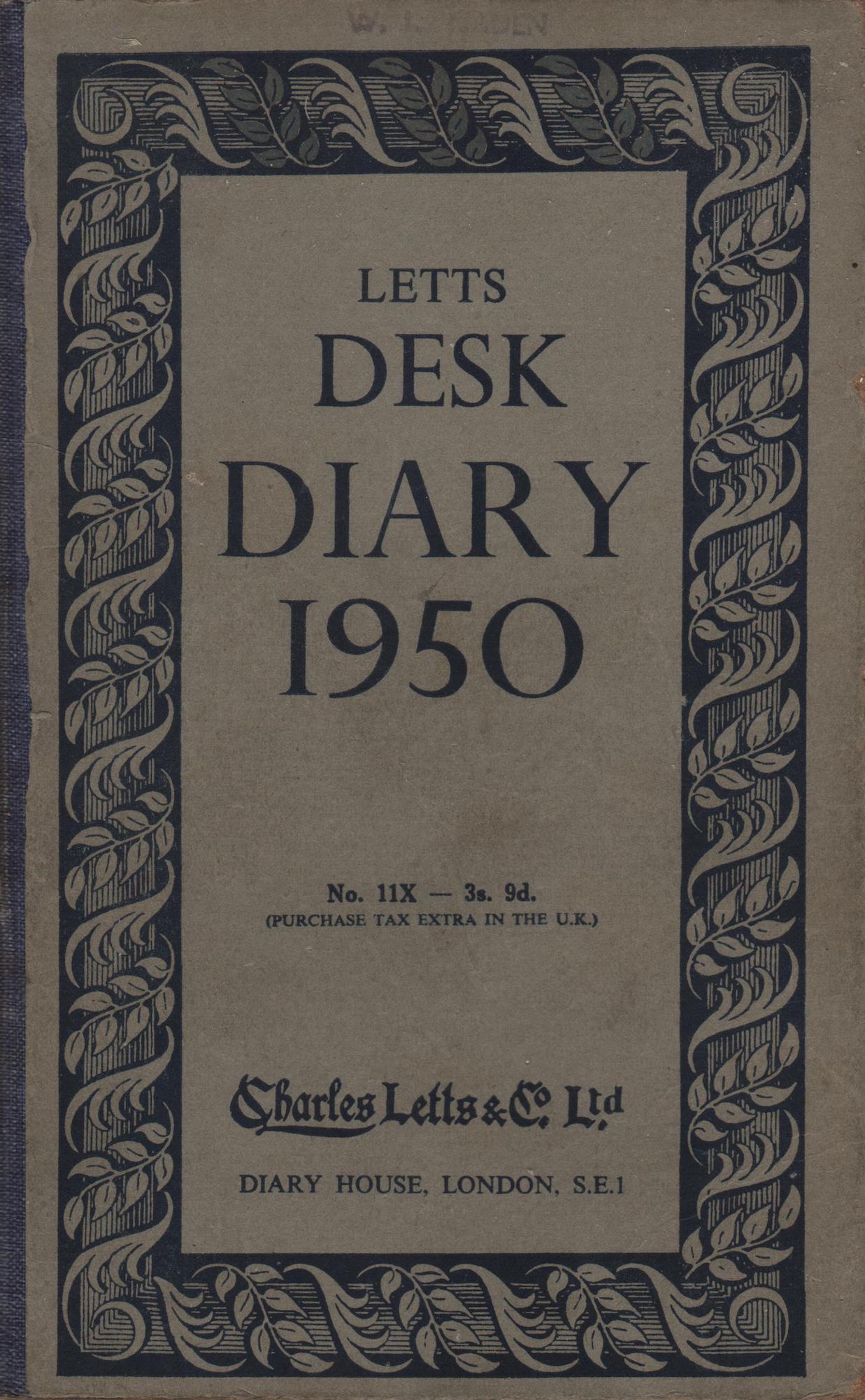
Another piece for this modern day ‘Diary of a Nobody ‘Tjaden diary 1950 pic 001(although William L. Tjaden was actually somebody in the gardening world). Should have gone up at Christmas, but better late etc.,

The words of our previously unidentified gardener diarist ( see earlier extracts from a 1957 diary) on Friday 29 December 1950. He has now been unmasked as William L. Tjaden (b.1913), who was married to the adorable Madge in 1945 and by 1950 had become the 37 year-old Chairman of the North Kent Dahlia and Gladioli Society.

In the quieter days of these immediate post-war years, long before the festive season was an excuse to stuff your face with chocolates while watching box sets, life in the Tjaden household at Christmas was a time for still more potting, transplanting and tying up plants. In a period when for many, including the Tjadens, the wireless and the gramophone were the only sources of home entertainment, William and Madge took advantage of both in the dark and freezing winter of 1950. And in a rather Dickensian note we find that before factory farms had made chicken and turkey available to all, goose was perhaps the more popular festive poultry. The Tjadens ate Polish goose on Christmas Day, while the same meat was eaten on the 29thand 30th. If this was the same goose it must have been a huge one.

Nor did New Year’s Eve (a Sunday) mean a rest from gardening chores. William cycled over to Bexley to buy 2 gallons of creosote ( shopping on Sunday was, it seems, legal then ) and spent all afternoon attending to his growing frames. Instead of copious amounts of alcohol, the couple took tea at 6.45, and having taken a decision to ‘ ignore the New Year ‘, were in bed by 11. [R. Healey]

The Beatnik Poet Machine

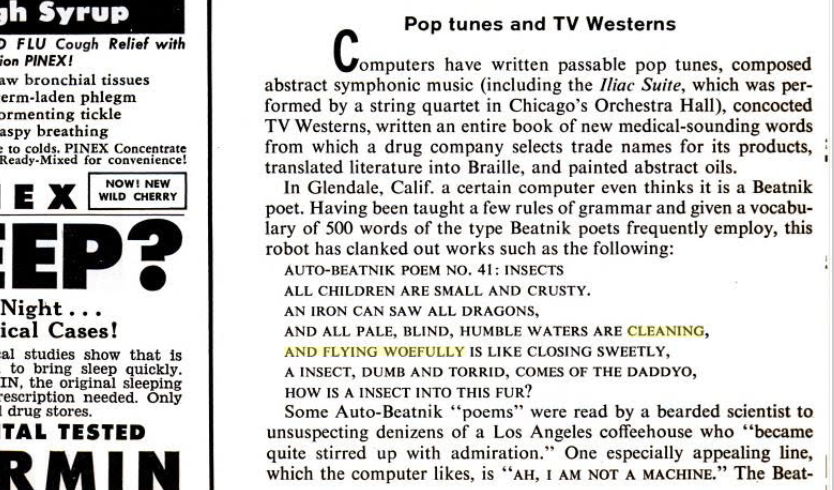
Screenshot 2018-12-28 11.02.57Found in an old LIFE magazine from March 3 1961 this computer story:

In  Glendale California a certain computer even thinks it is a beatnik poet. Having been taught a few rules of grammar and given a vocabulary of 500 words of the type that  beatnik poets frequently employ, this robot has clanked out works such as the following:

Auto beatnik poem number 41: Insects

“All children are small and crusty,

An iron can saw all dragons,

All pale, blind, humble waters are cleaning,

A insect, dumb and torrid (torpid) comes off the Daddy-o,

How is a insect into this fur?”

Some auto beatnik poems were read by a bearded scientist to unsuspecting denizens of a Los Angeles coffeehouse who ‘became quite stirred up with admiration.’ One especially appealing line , which the computer likes, is “AH, I AM NOT A MACHINE.”  The beatnik computer is not a stunt. Its masters are using it to study how to build better computers that can communicate in the English language.

This story is repeated with the variant word “torpid’ for ‘torrid’, possibly an improvement, in the 1962 book Science Shapes Tomorrow (Phoenix, London). They quote the poem in a chapter asking whether computers can think. They say that if a computer is going to think they must be able to do four main things:

  1. They must be able to learn by experience.
  2. They will have to become more flexible. The machine will have to come far closer to our almost miraculous five senses which feed our brains with information – great steps are being made in this direction ..the Perceptron is being taught to recognize letters of the alphabet even if they are sloppily written…
  3.  A the moment most machines work on strictly logical lines -they will have to break free to produce for themselves new and original ways of working with the data inside them.
  4.  The machine must be able to recognize when it is  being brilliant. Any machine fed with enough words and grammatical rules, for example can write poetry. It could even write very good poetry – another Shakespeare sonnet, perhaps, but the machine is not a great poet until it can distinguish the perfect sonnet from the drivel. And the same goes for  logical thinking- it must be able to recognise which of its logical statements are valuable and which are not, even though all of them are true. It would be sad if a machine, for example, hit on the successor to Einstein’s theory of relativity and then did not recognise  that this was a more valuable statement to make than printing out that the earth is round.. the complete answer to mankind problems might find itself crumbled up in the wastepaper basket…


Bookseller versus George Barker

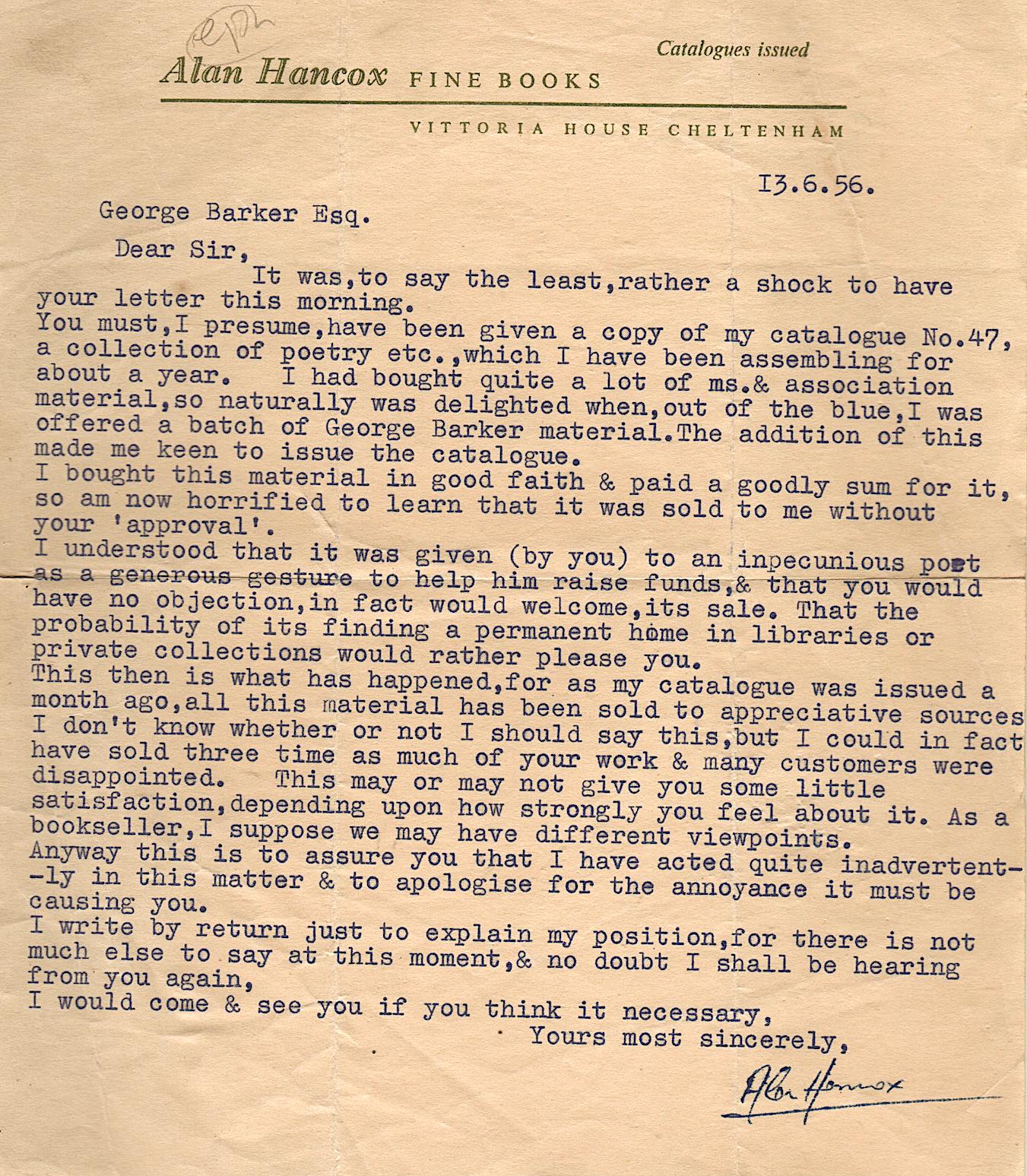
George Barker letter from bookseller 001The bohemian poet George Barker could be quite vehement in his anger, especially when drunk, as he often was. In a letter written in June 1956 that we found in our archive here at Jot HQ he wrote angrily to the Cheltenham bookseller Alan Hancox complaining that some slim volumes of his poetry had been sold from his catalogue ‘ without his approval ‘. According to the unnamed ‘impecunious poet’ who had sold the books to Hancox, Barker had given them to him as an act of kindness to ‘ raise funds’ and had had  no objection to  their sale. This, it would seem, had been a fabrication and Hancox was then obliged to apologise for selling the books.

Knowing the egocentricity of Barker, the gift was probably made as a way of impressing the impecunious poet, who may have been unfamiliar with his work. If this is true, one can perhaps understand his hurt feelings. Throughout the ages older writers  have sought to impress or influence their younger brethren by gifting them copies of their work. By so doing the donor hoped that in time this act of kindness would oblige this rising young talent him to repay the gesture by defending the reputation of the older writer. Sometimes it worked; sometimes it didn’t. In the case of Geoffrey Grigson and Wyndham Lewis, the mentorship (and possible gifts of books) lavished on the younger poet and journalist by Lewis in the ‘thirties reaped rich rewards for the artist and satirist twenty years later, when he had become totally out of fashion while Grigson was regarded as one of the most powerful influences in English letters. Although we don’t know who this impecunious poet was or when the gift of books was made, it is possible that at a time when Barker recognised that his reputation was beginning to nose-dive, he saw the poet as someone who could help him. Alternatively, the impecunious poet may have been one of Barker’s contemporaries , the alleged poet Paul Potts. Continue reading

Words for Wizards—a useful book at Hogwarts, perhaps

Words for Wizards cover 001Sometimes wizards—that is, magicians— don’t have the right patter to accompany their tricks. This is where George Schulte comes in. His Words for Wizards(G. F. Schulte, Chicago 1924), which we unearthed in a pile of ephemera at Jot HQ, is a guide to what could be said as the rabbit is pulled out of a hat or knots disappear from a handkerchief. What isn’t mentioned is how unimpressed members of an audience hearing this patter might be if they’d heard the same words from other magicians who’d also used Mr Schulte’s book.

If we want custom-made material we must turn to the back of his book, where we find Schulte’s own advertisement.


Written to order, for any magical effect or illusion. Humorous or serious patter, specially arranged, from one act to a complete show, at one dollar per item and up.


Magical entertainers who “SAY IT WITH LAUGHS” add additional amusement to their entertainment. If you are interested in improving your program, you may have further particulars by writing to

                                       GEORGE SCHULTE

4263 Lincoln Avenue                                             Chicago, Illinois


“ Vaudeville Monologues”       “Humorous Character Stories”

And Comic Chatter specially written for any act, club and stage entertainers looking for new “ LAUGH LINES” and “NEW IDEAS” will find that we have many valuable suggestions to offer them.

           All letters receive a prompt reply. Prices are regulated by the grade of material desired. If you are interested in this particular style of entertaining, write to…. Continue reading

The Aquarian Guide to Occult, Mystical, Religious, Magical London

Occult list London 001The MacGregor Mathers Society.

This is one of the more exclusive societies listed in Ms Strachan’s book. According to the entry it was founded by ‘ two writers in the occult field during the course of  a cream tea at the Daquise Restaurant, South Kensington, and its object is to commemorate  the memory of S .L. Macgregor Mathers, Comte de Glenstrae’.

Apparently, the Society was a dining club whose exclusive male membership was limited to ‘twelve English members and four honorary corresponding members’. It had neither Constitution nor rules except ‘insofar as the Founders invent ( and then forget) them as the occasion demands’. Several important dates are listed on which the members met to dine. These included Mathers’ birthday ( January 8th), his wedding day ( June 21st) and the anniversary of his ‘ famous ‘ manifesto to the R.R. et A.C. ( October 29th).These dinners only took place two or three times a year. It goes without saying that membership of the Society was by invitation only.

So who was  MacGregor Mathers?  It turns out that this celebrated occultist ( full name Samuel Liddell MacGregor Mathers)  was born in Hackney in 1854, and after working as a clerk in Bournemouth, became a Freemason and a Rosicrucian in London and was head of the Hermetic Order of the Golden Dawn for years before he was drummed out in 1900 for financial irregularities. He married the lovely Mina Bergson, sister of Henri Bergson, the philosopher, became a vegetarian (and possibly a vegan) at a time when such people were thin on the ground, and had among his enemies Aleister Crowley. A polyglot, whose languages included French, Latin, Greek, Hebrew, Gaelic and Coptic, he was well placed to translate various mystical and occult texts.

Ms Strachan doesn’t reveal what the letters R.R. stood for ( A.C was presumably Aleister Crowley), who the two founders of the Society devoted to the memory of Mr Mathers were, why they thought so highly of him, or why they were consuming a cream tea in a restaurant specialising in Polish food. Never mind. The elitist nature of the Society doesn’t make it an attractive proposition. In fact, it no longer exists. Luckily, the Daquise Restaurant is still there, looking as it might have done fifty years ago, though it no longer serves cream teas. Continue reading

No Hang Ups—funny answering machine messages

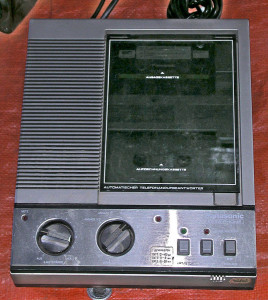
ansaphone picThis is a paperback published in California and written by two American stand up comedians, John Carfi and Cliff Carle, of ‘ funny ‘ messages that could be left on answering machines. It appeared in 1983, which means that quite a few of the jokes might not be acceptable in the more PC climate of 2018.

Hi, JANE here. Before you leave your message, I just want to mention that a friend of mine who lives in New York had to go to a specialist in San Francisco for a heart transplant. He just got back today—now there’s a guy who really “ left his heart in San Francisco!”

BEEP…

Hello. This is JOHN’s residence. I’m out fixing my wife’s car. There’s about a hundred things wrong with it —whenever she was driving and heard a strange noise, she just turned up the radio.


BEEP

Hi, this is JOHN. I’m playing golf again. I went yesterday for my first time and played with these so-called ‘ pros!’. After 18 holes, they scored in the low 70’s. You call that professional? It only took me 3 holes to score 70!


BEEP…


Hi, I’m at the gym lifting weights. Hey, I’m getting pretty strong! I’ve been at it only a month and already I can tear a telephone billin half! Continue reading

Diary of a Nobody (part 4)

chrysanthemum displaySeptember and October turn out to be very busy months for our gardener. He spends huge amounts of time preparing blooms for various local shows — spraying them with Malathion, deshooting ( etc etc), wins some prizes, including a first place, is disappointed by failures ( is second out of three), resents the success of other exhibitors and moans about the rain destroying blooms. He is writing articles for the Chrysanthemum Society and visiting various national exhibitions in London.

Perhaps ashamed at his poor performances in the language while on holiday he enrols for  Italian classes at the famous Morley College, but as they fall on Tuesdays and Wednesdays, regrets that he might be a poor attender ( Chrysanthemums come first, no doubt!). He later attends some on Monday evenings. He pores over his holiday snaps, worries when some don’t arrive on time, and pastes the flowers he picked in Austria and Italy into an album. And for the first time we discover that he has children. It’s the first mention of them in his Diary—unless they are someone elses’ children. And his cycle journeys to his mum become more frequent. On one visit in September she cooks him a ‘smashing dinner ( chicken and Xmas pudd)’ . On another occasion he brings her some of his prize blooms, leading on 28thSeptember to the perhaps unique and certainly hilarious diary entry in the history of diaries—‘ visit Mum, take her some ‘ mums ‘.

He still doesn’t own a car or a TV set, but he does buy a spanking new hi-fi gramophone and wireless combined, which he feels is ‘pricey ‘ at £29 ( it is really, considering that his monthly salary is probably around £50). As ever, in the evening entertainment is confined to listening at home to light opera, a talk on the Third Programme, a radio play on the Home Service, or the occasional game of canasta at a friend’s home. He never seems to visit the pub with ‘the lads‘ from work. Perhaps the redoubtable Madge wouldn’t like him to. Continue reading

‘Every woman with stockings is a whore’ and other scurrilous entries in an early nineteenth century common place book

Here is a dual purpose thick octavo notebook bound in calf with a clasp. Nineteenth century diary & common place book 001The front part is a short record of travels in Germany and Belgium in which the anonymous male diarist, who is accompanying his mother, at one point tells us that he was born in 1802, is very scathing about the appearance of most of his travelling companions. In one instance he remarks that the young son of the parson in the party ‘seemed to be as ugly as his father and as vulgar as his cousin’. He is singularly unimpressed by most of the foreigners he encounters along the way. For instance, he notes that his fellow diners at the Table d’Hote, were ‘12 disgusting looking Germans who luckily eat enormously & spoke little ‘. The following evening diners at the same table were’ rather more disgusting in their appearance & manner of eating than the day before ‘. Predictably, he is also critical of the meals he is obliged to eat and the inns that serve and accommodate him. In one inn he accuses the landlord of serving him a dish of greyhound puppy.  Our diarist certainly places himself above the common lot. He seems knowledgeable about art and is a little snooty regarding the collections he views, suspecting that most of the paintings were copies from the masters. More positively, he is often ecstatic about the scenery and buildings he encounters and he particularly praises cathedrals and castles. We yearn for more, but unfortunately, the diary stops abruptly after thirty pages.
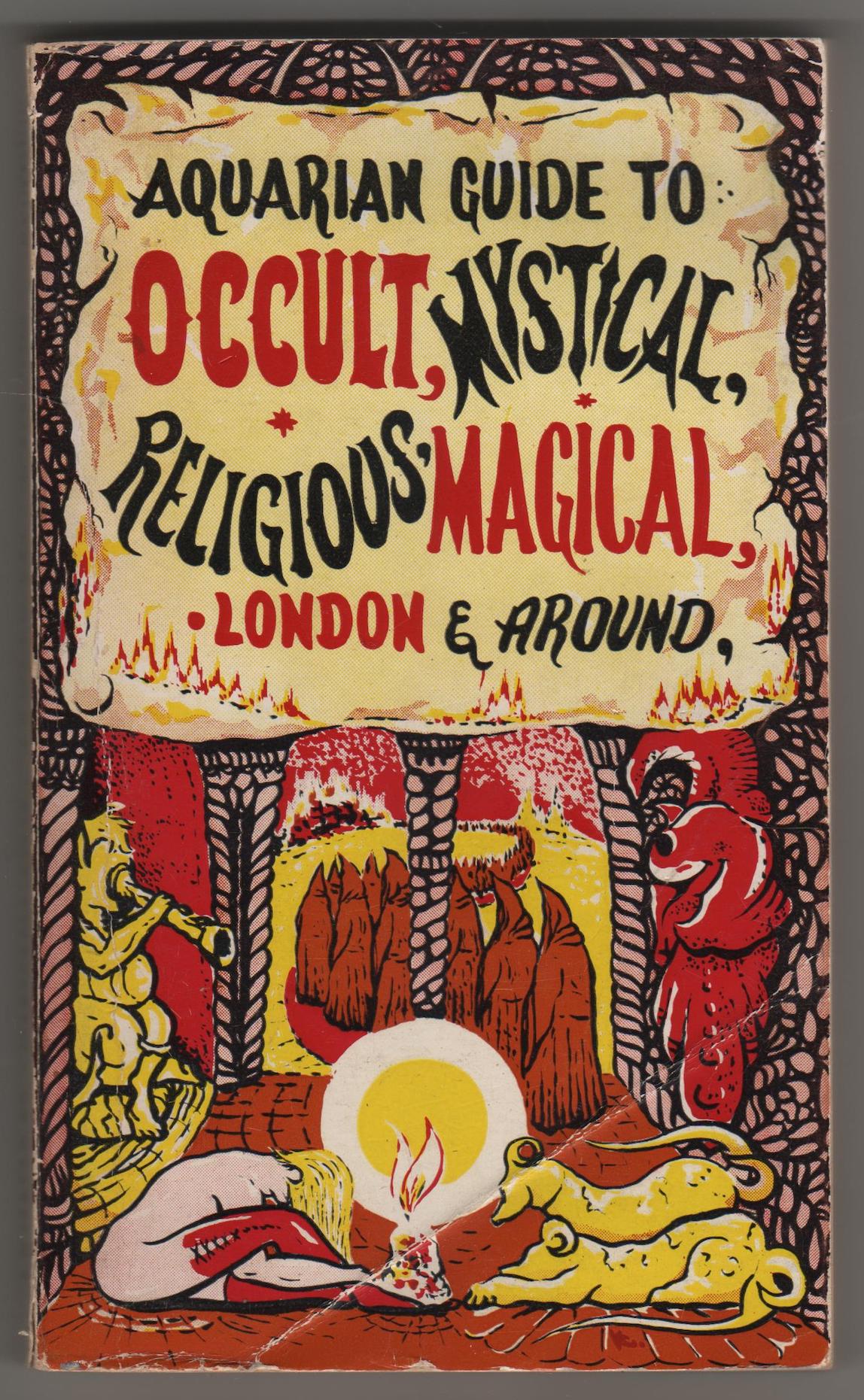
 

The back pages of the volume is devoted to anecdotes, jokes of dubious taste in English and French and snatches of Arabic —in ink and pencil and in different hands. The passages in Arabic may also be indecent, of course.

Here is a selection of the more publishable remarks from this section of the volume:

Gold and Paper

At a fashionable whist party, a lady having won a rubber of 20 guineas, the gentleman who was her opponent pulled out his pocket book and tendered £21 in bank notes. The fair gamester observed with a disdainful toss of her head.“ In the great houseswhich I frequent, Sir , we always use gold “. That may be so, replied the gentleman, but in the little houseswhich I frequent we always use paper.”

Appropriate text.

Mr Sterne (possibly the author of Tristram Shandy), the day after his marriage took for his text: “ We have toiled all night and caught nothing”

Royal Favour.

A low frenchman boasted in very hyperbolic terms that the king had spoken to him; & being asked what his Majesty had said, replied” He bade me stand out of the way “. Continue reading

 The Poetry Reading—a literary squib by John Heath-Stubbs

From the archive of the booksellers and publishers Eric and Joan Stevens is this carbon copy of a squib typed out by the poet John Heath-Stubbs and signed by him  on 30 May 1963.I say ‘ typed out ‘, but as he was virtually blind by this time, and there are no typos, it is unlikely that he actually did so. In his later years the cult figure Eddie Linden, hero of the book Who is Eddie Linden?,read to Heath-Stubbs, so he may also have been a sort of amanuensis in the sixties.

The poem, which is entitled ‘Poetry Reading ‘and appears unpublished, pokes fun at various eminent and not so eminent literary figures of the period. The occasion was a meeting to commemorate a ‘notable Georgian poet ‘ and was arranged by  ‘ The Organisation for Ossification Of Literatwitters ‘, which may be a swipe by Heath-Stubbs at the Royal Society of Literature, which had elected him a fellow in 1954.Identifying the poet being celebrated is not easy. Most of those who contributed to the famous Georgian anthologies were born in the 1870s and 1880s and weren’t around in 1963.The last of the genuine Georgians, Ralph Hodgson, died in 1962, so the poetry event may have occurred in that year or soon before. If he is ruled out the only other   possible contender would be Edmund Blunden, although the ‘Merton field mouse’ (as Geoffrey Grigson called him ) isn’t generally regarded as a Georgian poet. However, Blunden did receive the Royal Society of Literature’s Benson medal.

The other literary folk ridiculed —the Chairman,  ‘Estaban Heartsleeve ‘, ‘ Sandy Sladge of the Sunday Sludge ‘,‘ Sir Solon Sepulture ‘, ‘Mr Bang with his prizefighter’s roar ‘ and ‘Mr Bing’ —- are even more difficult to place, although the last two men, respectively ‘ tall and blond ‘ and ‘ short and pink’, should be a little easier to identify. The satirist reveals the name his friends knew him by (‘Stubbs’) at the close of the poem, as well as his avowed liking for alcohol and pub-going. He had been, after all, a prominent member of the Soho crowd in the ‘forties.

Today the RSL, perhaps aware of its past reputation for ossification, seems to have gone too far in the other direction. Seemingly anyone who has published at least two books, is well known as a reviewer for the nationals, and is a regular on TV, radio and at literary festivals, is offered a fellowship. Sadly, quite a few lack the literary skills of past Fellows. The Society also unashamedly reflects the current popularity of literary biographies and crime fiction to such an extent that the list of Fellows contains more writers in these genres than novelists, dramatists  and poets. Many believe that by a too ready recognition of these doubtful genres as ‘literature ‘it has betrayed its original aims.

[R.M.Healey]

Diverse Paths Lead Diverse Folks to Rome


Rome visit typescript 001An unusual item found among the archives at Jot HQ the other day is an eighteen page Xeroxed typescript bound in cloth and illustrated with rather poor Xeroxes of various art works.  Entitled Diverse paths lead diverse folk to Rome, it narrates a fortnight’s vacation in the Eternal City during May 1955. This particular copy was presented to the author’s travelling companion, the eighty year-old ‘Nell’ Hill.

The author, who identifies himself at the end of the narrative, was M. T. Tudsbery (‘Tud’), formerly the BBC’s Civil Engineer, and the man who in 1932, with the architect George Val Meyer, was responsible for Broadcasting House, the iconic BBC HQ in Langham Place. The other companion on this trip was Alan Campbell Don (1885 – 1966), who was Dean of Westminster at the time. Nell was his cousin.

It goes without saying that for the Dean this was not his first visit to Rome. However,   for Nell the occasion was a double first —it was her debut flight and her first trip to the Italian capital. Not so unusual for someone born in 1875. What is far more astonishing is the fact that this was also Tudsbery’s first visit. It would seem that this civil engineer, who must have studied the history of architecture, had never deemed it necessary to explore a city of such amazing and significant buildings –which included one structure, the Pantheon, which had been built by Hadrian himself, and had survived totally intact.

Tudsbery’s previous lack of exposure to the wonders of Rome may go some way to explaining his childlike enthusiasm for everything he encounters–from the Colosseum and the Pantheon to the paintings of Fra Angelico, Carravagio and Raphael. In contrast, as a civil engineer he was quick to notice all the inadequacies of the various ‘modern’ buildings in the city although he also admired scale of the main railway station. Tudsbery also had a good ear for the amusing anecdote. At the Colosseum he overheard an American tourist express amazement at the extent of the bomb damage inflicted by German aircraft on this ancient building! Continue reading

Occult London circa 1970

Occult list London 001Edited by the specialist in such books, Francoise Strachan, and published in 1970 by the Aquarian Press, the Aquarian Guide to Occult, Mystical, Religious, Magical London and Aroundis a handy paperback directory of practices, beliefs, individual practitioners, groups, national and international societies in the metropolis and its environs together with various short features on spells and associated esoteric matters.

For someone fascinated by the Occult at this fag end of the hippy movement, this was probably the most definitive guide on the market. Certainly we at Jot HQ haven’t come across anything like it. The most interesting aspect of the book is the chapter listing the esoteric societies that were flourishing in the UK in this period. Some have disappeared without trace over the past 48 years; others are still going strong. In the spirit of discovery we thought it would be instructive to mention a few of the more prominent and outlandish outfits around in 1970.

The Order of the Cubic Stone

This was run by ‘ Wardens’ and had its HQ at the ‘ Lodge’ in Penn, near Wolverhampton, a rather dreary village on the edge of the Black Country and one of the last places you would expect to find such an outfit. Its aim was to ‘ train its students in the group’s approach to Ceremonial Magic’ and their system was based on the Qabalah and The Golden Dawn. The Order also had its own system of ‘Enochian Magic’. I wonder if this was anything to do with Enoch Powell, who was a prominent figure at the time and who lived just a few miles from Penn. Today, its leading light is  Mr David F. Edwards, who has his own website, where you can read a little prayer he has composed just for you.

The Institute of Pyramidology.

Founded in London in 1940 by Adam Rutherford, who in 1967 moved the HQ to his   modest Victorian villa in Station Road, Harpenden. The building is still there but Rutherford died in 1974. Apart from Eric Morecambe, who I don’t think was at all interested in the symbolism of pyramids, the only other notable figure associated with Harpenden was the brilliant gay artist and poet  Ralph Chubb  (see Bookride ), who was born there. Continue reading

Short story by D — “Morphine…”

This was sent in by an old friend (writer and book dealer Robin Marchesi) – an occasional follower of jot. It concerns another old friend dead these seven summers…

Not long ago, I stumbled on a sheaf of papers acquired in the mid 1990s. I recalled the old friend, who left them with me.

His name was Derek Briggs and he was educated at Culford School near Bury St Edmunds, where he was recognized as a brilliant scholar. He made it straight to Kings College, Cambridge, but only lasted a year, before being sent down. As I recall marijuana was involved.

He went to London in the early 70’s where he established himself, as an underground figure with an esoteric air, exploring the varying options on offer, without visible means of support, other than his quick wit, intellect and charm.

No enemy of almost any drugs, he evolved from being a ‘pre-digital’ ‘couch surfer’ in London, to a world wanderer; in a permanent struggle, with himself, to survive, in the semi mystic state, which had become ‘normal’ to him.

Continue reading

My Book of Confessions…

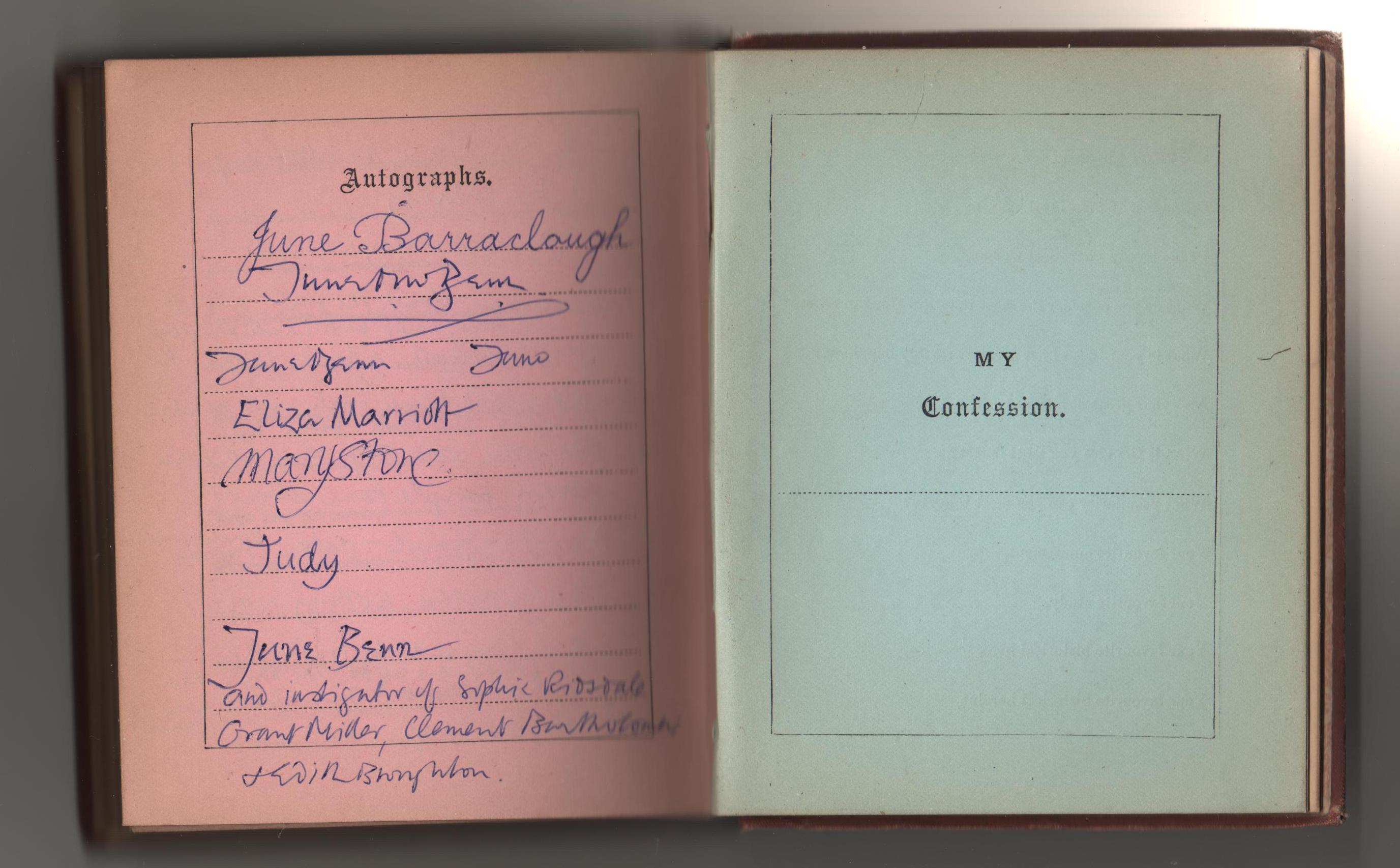
Benn June confession page 001Here’s an oddity that turned up recently at Jot HQ. The Querist’s Album: a Book for Confessions and Autographs (Glasgow, n.d., but c 1880) is a pocket-sized tome comprising several sets of pages meant for autographs together with questions addressed to the person supplying the autographs. All the questions are the same.

The questions are obviously addressed to young people—perhaps those in their late teens or early twenties. In this particular copy only around half the pages are filled and many responses date from the late Victorian or Edwardian period. One of those from this era was the actual owner of the book, one M.E.Laxton, who was given it by her aunt.

Most of those supplying an autograph have also answered the questions. However, Miss Laxton dodged many of them and appears to have found some impertinent, including one asking if she was ever in love.   A few have merely signed their names, but have left the question pages blank. One anonymous male has only answered a handful of the questions. When asked what is the most beautiful thing in Nature he has replied ‘ Woman ‘, and when asked at what age should men and women marry replies 45 for a man and 60 for a woman. This person also confesses to having been married twice and been in love thirteen times. Another male, a Mr Grant Miller, replies to the questions in what appears to be a ballpoint pen, even though he dates his answers to 1910. His ideal woman is Sophia Ridsdale. Then we have ‘Edith Broughton’, who also uses a ball point pen for her answers dating from April 1905. A further respondent is ‘Clement Bartholomew’.

Continue reading

Authors most in demand

Screenshot 2018-10-18 12.32.43With a bookshop in Charing Cross Road , in the centre of London, it occurred to us to find out which authors are most asked for and  sell the quickest. So we asked around. The answers are in  three tiers.

1. Asked for a lot

Jane Austen, Beckett,The Bible, Brontes, Lewis Carroll, Angela Carter, Agatha Christie, Churchill, Aleister Crowley,  Roald  Dahl, Conan Doyle, Darwin,  Dickens, Dostoyevsky, Scott Fitzgerald, Ian Fleming, Heaney, Joyce, Kafka, Kerouac, Stephen King, CS Lewis, AA Milne, Orwell,  Beatrix Potter, Pratchett, Rackham,  Ayn Rand, JK Rowling, JD Salinger, Shakespeare,  Bram Stoker,Tolkien, V Woolf, Waugh,Wilde, Wodehouse

2 Quite a lot

Jeffrey Archer, Marcus Aurelius, L Frank Baum, Enid Blyton, William Burroughs, Byron, Cervantes,  Baron Corvo, T.S. Eliot, Faulkner, Neil Gaiman, Kenneth Grahame, Graham Greene, Thomas Hardy, Hemingway,  I Ching, Keats, Kipling,  D.H. Lawrence, HP Lovecraft, Milton,  Nabokov,Sylvia Plath,  Pinter, Edgar Allan Poe, Anthony Powell, Rilke, Seneca, G B Shaw,  Dr Seuss, Mary Shelley (and PB), Tao Te Ching, Dylan Thomas, John Wyndham,

Continue reading

Having pun

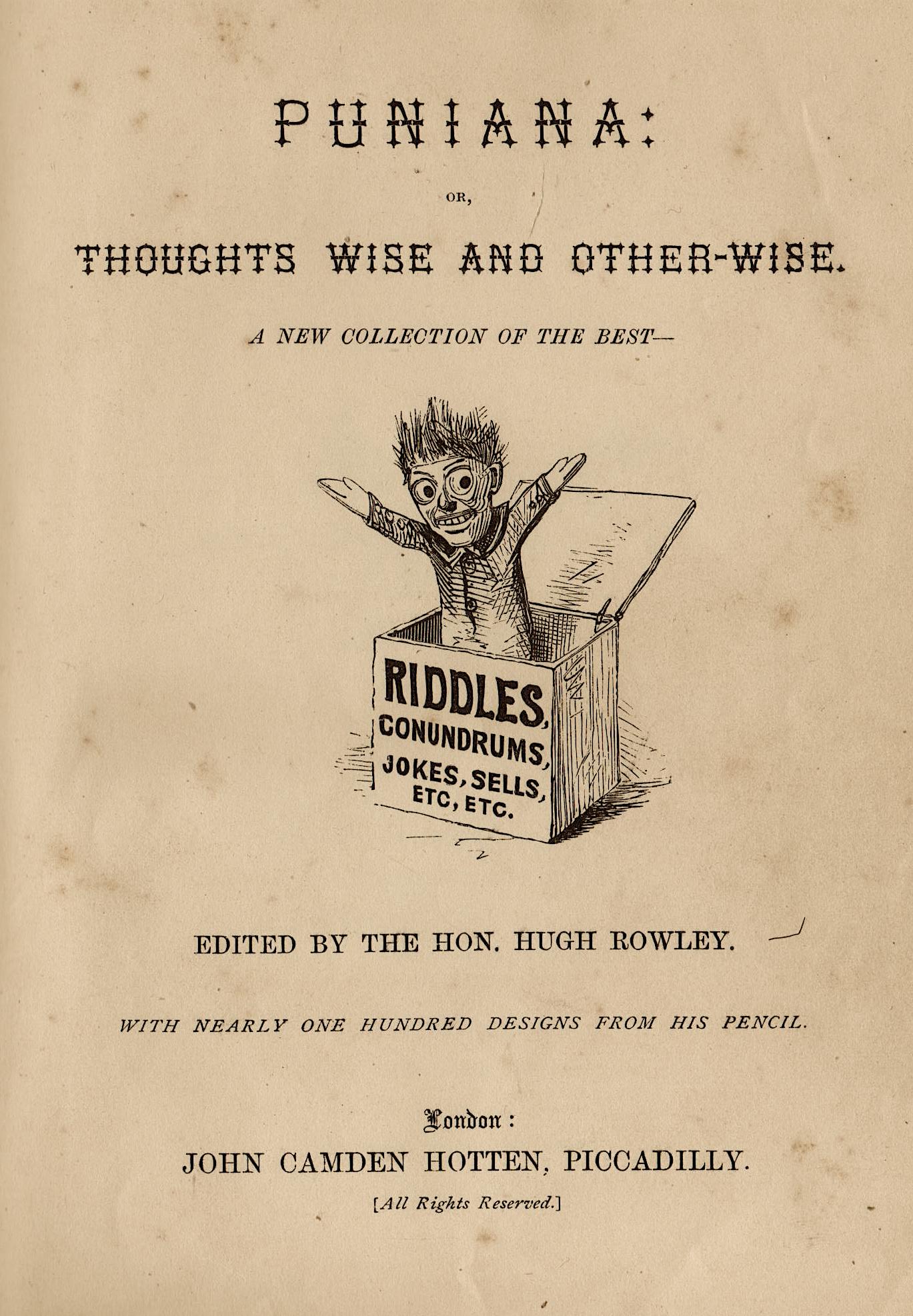
Puniana title 001Tim Vine and other contemporary stand-ups who base their acts on puns might take some inspiration from nineteenth century books on the subject, such as Puniana(1866), which was edited by the Hon Hugh Rowley, who also did the illustrations. Even if we recognise that many words ( such as ‘draught’ in the medical sense) have fallen into disuse over the past 150 years and that manners and morals have likewise changed, it is astonishing how well many of these mid-Victorian puns work today. Here are a few that do:

Why are cats like unskilful surgeons ?

Because they mew till late and destroy persons.


Why are cowardly soldiers like candles?

Because when exposed to the fire they run.


What flowers are there between a lady’s nose and chin?

Two lips.


Why are books your best friends?

Because you can shut them up without giving offence.


What street in London reminds you of a tooth from which you have suffered a great deal?

Long Acre. Continue reading

Pregnant with a new book—-Marguerite Evans writes to fellow novelist Berta Ruck

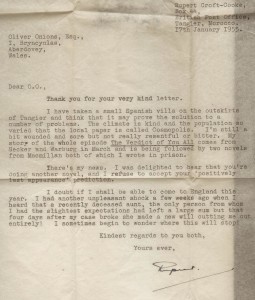
Oliver Sandys letter to Onions 001Found tucked away in the same envelope with the letter ( see earlier Jot) written to Oliver Onions from Rupert Croft-Cooke is a short letter dated May 24th1962 from the very prolific novelist and magazine contributor Marguerite Evans ( 1886 – 1964) to fellow novelist Berta Ruck (1878 – 1978), wife of Oliver Onions. Evans wrote under three pen names—Oliver Sandys—which she used on some of her headed notepaper—Marguerite Barclay (using her given name) and Countess Barcynska. Evans published an incredible 130 novels between 1911 and 1946, and her oeuvre also includes non-fiction. She has been described as a purveyor of ’middlebrow fiction ‘, which as one critic has pointed out, is not a helpful term in her case. Several of her novels were filmed, most notably ‘The Pleasure Garden’( 1925), which was Alfred Hitchcock’s first completed film as director.

Ruck and Evans did not live too far from one another –Ruck in Aberdovey and Evans at The Ancient House, Little Stretton, Shropshire. In the letter Evans promises to visit the older woman:

‘Would give anything for a long, long chat with you…Am on last lap of book & feeling very pregnant. Thank heaven for that because before, the sensation was like a bad ‘ mis ‘ ! How strange this opus creation  in its likeness  to those functions. Have you not felt the same?

I do hope EAT. is better. Tell him I am truly and regularlyconcentrating on him & it would be lovely to hear he is better & stronger. This isn’t a letter . It is to send love.

Always

Marguerite. ‘

Two years later Evans was dead. Her husband Caradoc, who she had married in 1933, had died aged just 67, back in 1945. A controversial writer, whose collection of short stories, My People(1915) earned him the unenviable title ‘ the best-hated man in Wales’, is now recognised as ‘ the founding father of Anglo-Welsh writing’. On his death Marguerite paid him the greatest tribute by publishing his biography. Her own autobiography, Full and Frank, may shed some light on her friendship with Ruck and may also identify EAT. Ruck died in 1978 aged 100.

I found Chris Hopkins’ online paper ‘ Self-portrait of the Middlebrow as artist’ useful in the compilation of this Jot.    [R.M.Healey]


Diary of a Nobody (Part 3)

Innsbruck 1957On 4thJuly 1957 our gardening civil servant and his wife Madge left London for their fortnight in Austria and Italy. Rather unusually ( but perhaps not so unusual for 1957 ) the couple cycledto town, deposited their rucksacks at the Air Terminal ( was this near Victoria coach station back then?) and then left their bikes at his place of work. They then caught a bus to London Airport, from where they flew by Swissair Metropolitan to Zurich, arriving at dawn. From here they took a train on a very hot day to Innsbruck and by early afternoon were settled in their hotel, the Weisses Kreug.

Being British our gardener devotes time to recording the weather ( from ‘Hot—jolly hot’ to ‘rains all morning’ and ‘rains slightly  in afternoon’) , praising good meals and complaining about not so good meals,  briefly mentioning sights visited and photos taken. Most of the holiday was spent among the mountains of northern Italy—in places like Cortina, Vigo di Fasso, and Bolzano, where they exalt in finding a restaurant that offers ‘ 2 courses incl. meat for 360L’. One of the main reasons for choosing this part of Austria and Italy is the prospect of locating Alpine flowers to photograph. They do find ‘ a fine meadow of alpine flowers ‘ and later our gardener leads Madge up Mount Marmolata in search of Entrichium, but fails to locate any. However ‘we do find other nice plants to photo…’ They also bump into the Olympic stands that were used in the previous February for the ‘Cresta Run’ and skating. Continue reading

Jailed for being gay—the experience of Rupert Croft-Cooke

Before 1967, when as a result of the Wolfenden Report,  homosexual acts Croft-Cooke letter pic 001between consenting adults were made legal, many men from all backgrounds, including actors, writers and at least one famous mathematician, were prosecuted and sometimes jailed. The persecution of Dr Alan Turing, the genius who helped the UK win the Second World War, is a shameful blot on the English penal system, but another victim of the law whose conviction has aspects in common with that of Turing is the less well-known writer Rupert Croft-Cooke (1903 – 75).

In 1953 Joseph Alexander, the companion and secretary of Croft-Cooke, a prolific novelist, crime writer, short-story and screenplay writer, picked up two sailors in the famous  Fitzroy Tavern , and took them back to Croft-Cooke’s house  in Ticehurst, Sussex. After they were plied with drink Alexander and Croft-Cooke had sex with them. On their way back to London the sailors got drunk and assaulted some men, including a policeman. After their arrest the sailors agreed to tell the police about their sexual encounter in return for immunity from prosecution. Croft-Cooke and his assistant were duly arrested, tried for gross indecency, convicted and jailed. Croft-Cooke was sentenced for six months and spent time in Wormwood Scrubs and Brixton.

Almost exactly a year earlier Alan Turing had been arrested for the same offence when his lover, Arnold Murray, confessed after a burglary at Turing’s home that he was in a relationship with the mathematician. Turing pleaded guilty and was given the choice of a prison sentence or a period of probation during which he would undergo treatment with female hormones. Continue reading

A jacket for E.H.W. Meyerstein

IMG_5582Found among a collection of publisher’s file copies from the Gollancz archive a novel by  E.H.W. Meyerstein. It was his last work, as he died in the year of its publication (1952). It was a  bibliomystery set in Hampstead entitled Tom Tallion. The blurb and printed notes on the sleeves of thejacket are lengthy and enthusiastic and its anonymous author had probably read the whole book and may have even been a fan of Meyerstein’s work.

 Connoisseurs have long regarded Mr Meyerstein as one of the wittiest and most urbane novelists of the day… This book has the same delightful blend of the prosaic and the fantastic [as his last novel Robin Wastraw]. Mr Meyerstein writes of the most startling events as if they were commonplaces, and through his eyes the ordinary business of living takes on a fabulous quality.

It would be a pity to describe the plot, though we could hardly spoil the reader’s pleasure by doing so. Tom, like Robin, is a reflective boy brought up in a scholarly and eccentric environment, haunted by echoes of murder and arson, pursued by a middle-aged woman, remaining detached from all such extravagances of behaviour and quietly following his own interests and calling. There are exquisite episodes. There’s the day, for instance, when Tom, bored with ‘nature study’ at school, eats the pomegranate which he is supposed to be drawing, then sketches it from memory with a sudden assurance – he thereby discovers a unique theory of art, and painting becomes his vocation. There is the business of old Mr Wilkins sudden death. There was Captain Clements, who erupts into Tom’s life with his sinister interest in the occult. There is Mrs Heene, the missionary author of God or Dog?  who abruptly loses her faith and raise a flag with the inscription: “THERE IS NO GOD (MRS) HIRAM HEENE.’

Continue reading