Dr. Alfred Salter

Statue of Dr. Salter in Bermondsey

Found among the Reeve* papers this portrait of Dr. Alfred Salter (1873 - 1945) medical doctor and Labour politician - still famous in Bermondsey - as Reeve says he was 'the salt of the earth…'

DOCTOR ALFRED SALTER

Fenner Brockway says that Dr Salter was the most brilliant medical student of his time. He could have had a nameplate proudly displayed in Harley Street, and ended his days a wealthy, outstanding medical practitioner welcomed by the affluent anywhere he sought his leisure moments. Instead he installed his surgery among the somewhat turbulent extroverts of Bermondsey, where the underprivileged masses suffered a shortage of skilful medical talent; and although the borough's alcoholic content may be proportionately higher than many places in England, throughout the district a sense of rightness, perhaps even a touch of gratitude exists for the services of a man whom people knew was a genuine servant of mankind. The dockers, usually fond of their pints, returned to parliament again and again, an ardent teetotaler who loved his fellow men. Bermondsey is like that.
Continue reading

The Secret Places V & VI

Two more chapters of The Secret Places (Elkin Mathews & Marrot London 1929) - a chronicle of the 'pilgrimages' of the author, Reginald Francis Foster (1896-1975), and his friend 'Longshanks' in Sussex, Kent and Surrey. See our posting of the first chapters for more on Foster and this book.

Continue reading

Ronald Searle – Caricature Manifesto

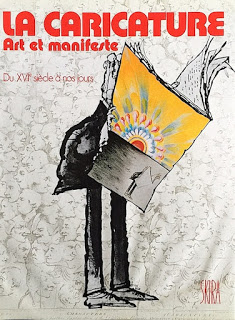
Another manifesto from Jot-- this one still relevant given the atrocities of early this year at Charlie Hebdo in Paris. We found it in La Caricature: Art et Manifeste Du XVI siecle a nos Jours (Skira, Geneva 1974) which was produced by Ronald Searle, Claude Roy and Bernd Bornemann. At the beginning Searle contributes a  piece ('Quelques Reflexions Authentiques..') that is a cross beneath a credo and a manifesto. It has not been translated before (to our knowledge) and our friend Tom A has done a sterling job. There is a pun about a hound's tooth which Tom says works better in French than English. Searle was much admired in France and lived there for the last 50 years of his life. Rave on...

La caricature est un art mineur qui comporte des responsibilites majeures.
Caricature is a minor art which carries major responsibilities.

L'humour c'est quelque chose qui met les gens en colere quand on leur dit qu'ils n'en ont pas.
Humour is something which makes people angry when you tell them they don’t have a sense of it.

La satire est la plus haute forme de la basse intention.
Satire is the highest form of a low instinct.

Continue reading

John Mason Neale

John Mason Neale (1818 – 66), was a High Church Anglican best known today as the author of several Christmas carols, such as ‘Good King Wenceslaus’ and hymns like ‘All Glory, Laud and Honour’. A talented classicist at Cambridge, he was nevertheless prevented from taking an honours degree because of his poor performance in mathematics. This must have been dire indeed considering how very few undergraduates of promise were failed because of their ineptness in this particular discipline. Indeed, there could be more sinister reasons for this treatment. It is easy to imagine that someone with his quasi-Romanist leanings, which he probably did not hide, displeasing die hard Anglican dons at the University.

Be that as it may, Neale was appointed Chaplin of Downing College in 1840 and two years later became Vicar of Crawley. However, disagreements with his diocesan bishop, which dogged him for fourteen years, led to his resignation in 1846. Luckily, soon afterwards he was appointed Warden of Sackville College, a large almshouse of seventeenth century origin in East Grinstead. Here he remained until his early death aged 48 in 1866.

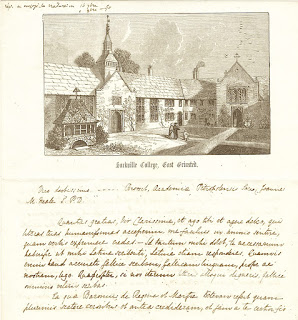
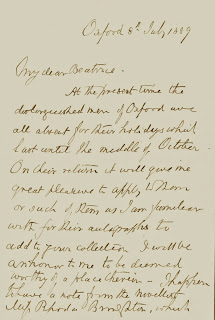
The attached document, found among some autograph material, is dated 1850 and is headed by an engraving of the courtyard at Sackville College. Under it Neale has penned a letter, or the draft of it, in Latin, seemingly to a fellow scholar, possibly in Europe, the first few lines of which some Classicists among the growing audience of Jot 101 might wish to translate. Here are the opening few words:

Viro doctissimus ----Brossch, Academiae Petropolensis Socio, Joannes M. Neale S.P.D.

Quantas gratias , Vir Clacissonie, et ago tibi et agere delco, qui literas tuas humanissimas…

At this point we at Jot 101 gave up. Some of the rest can be viewed above. Unafraid of religious controversy, Neale went on to found the Society of St Margaret, an order of Anglican women dedicated to tending the sick. At a time of strong anti-Papal feeling, such High Church activities were regarded with hostility by both the higher clergy and the laity, and Neale was banned from any preferment in the country of his birth. When recognition for his scholarly work eventually came, it was in the form of a doctorate from a college in Connecticut. [RMH]

The Literary Cranks of London – The Vagabond Club

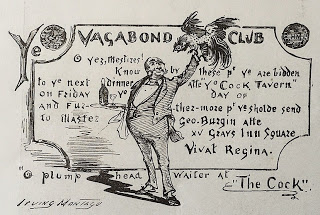
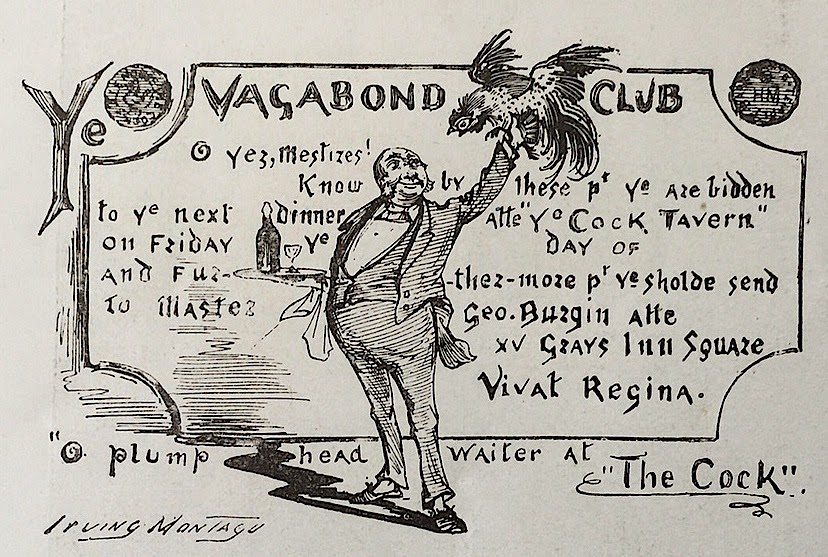
The second of a series on 'The Literary Cranks of London' this published in  The Sketch on Aug. 29th, 1894. Written by a member George Brown Burgin (1856-1944), novelist, critic and journalist. There are various photos of him in the National Portrait Gallery collection. He was sub-editor of the humorous journal The Idler from 1895 to 1899. He wrote over 90 novels but there is no Wikipedia page for him. However there is quite a bit online on him including various quotations such as his claim that: 'It is much more comfortable to be mad and know it than be sane and have one's doubts.' The Vagabond Club was founded around the blind poète maudit Philip Bourke Marston and boasted such distinguished members as Jerome K. Jerome, Robert Barr, Conan Doyle, Barry Pain,  and Israel Zangwill. No women. It is interesting that Burgin mentions, without opprobrium, that  it contained 'misogynists'...

Continue reading

1930s Diatribe against wage slavery

The recent Jot reproducing manifestos from The Idler that celebrate freedom from the corporatist world remind me of a wonderfully invocatory collection of poems from Kenneth Muir called The Nettle and the Flower, which came out in 1933. Muir, then just 26, had, just a few years before, graduated from St Edmund Hall, Oxford, where Geoffrey Grigson was his senior by two years. I seem to recall that Muir, being a rather serious-minded student, took against Grigson ostensibly because he performed a prank in which he dressed up as a ghost. But it is more likely that the freshman of solid Labour convictions felt contempt for anyone of a privileged background (though Grigson, who attended a very minor public school, was hardly in this category) who had broken the General Strike of 1926. Grigson was one of many at the University who helped unload ships at Hull docks.

Anyway, The Nettle and the Flower, though rather unfocussed politically, certainly reflected Muir’s equal hatred of the Stalinist view of conveyor-belt drudgery as something noble that contributed to the power of the worker-state, and exploitative Big Business. This is from a Poem to William MacCance:

Continue reading

The Literary Cranks of London – The Cemented Bricks

I came across this oddly named literary coterie quite recently in a catalogue by the august bookseller and writer John Saumarez Smith in a scholarly note about one of its members - the writer (anthologist) Robert Maynard Leonard (1869 - 1941) who among other things was secretary to the Anti-Bribery League, which sounds like something from a G K Chesterton short story. Members of the 'Cemented Bricks' included Richard le Gallienne, Walter Jerrold, Sir John Parsons, Lord Amulree and Joseph Knight. The web yields very little about them except this page from The Sketch of 13/2/1895 bought for the price of a mocha latte on eBay. It remains unknown to Google books and even Brewster Kahle (praise his name) has not archived it... At the same time we bought another in the series of 'Literary Cranks of London' on 'The Vagabond Club' which will follow later.

The Literary Cranks of London.

The Cemented Bricks.

The Cemented Bricks.! Who or what are they? Is it a new order of Hod-fellows, or is it a building society?

That question, or series of questions, was put to me by a lady three years ago. This article will supply the answer.

Continue reading

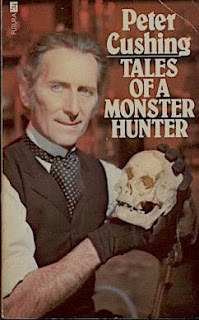
Afternoon Tea with Sherlock Holmes – Peter Cushing interviewed

Found among the papers of Peter Haining this account by him of a meeting with the Hammer Horror film star Peter Cushing. Haining worked with Cushing on several books including Peter Cushing's Monster Movies  (9 macabre short stories  all linked to Cushing's film career) and The Sherlock Holmes Scrapbook both with forewords by Cushing. These contributions were written by Haining and then approved by Cushing (after much correspondence, some slightly  rancorous- he appears to have been a perfectionist although all his communications end "God bless you, Peter Cushing")

Afternoon Tea with Sherlock Holmes
By Peter Haining

It was the perfect place to meet Sherlock Holmes: 'The English Tea Room' in Brown's Hotel, Albermarle Street in the heart of London's fashionable Mayfair district. Long associated with the great English tradition of taking afternoon tea - served with the hotel's own blend, home-made jams and clotted cream and tasty cakes and pastries the Nineteenth Century establishment is also steeped in literary tradition and has been patronised by among others Oscar Wilde, Rudyard Kipling and Agatha Christie who actually based her novel, At Bertram’s Hotel, on Brown's. Founded in 1837 by James Brown, a former valet to Lord Byron who referred to him as the 'gentleman's gentleman,' the hotel has become an oasis of elegance, comfort and fine cuisine in the heart of the bustling metropolis. Indeed, such is the timeless style of Brown's that it is not hard to imagine the great detective paying a visit and no surprise to me that Peter Cushing, associated with Holmes for much & his acting career and a man dedicated to his afternoon cup of tea, should have chosen it as his own haven whenever he was working in the vicinity of London on stage or in films and television.
Continue reading

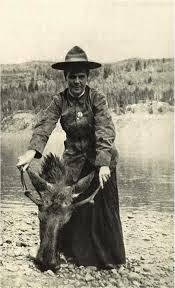
Mina Hubbard—feminist icon and explorer extraordinaire

Mina Hubbard (1870 – 1956) is not a name that means much in the UK, although this intrepid explorer of Labrador ( the first woman to do so) retired to Britain and ended up in suburban Coulsdon, of all places, where she died rather tragically at the age of 86.
Born in Bewdley, Ontario, in 1870, to a Canadian father and an English mother, there was little in her early years that would suggest that worldwide fame as an explorer would attend her by the time she was 35. After leaving school she spent two years  teaching, then trained as a nurse. It was while nursing that she met the journalist Leonidas Hubbard, then ill with typhus (or typhoid). The couple married in 1901 and within 2 years he had embarked on an unsuccessful expedition to map northern Labrador that ultimately cost him his life.  Such a tragedy would have destroyed some women, but Mina was made of sterner stuff. When Dillon Wallace, a survivor of the expedition, published his account Mina suspected that he had been responsible for her husband’s death through starvation and vowed to revenge herself on him by embarking on her own expedition to achieve what he and her husband had failed to do. Recruiting three guides, two of them Cree Indians, she left for Labrador on June 27th 1905 and by 29th August had completed a trek of 576 miles, beating Wallace, who had embarked on the same day, by seven weeks. Not only did she bring home an accurate map of northern Labrador, but she also made an important  photographic record of the native Labradorians she had met.

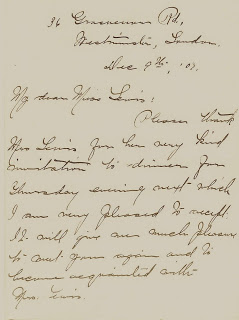
On her return home Hubbard became an overnight celebrity. Before long she had been sponsored by the Royal Geographical Society to undertake a lecture tour in England. It was while on that tour that she wrote this letter to a Miss Lewis (possibly an admirer) gratefully accepting an invitation to dinner. She also met her second husband, the MP Harold Ellis. In 1908 appeared A Woman’s Way through Unknown Labrador , which became a best-seller.  Today this account of her expedition, and in particular the   photographs she took of the native tribes, is generally recognised as one of the most valuable anthropological records of the period. More recently, however, it has sparked controversy. In particular, feminist commentators have interpreted the text as a seminal document in women’s studies. Hubbard’s projected persona in the book is seen as that of a woman performing a male role as a conqueror of a hostile environment.

The Ellises produced three children, but the couple parted in the twenties and Mina returned to Canada in 1936. After this she seems to have led a rather conventional life, latterly in poverty. In 1956, while staying with a friend in Coulsdon, near  Croydon, she left the house to ‘ explore’ and on her way to the nearby Coulsdon South station she wandered aimlessly over the tracks, was hit by a speeding train and killed instantly. She was 86. What the grizzly bears and below zero temperatures of Labrador had failed to do, a British Railways commuter train had completed. [RMH]

Library Lists

A piece of pre-Amazonian technology for ordering books from libraries, a rare, ephemeral survival probably from the 1930s...  An attractive little booklet with a carbon at the rear for keeping duplicates of 'library lists'. Inside are the following instructions--

These lists are made up from Literary Supplements, Publishers Lists of new books, reviews and books recommended by friends.

The list is torn out at perforation and sent to Library.

 The carbon copy is retained as a check on the books received.

 The carbon copy also becomes a useful record of books read, books to be recommended to friends, and a reminder of the works of Authors you have read. 

The booklet (about 40 pages) was part of something called the Terston Series and probably dates from around 1930.They also produced books off ready made bookplates and bookmarks…

John Elliotson—friend of Dickens, champion of mesmerism and vegetarianism

Dr John Elliotson (1791 - 1868 ), though attacked in his own time for his unconventional practices, would have thrived today as a go-to TV doctor on all things to do with alternative medicine. He was conventional enough as a medical student, but then went on to study phrenology, and afterwards introduced his friend Dickens to mesmerism, on which he became an acknowledged expert. Thackeray dedicated Pendennis to him and based his character Dr Goodenough in his last novel, The Adventures of Philip, on Elliotson. He was a Fellow of both the Royal Society of Physicians and the Royal Society, and was one of the first doctors to advocate the use of the stethoscope. Wilkie Collins called him ‘one of the greatest English physiologists’.  He was also, though the biographical sources don’t mention it, a firm fan of vegetarianism, which in mid Victorian England was still frowned on. In this undated letter, which was found in a collection of autographed material, Elliotson recommends to an unknown correspondent that his brother continue with his non-meat diet:

'He need not take fish--milk & all sorts of vegetable productions, offer dishes without end. Tell him to read the account of the meeting of the Vegetarian Society in the Daily News of this morning. I know members who eat no meat (excluding fish also) & drink neither wine … & are in the finest health. I would not wish him to eat fish if it disquiets him –but tell them one thousand good dishes (are) made from milk & vegetable matter…Bread & milk, custards, use arrowroot, sago, tapioca pudding, sweet omelettes, fruits of all kinds, in all ways.'

Despite being censured by many members of the medical community—and in particular Thomas Wakley, editor of The Lancet-- for his interest in mesmerism Elliotson persisted in championing the subject and even edited a magazine, The Zoist, which promoted the topic. He also founded a mesmeric hospital. [RR]

The Hell Hound

Another tale from a rare folklore book M. H. James's Bogie Tales of East Anglia (Pawsey & Hayes, Ipswich 1891). The setting is almost certainly Aldeburgh, a coastal town in Suffolk, now somewhat gentrified but still with its fisherman on the beach (and in the bars) some of whom still have dogs…

The Hell Hound 

At the north end of the town of A--- lie the salt marshes, which are sometimes full, like a lake, after rains or the prevalence of of certain winds, and of which there was a sunset view exhibited in London not long ago.Here a favourite walk of the inhabitants leads across a sort of common, planted with a fir grove; by one or other of two paths, one of which goes through the pine wood and emerges near the station; the other leaves the pine wood on the left, and skirts the mere, crossing the line, and leading into a sandy lane between more pine trees. At the sea end of this waste is a 'kissing gate'...and here it is quite likely that the presiding bogie will meet you, if you walk there after dark.

Continue reading

A Were-Dog Story

Among Peter Haining's books we found this folklore rarity Bogie tales of East Anglia by M. H. James (Ipswich, 1891) - from it comes this slightly  disturbing tale. What the Italian was doing in Lowestoft is anybody's guess.

This tale, which runs as follows, is still common talk among the beach men at Lowestoft. An Italian gentleman, with curly hair and a very dark complexion, asked a fisher-boy of Lowestoft, to become his page, but this the boy refused, as he did not wish to go forge in parts; whereupon the Italian, far from being angry, asked the boy to look after a dog for him, as he was going ways.

Continue reading

James Joseph Sylvester—the mathematical genius snubbed by Cambridge

The rule among the dons of Oxford and Cambridge up to the end of the nineteenth century was that you were permitted to take a degree at these  'august' institutions as long as you weren’t a dissenter or a Jew. At around about the same time, when the first colleges for women were established, similar restrictions were applied to women, who were only granted degrees at Oxford in 1920, and shamefully, at Cambridge in 1948. At the latter University, woman  were palmed off with 'certificates' up to that date.

Today, when we are so aware of discrimination against minorities, mathematicians who admire the astonishing achievements of the Jewish-born James Joseph Sylvester (1814- 97) invariably pick up on the fact that despite being ranked second wrangler in the 1837 Cambridge University Tripos, Sylvester, as someone who as a Jew had refused to take the Thirty Nine Articles of the Church of England, was barred from graduating. Nor was he permitted to compete for a fellowship or obtain a Smith’s prize. A year later, and still without a degree,  Sylvester was appointed Professor of Natural Philosophy at the University of London, where he had been a student for a short time from the age of 14. It was only in 1841, when Trinity College, Dublin awarded him the degrees he needed that Sylvester was officially qualified to teach students.

Continue reading

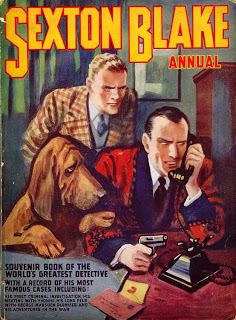
The Eric Parker Story

From the files of Peter Haining this draft of a piece by W.O.G. ('Bill') Lofts on the great Sexton Blake illustrator Eric Parker (1898 - 1974). It was published in the early 1980s in the Australian magazine Collector's Digest.

The Eric Parker Story.

By W.O.G. Lofts.

For over twenty years, it was my good fortune and privilege to meet many Directors, Editors, sub-editors, authors, and artists, not only down Fleet Street, but in the home of it all at Fleetway House in Farringdon Street, the home of the mighty Amalgamated Press. I use the expression 'fortune' in the sense, that living in London, it was quite easy for me to make these short trips.

Always firmly believing in sharing information with others not so fortunate, I used to write up many of these events in the various magazines circulating at the time. Nearly all personalities I'm glad to say, freely gave me information not only about themselves, but about the papers they were connected with in pre-war days. Papers that gave so much pleasure to us, as they do even today in some cases over a half a century later. Indeed, in time by so many meetings, many became good friends, when they probably gave me real inside information, that they would not have revealed to the ordinary interviewer. The very sad fact today, is that with all of them considerably older than myself-practically the majority of them have now passed on.

Continue reading

A – Z of Science Fiction words

A useful guide to scientific words for the Science Fiction enthusiast. It first appeared as monthly instalments in Authentic Science Fiction and was printed and published as a booklet by Hamilton & co., in the Goldhawk Road, London W 12. It was compiled by H.J. Campbell. Being 1954 very little is related to computers. At C you will find Cybernetics and at B Betelgeuse...

Absolute. Not relative. Independent of all scale and comparisons. E.g., zero temperature, number, the speed of light.

Acceleration. Rate of change of velocity. Increasing velocity is positive acceleration; decreasing velocity is negative acceleration. The average acceleration of any body falling to Earth in a vacuum is 32 feet per second per second.

Achromatic. Applied to optical apparatus which gives images free from colored fringes. A. lenses have one sense of crown glass and one of flint glass. The flint lens corrects dispersion caused by the crown glass.

Aerolite. (Sometimes called ‘aerolith’). A stony meteorite, as distinct from a metallic one. A meteorite that is a mixture of stone and metal, but preponderantly stone would be called aerolithic.

Albedo. A measure of the brightness of celestial bodies that shine by reflected light. Technically, it is the amount of light a body reflects in proportion to the amount that falls on it. The Moon’s albedo is 7%; that of Venus 65%.

Continue reading

Norman Lindsay Does Not Care – an Outburst

A pamphlet found in a Fanfrolico Press book The Antichrist of Nietzsche illustrated by Australian artist Norman Lindsay. Printed about 1927 it is by his great champion P.R. Stephensen who was a friend of Lindsay's son Jack. Stephensen (1901-1965) was known as 'Inky' and was a curious figure, starter of many presses including Mandrake and something of a left wing firebrand who moved to the far right in his middle years. Here he is in his late twenties ranting in full épater le bourgeois mode:

Norman Lindsay Does Not Care
An Outburst
by
P. R. Stephensen

Fanfrolico Pamphlets No. I
Price One Farthing

Why should Norman Lindsay care if suburbia shudders with a horror which is really terror of his stark and ruthless presentation of the image of beauty? Nothing else could be expected, for at this level criticism remains atavistically moral, tribal; and any artist making a vital expression is likely to be regarded as a spawn of Satan, Antichrist, lewd and wicked, abhorrent to all Right-Thinking People. Norman Lindsay does not care how loudly the Good People howl for his suppression. But the Official Art Mob (or Mobs) also dislike him, with the intensity of a fascination which repels as it attracts. And as these quite sophisticated persons officially disown Suburbia, it is difficult for them to damn the man in Suburbia’s phrasing. Yet they must do something about it, because his work is by contrast a continual exposure of their own artistic ineptitude and moral vacuity. So they seek to explain him away, ostrich principle.
Continue reading

Two manifestoes from The Idler

At Jot we try to print as many manifestoes as possible. Here are two manifestoes from The Idler. One of them is (or was) available on a tea towel from the Idler's  website. The Idler book from 2014  has a friendly and combative interview with Jeremy Paxman and a good article about the history of attempts to shorten the working week, reminding us how working men once had to struggle to get  a 10 hour day…Now we have the amazing Timothy Ferriss and his 4-Hour Workweek but so far no manifesto. The style of the 'Death to Supermarkets' rant is reminiscent of Blast, the brainchild of that well known boulevardier Wyndham Lewis…

More rants and manifestoes to follow.

The Agamemnon Dinner of November 1900

Found among a large collection of menus printed at the turn of the nineteenth century by the high class Cambridge printer W.P.Spalding is this menu for the annual ‘Agamemnon  Dinner’ of the famous Cambridge University Amateur Dramatic Club, which was held at King’s College on 27th November 1900.


A copy of this particular menu, signed by some who attended the Dinner, is in the King’s College archives. It shows that the medievalist M.R.James, a good amateur actor who enjoyed reciting his famous ghost stories at ADC events, was present at the Dinner, along with A.A.Milne, then in his Fresher year. All the menus reflect the high gastronomical standards of the various Cambridge colleges at that time, but the dishes on offer at the Agamemnon Dinner seem particularly delicious.

James and Milne could choose from starters that included Potage Dauphine served with an amontillado, Turbot boulli, sauce crevettes and filet de sole a la Villeroi which came with a liebfraumilch, perdrix aux choux, or petites timbales a la Royale, which were served with a 1894 Champagne Irroy.

The main courses consisted of Boeuf pique a la Godard, Oison Roti, sauce aux pommes, celery a l’Espagnoles, haricots verts, pommes de terre en croquettes et Oakley.

Or they might prefer Langue de Boeuf a la Ecarlate with puree d’Epinards.

Dessert number one came in the form of ‘Pouding A.D.C.’ or Bavarois au Curacao.

Then there were liqueurs offered with Glace au pain bis a la Jamaique..

Then, rather bizarrely, came Croutes d’ Anchois ( marinated fish towards the end of a meal; I wonder if this was ever popular). And finally, another  Dessert (not specified), after which came port and coffee.

Personally, I could happily scoff the lot—apart from the anchovies, obviously, although I’d want to know what potato croquettes ‘et Oakley’ exactly meant. [RR]

The Diary of A Dining-Out Man

From Virtual Victorian

From a volume of Bentley's Miscellany (London, 1841)- this piece by Albany Poyntz (i.e. Catherine Gore) other contributors to this volume included Ainsworth, Crowquill, Ingoldsby & Longfellow. She also wrote A World of Wonders (Richard Bentley, London 1845) - a polymathic work refuting popular superstitions with  chapters on Pope Joan, Wild Women, Sybils, Monstrous Births and Ventriloquism etc.,. The full text can be found at Project Gutenberg.

Catherine Gore (1799 - 1861) is best known for her many "silver-fork" novels, which depicted fashionable high society. In 1830, she published her first silver-fork novel, Women As They Are, or Manners of the Day, and then went on to write many more books in this popular genre that provided her with a considerable income. There is much on her at The Corvey Novels Project (Nebraska) She was known as a bright conversationalist, an attribute that also displayed itself in the dialogue in her novels. Her writing is often compared to Jane Austen's, particularly her descriptions of the "heartless society mother" in various novels. In this piece The Diary of A Dining-Out Man, which she writes as 'Albany Poyntz' the extreme worldliness of tone prefigures Saki. It is a world she would have known - she was herself at one time very rich but was swindled out of £20,000, and had to write several more society novels to recoup.

DIARY OF A DINING-OUT MAN.
BY ALBANY POYNTZ.

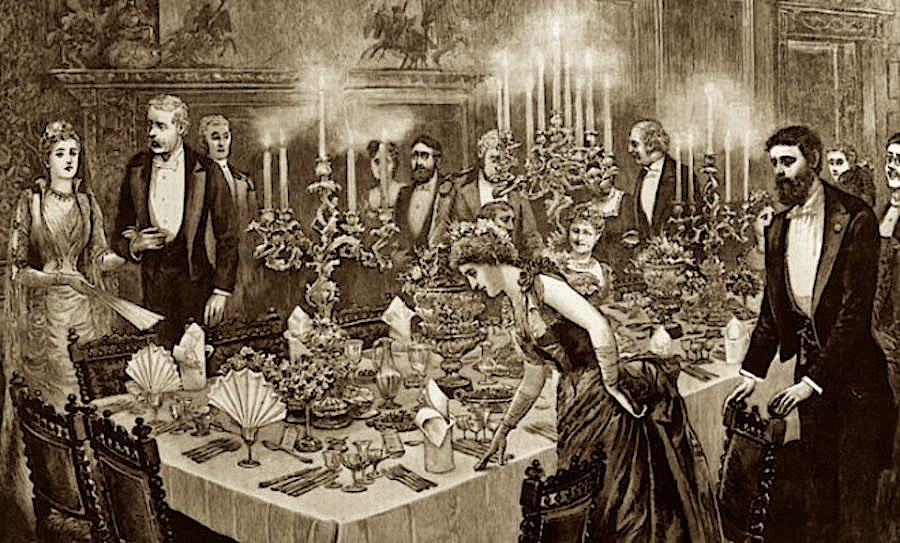
  So, here we are in the season again. — Goodness  be praised ! — Those country houses take too much  out of a man, in return for what he extracts from them. It is well enough in those where one has  the ear of the house, as well as the run of the house, — remaining a fixture, while successive parties of guests appear and disappear; for the  same bon-mots and good stories serve to amuse his  Grace on Friday, which were tried upon the country-neighbour party with success, the preceding Monday, — as inoculation was attempted upon criminals, before the royal family were submitted to the prick of the lancet. More particularly when the whole set has been renovated. It is a bore to have some single gentleman, or stationary souffre douleur cousin, on the watch for the point of every well-worn anecdote,–like people at a pantomime, familiar beforehand with the tricks.    Still, even when one makes a hit, the wear and tear of the thing is prodigious. One goes through  the work of three dinners per diem ; — to wit, breakfast, luncheon, and dinner, — and all without refreshment ! In town, one has the chance of the clubs and morning visits to brighten one. But in a country house, where one can only rub up per aid of the new works and periodicals lying on the table, or visits shared in common with the rest of the party, one must fall back on one's own resources, — and the effort is prodigious.

Continue reading