A flier for The War of the Worlds (1897/1898)

"...across the gulf of space, minds that are to our minds as ours are to those of the beasts that perish, intellects vast and cool and unsympathetic, regarded this earth with envious eyes, and slowly and surely drew their plans against us."

Found - a review slip or pre-publication publicity (a flier) in a first edition of H.G. Wells The War of the Worlds (Heinemann, London 1898) one of the greatest Science Fiction novels of all time.  The novel had previously appeared in serialized form in 1897, published simultaneously in Pearson's Magazine in the UK and Cosmopolitan magazine in the US. The reviews are from magazines and newspapers of the time including one from a French paper Mercure de France which says that Wells surpasses Jules Verne.

Continue reading →

Jacynth Parsons, W.B. Yeats and ‘The Songs of Innocence’

WB Yeats' preface to an illustrated edition of William Blake's Songs of Innocence (Medici Society 1927.) The illustrator was a young English girl called Jacynth Parsons*. It is an interesting piece about the illustrator but also about the Ireland of the time. The joke of doing the thing you are refusing to do (i.e. write a preface) is reminiscent of another Irish writer -George Bernard Shaw. GBS would reply to requests for his signature with notes such as 'Sir, I never give autographs! George Bernard Shaw.' There is very little about Jacynth Parsons online and no Wikipedia page.

Prefatory Letter
To the Medici Society.

Continue reading →

The Devil’s Hoof- Marks

Another chapter from this fascinating forgotten work Oddities: A Book of Unexplained Facts (Allan, London 1928) by R.T. Gould. The illustration is from an Edwardian novel (possibly Quiller Couch or Baring Gould.) Info on the polymath Rupert Thomas Gould (1890 – 1948) can be found at the foot of this post..

THE DEVIL'S HOOF-MARKS

  A Scottish minister once preached a sermon upon the text "The voice of the turtle is heard in our land".* He was literally-minded, and unaware of the fact that the "turtle" referred to is the turtle-dove, and not that member of the Chelonia which inhabits the ocean and furnishes the raw material of such "tortoise-shell" articles as are not made of celluloid. In consequence, the deductions which he drew from his text were long remembered by such of his hearers as were better-informed.

* Canticles ii. 12. 

  "We have here", he is reported to have said–"we have here, my brethren, two very remarkable signs and portents distinctly vouchsafed to us. The first shall be, that a creature which (like Leviathan himself) was created to dwell and abide in the sea shall make its way to the land, and be seen in the markets and dwelling-places of men; and the second shall be, that a creature hitherto denied the gift of speech shall lift up its voice in the praise of its Maker."

Continue reading →

Needwood Forest – The axeman cometh…

Cottage in Needwood Forest (Joseph Wright)

Found a few years ago in a job lot is this manuscript copy of a poem which ranks among the most famous ‘local’ poems in the English language. Needwood Forest was published privately in Lichfield in 1776 by one Francis Noel Mundy, a Derbyshire squire alarmed by plans to cut down and enclose much of the large Staffordshire forest he had known since his childhood.

Continue reading →

Making up is hard to do

A rare pamphlet (there is only one for sale on Abebooks), The Secrets of Making-Up, co-edited  by two old stagers, J. Ainsley Brough and George M Slater, is 70 pages of very useful advice on how to transform yourself into anything from a man of ninety to an octoroon. It seems to date from around 1922, but for some reason a typeface is adopted that was current c 1903. There are some wonderful photos of actors from the Music Hall and Revue, all demonstrating the transformative powers of grease paint and powder.

Although politically very much of its time (the N word is one of a number of dubious references), essentially this is a practical and modern guide. The humour—especially in a lively article on Revue and Vaudeville by Slater ( 1870 – 1949), a theatre manager and prolific writer of pantomimes, whose archive is now at the V & A—is genuinely funny, even slightly ribald. The ads at the back also contribute much to modern theatrical history.

Some tips:
1) An actor should ideally shave off his moustache, not cover it with 'goldbeater’s skin' , whatever that is,  if portraying a clean shaven person.
2) Stage Character make-up is useless for film work, and when wigs are used they must on no account have a ‘scalp join’ . No explanation is offered.
3) When portraying a Chinese or Japanese person, 'do not line under the eyes, as Chinese and Japanese have small eyes’. [RR]

Mersenne’s Numbers (R.T. Gould / Fermat)

Found - a fascinating forgotten work Oddities: A Book of Unexplained Facts (Allan, London 1928) by R.T. Gould. Rupert Thomas Gould (1890 – 1948), was a lieutenant Commander in the British Royal Navy noted for his contributions to horology. While in the navy in WW1 he suffered a nervous breakdown. During long recuperation, he was stationed at the Hydrographer's Department at the Admiralty, where he became an expert on various aspects of naval history, cartography, and expeditions of the polar regions. He gained permission in 1920 to restore the marine chronometers of John Harrison, and this work was completed in 1933. Jeremy Irons played him in Longitude, a dramatisation of Dava Sobel's book about John Harrison Longitude: The True Story of a Lone Genius Who Solved the Greatest Scientific Problem of His Time, which recounted in part Gould's work in restoring the chronometers.

Something of a polymath, he wrote an eclectic series of books on topics ranging from horology to the Loch Ness Monster. He was a member of the Sette of Odd Volumes (Brother Hydrographer) and the book Oddities is dedicated to the club. He was a science educator, giving a series of talks for the BBC's Children's Hour starting in January 1934 under the name "The Stargazer", and these collected talks were later published. He was a member of the BBC radio panel Brains Trust. He umpired tennis matches on the Centre Court at Wimbledon on many occasions during the 1930s. This is his chapter on Marin Mersenne (and of course Fermat). The reference to Mr R.E. Powers 'an American computer' dates the book, back then it meant 'one who computes..'

Continue reading →

Bookplate of Chesterton of Kensington

Found in a copy of Bella Duffy's Madame de Stael (Eminent Women Series, W.H. Allen, London 1887) a bookplate of one E. Chesterton of Kensington. This is almost certainly a close relation of G. K. Chesterton, the writer, novelist and creator of the immortal Father Brown. He was from Kensington and a member of the family who owned the Kensington estate agent Chesterton's - which still flourishes in London's white hot property market of 2014.

The illustration seems to be by E. Chesterton (a man) and is reminiscent of the style of Lucien Pissarro. The quotation is from one John Wilson, whom Holbrook Jackson, in his Anatomy of Bibliomania, notes was a London bookseller. Modernised, it reads thus:

“Oh for a book and a shady nook,
Either indoors or out,
with the green leaves whispering overhead,
or the street cries all about.
Where I may read at all my ease
both of the new and old,
For a jolly good book whereon to look
is better to me than gold” 

The Who – 10 Worst Hotel Wreckings

Found in a copy of Q Magazine from 2004. It was a special issue devoted to British rock band The Who ('The Inside Story') and the piece was titled "Remember the Gaff Where the Doors we Smashed"- a line from their song Bellboy. The article was mentioned on the cover as 10 Worst Hotel Wreckings. At Jot we are fond of lists, even lists of debauchery and excess - so here goes in slightly  abbreviated form:

1 New York
4 April 1968
The Who's first headlong tour of the US found them ejected from the Gorham Hotel after Moon rained cherry bombs (highly explosive red firecrackers) down on New York City cops from a ninth-floor window. He used another to blow up his toilet, knocking out the plumbing on the whole floor in the process.

2 New York
5 April 1968
The Who had barely unpacked their cases at the Waldorf Astoria before they were given their marching orders for failing to provide a cash surety. Moon, unable to retrieve his luggage because the door was locked, blew it open with another cherry bomb.

3 Saskatoon
11 July 1968
According to a myth-making interview Keith Moon conducted with Rolling Stone in 1972, it was at a hotel in Saskatoon that the bored drummer chopped all of his hotel furniture into kindling.

Continue reading →

The Physiognomy of the Oligarch

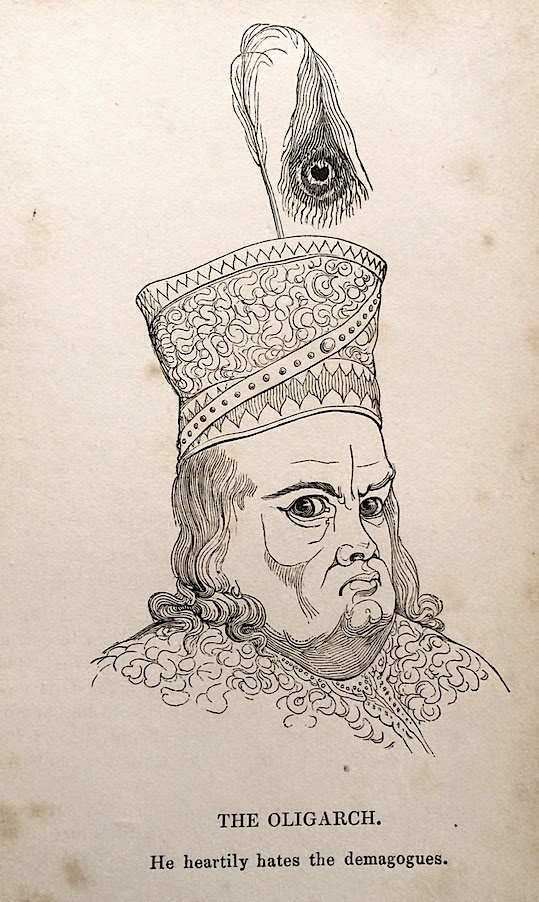
Found in a small book from 1831 this analysis of 'The Oligarch.' The word has now come to signify 'Russian billionaire' but there are (and were) other resonances. The Characters of Theophrastus Illustrated by Physiognomical Sketches to Which Are Subjoined Hints on the Individual Varieties of Human Nature (A J Valpy, London, 1831.) The ancient Greek classic of psychology and character study, updated  to incorporate the findings of modern science, (including the new science of phrenology, although it is not named as such.) The plates are in the vein of Hogarth, Hieronymus Bosch, and the grotesque drawings in the Notebooks of da Vinci.

THE OLIGARCH: OR, THE ADVOCATE OF DESPOTISM 

An arrogant desire to dominate over his fellows, appears in the opinions, the conduct, and the manners of this partisan of despotism. When the people are about to elect colleagues to the Archons for the direction of some public solemnity, he stands up to maintain that the magistracy should on no occasion be shared. And when others are voting for ten, his voice is heard exclaiming 'One is enough.' Of all Homer's verses, he seems to have learned only this:

"…think not here allow'd/ That worst of tyrants, an usurping crowd.

He is often heard using expressions of this sort: 'It is advisable that we should withdraw to consult upon this business. Let us separate ourselves from the mob, and from these popular meetings. This access of the populace to the magistracy should be barred.' If he meets with any personal affront, he exclaims 'That they and I should live within the same walls is insufferable.' 

At noon he stalks abroad, sprucely dressed and trimmed, and he drives the world before him with haughty defiances, as if he could not think the city habitable until the mass of the people should be expelled from it. He loudly complains of  the outrages sustained by the higher classes from  the crowd of litigants in the courts of justice;and he tells of his having been put to confusion in the assembly of the people, by the contact of a squalid, shabby fellow, who placed himself beside him. He inveighs against the popular leaders; whom he professes to hate heartily: 'It was Theseus', he adds, 'who was the author of all these evils in the State.' Such is the discourse which he holds with foreigners, and with the few citizens whose temper is like his own.

Pop music novel 1957

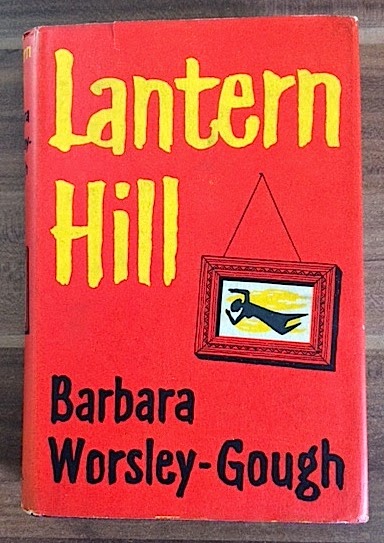
Novels, especially thrillers,  with pop or rock music settings are becoming quite collectable ..this novel Lantern Hill (Joseph, London 1957) by Barbara Worsley-Gough is so early it's practically an incunable. It has all the modern elements-- obsessive fans, excess, celebrity hauteur, displays of wealth (fabulous designer interiors) and an entourage; also the star even goes to a country retreat to get her head together...

The blurb on the inside flap of the dust wrapper reads:

Phyllis Flower, beautiful and famous, has become the 'top pop singer' with an immense fan-club following. Although an essentially nice person, she has been spoiled by success and made tyrannical by flattery. Like many successful people in the entertainment world, she is surrounded by a crowd of so-called friends and hangers on, all of them greedy for pleasure and bent on making as much as they can out of their generous patroness.

But Phyllis leavs her Knightsbridge house and goes to Lantern Hill, the Irish country home of her dead husband. There she romps in the fields with her child, takes pleasure in roughing it and forgets for a while that she is a celebrity whose faces known to everyone, whose voice has become the property of those thousands of unknown people who buy her records.

At Lantern Hill a tragedy occurs, a sudden death by poison. The unravelling of the mystery is undertaken by Aloysius Kelly, the Irish journalist who is an old friend of the family. By chance he finds out the strange method used by the poisoner and his efforts to solve an exceptionally nasty and cunning murder take him to Dublin ...Working with the police, his rudimentary notions of detection augmented by an intimate acquaintance with the Flower circle of sycophants and admirers, Aloysius Hill returns to London and at last discovers the motive for the murder...

From the text at the beginning of Chapter Two:

Basil Chalk had no taste for television, or for popular music. He would have been none the wiser if he had been told that the goddess on the balcony was Phyllis Flower, the Pop singer known to her innumerable fans as the Spirit of Song. He had only haziest notion of Pop singers, of what they sang, and he knew the names of none of them. He'd never sat before a screen worry platform or stage and heard the size of the rapture and seen the tears brush from adoring eyes as Phyllis indulged her fans with their favourite Only A Babe and I'll Dream it Again. He had never even heard a recording of the phenomenal Flower voice, with its extraordinary power and compass, the blood-curdling low notes, and the terrible ease with which it out-soared the range of every other living soprano. This experience was still in store for Basil Chalk.

Kent writer self-combusts

In the Dartford Chronicle for 7 April 1919 appeared an extraordinary report of a fire. A local writer named J. Temple Thurston had been found dead in his blazing home, Hawley Manor, under quite bizarre circumstances. He was discovered sitting up fully clothed at three in the morning with large red patches on the thighs and lower parts of the legs. At the inquest it was remarked that ‘it was much as if, bound to a stake, the man had stood in a fire that had not mounted high.‘

Although the victim’s torso was severely burnt, his legs were not wholly consumed and his clothes remained unscorched. The firemen found the fire raging outside Thurston’s room. There were no signs of arson, robbery or any such criminal act. The cause of death was given as heart failure due to smoke inhalation.

This is one of the cases included in Charles Fort’s Wild Talents, a pioneering study of unexplained phenomena. It gets in because the seat of the fire seems to have been the torso of the victim himself. Had it begun in the room next to Thurston’s, it surely would have burnt his clothing to ash. Fort suspected ‘spontaneous human combustion ‘and in the 70 years since the book’s publication, other similar cases have occurred that tend to support this theory. Two of the most frequent features of such suspected cases are that extremities, such as legs and arms, are left comparatively untouched and that clothing is sometimes unscorched.

Recent breakthrough research by Cambridge University biologist Professor Brian J Ford, has concluded that the production of highly inflammable acetone in mainly abdominal tissues through ketosis, is the key factor in spontaneous human combustion. These findings have been   generally accepted. And having interviewed Professor Ford, and witnessed the film he took of his experiments, I have become one of the converts.

Ford demonstrated that the fire produced after ignition, presumably through static or a stray spark, can be extremely intense and long-lasting, and if we assume that the flames that issued from the body of Temple Thurston shot sideways and perhaps upward, this would perhaps explain the significant damage to the door, walls and eventually the roof. Later in 1919, major repairs were undertaken to the house (online historical building report).

But one mystery remains unsolved. Just who was J. Temple Thurston? The Dartford Chronicle describes him as a ‘writer‘. Even if we assume that this term is often used loosely, his name must surely crop up in one literary context or another. But it does not. The middlebrow travel writer and historian, E. Temple Thurston (obit 1933), was perhaps a relative, as could be the living American mystic Leslie Temple-Thurston. But no-one seems to have heard of the writer J. Temple Thurston. Presumably, he was comfortably off, either as owner or tenant of  Hawley Manor, which was, and still is, a sizeable mansion, and was once the home of the famous Victorian painter William Quiller Orchardson.

Also, could it be a coincidence that the coroner who published a detailed account of spontaneous human combustion in 1961 is called Gavin Thurston? [RR]

Stephen Crane and a Sussex Ghost

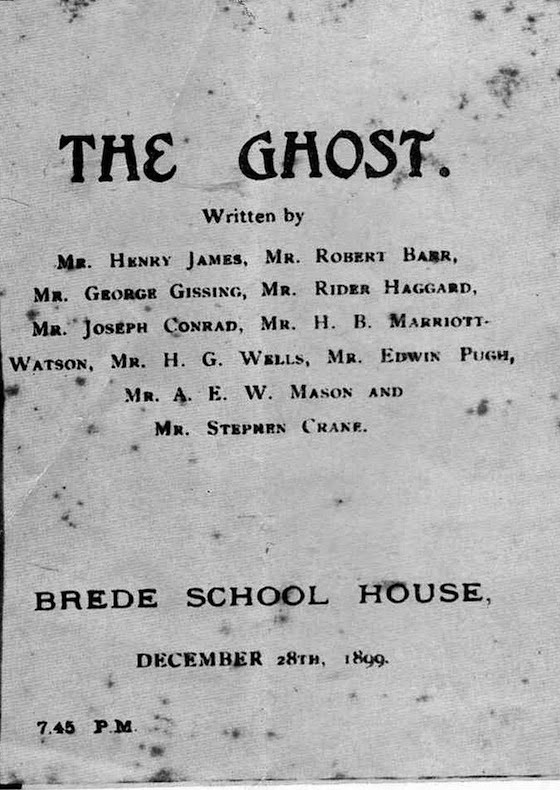
What is it about young ex-pats writing single performance plays performed by amateurs at Christmas? A recent Jot told the story of The Princess and the Pauper, a drama by the 24 year old British humorist Harry Graham, which was performed by amateurs at Christmas 1900 in Government House, Ottawa. Exactly a year earlier, a one-off performance of The Ghost, written mainly by the 27 year old American Stephen Crane, best known for The Red Badge of Courage, was acted out by amateurs, at Brede, near Rye in Sussex.

In 1899 Crane and his wife Cora were renting Brede Place, a crumbling mainly late medieval manor house, a mile from the village, with huge fireplaces but no indoor plumbing.

Though the Cranes were enchanted by its old-world charm and maintained an open house for all and sundry, some visitors were less enamoured. One was Karl Edwin Harriman, who in print complained of the ‘chill, damp and draughts of the old house ‘, and of the wind ‘which whistled through the casements every moment of the day and night ‘. Ford Madox Ford described it in Mightier than the Sword as ‘ an ill-fated mansion…full of evil influences ‘.

Continue reading →

A letter from Baron Corvo

An undated  Baron Corvo letter (1889-1890) about the artworks in the church of St Cuthbert with Matthias in Earl's Court, London. Rather short but with classic Corvine nuances.

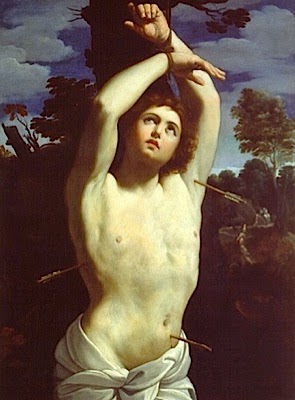
Written to the vicar Father Westall shortly after the first 2 or 3 pictures of the Stations of the Cross were hung in the London church, from the Collegio Suizzera, Rome (Scots College). There is much online about this splendid church (and Fr. Westall) but no mention of the Guido Reni (sold/ stolen?) The letter was published in the Autumn 1966 Philbeach Quarterly, a magazine somewhat in advance of the usual parish newsletter - it had a poem by Betjeman ('Anglo Catholic Congresses') a good piece on the Arts and Crafts figure William Bainbridge Reynolds + John Heath-Stubbs and Michael De-La-Noy were on the editorial board.The enigmatic self-styled Baron Corvo, Frederick Rolfe (rhymes with loaf*) writes:

Dear Sir,
May I be allowed to ask the name of the painter of the Stations of the Cross in your church, and history of the very fine copy of Guido Reni's San Sebastian, which also hangs there?
Though I do not suppose any weight attaches to my opinion, I feel bound to say that your Stations are far more beautiful than any I have seen, even here, and the Guido, too, is the best representation of the original I know, though perhaps a little "skied."
Your obedient servant,
Frederick William Rolfe,
Clerk.

*The late Donald Weeks' pronunciation, presumably researched and authenticated by him.


An Ear for Murder

Found - a rare and sensational Australian pulp mystery/ thriller from the late 1940s. Unknown to online malls and the great bibliography of crime fiction by Allen J Hubin, although he lists other titles by Max Afford. It is titled An Ear for Murder (Frank Johnson, Sydney, no date). The inside cover reads:

This is a Magpie novel - read it now it will hold you to the end.
What manner of creature was this, to whom the slaying of his victim was not enough? What manner of foul beast was it whose bloody fingers must perform the further savagery of mutilation? What strange secrets lay behind the locked doors of the mysterious, corpse-guarded study? These are the questions answered by world-famous criminologist Jeffery Blackburn in this punch-packed story of murder on the loose. With thrills on every page, this grand story of crime and detection is a "must" for murder-fiction fans. You won't be able to put it down until you've turned the last page.

The book appears intelligent and well written , the sleuth's day job being a professor of higher mathematics. The claim on the cover 'No crime could be more horrifying in its ferocity' may be something of an exaggeration..the plot involves a crazed novelist, a millenarian sect and a titled British millionaire stockbroker. There are as many as 100 books in the Magpie series, not all thrillers or even fiction.


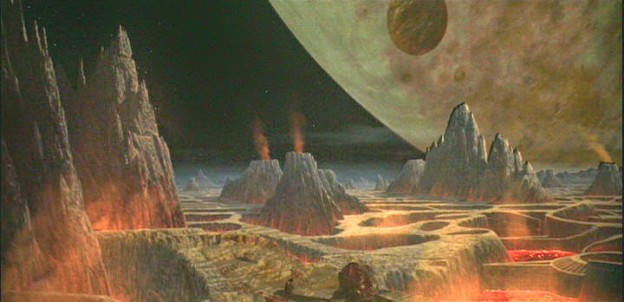
Vulcan 2

The second part, from the fascinating forgotten work Oddities: A Book of Unexplained Facts (Allan, London 1928) by R.T. Gould, on the non-existent planet Vulcan. The first part can be found here.

Vulcan Landscape (from Star Trek, the Motion Picture)
 Leverrier, once convinced as to the real character of Lescarbault's discovery, lost no time in performing the necessary calculations which that worthy had found so baffling. He obtained, for the new planet's mean distance from the sun, about 13,000,000 miles, and for its period of revolution 19 days 17 hours. Lescarbault, who had seen Mercury in transit over the sun with the same telescope, and the same magnifying power, on May 8, 1845, considered that the new planet (which he decided to name "Vulcan") had a disc rather less than a quarter as large. Accordingly, Leverrier calculated that Vulcan's volume was probably about one seventeenth that of Mercury. It did not escape him that, supposing its mass to be in anything like the same proportion, Vulcan could not be held responsible for more than a small fraction of the disturbances observed to be taking place in Mercury's orbit.

  He also calculated that Vulcan ought to be in transit on the sun's face on or about April 3rd and October 6th of every year, at which times it should, of course, be visible in the same manner as it had been to Lescarbault. He did not hold out much hope of its being seen at other times, since he computed that its lustre would be so feeble that it might easily remain unseen, even during a total eclipse of the sun.*

  * Proctor has questioned this statement. By his calculations, Vulcan and Mercury, seen during eclipse at their greatest angular distance from the sun, would appear about equally bright.

Continue reading →

Flexible Books from Jonathan Cape

In a little recorded piece of publishing history Jonathan Cape in 1934 issued a series of small books called Flexibles. They were cloth covered books with dust jackets but the covers were much thinner than hardbacks and  flexible. They were a sort of half-way house between paperbacks and hardbacks. The first Penguin paperbacks appeared the next year and may have caused the premature demise of this series after only 10 books. They were quite stylishly presented and pleasant to handle. All were reprints.

The first in the series Lewis Browne's The Story of the Jews was probably re-issued as a counter to  the rise of Hitler.  Others in the series include Hemingway's Men Without Women (uncommon now especially in the jacket) Joyce's Portrait of the Artist and later Dubliners, followed by Beverley Nichols Twenty-Five. The last 'flexible' was Italian Backgrounds by Edith Wharton, number ten in the series. All came out in 1934 and as far as can be ascertained there was no number eleven. Amazon has this review of the fifth book in the series Sarah Orne Jewett's The Country of the Pointed Firs: 

No plot devices or car chases here--this is a book to read on a rainy afternoon when nostalgia and melancholy threaten to overwhelm. It's comfort food like grandma used to make--reassuring, soul-fortifying, and full of the capacity to cheer. It's also addictive--once you take a bite out of Pointed Firs, you can't stop.


Arts and Crafts Fiction 1909

Frontispiece by Frances Ewan showing Sara 'at work in the Art Galleries of Florence.'

Found - an Edwardian novel by Rosa Mulholland Cousin Sara. A Story of Arts and Crafts (Blackie, London 1909). A novel of its time with a setting in the artistic world, with Britains travelling in Europe (Italy) and manufacture and invention. These themes appeared in many novels of the time - especially Galsworthy, E.M. Foster and H.G. Wells (the brilliant Tono Bungay- also from 1909). The plot is neatly summarised on a loosely inserted flyer:

 Miss Mulholland's new book is a story of arts and crafts in the double sense of both words. The scene is laid in Belfast and its environments, in London, and in Italy. Sara's father has lost his legs in battle, as developed a talent for the invention of machinery. Arno Warrender is the son of a dead friend of Robert Montgomery, owner of Montgomery's flax spinning mills at Bleachgreens, and has been received in the office of the mill side-by-side with Harvey Durrant, the protege and supposed heir of Sir Jonah Cunnyngham, a wealthy banker and retired shipbuilder. Arno, with genius and passion for art, gets into disgrace, and through tribulation finds freedom, flies to Italy, and gains the highroad to distinction, while Harvey remains the favourite of his circle. The Colonel's important invention is stolen and patented by a person in his confidence, while the real inventor is discredited. On this incident, and all that leads up to it, and on its consequences the main action depends. Sara is a devoted daughter, and the good angel of Arno through all his troubles.

Macaroni Cheese by Wilfred Pickles

Wilfred Pickles and his wife Mabel

From "As We Like it" Recipes by Famous People edited  by Kenneth Downey  (Arthur Barker, London 1950.)  There is much mention of rationing as in this recipe from Wilfred Pickles. Rather forgotten today but at one point his shows on BBC Radio and TV attracted millions. He also appeared as the grumpy father in Billy Liar (1963).

Macaroni

Here is the recipe I promised you: in these days of shortage of meat this is a recipe which is easy to make and all of the food is unrationed.

First, steam some macaroni in a pressure cooker for 10 minutes, then make a white sauce with grated cheese. Put this cheese sauce over the macaroni, fry some rings of onions crisp, grill some tomatoes and serve with hot, dry toast. And by gum it's grand!

Cherry Cake by Enid Blyton, Mulled wine by Evelyn Waugh

From "As We Like it" Recipes by Famous People edited  by Kenneth Downey  (Arthur Barker, London 1950.) Famous people included Joyce Grenfell, Georgette Heyer, Leslie Charteris, Douglas Fairbanks, Christopher Fry, Celia Johnson Vivian Leigh, Richard Mason, Charles Morgan, Ivor Novello Laurence Olivier, Wilfred Pickles, Freya Stark, Richard Rogers, Eleanor Roosevelt ,Katherine Hepburn, Enid Blyton and Clementina Churchill. The book has a forward by Edwina Mountbatten of Burma and she writes that every penny from the sale of the book will go to the funds of the Returned Prisoners of War Association. There is much mention of rationing and tinned food  but Evelyn Waugh goes for an extravagant and slightly incapacitating mulled wine in full Brideshead fashion.

Mulled Claret (for six persons)

Take six bottles of red wine (it would be improper to use really fine Bordeaux, but the better the wine, the better the concoction.)  Any sound claret or burgundy will do. 1 cup full of water; 2 port glasses of brandy; 1 port glass of ginger wine; 1 orange stuffed with cloves; peel of two lemons; 3 sticks of cinnamon; one grated nutmeg.

Heat in covered cauldron. Do not allow to simmer. Serve hot and keep hot on the hob. Should be drunk at the same temperature as tea. To be drunk during and after luncheon in February or after dinner on any winter evening.

Enid Blyton's recipe is for a fairly simple and economical  Cherry Cake for the children…

This is a cake my own children love, and is easy to make when children come to tea.

Ingredients:

Half pound of margarine. 3 eggs. 6 ounces castor sugar.6 ounces cherries. 6 ounces flour. A few drops of vanilla essence.

Method: Beat the margarine and sugar till soft and creamy, drop in eggs one by one and beat well in between each. Add flour gradually, and lastly cherries and flavouring. If too stiff, add a little milk. Bake in a moderate oven to start, and then drop to Regulo 3. It takes about 1 1/2 to 2 hours to bake.

This is just as nice with fruit instead of cherries, or ginger cut up it is excellent.

Half the quantity makes a nice little cake for tea, but only takes 3/4 to 1 hour to cook.


A Johnson and Boswell scholar at the front 1918

From the introduction to R.W. Chapman's scholarly edition of Johnson's Journey to the Western Islands of Scotland... (Oxford 1924.) Chapman survived World War One. While a generation of great  scholars were killed and many books and academic projects were never completed Chapman actually managed to work on editing Boswell while soldiering at the Macedonia front - as he explains.

In the fine tradition of the soldier/scholar he always travelled with his Horace (Odes); just after the war he wrote The Portrait of a Scholar and Other Essays Written in Macedonia 1916-1918 (Oxford University Press, 1920.) He collected silver spoons, and on that subject he regarded 'the speech of Eton and Christ Church as the most beautiful of earthly sounds...' Returning from the Eastern front he stated that there were 'few more exciting pursuits than textual criticism.' He also edited Jane Austen, for which he is now chiefly known.

Mountain gun at Macedonia Front in World War 1

This edition was planned, and in great part executed, in Macedonia, in the summer of 1918. I had a camp behind Smol Hill, on the left bank of the Vardar, and a six inch gun (Mark XI, a naval piece, on an improvised carriage; 'very rare in this state'), with which I made a demonstration in aid of the French and Greek armies, when they stormed the heights beyond the river; I think in June. This was in the early hours of the morning, and a very  pretty display of fireworks. 12 hours later, I remember, Mark XI was still too hot to touch. But long weeks of inactivity follow. I had a hut made of sandbags, with a roof constructed of corrugated iron in layers, with large stones between, to allow perflation*; and here, in the long hot afternoons, when 'courage was useless, and enterprise impracticable', a temporary gunner, in a khaki shirt and shorts, might have been found collating the three editions of the Tour to the Hebrides, or re-reading A Journey to the Western Islands in the hope of finding a corruption in the text. Ever and again, tiring of collation and emendation, of tepid tea and endless cigarettes, I would go outside to look at the stricken landscape - the parched yellow hills and ravines, the brown coils of the big snaky river at my feet, the mountains in the blue distance; until the scorching wind, which always blew down that valley, sent me back to the Hebrides. These particulars are doubtless irrelevant; but I like to think that the scene would have pleased James Boswell."

*Samuel Johnson has the word perflation in his dictionary and defines it as 'the act of blowing through' from perflate 'to blow through.' He uses it in this very book on page 72 -'perpetual perflation' - talking of the drying of oats. See also this excellent posting on Chapman and this book.