Arnold Bennett and ‘dressing apraxia’

Football fans among the Jot 101 community may remember the ridicule which greeted the failure of the childlike Manchester City striker Mario Balotelli, to don a  simple training bib. Fans blamed the footballer’s apparent dimness , but his difficulties with clothing recall a syndrome known as  ‘dressing apraxia ‘,which, according to the consultant neurologist G. D. Perkin, writing in the British Medical Journal,  ‘are graphically described by the novelist Arnold Bennett in Clayhanger*

Bennett ‘s Journals reveals the novelist to have been interested in medicine as it concerned his own chronic poor health , some of the symptoms of which were neuralgic pains, headaches and insomnia, but also that of his  father, Enoch. Perkin argues that the ‘dressing apraxia’, clearly demonstrated in Darius Clayhanger’s inability to dress himself, was a reflection of Enoch’s own medical condition. Having failed to identify the disease responsible for the symptoms suffered by both men, Perkin final alighted on Pick’s disease, a rare neurodegenerative condition, a description of which he discovered in a French medical journal of 1928. As this disease is often familial, and according to Bennett’s biographer Margaret Drabble, it was reported to have killed two of his sisters, might  the symptoms suffered by Bennett suggest that he too may have been afflicted, though Perkin maintains that the Journals ‘nowhere support the possibility’.

Bennett’s sometimes frantic search for quack remedies for his chronic bad health occasionally placed him in further danger. Could it be that the ill-judgement, a product of the cognitive impairment brought about by Pick’s disease, caused the novelist’s own tragic death. In January 1932, while staying in a Paris hotel, Bennett refused to pay for mineral water in the restaurant and, ignoring the advice of the waiter that this was not a wise thing to do, downed a glass of tap water from the carafe. He was taken ill with typhoid and died two months later. [RR]

*For many months now he had helped Darius to dress, when he came up from the shop for breakfast, and to undress in the evening. It was not that his father lacked the strength, but he would somehow lose himself in the maze of his garments, and apparently he could never remember the proper order of doffing or donning them. Sometimes he would ask, “Am I dressing or undressing?” And he would be capable of so involving himself in a shirt, if Edwin were not there to direct, that much patience was needed for his extrication. His misapprehensions and mistakes frequently reached the grotesque. As habit threw them more and more intimately together, the trusting dependence of Darius on Edwin increased. At morning and evening the expression of that intensely mournful visage seemed to be saying as its gaze met Edwin’s, “Here is the one clear-sighted, powerful being who can guide me through this complex and frightful problem of my clothes.” A suit, for Darius, had become as intricate as a quadratic equation.

R.T. Gould and The Planet Vulcan 1

T.T. Gould & his wife Muriel
Found - a fascinating forgotten  work Oddities: A Book of Unexplained Facts (Allan, London 1928) by R.T. Gould. Rupert Thomas Gould (1890 – 1948), was a lieutenant Commander in the British Royal Navy noted for his contributions to horology. While in the navy in WW1 he suffered a nervous breakdown. During long recuperation, he was stationed at the Hydrographer's Department at the Admiralty, where he became an expert on various aspects of naval history, cartography, and expeditions of the polar regions. He gained permission in 1920 to restore the marine chronometers of John Harrison, and this work was completed in 1933. Jeremy Irons played him in Longitude, a dramatisation of Dava Sobel's book about John Harrison Longitude: The True Story of a Lone Genius Who Solved the Greatest Scientific Problem of His Time, which recounted in part Gould's work in restoring the chronometers.

Something of a polymath, he wrote an eclectic series of books on topics ranging from horology to the Loch Ness Monster. He was a member of the Sette of Odd Volumes (Brother Hydrographer) and the book Oddities is dedicated to the club. He was a science educator, giving a series of talks for the BBC's Children's Hour starting in January 1934 under the name "The Stargazer", and these collected talks were later published. He was a member of the BBC radio panel Brains Trust. He umpired tennis matches on the Centre Court at Wimbledon on many occasions during the 1930s. This is the first part of the chapter on the planet Vulcan (more to follow)-

Continue reading →

Gabrièle Buffet Picabia on Dada

Found in an exhibition catalogue from the Hanover Gallery, London 1968 of Francis Picabia watercolours this unpublished essay on Dada by Picabia's widow Gabrièle Buffet Picabia (1884 - 1988). It is mostly quotations from important Dadaist manifestoes but the first part is by her (followed by Andre Breton.)

The intellectual world of Europe has been upset for several years by a strange sect which calls itself "Dada", and its followers Dadaists.

It is difficult to define Dada because Dada pretends to escape from everything that is common or ordinary or sensible. Dada does not recognise any traditions, any influences, or indeed and limits. Dada is a spontaneous product of life; a sort of cerebral mushroom which can appear and grow in every soil.

Dada cannot be defined; it reveals itself; and during the five years in which Dada manifestations have taken place all over the world, the public which comes en masse, in turn furious, amused, deceived, and nevertheless subjugated, has not succeeded in solving this problem:

Are the Dadas serious?
Are the Dadas curers?
Are the Dadas artist?
Are the Dadas dangerous?
Are the Dadas harmless idiots?

Continue reading →

The face that launched a thousand ships

In Marlowe’s Doctor Faustus the hero greets Helen of Troy with two of the most famous lines in English literature:

Was this the face that launch’d a thousand ships
And burnt the topless towers of Ilium ?

It was always assumed (for some reason) that this arresting imagery could not have emanated new-minted from Marlowe’s imagination, and for years scholars tried to find a source. Classical texts were ransacked for clues and in 1938 the art historian W. S. Heckscher, writing in the Journal of the Warburg Institute, reported that in an exchange between Hermes and the cynic Menippus in Lucian’s Dialogues of the Dead he had discovered the following lines which had been prompted by the two men surveying a pile of skulls of the once famous, who included the former beauty, Helen of Troy:

Menippus: And for this a thousand ships carried warriors from every part of Greece;
Greeks and barbarians were slain, and cities made desolate.. (translation by F. G. Fowler )

Heckscher argues that this democratic dictum of mors omnia aeqat (in death we are all equal)-- that the facial characteristics of beauty and ugliness which distinguish us in life-- are wiped out in death, was  quite common in the later period of the ancient world. He also speculates that the learned Marlowe probably met with the Lucian dialogue from the translation by Erasmus of circa 1535.
Of course, a similar message can be found on gravestones in Britain from the sixteenth to the eighteenth centuries. One epitaph that never fails to chill my bones accompanies a most life-like skull:

Remember man, as you walk by
As you are now, so once was I
As I am now, so shall you be ….

[RH]

Many thanks Robin...Eliot's lines from The Waste Land inevitably come to mind:

Gentile or Jew  
O you who turn the wheel and look to windward,
Consider Phlebas, who was once handsome and tall as you.

Consider Phlebas? Good title for a novel...

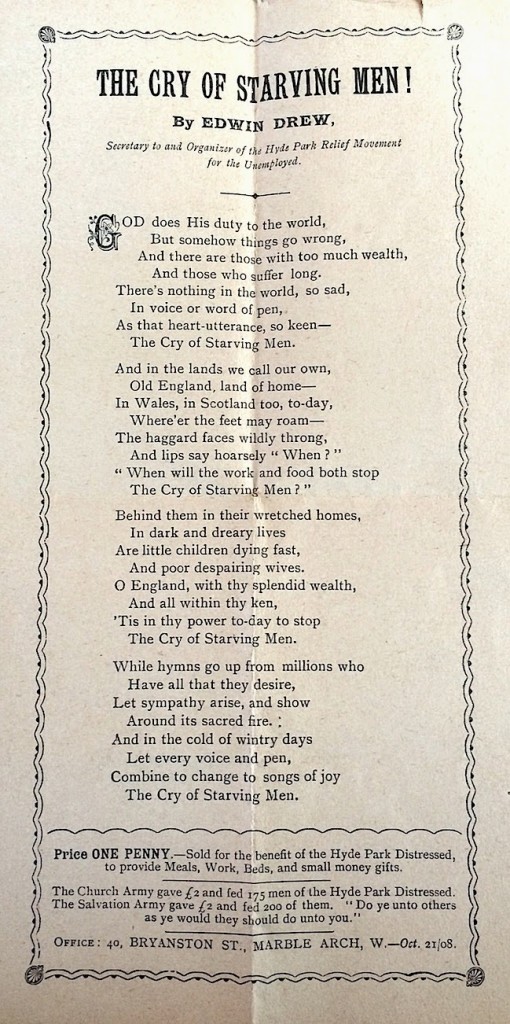
The Cry of Starving Men by Edwin Drew (1908)

A small hand bill, a one page poem, sold for a penny in 1908 to raise money for the poor by the 'Hyde Park Relief Movement for the Unemployed' with The Cry of Starving Men written by the author, elocutionist and poet Edwin Drew. He appears to have been a correspondent of Dickens (the name Edwin Drood was inspired by his name.) He flourished between 1870 and 1915. There is Pathe News footage of him as 'the last survivor of the Dickens society' - placing a wreath on the novelist's tomb. Drew's last published work was The Chief Incidents of the 'Titanic' Wreck (1912). Of the Hyde Park Relief Movement for the Unemployed very little is known*,apart from the information on this hand bill.

* There may well be much more information in libraries, online research reveals this one note at Open Library - 'The Labour Bureau was established in consequence of Drew's founding of the Hyde park relief movement following his speeches on unemployment, in Hyde park in September 1908.' This poem is dated October 1908...

A Khruschev joke

A clipping from the Daily Telegraph 2/6/1956.

Khruschev Anecdote 

Only rarely did Molotov, now retired, show the slightest trace of a sense of humour. Khruschev , on the other hand,won full marks in Downing Street for the story he told there.

He was describing his difficulties with his new middle class of technicians. 'You can't' he explained 'go on telling them what to do and think.The Secret Police handle them stupidly.'

Then he said that recently he had joined some technological students over the samovar to see what sort of ideas they had.

He turned to one and asked: 'Tell me, who wrote Anna Karenina?' 'Not me Comrade Khruschev, not me. I assure you.'

Tolstoy Redivivus

Next day Khruschev sent for the Secret Police chief. 'You see' he told them 'what nonsense goes on as the result of your stupid methods. I ask a student who wrote Anna Karenina and  me tells it wasn't him.'

Later that day the Secret Police chief came back and said: 'I have dealt with the matter of the student you complained about.'

'Well' said Khruschev, 'what have you done?'

'I had him round the office for an hour and he has now confessed he did write Anna Karenina.'

Unknown cat poem…

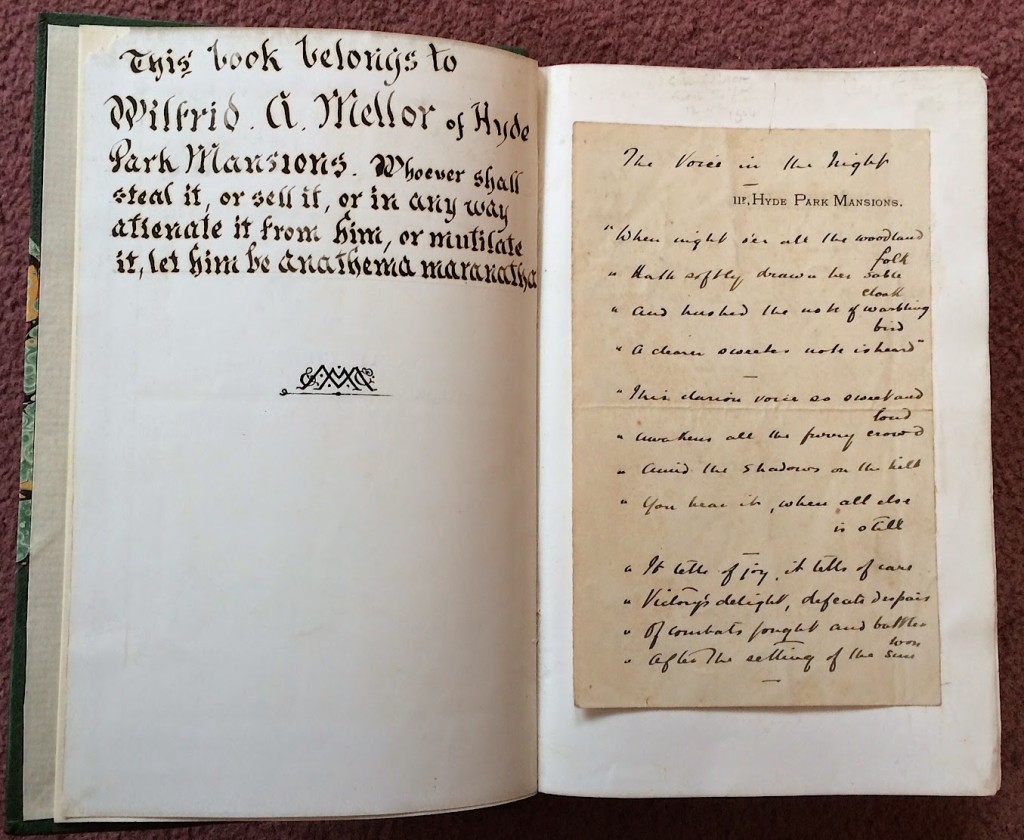
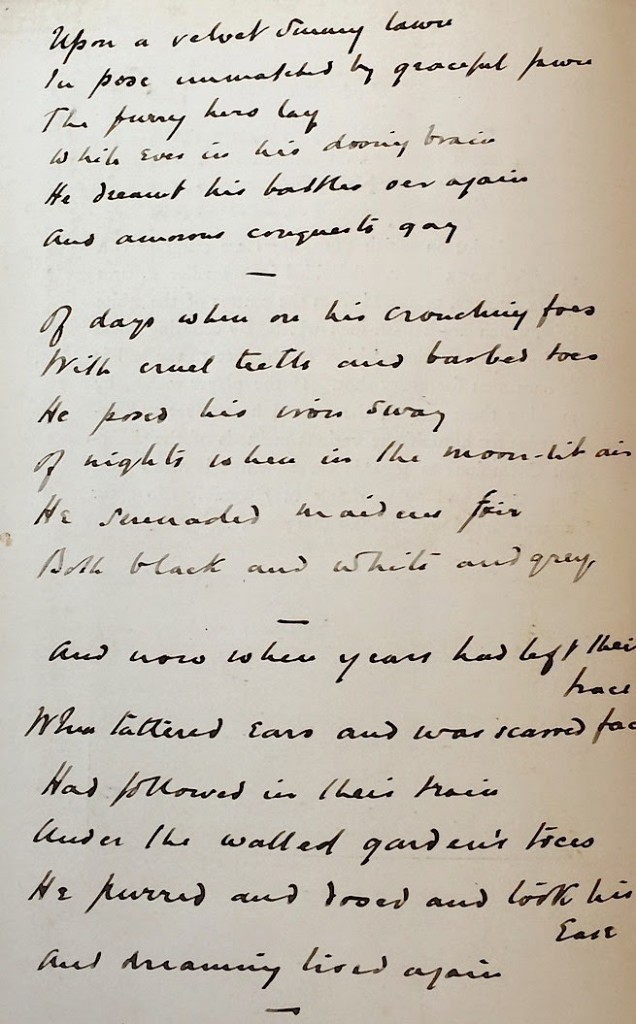
Found in an expensive leather bound book on golf courses from 1909 these tipped in poems. They appear to be the work of one Wilfrid A Mellor. The second poem about a cat is a sort of prequel to Eliot's Old Possum, not quite up there with Eliot but a bravura performance which we quote in its entirety:

Upon a velvet sunny lawn
In pose unmatched by graceful fawn
The furry hero lay 
While ever in his drowsing brain
He dreamt his battles o'er again
And amorous conquests gay

Of days when over his crouching foes
With cruel teeth and barbed toes
He posed his iron sway
Of nights when in the moon-lit air
He serenaded maiden fair
Both black and white and grey

And now when years had left their trace
When tattered ears and war scarred face
Had followed in their train
Under the walled gardens trees
He purred and dozed and took his ease
And dreaming lived again

Written in the front of the book are these words:'This book belongs to Wilfrid A Mellor of Hyde Park Mansions. Whoever shall steal it, or sell it, in any way alienate it from him, or mutilate it, let him be anathema maranatha.'

('Anathema maranatha' is from the Septuagint, the Greek version of the Old Testament and means 'Accursed (for) the Lord is Coming.') The other poem is less memorable but can be read by clicing on the image at the top. A search online reveals that a Wilfrid A Mellor was a solicitor from Downham Market, Norfolk. He is  mentioned in the Police Gazette as attending various trials between 1895 and 1910. 11F Hyde Park Mansions may have been his pied a terre. The country address might explain the golf..

Chesterton, Belloc, Baring

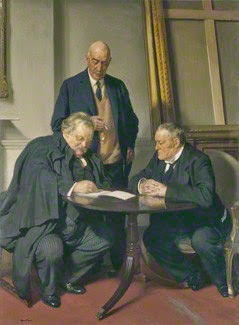
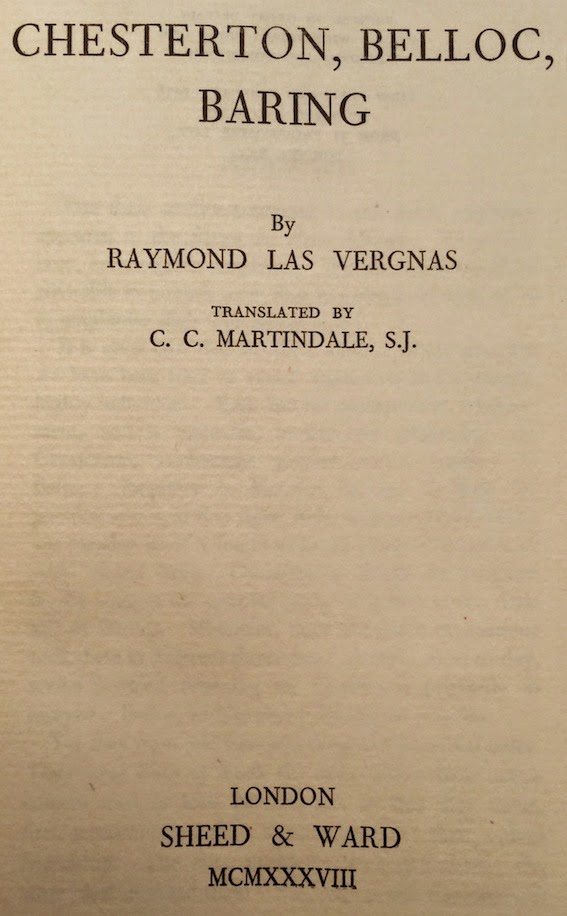
Found in the vast Jimmy Kanga collection a work on three of his favourite writers. Nearly 10% of his 20,000 books are by or are related to this British Catholic triumvirate, many in multiples... The book is Chesterton, Belloc, Baring by Raymond Las Vergnas (Sheed & Ward, London 1938.) The jacket shows  Sir (Herbert) James Gunn's oil painting Conversation Piece (G.K. Chesterton; Maurice Baring; Hilaire Belloc). The picture resides at the National Portrait Gallery with this note in the catalogue:'The idea for the portrait came to Gunn at a dinner to celebrate Belloc's 60th birthday ; the completed work was shown at the Royal Academy in 1932.'

From the foreword to the book :

Inside d/w blurb

It is quite true that the three authors whose portraits we have here tried to sketch were, first and foremost, highly individual. Each had his characteristic temperament, and a vigourous, undisguised originality. In Chesterton, exuberance predominates: lucidity in Belloc: limpidity in Maurice Baring. A taste for paradox seems, at first sight, to be common to all three: yet paradox itself is found to be, in them, susceptible of very varied hues. Chesterton's shouts of laughter hardly suggest the guarded irony of Belloc or the Attic salt of Baring. Moreover, their dominant inclinations took them in different directions. A critic, even-to-day, seems justified fastening on Chesterton primarily as essayist; Belloc, as historian; Baring, as novelist.

Yet they meet and fuse in a deep and powerful unity. They were born at much the same time; their active careers were at least parallel, and to this they owed, first, acquaintance; then, a mutual esteem; then, a close friendship. The same problems fascinated them: the same ideal directed them: they met in the Communion of a self-same Faith. The Catholic Faith did indeed provide one and the self-same inspiration not only to their work, but to their very being. Against the general background of after-war English letters, one sees them standing out ever more clearly as a trinity. Yes; they are 'the Three Catholics,' indeed, the 'Three Great Papists,' as not a few have already liked to nick-name them.

Further still;, we find united together in their love for France,a love that they have always sought to express with so much culture and alertness, and so effectively. All three sought with an equal ardour to present France under her true aspects to English eyes. One of these three 'Friends of France,' Chesterton, has died. On the morrow of so grave a loss to Anglo-French literature, it seems to us not only right, but a duty, to associate with his great memory the greatness of those other two who toil at the self-same task.

We can pray for no worthier justification of this book.

Rayond Las Vergnas December, 1936

London Night and Day 1951

London Night and Day, illustrated by Osbert Lancaster, edited by Sam Lambert (Architectural Press, 1951)

Surely one of the most entertaining of the plethora of books brought out in the wake of the Festival of Britain. The coloured cover illustrations and the vignettes in black and white were by Osbert Lancaster, a friend of John Piper—the same John Piper who is named in a section devoted to the Festival, to which he contributed, among other things, a superb semi-abstract panorama. If you hadn’t been informed that Lancaster had designed the cover, you would have attributed it to Piper, whose style of portraying shop fronts is showcased in Buildings and Prospects, which had appeared just a few years earlier. Lancaster’s style is identical. Was Piper concerned that he was being flagrantly copied by Lancaster? Probably, but according to his biographer Frances Spalding, the two men were friends.

Continue reading →

Battle of Waterloo not won on the playing-fields of Eton

Further illusions shattered by this small book The Encyclopaedia of Fads and Fallacies by Thomas Jay (Elliott Rightway Books, Kingswood Surrey 1958.) Apparently bulls are colour blind so red rags do not bother them, Turkish baths are not Turkish (and they are not baths) and alcohol cannot be drunk in any concentration strong enough to kill germs. Even the assertion that 'The Battle of Waterloo was won on the playing-fields of Eton' also appears to be unfounded according to the iconoclastic T. Jay. It seems a pity, as it is one of those poetic ideas like AE's 'In the lost boyhood of Judas / Christ was betrayed.' What Jay actually says is:

The Duke of Wellington is credited with having said 'the The Battle of Waterloo was won on the playing-fields of Eton.' There is no truth in that assertion. There were only a very small number of officers from Eton at the battle.

The quotation may have been taken too literally by Jay -online research reveals this at the Wikipedia entry on Eton:

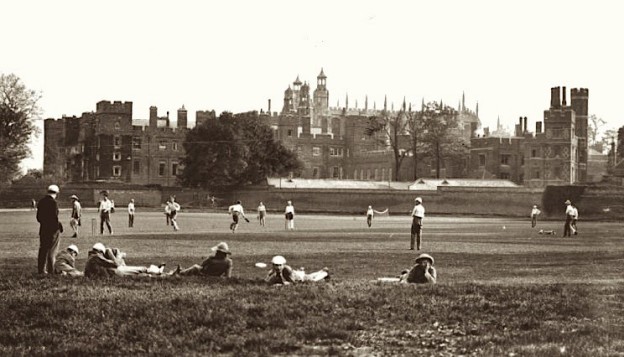
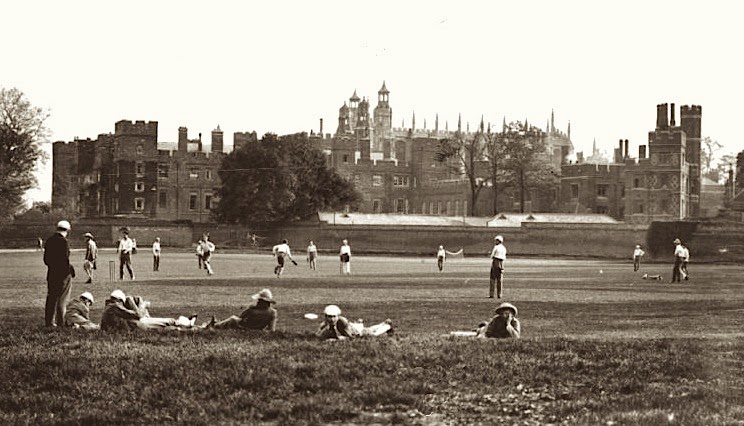
According to Nevill (citing the historian Sir Edward Creasy), what Wellington (actually) said, while passing an Eton cricket match many decades later, was, 'There grows the stuff that won Waterloo', a remark Nevill construes as a reference to 'the manly character induced by games and sport' amongst English youth generally, not a comment about Eton specifically. In 1889, Sir William Fraser conflated this uncorroborated remark with the one attributed to him by Count Charles de Montalembert's C'est ici qu' a été gagné la bataille de Waterloo ('It is here that the Battle of Waterloo was won.')

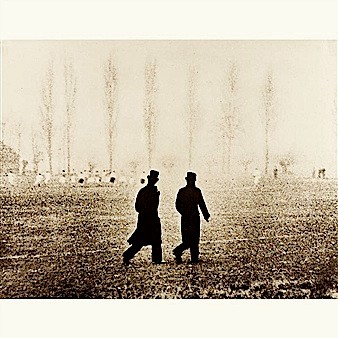
Moholy Nagy 'Dusk at the Playing Fields of Eton'

Ostrich Fallacies

Found in The Encyclopaedia of Fads and Fallacies by Thomas Jay (Elliott Rightway Books, Kingswood Surrey 1958) a small section on ostrich fallacies. The reference to a Bergen Evans
book is probably his Natural History of Nonsense.

The Diet of the Ostrich

There is a foolish notion that the ostrich can digest iron. Many zoos and menageries have quite a lot of trouble because the public will feed ostriches with nails or bits of metal. As Bergen Evans points out in one of his books, it rarely occurs to people that the purposes of the bars, moats, and walls at zoos is to protect the animals from us. 

Ostrich

An ostrich does not bury its head in the sand thinking that it is hiding itself. But what some politicians will do without the metaphor I don't know. If alarmed, or suspicious, the ostrich will lie flat on the ground with its head stretched out flat in front so that it can size up the situation. And it can do that very well from that position.


The Sensational Story of the Christie Case

Found - a sensationalist paperback The Christie Case (Gaywood Press, London circa 1958). A rare non-fiction pulp by Ronald Maxwell - one of the youngest journalists following the case. The book begins:

The Christie case was more than the stories below the headlines for me.It was the story behind the headlines and it took many sleepless nights and long-drawn days to unfold as I followed closely upon the greatest manhunt of modern days, culminating in the final arrest of a man named John Reginald Halliday Christie, in whose flat the partly clothed bodies of four women were found strangled. In the small garden behind the flat, there were uncovered the skeletons of more women, who were still not identified weeks after the discovery.

The story began when a coloured man named Beresford Brown decided to fix the wireless in the kitchen of the ground floor flat at number 10 Rillington Place, Notting Hill, London W 11. That was on Tuesday, March 24, 1953. Beresford Brown intended to share the kitchen of the flat – which had recently been vacated by John Christie – with other tenants of this dingy, two storey house. By accident, the man tapped against the wall, and there was a hollow sound. It intrigued him. He tore away a strip of wallpaper and discovered a small hole in the partition which his action had exposed. Through the hole, in the small cavity inside, he saw a woman's leg. Shaken with horror, he looked closer. There, in the dark hollow, he could see well enough to distinguish the outline of a partly clothed body. In his brief glance it up in the fact that there were two bundles behind the body. 

… He ran excitedly into the street in search of the police, it was not difficult to find a constable in this part of the Royal Borough of Kensington... within minutes, the whole apparatus of Scotland Yard been set in motion in motion and the hunt had begun...

J.N.W. Sullivan & Colin Wilson — ‘The Desirability of the Ordinary.’

Found in a pamphlet by Colin Wilson: Autobiographical Reflections (Paupers' Press, 1980) this quotation from the writer J.W.N. Sullivan. Sullivan was a friend of Aldous Huxley & John Middleton Murry, later he knew Aleister Crowley and was part of Ottoline Morrell's intellectual country house salon at Garsington in the 1920s. In the first World War he worked in the ambulance services in Serbia. Colin Wilson writes of him:

I have always felt that the very essence of the human problem was grasped by that fine music critic, J. W. N. Sullivan, in his classic autobiography But For the Grace of God (London: Jonathan Cape 1932). He writes about the first world war:

Continue reading →

Carroll Levis and the Meaning of Dreams

Found in The World's Strangest Ghost Stories by R. Thurston Hopkins (Kingswood: The World's Work, London  1955) this piece in the preface about the American writer, TV personality and dream therapist Carroll Levis. There is much on Carroll online with Pete Waterman claiming he invented reality TV and The Beatles in their earliest form as The Quarrymen failing in the first rounds of one of his TV talent contests(1957). Paul McCartney described him as the 'Hughie Green of his day.'

Thurston Hopkins is dealing with an earlier incarnation of Levis as a radio star and before that a sort of analyser of dreams (during the depression.) At the end Hopkins even brings in our own J.B. Priestley, also in his time something of a star...The radio show where the public's dreams are re-enacted seems ripe for rebirth.

In 1931, Carroll Levis, who presented the Levis Discoveries Radio Show to eight million aficionados, published Dreams and their Meanings, which was syndicated and featured in newspapers in Canada and the United States. The same year, he wrote a radio series entitled Dream Dramas. Listeners were invited to send a description of their most vivid dreams to Levis, who rewrote them into short twelve-minute playlets. The dreams were re-enacted by  a group of actors, under the direction of Carroll Levis, and at the conclusion of the dramatized dream, a three-minute analysis and interpretation was given to the listeners.

Continue reading →

I once met….. William Rees Mogg

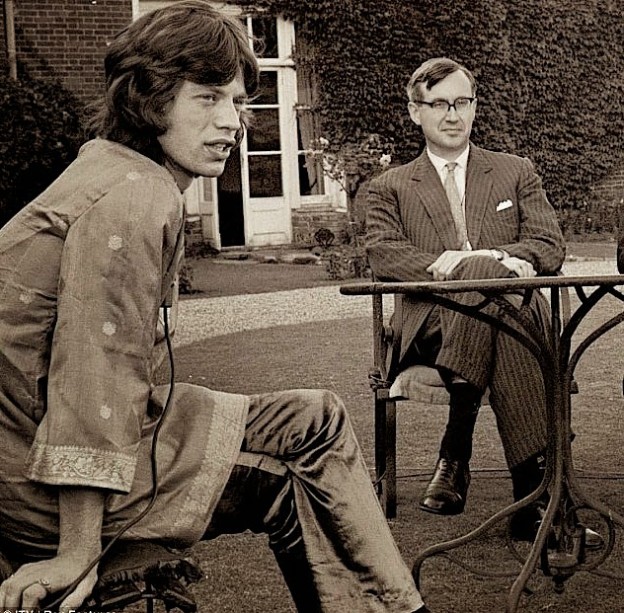
Sent in by a Jot regular - this moving account. In the rare book trade he was renowned for having returned an expensive book he had bought from another bookseller, saying 'I did not find it as saleable as I had hoped.' Only someone as eminent as the ex-editor of The Times could get away with such an excuse. The shot below is of him with Mick Jagger at a TV discussion in 1967 after William Rees Mogg's 'Who breaks a butterfly upon a wheel' editorial condemning a jail term handed to Mick for dope offences. At the time he was 10 years older than the great Stone.

This was after he’d left the editorial chair of The Times and was running the very posh Pickering and Chatto antiquarian bookshop in Pall Mall. Before I arranged to interview him I had mugged up on his tastes by reading the guide to book collecting that  he’d published a few years earlier. I must admit that I was a little intimidated by his reputation—not just as a high Tory patrician figure from the higher reaches of journalism—but also as someone whose refined tastes in Augustan literature were likely to show up my own thin knowledge of this area.

Continue reading →

How to be Happy on the Riviera 4


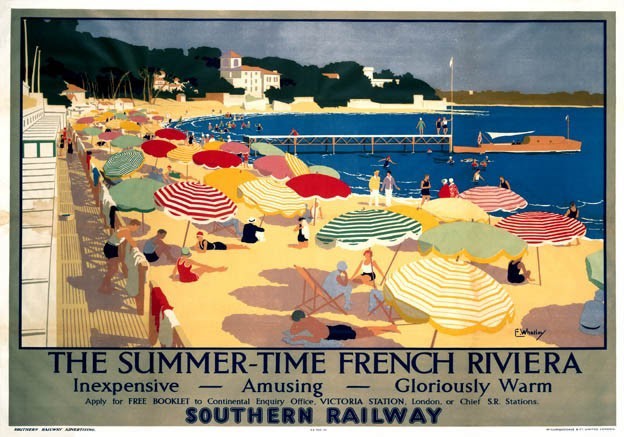
The concluding part of a posting of a complete book How to be Happy on the Riviera by Robert Elson W. (Arrowsmith Ltd., 11 Quay Street, Bristol, 1927).The appendix has a wealth of information, much of it aimed at the long stay vacationer and the expat or 'remittance man' (similar to the trustafrian of our time). The address and name of the British Consul in Monte Carlo (G W Hogg) the address of the British Library and the Anglo-American Library (in the Grand Hotel building.) There was even a weekly paper for the British abroad,The Cote D'Azur,that came out on a Friday. There is good advice for those who 'winter abroad' -- Hyeres is suggested for those who like it quiet, Monte Carlo for those who want it lively (but the bathing is poor). Also invaluable advice for the journey there, that might still hold true:-
"Don’t trust the time-tables as to there being a restaurant-car on any train southward from Paris (except the Calais–Méditerranée); bring a tea-basket with you and be prepared to grab things from the buffets at the Gare de Lyon and at Marseilles, or you may go foodless."

Continue reading →

Political and Royal gossip 1920s

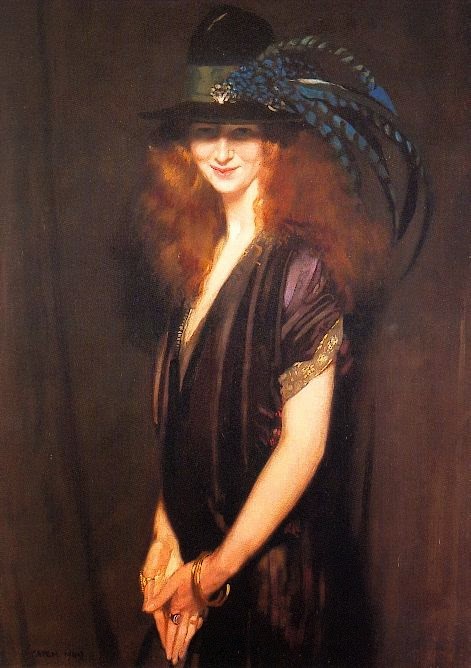
Lady Elvery by William Orpen

A good letter, over 20 closely written pages. Indiscreet, gossipy ('The Prince of Wales was blotto..') from the inner circles of power and privilege in the mid 1920s. The recipent was Beatrice Elvery, Lady Glenavy (1881 - 1970). Irish artist and literary host, friend of Katherine Mansfield and friend of Shaw, Lawrence and Yeats. She modelled for Orpen and painted 'Éire' (1907) a landmark painting promoting the idea of an independent Irish state. The letter is from her husband Charles Henry Gordon Campbell, 2nd Baron Glenavy (1885–1963) politician and banker in England and Ireland.

Quite a good little show at the Londonderry's the other night. Great strong retainers at the door in short kilts of the Stewart tartan created an atmosphere of sex appeal, much fortified by the magnificent bosoms of the Marchioness Curzon which are said to have only reached their full bloom for the first time this season.

Eire by Beatrice
Elvery (1907)

The white face of Elinor Glynn, a a long green velvet gown, made our RC aboriginals visibly insecure: her walk is so sensuous as to suggest unimagined pleasures in love and is enhanced by some minor pelvic obstruction which necessitates a few swings with the right leg before she can take a step. Her daughters, married to a pair of peers or better, offer a pleasant contrast of blackheads and anaemia. Lady Jowett was escorted by Eddie Marsh who is still holding up wonderfully together...........We bumped into Gladys Cooper fresh from the theatre in full make up, on Londonderry's arm and a bodyguard of four young men........

On asking Lady Jowett how she explained Baldwin's remaining in public life she said the Baldwin family had a firm hold on the British public's imagination ever since she said, when asked whether she found it (illegible) to have so many children imposed upon her by her husband that 'each time she closed her eyes and thought of England'...........

On Friday McGilligan, Hogan and Fitzgerald went to dinner with the King. Everything gold including the forks.

But the king forgot it was Friday: the soup was a meat soup so the R.C's couldn't eat it and in the end, after a huge long dinner all they had was a bit of sole. a few peas and an ice cream. They rushed back here at midnight and gorged themselves on rolls and butter and tea. They said the Prince of Wales was blotto........

[Later he goes to a party at Buckingham Palace and his take on the queen's breasts is hilarious....  He spends a lot of time with Mark Gertler and Mary Hutchinson. The letters ends on a scrap of 'Irish Free State Delegation' paper.] I am writing to keep myself awake while Ramsay Macdonald meanders on about things he doesn't understand.....

Constable and the Spedding family—-the missing pieces of the jigsaw

Sent in by a regular from Hertfordshire - Robin Healey.

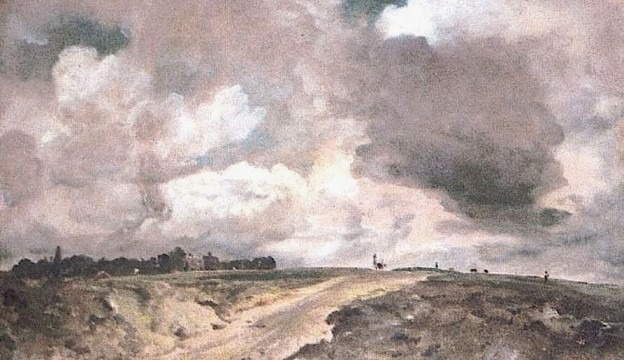
John Constable -- The Spedding Home

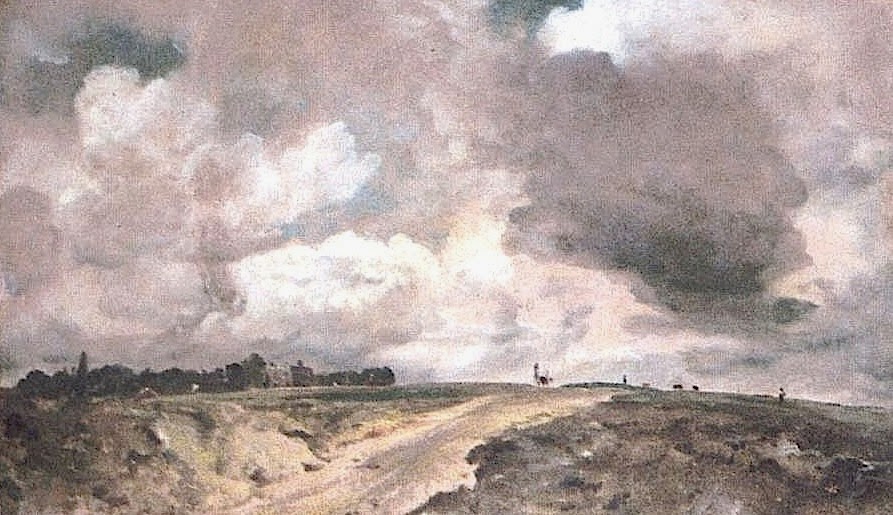
Less than five minutes into an episode of the recently aired Fake or Fortune series I pricked up my ears. Fiona Bruce and her art sleuths were discussing the provenance of a putative Constable painting of Yarmouth Harbour when they pronounced the name of a former owner, Jane Spedding.

That rang a very loud bell with me. You see, about 25 years ago I bought a rather battered dissected map of England and Wales, dating to around 1811, from an eccentric old dealer in the Pimlico Road. It was priced at just only £2, and I assumed that its cheapness reflected the fact that it, like many of these early jigsaw puzzles, had many pieces missing. At home I examined it further and discovered that the handwriting in pencil on the bare wood on the reverse of the lid confirmed my suspicions. There were, according to the writer, six pieces missing---‘ Anglesea, Flintshire and Radnor, Surrey, Middlesex and Isle of Wight ’. But there was more information. The writer had appended two names and two addresses: ‘Margaret and Jane Spedding 23, Norfolk Street, London & Hampstead Heath, near London, Middlesex, England’.

Continue reading →

How to be Happy on the Riviera 3

The penultimate part of Robert Elson's 1927 book dealing with indoor and outdoor amusements and of course gaming. There is a good description of a Gala dinner which has the authentic 1920s tone:

 "A gala dinner may be ...a more elaborate entertainment indistinguishable from a fête, the room being decorated for the occasion–sometimes in a really artistic manner–and a good programme of show-turns provided. There are sure to be surprises–toys to make noises with, balloons, etc. The peculiarity of surprises is that they are always the same. Occasionally really attractive gifts are distributed, or prizes given in connection with dancing or a tombola (raffle). If you are in an appropriately happy-go-lucky mood, a gala is usually quite enjoyable. It is good to play the fool sometimes, pelting and being pelted by the occupants of neighboring tables with little coloured balls, and trying to hit people at a distance with harmless projectiles. Also, you never know what may come of it. A happily-married lady of my acquaintance first made her existence known to her husband by hitting him on the ear with a flying sausage; he asked her to dance, and the thing was as good as done."

Such goings on would have been vieux jeu by the 1940s. Interestingly many fetes described have gone - The Venetian Fete at Cannes has been replaced by a film festival, car shows and uphill car racing at Monte Carlo has become the Rally, but the Burning of the Boat still goes on and the Battle of Flowers - so all is not lost.

Continue reading →

Doctor Who fan solicits Abu autograph

An interesting fan letter from 2005 found among a collection of TV memorabilia. A very polite and thoughtfully composed letter from an ultra-keen collector of 'The Doctor.' He even goes as far as enclosing a pen, a good idea for an autograph hound on the street but unusual in a soliciting letter (surely?). 850 autographs is pretty good going...could only find one photo of Terence Brown in his role as Abu. By the way the factoid about the early use of dry ice sounds convincing but how true is it?

Dear Mr Brown

I am writing in the hope that you can add to my collection of Doctor Who autographs.

If possible, I should be grateful if you would sign the enclosed cards, which relate to the Doctor Who story The Krotons in which you appeared as the doomed Gond  student "Abu."  His death at the hands of the croutons  was one of the first major uses of dry ice in television drama, and was the catalyst for the Doctor and his friends becoming involved in Gond society. Also enclosed is a pen, which should help with signing certain cards, and a return envelope with sufficient postage for both the cards and a pen.

Of course, I appreciate that Doctor Who is only a very small part of your career, and that you make the firm not to sign certain cards, but I should be grateful if you would return them in any event.

Terence Brown as Abu

Please could you also let me have a signed photograph. I have made one using images from the Doctor Who website, as I realise you may not have any available, but please accept my apologies for the quality. I much prefer a signed picture of the actor, rather than their role in Doctor Who, so I should be grateful for a current photograph if at all possible. These items are solely for my personal collection of over 850 actors and crew from the programme, and I'm quite happy if you would like to dedicate them.

The Krotons is one of the Doctor Who stories for which I have only been able to obtain a couple of autographs, most recently from actor Gilbert Wynne.

I do hope that you will find the time to reply…