I once met…Desmond Morris

A book dealer I knew mentioned in passing that the author of The Naked Ape and Manwatching was a passionate collector. But no-one had prepared me for what I encountered when I rang his doorbell in leafy North Oxford.

This zoologist was not a collector—he was a bibliomaniac! He admitted to visiting book fairs, second-hand bookshops, junk shops and auctions. At one time he mistakenly bought copies of books he already owned, but remedied this error by always carrying around a laptop containing a disk that listed  all the books in his library. And what a library ! He had had it built as an annexe to his large Victorian house and it was absolutely crammed with books, floor to ceiling, and a few of his own paintings were also displayed. He, of course, was a sort of Abstract Surrealist, strongly influenced by Miro. There was a lot of ethnographical art too—mainly pots and animal inspired pieces.

We talked for over three hours—some of the conversation was off the record. He told me that he came from a village near Swindon and as a youth had gone out with Diana Dors, whose real name was Diana Fluck. Books were part of his DNA. Morris’s great great grandfather had been a bookseller in old-town Swindon, while his great-grandfather, one William Morris, was a well known local historian and naturalist in Wiltshire. It was a book, Grew’s Comparative Anatomy of Stomach and Guts, which the zoologist later inherited from his library, that inspired him to study animals. From such an eclectic pedigree of learning arose  Morris’s extraordinary range of knowledge—which encompasses a range of art-related disciplines, of which Surrealism and ethnography was two, and a variety of scientific subjects, the most prominent being zoology. Whole stacks were devoted to two main interests—dogs and primates, but human psychology was strongly represented too. There was also a fair-sized section on English poetry and here Morris revealed that in the late 1940s he had met Dylan Thomas, who had shown a strong interest in one of the younger man’s own paintings that he happened to be carrying. Thomas offered to strike a deal. He would swap a manuscript of a poem he had recently written for this painting. It must have been a good painting (or a poor poem), because Morris declined the deal. Thomas died just a few years later at the height of his fame and Morris told me that he has regretted that mistake ever since.[RR]

Horror in the Night by Richard Macgregor (aka MacGregor Urquhart )

A local dealer has this graphic artist's illustration for a lurid book cover. He thinks he may have bought it from someone selling a quantity of book cover illustrations on card (gouache, watercolour etc.,) by the railings on Bayswater Road about 30 years ago. Art (now mostly kitsch and worse) is still sold there every Sunday. Often these illustrations  have lettering so you can see the title, but not in this case, and no artist had signed either.

By sheer chance he found the actual book that had used the illustration - in a box of SF, fantasy and horror paperbacks.  The book was Horror in the Night, a short story collection by Richard Macgregor published by Digit in London in 1963. Not a lot is known about Macgregor, these were 5 short horror stories and he seems to have written 5 other books between 1963 and 1964 for Digit. Titles like The Deadly Sun, Creeping Plague, The Day a Village Died --- a category that came to be known as Doom Watch fiction, possibly post apocalyptic in content. A further book Taste of the Temptress came out in Sydney in the mid 1960s published by Eclipse, so he could have been Australian -this was also published by Digit so possibly not (also it seems he was from Essex - see the excellent Bear Alley.) As for the artist it could be one R.A. Osborne (1923 - 1973) art director of Digit at the time and responsible for many of their covers including Macgregor's Day a Village Died, the story of a village plagued by killer ants.

This piece first appeared at our old site Bookride and since then new information has come to light via dealer Cold Tonnage and the IMDB database. It seems that his real name was MacGregor Urquhart. IMDB's short biography says he 'was a writer and actor, known for The Powder Monkey (1951), John of the Fair (1951) and The Malory Secret (1951). He died on March 17, 1967.' His first work of fiction appeared in the early 1960s  so it seems that his writing career followed his spell in movies. Further investigation shows he was also a playwright with at least one published play Investigation. A Pay in Three Acts (Evans, London 1958.)

Robert Byron and Tripadvisor review Balkh

Balkh is in northern Afghanistan and  is one of the oldest cities in the world, possibly the oldest. Tripadvisor make this claim, as does Robert Byron writing in 1937 in the supreme travel book The Road to Oxiana. Balkh is still known locally as 'the Mother of Cities.' It was the centre of Zoroastrianism and under the Greeks it was renamed Bactra, giving its name to the surrounding  Bactria territory. Balkh is now, for the most part, a mass of ruins but has an extremely long history, going back to the 26th century BC and further - when the plains were fertile…

Continue reading →

The Blind Boy Medium

 The second of a couple of pamphlets from the world of mediums, psychics and seances - part of a large collection bought from a major collector who was trying to disprove it all. He was particularly incensed by the spoon-bending Uri Geller and worked back from there. There were books on the occult, the paranormal, spirit messages from famous dead authors like Doyle and Wilde, the inevitable Madame Blavatsky, afterlife experiences, many books with titles like 'There is no Death' and messages from the ether, heaven and hell. 

This is the well told and touching story of a boy who lost his sight, the operations he went endured, the dismal reactions of his school friends and so called experts and his fortunate awakening to his mediumistic skills and partial regaining of his sight. He appears to have been an accomplished performer and he ends the piece with this caveat 'to all my friends' - 'I wish to state that I do not give private readings or psychometry neither by post or at my home. My work is exclusively confined to the platform.' The work was published in Britain in 1919 but is unknown to the internet and all world libraries - but no longer!

Continue reading →

The McWhirters v. the unions (1974)

Ross & Norris McWhiter, founders of Guinness Book of Records

In the 1970s a phalanx of right-leaning protests groups emerged in Britain antagonistic to the trade unions and overwhelmingly drawn from Conservative voters. The Current Affairs Press was set-up by Ross McWhirter in 1974 with the ‘express purpose of fighting the unions.'  A flyer by McWhirter entitled Standing up to the Unions, reveals working capital of £100,000 and their ability to print three million newspapers a day in the event of a national printers strike. It also describes operation ‘Roadlift’, designed to take effect in the event of a national rail strike. In an experiment in Brighton, two hundred car owners offered 700 seats for more than one thousand commuters who applied for transport facilities. The Current Affairs Press, though officially non-partisan, pledged its support to the new leader of the Opposition: ‘Mrs Margaret Thatcher deserves, and must be given full support not only of the Conservative party but of anti-socialists everywhere.'

Out of it grew The National Association for Freedom (NAFF) possibly the most successful anti-trade union campaign group, attracting some 20,000 members within a year. The flyer, like much political ephemera, is oddly rare but we were sent one by an offshore jotwatcher (PDJ) who found a perfect example in between the pages of an antiquarian atlas. This was a sort of British Tea Party avant la lettre-- the difference with the later American group being that the Roadlift crowd would have  actually drunk tea…

Continue reading →

How to run a Psychic Circle

We are publishing a couple of pamphlets from the Spirit World - part of a large collection bought from a major collector who was trying to disprove it all. He was particularly incensed by the spoon-bending Uri Geller and worked back from there. There were books on psychics, seances, the paranormal, spirit messages from famous dead authors like Doyle and Wilde, the inevitable Madame Blavatsky, afterlife experiences, many books with titles like 'There is no Death' and messages from the ether, heaven and hell. This book is a guide to running a psychic event or meeting. There is much practical advice- e.g. ' Do not have a heavy meal immediately prior to a séance.' The author has the same name as the famous post-romantic writer but is known to librarians as Leigh Hunt, 'writer on Spiritualism.' It was published in London in 1937.

THE CONDUCT
OF
PSYCHIC CIRCLES

A Few Hints
by
LEIGH HUNT

PRICE THREEPENCE

L.S.A. PUBLICATIONS LTD.,
16 QUEENSBERRY PLACE.
LONDON, S.W. 7
1937

FOREWORD.

  No attempt is made in this little brochure to cover the whole ground of mediumistic activity, either in connection with development or with the various phases of phenomena. I have merely indicated by the hints given what I consider to be the best methods for investigators to adopt when holding a circle for psychic unfoldment. It cannot be too strongly emphasised that the whole subject calls for careful and serious consideration and investigation, and, therefore, at least a fair acquaintance with the literature of Spiritualism and Psychic Research is necessary if the inquirer is to pursue his quest with the hope of achieving any full measure of success.

Continue reading →

Literature dead (1870) says Katawampus

Found in an obscure short-lived journal  The Trifle of September 1912 (edited  by Ernest Hicks Oliver, a writer on yachting and history.) Oliver  quotes the writer and lawyer Sir Edward Abbott Parry ('Judge Parry') the  speaker at the annual ladies' night debate of the Hardwicke Society. It is amusing to see someone declaring reading dead over 100 years ago- in fact in the view of the diehard Parry since 1870 - when the Elementary Education Act set the framework for schooling of all children between the ages of 5 and 13 in England and Wales.

There were many objections at the time  to the concept of universal education, primarily it was felt by some that it would make the poor 'think' and become dissatisfied with their lives, it might even encourage them to revolt. Parry's objections are more on aesthetic and elitist lines...He was a fairly prolific dramatist and writer for children. At the time of this speech he was writing Katawampus - A Musical Play for Children of All Ages and Katawampus: its Treatment and Cure:

The demand for good literature ended about 1870, when the Education Act came in and literature went out. Since that date every citizen has been taught to read, but not to know what to do with his reading. Any rubbish for which he has a taste is constantly supplied to him, he is exercising enormous influence on the so called literature of today. Men's ideas are formed today, not by their fathers and mothers in their homes, but by codes shot  from education departments, and carried out by half educated people. Good taste in books and literature is born in the home, and it is impossible to get it in schools. Today the demand for literature is really in the hands of the feeble-minded, who are in the great majority, and rule the market. One piece of evidence as to that feeble-mindedness is to be found in problem plays and problem novels. There is nothing in literature more degrading than the vogue for such plays and novels. People are not assisted by them in understanding any great problems, they are only enabled to swagger around as those who know a little more than their neighbours.

Ponge’s Museum of Street Cries

Found - an American press cutting from Adams County News April 1914:

Armed with a recording gramophone, M. Ponge, a schoolmaster in Paris, spends his leisure hours lying in wait for street cries in populous quarters. He is preparing a museum of speech, which he will leave behind him for the instruction of future ages. When he hears the Parisian equivalent of 'Milk' or muffin man, he pounces on them and compels them to sing or ring bells into his receiver. He has already collected most of the well-known street cries.

The story appeared in British and American newspapers between 1911 and 1914 in various forms, The Daily Telegraph's Paris correspondent even specifying that he had recorded the Parisian flower men selling mimosas and 'the shrill  tenor who pieces together again "marble alabaster and porcelain."' One commentator noted '…well every man to his humour; but we are not visiting any museums to hear street cries, thank you.'

Spokane Daily Chronicle Nov 4 1911 reports:

The intention is to obtain registers of all forms of speech in France including the various patois of different regions, villages and cities, and also popular songs and street cries. Among other things registered by M.Ponge are songs of children dancing in circles and the cries of sellers of fish and vegetables, together with the talk going on between sellers and buyers. The museum is to have a scientific character, since microphotographs of the impressions made by the voice in its various forms are to be preserved, and a complete  'phonetic chart' of French vocal utterances is aimed at.

Monsieur Ponge's innovative audio museum appears not to have happened - but we salute him as a far-thinking researcher and hope these sounds are still to be found somewhere.

* Some light googling shows this work by him:Le Musée de la Parole / Alfred Ponge (Michon et Gibeau , Paris 1911). His work seems to have been taken up by Ferdinand Brunot at the University of Paris thanks to support from Pathé.

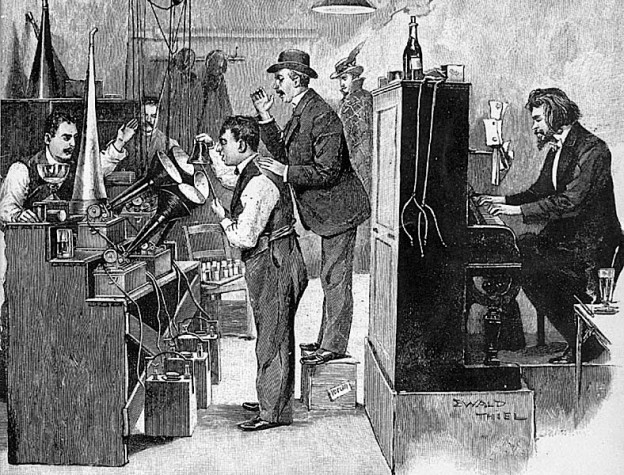
An early recording session, Germany 1899

The Enchanted Forest

Came across a book about the New Forest in Hampshire - The Enchanted Forest by Gladys Mackenzie Forbes (Mate & Sons, Bournemouth circa 1930). It is attractively illustrated in black and white by the young artist Jacynth Parsons and is written in a sort of poetic, evocative prose that was popular at the time in nature writing. This piece is about the gypsies who had long been in the New Forest and is a somewhat romanticised view of their world. This is the New Forest of Augustus John and and Juliette de Bairacli Levy both of whom had befriended the forest dwelling gypsies.

Green-Wood Fires

Aromatic sweet scented smoke hangs in the windless air like a grey-blue curtain, and mingles itself with the autumn mist. A stream sings lazily along, and the mist changes its singing into plaintive sadness, as it also does the sharp thin music of distant children's voices. A dog's bark has a note of mystery, and all things seem far away and unreal.

Down in a sleepy sheltered hollow is a picturesque encampment of gay coloured gypsy vans, yellow, green, gold, and crimson, decorated with the brooms and rush baskets, by which the gypsies make a living, and looking like distorted giant toadstools against the glory of the woods. Each van has its own graceful plume of smoke, which gradually widens out, until it is lost in the blue grey curtain. In the centre of the ring of vans, is a large fire, made from the green-wood, gathered by the gypsy children, who are far afield after still more fuel, it is their voices which vie with the streams faint song.

Over the communal fire from crossed sticks, hangs a large black pot whose steam has the most inviting odour. Near the fire, women are busy with a culinary duties, and almost in silence the men are tending the animals, lean horses, and small sturdy donkeys, while several nondescript dogs group themselves hopefully around the simmering pot. Obviously the gypsies have only just arrived, yet already the hollow has an air of home, and is fragrant with green-wood smoke, and the good smell of savoury food. When darkness falls, the campfire will glow redly, and its smoke have an even  sweeter scent. One leaves the homely hollow, and the gay caravans, reluctantly, and with a tiny pain of regret.
To very few of us, for even a short time, is it made possible to live in such a simple, sane, and happy way.

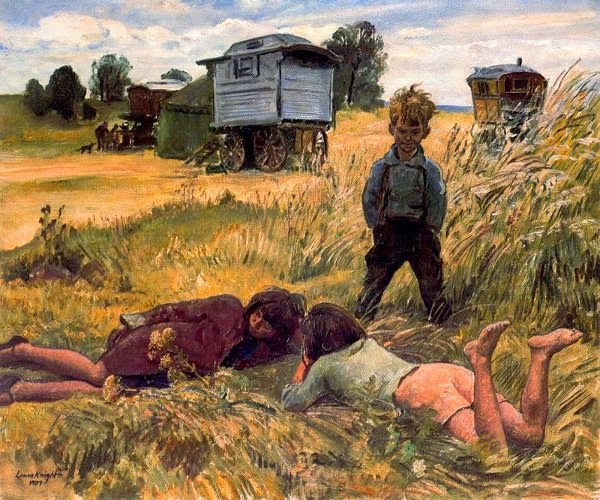
Young Gypsies by Augustus John

Reggie Caton (R.A. Caton of Fortune Press)

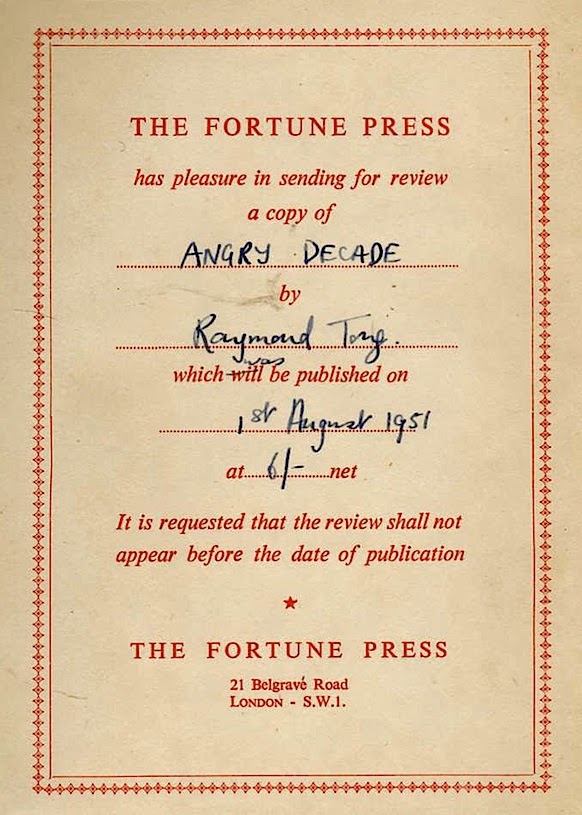
Discovered in a copy of Raymond Tong’s Angry Decade, a slim volume brought out by the famous Fortune Press in August 1951, is that rarest of objects—a review slip inscribed in the handwriting of the actual  publisher, R. A. Caton—known to his friends (if he had any) as 'Reggie'. Nowadays a publisher’s slip like this would normally be filled in by some unpaid, starry-eyed intern with a B.A.(Hons) in Englit. But much as penny-pinching Reggie would have welcomed free help back in 1951, any new graduate would probably have walked out of his basement HQ in Belgrave Road, before a week had elapsed, so unpleasant, by all accounts, was this particular employer. One Fortune Press author, Margaret Crosland,  told me that Caton looked like 'a second-rate accountant, wearing the traditional dirty raincoat, on his way to a sex shop.'

'The Fortune Press' , Philip Larkin complained in 1945, 'is only a yelping-ground for incompetents who can’t get a hearing elsewhere' . At the time Larkin had just posted his novel Jill to Caton, who was also preparing to bring out his debut collection of poems, The North Ship. The protracted publication of both books and the censorship of Jill by Caton (himself, ironically, a publisher of mild homosexual porn) kept their author in a fury of irritation and frustration for years —a state of mind which was soon to be shared by his friend Kingsley Amis, whose own first slim volume, Bright November was also to be taken on by Caton. Both men concocted private, long-running jokes about their publisher, and according to Larkin, Amis never lost an opportunity of introducing the seedy publisher into his novels, sometimes under a thinly disguised pseudonym.

But for all his tardiness and physical repulsiveness, Caton was a visionary who was responsible for bringing out more debut volumes by good poets than just about any other publisher in the UK. And considering that he operated alone, this is an astonishing achievement. Having begun in 1925 as the vanity publisher of  C Day Lewis’s now almost unobtainable Beechen Vigil, by 1939 had published some of the earliest work by Lawrence Durrell, and by the end of the war had taken on Gavin Ewart, Roy Fuller Julian Symons,  Henry Treece, Nicholas Moore, Francis Scarfe, Tambimuttu, and Drummond Allison. In all, he published more than 600 books between 1924, when he set up his press, and the late sixties, when he finally shut up shop. He died in 1971.

Neither Amis nor Larkin received a penny for their work , but Caton did manage to recompense a few  (in Inside the Forties Derek Stanford, who gives a graphic description of his dealings with the publisher, claimed to be one of the lucky ones). Many were happy to pay Caton for the thrill of seeing their poems in print. In return Caton, by listing his authors and their works on the backs of each dust jacket, made his customers feel as valued as any of the poets of the more eminent houses, such as  Faber. At the same time he cut corners to keep down costs. Apparently, in the early years of the war, he stockpiled a huge amount of cheap binding cloth of various colours and textures, which accounts for the variety of bindings you can find. In contrast, by the fifties, when presumably Caton had become more prosperous, you could  buy copies of Terence Greenidge’s Girls and Stations (1952), in mock alligator skin bindings. [RMH]

A Vorticist row in 1967

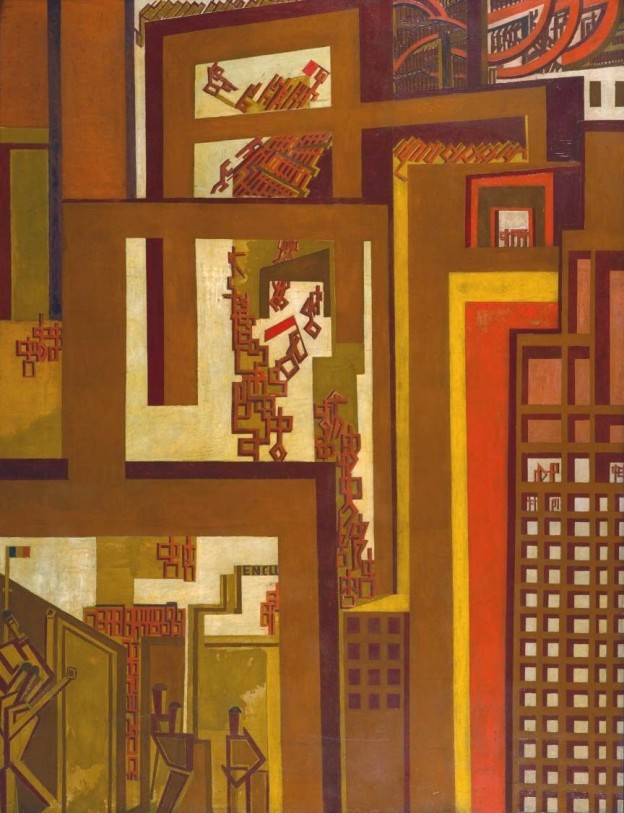
Revolution 1915 ('The Crowd')

Found in the letters column of The New Statesman of 21 April 1967 this angry exchange about Vorticism and Wyndham Lewis. The Surrealists were famous for arguing amongst themselves and it is interesting to see the vehemence in this post-Vorticist  argument. Michael Ayrton shows Lewis as a difficult man (others were less kind) and Robert Melville's reply scores a few points - but not a direct hit. It is odd that there was any debate about Nevinson being a Vorticist: he is now seen  with Lewis as their greatest exponent...

Sir, Mr Robert Melville contrives to perpetuate an ugly falsehood when he wrote as it was 'with the connivance of Lewis' that the Tate 'took advantage of the public ignorance of Bomberg's early work and included only a single unrepresentative drawing in the exhibition Wyndham Lewis and Vorticism in 1956 to create the impression that he was one of Lewis's lesser camp followers.' A similar argument was vociferously advanced by and on behalf of William Roberts in 1956. David Sylvester took up Roberts's cudgels in the New Statesman and, in passing, pointed out that Bomberg was not a Vorticist at all, but had simply exhibited with them. Denigrators of Lewis are tenacious but they cannot have it both ways. If Bomberg was not a Vorticist but one of what Mr Roberts called 'the Tail' then he had no special place in the Tate exhibition, which was avowedly concerned with Lewis and Vorticism.

Continue reading →

Simon Raven – poet and Greek scholar

Found - in a 1949 Cambridge University magazine Imprint, very early work of the British novelist Simon Raven. This is the first issue of the magazine, edited by J.M. Grundy of Caius College (Raven was at King's College in his second year after completing National Service.) Raven contributes 2 translations from The Greek Anthology by anonymous authors. There is much mention of Greek literature and mythology in his subsequent novels, especially in his magnum opus The Roses of Picardie. His first novel The Feathers of Death was published nine years after these translations:

TWO POEMS  (translated from the Greek of unknown authors)
                         1
Who garlands for my tomb,
Who scented oils will bring,
Who feeds high the fire,
Makes vain offering.

While yet I live, be kind;
No wine on ashes pour -
Thus only mire is made of him
That's dead and drinks no more.

                         II
Nymphs and cold pastures, this
Tale the bees must hear
This tell them as they wander
The spring ways of the year:

That old Leucippus perished
Under a winter's sky,
Laying his nets at midnight
Where the light-foot hare goes by.

His care of hive and garden
Has with him an end:
The peak has now no neighbour,
The meadows mourn a friend.

The themes of death and mourning are addressed by him in a later piece 'Memento Mori' at The Spectator where he quotes his own translation. It is interesting to compare his translation of the second piece with an earlier prose translation by the classical scholar J W Mackail:

Naiads and chill cattle-pastures, tell to the bees when they come on their spring-tide way, that old Leucippus perished on a winter's night, setting snares for scampering hares, and no longer is the tending of the hives dear to him; and the pastoral dells mourn sore for him who dwelt with the mountain peak for neighbour.

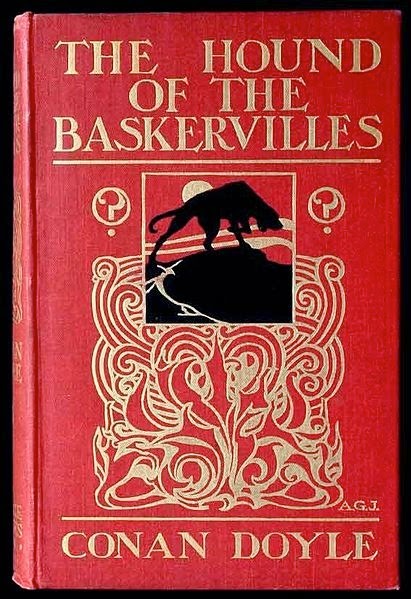
The Hound of the Baskervilles – the libretto?

Found - an interesting Sherlockian letter in a collection of papers of the late 'Evoe' - the comic writer, satirist, poet  and one time editor of Punch known as E.V. Knox. It is from James Edward Holroyd* dated 23/4/1967 from 11 Heath Royal, Putney to Knox in Frognal, Hampstead. He brings attention to his (Holroyd's) letter published in that weeks New Statesman and recalls a Press Club Sherlock Holmes dinner when he had sat with 'Evoe' and Sir Sidney Roberts, another follower of what Sherlockians call 'the higher criticism.' He invites him to visit old Fleet Street haunts with him ('a glass of wine at El Vino'). The published  letter reads:

Your readers may wish to be reminded of the enchanting theory, advanced by E.V. Knox, that Conan Doyle's famous story The Hound of the Baskervilles was originally written as a libretto. In support of his claim, he quoted the following stanza :

I stooped, panting, and pressed my pistol
To the dreadful, shimmering head,
But it was useless to press the trigger,
The giant hound was dead.

No wonder that on another occasion Holmes remarked : "Cut out the poetry, Watson".

Evoe's original piece A Ramble in Dartmoor published in Punch 21/1/1948 also quotes these lines of 'found poetry' from The Hound of the Baskervilles:

The night was clear and fine above us
The stars shone cold and bright,
While a half moon bathed the whole scene
In a  soft uncertain light..

He concludes 'I can only hope that we may one-day discover the manuscript of the original poem, ballad, or libretto from which the story has been reduced down into workaday prose.'

*Editor of Seventeen Steps to 221B: A Sherlockian Collection by English Writers and Baker Street By-Ways. 

Paul Nash bookplate for art collector Samuel Courtauld

Found - a loose bookplate by Paul Nash  for the industrialist and art collector Samuel Courtauld. Produced around 1930, it measures a sizeable 13 by 9.5 cms, probably intended mainly for art books and livres d'artistes. The writer and broadcaster Lance Sieveking writes in his autobiography The Eye of the Beholder (Hulton Press, London, 1957) -'Sam Courtauld and Paul met at a dinner party I gave at Number 15 The Street, and Courtauld persuaded Paul to design a book plate for him. The result was one of the most charming he ever made.' The engraving is said to be the only one initialled by Paul Nash on the block. The bookplate is quite scarce as, presumably, it is mostly found in books held at the Courtauld Institute; few have entered the used book trade.

The woodcut is British Surrealist in style with an echo of Cubism and Vorticism - both movements had earlier attracted Nash. Samuel Courtauld's family fortune came from the textile industry (rayon), hence the bobbin and threads. The French flag refers to the origins of the name Courtauld, a French Huguenot family whose early descendant was the celebrated goldsmith Augustine Courtauld. The Courtauld textile industry was based in Braintree and Halstead in Essex. The view through the frame shows what appears to be a Martello Tower - these are closely associated with the  East Anglian Coast.

English Books in Paris

Found in a mid 1930s American detective thriller, tipped in at the front (for exchange purposes) this flier for  the Gibert Joseph (or Joseph Gibert) bookshop at 26 Boulevard St. Michel in the 5th arrondissement of Paris. It is still there at the same address with many books in languages other than French. The English language section is adequate but there are few rarities as there were in the past.

The curious thing in this ephemera is the notice 'Free Entrance' -- I can think of only one bookshop in the world that charges entry ($5) and that is run by a much arrested, deranged and violent bookseller in New Hampshire U.S.A. Possibly this is a mistranslation. The phone number has been changed by hand which might enable someone in the know to date it quite accurately. It looks like the 1950s. Until the advent of Shakespeare and Co.,  Gibert was the main source of used English books in Paris. Interestingly it also caters for the four other most wanted languages there, mostly because these are the nearest countries, although there has long been a large Russian community in Paris.

A Remedie against Ache of the Herte

Found - this small keepsake card with deckled edges published by Mowbray's (bookshop chain and publisher.) It was written by Margaret Smith-Masters, a poet, novelist and translator (from French) who seems to have flourished in the early part of the 20th century. COPAC record a dozen works by her between 1907 and 1936, including one on boy scouts and one published by Burns & Oates, which might indicate she was Roman Catholic. This piece in fake 'Olde Englishe' is reminiscent of the more famous Patience Strong or Wilhelmina Stitch...

A REMEDIE 
against Ache of the Herte

Take 
A lyttel Silence
And of Charitie much quantitie
And of Courtesie a good lie store:
Add thereto some portion of the lowly
    herbe Humilitie;
Of balme of Kindnesse be prodigale;
Season these with spice of Wisdome
And temper with dewes of Mercie;
Of oile of Gladnesse droppe full measure,
And blende alle with sweet Patience.
Be spende-thrifte of this salve for comfort
   of thy fellows
As through the world thou wendest;
Soe shall Ease of Herte be ever thine.

Margaret Smith- Masters

The day that May Kovar’s luck ran out

One of the most poignant inscriptions in the celebrity album kept by Swindon landlady Barbara Slocombe is the 'Good Luck to You' which was left by May and Harry Kovar in November 1937. The couple were acclaimed wild animal trainers who specialised in lions and tigers, Harry being acknowledged as one of the greatest big cat trainers in the world. At the time both worked for Chapman’s Circus, but by 1941 they had moved to a more lucrative career in the States.

On 6 July 1944, the Kovars were the act that immediately preceded the discovery of a fire that quickly engulfed the huge tent of Ringling’s Circus in Hartford, Connecticut, where more than 7,000 spectators were watching the show. In the carnage that followed  around 169 were killed and over 700 were injured, many being  badly burned by the paraffin wax that had been used to waterproof the tent canvas. In 1950 a 21 year old former employee of the circus named Robert Segee confessed to what has been called the worst act of arson in American history, but he was never tried.

While the fire blazed the brave May desperately tried to force her animals back into their cages. She survived, but in 1949 her luck finally ran out. In California, during a training session, she was coaxing a recalcitrant lion, Sultan, from his cage, when the animal suddenly attacked her. Watched by her three horrified children, she was badly mauled and her head ended up in the lion’s mouth. She died instantly when her spine was snapped.

May was just 48 at the time. Her daughter (also called May) forged her own successful career with big cats for a number of years, before retiring to raise children. Today, one of those children is writing a book about her grandmother’s exploits. I wonder if those happier days at Mrs Slocombe’s will get a mention.

It is rocket science…

An apposite Jot in view of the recent death of Wurzel soundalike, Professor Colin Pillinger, the space scientist behind the Beagle 2 Mars landing vehicle.  The British Interplanetary Society was actually founded as long ago as 1934, when H. G. Wells was still alive, and is still going strong. I don’t know if Pillinger was a member, but in 1954 Arthur C. Clarke was on the publications committee and Patrick Moore was sitting on the Council. It is notable that although most of Moore’s fellow Council members had a degree, not one of them achieved anything like as much as this college dropout did in the field of astronomy.

The lead article in this January 1954 issue of the Society’s Journal  is a passionate plea by Dr A. V. Cleaver, head of the rocket division at Rolls Royce, for funds to be taken out of Europe’s various military budgets and put into a space programme which would ultimately see a man on the moon, flights to Mars and Venus, and ultimately the establishment of bases on these and other planets. Like many scientists before and since, Cleaver argues that the space race must be seen, not as a huge waste of resources, but as a logical extension of Man’s ceaseless striving to explore, and also a potential opportunity to develop various technological projects.

The writer betrays a political naiveté shared by many scientific visionaries, but his technical knowledge can hardly be faulted. The article ends with some fascinating appendices outlining time scales and costs. Interestingly, although he speculates  vaguely on significant progress occurring in  'generations' ,  he does make some bold predictions. For instance, by 1975 a 'relatively small piloted Earth –satellite- vehicle might take up its orbit'. And perhaps during the 1980s and 90s 'a few expeditions by small ships, carrying human crews of only one or two, might be organised.'

If anything, these predictions were a little conservative. Within just fifteen years of the article appearing, Man had landed on the Moon— in another issue of the Journal, the more cautious Clarke had predicted that this would happen by 1975. [RH]

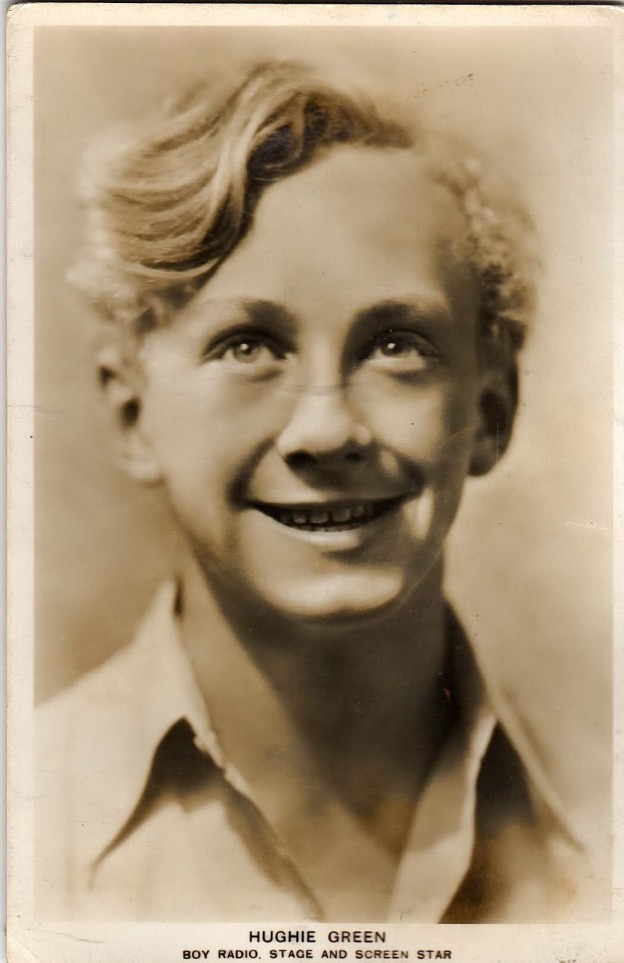
Hughie Green and his Gang

‘And I mean that most sincerely, folks’. This was one of Hughie Green’s catchphrases. Another was ‘Vote, vote, vote, ‘cos your votes count’. As the host of quiz show Double Your Money and Opportunity Knocks, a forerunner of Britain’s Got Talent, he had one of the most recognisable faces (and voices) on TV in the sixties and early seventies. Then, abortive lawsuits, womanising and alcohol all took their toll and he died largely forgotten in 1997 aged 77. But what many below the age of eighty might not know is that Green was once a child star who, with his very own 'Gang' of fellow child performers, toured the halls from the mid thirties. One of his star turns was a distinctly manic solo dance routine.

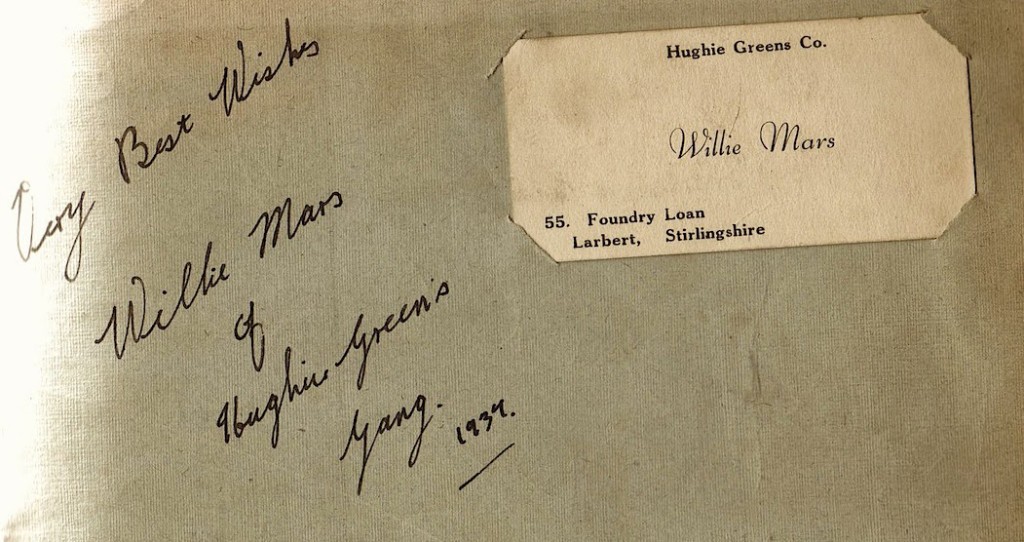
So what we have here is evidence that young Green and his Gang performed at The Empire, Swindon in February 1937. Evidently, Mrs Barbara Slocombe, his landlady at 5, Farnsley Street, was a bit of a celeb spotter and kept an album in which she got her showbiz guests to sign, perhaps with a message, a calling card, and often with a signed photograph, or even a drawing. Several of Green’s gang obliged, but there is no record of the boy wonder himself leaving a signature. What we do have, however, is a postcard from Penge featuring a photograph of Green which was sent by one of the gang, Willie Mars, asking if Mrs Slocombe would kindly send on the sports jacket that he had left behind in her guest house.

I wonder what happened to Willie Mars.

The Pan Bookshop, Fulham

A bookmark of the much loved Pan Bookshop in Fulham, London. In late 1997 its landlord accepted a high offer from a grocer and the bookshop 'went dark' (or is it that only for restaurants?) after 32 years trading. The shop's blog is still up and has many commiserations in the comments field - 'best bookshop in London,' 'irreplaceable' and a fulsome piece from Vogue food writer Arabella Boxer (cook books were one of its specialities.) One customer writes: " I will refuse to step foot in whatever shop might replace it - heavens forbid another Carluccio or Starbucks or bar serving caperinias - I would launch a hunger strike if I thought it would do any good."

It seems that by the mid 1990s the area (now known as 'The Beach') was moving away from book culture to cafes, food and delis. The book mark is probably from the 1970s as the 01 number was current then. The Pan Books pink symbol is interesting and one imagines at some point it was full of Pan paperbacks (now quite collectable) although latterly it was owned by Macmillan. Macmillan blamed "tough market conditions, a decline in the overall trading of independent bookshops combined with an expensive high street location in Chelsea" for the closure.