Sir John Betjeman’s last poem

Found - a broadside poem poem of twenty lines in honour of the famous old central London church St.Mary-le-Strand. It dates from about 1980 and is signed by John Betjeman in what one cataloguer calls his 'frail hand of old age'. It was published from his address at 29 Radnor Walk, SW3 and was part of the campaign to raise funds for the restoration of this masterpiece of baroque.

This copy came with a letter from the church to a professor at Ilorin University, Nigeria. The secretary of the trust, a Ms Anne Butters, thanks him for his £20 donation and informs him  that JB's publisher, John Murray, says that this was the last poem he ever wrote. So far unknown to 'go ogle' (as he may have called it) and not in any major UK library, it is decidedly scarce...
A single sheet of imitation parchment paper, printed in black on recto only. 296 x 206mm.

St.Mary-Le-Strand

Shall we give Gibbs the go by
Great Gibbs of Aberdeen,
Who gave the town of Cambridge
The Senate House Serene;
Every son of Oxford
Can recognise he's home
When he sees upon the skyline
The Radcliffe's mothering dome.
Placid about the chimney pots
His sculptured steeples soar,
Windowless he designs his walls
Above the traffic's roar.

When ever you put stone on stone
You edified the scene,
Your chaste baroque was on its own,
Great Gibbs of Aberdeen.
A Tory and a Catholic
There's nothing quite so grand
As the baroque of your chapel
Of St Mary in the Strand.

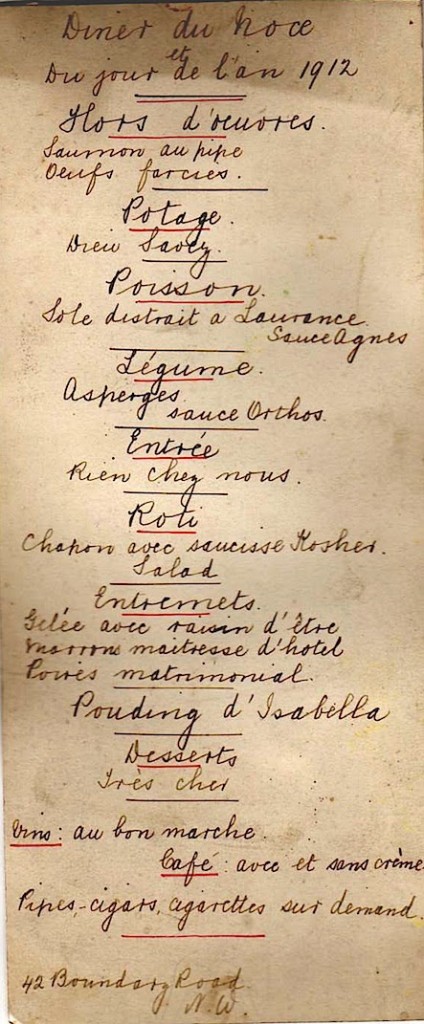
A Very Private Dinner, 1912

In the year of the Titanic and the Antarctic disasters here is the handwritten menu --found among the papers of Ernest B Rubinstein, of a special meal—possibly a marriage feast—held by members of the Rubinstein and Laurance families at 42, Boundary Road, South Hampstead.

Not that remarkable you would think, although on closer inspection some of the dishes are unusually named -- 'Sole distrait a Laurance,' 'sauce Agnes', 'poires matrimonial,' 'gelee avec raisin d’etre'. If the dinner was held to mark a marriage—and 'poires matrimonial' strongly suggests this-- then it was a marriage that produced one of the most original children’s writers of the twentieth century.

That writer was Patricia Rubinstein, aka Antonia Forest (1915 – 2003 ), who was born three years after the dinner, later attended South Hampstead High School, just a few minutes walk from 42, Boundary Road, and who learned her love of literature, and particularly drama, from her stage-struck father, Ernest B. Rubinstein, whose signature heads the list of diners that appears on the reverse of the menu.

Others signatures include that of Kate Rubinstein, an Irish Protestant whose marriage to Ernest introduced her into a Jewish circle in Hampstead whose members were to contribute their signatures and messages to Patricia’s autograph book of 1924—another item found among the Rubinstein papers. Two other Rubinstein signatures on the menu were probably those of Ernest’s siblings.

It could be said that Antonia Forest guarded her privacy every bit as jealously as J. D. Salinger did his own. For most of her life she lived quietly in Bournemouth. Even her devoted fans did not know her real name and in one of her very rare interviews she studiously omitted any meaningful details of her parentage and early life that might help a biographer. Because of this, the career of her father as a prominent theatre critic, versifier and amateur playwright, has remained shrouded in mystery---until now. But we can at least surmise that the much more prominent man of the theatre, Harold Rubinstein (1891 - 1975), who as a lawyer defended Lady Chatterley’s Lover in 1960, was a relation-- possibly a nephew.[RR]

Angels at Mons

Found - a small thin 4 page pamphlet Angels at Mons printed in Felixstowe, England about 1920. Its price was ninepence for a 100 and it was almost certainly for distribution in churches. Ours was found in a missal.

There is much elsewhere about the angels that are said to have appeared on the WW1 battlefield at Mons. Arthur Machen's 1915 book The Bowmen and Other Legends of War really started the legend.

Historian A.J.P. Taylor was so impressed by the evidence then available that he felt confident referring to Mons, in his 1963 History of the First World War, as the only battle where “supernatural intervention was observed, more or less reliably, on the British side.”

The Penguin Encyclopedia of Horror and the Supernatural says of Machen's book: "During Machen's lifetime 'The Bowmen' was easily his most influential work of fiction, in ways he never predicted. First published in a 1914 Evening News after the Battle of Mons, it told how British troops, their retreat cut off by the Germans, were miraculously rescued by a ghostly St. George and his bowmen of Agincourt. Widely accepted as true or as a genuine legend, the incident is regularly referred to even today, in books of occult lore and oral histories of the Great War." Fortean Times has this great story of hoaxes and mayhem around the legend with a report on a Hollywood movie that was going to be made on the angels with Marlon Brando.

Continue reading →

Air Raid Precautions. Hints for Housewives..

A wealth of practical information from a Mrs Creswick Atkinson. This 1941 booklet was aimed at housewives in World War II. In the case of an air raid or the possibility of such you either went to to your own air raid shelter (often an Anderson shelter), a public shelter or 'a table indoor shelter' or refuge room. If sheltering under a table you had to be sure it was the bottom floor or basement. The booklet is good on children and pets (although a child is often referred to as 'it') and says several times that they should be sent to the country, something not always possible. There is advice on gas attacks, incendiary bombs and even what to do if being machine gunned by an enemy plane:

Do not run away from the plane. Throw yourself down on your face at once. If you have to run, run towards the plane, not from it. 

In case your house is bombed:

1. Pack a suitcase of spare clothing and keep it at a friend's house in another part of town.
2. Arrange with a friend at the opposite end of your street or in another part of the town to give you hospitality for a short time in case of need.
3. Arrange with a relative to take you in until you can return to your house or find other quarters.

There is the usual advice about not spreading rumours and to 'keep cheerful yourself, and keep others cheerful too. A long face does not help anyone, but a cheerful face always makes the day seem brighter.' In fact 'Keep Calm and Carry on!'

Continue reading →

The Wheel of Orffyreus 2

The second and last part of a chapter from this fascinating forgotten work Oddities: A Book of Unexplained Facts (Allan, London 1928) by R.T. Gould. Gould was a polymath who appears to have tolerated fools and cranks gladly...however Johann Bessler was no fool (although he may have been insane) and no less a figure than the philosopher Leibniz and  and the scientist and Newtonian Willem Jacob 's Gravesande thought he had the secret of perpetual motion. Gould gets to the heart of the matter -as always with footnotes blazing...

Was Orffyreus honestly deceived when he wrote down such an incorrect description (for so we must regard it)† of his own mechanism? The thing is unlikely–but it is possible, as a later case has sufficiently shown.

 † The supposition that the wheel was kept going by external power does not, of course, exclude the possibility that it also contained "overbalancing" mechanism. If well made, this would waste very little power, though it could not generate any: and it would certainly impress an amateur mechanic like the Landgrave–the only man who ever saw it.

Continue reading →

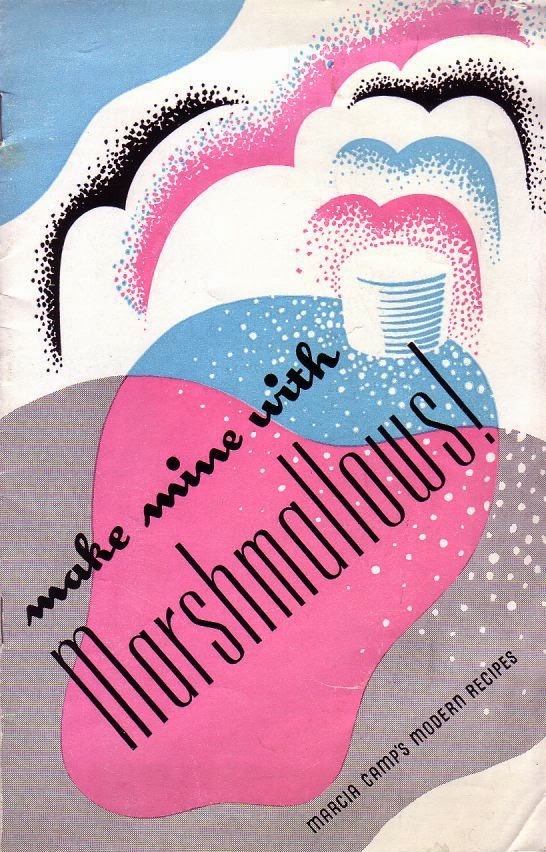
Make Mine with Marshmallows

Some recipes from the 1939 marshmallow cook book Make Mine with Marshmallows.  The booklet was produced by the Angelus Campfire Company and the company continues today as Doumak in Bensonville near Chicago. The original marshmallow, a delicacy enjoyed by the Pharaohs in 2000  BC, was based on the marshmallow plant. The modern variety is simply corn syrup, sugar, dextrose, water and (the magic ingredient) air. Doumak have a website about the history and manufacture of marshmallows. Here are 3 recipes from this excellent cookbook.

CAMPFIRE MARSHMALLOW MERINGUE

1 quarter-pound package (16) Campfire Marshmallows
1 tablespoon milk
2 egg whites
¼ cup sugar
¼ teaspoon salt
¼ teaspoon vanilla extract

Continue reading →

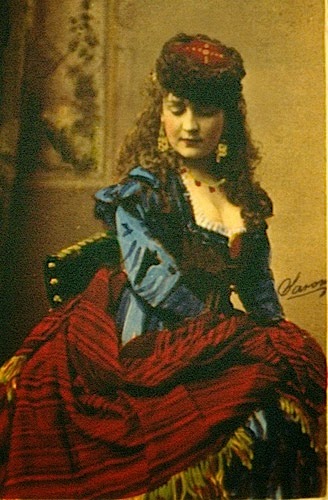
Adah Isaacs Menken – A Victorian Lady Gaga

Today, the actress and poet Adah Isaacs Menken (1835 – 1868) has been largely forgotten and when her name crops up at all it is usually in association with Algernon Swinburne, with whom she reportedly had an affair. But in the mid nineteenth century, both in her native USA and in Britain, she was the Lady Gaga of her day—a sensational performer in various erotic guises and at one time the highest paid actress in the world.

Like Lady Gaga, she entered show business early and with some éclat. She also seems to have been obsessed with dressing up in outrageous costumes that reflected her need to regularly re-invent herself. Like Gaga too, she changed her name. She had begun life as plain Ada McCord, a child with Creole blood, but later, each of her three marriages gave her a chance to add exotic elements to her name. By her death she had adopted both the name and the faith of her Jewish husband. Today, in some quarters of the States, her Creole ancestry has made her a black icon of female liberation.

Menken had always expressed an interest in writing poetry and by her early thirties she had amassed enough material for a book. Tragically, in 1868 at the age of just 33, she died suddenly of peritonitis complicated by TB and a few days later, Infelicia was published privately—presumably through the auspices of her husband. Though heavily influenced by the invocatory style of Walt Whitman, Infelicia, reflects a good deal of her genuine literary talent, and it is easy to appreciate the effect it must have had on a generation of female freethinkers from the 1870s onwards.

Continue reading →

The Wheel of Orffyreus 1

Yet another chapter from this fascinating forgotten work Oddities: A Book of Unexplained Facts (Allan, London 1928) by R.T. Gould. Gould was a polymath who appears to have tolerated fools and cranks gladly...however Johann Bessler was no fool (although he may have been insane) and no less a figure than the philosopher Leibniz and  and the scientist and Newtonian Willem Jacob 's Gravesande thought he had the secret of perpetual motion. Gould gets to the heart of the matter -as always with footnotes blazing...this is the first part:-


ORFFYREUS' WHEEL

The history of human folly, on any scale commensurate with the vast and "ever-increasing amount of material available, remains to be written. A casual effort in this direction was made by Sebastian Brant, who published his Ship of Fools* in 1494. But while this book may have inspired Erasmus to take up the cudgels "for self and fellows", and produce his Praise of Folly,† its satire fell, for the most part, on deaf ears. Centuries later an atrabilious Scotsman, peering at the world from an anacoustic study in Chelsea, recorded his conviction that it was peopled by "too many millions, mostly fools”–a sweeping statement, but embodying an essential truth. Most of those, for example, who have had experience (internal or otherwise) of Government Departments can testify to having, like Oxenstiern, been amazed at discovering how little wisdom it takes to govern the world; and if there be any truth in the often-quoted assertion that "a nation gets the government it deserves”, Carlyle's apothegm must be regarded as resting upon a very solid–one might even say dense–basis of fact.

Continue reading →

Wartime codebreaking—the professorial connection

This article in the January 1986 issue of Cryptologia by leading expert  Ralph Erskine reveals how code-breakers were recruited just before WW2 broke out. In the summer of 1939, due to the fact that throughout the 1930s the Government Code & Cypher School (GCCS) had been starved of funds, there were hardly any cryptologists who could rise to the challenge of deciphering the German codes. So when, in early September 1939, war was looming, the Director of the GCCS, Commander Alastair Denniston, was forced to recruit an emergency team of supposedly large brained cryptologists. Denniston wanted 'men of the Professor type' , which in 1939,  social and intellectual snobbery being what it was, meant academics likely to possess degrees in German, mathematics or classics from Oxford or Cambridge.

Continue reading →

The Auroras and other doubtful islands

Another chapter from this fascinating forgotten work Oddities: A Book of Unexplained Facts (Allan, London 1928) by R.T. Gould. The Aurora Islands group of three phantom islands was first reported in 1762 by the Spanish merchant ship Aurora while sailing from Lima to Cádiz. They are referred to in an episode in Edgar Allan Poe's novel, The Narrative of Arthur Gordon Pym of Nantucket, where Pym and his crewmates search for but fail to find them. Gould was  an admirer of the 'divine Edgar' - whom he calls ' one of the greatest and most unfortunate of all writers... the only world-figure of American literature.' The islands were last reportedly sighted in 1856, but continued to appear on maps of the South Atlantic until the 1870s.

Aurora Islands on a map circa 1800 (far left)
THE AURORAS, AND OTHER
DOUBTFUL ISLANDS


   At the beginning of last century the existence of the three Aurora islands, lying to the south-eastward of the Falklands, was as little doubted as that of Australia. Originally discovered by the Aurora in 1762, they were reported again by the Princess, Captain Manuel de Oyarvido, in 1790, and by other vessels at various dates, while in 1794 the Spanish surveying-vessel Atrevida surveyed and charted (so she imagined) all three islands, as well as determining their position by astronomical observations. Lying in the track of sailing vessels bound round Cape Horn, they were, of course, much too important to omit from even small-scale charts; consequently every chart-maker who valued his reputation and his sales proceeded to embellish his charts of the South Atlantic with a "new and correct delineation" of the group, frequently adding the track of the Atrevida in their vicinity–presumably as "corroborative detail" in the Pooh-Bah style, although that vessel's narrative was neither bald nor unconvincing.


Continue reading →

Berwick Sayers on annotation 2

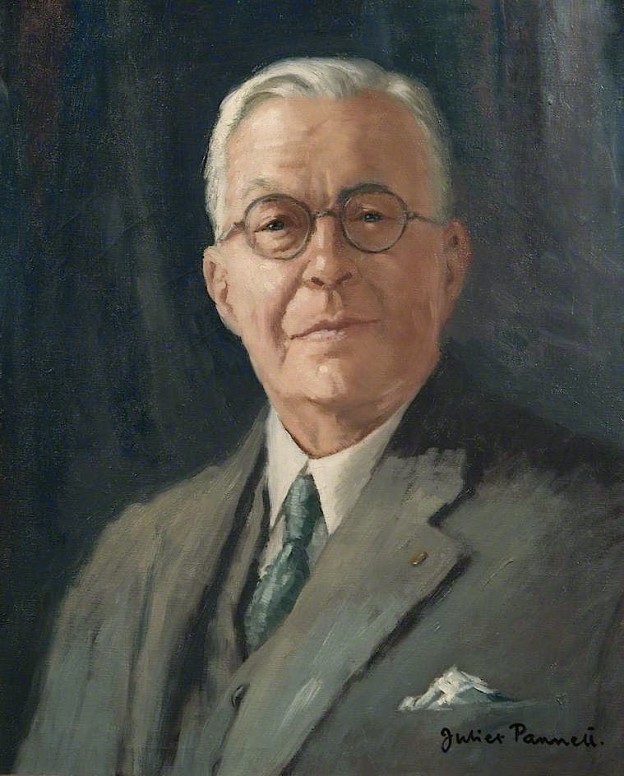
Berwick Sayers by Juliet K Pannett

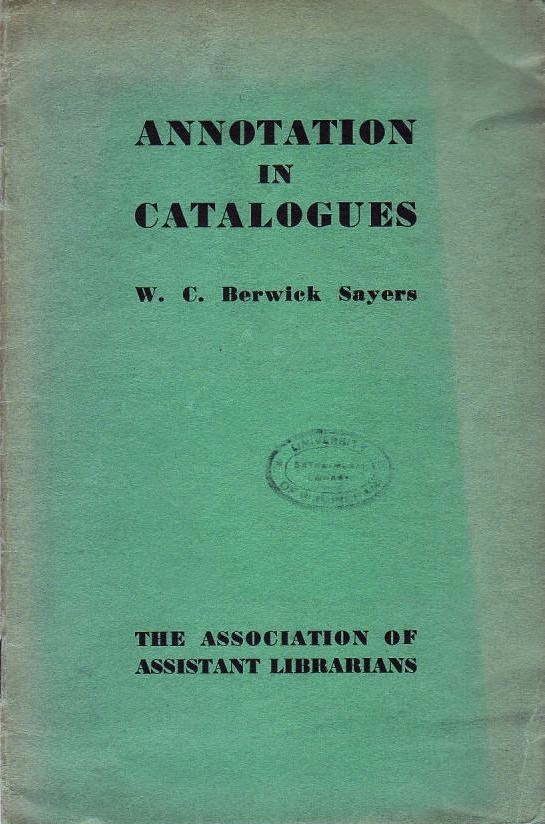
The second and last part of Berwick Sayers masterly work  Annotation in Catalogues (1948). Sayers was, like Casanova, a prince among librarians and also a man with many other interests - he wrote poetry, music, fiction and a book on the black composer Samuel Coleridge-Taylor. He also wrote a travel book Over some Alpine Passes. Memories of 1908. His life was commemorated in a work published a year after his death The Sayers memorial volume : essays in librarianship in memory of William Charles Berwick (1961.) He also wrote much on librarianship, including some dryish titles like: Report on the hours, salaries, training, and conditions of service of assistants in British municipal libraries (1911.)

He wrote a comprehensive history of Croydon and his life was spent there, mostly at Croydon Library. Croydon is a large London outer suburb of some importance - one time residents include: Flower Fairies creator Cicely Mary Barker, singer Desmond Dekker, Raymond Chandler, Emily Blunt, Samuel Coleridge-Taylor, A. Conan Doyle, Amy Winehouse, Kate Moss, Tracey Emin, D.H. Lawrence, Alfred Russell Wallace, Brit-pack artist Sam Taylor-Wood, Katie Melua, Kirstie MacColl, Roy Hodgson, billionaire Philip Green, Noel Fielding (Mighty Boosh) Victorian sexologist Havelock Ellis, Jeff Beck and Emile Zola.

Continue reading →

W. T. Stead – a message from the Titanic & the after-life

Found - a rare booklet published in Melbourne, Australia circa 1913 -What Life in the Spirit World Really is. Being messages received from beyond the veil by Annie Bright. It is purportedly by the great newspaperman W.T. Stead (1849 - 1912) who had drowned in the 1912 Titanic disaster. It was  in fact 'channelled' from Stead by one Annie Bright. Stead numbered spiritualism among his many interests and as well as editing The Pall Mall Gazette (which became the Evening Standard) he also edited the occult quarterly Borderland. He is said to be the first 'investigative journalist' and campaigned against child prostitution and the London slums. He befriended the feminist Josephine Butler and joined a campaign with her to successfully repeal the Contagious Diseases Act. He was an early Esperantist and he is also the father of modern paperback publishing and even 'digest' publishing, issuing severely abridged versions of the classics. Wikipedia has this to say of his last moments on the Titanic:

After the ship struck the iceberg, Stead helped several women and children into the lifeboats, in an act "typical of his generosity, courage, and humanity", and gave his life jacket to another passenger.
A later sighting of Stead, by survivor Philip Mock, has him clinging to a raft with John Jacob Astor IV. "Their feet became frozen," reported Mock, "and they were compelled to release their hold. Both were drowned." William Stead's body was not recovered. Further tragedy was added by the widely held belief that he was due to be awarded the Nobel Peace that same year.

Continue reading →

A.N.L. Munby book collector, academic and ghost story writer

Found - a scarce pamphlet outlining the life of Alan Noel Latimer ('Tim') Munby (1913 - 1974). He was born on Christmas Day, hence the unused name 'Noel.' The Victorian diarist and poet Arthur Munby ('Man of Two Worlds' of Derek Hudson's book) who 'adored the roughest working-girls' and was for years secretly married to his kitchen-maid was his great-uncle. As a schoolboy and as an undergraduate (at King's College, 1932-35) he collected books; for a brief period after graduation he worked at Quaritch's bookshop. During the war he joined the Territorials (Queen Victoria Rifles); he was captured at Calais in 1940 and held as a prisoner of war in Germany for 5 years. On his return to England he worked at Sotheby's, then in 1947 was appointed College Librarian at King's. He is best known for an excellent collection of ghost stories The Alabaster Hand. Ghost fiction watchers Boucher and McComas praised the stories in The Alabaster Hand as 'quietly terrifying modernizations of the M.R. James tradition.' M.R. James was also a Cambridge academic and Cambridge produced several other writers of fantastic fiction.. The pamphlet is typical of the slim memorial papers  turned out at the great universities when a distinguished or well known colleague had died.

Continue reading →

Pollen charts

Found in Dorothy Hodges bee book The Pollen Loads of the Honeybee (Bee Research Association Limited, 1962) an attractive 'pollen load' chart over a dozen pages. Similar to a paint chart and showing a surprising variety..

The colour of the pollen load is the colour as it appears when the pollen arrives at the beehive. Bees mix dry pollen with nectar and/or honey to compact the pollen in the pollen basket. The pollen basket or corbicula is part of the tibia on the hind legs of certain species of bees. They use the structure in harvesting pollen and returning it to the nest or hive.

The honey or nectar is used by the bees to mix the dry pollen into a paste-like condition suitable for packing her pollen loads…  as Dorothy Hodges says 'this mixing of the pollen with liquid, either honey or nectar, or possibly a mixture of both, makes the colour of the honeybees pollen load quite different from the colour of the pollen alone as it is seen on the anther of the flower.' This photo of a  Squill flower seems to bely this as the pollen is clearly visible as a dark blue...

Song of the Football Cup (Eton 1890)

Found- a rare pamphlet Song of the Football Cup (Ingalton Drake, Eton 1890) by R. Carr Bosanquet, with music composed by Joseph Barnby. The whole song goes thus:

Mustering under the old red wall, less than year ago
(The sky that day was sullen and gray the frost lay hard below,)
Each of us vow'd he would conquer or fall, facing the friendly foe;
Our hearts we steel'd as we took the field, and felt our pulses glow.

Mustering under the old red wall, less than year ago etc.,

Continue reading →

Berwick Sayers on Annotation I

A  pamphlet for librarians that is still relevant in the days of the web. People still need to know how to annotate information in catalogues. As Berwick Sayers says, annotation is elucidation - but he is down on the annotator who adds information needlessly. A real offender is a cataloguer who in noting the plot of a novel gives away the whole story.  Internet booksellers  break B-S's rules every day. For example, if the information is obviously there already do not annotate-- we do not need to know that Wood's British Trees is 'a handbook to trees growing in Great Britain' or Harrison's The Boys of Wynport College is a 'a schoolboy story.'

He also points out a fault of which many cataloguer is now guilty - giving irrelevant details about the author: for example, if a man writes a book on The Fertilisation of Soils it is of no consequence to the reader to know that "the author was Chancellor of the Exchequer." There are of course different rules for sellers; a librarian is not trying to get someone to buy the book. B-S's rules however apply to the world of Wikipedia where they are often broken - giving opinions, recommendations, irrelevance, shallow research and, conversely, faults that '..arise from too great a devotion to this work. The introduction into catalogues of fine writing or elaborate language is an abuse greatly to be deprecated.'

In the case of undesirable books B-S notes that drawing attention to them by 'danger notes' is self-defeating - "to say that a book is 'not written for girls' schools' must really be frightfully tantalising to any normally built schoolgirl."  To be continued with info on the life and writings of the great librarian-- a book on card indexes, mountaineering, songs, poems and a history of his borough Croydon..

Continue reading →

French bicycle poster – Durex ‘en vente ici’

Found! Actually the gift of an American colleague and dealer in ephemera- this hanging wall card for cycle parts from the French company Durex. Probably from the early 1950s, the company appears to be now defunct.... This poster may amuse some Brits as Durex is the pre-eminent maker of condoms in Britain. Durex is practically synonymous with condoms there in the way Hoover is with vacuum cleaners.

In the USA it is Trojans which, although not unknown in Britain, is also the name of several different companies on the sceptered isle including an electronics company, an arms dealer ( Trojan Group) and a timber crating company.

The arms dealer Trojan sells assault rifles  with this quote from Voltaire: 'God is not on the side of the big battalions but  on the side of those who shoot best.' Exactement.

Losing his marbles…

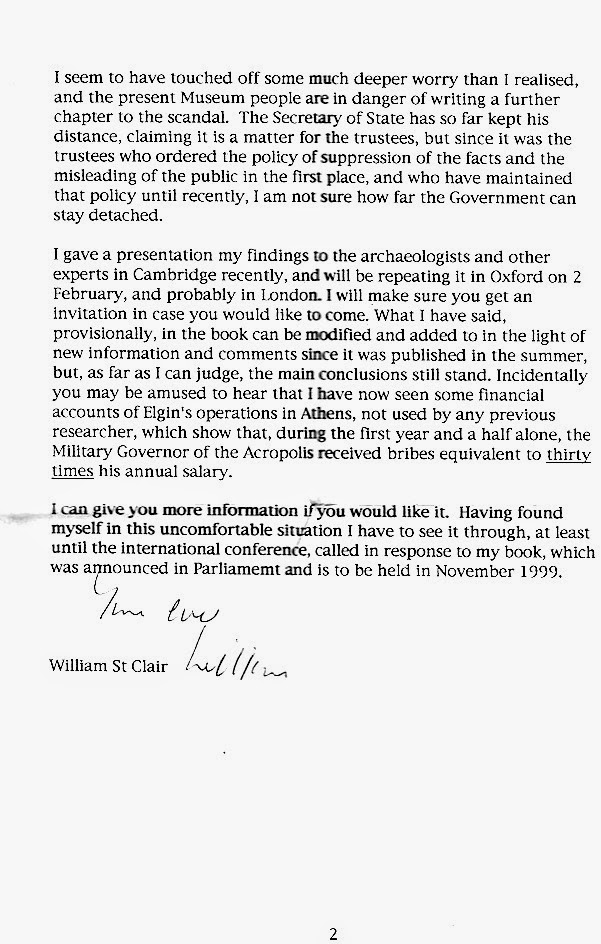
Sent in by a loyal jotwatcher. We have had many heavily annotated review copies, some angrily, some with further scholarship, praise or damning criticism.The Hon. Michael  Foot was a good customer at our West End shop and was much liked. He spent money, which is always endearing. He could get behind a cause and was in his way a powerful man...one of the 'great and the good' - like the late, lamented Tony Benn. Thanks for emailing this in:

This letter was discovered in Michael Foot’s review copy of William St Clair’s Elgin Marbles (1998), which was inscribed to the reviewer by the author. Judging by the angry-looking pencil marks  in the margin, Foot was mainly interested in Chapter 24,which focused on the cavalier way in which British Museum ‘cleaners’ under the direction of the egregious Lord Duveen, rightly condemned by St Clair as an  ‘unscrupulous art dealer’, damaged for ever the surface of most of the Marbles back in the mid ‘thirties.

The publication of St Clair’s exposé—particularly  his accusations that  a cover-up by the PR department and curatorial staff of the Museum-- over the past few decades, prevented the scandal emerging much earlier, caused a huge rumpus at the time. Worse still, the subsequent further threats and bullying of external experts and the Press that followed the publication of the book, reverberates even today. St Clair was particularly incensed by the sneering review of his book by one Ian Jenkins, a supposed ‘expert’ at the BM, who referred to the author as an ‘ amateur’ and who stated quite erroneously that only ten percent of the Marbles had been damaged.

The whole truth has yet to be exposed.

River and Joaquin Phoenix – young vegans

Found - a vegan book from 1987 Pregnancy Children and the Vegan Diet by Michael Klaper ( Gentle World inc., Florida.) An interesting slightly out dated book but still of great interest because of the vegan children on the cover - the late teenage heart-throb River Phoenix, his sisters Liberty and Summer Phoenix, and his brother Leaf who changed his name to Joaquin Phoenix (same row, right) and is thankfully still with us.

The jolly gap toothed kid at bottom left is Ocean Robbins, son of John Robbins of the Baskin Robbins dynasty and author of the groundbreaking Diet for a new America. The story of the Phoenix family is told at River Phoenix's Wikipedia entry.

The parents were hippies of the 1970s, ex Children of God, who had become vegans at a commune in South America. When they finally got as far as Los Angeles top child star agent Iris Burton spotted River, Joaquin and their sisters Summer and Rain singing for spare change in Westwood, and was so charmed by the family that she soon represented the four siblings. At jot we are keen on recipes - here is one from this excellent work:

TOFU EGGLESS SALAD

2 12 oz cakes of tofu
2 tablespoons tamari
1 tablespoon oil
2 small onions, diced
2 celery stalks diced
Half teaspoon sea salt
1 teaspoon turmeric
6 tablespoons nutritional yeast

In a medium size bowl, mash the tofu add the remaining ingredients and mix well. Refrigerate to keep cold. Delicious with salad or as a sandwich. Serves 4.

A Post-Punk Manifesto (1993)

Found in a now unfindable short-lived magazine Verbal Abuse from 1993 - a post punk manifesto by 'editrix' Chi Chi Valenti in a special Punk issue 'No/ The Future.' Coming out of New York's early 90s underground demi-monde (especially the legendary club Jackie 60) the magazine was, in this issue, boldly keeping the punk flag flying 15 years after its demise. It was a time of  AIDS and cyberpunk, just pre internet… Vogue was championing punk fashion for that fall. Contributors included Richard Hell, Matthew Barney, Patti Smith, Charles Henri Ford, Chris Stein, Alan Vega etc., We like a good manifesto and this is a curiosity- a manifesto after the event, proclaiming former glories possibly with a view to re-igniting the dying embers. But some say punk never died..

Punk made good on its only promise -DESTROY- by self-destructing while still in its infancy, thus guaranteeing eternal life.

Punks morals were spray-painted like prophecies on Paris walls by the rioting student of 1968 : 'NEVER WORK' 'BE CRUEL' 'IT IS FORBIDDEN TO FORBID.'

Continue reading →