Walt Whitman Parody

From a Ignes Fatui, a Book of Parodies by Philip Guedalla (Oxford 1911) Parodic poems and playlets written while Guedalla was at Rugby and Balliol College, Oxford. Some of the parodies are of slightly forgotten authors like W.E. Henley and Maeterlinck (a piece that sounds like  Beckett's Godot) but he also lampoons Macaulay, Swinburne, Kipling, Baedeker, Omar Khayyam, Hardy, Shakespeare and Shaw. Here is his Whitman squib - at the time Whitman's reputation was still breaking in England.

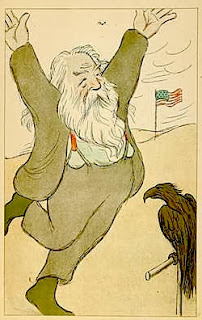
'Walt Whitman, Inciting the Bird of
Freedom to Soar' by Max Beerbohm 1904

Canzonette to Democracy

I sing the song of me mendacious and the lies of
me mendacious:

I see God give the Land to the People, and the
grasshoppers on the Land,

I see double! Libertad, Americanos, Libertad I
cry. (No, I will not keep quiet.)

I want Eight, Votes for Women, brilliantine, a half blue,
one Man one Pub., Home Rule for Wales and a National Theatre.

Allons, camerados, let us tax the foreigner; let's
tax him in Paumanok, Manhattan, Oswego
and Illinois, but especially in Illinois.

I care nothing, or comparatively nothing for 
Second Chambers, Revising or otherwise. I 
am not a Peer: are you?

How hot you all look, the En Masse, the Tout
Ensemble: I too am hot from my unkempt
hair-thatch to the ten curling toes, each self
-contained with its individual nail.

O Columbia, how hot I am!

[Oxford 1910]

The tone is reminiscent of Rick the 'people's poet' from The Young Ones but it passes the first test of parody - i.e. you know who is being parodied...not sure what 'Eight' was however.

Riddle Me Ree

A few riddles from a mid 19th century joke book Tom Brown's Jest Book. Purchased from the amazing library of Jeremy Beadle MBE (1948 -2008) British entertainer, television star,  hoaxer, quizmaster, book collector and philanthropist. He had a dozen shelves of joke books, mostly modern and the family kept a lot but this one escaped. Most are slightly groan-making to modern ears, some slightly  smutty and several by coincidence concerned with sheets...

Why is an unbound book like a lady in bed ?
Because it is in sheets.

Why is a lady in her shift like the Hague ? Be-
cause she is in Holland.

Why is a drunkard with a fiery face like a Chris-
tian Monitor ? Because he puts in mind of Hell
fire.

Why is a Prime Minister like a May pole ? Be- .
cause it is a high post.

Why is a grave-digger like a waterman ? Because 
he handles skulls.

Continue reading

Punk

Several derivations of the word punk can be found. The word occurs in Shakespeare  to describe a woman of doubtful virtue. Dr Johnson, citing the Bard, defined a punk as ‘a whore, a common prostitute, a strumpet’ while in later street argot it meant yob or hoodlum. But the OED has another definition for punk—‘rotten wood, fungus growing on wood’ or ‘worthless stuff, rubbish’. Recently, I found the OED definition confirmed in a scarce recipe book of circa 1809, and online this was re-affirmed by a modern American naturalist, who called  the  bracket fungus piptoporus betulinus, ‘white punk’.

This fungus, which is known in the UK as ‘razorstrop fungus’, can hardly be described as 'worthless'. In fact, ‘white punk’ is very valuable if you wish to make a fire but have no cigarette lighter or matches on you, but perhaps do have a magnifying glass, two twigs to rub together or a piece of flint.

Punk is a polypore that grows mainly on silver birches and which, when dried, and cut into strips, makes handy tinder. But don’t take my word for it. Read the wise words of Anon from The Family Receipt Book ( London ca.1809).

Continue reading

I once met Francis Bacon

Not the essayist and improbable author of Shakespeare's plays, but the artist who yesterday broke the world record for highest sum ever achieved by an artist in auction.$142.2 million.

It must have been in the early 1980s, I had been viewing a book sale at Christies South Kensington ('CSK') in the days when they still had large lots of books in tea-chests and you would find the legendary Roger Elliott ('2 L's, 2 T's') and the writer /bouquiniste Alex Trocchi ploughing through them. I bumped into an old friend and he told me he was going to look at, and possibly buy, some precious stones at a sort of geology shop just off the King's Road. We made our way to his car through Reece Mews a cobbled street opposite the mighty auction rooms. Half way along we were hailed by an oldish but very lively man in what appeared to be a rubber mac, surmounted by a pleasing slightly waxy face - it was none other than the artist Francis Bacon who appeared to have lunched well and was on his way to his studio. We chatted for a moment and he asked us where we were going. We told him that we were off to buy some precious stones. Possibly he was about to invite us into his studio...however he replied 'So you're going abroad are you?' That was it. A slightly enigmatic remark. It seemed curious but it could be that, like Graham Greene, he took valuables with him when he went abroad to exchange or give as gifts - something practiced only by those with very long suits of cash.

Our colleague Martin Stone, guitar musician and book scout, met him a couple of times in Paris when he was working for Shakespeare & Co. He dined with him at the smart restaurant, next to the Whitman bookshop,  called La Bucherie. Martin reports that he was very good company- erudite, worldly and witty. Later at Reece Mews someone

made a fortune clearing a skip (dumpster) placed ouside  full of bits of half finished canvas, palettes and sketches..

See this Fortune article explaining why his tryptych of Lucian Freud made so much. It's basically about the rich getting richer.

I once met….Uri Geller

Sent in by a supporter of Jot for which many thanks...


It was in the spring of 2005 that I was dispatched to interview the great Spoon Bender himself. His assistant had given me an address in Sonning-on-Thames, that home of the more discerning glitterati. I found his place quite by chance. Well, you could hardly miss it. Glimpsed through trees at the end of a longish drive was a large and modern mansion of the Bishops Avenue School of architecture, complete with portico. There was also a pair of huge metal (unbent) gates flanked by brick pillars, one of which incorporated the inevitable entry phone. I phoned through, the gates opened slowly, and I started down the drive towards the house.

Geller himself answered the door--a slim, smiling figure with neat bouffant hair, greying slightly. He must have been in his late fifties but retained his boyish good looks. He guided me across the marble floor of an atrium that wouldn’t have disgraced the palace of a Hollywood A-lister. I looked for signs of spoons and there they were, all the cutlery he had deformed over the thirty or more years of his career, drooping from a dozen or more spray-painted skeletons of trees ranged around the walls in a parody of Santa’s grotto.

Continue reading

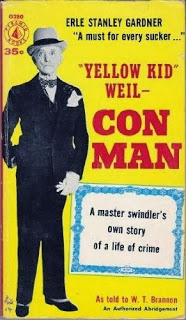
100 year old con man – the Yellow Kid

Found in a sensational crime paperback The Big Con (Pocket Books, NY 1949) a press cutting dated 1975 - the obituary of an amazing conman/ hustler/grifter Joseph Weil (1875-1975). He seems to have been the first to put forth the idea (often mentioned in the TV series Hustle) that 'you can't con an honest man.' It is possible that their  character Albert Stroller (Robert Vaughn) the elderly 'roper' responsible for ensnaring potential marks, is based on Weil. There is an exhaustive profile of Stroller at Wikipedia with no mention of any influences but useful info such as '...he cannot go to Indonesia as he sold the air force some fighter jets in the '70s, and they still haven't arrived.' Weil's comments on bankers are especially prescient..

Joseph (Yellow Kid) Weil, 100, Leading U. S. Trickster in '20s. From Wire Dispatches Chicago, Feb 27- 1975.

 Joseph (Yellow Kid) Weil, 100, the 1920s confidence artist whose con schemes netted him an estimated $8 million, died yesterday in a convalescent home.
 For nearly three years, the fragile little man had been a welfare patient, living out his life on the memories of his heyday, when his canary-yellow gloves, cravats and suits, yellow calling cards and autos, yellowish red hair and golden whiskers made him an international figure.
"If I had to do it all over again, I would be foolish if I didn't," Weil told an interviewer last summer on his 100th birthday
. "I don't feel a day over 70. I still like to look at the ladies and take a sip of wine. I like to listen to the radio, but I'll be damned if I'll play bingo with the rest round here. It's a ripoff."

Continue reading

Bolan in Cyclops

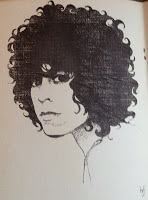
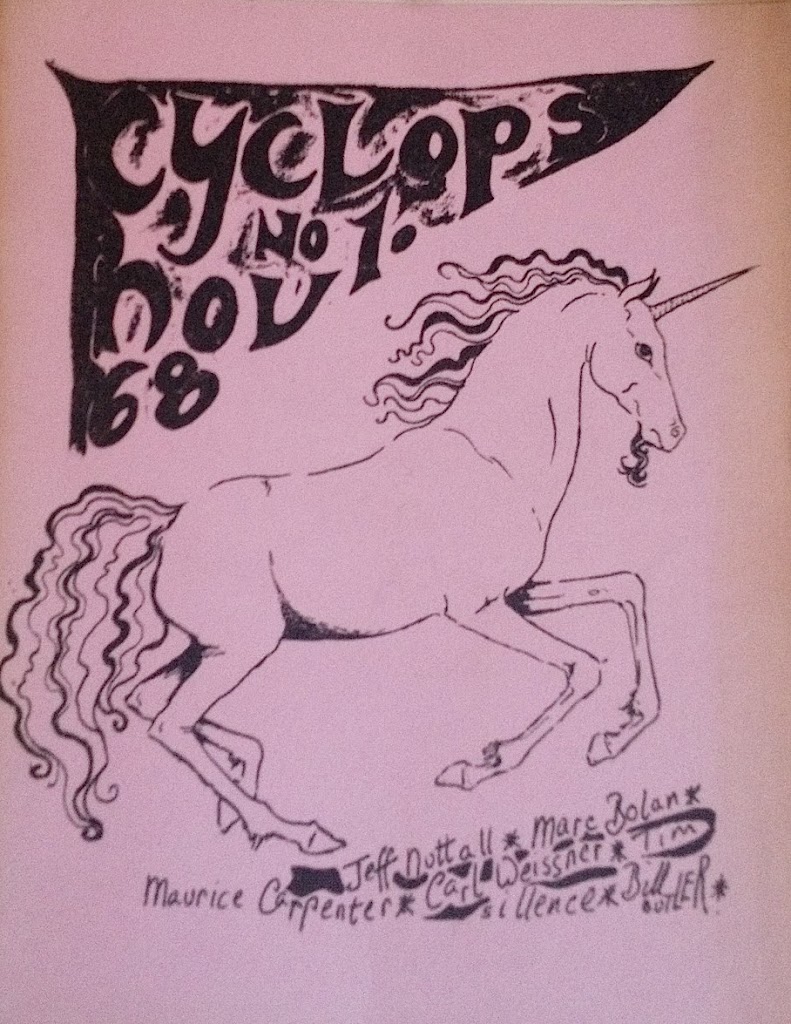
From the first issue of the Norwich based literary magazine Cyclops (Wild Pigeon Press 1968). Other contributors included Jeff Nuttall, Snoo Wilson and Bill Butler. There is a full page portrait of Marc by Harriet Franklin, the wife of the magazine's editor Dan Franklin. Cyclops says of Marc: 'Sings with Tyrannosaurus Rex. First book of poems is appearing soon.' Indeed this poem appeared soon after in his Warlock of Love. Untitled (as it is titled) is  a prose poem so abstract it might turn into mist and float out to sea. It seems probable that rare and exotic herbs were consumed during its creation...Take it away Marc:

Tall as the truth the creature coughed in the clouds, 
feeding on mountain tips and the rare winged eagle lords 
that journeyed higher than the memory of man. Its claw, caked in mist and wishes, ripped at a pillar of fear 
masoned long ago by terrible forgotten Titans, to
 prevent the dreams of man from floating in the valleys 
of the diamond.
 Its eyes, like women and sand, shifted ever searching 
for the perilous horn of plenty. A foolish colossus 
it looked, ragged and unworshipped. Solitary on the 
roof of the world, a remaining nightmare in a plateau 
of fair thought.
It moaned and clumsily spewed spells of fear on the 
storm stallions grazing in the temple of pearls. And 
the years danced on. And all that moves returns to 
stone, eventually.

Violent Poets No:5 Darius Guppy

As pugnacious ex-offenders go, Darius Guppy is a bit of a one-off. The convicted insurance fraudster, fellow Bullingdon Club member with Boris Johnson and David Cameron, doesn’t do remorse. Instead of keeping a low profile in his newly adopted home in South Africa, he has come out fighting. Guppy, as readers of Private Eye will know, is said to have once asked his friend Boris to arrange to have a pesky reporter beaten up for violating some sort of honour code — a Guppian honour crime, if you like. Johnson refused, but according to the TV profile of the London Mayor, the two men remain friends, and not long ago Guppy defended his Oxford pal. In the past couple of years Guppy has several times railed publicly against the moral failings of Western society, comparing them to the honourable principles upheld by the present Iranian government, who continue to practise public hangings and still persecute, among others, the peace-loving followers of Ba’hai.

On his mother’s side Guppy has some dubious claim to ancient Persian aristocratic blood. One ancestor was a poet and indeed the talent for verse manifested itself quite early in young Guppy’s life. Although he has never published a collection, in 1984 he edited with John Adlam  an anthology of Oxbridge poetry entitled First Set: Blue Jade, which has become a bit of a collectors’ item. Guppy wrote eight of the fifty poems in it, some of which demonstrate a genuine lyricism, especially when applied to descriptions of place, in this case, Venice:

By a lamp post, on an edge,
A blue green wave danced up to me
And kissed a pair of
Dangling legs, draped on a ledge
Then melted into blue jade

Immortal like stone, a stony city
Rose up from the pearls with a ruby sun
To haunt the ghostly speckled sea blanket
With shadeless colours, vague reality
Which rolls and sways and dives into itself… ( Blue Jade in Venice)

Continue reading

The Estate of the late F.Scott Fitzgerald

After his death, there was $706 cash in hand, Frances Kroll wrote Judge Briggs; $613.25 would go for burial expenses: “casket and services $410; shipping $30; city tax $1.50; transportation (to Baltimore) $117.78.” His worldly goods consisted of:

1 trunkful of clothes

4 crates of books

1 carton of scrapbooks and photographs

1  small trunk with some personal effects—the Christmas presents sent him, personal jewellery (watch, cuff links), several scrapbooks and photographs

2  wooden work tables, lamp, radio

Is this how a man ends? — a few crates “dumped to nothing by the great janitress of destinies” (from the brief verse found in his desk after his death).

From College of One: The Story of How F. Scott Fitzgerald Educated the Woman He Loved (1967) by Sheilah Graham.

The famous composer who worked in a shop

Invoices bearing letterheads can often be found among boxes of ephemera at auctions, but rarely does one come across an invoice on which a letter has been appended, especially one signed by a famous Italian composer. But when that composer is also the part-owner of probably the most famous piano retailers in Georgian London, you’ve got something rather special.

Muzio Clementi (1752-1832) composed around 110 piano sonatas and was greatly admired by Beethoven. In 1798 he became a partner with Collard and Collard in a company that boasted the patronage of both the Royal Family and the East India Company. With a manufactory in Tottenham Court Road and a shop at 26, Cheapside, Clementi, Collard and Collard were for many years the best know musical instrument makers in London and as such were the go-to establishment for well heeled musical amateurs throughout the Empire.

This particular invoice, which was for 'An elegant new Piano Forte of 6 Octaves…with round corners on six legs', is  addressed to 'John F Halahan, MD, Assistant Surgeon, Royal Artillery, Montreal', and is dated August 17th 1824. It reveals that the full cost, with packing case included, came to 42 guineas, but this was reduced to £31 10s for cash. Additional expenses included freight charges of a mere £1 2s 6d and insurance at £1 11s 6d. Dr Halahan had already handed over 30 guineas cash as a down payment, leaving a balance of £14 6s 6d.

Continue reading

John Cowper Powys’ Bookshop Rant

Found on a late 1960s bookmark from the renowned Holland Park bookseller Peter Eaton adapted from essays of John Cowper Powys in his 1938 work Enjoyment of Literature.

An over the top rant with a lot of incendiary keywords... but a rant would not be a rant if it wasn't slightly unhinged: take it away JC!

What a history of human excesses a second-hand book-shop is! As you 'browse' there– personally I can't abide that word, for to my mind book-lovers are more like hawks and vultures than sheep, but of course if its use encourages poor devils to glance through books that they have no hope of buying, long may the word remain!–you seem to grow aware what a miracle it was when second-hand book-shops were first invented...it too often happens that the books an ordinary man wants are on the 'forbidden shelves'. But there is no censorship in a second-hand book-shop. Every good bookseller is a multiple-personality, containing all the extremes of human feeling. He is an ascetic hermit, he is an erotic immoralist, he is a Papist, he is a Quaker, he is a communist, he is an anarchist, he is a savage iconoclast, he is a passionate worshipper of idols. Though books, as Milton says, may be the embalming of mighty spirits, they are also the resurrection of rebellious, reactionary, fantastical and wicked spirits! In books dwell all the demons and all the angels of the human mind.

Continue reading

The 100% office (1930)

This is from an uncommon self improvement work from circa 1930 The 100% Office (Efficiency Magazine, London) by the prolific Herbert N.

Casson. He had obviously been taking his own medicine as he appears to have written over  60 books on these lines, as well as producing a monthly magazine on efficiency, not to be confused with Health and Efficiency.

Among his works are 52 Ways to be Rich, The Meaning of Life, The 12 Worst Mistakes in Business, The Romance of Steel, 12 Tips on Window Display, Will Power in Business etc., He was at the beginning of a business that is still going strong. Below is a sample of his advice to the 1930's office worker. The office appears to have a machine for addressing letters but otherwise no technology as we know it...

The 100% Office 

How to use the present moment as it flits past – that is the eternal problem, for all ambitious workers want to make the best use of their lives. There is in reality no time but NOW.

Continue reading

The correct British way to make tea

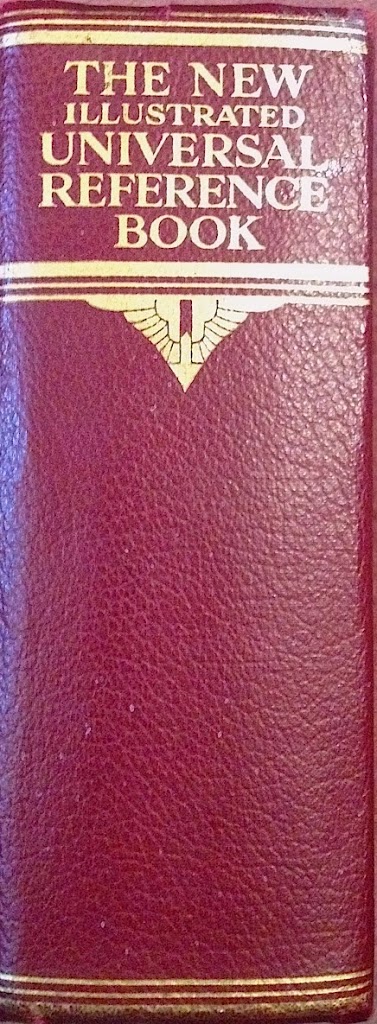
From The New Illustrated Universal Reference Book (Odhams, London 1933). It called itself 'the book of a million facts' and was a sort of Google of its day. It advertised itself as covering 'the main interests of humanity…no essential subject is left out.' To test this I checked if it had instructions for making tea, as few things are more essential. Sure enough a third of the way through at page 414 it has this:

TO MAKE GOOD TEA

It is the easiest thing in the world, yet nine people out of 10 do not manage to make a success of it. First of all the water must be freshly drawn from the tap. That left already in the kettle is flat and lifeless. It must be quickly boiled and poured over the tea just as it reaches boiling point. Give preference to a pot of either earthenware or aluminium ware, as the two kinds that make the best brew, and let the pot be thoroughly heated before the tea is put in. This is generally accomplished by pouring boiling water into the pot and then pouring it out again. A way that comes to us from China, and an excellent way too, is to put the tea into a perfectly dry pot, and let pot and leaves get hot together by leaving it on the rack or any other warm place.

That's it. They might have added the measurements - usually one heaped teaspoon for each person and 'one for the pot.' Once the water has been poured (during a 'rolling boil') 4 or 5 minutes is the brewing time and a tea cosy can be used - but they seem to have fallen from favour. The fresh water should be taken ('drawn') from the cold tap; the Queen Mother is said to have had her tea made with still Malvern water. The pouring of the water while it is boiling is the quintessential bit. The writer Kyril Bonfiglioli, in one of his Jersey based thrillers, has a character say something along the lines of 'you can kill me or you can give me tea made with water that hasn't come to the boil…'

E.V. Lucas remembered

Sent in by a sharp-eyed jotter this aside on the slightly  forgotten writer and belle-lettrist E.V. Lucas (not to be confused with E.V. Knox who was known as 'Evoe.')

Portrait of E.V. Lucas by the Canadian artist J. Kerr-Lawson

R .G .G. Price revealed some jaw dropping facts about E. V. Lucas (1868-1838) light essayist, biographer of Charles Lamb and lover of dogs, cricket and long country walks, in his excellent History of Punch (1957). On page 194 we find the following remarks on his fellow Punch stalwart:

'More than any other Punch man, he adopted a mask for his work…His literary personality was light, charming and kindly. He appeared as a lover of Georgian week-end cottage life, a bit of a scholar, a bit of a dog lover and a stalwart defender of what he considered the better human impulses. In private he was a cynical clubman, liking to entertain peers to sumptuous meals with champagne and brandy, very bitter about men and politics and the decadence of modern art. He was a great ‘trouncer ‘ of outspoken books  and was rumoured to have the finest pornographic library in London….’

Eh ? Anodyne E.V., author of At the Shrine of St Charles and of Quaker stock, is ‘rumoured to have the finest pornographic library in London.’ Well, in 1957 Lucas had been dead for 19 years , which meant Price was safe from litigation,  but some of his friends and fellow Punch men, might have objected. But they didn’t, as far as I know, and this rather astonishing slur (if you wish to call it that) remains unchallenged to this day.

Incidentally, what happened to Lucas’s curiosa ?

Continue reading

Hope Mirrlees The Counterplot (1925)

Found in the Donald Rudd collection of detective fiction at the back of Death of a Millionaire (Collins 1925) amongst the publishers announcements of forthcoming books this summary of the plot of the very rare Hope Mirrlees novel The Counterplot. These publishers advertisements  are useful to dealers, scholars, collectors etc., as they are able to ascertain what a book is about without the tedium of reading it. Also they are particularly useful for collectors of fantasy to see whether there is any supernatural content. Hope Mirrlees did write one fantasy Lud-in-the Mist published by Collins in 1926. This novel was described by Neil Gaiman as 'one of the greatest fantasy novels ever written.' Her novel The Counterplot contains within it a 100 page play. Hope is also celebrated for her ultra modernist long poem Paris (Hogarth Press 1919).

The Counterplot

The Counterplot is  a study of the literary temperament. Teresa Lane, watching the slow movement of life manifesting itself in the changing interrelations of the family, is teased by the complexity of the spectacle, and comes to realise that her mind will never know peace till, by transposing the problem into art, she has reduced it to its permanent essential factors. So, from the texture of the words, the emotions, the interactions of the life going on around her, she weaves a play , the setting of which is a Spanish convent in the 14th century, and this play performs for her the function that Freud ascribes to dreams, for by it she is enabled to express subconscious desires, to vent repressed irritation, to say things that she is too proud and civilised ever to have said in any other way.

The Perils of Irony

From a Bookman's Budget by the estimable Austion Dobson (OUP 1917). The case was reported in the Westminster Gazette of 1916 but has a slightly  Dickensian ring.

THE PERILS OF IRONY 

Irony, which Byron described as a ' master-spell ', 
and Mrs. Slipslop called 'ironing'* is at times an 
awkward edged-tool.There is no better illustration 
of this than an anecdote of the late Lord Justice
Bowen. Once, when acting as a Puisne Judge, there 
came before him the case of a burglar who, having
entered a house by the top-story, was afterwards 
captured below stairs in the act of sampling the silver.
The defence was more ingenuous than ingenious. The 
accused was alleged to be a person of eccentric habits,
much addicted to perambulating the roofs of adjacent 
houses, and occasionally dropping in 'permiscuous' 
through an open skylight. This naturally stirred the
judge to caustic comment. Summing up, he is reported 
to have said : "If, gentlemen, you think it likely that
the prisoner was merely indulging an amiable fancy for
midnight exercise on his neighbour's roof; if you think
it was kindly consideration for that neighbour which led
him to take off his boots and leave them behind him before
descending into the house ; and if you believe that it was
the innocent curiosity of the connoisseur which brought him
to the silver pantry and caused him to borrow the teapot,
then, gentlemen, you will acquit the prisoner!" To Lord 
Bowen's dismay, the jury did instantly acquit the prisoner. 

*Byron must have remembered this when he said that the 
irrepressible Mme de Stael was ' well ironed ' by Sheridan at 
one of Rogers's breakfasts. 

Iced Soda Water Soup

From the fearless British reporter Noel Barber the first Briton to reach the South Pole since Scott. Found in The Artists and Writers Cookbook (Contact Editions, Sausalito 1961.) His other recipe is not for the fainthearted - a meal in Malaya with Dyak head-hunters.

Contributors to this uncommon (but not valuable) anthology includes: Man Ray, Pearl Buck, Marcel Duchamp, Burl Ives, Marianne Moore, James Michener, Paul Bowles, Harper Lee, Kay Boyle, Upton Sinclair, Richard Wilbur, Lawrence Durrell, Robert Graves, Malcolm Bradbury (from whom this book came-- he gives a recipe for Yorkshire Pudding) William Allen White, Max Eastman, Katherine Anne Porter, Simenon, Lin Yutang, Sir Shane Leslie, S.I. Hayakawa, Sam Francis and many more. The recipe sounds abit bit like a very savoury Lassi. Barber's advice to use as much soda water as you like could be the making or breaking of this hearty soup. The tone of this Daily Mail reporter is very much of his time..

Iced Soda Water Soup 

I tasted this first in a village in Persia, the morning after an earthquake in which several thousand people were killed in a vast area between Teheran and the Caspian Sea. Since my knowledge of Persian is considerably less than my knowledge of arithmetic, the only thing I could do (after tasting the soup and finding it delightful) was to watch the villagers make it for me all over again and write down just what I saw.

Continue reading

Buying a pair of jeans in 1829

Cotton cords, Drills, Fustians, Jeans etc.,

This classified ad from the Chelmsford Chronicle of 17 April 1829 shows that you could buy a pair of jeans from the Regency equivalent of Primark at 88, Whitechapel High Street, just 'thirteen doors down from Brick Lane'.

Chances are, your new jeans wouldn’t have been made in a sweat shop in the far east, but would have arrived at the London Docks ( just down the road from Whitechapel) on a boat from Genoa, the word jeans being derived from ‘Genes’,  the French word for the Italian seaport.*

Nor would your 1829 strides have been made of denim, which was made into pants (trousers) for Californian gold miners by Levi Strauss around 1854--ironically, Strauss was born on 26 February 1829, a couple of months before this ad appeared. The OED maintains that the 1829 cloth was originally known as 'jean fustian', which was abbreviated to jeans. It’s likely that back then your average Regency buck-- Corinthian Bob or whoever-- wouldn’t have been seen dead in a pair of jeans (or in Whitechapel High Street, for that matter) and would have associated them more with sailors from Wapping or Shadwell dock workers.

*The word 'denim' is also of French origin. It comes from the name of the sturdy fabric called serge, made in Nîmes, France, by the André family. Originally called Serge de Nîmes, the name was soon shortened to denim...

I once met Jane Grigson

Sent in by faithful jotter R.M.Healey. My nearest thing to this was walking through Elizabeth David's hall past some serious antiquarian cookery  to get to the garret of her sister to buy some books. Belgravia?


I met the woman who has been called one of the greatest writers on food in the twentieth century in the early autumn of 1985. But I wasn’t so much interested in her own writings, but in her husband, the poet and critic Geoffrey Grigson, twenty three years her senior, who was slowly dying.

Earlier that year I had compiled a festschrift for Grigson’s 80th birthday and he had sent me a letter of thanks dictated by his daughter Sophie, who had not yet embarked on her own career as a TV chef and food journalist. At that time I hadn’t fully realised how ill he was (I think it was prostate cancer) because I plagued Jane with letters and phone calls begging to visit them both. Eventually, she relented and one weekday in October my girlfriend and I caught the coach from Victoria to Swindon.

Continue reading

Stars on Carnaby Street 1965

From Swinging London's Fabulous Magazine 23/10/1965 a piece by Sheena McKay on starspotting around Carnaby Street. The beginnings of a new celebrity culture. 30 years before this type of piece would be full of Lords and Countesses. Sheena Mckay may or may not be the Booker shortlisted novelist...

If the stars don't come to you, the next best thing is to go to them. And the best place to find them is about 11 o'clock in the morning while they're doing their shopping in London's Carnaby Street, the centre of all clothes lines. 
OOOH, smashin' a whole morning out of the office wandering round Carnaby Street with Fab photographer Fiona looking for groups looking for gear! What cooud be lovelier, eh? There is only one place for a man to get the right sort of clothes - from the many little boutiques scattered in and around the narrow little lane just behind Regent Street. Pete Townshend walked into Lord John's boutique drinking a pint of milk which he'd borrowed from his manager's doorstep. He'd had no breakfast. Half a dozen assistants scuttled around pulling out different jumpers, coats and trousers for The Who to try on. Their efforts were rewarded as Pete left with thee pairs of trousers and a shirt, John with two pairs of trousers and two shirts, and Roger a three-quarter chorduroy coat, a crew necked sweater, an order for a suit made to measure and six pairs of special trousers. Over £100 - just like that! Keith Moon was in Bournemouth but I'm sure he'll make up for his absence next time he's in town.

Continue reading