Author Archives: Jot 101

A rare drawing by Lavinia Spencer—Princess Diana’s great great great grandmother

Bought a few years ago in a provincial auction house for very little, this signed drawing of Frances Molesworth by the talented amateur Lavinia Bingham, dated 8th June 1780, is interesting for a number of reasons, not least because the artist was Princess Diana’s great great great grandmother. However, the relationship between Lavinia and Frances is also significant. After the death of her natural mother, Frances entered the household of her mother’s only surviving sibling, Lady Margaret Bingham, and her cultured husband Sir Charles (later Lord Lucan),who were the parents of Lavinia. At the time Frances would have been twenty and Lavinia two years younger, and it is highly likely that the drawing, which Lavinia presented to Frances,  was executed at the family home at Laleham, Surrey. Interestingly, the sitter seems to be wearing the same, or a very similar, wide brimmed hat trimmed with feathers that she was to wear in a later portrait by Sir Joshua Reynolds. No doubt the two girls were rivals in the marriage stakes. Both had striking good looks, but whereas  less than a year after the sitting Lavinia married George, the second Earl Spencer, brother of Georgiana, Countess of Devonshire, Frances rejected two very eligible suitors, including Lord North, before she agreed to marry John Jeffreys, Marquess of Camden, in 1785.

Although, like her descendant, Princess Diana, Lavinia Spencer was a beauty, none of the features of the  ‘People’s Princess’ can be detected in the famous portrait, also by Reynolds, which now hangs in Althorp, along with some of the sitter’s own artistic productions. Nor did Lavinia seem to share many of her descendant’s personality traits. Although before her marriage she was described as a ‘sweet creature’, she was later disliked by some for her perceived bitchiness and arrogance. Certainly, she ruled her household at Althorp with a self confidence born of her elevated station, which Diana, for all her occasional feistiness, could not rival.

We know how Diana’s short life ended, but in contrast Lavinia’s appears to have been full of contentment. She died in 1831, aged 69, just long enough to see her son, Viscount Althorp, became Chancellor of the Exchequer. [RR]
The irresistible Samuel Foote

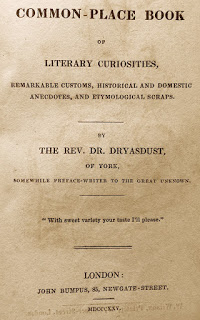
Found- in the The common-place book of literary curiosities, remarkable customs, historical and domestic anecdotes, and etymological scraps by Rev. Dr. Dryasdust, of York. (London: John Bumpus 1825) these amusing anecdotes about Samuel Foote (1720 – 1777) the British dramatist, comic actor and theatre manager. Probably the best known quotation associated with him is a put down of an unnamed ‘law lord’. Foote said of him- ‘What can he mean by coming among us? He is not only dull himself, but the cause of dullness in others.’ Dr. Dryasdust provides six anecdotes about Foote. The first concerns Samuel Johnson, who tried very hard not to be amused by him..the last, where he messes up his lines in Hamlet, has the spirit of Tommy Cooper or Stanley Unwin. His Othello was apparently a ‘masterpiece of burlesque..’

1. Life's a poor player.

"Dr Johnshon said, 'The first time I was in company with Foote, was at Fitzherbert's. Having no good opinion of the fellow, I was resolved not to be pleased; and it is very difficult to please a man against his will. I went on eating my dinner pretty sullenly, affecting not to mind him; but the dog became so irresistibly comic, that I was obliged to lay down my knife and fork, throw myself back in my chair, and fairly laugh out. Sir, he was irresistible!"

Continue reading

The Secret Places XXI & XXII

The last two chapters of The Secret Places (Elkin Mathews & Marrot London 1929) - a chronicle of the 'pilgrimages' of the author, Reginald Francis Foster (1896-1975), and his friend 'Longshanks' idly rambling in Sussex, Kent and Surrey. See our posting of the first chapters for more on Foster and this book, including a contemporary review in The Tablet.

Continue reading

A voyage to Russia in 1908 & 1965 (2)

Nevsky Prospect Leningrad 1960s
(thanks Transpress N.Z.)
This is the second part of an anonymous diary found in our archives (see part one.) It was written first by a young woman of about 20 in 1908. Here she returns in her mid 70s (by plane.) Leningrad has since become St. Petersburg and the Astoria has become very expensive...

Sunday 12th September, 1965

 Perfect flight from London taking less than seven hours including half-an-hour at Copenhagen. Wonderful cloud effects. We spent ages waiting at the Leningrad customs. On reaching the hotel Astoria unpacked and changed. We had an excellent luncheon at 1 o'clock; sprats, not unlike sardines, Chicken Kiev. Separate course of peas, (not very good) grapes. A white wine and a red wine. The latter good, the white not interesting.

 In the afternoon we went to St.lsaac's Cathedral, a monster of vulgarity - everything gilt or malachite, except two elegant columns of lapis and a wooden model of the cathedral; these were the only things that pleased me.
We had a good dinner, but oh, the slowness of the service! We went to bed early.

Continue reading

A voyage to Russia in 1908 & 1965 (1)

Found- an anonymous account of a a trip to Russia on The Salsette in 1908 written by a young woman of an artistic bent. There is a certain amount about the ship, mostly at Shona's Wrecks (many thanks) which mention this voyage to Northern European cities, the Salsette's first major outing. In 1915 the ship was hit by a torpedo and lies 600 feet down off Portland Bill, now a favourite wreck for divers to explore.In 1965, probably by then in her mid 70's, our diarist flew back to Russia and remarks on the changes (to follow).

ON BOARD “THE SALSETTE”

20th August, 1908

  It has been rather rough and cold all day but for all that I have greatly enjoyed it. I was so tired after last night that I slept on till past 9 o'clock this morning, and then had breakfast in bed. All the competitions have started again, and out of the two I have played to-day I have again won one. It has been very nice and restful having another whole day at sea - one gets so frightfully tired sightseeing. Every town we have been to see so far has been paved with cobble stones, roads and pavements alike, and this, especially when one has thin soles to one's shoes, very quickly makes one's feet ache.

Continue reading

Famous people from Stevenage (2) Edward Gordon Craig

The only other one appears to be the racing driver Lewis Hamilton, who was really born in Tewin, a few miles away, though some sites will tell you differently. According to the site devoted entirely to famous Stevenage people, most of the other contenders are bit players on soap operas or models, although it is not specified that the one decent footballer amongst them, Manchester United’s Ashley Young, actually came from the town.

Anyway, it can truly be said that Edward Gordon Craig (1872 – 1966), the eminent man of the theatre, designer of stage sets etcetera, was indeed born in Stevenage, long before the ancient Georgian coaching town had a bright, spanking New Town tacked onto its southern end. The illegitimate son of the famous actress Ellen Terry and architect Edward Godwin, it was almost inevitable that he would make his name as a stage designer, with his radical ideas of neutral non-representational sets and use of top-lighting. This photo (to follow) comes from the same archive of press photos featuring Herbert Read, Stephen Spender, Harold Nicholson and Desmond MacCarthy that inspired previous Jots– so one must assume that it too belongs to the Sunday Times Book Exhibition of 1936.

One extraordinary fact about Craig is that although he lived to be 94, all his most significant work was done before the age of 40—that is, before 1912. [RR]

Thomas Augustus Trollope—the famous novelist’s forgotten brother

While many admirers of Anthony Trollope are busy celebrating the great novelist’s bicentenary, spare a thought for his older brother, Thomas Augustus Trollope (1810 – 92), who was always in his shadow, but who as a novelist, prolific travel writer and biographer in his own right, may have eclipsed Anthony in the word stakes.

In a long literary career Thomas published around sixty books, having begun a writing partnership with his mother while still at Oxford? In addition, he was a prodigious contributor to magazines. His friendship with Dickens, for instance, led to a long association with Household Words. Much of his work was achieved while living in some style in Italy. He moved to Florence in 1843, creating with his first wife a salon for expatriates at the Villino Trollope, which was expertly decorated and whose  sumptuous furnishings included a library of 5,000 books.
From here he migrated to Rome, where with his second wife, the writer Frances Trollope, he established another refuge for the expatriate  community.

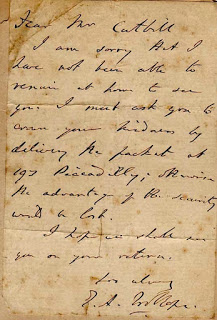
In this short undated letter Trollope apologises  to a Mr Cutbill for not being ‘ able to remain at home’ to see  him, and suggests that he  instead  delivers a ‘ packet ‘ to number  193, Piccadilly, ‘ otherwise the advantage of the scarcity would be lost ‘.As the address in question was that of Trollope’s publishers, Chapman and Hall, and if the letter dates from the period before he left for Italy, this packet may have contained some literary material of interest to the writer, but equally,  it could have been something perishable which may have spoiled if Cutbill, who was away from home at the time, had waited until his return to present  personally to Trollope.

This latter possibility seems unlikely. We simply don’t know what Trollope meant by ‘the advantage of the scarcity’, but if the package did indeed contain a perishable gift from Cutbill, perhaps Trollope felt that his publishers would be best placed to look after it until he returned to claim it.
[R.M.Healey]

Benjamin Jowett—‘I am Master ‘

"Here come I, my name is Jowett
  All there is to know, I know it
  I am Master of this College
  And what I don’t know isn’t knowledge."

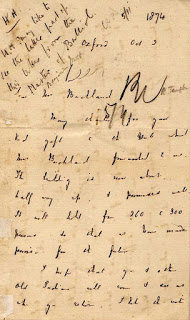
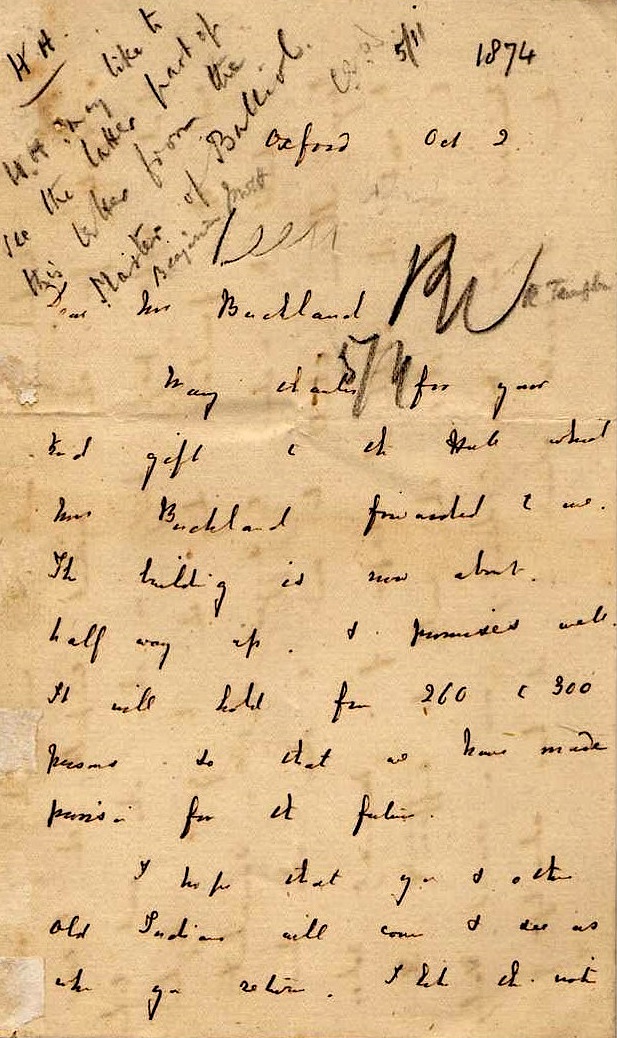
This squib gently mocks the pretensions of arguably Balliol College’s most famous Master. Jowett was a Greek scholar, and like many classicists through the ages, felt that a grounding in Latin and Greek was sufficient qualification to tackle most areas of knowledge. But he was also a dedicated theologian and an educational reformer. This letter, which another hand (possibly the same one that snipped out Jowett’s signature, thus losing text) has dated in pencil 5th November 1874, four years after Jowett was appointed Master, is addressed to a Mr Buckland (possibly a member of the celebrated clan of eccentric scientists). In it Jowett, who was always interested in Indian affairs and was a member of the 1854 committee drawn up to debate the future administration of the colony, shows his keenness to promote the benefits of an education at Oxford University to young men who might wish to join the Indian Civil Service. Previous to 1858, when it closed, such candidates would have been trained at Haileybury College, near Hertford, but Jowett argues that an Oxford education might prove more attractive to these young men than a stint at Haileybury, should that institution be ‘revived’.

Continue reading

James Greenwood (1832-1929) A Janus of Journalism

Found at the front of a book catalogue ('Chat Dept.') of  J.J. Rigden from the Haining collection this well researched piece on Victorian journalist James Greenwood.

James Greenwood (1832-1929) A Janus of Journalism

This author is now a little better known than he was a few years ago. He contributed to the world of boy's books, some exciting, though bloodthirsty works of fiction that can still be avidly read today.

Relying on his experience as a sensational journalist, he leaned heavily on the plot. His charters were not much more than 'cardboard cut-outs', and to a certain extent, he seemed to be obsessed with lycanthropy. 'The Bear King' 1868, 'Purgatory of Peter the Cruel' 1868, 'Adventures of Seven Footed Foresters' 1865… all have shape-changing as a major theme. His descriptions of blood-letting in various forms were highly coloured, leaving very little to the imagination.

Continue reading

The Secret Places XIX & XX

The penultimate two chapters of The Secret Places (Elkin Mathews & Marrot London 1929) - a chronicle of the 'pilgrimages' of the author, Reginald Francis Foster (1896-1975), and his friend 'Longshanks' idly rambling in Sussex, Kent and Surrey. See our posting of the first chapters for more on Foster and this book, including a contemporary review in
The Tablet.

XIX

OLD CRACKPOT

All day we had laboured southwards into the Kentish Weald, our clothing plastered in front with the sleet that drove upon us and our boots squelching at every step. In many miles we had not spoken. Longshanks sucked dismally at an inverted pipe which had long since grown cold.
In the end of such journeyings is a deeper content than of those made in fair weather. When the light failed over the eastward hills and the shifting wind brought a greater cold, we came upon a barn, and entered it as men who come to their last rest. As we heaved the door into place the day died over Sussex.
Continue reading

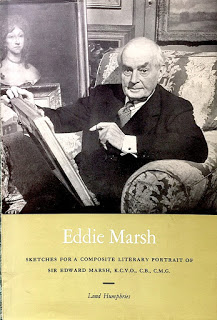
‘Eddie’ – tributes to Sir Edward Marsh

Found in a book* of tributes to Sir Edward Marsh, these two pieces unknown to the web - the foreword by Winston Churchill and the 'Tailpiece' by Max Beerbohm. Wikipedia (who regard him as a polymath) has this on him. Very clever, amusing, retiring, gay, one of the 'great and the good' and a patron of the arts - it is hard to think of a modern equivalent. Churchill, whom he served as Private Secretary for many years, attended his memorial and here contributes a touching piece on 'Eddie.' Beerbohm, who regarded him as 'not unalarming' also recognised him as 'one of the ornaments of his time.'

Foreword

Winston Churchill 

The friendship of Eddie Marsh is a memory which I put high among my treasures. We began working together at the Colonial Office in 1905 and from then onwards out association remained intimate and happy for nearly fifty years. He was not only an admirable Civil Servant, on whose judgement, loyalty, and competence I could always count, but he was a master of literature and scholarship, a deeply instructed champion of the arts, and a man for whom the esteem of his friends could not fail to be combined with their deepest affection. His serenity in all things made his companionship a pleasure; and his noble and generous nature made him an unfailing joy to men and woman of all generations who were so fortunate as to walk with him along the road. 


Tailpiece

Max Beerbohm

Eddie 

I do not remember having anywhere at any time heard him spoken of by anyone as Edward Marsh. And yet, with his tufted eyebrows and his monocle, and his sharply chiselled features, and his laconic mode of speech, he was not, one would have thought, unalarming. Or at any rate one would have thought so if his great kindness of heart had not somehow shone through the rather frigid surface of his social form. He was immensely more interested in other people than in himself - though he must have known that he was undeniably one of the ornaments of his time. 


*Sketches for a composite literary portrait of Sir Edward Marsh. C. Hassall and D. Mathews. London: Lund Humphries for the Contemporary Art Society, 1953.

Dattatreya Rama Rao Parvatikar

Found among the papers of Leslie Shepard this article on the Indian holy man and musician Dattatreya Rama Rao Parvatikar (1916 - 1990). Shepard refers to him as Sri Ramdatta Parvatikar. The article appears not to have been published. For more on Shepard follow this link to an earlier piece of his on Charles Fort.

SRI SWAMI RAMDATTA PARVATIKAR

A Portrait of an Indian Musician

by LESLIE SHEPARD

  It is twilight in the Himalayas, by the side of the sacred river Ganges, a magic moment when the forms of the visible world tremble as night falls. The dark outline of the hills with a shaggy growth of jungle might be a giant's head. Across the water comes the cry of rooks and the call of a boatman. The white domes of temples become unreal in the fading pink glow of the half-light. The sound of rushing water is like the music of dreams.
  From the old Sri Shatrughana Temple comes another music - the notes of a Rudra-Vina, a traditional instrument, played by a master hand. On the temple steps is a picturesque figure with a small group of devotees. Sri Swami Parvatikar Maharaj has the long uncut hair of a sadhu plaited and twisted round the top of his head. He has a majestic beard and keen eyes. He wears a tattered red cloak, and sits in padmasana, the lotus posture, as he plays his instrument in the service of the Lord. A cow stumbles past noisily, but nobody takes any notice, entranced by the subtle and powerful vibrations that pour from the strings of the Rudra-Vina like the swift current of the Ganges.
  Sri Swami Parvatikar is a commanding figure, with an extraordinary dignity and power. He is a sadhu - a wandering monk - but he is also a Bachelor of Science, a radio artist, and one of India's greatest religious musicians. With all his contradictions, the man is inseparably connected with his background...
  The scene is part of a timeless India. Day by day in the big cities, men are struggling with the hard economics of five-years plans, with the new threat of enemies on the border, but here, at Rishikesh, one man is preserving an ancient way of life for the benefit of a modern world.

Continue reading

Dail Ambler

A letter from the Peter Haining collection unsigned but certainly from Steve Holland, a fellow British pulp enthusiast who wrote a definitive book on the subject - The Mushroom Jungle and later a book on pulp writer Dail Ambler The Lady Holds a Gun! Both books can be bought at Amazon, the latter only as a Kindle download…Among many works written under pseudonyms Dail Ambler (a.k.a.Danny Spade) also wrote the screenplay for the cult film Beat Girl (1960) starring the amazing Gillian Hills.

Dear Peter,
 Many thanks for your letter, and for the offer of some Janson's on loan...
THE MUSHROOM JUNGLE: well, you've certainly come to the right person to ask, as this is the working title of my book on the fifties publishers! I dreamed up the title years ago when I started, a sort of play on The Asphalt Jungle, with mushrooms chucked in because of how these publishers seemed to pop up overnight. The bulk of the bibliography (which runs to 250 pages} is written, but I'm adding to it all the time…

Continue reading

The ‘Belfast of Canada’

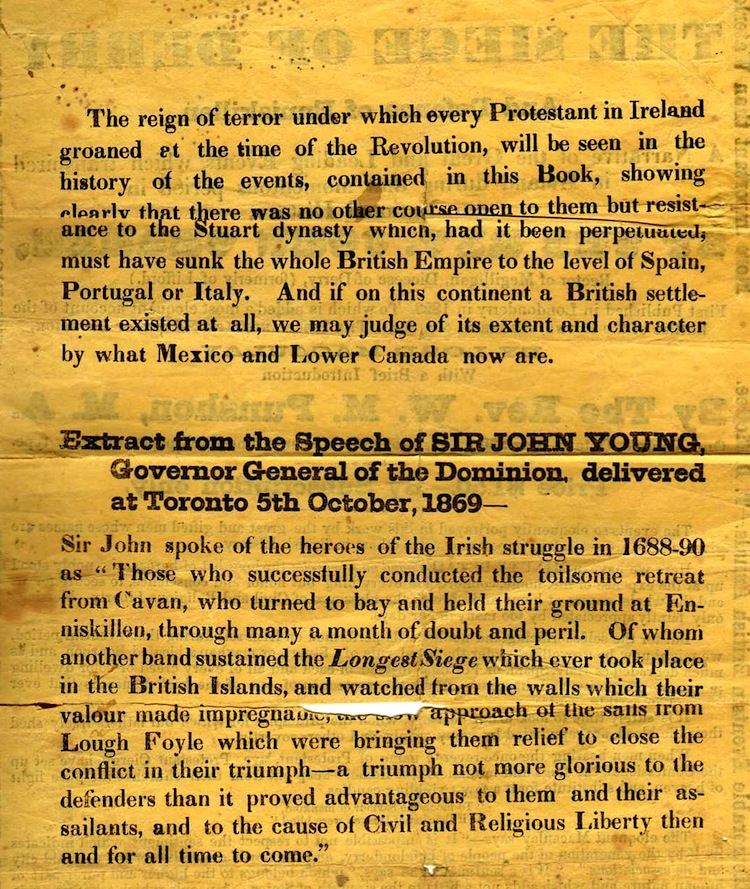
Anyone with even slight Catholic sympathies would probably not have got on well in Toronto during the late nineteenth century, when it had become a hotbed of Protestant ascendancy. By the turn of the century, the power of the Orange Order, who returned twenty of the twenty three mayors in fifty years, got it nicknamed 'the Belfast of Canada'.
Even by the 1940s this legacy had not waned sufficiently for the artist and writer Wyndham Lewis who, forced by circumstances to spend several years there during the War, was constantly frustrated and angered by the philistinism and religious bigotry of its leading lights.

The prevalence of militant Protestantism in mid nineteenth century Toronto is well illustrated by this scarce flier of c 1869 from Maclear and Co, the dominant publisher in Canada for many years. In advertising the forthcoming reprint of The Siege of Derry, originally published in 1823 by  the Rev John Graham, a clergyman from Ulster , it combined blatant propaganda on behalf of ‘ the heroes of the Irish struggle in 1688 – 90 with a nifty aside aimed at backsliding Anglo-Catholics:

'When men bearing the once-revered name of Protestant , aye Protestant clergy, have set up the Confessional, the Rags and mummeries of Rome…'

A rather appropriate piece of propaganda, given the crisis now attending the power-sharing agreement at Stormont.

R.M.Healey

Stephen Pribil—the Invisibility Man

Here are three photographs out of a possible six from the photo-archive of the famous newspaper  El Mundo of Argentina. Interestingly, they are stamped 1st April 1935. Now, I don’t know if the Spanish, or indeed the Argentinians, reserve the 1st of April for tricks, leg-pulls, spoofs, scams or other deceptions, but if Dr Pribil, a Hungarian oculist, was deliberately playing a trick on journalists with his demonstration of ‘Invisibility  Rays’, then he certainly went to a lot of trouble to do it.

According to the typewritten labels on the back of each photograph Pribil placed three objects—a teddy bear, a bronze statuette and an opaque china vase -- in his apparatus—basically a wooden box fronted by a picture frame behind which is a sort of slated affair. Out of the back of this box electric cables are connected to a supply. Unfortunately, the two photos showing how the objects gradually fade away are missing, but the last photo does show that all the objects have now disappeared.’ They are in the same place, perfectly tangible ‘, the caption points out, ‘but are completely invisible’.

Continue reading

Famous people from Swindon Number 3: Alfred Williams

Two other contenders could be Diana Dors (nee Fluck ) and Desmond 'Human Zoo' Morris. This letter, from a perhaps less famous Swindonian (though he actually came from South Marston) was rescued from a junk stall on the Portobello Road a few years ago. It was written by Alfred Williams (1877 – 1930), sometimes known as the ‘Hammerman Poet ‘, because for 23 years he worked for the GWR, latterly  operating  a steam hammer—a task that severely damaged his health.

Williams, who published several volumes of decent verse and topographical writing as well as the much admired Life in a Railway Factory, belongs to that small category of writers (most of them poets) who held boring and/or physically taxing jobs while creating reputations for themselves in the literary world. The best known was probably John Clare, but a more recent example is the celebrated poet Peter Reading, who had the thankless task of operating a weighbridge. After many years of doing this he famously refused point blank to wear a uniform when it was imposed on him and instead resigned, whereupon his admirers in the literary world came to his rescue with offers of more congenial literary work.

Continue reading

The A.A. Gunner’s creed

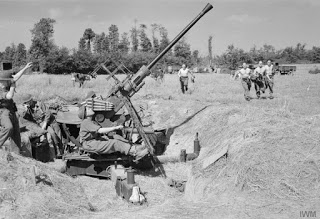
A.A. RAF team in Normandy.
Many thanks Histomil
Found in The Journal of the Royal Air Force Volume 15, no. 2 Autumn, 1935. pp 229-230 The A.A. Gunner's Creed, by H. W. H. The journal preface the creed by stating "…the origin of this creed is unknown, and the Editor publishes it hoping that he is not infringing any copyright" - a sentiment we also echo. HWH shows considerable wit and was probably a formidable gunner. A.A., as every WWII buff knows, stands for 'Anti-Aircraft.'

Whosoever will be saved: before all things it is necessary to hold the A.A. Faith.

Which Faith except every one do keep whole and undefiled: without doubt he shall miss the target everlastingly.

And the A.A. Faith is this: that we worship Calibration and the Mean of Three Height Readings.

Neither confounding the Height-takers: nor cavilling at their marvellous discrepancies.

For there is one Height of the Mirror, another of the Altimeter: and another of the U.B.2.

And yet there are not three Heights; but one Height.

Continue reading

Smatterers or Scholars?

Found – an obscure book by a forgotten journalist. In the 1920s and up to the early 1950s his short ‘thought pieces’ were syndicated in the UK and as far as Australia. This tradition of coffee break columns is still with us – now it’s Robert Crampton rather than Robert Power. His ideas are oddly prescient given the plethora of information now available. The answer to the second part of Dr Johnson’s question is known by everybody – and it’s not the Encyclopaedia Britannica! This is from Two-minute talks. Second volume. Robert Power. London: S. W. Partridge [1925] pp.45-46.Other ‘talks’ have titles such as ‘Poppy Friendships’, ‘Blistering Tongues’, ‘In the W.P.B.’, ‘Rich Poverty’, ‘Are you Popular?’, ‘Poachers’ and ‘Rubbernecks.’

Smatterers.


Time was when we used the word “smack” to mean “taste,” and thus a taster became known as a “smacker”. It is not difficult for a generation of slovenly talkers to corrupt a word, and thus “smacker” or taster has become “smatterer,” one who has only a slight, superficial knowledge, a sciolist.

Continue reading

Edgar Wallace at Sing Sing

Found in the Haining archives - this article by Edgar Wallace.It is unclear from which magazine it was clipped but probably dates from the late 1920s and was published for his British readers. Several of Wallace's books refer to Sing Sing prison including  Mr J.G. Reeder Returns (1932) which has a story called The Man from Sing Sing. Edgar Wallace (1875-1932) was the adopted son of a Billingsgate fish porter in London, and largely self-educated - the newspaper boy who became one of the most famous writers in the world. He sold millions of books, but he was plagued by debts due to an extravagant lifestyle. He left Britain for the United States in 1931, only to die in Hollywood in 1932, aged 56, after writing the original story for King Kong. His body was returned by ocean liner in honour, only to be reunited with an ocean of outstanding bills.It is said all his debts were paid off in a few years from massive book sales. A BBC radio programme earlier this year by thriller writer Mark Billingham on Edgar Wallace (The Man Who Wrote Too Much?) suggested he was somewhat forgotten. He may not be much read anymore but his books are still collected throughout the world…

Continue reading

Professor Alexandre Lacassagne – a real Sexton Blake

Found in the endless Haining archive, an article cut from The Union Jack Detective Supplement, undated but about 1925. Peter Haining was a collector of Sexton Blake books so this piece on the scientific / forensic detective Professor Alexandre Lacassagne (1843-1924) would have interested him.

A Real Sexton Blake

By Donald Campbell.

They read like improbabilities, the achievements of this real-life Sexton Blake. But we credit them when we see the working methods of Professor Lacassagne, who has recently died.

  A few weeks ago there died at Lyons one of the greatest scientists of his own kind in the world.
This was Professor Alexandre Lacassagne, honorary professor to the Faculty of Medicine, who passed away at the ripe old age of eighty-two. He was the first man in Europe to apply science to detective work. He served as an officer in the army of Napoleon III., and fought through the Franco-Prussian War of 1870-71.He was taken prisoner. When released he was attached to the Bataillons d’Afrique, then a species of depot for all the rough characters who came to do their military service, usually very much against their wills.
  First he merely studied characters, but afterwards the real criminals, and specialized offenders who came under his treatment.

Continue reading