Barbarossa’s Pike

On this day 5th of October 1162 the Emperor Barbarossa threw a tagged baby pike into a pond. Weighing 350 pounds, the same pike was caught and eaten in 1397, having lived for 235 years.

Source: The Gourmet's Companion by Ross Leckie (Edinburgh 1993) Actually Leckie gives the dates decades after Barbarossa's death so have adjusted the dates (from 1262 to 1162). Possibly file under myths and legends -

or fisherman's tales...

London’s first boutique

From Gear Guide (Hip Pocket Guide to London's Swinging Fashion Scene) published in London in May 1967.

Bill 'Vince' Green was a stage portrait photographer who specialised in taking shots of body-builders. One of  his problems  was finding briefs that were brief enough and close fitting to show off the body beautiful to the best effect. There seemed to be no solution to his problem until Vince started making the briefs himself. He tried using stretch material intended for women's roll -ons and other unlikely cloths.  it was really only a part time activity for Vince, but his name spread -  people started turning up and asking for briefs to order in unusual materials. Even visiting royalty  sought him out and were fitted with swimwear.  In 1954 he visited Paris  and was struck by the clothes of the beat Left Bank student fraternity  and cafe society - young people who lived it up through the night in the cafes wearing dark glasses and a lot of denim.

Denim took Vince Green's fancy. He discovered that  people  were actually bleaching their denims and sitting in baths to shrink them to body-hugging shapes. It seemed a great idea and Vince  decided to sell denim made like this. In October 1954 he opened up a boutique selling pre-shrunk pre-bleached clothes. At the beginning the trade was highly amused and though it a quickly passing gimmick. But soon he was supplying his denim wholesale to big stores like Harrods. Today over a decade later, this particular gear style is still very popular in many different forms. Is not surprising  and new as Vince probably thought. In the days of the great army of the Russian Czar's the officers were known to sit in  the hot baths to soak their sealskin trousers before a big parade or ball.

Continue reading

The Man who sold Alton Towers

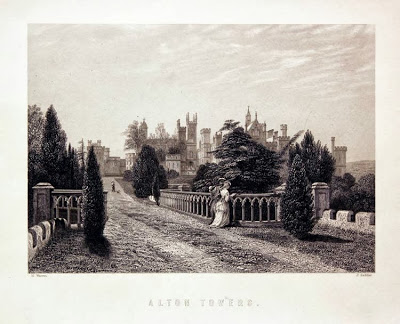
Charles Chetwyn Talbot, 20th Earl of Shrewsbury (1860 – 1921) was this man, and it turns out that he was a bit of a cad. Having inherited the title at the age of 16, he proceeded at the age of 19 to elope with an older, wealthy, married woman, by which he had two children. As a commoner his wife was never accepted by the aristocracy, whereas the Earl went on to receive several honours, including one from the Queen. The couple separated in 1896, a few months after this letter was written, and Shrewsbury decamped to Ingestre Hall, twenty or so miles south of Alton Towers.

Perhaps Lady Shrewsbury felt her husband was spending more time with his sporting passions and business interests than he was with her. He was, after all, potty about  polo and the letter addressed to ‘ B ‘ was probably sent to Algernon Burnaby, one of his regular polo pals at Alton Towers. When he moved to Ingestre he established the Staffordshire Polo Club there. He also owned a hansom cab service—the vehicles being emblazoned with ‘ S. T ‘ for Shrewsbury and Talbot. He was the first to have those cabs that operated in London and Paris fitted with noiseless tyres. In addition, he was a motoring pioneer. In 1903 his company, Clement Talbot Ltd, began to import from France what became the ‘Talbot ‘car.

According to the official History, Alton Towers was sold to a group of local businessmen in 1920. A year later, The Earl died and the title was inherited by his grandson, his own son, Viscount Ingestre, having died during the War. In 1924 the grounds began to be developed as a tourist attraction and the dowager Lady Shrewsbury was booted out of the house she had known for 44 years and re-housed, probably at Ingestre. She lived on, possibly more accepted by now, until 1940.

After the Second World War Alton Towers fell into decay, but by now the vast grounds had become a popular resort. It was only after 1973 that the Alton Towers amusement park, with its terrifying rides and spectacular features, came into being. The ruins of the house are now part of the Alton Towers Experience.[RR]

King Kong’s Vital Statistics

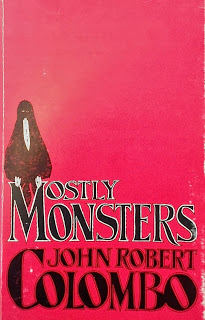
Found in Mostly Monsters by John Robert Colombo (Ontario 1977). A curious work of 'found' poems mainly from monster books and movies. For example, this piece extracted from Gustav Meyrink's 1915 novel The Golem:

But this I know-
That there is something here
In our quarter of the town...
Something that cannot die,
And has its being within our midst.
From generation to generation
Our ancestors have lived here
In this place,
And no one has heard more tales
About this reappearance
Of the Golem-
Happenings actually experienced
As well as handed down-
Than I have.

Another 'poem' is taken from a publicity handout for Merian Cooper's 1932 movie King Kong:

Continue reading

NIM – the first Computer Game (1951)

Sold this item about 10 years back for $500. Possibly worth a whole lot more now. The game is the same as the match-stick game being played in the movie L'Année Derniere a Marienbad and is said to have originated in ancient China where it was known as Tsyanchidzi the 'picking stones game.' The match game can now be played online at the Archimedes' Lab site. Good luck if you can beat your computer there!

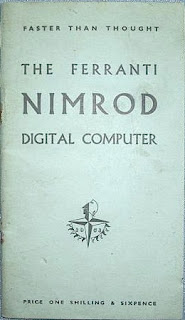
THE FERRANT NIMROD DIGITAL COMPUTER
Computer manual. Original booklet from The Festival of Britain, 1951 with the words "FASTER THAN THOUGHT." on cover with the Festival's symbol.

Revealed to the public as part of the Science Exhibition at the Festival of Britain in 1951, the Ferranti Nimrod Computer was the first ever computer game - a machine built exclusively for the purpose of playing a computerized version of the logical game of 'Nim'.

(From the booklet) The game is for two players, being played nowadays with matches. At the beginning of the game one of the players arranges the matches in any number of heaps in any way he chooses. The players then move alternatively taking any number of matches from any one heap but at least one match must always be taken. In the normal simple game the player who succeeds in taking the last few matches wins but in the reverse simple game the player who takes the last match or matches loses.

Nimrod could play all the variations of the game and at the exhibition members of the public were invited to play against the machine; at the end of each game the computer would flash up the message 'COMPUTER WINS' or 'COMPUTER LOSES'. When the famous British scientist and ENIGMA codebreaker Alan Turing played it he managed to beat the computer, although witnesses were amused by a malfunction whereby Nimrod 'changed its mind' from 'COMPUTER LOSES' to 'COMPUTER WINS' and refused to stop flashing.

The booklet, which was sold at the exhibition for a shilling and sixpence, is a detailed guide to the machine and how it plays the Nim game, preceded by a more general introduction to the emergent sciences of computing and artificial intelligence. As an indication of how early the language is, it could be noted that the term 'memory' is mentioned only as an alternative to the preferred term 'storage'. Rare -  so elusive that it is not listed by Hook and Norman in their compilation of the most exhaustive bibliography of computer literature to date, The Origins of Cyberspace.

Two Windmill Girls play Nim at the Festival of Britain

Rudolph Putnam Messel—a forgotten member of The Brideshead Generation

When, a few years ago, I bought a copy of Ernst Toller’s Brokenbrow (1926) for its brilliant illustrations by George Grosz, I didn’t take much notice of the bookplate. Recently, I took another look and discovered that it was made for Rudolph Messel, Oxford friend of Evelyn Waugh in the early twenties and one of the lesser known members of the 'Hypocrites Club'.

Born in 1905, the son of wealthy stockbroker Harold George Messel, art was part of Rudolph’s heritage. Famous stage designer Oliver Messel was his cousin and his aunt Maud was daughter of the celebrated Punch cartoonist Linley Sambourne. In 1918, when he was 13 he lost his mother. On his father’s death two years later Rudolph may have become a ward of his uncle Leonard, who in 1915 had inherited Nymans, in Sussex, from his father Ludwig (also a stockbroker ).While Leonard was transforming the gardens of Nymans and filling the mansion with costly art works from around Europe, his nephew Rudolph was living an effete life at Oxford as a member of the notorious Hypocrites Club, whose more famous members included Evelyn Waugh, Terence Greenidge and Lord David Cecil. In 1926, aged 21, Rudolph stayed for a few days on Lundy with Greenidge, probably on the recommendation of Waugh, who had visited the island two years earlier with some fellow Hypocrites. Greenidge and Messel had interests in common . Both liked dogs and both were keen on film. The eccentric Greenidge was perhaps a little keener on dogs than was Messel and attracted attention on Lundy by a habit of kissing his pooch on the mouth.

Continue reading

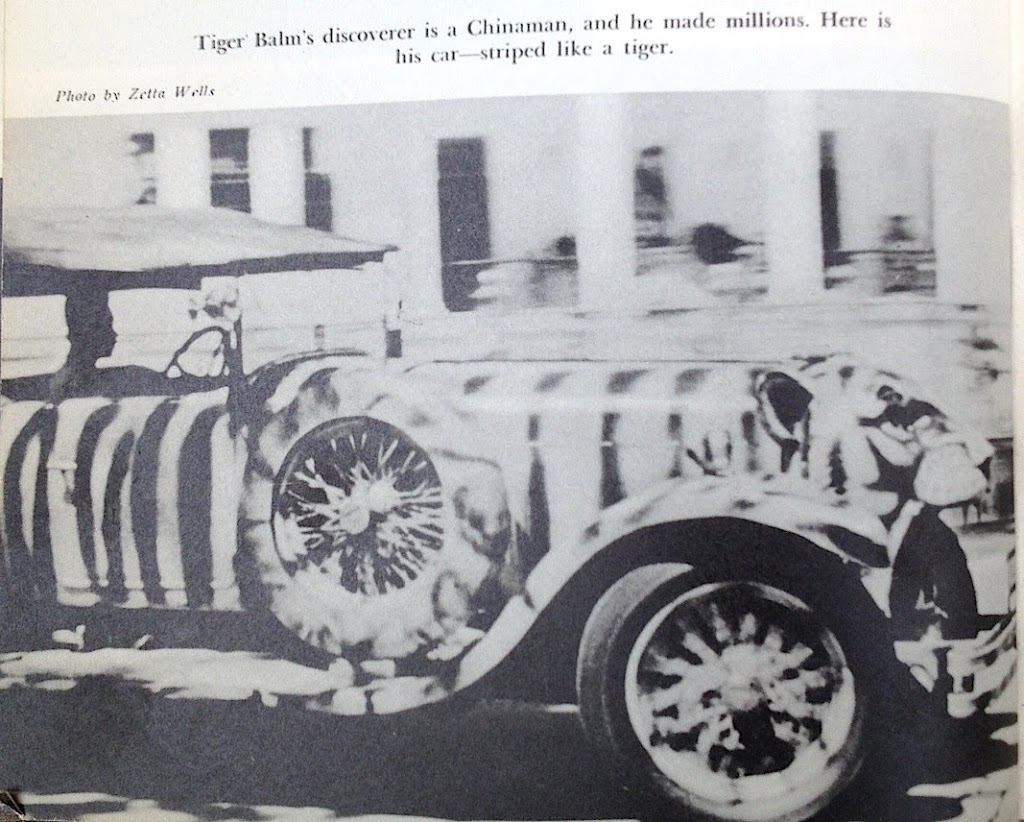
Boon Haw’s Tiger Balm Car

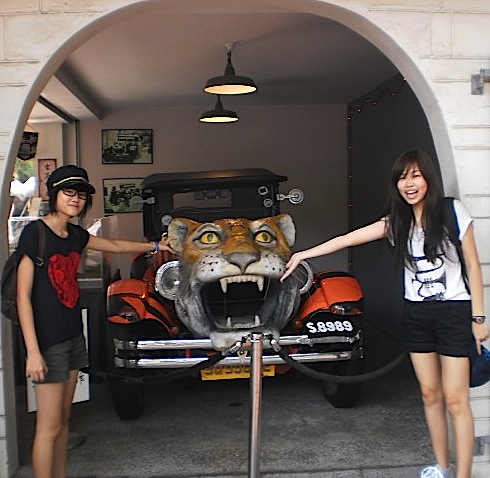
Aw Boon Haw was the founder of the Tiger Balm fortunes.  His splendid sports car is shown in Carveth Wells 1940 book North of Singapore. 75 years later it is on display in the Tiger Balm mansion Haw Par Villa in Singapore. Aw Boon Haw used to drive the car (a customised Humber) around Singapore, a tiger head on the radiator, fangs protruding, wire whiskers. Red bulbs were in the eyes, and the horn sounded like a tiger’s roar. Great publicity - way before Shell's  "tiger in your tank."

There is a story of a road rivalry between Boon Haw and Sultan Ibrahim of Johore. Sultan Ibrahim was a sportsman and hunter. The incident took place when the Sultan, enraged at being overtaken by Boon Haw in his famous Tiger Car. Sultan Ibrahim shot at the Tiger Car on Bukit Timah Road. It was considered lese-majesté to overtake royalty even on foreign roads*. Notwithstanding, the British colonial administration forbade the Sultan thereafter from visiting Singapore ever again except for purpose of going to and from the Singapore airport.

* This tradition of royal road rage still persists among plutocrats - for example Aristotle Onassis's biographer notes that he detested anyone who overtook his Porsche...

Salinger reading Salinger

An auction concluded this August at the august RR Auctions where a credit card receipt signed by the reclusive J. D. Salinger made $450. It was described thus:

Receipt for a purchase of two books at the Dartmouth Bookstore in Hanover, NH, on November 11, 2001, 2.75 x 7.5, signed in black ballpoint, “J. Salinger.” In fine condition, with an area of slight staining at the bottom. Pre-certified PSA/DNA and RR Auction COA.

This was spotted by a Jot101 reader (many thanks JK) who saw the salient point in the lot – one of the books was about the writer himself With Love and Squalor: 14 Writers Respond To The Work Of J.D. Salinger.

This writer remembers Catcher in the Rye being confiscated at school in the 1960s and one of the ‘Squalor’ contributors, Walter Kirn, talks of how the book was snatched from his hand and thrown across the floor at college when he was reading it after the murder of John Lennon (it was reported that his assassin had found secret messages in the novel.) It is not uncommon for a writer to buy books about himself – we had a copy of J. Franklin Bruce’s book on Robert Heinlein extensively annotated by Heinlein. Of course being notably litigious JDS may have been looking for something to put his lawyers on to…

The model for the Phantom of the Opera’s girl

It is now generally accepted that the Swedish diva Christine Nillson, afterwards Duchess de la Miranda ( 1843 – 1921), was the model for the Phantom’s lover, Christine Daee in Gaston Laroux’s novel The Phantom of the Opera (1910). Both figures have biographical facts in common—both were Swedish blondes with blue eyes, both sang at country fairs in Sweden to provide money for their parents and both trained in Paris.

During her brilliant career touring Europe as one of the greatest sopranos of her age—a direct rival of the Italian Adeleina Patti — Nillson must have sung before Laroux in Paris at least once, and the novelist, like so many other men of the time, was doubtless in thrall to her wonderful bel canto voice and Nordic physical beauty.

In 1887 Nillson married her second husband (Count Casa Miranda) and soon afterwards retired, to become one of the best known celebs in Europe. The undated, rather effusive letter to ‘Mrs Kennard’-- probably the now forgotten ‘horsey’ novelist ( a sort of late Victorian Jilly Cooper )--Mrs Edward Kennard ( 1850 - 1936 ) post-dates 1895, when the Hotel Metropole in Brussels opened its doors. As the singer mentions having recently stayed at this ultra exclusive resort of the rich and famous (both then and now), and as she was writing  to Kennard from the swanky Grand Hotel in Menton on the French Riveira, it seems likely that  post- retirement, she was still a very wealthy woman. [RH]

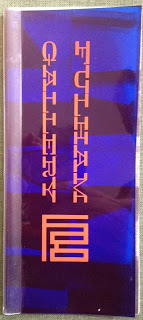
Fulham Gallery. (First exhibition.) Only Connect.

Having just sold this art catalogue we would like to record it's passing by archiving the catalogue entry. A rare John Fowles item, amongst other things, and visually attractive and interesting to touch and handle. A record of when the Fulham Road was an artistic hub...the title is from E.M. Forster (the epigraph to Howard's End) and has been adapted more recently by waggish dealers as 'Only Collect.'

Tall narrow 8vo. Trendy in appearance with blue thin plastic covers printed orangey red over abstract photo by Michael Dillon. No date (1967). Stiff plastic spine with 18 page catalogue printed recto only on 3 different coloured papers. Short introduction by John Fowles ('Only Connect.') Foreword by the d/w illustrator Tom Adams whose gallery this was. It was showing the work of poet / artists like Michael Horowitz and Asa Benveniste and established artists like Prunella Clough, Carel Weight and John Bratby. The first item listed in the unillustrated catalogue was an oil by Adams 'The Magus.' Adams did the jackets for Fowles first 3 books as well as many Agatha Christie works.  A rare ephemeral item lacking from most Fowles collections. A search on the web revealed the following: 'In 1967 Adams opened the Fulham Gallery, which not only gave first exhibitions of some now famous artists, but was for several years the center of the late '60's phenomenon - the poetry print. With C.Day-Lewis (the Poet Laureate) and artist Joseph Herman and John Piper, Adams produced the investiture print for the Prince of Wales.

Adams also designed posters for Mark Boyle's light shows (The Sensual Laboratory), going on tour with The Jimmy Hendrix Experience and The Soft Machine. His connection with the modern world of rock music continued when he met Lou Reed, an admirer of his Christie and Raymond Chandler covers. Reed asked Adams to design the cover for his first UK solo album. As a result of this friendship with Lou Reed, Andy Warhol offered to sponsor of exhibition of Tom's work in New York. Adams did eventually work in the States in the early 70's where he was asked by Marshall Arisman to teach at the New York Central School of Art.'

Aerophobic Germany

From Pilgrimages to the Spas in pursuit of health and recreation; with an inquiry into the comparative merits of different mineral waters: the maladies to which they are applicable, and those in which they are injurious by James Johnson M.D. (London 1841). A fresh air fiend Britisher attacks unhealthy Germans...

Aerophobia. From one end of Germany to the other, among all ages, ranks, and professions, an AEROPHOBIA, or dread of fresh air, universally prevails ! If you take a seat in the diligence or eilwagen, your German neighbour in the corner closes the windows immediately, lest a breath of pure air should enter the vehicle. On arriving at the hotel, half poisoned by the disoxygenated atmosphere of the coach, and enter your chamber, you find all the windows securely fastened, and the air of the apartment a mass of heavy mephitic vapour, like that which issues from a long unopened tomb. If you descend to the spies-saal, where the air is still farther vitiated by the fumes of tobacco, and throw open a window, you are stared at by the ober-kellner, the under-kellner, and every "GAST" in the "HAUS," as a person deranged. I had long puzzled my brains to account for this aerophobic phenomenon, and, at last, traced its cause to the GERMAN STOVE that black brewery of mephitism, which, bearing a mortal antipathy to the fresh air of Heaven, imbues every one who sits near it with the same prejudice. In fine, the German exhibits as great a horror of oxygen, as he does a mania for azote! [Azote = Nitrogen]

And what is the consequence of this? Why, that the Germans are ten times more susceptible of colds, rheumatism, face-aches, and tooth-aches, than the English, who live in a far more variable, wet, and ungenial climate. This aerophobia is one of the causes too, of that sallow, unhealthy aspect which all Germans, who are not forced to be much in the open air, exhibit. It is no wonder that they swarm like locusts round their numberless spas, in the Summer, to wash away some of those peccant humours engendered by their diet, and fermented by their stoves.

Harold Monro puts up a sign

An excellent photo of the poet Harold Monro (1879 - 1932). Found in a copy of  his Collected Poems (Cobden Sanderson, London 1933). A handsome man reminiscent of TV's Inspector Lynley, the sign is almost certainly by McKnight Kauffer and was seen in commerce at last year's Santa Monica Bookfair.

There is a good piece on him at the Oxford DNB site. It informs us that he inherited a small income from a family-owned lunatic asylum. He was inspired by H. G. Wells's A Modern Utopia (1905) to start an order of ‘Samurai’, Wells's voluntary ruling class.This 'nascent order' (started with Maurice Browne who also started the Samurai Press) collapsed along with his first marriage in 1908. He opened the Poetry Bookshop in December 1912. It was revived after the war and in 1926 moved to Great Russell Street near the British Museum which is likely to be where he put this sign up.The DNB says this of the shop and HM:

Bookshop parties became famous; despite his chronic melancholy, the reverse side of his idealism, he was a generous host and kindly listener, delighting in serious conversation. Some people thought him handsome, others said he looked like an intelligent horse; he was tall, lean, and upright, with sleek dark hair, thick moustache, long face, and sad eyes. His tactless survey, Some Contemporary Poets (1920), shows little critical insight; his greatest service to his fellow poets was as an enabler.
James Bond and the origins of the skateboard

Sent in by an avid jotter just retired at 50 and spending his time in browsing his vast library (mostly acquired in the purlieus of Charing Cross) and sharing it with a waiting world. Just like a Victorian gentleman scholar or, say, Casaubon himself. Good to see the mountaineering writer Arnold Lunn name-checked. He was,with Alfred Noyes, a great favourite of supercollector Jimmy Kanga…

James Bond and the origins of the skateboard 

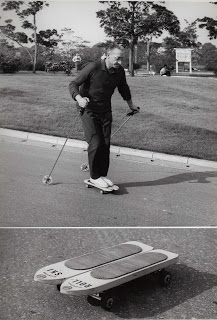
Some skateboard historians will tell you that the invention came about almost by accident in the early fifties when surfers wanted to practice their surf moves on land. Before long, a firm in LA was making them and the basic board was modified in the next two decades. No actual inventor is named…until now. I can now with confidence say that the photo ( from an archive of sport-related press photos) shows the inventor, Hannes Schneider (1890 – 1955), hitherto known for his pioneering work in popularising skiing, demonstrating a pair of skateboards to the amusement of some Japanese onlookers.
The problem is that Schneider isn’t road testing two skateboards, but a pair of ‘Roll-Skis ‘.All the evidence suggests that the photo was taken in the early fifties, when Schneider would have been in his early sixties. Also, the roll-skier is definitely Schneider himself. The man’s features resemble those on earlier photos and who else but the inventor would be demonstrating sports kit bearing his name?

Schneider had a long association with Japan going back to 1930, when he was invited by the Japanese government to teach schoolchildren to ski. The new craze caught on and the Japanese love for skiing is totally down to Schneider’s influence and teaching there. It makes sense that he chose Japan to road test his new invention, the Roll-Ski, which was supposed to give skiers the opportunity to practise their sport in summer, when many pistes had thawed.

Continue reading

I once met….Bryan Forbes

It was in the summer of 1999 that the actor, screenwriter, director (Stepford Wives, Whistle Down the Wind, Séance on a wet Afternoon), turned crime writer, who died last May, had asked me to meet him at his second hand bookshop in Virginia Water.

It was an odd sort of shop—not the type one would come across in most provincial towns or indeed most parts of London. Here were no grubby leather-bound tomes in tottering piles, or cabinet of curiosities. I think it sold new as well as second books and indeed most volumes seemed to be of the twentieth century. I glanced around expecting to find rare books on golf or lawn tennis, classic American hard boiled thrillers or collections of recipes for cocktails.

But there no time to look further as Forbes appeared in person and we were soon speeding along in what was probably his Aston Martin to his home on the ultra- exclusive Wentworth estate. I only caught a glance of its exterior, but it seemed to be a huge and classic twenties film-star mansion, which it was, in the sense that Forbes later told me that as a young budding film star in the fifties he had bought it as a total wreck and had spent  many thousands of pounds doing it up. Something to admire, I thought.

Continue reading

A Mussolini Howler

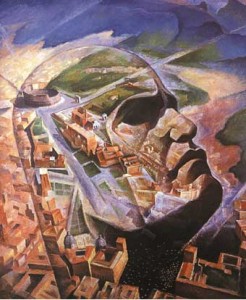
Mussolini by Marinetti

From a book of  of schoolboy howlers collected by Colin McIlwaine and published in London in 1930. Most howlers are short and many are online already ('a polygon is a dead parrot') , some rather odd ('A Molecule is a girlish boy') and some very silly ('The highest peak in the Alps is Blanc Mange'.) This is the last entry in the book and one of the longer howlers.

Mussolini is an ugly man. He wears the shirt of the Madonna, and when he smiles he makes people weep. He has been killed four times. The first time they wounded him in the nose, the second time in the forehead, but he himself they never wounded. He is a phenomenon, a thing that comes only once in 1000 years. He hardly ever sleeps, but shuts his eyes for 10 minutes, then goes and has a good wash and returns to work as fresh as a rose. He is a man of mystery. He can do everything and knows everything and loves playing the saxophone with his family. Galileo was charged with High Treason because he said that Mussolini moved round the sun, and not the sun around Mussolini.

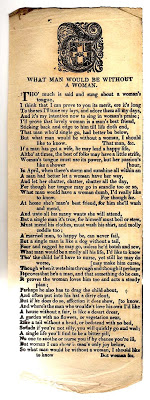
What Man Would be Without a Woman

This penny ballad (no printer/publisher named and no date, but circa 1840) was found among the archive of the late Leslie Shepherd, expert on catchpenny ballads etc., and connoisseur of the paranormal and bizarre.

It is laughably non PC, as you would expect ('she’s man’s best friend, for him she’ll wash and mend'), but generally is very appreciative of the female sex, is pro-marriage, and strongly against bachelordom.

'So lads if you’re not silly, you will quickly go and wed;
A single life you’ll find to be a bitter pill…'

The use of the word 'molly' is interesting. I had always thought it referred to a gay or effeminate man, but in this context the line 'What man would be a molly all his life?' suggests that to be an unattached male who must ‘ mend his own clothes , must wash his shirt, and molly coddle too’ was to be per se effeminate, which is a notion that has persisted  right up to the present, though the general acceptance of 'house husbands' today suggests that it is slowly dying out.  The use of the term 'molly coddle' is also instructive. According to the O.E.D. it was coined in 1833, and meant (and still means ) to treat like an invalid. Did it therefore follow that in the early Victorian period being treated like an invalid was linked with being effeminate ?

Thoughts on this are welcome. [RH]

Aluminium / Aluminum

We did a posting on our old site Bookride on Chick Marrs Quinn's unfindable book The Aluminium Trail a self published and much wanted book about US aerial operations in the Pacific Area in WW2  The book is dedicated to 1st Lt. Loyal Stuart Marrs, Jr., Chick's husband who was killed February 27, 1945.  The 'aluminum trail' title refers to the pattern of air crashes in the difficult Indo-China regions, especially the Himalayas. People who lost relations and loved ones flying so far from home eagerly want this rare book and not a few libraries. Amazon sometimes has it at bearable prices.  As for Aluminum (or Aluminium as it is known in Britain) Everybody's Book of Facts (1940s) reveals this:

 The youngest child of the great family of metals is aluminium, which 50 years ago was as expensive as silver, just as silver was once more precious than gold, and iron more valuable than either. The first to isolate it was the German chemist Friedrich Wohler in 1827. Napoleon the Third used an aluminium spoon at state banquets, and had a set of buttons for his uniform of the same substance. It then cost about £109 a pound. In 1880 only 70 pounds were produced annually; in 1885 13 tons; in 1926 some 200,000 tons; now even cooking vessels are made of aluminium.

The metal is never found by itself but always in combination with other elements, including clay. The United Staes is the chief producer, although it is believed that aluminium worth about £288 million is available in the Gold Coast colony. The largest night sign in the world is made of this metal. It  graces the RCA building in Rockefeller Centre, New York, is 24 feet high and outlined in  neon lighting.

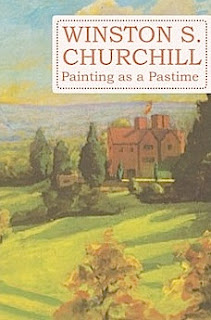
Winston Churchill book lover and painter

With the 50th anniversary of Churchill's death in 2015 there will be  celebrations and (possibly) an exhibition of his paintings. Churchill, while not leading the free world, was something of an amateur painter. His paintings have become valuable.

He wrote a book called Painting as a Pastime (Odhams, London 1948) of which his daughter Mary (Soames) said: "it is pure enchantment to read, throbbing as it does with enthusiasm and encouragement to others to seize brush and canvas and have a go, as Winston himself had done before, when, under the flail of misfortune, he had discovered in painting a companion with whom he was to walk for the greater part of the long years which remained to him." This quotation from his book is not about painting but about books:

If you cannot read all your books, at any rate handle, or as it were, fondle them – peer into them, let them fall open where they will, read from the first sentence that arrests the eye, set them back on the shelves with your own hands, arrange them on your own plan so that if you do not know what is in them, you at least know where they are. Let them be your friends; let them at any rate be your acquaintances. If they cannot enter the circle of your life, do not deny them at least a nod of recognition.

Churchill's own books are heavily collected and he obviously had a good working library. He probably did not have time for book collecting but certainly he had the right attitude about books.

Kenny Everett on the Ouija Board

From a paperback called I've Seen a Ghost - True Stories from Show Business by Richard Davis (Granada, London 1979). A series of mostly tall, real ghost stories from British stars of the time -Jon Pertwee, Roy Hudd, Pat Phoenix, Vincent Price, Bob Monkhouse, Rula Lenska etc.. There are the usual actor's superstitions and tales of ghosts seen in old theatres...the one from Kenny Everett could be filed under 'more things in heaven and earth' or Kenny was simply blagging - which seems unlikely as there is no joke or punchline. Also it is worth noting that this was before the time of proper mobile phones...

It happened when we were staying at Pete Asher's house in Surrey, near Rosper. It looks rather like a Chinese house – all made of paper walls and bits of stick. And it was by a lake, an 8 acre lake with two islands on it. All very deserted, it was.

We had a cameraman and his assistant staying with us, and we decided to have a go with the Ouija board.  Well, the cameraman got a message through from his girlfriend; he said "that's odd - she's not dead". And she said by means of the Ouija board that she'd died that day. She'd taken a load of pills and she was in Bicester Mortuary. He couldn't believe this. He thought we were messing around, though I don't think any of us would have been quite as cruel as that. So he rang her dad, and her dad picked up the phone and he was in tears, because she had just taken a load of pills and he had taken her to the mortuary. The cameraman had been with us for two days; the phone hadn't rung and there was no way he could have known.