
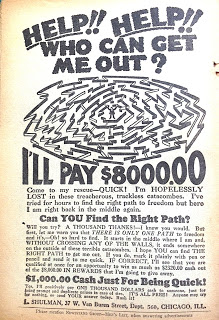
Found this ad in a pulp magazine Clues - A Magazine of Detective Stories from November 10 1930. The advertiser pleads:
Help! Who can get me out? I'll pay $8000. Come to my rescue – quick. I'm HOPELESSLY lost in these treacherous, trackless catacombs.
I've tried for hours to find the right path to freedom but here I am right back in the middle again. Can you find the right path? Will you try? 1000 thanks! – I knew you would. But first let me warn you there is only one path to freedom and it's oh so hard to find... Mark it plainly with pen or pencil and send it to me fast. If correct, I'll see that you are qualified at once for an opportunity to win as much as $2320 cash out of the $8000 in rewards that I'm going to give away. It's all free...
Is this an eccentric millionaire, or a wily entrepreneur garnering the addresses of mug punters, or a publicity stunt?
The clue is the word 'qualified'. Surely this is a forerunner of the Nigerian scams? The maze is probably not that difficult-- you send in your solution and soon hear that you have qualified to win a big prize and must send in, say, $10 (a useful sum in 1930) to enter for the big prize. After that you never hear from him again or are asked for further sums for even bigger prizes. Chap was based in Chicago.


Bay Psalm Book, 1640
This is an edited reposting from our sister site Bookride first posted in June 2007. Sotheby's NY is selling a copy in November 2013 and expecting $30 million. It is about to go on a tour of America. Sadly our archive does not have a copy although it is worth noting that the same printing press (shipped over by the pilgrims) also produced some ephemera...

"...we have therefore done our endeavor to make a plain and familiar translation of the psalms and words of David into English metre, and have not so much as presumed to paraphrase to give the sense of his meaning in other words; we have therefore attended herein as our chief guide the original, shunning all additions, except such as even the best translators of them in prose supply, avoiding all material detractions from words or sense." From the introduction to the Bay Psalm Book, 1640.
THE WHOLE BOOKE OF PSALMES. Faithfully translated into English Metre. (The Bay Psalm Book.) [Cambridge, Mass.] : Imprinted by S. Daye, 1640. Compiled and translated by John Cotton; Richard Mather; John Eliot; Thomas Weld; Stephen Day; Matthew Day; Adrian Van Sinderen.
The Bay Psalm Book was the common hymnal of the Massachusetts Bay colony. An American icon, a piece of heroic history - it was both the first book printed in the Colonies and it was also the first book entirely written in the Colonies. Printed 20 years after the first arrivals in Plymouth in 1620 on the first printing press in New England which was purchased and imported from London specifically to print this book. In 1639 the press printed first the Freeman’s Oath and then an almanac, no copies of which are extant. The mind boggles at the value that could be attached to these.
Continue reading
Slang glossary 1962
From a cult novel by old Etonian Robin Cook who later changed his name to Derek Raymond to avoid being confused with schlock novelist Robin 'Coma' Cook. As Raymond his books became very dark and gory but persisted with varieties of slang for which his first book The Crust on Its Uppers (1962) was known. A rich source book of slang, some unique, some well worn and some highly ephemeral. Here is a small selection:

Angst = trouble
Archbishop = Archbishop Laud = fraud
Baize, the = Bayswater Road
Binns= spectacles (dark binns- dark glasses)
Blag= a bluff, a tall story (Fr. 'blague?) Also as verb
Bubble=bubble-and-squeek= Greek (thus Archbubble= ArchGreek or Greek-in-chief)
Cat's-meat gaff= hospital
Charver= to have sex with
Deviator= a crook (devious= crooked; deviation= a crime)
Drum= a room or flat
Duke= duke of Kent= rent
Exes= expenses
44X= extreme, i. e. '44X angst' = big trouble
Continue reading
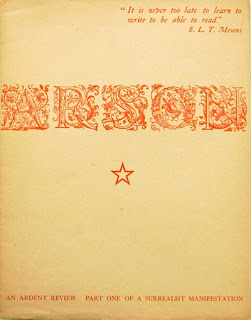
British Surrealism – Arson – an Ardent Review (1942)

Toni del Renzio. ARSON. AN ARDENT REVIEW. Part One of a Surrealist Manifestation. London, 1942.
Although billed as 'Part One' this was the only issue of this surrealist magazine of 'incendiary innocence' ever to appear. Several other magazines, mostly smaller in format and associated with E.L.T. Mesens appeared and all have become quite hard to find and consequently expensive. Del Renzio was a key figure in British Surrealism, never a burgeoning movement but oddly attractive and now quite collectable. Under the headline 'SUPERDAD' the art journal 'Studio' published this obituary for him in Febuary 2007:-
Toni del Renzio has died aged 91. Truer than life always, he was born to a landed Italian family outside St Petersburg, where his father was a diplomat to the Tsarist court. He had a legendary and varied life, not least in contributing to Studio International, with whose editor, Peter Townsend, he established a natural rapport. Fluent in several languages, he had fought in the Spanish Civil War but ended up in the lap of the Surrealist movement in Paris. On eventual arrival in London, he founded the Surrealist magazine Arson.

In 1951 he joined the Institute of Contemporary Arts and was involved on exhibition panels and juries. For a time back in Italy, he became the Fashion Editor for Harpers Bazaar, and then reorganised the Milanese magazine Novita as Vogue Italia. He staggered his friends and acquaintances much later on by becoming, at the age of 70, the father of quadruplets, two sons and two daughters: and then wrote about it as if it was the most natural thing in the world, which for del Renzio, it was. His métier was the surrealist collage. He became distinguished as a teacher, both at Bath and subsequently at Canterbury, where he was Head of Art and Design History. Vale, ti saluto, Toni del Renzio, maestro.

Antonio Romanov del Renzio dei Rossi di Castelleone e Venosa (to give him his full name) was a mercurial character and as a surrealist spent a lot of time engaged in aesthetic and political arguments, being at one time being considered a monster by the Mesens crowd. His key work 'Arson' was partially financed by Ithell Colquhoun whom he married in 1943 and divorced in 1948. He was also, briefly, the lover of the surrealist painter Emmy Bridgwater.
In 1942 de Renzio also mounted a London exhibition entitled Surrealism resulting in more general recognition for the movement. Arson was printed on turquoise stock and decorated on the front cover with surrealistic appropriations of steel engravings, printed in purple. Collage was a favourite medium for del Renzio. Contributors included Robert Melville, Giorgio de Chirico, Conroy Maddox, Nicolas Calas, Pierre Mabille + an interview with André Breton. Books by TDR are quite collectable--his 1968/ 1969 paperback on hippies 'The Flower Children' is very uncommon and his 1971 book After a Fashion is highly elusive.
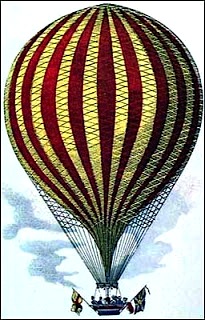
A Ballooning Humourist
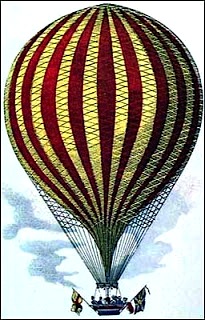
Albert Smith ( 1816 - 60 ), a qualified physician turned humorist, who unlike some of the more famous writers for Punch, is rather forgotten now, was, for a short while, an enthusiastic balloonist, until he came a cropper. One of the letters featured here is addressed to a certain Barton, and may refer to an impending ascent, because 'Vauxhall Station' is described as 'a meeting place' and we know that in this period many balloons took off from Vauxhall Gardens. In the other letter, written on a Monday night, he warns ‘Sir Edwin ‘ (possibly the painter Landseer ) that he has a morning ‘ascent’ on Tuesday morning ( no date, alas), but will come to see him in the late afternoon, when he has landed.
The letter to Sir Edwin may refer to an impending balloon flight from Cremorne in July 1847 in which Smith and nine other passengers, who included fellow Punch contributor Shirley Brooks. The ecstatic Smith recalled the novelty of his experience thus:
‘ The first sensation experienced was not that we were rising, but that the balloon remain fixed whilst all the world below was falling away; while the cheers with which they greeted our departure grew fainter, and the cheerers themselves began to look like the inmates of many sixpenny Noah’s Arks grouped upon a billiard table…’
Continue reading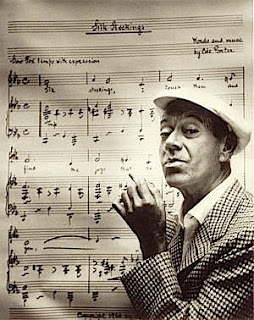
A scrap of Cole Porter

Cole Porter (1891 – 1964) is arguably the greatest popular songwriter of the twentieth century. I read somewhere that he composed around 1,000 songs, not all of which are as brilliant as ‘Night and Day’, ‘I get a Kick out of You ‘ and ‘Anything Goes ‘. One is called ‘Ours ‘and was written for the rather forgotten comedy musical of 1936 ‘Red Hot and Blue ‘, in which Bob Hope, Ethel Merman and Jimmy Durante starred. Somehow or other, along with some unrelated letters, I acquired a tiny fragment of the original manuscript which the maestro had given to a lady to give to a young man he had taken to. This information was typewritten on a slip of paper that came with the fragment. Here are the words on it:
‘Inclosed (sic) is the original hand writing of Cole Porter…This is a number that Cole Porter gave to Mother to give to one of her pupils, whom Cole Porter was particularly interested in. Mother knows him, and was out to his Beverley Hills home on an interview for this same pupil. Cole Porter is a great artist, and as modest and unassuming and sincere as all artists be.

I know nothing of this Mother, the child who typed the slip, the mysterious male pupil, or whether Cole Porter’s interest in him was purely professional or romantic. It would be nice to solve this little mystery and perhaps trace the remainder of the musical manuscript. I presume that the pupil allowed Mother to cut off the heading as a keepsake of the great man.[R.H.]
Oscar and the Oxford bullies
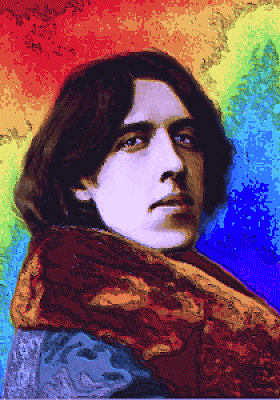
T. Earle Welby (1881-1933) is an almost forgotten writer, columnist and character. He is at present unknown to Wikipedia although Bill Greenwell writes about him at his blog about the New Statesman competition. It's odd that this should be his only memorial as he was somewhat right wing and hostile to democracy.He enjoyed conversation, and was known for a mannerism whereby he used a sideways movement of his hand for emphasis, which, since it was often associated with his reminiscence of India, was described by a wit as 'the Calcutta Sweep.' His collection of literary essays has a review of a memoir by the actor manger Sir Frank Benson who was at Oxord with Oscar Wilde. Welby writes:
Oscar Wilde, a contemporary at another college, was, (Sir Frank) tells us, so far from being in those days 'a flabby aesthete' that only one man in that college was physically his match. Four raggers having decided to wreck his rooms, Wilde knocked down three, picked up the fourth and carried that vainly struggling enemy to his rooms, piled up all his furniture on top of the poor wretch, and then invited a crowd which had changed its allegiance to celebrate the triumph in the wines of that parsimonious creature. Excellent! and, disapproving of those who engage in horseplay with ass-sense, were I capable of tampering consciously with the sacred text of Peacock I should comment :
'The wines of beasts provide our feast,
And their overthrow our chorus.'
But, and alas! it is very evident Sir Frank Benson thinks that if Wilde had kept to throwing hefty men downstairs he would have written something better than that matchless play, The Importance of Being Earnest, which is at once the perfect comedy of manners and the perfect parody of the comedy of manners.
**Welby is included in The Oxford Dictionary of Humorous Quotations for this piece from his culinary book The Dinner Knell : '"Turbot, sir," said the waiter, placing before me two fishbones, two eyeballs, and a bit of black mackintosh…'
The real Downton Abbey
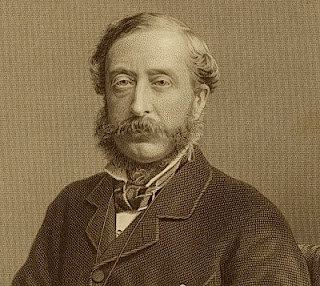
Every fan of ITV’s Downton Abbey will know that is filmed at Highclere Castle in Hampshire, the ancestral home of the Earls of Carnarvon. The third Earl built the present Castle, but it was his son, the fourth Earl (1831 – 90), who in his second term as a Tory Secretary of State for the Colonies achieved notoriety as the man who, through his policies of the enforced confederation of South Africa, indirectly caused the Boer Wars.
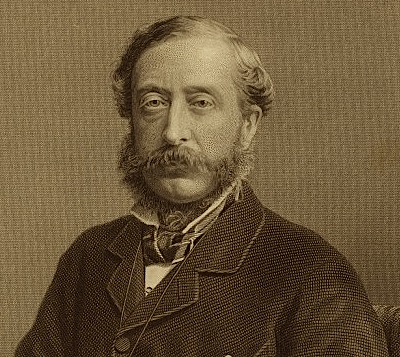 |
| Earl of Carnarvon ('Twitters') |
Carnarvon was clearly not a man to be trifled with. In January 1864 he had a number of fliers printed and circulated to his neighbours, informing them that 'the want of definite regulations for admission to or through' his park had obliged him to revise the 'rules'. One of those who received a flier* was the Rector of Highclere, Philip Menzies Sankey, a graduate of Oxford who claimed among his friends, the influential proto-aesthete, Walter Pater. Presumably Rev. Sankey had been obliged to traverse the park in order to get to his church and so a copy of the new 'rules' that governed access would have been useful. Unfortunately, Sankey’s copy of the amended rules, together with his pass-card, which were originally included with the flier, are now missing, which means that we don’t know what these new rules were. However, I’m sure that 'Twitters', Carnarvon’s nickname on account of his various nervous tics, was scrupulously fair to his neighbours.
Continue reading
Herbert Horne (1855 – 1916)
An article from the long defunct Anglo - Italian Review, October 1918. Edited by Edward Hutton, an English Italophile who wrote several Italian travel books and featuring articles by Nobel Prize winner Grazia Deledda, Norman Douglas & Benedetto Croce. This piece is by the novelist Reginal Turner and is an affectionate tribute to his friend Herbert Horne - art historian, art dealer, architect, typographer and Arts and Craft movement designer. The photo below is of him with his friend and colleague the architect A.H. Mackmurdo (standing) and an older woman, possibly AHM's mother at a house ('Brooklyn') in Enfield. The story of Horne finding two Michelangelo drawings for a penny each in the Fulham Road is hard to top...

HERBERT PERCY HORNE, who died in Florence
in May, 1916, belonged to the numerous band of interesting Englishmen who made Italy their home, and the memory of whose sojourns there does not pass with their death. He did not found a family there as did Walter Savage Landor. He took no part in public life as did Waddington, who went casually to Perugia and remained there to become Syndic. It may even be said that to the majority of Italians as to Englishmen his name was unknown. He had an almost morbid love of retirement ; those who knew him well could not but be amazed at his slight suspicion--there is no other word--of hospitality. Yet Herbert Horne was known to a large circle which included some of the best-known and ‘many of the most talked about of his contemporaries: most of them loved him, all of them respected him, and he was recognised by them as one of the most learned, one of the wisest, and one of the most reliable men of his time. Continue reading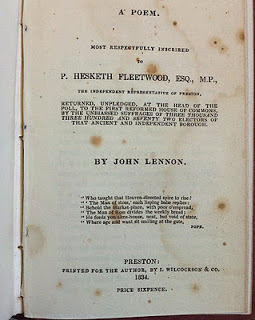
The other John Lennon
A curious find in a box of old poetry -- the completely unknown John Lennon's Rossall Hall. A Poem (Printed for the Author, Preston 1834.) It was bound up with 6 other books including a book of Epicurean Recipes (1832) and Memoirs of Madame Malibran de Beriot by Isaac Nathan author of The Hebrew Melodies. All in a small rust coloured moiré cloth-bound book with a leather label on the spine with the word 'Miscellanies' lettered in gold. Decent condition with some occasional foxing to text. The John Lennon book appears to be, like its author, completely unknown-- no copies at WorldCat, Copac or the vast Karlsruhe database which has the complete catalogues of many worldwide libraries.
It is a mere 36 pages and is mostly devoted to unadulterated praise of the great local landowner and philanthropist Sir Peter Hesketh-Fleetwood (1801 - 1866) who founded the town of Fleetwood, in Lancashire and was squire of Rossall Hall. At the time he also owned most of Southport. The work is dedicated to him and some of the verses may have been used in his election campaign. At the 1832 general election, Fleetwood was elected M.P. for Preston, in the first parliament following the Reform Act. The poem's style is very slightly thumping, far better than McGonagall, but Swinburne he was not:
Continue reading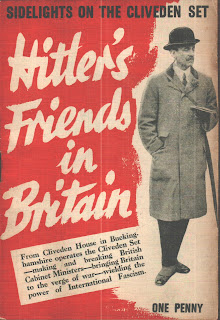
Communist attack on Cliveden Set 1938
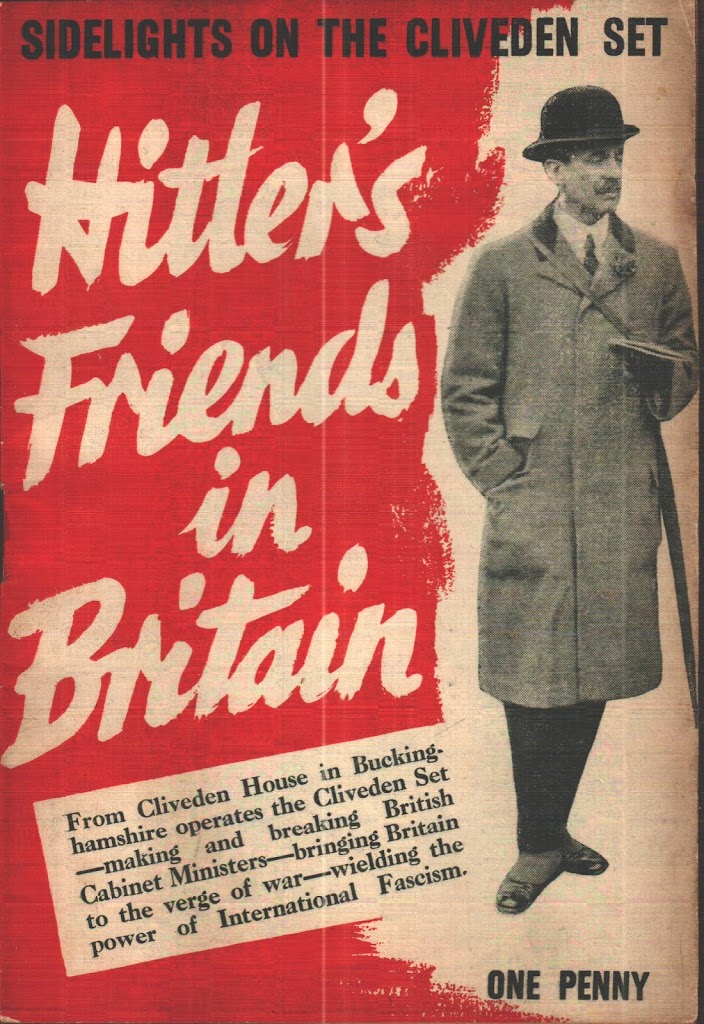
Found in the Chips Channon collection a pamphlet produced by the Communist Party of Great Britain attacking his friends in the Cliveden set. Produced in an edition of 10000 in March 1938 it also has much on the Spanish Civil war - they demanded 'immediate assistance for Spain...the withdrawal of Hitler and Mussolini's armies and airplanes..protection of all shipping in Spanish Republican ports.' Channon himself is attacked along with Lennox Boyd 'open pro-Fascists who got ministerial posts.' The first page reads:
Cliveden House at Taplow, Buckinghamshire, country home of Lord and Lady Astor, meeting-place of powerful secret diplomats. Week-end parties at Cliveden House have made and broken British Cabinet Ministers. Decisions taken there have brought Europe to the verge of war. Friends of Hitler and enemies of the people are welcome there. Many of the “National” Government’s betrayals of peace have begun with a Cliveden week-end party. The Cliveden set . . . their power reaches through British banking, transport, journalism- through Britain’s Parliament, across the seas to International Fascism. But their power can be broken. . . .
 |
| 'The Astors are a very wealthy American family..' |
Cliveden was, of course, to be back in the news 24 years later with the breaking of the Profumo scandal in 1962.

Le Matelot (London restaurant run by a psychiatrist) 1955


A review of the Le Matelot restaurant found in Bon Viveur's London & the British Isles (Dakers, London 1955). Bon Viveur was a pseudonym for Fanny Cradock and her husband the fly-whiskered Johnny. They later became celebrity TV chefs. The use of the word gay at the time tended to indicate merry, jolly, insouciant, zany etc., although the restaurant went on into the 1960s (possibly later) and is referenced at The Lost Gay Restaurants site. The girl in the coral jeans and exposed midriff sounds distinctly modern and the whole scene described might be something out of the 1961 Tony Hancock movie The Rebel. The owner roaming the restaurant in horns is not something you see in current London eateries.
LE MATELOT
You will either be enchanted by this small restaurant or embarrassed. It is unique. The proprietor, Dr. Hillary James, is a psychiatrist by day and a restaurateur by night.
Continue reading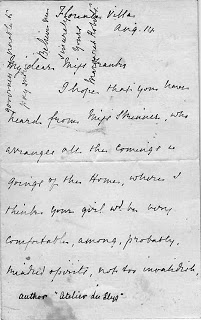
The other Margaret Roberts

Margaret Roberts was a novelist from North Wales ( 1833 – 1919) author of at least 38 books of fiction and non-fiction, including Mademoiselle Mori and The Atelier du Lys (An Art Student in the Reign of Terror). She spent her middle years in Torquay and this letter addressed from Florence Villas to a Miss Franks reveals her to be quite a bluestocking and also something of an entrepreneur.
We know, for instance, that she wrote Mademoiselle Mori in Italian (all but the last chapter) and then translated it into English, but the letter tells us that she was also proficient in 'advanced'French. It seems that she was planning to promote classes in German and French aimed at ‘governesses and others who cannot manage Cambridge terms‘ and asked Ms Franks if she knew of any such people who could benefit from learning a new language. She had already recruited two tutors—one from St Mary Church at 10/- a year , and another from Newton Abbot at 15/- a year. She herself would offer her services at 10/- a year.

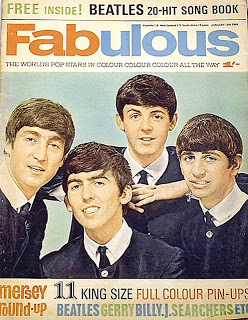
Facts on the Fab Four from ‘Fabulous’ 1965
Trivial info on the Beatles from their 'fab' days. Found in 'Fabulous' 1965. Surely they were the first 'boy band' and the template for all boy bands since?

John flew to Hong Kong wearing pyjamas.
John is a cat lover.
Ringo spent much of his childhood in a Cheshire hospital.
John used to envy his cousin Stanley's Meccano set.
Brian Epstein hesitated a long time before taking Ringo as a replacement for Pete Best.
Patti Boyd didn't like the Beatles before she met them on the set of A Hard Day's Night.
Continue reading

Lotos Club, New York – The Ace of Clubs
The Ace of Clubs

That’s what Mark Twain called New York ‘s famous Lotos Club, which still exists. Founded in 1870 by a group of writers and critics, it seems, back then, to have been a sort of plusher Groucho Club. Its first home was at 2, Irving Place, off 14th Street. The early leading lights were, like Twain, high powered journalists; but before too long, scholars, artists, collectors and connoisseurs had joined the throng. Within two years the Club had outgrown its quarters and had moved to more spacious premises in Fifth Avenue. Here members might live semi-permanently.
Thomas W. Knox (1835 – 96), adventurer, soldier, popular author and journalist, had begun as a teacher, left to join the gold rush and when the Civil War broke out in 1863 was made a colonel in the Californian National Guard, but was invalided out and subsequently became a war correspondent for the New York Herald. He then travelled the world, initially with the Russo-American Telegraph Company, and from the 1880s, when not travelling abroad, had an apartment at the Lotos Club. By 1889, it would appear that he had lost his taste for ‘parties and receptions’. In this letter to fellow journalist Alphonse Miner Griswold, popularly known as ‘The Fat Contributor’, politely declining an invitation, Knox writes that ‘for the past two years and more I have altogether ceased to be a society belle (sic)…I’m nearly always in bed by 11 pm.’

But Knox’s taste for adventure never waned. In 1896, just seven years after writing to Griswold, Knox died at his beloved Lotos Club after returning from the Sahara. He was just 60. Griswold had predeceased him in 1891 aged 57. It must have been all that rich Lotos Club food. The Club is still famed for its Michelin star cuisine.[RH]

National Front versus Calder & Boyars + ‘corruption and depravity’ 1968

From a collection of political ephemera. A note attached to an ordinary paper bag which was intended as a sick bag. A protest at a performance at the Royal Festival Hall in 1968 The arts and censorship : a Gala Evening concerning depravity and corruption. Put on by 'The National Council for Civil Liberties and Defence of Literature and the Arts Society', this was a performance involving, among others, Alexander Trocchi and Samuel Beckett. It was compered by George Melly and with contributions, performance, material or both by John Mortimer, Roger McGough, The Scaffold, Larry Adler, Fritz Spiegl, Edward Bond, Willie Rushton, Marty Feldman, Barry Took, Billie Whitelaw, Christopher Logue, Adrian Mitchell, Sheila Hancock, Tom Lehrer, Ann Firbank, Paul Jones, William Burroughs, Bertolt Brecht & Dame Peggy Ashcroft.
Copies of the programme are to be found in distinguished American libraries with the vomit bag and statement laid in. The cover for the night's programme was by Alan Aldridge and his poster for the event is shown below.
The National Front is a far right UK political party. In the 2010 general election they garnered 0.6% of the vote.
VOMIT IS VALID!
This paper bag is presented to you with the compliments of
****THE NATIONAL FRONT****
Continue reading

Model School and DJ rules

From a book by the YBA Angela Bulloch called Rule Book (2000). An artist's book which collects together official lists and full plain colour pages with their official names ('Pantone Yellow C'). Basically new conceptual art-- the lists include things taken from the side of packets, directions to make a hair lock, health warnings, The Universal Declaration of Human Rights etc., + this list of rules from a (Russian?) model school.
August VIII Model School
1 The dormitories may not be locked and will be checked at night by four security guards to deter intruders.
2 The dormitories are strictly single sex. Members of the opposite sex are not allowed.
3 You are expected to run five kilometers at 6:30am and then do two and a half hours in the gym each morning.
4 Your diet will be strictly controlled for you and you will be expelled for gaining weight.
5 Alcohol, smoking (for girls), sex, and chocolate are banned.
6 If you have crooked teeth they will be straightened by means of braces or they will be capped.
7 If your nose is not straight or your ears stick out too much they will be fixed by Dr, Rudenko and if the implants are available you may also have breast surgery.
8 Each model will make a promotional video and you will be required to make a speech in English for it.
9 The fees are 400 Roubles a month. Also 15% of your future earnings will go to your agent.
10 You cannot do anything without your agent's permission.
Sounds more like Cromwell's New Model Army and assumed to be real. The agent's commission sounds modest. This list of instructions pinned outside a DJ's booth sounds authentic.

1. Say 'Hi' then 'BYE' (better yet, wave from the dance floor)
2. If the DJ is in position he obviously cannot speak to you.
3. No person in this booth is employed by a record store.
4. The dance floor is where all the people are dancing - NOT HERE.
5. Since the DJ doesn't DJ in the lounge, the loungers shouldn't lounge in the DJ booth.
6. When in the DJ booth, if you find yourself saying 'Excuse me' more than once, then you should excuse yourself from the booth.

Bon Viveur at the Connaught
A review of the Connaught Hotel's restaurant found in Bon Viveur's London & the British Isles (Dakers, London 1955). Bon Viveur was a pseudonym for Fanny Cradock and her husband the fly-whiskered Johnny.They later became celebrity TV chefs. The style is of its time, revelling in luxury after the austerity of the decade since the war -'shriek for grilled kidneys...'

Where Maitre Chef de Cuisine Pierre Toulemont rules the kitchens the restaurant must inevitably prosper. The Connaught is severely English in the most distinguished manner. The wine butler stalks majestically across the panelled dining room bearing the silver salvo which, from time immemorial has been the proper platter from which to proffer (decanted) port. Overseas visitors will capture here some of the nostalgic atmosphere of old London where rendezvous with gastronomy is kept by the subjects of King Edward VII, King George V, King Edward VIII, King George VI and Queen Elizabeth II.
Let us not commit the solecism of discussing price, beyond stating that the best is never cheap– a repellent word in any context – but is seldom exorbitant – that is reserved for the fashionable, which is quite another thing.
Choose Oeufs Poché en Surprise, the eggs tucked into a foaming casket of soufflé Parmesan, that superb Faisan a la Creme which is sent to table reposing on a couch of chestnut purée. Confer with M.Charles concerning grouse, pheasants, partridges, with sliced truffles slipped beneath their breasts skins before roasting, dream of the dinner of your choice now that all is free again and ask that it is prepared to you with classic expertise. Throw back, if you must, to the Edwardian breakfast and shriek for grilled kidneys,kedgeree,York ham, grilled sole… you'll get them. Desire foie gras aux raisins... Brioche de foie gras…a mousse of caviar… a boned bird in feuilletage Lucullus… You will be served. We need scarcely add the bedrooms are irreproachable (£2-£3 per night doubles £3.10 shillings to 5 guineas) or that, as you might expect, no extra charge is made for room service.
Note: 2013 prices are almost exactly 100 times 1955 prices.

The Finer Points of Advertising

Found in a privately published book on advertising From One Person To Another. What advertising is all about and how you go about it. By John E O’Toole. (FCB, London & NY 1977 -'Intended solely for the use of FCB people in their work for FCB clients'). A good summary of basic laws from the splendidly named Fairfax Mastick Cone, an advertising wunderkind from the days of Mad Men and before…
EXECUTION: SOME FINER POINTS.
Fairfax Cone has said only one thing, to my knowledge, that is patently untrue. It is in this brief piece he wrote years ago, something many of us keep in our offices and try to keep in our minds. I include the piece here, not only to see if you can spot the untruth, but because it can serve as a summary of this entire book for those in a hurry.
"It is the primary requirement of advertising to be clear, clear to what exactly the proposition is.
If it isn’t clear, and clear at a glance or a whisper, very few people will take the time or the effort to try to figure it out.
The second essential of advertising is that what must be clear must also be important. The proposition must have value.
Continue reading

Musical Sand in China
 |
| Taklamakan Desert, Khotan |
Joseph Offord Musical Sand in China published in
Nature, Volume 95, Issue 2368, pp. 65-66 (1915).
Among the immense mass of ancient Chinese records and manuscripts brought back from the buried cities and caves of ancient Khotan, in Central Asia, and now stored in the British Museum, is one called the Tun-Huang-Lu, a topographical description of part of Khotan itself. This little geography was written in the time of the Tang dynasty, in the seventh century, but probably contains matter from earlier authors.
 Among the specially interesting natural phenomena of the country described in the Tun-Huang-Lu is a large sandhill, which at certain times gave forth strange noises, so much so that a temple in its vicinity was entitled the “Thunder Sound Temple.'
The geographer, speaking specially of the sandhill, says:-"The hill of sounding sand stretches 80 li east and west and 40 li north and south. It reaches a height of 500 ft. The whole mass is entirely constituted of pure sand. In the height of summer the sand gives out sounds of itself, and if trodden by men or horses, the noise is heard 10 li away. at festivals people clamber up and rush down again in a body, which causes the sand to give a loud rumbling sound like thunder.Yet when you look at it next morning the hill is just as steep as before."
Mr Lionel Giles, from whose translations of the Tun-Huang-Lu these extracts are made, mentions that this sounding sandhill is referred to in another old Chinese book, the Wu Tai Shih.
Found reprinted in Strange Planet, A Sourcebook of Unusual Geological Facts (Sourcebook Project Maryland 1975). Compiled by William Corliss, this is from Volume E-1. From the amazing library of Jeremy Beadle MBE (1948 -2008) British entertainer, television star, hoaxer, quizmaster, book collector and philanthropist.The cave from where this mass of ancient Chinese records came is mentioned at Bookride. It was discovered in 1907 by Sir Aurel Stein -author of many valuable travel books including Sand Buried Ruins of Khotan.
Corliss cover many othe 'musical sands' including the 'Singing Beach' at Manchester, Massachusets and the 'Singing Sands' at Eigg in NW Scotland referred to in Josephine Tey's 1952 detective novel of the same name. In the Khotan caves among the books (actually a 16 foot printed scroll) was Gautama Buddha's Diamond Sutra ("The Sutra of the Perfection of Wisdom of the Diamond that Cuts Through Illusion") the earliest known (868 AD) dated printed book in the world and of inestimable value.
