Author Archives: Jot 101

Secret Places XV & XVI

Two more chapters of The Secret Places (Elkin Mathews & Marrot London 1929) - a chronicle of the 'pilgrimages' of the author, Reginald Francis Foster (1896-1975), and his friend 'Longshanks' idly rambling in Sussex, Kent and Surrey. See our posting of the first chapters for more on Foster and this book, including a contemporary review in The Tablet.

Continue reading

Edward Fitzgerald buys a Constable and conceives Alice (1841)

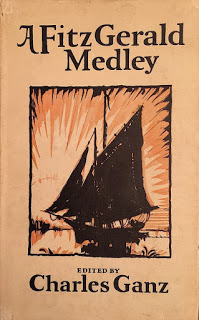
Found in  A Fitzgerald Medley (Methuen, 1933) an excerpt from a letter by Fitzgerald (the translator of Omar Khayyam) that he sent to his friend Frederick Tennyson in January 1841. Charles Ganz, the editor of the anthology, includes this in the introduction to a piece Fitzgerald wrote for children - a version of Dickens's Little Nell in simple language for children. The letter reads:

I have just concluded, with all the throes of imprudent pleasure, the purchase of a large picture by Constable*, of which, if I can continue in the mood, I will enclose you a sketch. It is very good:but how you and Morton would abuse it! Yet this, being a sketch, escapes some of Constable's faults, and might escape some of your censures. The trees are not splashed with that white sky-mud, which (according to Constable's theory) the Earth scatters up with her wheels in travelling so briskly round the sun; and there is a dash and felicity in the execution that gives one a thrill of good digestion in one's room, and the thought of which makes one inclined to jump over the children's heads in the streets. But if you could see my great enormous Venetian picture you would be astonished.

Does the thought ever strike you, when looking at pictures in a house, that you are to run and jump at one, and go right through it into some behind-scene world on the other side, as Harlequins do? A steady portrait especially invites one to do so: the quietude of it ironically tempts one to outrage it: one feels it would close again over the panel, like water, as if nothing had happened.

Ganz comments: "This fantastic idea reminds us of Lewis Carroll in Through the Looking Glass and what Alice found there. Carroll wrote his story. Fitzgerald played with the idea and let it slide. One cannot  help regretting that he never wrote an original story for children, but we must rejoice that Little Nell's Wanderings, the result of the efforts of two men of genius is left to us."

*Not sure what this picture was. I can find no paintings of Venice by Constable. It would of course be excessively valuable now. He is known to have bought two Constables in 1842 that sold for healthy sums when he died in 1876. The cover of the book is by Frank Brangwyn.

Read and Spender—unlikely double act

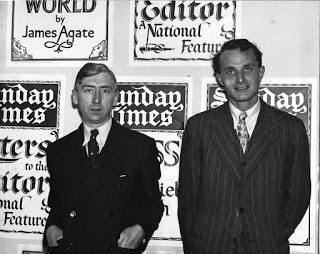
Whatever—or whoever—could have brought publicly together ‘pylon’ poet Stephen Spender (1909 – 95) and Herbert Read (1893–1968), art critic,  professional writer of introductionsto other people’s books and self-styled anarchist? This press photograph gives few clues, although the most evident seems to be the large posters advertising The Sunday Times, in front of which the two men are standing. The photo was one of many in a small archive of similar material that turned up in an auction a few years ago.

The photo appears to date from around the mid thirties, which may suggest that both men were snapped at the London International Surrealist Exhibition of 1936, which was covered by al the major London papers, including the Sunday Times. However, there is no real reason why the two very different writers should have been grouped together. Spender admitted that Read had become a friend ever since the older man’s sympathetic review of his Poems (1933), but Read’s name is missing entirely from the published Journals, 1939 – 82, of Spender, who never showed much interest in Surrealism. It does not follow, of course, that there should be any connection between the two figures, who may have been snapped by a Sunday Times photographer while they visited the Exhibition.

An alternative circumstance for this pairing may have been the Spanish Civil War, which was dividing intellectuals in the mid thirties. Both Read and Spender would have supported the Communists, and indeed Spender reported to Read at this time that he had become a communist.

While Spender’s reputation has been enhanced since his death. John Sutherland’s biography and the Stephen Spender Trust has seen to that, Read’s profile, despite a biography  (The Last Romantic) has faded somewhat. The view of his contemporary and fellow critic, Geoffrey Grigson is fair, I think, and echoes my own views of Read, who was once such a ubiquitous presence in the literary world.

‘He was no genius, he had no very acute perception… of the arts of painting, sculpture or writing. I would even say there was something to Wyndham Lewis’s charge that he had never looked a picture in the face, although he knew the kind of picture to look in the face…Not much of a poet, to tell the truth not much of a writer, he was an art apostle who stuck to his preaching…’ [R.M.Healey]

J. B. Priestley by L.R. Reeve

Another piece from the papers of L.R. Reeve*. He never met Priestley but saw him speak and even appears to have been pointed at by the great man.

J. B. PRIESTLEY

J. B. Priestley may during his adult life have sometimes failed to reach his usual high standard. Certainly I have at times experienced an uneasy feeling that some passages have galloped along giving a faint impression of superficiality, a suspicion of slickness, pretentiousness, and pot-boiling. Yet I would forgive him half-a-dozen trifling contributions because of the heart-lifting, sustained enjoyment arising from The Good Companions, which I encountered more than thirty years ago, and have read again in 1969 with even more pleasure than at the first reading: a fact which leaves me wondering why thirty years on, when one is supposed to reach a plateau of jaded thrills and fancies, the enjoyment of an earlier book is assuredly enhanced. It may be that one's appreciation of a classic increases after many years of weary persistence in studying second-rate literature which misguided critics have informed us are masterpieces; or it may be that when one's knowledge of the human condition is greater than in early days, the better we are able to appreciate a perfect delineation of real men and women.
Continue reading

Francine Saigon parodist of Francoise Sagan

Found  - a Keystone file photo from March 9th 1963 of 16 year old  novelist Felicity Moxton. Her book Bonsoir Maitresse: a novel (Pavilion Publications, London 1963) was a parody of Francoise Sagan's bestselling 1954 novel Bonjour Tristesse. It is quite rare but looks like this (the design very much like Francoise Sagan's French paperbacks):-

The back of the press photo reads:

Only 16 years old… is the young English writer Felicity Moxton and in a short time her first book will be to get in all book-shops. Felicity is the daughter of a writer in London. Her first book has the title 'Bonsoir Maitresse' and her pseudonym is 'Francine Saigon'. Everybody can see by this title and this name, that Felicity thought to the famous French author Francoise Sagan and her book 'Bonjour Tristesse'. Felicity told a newspaper, that she wanted to make a joke about the books of Francoise Sagan. Let us see, what Felicity had to write!

There are fake reviews at the rear 'Sagan, beware' (Paris Snatch) and 'Proceeds entrancingly from one triviality to another.' (Figarifico). The fictitious former works by Francine Saigon are noted as -Un Certain Sneer, Aimez-vous Hams? and *Marvellous New Ages. The blurb reads:

What is a mistress? How does a mistress begin? How does a mistress end? Exploring this theme, Francine Saigon's new novel tells the story of a young girl's relationship with a father who is more faithful to his old mistress than his successive wives.

Written in the inimitable style which is so familiar to Saigon devotees, 'Bonsoir Maitresse' will linger in the reader's heart long after the covers are closed.

* Les Merveilleux Nuages

Bailey, Keeler, Faithfull in 1969

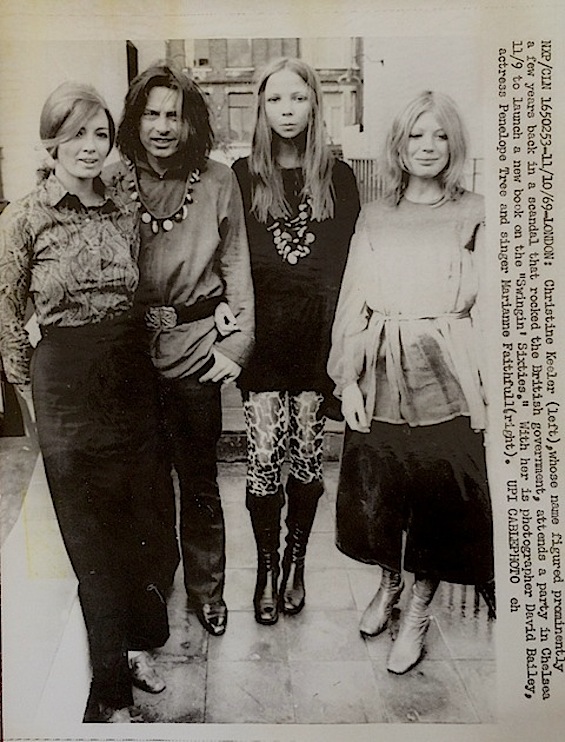
Recently found - this 1969 press photo. The byline reads:

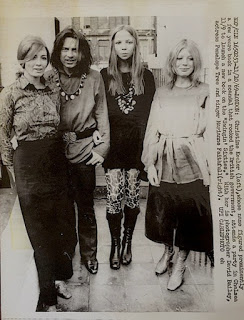
1/10/69 London. Christine Keeler (left), whose name figured prominently a few years back in a scandal that rocked the British  government attends a party in Chelsea 11/9 to launch a new book on the "Swingin' Sixties".  With her is photographer David Bailey actress Penelope Tree and singer Marianne Faithfull (right).

The book was Goodbye Baby & Amen. A Saraband for the Sixties. The text was by Peter Evans and photos by Bailey.

The sitters included Brigitte Bardot, Cecil Beaton, Marisa Berenson, Jane Birkin, Michael Caine, Julie Christie, Ossie Clark, Joan Collins, Catherine Deneuve, Mia Farrow, Albert Finney, Jean-Luc Godard, Mick Jagger, Brian Jones, John Lennon, Paul McCartney, Dudley Moore, Rudolf Nureyev, Oliver Reed, Keith Richard, Peter Sellers, Jean Shrimpton, Barbra Streisand, Andy Warhol, Franco Zeffirelli. Presumably some of these illuminati were at the party..

Wood Norton Hall, former home of French royalty that helped to win the war against Hitler

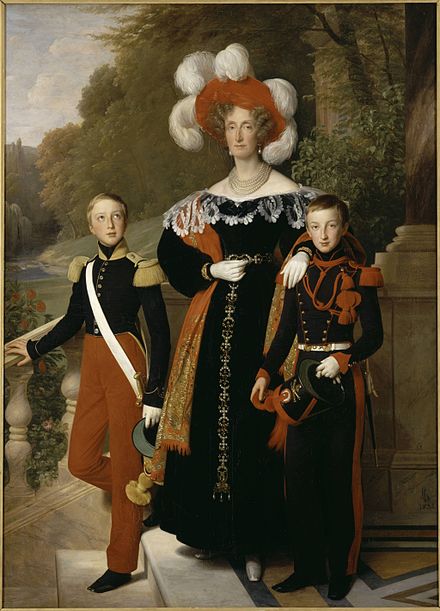
Henri (left) with his brother 
Antoine and his mother
Queen Marie Amélie.

In his Shell Guide to Worcestershire of 1964 the peerless James Lee-Milne is rather hard on Wood Norton Hall, near Evesham:

‘Now the BBC Engineering Training Department, tarmac-ed and pig wired. Built 1897 for the Duke of Orleans, who lived here in exile and secluded splendour. The house of red brick and half- timber is sprinkled with crowns and fleur-de-lis; interesting on account of its period ugliness ‘.

What he doesn’t mention is that just twenty years earlier the Hall was the HQ of the BBC Listening Station, where eminent writers, journalists and linguists worked together in specially built huts to listen into communications from Europe. The great critic and poet Geoffrey Grigson and eminent art historian Ernst Gombrich, not to mention the TV star Gilbert Harding out of ‘What’s My Line’, were a few of the celebs who did their bit for the war effort here by intercepting messages, mainly from the Germans—vital work that has received far less attention than that done at Bletchley Park. The full story is told in Assigned to Listen while the less than enjoyable experiences of Grigson can be read in his autobiography Crest on the Silver (1950).

What we have here though is a letter from ‘H. d’Orleans’ dated 8th March 1862 to an agent --- thirty years before the present building was erected. Here is my translation:

Continue reading

John Mitford—‘a pleasant layman spoiled’

Mitford's vicarage at Benhall

That’s what Charles Lamb called this literary odd job man, who was a cousin of the essayist Mary Russell Mitford, and who wrote of a visit to Lamb at his home in Islington in the  Gentleman’s Magazine, which he edited for seventeen years; he was   also editor of Gray and Goldsmith, and collected manuscripts ,old books, paintings and Chinese ceramics. He was a gifted cricketer too, a passionate gardener, and in any spare time left to him, he managed to squeeze in a bit of preaching in his parish of Benhall, near Saxmundham in Suffolk.

Here we have a tiny letter from Mitford, in miniscule handwriting, dated July 5th 1848 and addressed to an unnamed correspondent—probably the editor of a magazine, for Mitford was a prolific writer of articles. At this time Mitford himself was editing the Gentleman’s Magazine. It’s worth transcribing the letter in full as it gives a flavour of what a literary hack of the early nineteenth century got up to, although with the security of a clergyman’s income, Mitford was hardly a typical denizen of Grub Street. The letter relates principally to Mitford’s opinion of a new biography of Oliver Goldsmith.

Continue reading

Violet Jacob—-Scottish poet and novelist

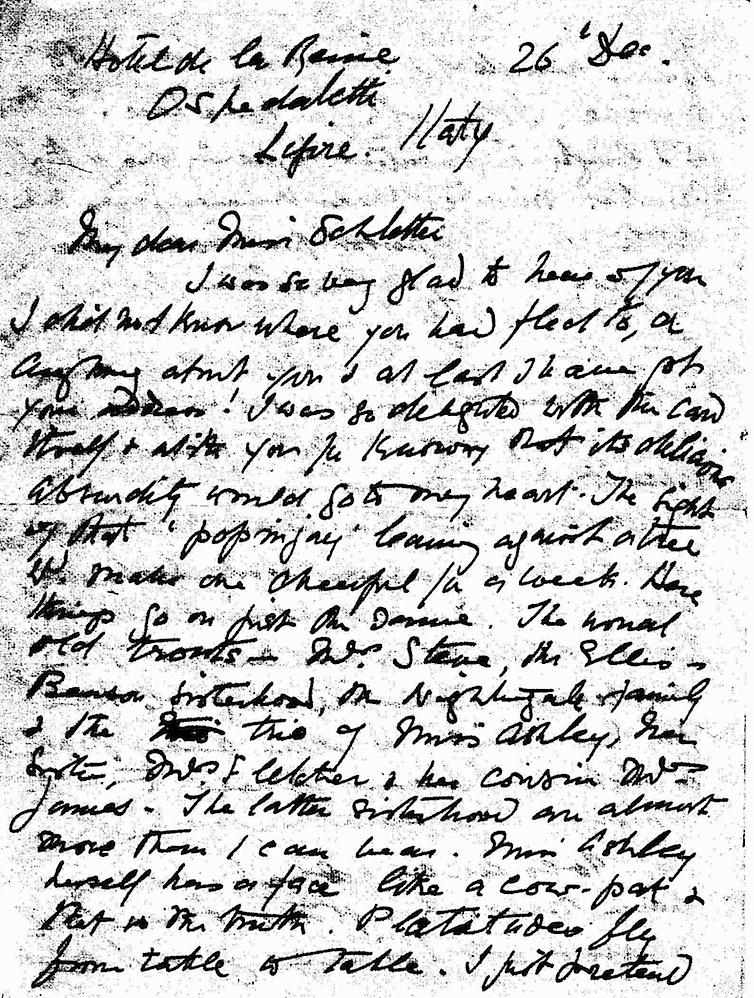
Although Violet Jacob (1863 – 1946), is highly regarded in her native Scotland as the author of the much admired novel Flemington (1911) and as a poet writing in the Scots vernacular, she is hardly known in England. She is often compared in stature to Hugh MacDiarmid (whom she knew) and her work,both printed and in manuscript form, can be found in public collections throughout Scotland. She is also appreciated online, where a scholarly site records her life in two parts—early and late. The letter shown here , which dates from Boxing Day 1935, and is from the  archive of her friend Annie Schletter,
belongs to the last decade of her life, when she was often to be found touring Europe with her severely asthmatic  husband Arthur, a former soldier. On this particular sojourn in a part of Italy that she seems to have known since at least 1930, she was staying in the very opulent Hotel de la Reine in the fashionable Ligurian resort of Ospedaletti, a favourite haunt of the English for decades. In the previous decade Sigmund Freud had stayed at the same hotel, but a very different kind of clientele became the target of Jacob’s lash in Christmas 1935. In a very lively account of her latest stay at the hotel, she turns her withering humour and novelist’s eye on her fellow guests:

The usual old trouts---Mrs Steve, the Ellis & Benson sisterhood, the Nightingale family & the trio of Miss Ashley, her sister, Mrs Fletcher & her cousin Mrs James. The latter sisterhood are almost more than I can bear. Miss Ashley herself has a face like a cow-pat & that is the truth. Platitudes fly from table to table. I just pretend that I am deaf & dumb & blind & so I survive. I do wish you were here. Arthur & I laugh in private & he, being one of the greatest mimics I ever knew, gives me little private impersonations.

Jacob also announces that she has taken up oil painting and that the Italian that Schletter had taught her ‘has been the joy of life here ‘. Alas, Jacob’s life was to change forever a few months later with the death of her beloved husband. She retired to Kirriemuir in Angus and died in 1946. [RR]

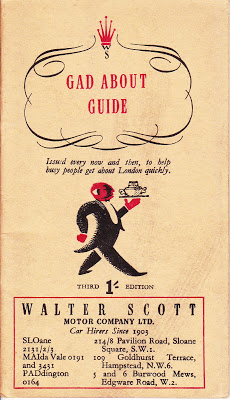
Gad About Guide (London 1948)

Found - a city guide book from 1948 - the year of the London Olympics. The tone is upbeat. There is no mention of the war or austerity, there is even talk of one businessman commuting to work by helicopter. The guide was put out by a long defunct car hire company called Walter Scott, possibly named after the novelist…the guide book is a good snapshot of late 1940s London. The letters of appreciation from aristocrats and a 'world famous actress' are especially amusing.


GAD ABOUT GUIDE

Issued every now and then, to help
busy people get about London quickly.


THIRD EDITION

Continue reading

Gordon Bottomley – 1890’s poet

Found in a copy Poems at White Nights (published in 1899 in Cecil Court, London) a contemporary review of the book. The review is unsigned but was obviously from a national daily paper as there are financial reports on the back. Gordon Bottomley is a mildly collected fin de siecle poet, of considerable talent but slight neglected -possibly because of his name which could be used as the the butt of jokes, so to speak. His first book The Mickle Drede and Other Verses was privately printed in Kendal in 1896  and is a great rarity and of some value. He attempted to destroy all of the 150 copies as he considered the work immature..The reviewer below senses dark currents in his work.

Mr. Gordon Bottomley's second volume, Poems at White Nights (At the Sign of the Unicorn), shows him still frequenting the darker woods of Faerie. One fragment in it is a dedication for some book of verses in which the receiver is bidden to read:

Continue reading

Maurice Baring quotations – “Good things”

Maurice Baring with his
pet budgerigar 'Dempsey.'

Found in Paul Horgan's Maurice Baring Restored (Heinemann, London 1970) a collection of quotations - snippets from the work of the great (and somewhat neglected) writer. Horgan calls these pages 'Good Things.' Maurice Baring was very good on music and art, his Beethoven story has probably been told by others but is still poignant.

We have selected a few of the very best... There are many quotation sites on the web, most have just one 'quote' from him: 'Memory is the greatest of artists, and effaces from your mind what is unnecessary.' The following are from Paul Horgan's selection.

There is no amount of praise which a man and an author cannot bear with equanimity. Some authors can even stand flattery. (From the dedicatory letter of Dead Letters)

Whoever one is, and wherever one is, one is always in the wrong if one is rude.

Art was Flaubert's religion; he served it with all his might; and, although he wrote but little, he died of overwork. (French Literature)

Continue reading

Robert Barlow – teacher and athlete

I can find nothing about Robert Barlow apart from this affectionate portrait by his friend and colleague L.R. Reeve* whose archive we acquired. He may have been born in 1897 but that's about it..His obscurity is particularly odd because Reeve rated him 'supreme ...above all' and he had met many famous men and women, some world famous.

ROBERT BARLOW

In my opinion Robert Barlow, born in Manchester, was the most outstanding Lancastrian of his era, and during the last hundred years Lancashire has been rightly proud of many great men. Moreover, although I spent most of my long life in London persistentIy visiting the House of Commons, colleges of the University of London, conferences, public meetings and lectures in search of and finding really great men and women, supreme above them all stands Robert Barlow.
Continue reading

The Secret Places XIII & XIV

Two more chapters of The Secret Places (Elkin Mathews & Marrot London 1929) - a chronicle of the 'pilgrimages' of the author, Reginald Francis Foster (1896-1975), and his friend 'Longshanks' idly rambling in Sussex, Kent and Surrey. See our posting of the first chapters for more on Foster and this book, including a contemporary review in The Tablet.

Continue reading

Mendel, A Story of Youth (Mark Gertler)

Found - a rare 1916 first edition of Mendel, A Story of Youth by Gilbert Cannan. The novel is a roman a clef about the artist Mark Gertler and has much on his disastrous affair with Bloomsbury Goddess Dora Carrington. The verse dedication is to her:

To D.C.

Shall tears be shed because the blossoms fall,
Because the cloudy cherry slips away,
And leaves its branches in a leafy thrall
Till ruddy fruits do hang upon the spray 
Shall tears be shed because the youthful bloom

And all th'excess of early life must fade
For larger wealth of joy in smaller room
To dwell contained in love of man and maid?
Nay, rather leap, O heart, to see fulfilled
In certain joy th'uncertain promised glee,
To have so many mountain torrents spilled
For one fair river moving to the sea.

Gilbert Cannan entertained Mark Gertler, Katherine Mansfield and D H Lawrence among others to a famous 1914 Christmas party at Cholesbury Mill in Buckinghamshire and between 1914 and 1916 Gertler was a frequent visitor. Gertler used Cannan’s shed as a studio and his painting of Gilbert Cannan at his Mill now hangs in the Ashmolean Museum, Oxford (for which much thanks).

Between 1914-15 Gertler pursued a frustrating love affair at Cannan's  Mill and elsewhere with Dora Carrington, who eventually left him to live with Lytton Strachey. Their relationship is the subject of the 1995 film Carrington*. After Strachey’s death in 1932 Carrington committed suicide.

*Rufus Sewell played a fiery Mark Gertler in the movie. Below is a sample from Christopher Hampton's script - Gertler is very annoyed that Carrington is in love with Strachey:

Mark Gertler: Haven't you any self-respect? 
Dora Carrington: Not much. 
Mark Gertler: But he's a disgusting pervert! 
Dora Carrington: You always have to put up with something.

Martin Stone and the Forgotten Shelf

Found-- Martin Stone's Forgotten Shelf book catalogue no. 5: Modern Literature Fantasy and Detective Fiction - November 1982. The macabre cover was hand-coloured by impecunious students and the image from the cover taken from a Marcel Schwob novel Coeur Double (Paris, 1891.) Martin, now an expat in Paris, is still going strong but has not done a catalogue since the 1980s. The dedication reads..

Thanks should go to Mr. D. Attoe of Wapping and Mr. Robin Summers  for sterling excavation work in the compiling of this catalogue. A tip of the hat also to Iain Sinclair of Albion Village Books for light shed in some obscure bibliographic corners and to Skoob Books for the use of congenial office facilities beyond the boundaries of the East End.

There follows a poem by David Attoe, now a US expat and at that time poet, book collector and Ford Madox Ford expert. He later published a novel Lion at the Door (Little, Brown, 1989) which had a great succes d'estime, even carrying a blurb from Thomas Pynchon.

Continue reading

Disability ! What disability ? The Amazing Constance Smedley

In her sixty six years Constance Smedley (1875 - 1941) managed to pack more into her life than most centenarians would do. Despite being on crutches from her early years and confined from her thirties to a wheelchair (due to some unidentified disability, possibly a hip problem) this Birmingham-born fireball, who married the gay artist Maxwell Armfield, was at various times a crusading feminist, suffragist  and journalist, an artist,  novelist, playwright, organiser of pageants and folk dances, and perhaps most notably, the founder of the world’s first arts and science club devoted entirely to women.
It is on the notepaper of the London-based Lyceum Club, which the twenty-eight  year old Smedley helped to found in 1903, that this featured letter (below) also shows her to be a tireless encourager of talent among women—especially budding musicians and actresses. Here she writes to an actress and fellow feminist Annie Schletter, inviting her to a ‘ semi dress rehearsal ‘where she will witness the enormous promise of a twenty three year old thespian called Gwenol Satow:

‘…I feel Miss Satow has great gifts, but they are entirely undeveloped: her intelligence is far before her technique---& she needs the discipline of training . She is ineffective for lack of technique & is very self-conscious. If she stayed with us & really worked day by day & all day, she might be very, very good.
It is a very hard profession---and she has a great opportunity with us—but I don’t know if she quite realises what a lot of hard work she has to put in, if she is to make good …’


Alas, Miss Satow does not appear to have made the most of her extravagant gifts. In fact, there is no record of her lighting up the professional stage in any way. She became the second wife of the brilliant songwriter David Heneker, also born in 1907, and the composer responsible for such hit musicals as Irma La Douce, Charlie Girl and Half-a-Sixpence. Indeed, Heneker credits his wife for bringing Tommy Steele’s musical into being. According to him she ‘suddenly sat up in bed one night and produced the idea for Half-a-Sixpence ‘. So, in her ninety years perhaps Satow did contribute something to the success of the British theatre, although it is unlikely that Constance Smedley would have been impressed. [RR]

A rare British Museum Library ticket

There are plenty of biographical anecdotes concerning the experiences of writers using the facilities of the old British Museum Library —from Washington Irving through Karl Marx up to David Lodge and beyond. When the famous round Reading Room was built many incorporated into their fiction memories of studying there. However, we have little idea today of the process by which books were ordered in the very early years of the Library.

So when an actual ordering slip from this period turns up —and one signed by a well known author—it is a rare event. Surely such ephemera are scarcer even than Shillibeer omnibus tickets and must rank among other celebrity souvenirs, such as non-presented cheques signed by Hollywood film stars and the like.

This particular ordering slip was made out by the poet Thomas Campbell (1777 – 1844), whose Pleasures of Hope  was a minor success in 1799, and who remained a well known, though hardly revered, figure of the Romantic period. The book he ordered was The History of Edward the Second by Sir Francis Hubert, which first appeared in 1629. We know the book was asked for on August 23rd , but with no year date present we must examine the style of the vestigial remnant of the printed part of the form and guess that the order was made sometime between 1803, when Campbell settled in London, and 1819, when he brought out his Specimens of the British Poets.

If the order was made before 1810 it would be interesting to know if Campbell had problems obtaining a ticket to the Museum, or whether his celebrity as an author removed any barriers to entry. After this date the ticket system was abolished, which made it much easier to access the Library, although readers often had to wait for many hours, sometimes days, for their books to arrive. [RMH]

J. W. Samuel B.A

From the papers of L.R. Reeve* this record of a remarkable educationalist, mathematician and speaker. He is unknown to  Wikipedia and online research reveals very little.  He contributed some photographs to the Country in Town  exhibition (July 2 to July 16, 1908) at  Whitechapel Art Gallery to illustrate 'Day Educational Rambles' in the education section. He appears to have received a double honours degree at London University in Anglo- Saxon and Early English (1901?.) As with many of Reeve's subjects he was a remarkable speaker...

J. W. SAMUEL, B.A.

It was during a conference at the Memorial Hall, Farringdon Street, London, that I first saw J. W. Samuel. He was delivering an address, and I recall vividly the profound impression he made upon me, for I was listening to a man who was one of the most effective speakers in London. He had every attribute required for the highest standard of oratory, and his first essential gift was a perfect delivery. His cultured accent, smoothly expressed, would certainly be my aim if I were to enter a competition in debate, and for some mysterious reason which I could not quite explain, his voice always made me think of Earl Balfour, one of England's greatest statesmen.
  Additionally he was a remarkably handsome man, tallish, with a magnificent head of white wavy hair. He had a truly extensive vocabulary, which made him a most persuasive speaker who could, in a debate, demolish most of an opponent's points and, when he occasionally felt that way, would add a little sarcasm to complete his triumph.
Continue reading

The art of being very annoyed, very politely

Found -- this rather unusual author's notice in a copy of the 1885 edition of George Long's translation of Marcus Aurelius' Meditations. It is printed where the frontispiece should be.  A little digging reveals the following.

The first edition of Long's translation was published in 1862.  By 1864 a pirated edition appeared by Ticknor & Fields, Boston. Long's notice appeared first in the 1869 British 2nd edition published by Bell & Daldry, London, and was still appearing several printings later in 1885.

Long's consideration of a Confederate dedication to a pirated Union publication is an excellent example of being politely very rude, and his opening paragraph pure stoicism!

[Submitted by P.Hatcher / Many thanks]