Anti Coronation satire 1953

IMG_1874
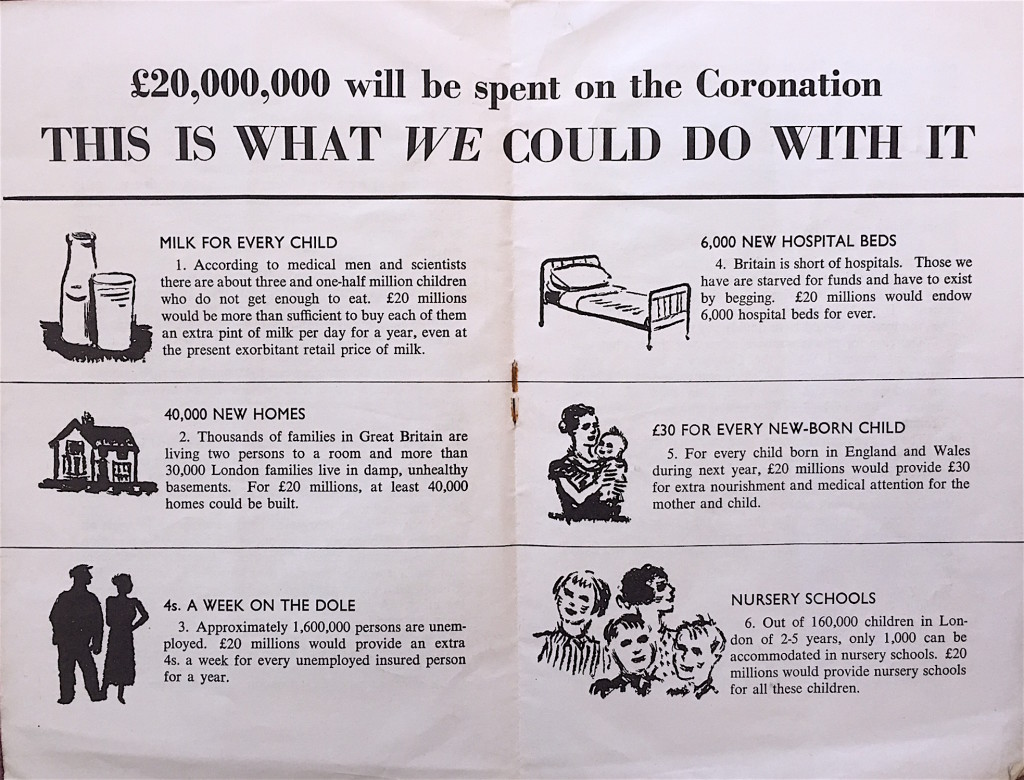
Found – a 1953 Communist Party booklet criticising the amount of money being spent on the Coronation of Queen Elizabeth II. The figure of 20 million pounds is probably about a billion now but it may not be totally accurate. The name Beavermere is a compound of the two major Press Barons of the time-  Beaverbrook and Rothermere. The style is that of a contemporary gossip column:

Lord and Lady Beavermere will be staying at Claridge’s during Coronation week. Claridge’s will be more than usually expensive because there are so many people like Lord and Lady Beavermere competing for room. The reason why they are stopping at Claridge’s is because the Beavermeres, like the others, have let their town mansion. Living in Lord  Beavermere’s house is the Rajah of Muddlecore who is paying £1000 for the week so as to be on the Coronation route. So, despite the expensiveness of Claridge’s, the Beavermeres can afford to do themselves well. Continue reading →

Odd photos bought online 1

Bought for the price of a cup of tea at eBay – the infinite online flea market, a photo of a jumble sale*, in England and likely to date from the earlier part of the 1960s. It is stamped on the back Salisbury Journal with a phone number ‘Salisbury 6933.’ The women are mostly wearing rain bonnets probably  because it was raining outside and possibly because it might rain (a fairly good bet most of the year in England, especially Wiltshire) or it may have been a fashion. The younger woman to the left with a transparentjumble plastic bonnet would indicate recent rain and also dates the photo in the 1960s, the rest of the women could come from the 1950s if not earlier. The goods displayed on the table are fairly meagre– some very basic bookends, a thermos flask without its cup, a lamp without a shade, a glass fruit juicer, some glass and tin jelly moulds, a cut-glass vase and one slim book. Some sort of raffle or tombola was also being offered (‘every card wins a bottle’.) The woman in the middle is obviously a keen and seasoned jumble sale shopper- she has three objects she may be buying from a box (a ruler, a chopping board and a wool hat or tea-cosy) and three bags ready for stuffing with bargains. Possibly she is holding these objects in order to be able to see or deal with things further down in the box. The lady to her left is either a friend or someone waiting to dive in…The woman behind in hornrim specs anxiously waits her turn – it is probably the very beginning of the sale, the first rush. Jumble sales still go on with bargain hunters, also online traders sourcing their wares , and people trying to help out the charity that has organised the event.

  • A sale of a mixed collection of things that people no longer want, especially in order to make money for an organisation, usually a charity. UK and Australian usage. In USA and Canada they are known as rummage sales.

How to dance the Hokey Cokey

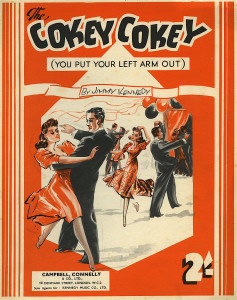
60670Found- some sheet music for the song The Cokey Cokey which later became the song (and dance) the Hokey Cokey. This is what it is all about… There are many theories about its origins – dealt with at Wikipedia and in a Mental Floss piece on its ‘dubious origins.’ Possibly the name came from the magician’s ‘hocus pocus’. This version was written in 1942 by Jimmy Kennedy (1902-1984). Jimmy Kennedy states that his version is based on ‘a traditional action song known long ago in the mining camps and saloons of the Canadian West. The word ‘Cokey’ means a dope fiend but what this has to do with the dance is not at all clear!’ As he says – it then came over in World War 2 with the Canadian troops. He explains on the back of the sheet music exactly how to do the dance:

This is one of the simplest dances ever. You hold your partner in the normal way and while the verse is being played you may fox-trot using any steps you like.   When the chorus starts, that is, on the words, ‘Left arm out’, you put your left arm in line with your shoulder, continuing on the words ‘Left arm in’ by bending the left arm in and touching your shoulder, then ‘Left arm out’ as before.  You hold your partner with the other arm. ‘Shake it all about’ explains itself —you simply shake your hand and arm with a circular motion. On the next line ‘You do the Cokey Cokey and turn around’ the appropriate action is to place the forefinger of the right hand pointing downward on top of your head and do a complete turnaround. ‘That’s what it’s all about’ ends the actions and you take hold of your partner in the normal way. Then the chorus starts over again with the right arm, then left foot and then the right foot etc., It should not be taken to fast..

This dance, since its introduction here by the Canadian forces, has caught on like wildfire and bids fair to out-rival some of the most sensational dance successes of the past.

Note: Alternatively the dance maybe performed by partners facing each other in line as in the Palais Glide and on the words ‘That’s what it’s all about’ both hands are spread out palm upwards. SEE?

Firework Poems from Turkey

IMG_1446

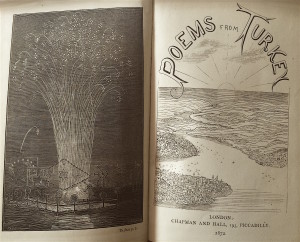
Found- a copy of a rare book: Poems from Turkey (Taylor and Co., London, 1872). The author is anonymous but is known to be William Platt Ball (born 1844). Loosely inserted is a note giving info about him (see below*.) Of interest is the fact that he was in Turkey advising the Sultan about fireworks and while there seems to have put on a few shows. The frontispiece illustration shows a display over water with the fireworks being launched from a raft or jetty. There are poems about fireworks in the book one of which  ('Pyro's Pilgrimage') is quoted after his preface:

These poems (except a few pages on Turkish subjects added since my return) were written during a stay of fourteen months in Constantinople. During this period I superintended (under His Excellency Halil Pasha)  the Sultan's firework displays, organised a firework factory, and taught the complete art and mystery of firework making to a set of forty Turk soldiers, and English (in the mornings) to a class of four Efendis.

Continue reading →

Puzzles and Problems, mostly punning

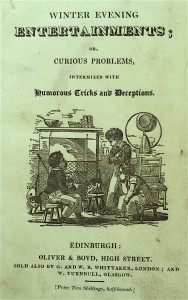
From A Winter Evening Entertainments; or, Curious Mathematical and Philosophical Problems, etc. (Jasper Wiseman, Edinburgh: Oliver and Boyd 1820.) Most of these puzzles have punning answers that might nowadays elicit groans.. Almost all are present in many other books and magazines of the time, it is doubtful that the author made up any of them. Wise man.

IMG_1430.JPG

What step must I take to remove the letter A from the alphabet?

By B heading it.

If I buy four oranges for a penny, and give one of them away, why am I like a telescope?

Because I make a far-thing present.

Which of the cardinal virtues will water be when just frozen?

Just-ice.

Why is spectator like a bee-hive?

Because he is a be-holder.

Why is an axe like coffee?

Because it must be ground, before it can be used.

Continue reading →

Stephen Pribil—the Invisibility Man

Here are three photographs out of a possible six from the photo-archive of the famous newspaper  El Mundo of Argentina. Interestingly, they are stamped 1st April 1935. Now, I don’t know if the Spanish, or indeed the Argentinians, reserve the 1st of April for tricks, leg-pulls, spoofs, scams or other deceptions, but if Dr Pribil, a Hungarian oculist, was deliberately playing a trick on journalists with his demonstration of ‘Invisibility  Rays’, then he certainly went to a lot of trouble to do it.

According to the typewritten labels on the back of each photograph Pribil placed three objects—a teddy bear, a bronze statuette and an opaque china vase -- in his apparatus—basically a wooden box fronted by a picture frame behind which is a sort of slated affair. Out of the back of this box electric cables are connected to a supply. Unfortunately, the two photos showing how the objects gradually fade away are missing, but the last photo does show that all the objects have now disappeared.’ They are in the same place, perfectly tangible ‘, the caption points out, ‘but are completely invisible’.

Continue reading →

A rare souvenir of London’s Great Wheel

The Great Wheel, which was built for the Empire of India exhibition at Earl’s Court in 1895, and was the ‘London Eye’ of its time, is pretty well documented. Postcards showing various aspects of it can be had quite easily, as can medallions, which were struck periodically throughout its career, right up to 1907, when it was demolished. But what we have here is something quite rare—on a number of levels. Firstly, it is a large photographic image of the wheel—four times the size of a postcard—which was mounted on board and sold –presumably to be framed and hung—by the famous  commercial printers of posters, stamps and banknotes, Waterlow and Sons Ltd. And there on the lower right hand corner is the signature of the Wheel’s ‘constructor ‘ Walter B Basset ‘, which may be original, but could equally be a facsimile. Lastly, we can date the photograph because it depicts the Wheel looming above the temporary constructions in painted wood and ironwork—some especially imported from India-- that comprised the Exhibition, which was the brainchild of Imre Kiralfy, a producer of burlesques and spectacles.
Interestingly, in the background can be glimpsed  the warehouses that stored the forage for the horses that transported goods of London largest department store, Whiteleys, while in the bottom left hand foreground can be seen a very early example of an elaborate electric floodlighting system for the Exhibition. If the signature is a facsimile then this mounted photograph could well have been a bit of opportunistic merchandising by Basset, who remains a very significant figure in the history of the amusement industry. Born Walter Basset Williams in 1864, the scion of an ancient Devon family, whose seat was Watermouth Castle, he entered the Royal Navy but left in 1882, possibly due to ill health, and instead took up engineering with the well established Maudslay Sons and Field, which specialised in steam-power. Here he did well and by the age of just 27 had become managing director. In 1894, inspired by the pioneering example in Chicago, he begun to build his first steam-powered Ferris Wheel at Earl’s Court, which when completed stood 300 feet high and contained 30 carriages, each of which could carry 30 passengers. It was an immediate success, but its popularity waned over the following years and in 1907 it was dismantled and the metal sold for scrap to the same company which 46 years later was to buy the Skylon at the Festival of Britain and produce cigarette cases from the scrap metal.

While the Wheel was still operating, however, Basset built other Ferris Wheels at Blackpool and Paris, but neither were a financial success, and when Maudslay went bankrupt in 1899, he set up his own business, The Basset Nut and Screw Company, in Belgium. In the end the destruction of his prized project at Earl’s Court may have been the last straw for a man in poor health, for in May 1907 he died, aged just 43, at the family home in Devon.  Thankfully, the Vienna Riesenrad survived its creator and is now one of the city’s greatest attractions—it featured in the films ‘The Third Man’ and ‘The Living Daylights’.

[R.M.Healey]

Etching of Farringdon Road bookstalls in the 1930s

Photographs exist of the famous bookstalls in Farringdon Road, dating from the nineteen forties and fifties, and the one by Moholy-Nagy that illustrates the excellent London Street Markets, was taken in the thirties. But as far as I know, the stalls were never the subject of an etching, of whatever date. Here, dated 1934, is an etching by the brilliantly talented Nathaniel Sparks (1880 – 1956), one of the most popular masters of this art, which of course became moribund almost overnight as a result of the Wall Street Crash.

During the American-led collecting craze, which began just before the First World War, Sparks produced a huge number of etchings, many of them of notable London landmarks such as Westminster Abbey and Tower Bridge, and it is surely a sign of its fame in the thirties that Sparks regarded Farringdon Road as a fit subject for an etching. At that time he was doubtless a customer at the stalls himself, and it is known that in his last sad months, when poverty and illness had him holed up as a lodger in Somerton, he comforted himself by collecting old books. It is also likely that in the last half of a largely peripatetic life, which saw him living with gypsies and farmers in Somerset and the New Forest, he was forced to jettison many of the books he had picked up over the years, in favour of his paints and paper.

Naturally shy, physically slight, and all too aware of the severe rhinophyma which disfigured his face, Sparks sometimes cut a pathetic figure. He could not help compare his ill luck with the fame and fortune that attended his much older cousin, Thomas Hardy, and recorded his resentment in an unpublished satire. Things came to a head in 1940 when an enemy bomb smashed his printing press and he was forced to abandon etching entirely and eke out a living producing pellucid watercolours of scenery in his beloved Somerset.

[R.M.Healey]

The author is grateful for the excellent Nathaniel Sparks Gallery for allowing him to reproduce the two etchings.

Now have proof positive that the etching is of Exmouth Market! (ed.)

A Short Cut to Ventriloquism

Found -an old booklet A Short Cut to Ventriloquism (London: L. Davenport 1934) by one Maurice Hurling. Apparently  ventriloquism has had a slight revival due to reality TV talent shows. The book gives various exercises to improve  ventriloquial skills but starts with the basics which we post below. The two major problems are the 'plosives' that cause the lips to move (B M P V) and the awkward W. Also developing a second voice for the dummy/ figure is essential. Hurling recommends starting with a 'Cheeky Chappy' voice, he also notes that the ventriloquial smoker has an advantage because 'a cigarette placed between the lips will help to keep them perfectly still.'

Preliminary Exercise

Stand in front of a mirror, not too close, and let your lips be slightly apart.

Now try to say each letter of the alphabet without any movement of the lips. With very little practice you will soon find you can do this quite easily except for the letters B, M, P, V and W. 

For these: 
B is pronounced "ge"
M is pronounced "EMG"
P is pronounced "Key"
V is pronounced "VHEE" (breathe it)
W is pronounced "Duggle-you"

Continue reading →

36 hours in the water with a lion

When I read the caption stuck on the back of this press photo of a certain Otto Kemmerich I was a bit taken aback, to say the least. According to the reporter,’ the famous German swimmer, accompanied by his trained lion ”Leo” have swum for more than 36 hours in a tank at the Circus Busch at Hamburg’. It was also reported that Kemmerich was planning to swim 50 hours without a break, also with his ‘pet’ and hoped to swim the Channel with Leo.

A bit of internet investigation revealed that the feat took place in April 1928 and that Leo wasn’t a feline at all, but a sea-lion, which suggests that the incompetent journalist had never heard of a cat’s dislike of water and had obviously never been shown any action shots of Herr K together with his  pet. In fairness to ‘SSS’, the idiot in question, something may have been lost in translation from German to English, but surely any decent journalist must read back what he or she has written before releasing it to the world.

If the caption survived the sub-editor’s rigorous scrutiny there must have been red faces all around the press rooms of  the papers that carried the story. Personally, that image of a fully grown lion swimming for 1 ½ days in a tank with a very edible human alongside him will remain with me for a long time.

The day that May Kovar’s luck ran out

One of the most poignant inscriptions in the celebrity album kept by Swindon landlady Barbara Slocombe is the 'Good Luck to You' which was left by May and Harry Kovar in November 1937. The couple were acclaimed wild animal trainers who specialised in lions and tigers, Harry being acknowledged as one of the greatest big cat trainers in the world. At the time both worked for Chapman’s Circus, but by 1941 they had moved to a more lucrative career in the States.

On 6 July 1944, the Kovars were the act that immediately preceded the discovery of a fire that quickly engulfed the huge tent of Ringling’s Circus in Hartford, Connecticut, where more than 7,000 spectators were watching the show. In the carnage that followed  around 169 were killed and over 700 were injured, many being  badly burned by the paraffin wax that had been used to waterproof the tent canvas. In 1950 a 21 year old former employee of the circus named Robert Segee confessed to what has been called the worst act of arson in American history, but he was never tried.

While the fire blazed the brave May desperately tried to force her animals back into their cages. She survived, but in 1949 her luck finally ran out. In California, during a training session, she was coaxing a recalcitrant lion, Sultan, from his cage, when the animal suddenly attacked her. Watched by her three horrified children, she was badly mauled and her head ended up in the lion’s mouth. She died instantly when her spine was snapped.

May was just 48 at the time. Her daughter (also called May) forged her own successful career with big cats for a number of years, before retiring to raise children. Today, one of those children is writing a book about her grandmother’s exploits. I wonder if those happier days at Mrs Slocombe’s will get a mention.

Making up is hard to do

A rare pamphlet (there is only one for sale on Abebooks), The Secrets of Making-Up, co-edited  by two old stagers, J. Ainsley Brough and George M Slater, is 70 pages of very useful advice on how to transform yourself into anything from a man of ninety to an octoroon. It seems to date from around 1922, but for some reason a typeface is adopted that was current c 1903. There are some wonderful photos of actors from the Music Hall and Revue, all demonstrating the transformative powers of grease paint and powder.

Although politically very much of its time (the N word is one of a number of dubious references), essentially this is a practical and modern guide. The humour—especially in a lively article on Revue and Vaudeville by Slater ( 1870 – 1949), a theatre manager and prolific writer of pantomimes, whose archive is now at the V & A—is genuinely funny, even slightly ribald. The ads at the back also contribute much to modern theatrical history.

Some tips:
1) An actor should ideally shave off his moustache, not cover it with 'goldbeater’s skin' , whatever that is,  if portraying a clean shaven person.
2) Stage Character make-up is useless for film work, and when wigs are used they must on no account have a ‘scalp join’ . No explanation is offered.
3) When portraying a Chinese or Japanese person, 'do not line under the eyes, as Chinese and Japanese have small eyes’. [RR]

Mona’s 440 Club – dancing at the Lesbian Bar

Found, folded into an American thriller from the Donald Rudd collection of detective fiction, this napkin - a memento of Mona's 440 Club generally credited as being the first lesbian bar in the United States -'Where Girls Will be Boys.'

James R. Smith's San Francisco's Lost Landmarks (2004) says the following about Mona's:

Mona's 440 Club was another [club] that took advantage of the city's tolerance and tourism. Opening in a Columbus Street basement in North Beach in 1936, Mona Sargeant's tavern quickly hit the travelsheets as a place "where girls will be boys." The first openly lesbian club, Mona's female waiters and performers wore tuxedos and patrons dressed their roles. Within a couple of years, Mona's moved to 440 Broadway and took the address as part of the club's new name, Mona's 440 Club. Great entertainment, first local and later national talent, made a night at Mona's an event.

Continue reading →

I once met….Uri Geller

Sent in by a supporter of Jot for which many thanks...


It was in the spring of 2005 that I was dispatched to interview the great Spoon Bender himself. His assistant had given me an address in Sonning-on-Thames, that home of the more discerning glitterati. I found his place quite by chance. Well, you could hardly miss it. Glimpsed through trees at the end of a longish drive was a large and modern mansion of the Bishops Avenue School of architecture, complete with portico. There was also a pair of huge metal (unbent) gates flanked by brick pillars, one of which incorporated the inevitable entry phone. I phoned through, the gates opened slowly, and I started down the drive towards the house.

Geller himself answered the door--a slim, smiling figure with neat bouffant hair, greying slightly. He must have been in his late fifties but retained his boyish good looks. He guided me across the marble floor of an atrium that wouldn’t have disgraced the palace of a Hollywood A-lister. I looked for signs of spoons and there they were, all the cutlery he had deformed over the thirty or more years of his career, drooping from a dozen or more spray-painted skeletons of trees ranged around the walls in a parody of Santa’s grotto.

Continue reading →

A Ballooning Humourist

Albert Smith ( 1816 - 60 ), a qualified physician turned humorist, who unlike some of the more famous writers for Punch, is rather forgotten now, was, for a short while, an enthusiastic balloonist, until he came a cropper. One of the letters featured here is addressed to a certain Barton, and may refer to an impending ascent, because 'Vauxhall Station' is described as 'a meeting place' and we know that in this period many balloons took off from Vauxhall Gardens. In the other letter, written on a Monday night, he warns ‘Sir Edwin ‘ (possibly the painter Landseer ) that he has a morning ‘ascent’ on Tuesday morning ( no date, alas), but will come to see him in the late afternoon, when he has landed.

The letter to Sir Edwin may refer to an impending balloon flight from Cremorne in July 1847 in which Smith and nine other passengers, who included fellow Punch contributor Shirley Brooks. The ecstatic Smith recalled the novelty of his experience thus:

‘ The first sensation experienced was not that we were rising, but that the balloon remain fixed whilst all the world below was falling away; while the cheers with which they greeted our departure grew fainter, and the cheerers themselves began to look like the inmates of many sixpenny Noah’s Arks grouped upon a billiard table…’

Continue reading →