Manners in Public — some ‘don’ts’

From an undated but late Victorian self-help / etiquette book called Don't: A Manual of Mistakes and Improprieties more or less prevalent in Conduct & Speech (Ward, Lock, London circa 1900). The author is noted as 'Censor' and some of the advice still holds, e.g. behaviour in an art gallery...

DON'T neglect to keep to the right of the walk, otherwise there may be collisions and much confusion.

DON'T brush against people, or elbow people, or in any way show disregard for others.

DON'T fail to apologize if you tread upon or stumble against any one, or if you inconvenience one in any way; be considerate and polite always.

DON'T carry a cane or umbrella in a crowd sticking out horizontally before or behind you. This trick is a very annoying one to the victims of it.

DON'T eat fruit or anything else in the public streets. A gentleman on the promenade, engaged in munching an apple or a pear, presents a more amusing than edifying picture.

DON'T stare at people, or laugh at any peculiarity of manner or dress. Don't point at persons or objects.

DON'T turn and look after people that have passed.  DON'T forget to be a gentleman.

DON'T spit on the sidewalk. Go to the curbstone and discharge the saliva into the gutter. Men who eject great streams of tobacco-juice on the sidewalks, or on the floors of public vehicles, ought to be driven out of civilized society.

DON'T smoke in the streets, unless in unfrequented avenues.

DON'T smoke in public vehicles. DON'T smoke in any place where it is likely to be offensive.

Wherever you do indulge in a cigar, don't puff smoke into the face of any one, man or woman.

DON'T obstruct the entrance to theatres, churches or assemblies. DON'T stand before hotels or other places and stare at passers-by. This is a most idle and insolent habit.

DON'T, when visiting a gallery...stand in front of any painting which appears to be attractive...DON'T affect artistic or technical knowledge. If you really posses it, DON'T obtrude it.

A thought for Holocaust Memorial Day–The Kitchener Camp, Richborough

Sent in by top jotter Robin Healey who asked me to post this on Holocaust Memorial Day.

Dilapidated training buildings left over from the First World War, on a site just outside Sandwich in Kent, were requisitioned early in 1939 to accommodate thousands of Jewish male refugees fleeing from Hitler. The operation, financed by the Balfour Fund, was designed to give these refugees—who ranged from skilled manual workers to University professors—the chance to train for a new life outside continental Europe. Within a few weeks of the camp opening for business, a magazine, the Kitchener Camp Review had been established to publish the opinions, life stories and impressions of these refugees from Nazi oppression.

I own a full run (nine issues) of this exceedingly  scarce publication, which rarely ran to more than eighteen, sometimes very feint, pages, which were mimeographed on good quality foolscap, and stapled to a printed cover of light crimson coloured paper. Although almost all inmates were German speakers, the journal was published in English, principally because the editor, Phineas L.May, wanted to encourage the refugees to be fluent in the language. So, he either published a translation of the contributions, or occasionally invited those with good English to write in the language of their adopted country without editorial intervention. When we consider how good the language skills were of a refugee like Nikolaus Pevsner, who had fled Germany years before, we should assume that the English of some of his fellow, highly educated, Jewish compatriots at the Camp, probably needed very little correcting. Indeed many of those who wrote for the Review, had previously held high academic posts in Germany, and after the War went on, like Pevsner himself,  to pursue  illustrious careers in the English speaking world. Indeed, I have reasons to suspect that one of these academics, a geophysicist, was the father of an old girlfriend of mine.

Continue reading →

Give Puce a Chance

Thoughts on puce suggested by this (presumably) early 1914 pamphlet. Wyndham Lewis's Vorticist magazine BLAST (aka 'the puce monster') appeared in July of that year, the same month as war broke out and the pamphlet, judging by the title, appeared earlier that year. Was there a load of puce dye offloaded in London at that time, was it the colour of the moment? Is this really puce? Ezra Pound called Blast  “the great MAGENTA cover'd opusculus” The big Bloomsbury dictionary describes puce as 'a brilliant purplish red colour.' Did Wyndham Lewis spot someone hawking the pamphlet in the street, it seems quite possible - even the typography is similar (at least the angular printing...)

The pamphlet (of which I have the cover only) is unknowable, no such title shows at WorldCat or Copac and the title page may have born a different title and possibly the name of an author. A colour that used to be seen in the 1990s 'hot pink' was similar to puce but rather cheap looking; the 1940s Elsa Schiaparelli colour 'shocking pink' is nearer to the mark but puce has a glamour all of its own. A fine copy of the first BLAST is a rare and valuable thing. They usually turn up in distressing shape; as for the war pamphlet it is probably too rare to have real value.

Below is a recently added and obviously modern puce punk publication - of which I know nothing, except it appears to be part of the enviable collection of kunstler Richard Prince. Such material was highly collected a few years back but  the punk artefact looks somehow more dated than the irascible Lewis's 100 year old puce monstrosity…

Major-General Fuller on ‘The Black Arts’

From The Occult Review in April 1926 this article by J.F.C. Fuller. Major-General John Frederick Charles Fuller, CB, CBE, DSO (1878–1966) was a British Army officer, military historian and strategist, notable as an early theorist of modern armoured warfare. He was also the inventor of "artificial moonlight". He was also something of an occultist and an early fan of Aleister Crowley and author of a book on him The Star in The West: a critical essay upon the works of Aleister Crowley (Walter Scott Publishing Co., London, 1907).This article was also published in Austin Osman Spare's magazine Form. When later Fuller attempted to distant himself from Crowley to advance his military career The Great Beast fired this salvo at him:

I wanted to give you a leg up the literary ladder. I have taken endless pain to teach you the first principles of writing. When I met you, you were not so much as a fifth-rate journalist, and now you can write quite good prose with no more than my blue pencil through two out of every three adjectives, and five out of every six commas. Another three years with me and I will make you a master, but please don't think that either I or the Work depend on you, any more than J.P. Morgan depends on his favourite clerk.

As to Fuller's merits as a writer, it is probable that he wrote better prose as a military tactician than a follower of the occult. Worth noting in this longish piece is Fuller's quotation from Arthur Machen-- an over-the-top rant about the British Museum Reading Room:

O dim, far-lifted, and mighty dome, Mecca of many minds,
mausoleum of many hopes, sad house where all desires fail! For there men enter in with hearts uplifted, and dreaming minds, seeing in those exalted stairs a ladder to fame, in that pompous portico the gate of knowledge, and going in, find but vain vanity, and all but in vain...

Continue reading →

A Scottish Seal of Approval

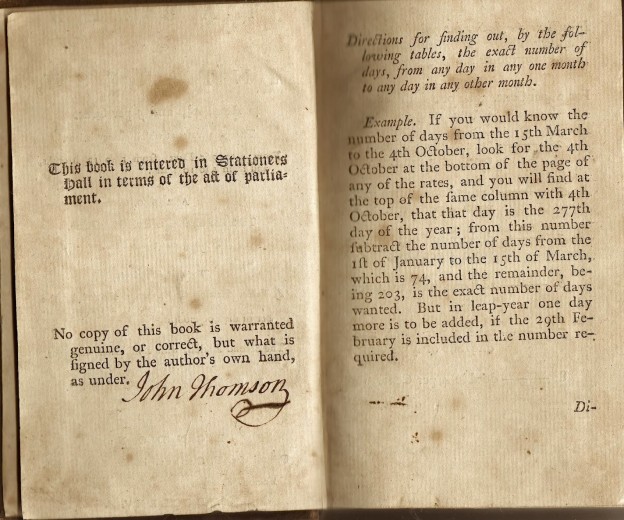
Another Jot from the loyal RH, scholar, idler, gent and swordsman. The book mentioned is a signed book of mathematics (sort of) from 1775 and not in the British Library but obtainable online as we speak, signed by the author, for a paltry $50.

A Scottish Seal of Approval

Remember those Edwardian newspaper ads for Dr Collis Browne’s ‘Chlorodyne’—a patent medicine that purported to clear up cholera and diarrhoea, but which would certainly not cure the former, as it  contained mainly laudanum and tincture of cannabis, both of which, incidentally, would be banned today. Every bottle had Browne’s printed signature on it. Going a little further back, each label for Warren’s patent boot blacking bore the printed signature of its manufacturer, a fact to which  the teenage Charles Dickens, whose job in 1824 involved sticking these labels onto the pots, could attest .

I cannot recall any grocery or pharmaceutical product that bore the manufacturer’s signature before the days of Warren, but I might be wrong. Robert Warren was a marketing pioneer (as John Strachan’s excellent study, Advertising and Satirical Culture in the Romantic Period, discusses at some length). But look in vain in Strachan for books of the Romantic period that bore the author’s printed signature. As for a handwritten signature, I’ve come across none whatsoever. You have to go back  to the Age of Johnson to find just one example. The second edition of Tables of Interest at 4, 4 1/2 and 5 per cent, which Cadell and Murray bought out in 1775 warns the buyer on page two not to accept  any book bearing Mr Thomson’s name on the title page that does not also feature his actual signature. So there it is, written in ink, at the bottom of page two. Amazing !

The reason for all this wariness must have something to do with the frequent acts of book piracy that prevailed before the Copyright Act was passed in 1842. It would seem that the first edition of Mr Thomson’s book had been a victim of piracy soon after it had appeared in Edinburgh in 1768.Book piracy in the 1760s seems to have been particularly prevalent. My own edition of Pope’s Works, which came out a year earlier, was a pirated edition by A. Donaldson, a notorious offender from Scotland, who may have been the culprit in the case of Thomson’s Tables.

Bloomsbury lampooned (1925)

Confident that art and brains
end with them (and Maynard Keynes)
the school of Bloomsbury lies here,
greeting the unseen with a sneer.

From Lampoons by Humbert Wolfe (Benn 1925) a collection of humorous epitaphs of (mostly) living writers.

Of Galsworthy he writes:

Ash to ash, to earth the earthy,
was not spoken by John Galsworthy.
Like his books the soul of John
goes marching on, and on, and on.

It is interesting to note that as early as 1925 Bloomsbury was recognised as a 'school' and its members a rather contemptuous, haughty crowd...Humbert Wolfe is somewhat forgotten and almost uncollected, except his Circular Saws-- wanted only in its dust jacket, designed by Evelyn Waugh.

Ruscovitch – forger and criminal apologist

Found in a thriller from  the Donald Rudd collection of detective fiction, this preface to The Poison and the Root (Jarrolds, UK 1950) by Richard Savage. It is a sort of apologia or plea for the criminal by one G. Ruscovitch, 'professional forger'. I had thought this person was fictitious or possibly a character in the book (which is not about forgery) but in fact there was a forger of this name. He is mentioned by Havelock Ellis in The Criminal (1890) and appears to have flourished in the mid 19th Century. He may also have been a murderer but Ellis describes him thus:

'...a prince among forgers, the accomplished student of science, the perfect master of half-a-dozen languages..' He then quotes the same piece as Savage. Possibly this was spoken from the dock in mitigation:

Too often it is forgotten that criminals are members of society. These bodies, sometimes abandoned by all except the satellites charged to guard them, are not all opaque; some of them are diaphanous and transparent. The vulgar sand that you tread underfoot becomes crystal when it has passed through the furnace. The dregs may become useful if you know how to employ them; to tread them underfoot with indifference and without thought is to undermine the foundations of society and fill it with volcanoes. The man who has not visited the caverns, can he know the mountains well? The lower strata, for being situated deeper and farther from the light, are less important than the external crust? There are deformities and diseases among us to make one shudder; but since when has horror forbidden study, and the disease driven away the physician?

How many molecules in a drop of whisky?

From R. Houwink's The Odd Book of Data (Elsevier, Amsterdam 1965) obtained from the amazing library of Jeremy Beadle MBE (1948 -2008) British entertainer, television star,  hoaxer, quizmaster, book collector and philanthropist (with his blind stamp reading 'Property of Beadlebum OK?')

It's a curious ur geek book full of data such as 'the light now reaching the star Pollux tells us about Hitler's rise to power, whilst a star in the Andromeda Nebula brings us, as it were, a visual greeting from the period when Homo Sapiens made his engravings in caves (15000BC)...' Here is a piece about the number of molecules in a drop of whisky:

Peter looked askance at John who was just polishing off his umpteenth glass of whisky.
'Steady on, old man… leave a drop for the stragglers!'
'Shteady on?'  echoed John, ' Why , theresh heapsh of the shtuff…hic.  Tell you what, shport, I'll dish out a thousand molecules per second to every living soul for the next 30 odd years…hic'.
John upturned his glass and shook a single drop on to Peter's palm. 'Take care of dishtribution old shport!'

Brushes with famous writers 4, Philip O’Connor (1916 – 1998)

Sent in by the constant jotter R M Healey, this piece about a major/minor writer still admired in France. His main work was translated as Mémories d'Un Bébé Public and another work Steiner's Tour was first issued by Olympia Press in Paris (1960.) The dust wrapper was designed by Ronald Searle.


Philip O’Connor was a faded starlet of thirties Surrealism when I wrote to him sixteen years ago. Mine was not a fan letter, though I liked his Memoirs of a Public Baby (1958) and his surreal contributions to New Verse in the ‘thirties. I wanted to know a few details concerning his association with New Verse editor Geoffrey Grigson, but I got a lot more than I bargained for.

I obtained his address in the south of France via a female contact, who had visited him recently. She reported back that he was ‘not at all well ‘.He was, in fact, dying slowly of cancer. So I wrote to him and received a three page letter ( 21 Oct 1997)that crackled and fizzed with philosophical speculations mixed with invective, mainly aimed at middle class English sensibilities, the first page of which I offer here. 

The other two pages are in a similar vein. It was all great stuff and good reading for a student of Grigson, or indeed thirties literature in general. Enclosed with the letter were several unpublished pages of his ongoing Journal which, as he observed himself, could be read alongside the letter as reflecting his current literary and philosophical preoccupations. At one point he invited me to visit him in his ‘tiny’ house in Fontareches.

Continue reading →

‘Today’s Sound’ – learning from rock music (1970)

From Tony Jasper's Today's Sound (Galliard, Great Yarmouth, England 1970) a Christian teaching book. The teacher is encouraged to use rock songs and their lyrics to discuss contemporary morals, behaviour and ways of being. Thus we get some of the lyrics of  Martha and the Vandella's Dancing in the Street, transcribed thus, and followed with topics for discussion:

Cryin out in the world,
Are you ready for a brand new beat?
Summer's here and the time is right
For dancin' in the street.
They'e dancin' in Chicago, down in New Orleans
In New York City
All we need is music, sweet music,
There'll be music everywhere
There'll be swinging and swaying and records playing
Dancing in the street

Oh -- it doesn't matter what you wear,
Just as long as you are there.
So come on every guy, grab a girl,
Everywhere, around the world

Dancing in the street….

Describe the aspects of the present youth culture bought out in this song. Live out the song through movement, reduce the world, sing to it, love it, touch it, it's yours.

Take out a tape recorder, a camera, film camera and capture life as it's happening now. Think of ways and communicating the spirit of this song, your experiencings to the Other  generation.

Continue reading →

The Legend of the Romsey Nuns

This is from Folklore Legends and Superstitious Customs in Connection with Andover and Neighbourhood  by M Gillett (Andover 1917.) A shortish book with were wolves, ghosts, shadows of the firstborn and the Glastonbury holy thorn. This dramatic tale shows how legends are made...

The following legend I admit is rather hard to believe, but I have heard it from two quite different sources, and I relate it as follows:

 When the Danes ravaged Wessex, they marched up to Romsey Abbey, pillaging as they went. The nuns,  terrified at the barbarous and heathen hordes, fled, and supposing Winchester to have shared the same fate, journeyed on to Wherwell Abbey - now Wherwell Priory. But before they arrived at the nunnery they got lost in the woods, which still remain, and many of them perished from exposure and starvation. Tradition says that the nuns sat down in despair, and  in their hopelessness began to abuse the Almighty  and angered Him to such an extent that when they died their souls became wild cats.

Continue reading →

Good Things in England

Florence White ( 1863 - 1940),  recently lauded by TV chef Hugh Fearnley Whittingstall and trendy cultural historian Alexandra Harris, author of Romantic Moderns, founded the English Folk Cookery Association in 1928 in order to promote regional cookery in the UK. In the book that emerged from her extensive research, Good Things in England (1932), a brilliant anthology of recipes from 1399 to 1932, White unashamedly name checks many of her friends, colleagues, and suppliers in the proud tradition of Dr Kitchiner, whose early nineteenth century Cooks’ Oracle did something similar, though on a much smaller scale.

Michael Cardew - Ramekin

For instance I don’t think Kitchiner would ever have said  'These mutton chops taste  twice as good on one of Mr Wedgwood’s beautifully decorated Queensware plates ', which is essentially what Smith is doing when in her own recipe for Savoury Baked Eggs she writes approvingly of what we would now call ramekins that were produced by pioneer studio potter Michael Cardew. 'For these use the delightful little slip-ware pipkins made by Michael Cardew at Winchcombe, Gloucestershire…'

In this early stage of his career, Cardew (1901 – 83), then a little known disciple of Bernard Leach, must have been delighted with this free publicity from such a trusted source, especially as White’s book quickly became a best-seller. Good Things in England  is now regarded as a key document in the renaissance of regional British cookery that was to have its zenith in the work of Jane Grigson and others. As for Cardew, now acknowledged as only second to Leach himself in originality, his pots can sell for four-figure sums, and recently his enormous influence has been the focus of a full-length  biography , The Last Sane Man in England, which discusses, among many other things, his 'obsession' with food. [RR]

Pigeons in War

From Pigeons in World War II edited by W H Osman (London 1950) two stories of amazing feats by army pigeons from this thorough record of WWII pigeon services. A few pigeons received the highest award - the Dickin Medal. No names, no pack drill..

1.Army pigeon 8790 DD 43 Q Bred by Australian Pigeon Section whilst attached to the United States 6th Army

During the fight for Manus Island (1945) the United States Marines sent a reconnaissance patrol to the strategic village of Dravito. The patrol was strongly attacked by Japs whilst returning with the information that a strong counter attack was in preparation The patrol's radio was rendered inoperative during the action so two pigeons were released warning the Headquarters of the impending attack. These pigeons were shot down immediately as the Japanese intensified their efforts to annihilate the patrol. This left one pigeon (8790 DD 43 Q)…the sole remaining means of contact  they were released leaving Army pigeon 8790 DD 43 Q as the sole remaining means of contact with Headquarters. It was released during a lull in the fighting and despite heavy fire directed at it reached Headquarters thirty miles in difficult country in 46 minutes. As a result Dravito was heavily bombed and the patrol extricated from its perilous position.

2.Army pigeon 3863 DD 44

Bred by Australian Pigeon Service. Trained by 1st by Australian Pigeon Section (operating with the first Australian Water Transport Group.)

In July 1945 during the operations on Bougainville an Infantry Company of the 3rd Australian Division was pinned down and surrounded by a superior enemy forces. The Japanese had cut off or destroyed all means of communication to Battalion Headquarters except two pigeons carried by the Company. Army pigeon 3863 DD 44 was despatched with an urgent call for reinforcements and artillery support in order that the position could be relieved by nightfall. Despite heavy tropical rain and the fact that this bird was fired on by 60-70 Japanese immediately on release (which wounded the pigeon) Army pigeon 3863 DD 44 flew the 22 miles in 3 hours arriving at the loft in a state of complete exhaustion. As a result of this gallant effort artillery support was given and the Company with its wounded was withdrawn safely before dark.

Scary monsters – artist (almost) unknown

This truly horrible image is the stuff of nightmares. I can’t quite relate the birds, if indeed they are birds, to anything in nature, so I will assume that the etcher, one J. B. Kenrick, was on something at the time, or just had a rather lurid imagination.

But exactly who was the etcher? I’ve tried every source, but cannot find anyone matching that name in any reference work listing artists. The only candidates I can locate are Joseph and Josephus Kendrick, who were both sculptors. It is possible that one of these may have decided to drop the letter  ‘d’ in their name. And as I also acquired two other, much smaller, much less accomplished etchings with the same signature, which depict some sinister monkeys sitting in a circle, it could be that one of these sculptors amused himself with etching some time in the early or mid nineteenth century. Or the etcher could be a gifted amateur called Kenrick who has escaped the attention of art historians.

It did occur to me that in depicting monkeys Kenrick might have been attempting a satiric comment on Darwin, but the horrific ‘ birds’ don’t seem to be satirical in any way. I would, however, welcome any interpretation of this image ---the more outlandish the better. [RH]

The Daily Mail –The Busy Man’s Daily Journal

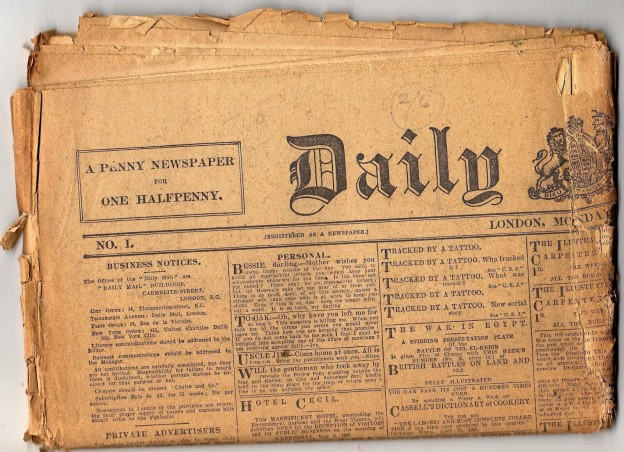
Sent in by a loyal jotter and keen accumulator of ephemera and near nonsense. The clue here is that it is the first issue. Surely stuff get's made up at that point...

Check out these Personal ads on the front page of the first issue of the Daily Mail, May 4th 1896. Surely, they can’t be for real. The first and the second read like extracts from late Victorian romantic novels (‘There shall be no reproachful letters; but for heaven’s sake, let me hear of or from you…’ and ‘ if you do not come back to me soon, I fear I shall be tempted into accepting one of the many offers of marriage I am receiving almost daily’ ). Then look at the names attached to the second  ad:‘ To Oak’ from ‘ Ivy’ .  The third ad reads like a Music hall joke.

Uncle Jim---Come home at once. All is forgiven. Bring the pawn tickets with you---Niece

As for the last announcement, this is a neat effort at sardonic humour:

Will the gentleman who took away by mistake the Brown Pony standing outside the Star and Garter on City and Suburban day, kindly send to the same place for the trap, or return pony ? One is no use without the other.

Hurgh hurgh! But back then, the Daily Mail was a light-hearted read for a mere halfpenny, not the tissue of ill-informed opinion that it is today. Along with fashion tips and household hints, it advertised romantic fiction and jolly magazines, announced violin and piano recitals, and even ( horror of horrors ) included an advert for a novel by that dastardly communist Emile Zola !

Those were the days. When did it all go so wrong ?

Crime Fiction by Setting

Hubin's Comprehensive Bibliography of Crime Fiction 1749-1990 lists crime novels by their 'setting' in its second volume. This is mostly places, countries, states and towns with a few other settings like the past, the future, aircraft and academia. Naturally there is an emphasis on America  e.g. under 'Massachusetts' Hubin lists 200 thrillers but at the next entry 'Mauritius' just one - J.C. Shill's Murder in Paradise. The section on the Canary Islands is of interest with just these 5:

P. Attlee. Silken Baroness.

R. Harding. Appointment in Tenerife.

R. MacLeod. Legacy from Tenerife.

D. Serafin. Port of Light. 

J.M. Walsh. Danger Zone.

Madeira has these:

M. Farnsworth. Castle that Whispered.

E. Ferrars. Skeleton Staff.

E. Ferrars. Witness Before the Fact. 

R. Goddard. Past Caring.

Alicen White. Watching Eye.

The sparsely populated Azores throw up just one novel:

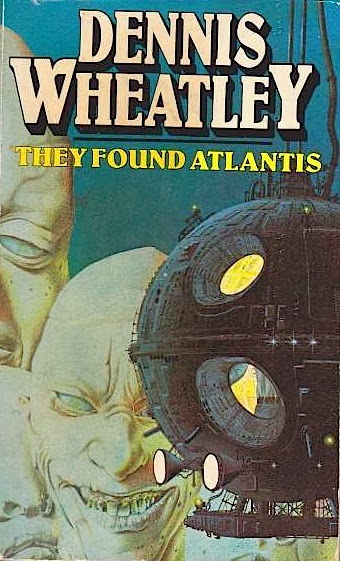
Denis Wheatley. They Found Atlantis.

Locked Room Murders – 20 Solutions

From Robert Adey's Locked Room Murders (Ferret Fantasy, London 1979)

Major discussions on the subject of locked room murders are to be found in Carr's The Hollow Man, Rawson's Death from a Top Hat and Holmes' Nine by Nine.

There appear to be some 20 different ways in which a locked room can be breached.

Analysis of solutions

1 Accident.

2 Suicide.

3 Remote control – poison gas or impelled to do so with his own hands.

4 Mechanical and other devices.

5 Animal.

6 Outside the agency made to look like inside agency. E.g. dagger fired through window.

7 Victim killed earlier but made to appear alive later.

8 Presumed dead but not killed until later, e.g., by the first person to enter the room.

9 Victim wounded outside, dies inside.

10 Turning key, bolt, catch, etc, from outside with pliers, string, etc

11 Unhinging and rehinging door or window.

12 Taking out and replacing windowpane.

13 Acrobatic manoeuvre,.

14 Door locked or wedged on outside. Key replaced or bolt thrown after re-entrance.

15 Door locked on outside. Key returned before re-entrance.

16 Other methods of gimmicking doors, windows etc.,

17 Secret passages, sliding panels, etc.,

18 Murderer still in room when entrance forced.

19 Alibi provided while murder committed in an apparently  
guarded area.
  
20 Other impersonation stunts

  A further mystery is the price and rarity of the much enlarged edition from Crossover Press 1992. A copy on Canadian Amazon (often a home for awesome prices) at $10000 seems to have now vanished...

Warding off the Evil Eye

According to R.C. Maclagan's Evil Eye in the Western Highlands (Nutt, London 19 02) the Evil Eye superstition was widespread in the area well into the late 1800s. Possibly it still lingers in the Western Highlands of Scotland. The simplest way of telling who had the Evil Eye (the 'diagnostic mark') was to look out for persons with different coloured eyes but as he says 'all the parti-coloured eyes in Scotland would not account for a tenth part of the results accredited to evil eyes.' Atrtractive children were particularly prone and various dress codes are suggested to ward it off:

THINGS THAT SPECIALLY ATTRACT

A woman of twenty-eight, whose information is quite
reliable, the daughter of a respectable man in one
of the inner islands, remembers when young people
talked a great deal about these things, and many were
very much afraid of them. "The idea was that it
was always the best and prettiest of beast or body
that was most liable to be injured by a bad eye.
(My) youngest brother was awfully pretty when a child.
They used to have him dressed in a red frock and
white pinny, and with his fair skin, fair curly hair,
and red cheeks, he was the nicest-looking child in
all the place. Many a time, when my father would
take him out, the neighbours would be warning him
to take good care lest some one might do the child
harm, and some would advise my father to go in and
take the frock and pinny off him, so that he might not
draw one's attention so much."

Continue reading →

I once met Alec Guinness

In a former incarnation I worked as a TV critic on the short lived London listings magazine Event. It was owned by Virgin and one of Branson's minions sent me to the BBC at White City to review Smiley's People. This was 1982. There was a showing and then a small reception with canapés and wines at which point they wheeled out the star Alec Guinness who with an assistant 'worked the room' - making critics feel good and hopefully thus obliged to write well of the TV series. It was actually very good ,and Guinness was the perfect Smiley.

At one point he was introduced to me and I said I liked the show. I had been an admirer of one of his directors, Robert Hamer, and mentioned him. His face brightened and he said he had been thinking about him that very morning. He did not seem to know that Hamer was something of a poet and asked me to send him some examples. I had vague ideas of publishing his work in a (very) slim volume. Guinness moved on and later, having received the copies of the poems he wrote from his house near Petersfield to thank me.

Continue reading →