The Best of British More choices from The Best (1974)


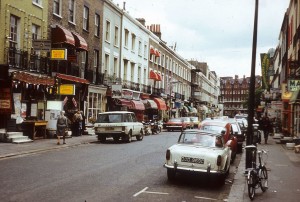
Wilton's restaurantIt’s instructive to get an American view of some British institutions. So here are Peter Passell and Leonard Ross on ‘The Best London Restaurant’.

The trouble with eating in London is that it is like eating in New York. There are vast hordes longing to dine well and dozens of exciting new restaurants longing to fill the void. Yet somehow nothing seems to work out. Perhaps it is only a scarcity of talent—-running a restaurant well demands more than one chef imported from the Continent. More likely it’s incentives. There aren’t enough people who both know good food and are willing to pay for it. Restaurants are made or broken by who shows up, not by what is served. The few establishments that start out with standards find little reason to maintain them. No guidebook inspector will turn the decline into headlines; no army of food pedants will organize a boycott.

Of course, there are a few bright spots. Robert Carrier’s relentless pursuit of the nouveau may irritate the snob, but the fixed menus frequently work well. Inigo Jones’s lovely room can make up for an occasional error in service. The fish is very fresh ( and very expensive) at Wilton’s. The new Capital Hotel dining room produces the best rack of lamb north of Paris. Marynka demonstrates that Polish food is no joke.

But for our money we’ll take London’s Indian/Pakistani restaurants. They tend to be much more sophisticated than the North American version and not nearly so lacking in grace. The best of them, Sri Lanka, is in fact not Indian but Ceylonese, a variant on the national cuisines of the subcontinent. This pretty little restaurant near Earl’s Court ( an unsocial twenty-minute taxi ride west from Mayfair) prepares the predictable curries, flavored rices, and breads as well as well as any other in London and adds a dozen distinguished  Ceylonese specialties. Among them, a super-hot tomato broth ( perhaps really a puree of chili peppers), the pleasure of which comes in the vibration of subtler spices in the aftertaste; delicate rice-flour crepes served with fried eggs; chewy fried breads stuffed with egg, vegetables , or meat, and far superior to the usual Indian paratha; a steamed rice-flour cake drowned in coconut milk. With a couple of German lagers, the bill comes to two pounds per person.

Today, the eating scene in London has changed incredibly. Here you can eat around the globe, from Brazil to Russia and Indonesia to California, often from street stalls in Brick Lane and Portobello Road, a development that Passell and Ross could hardly have imagined. The Indian/Pakistani restaurants are still there, of course, and are proliferating day by day. It is odd that our Americans fail to mention the curry houses centered on Brick Lane, and further east, in and around Whitechapel High Street, where the best of them offer high-class ‘ home-cooking ‘ of the kind described by the authors. But it is true that Sri Lankan restaurants are not as common, but are becoming more so and those that flourish today serve some of the dishes described by Passell and Ross. The restaurant selected out for special praise, however, appears to have gone.

As for the other top restaurants mentioned, Wilton’s is still there and is still very expensive. The restaurant at the Capital Hotel is flourishing and is probably still offering its rack of lamb. Unfortunately, the Marynka near Earl’s Court appears to have disappeared, but there are other Polish eateries in the capital, including the rather dowdy Daquise, near the V & A, which seems to have been around since the First World War.[R.M.Healey]
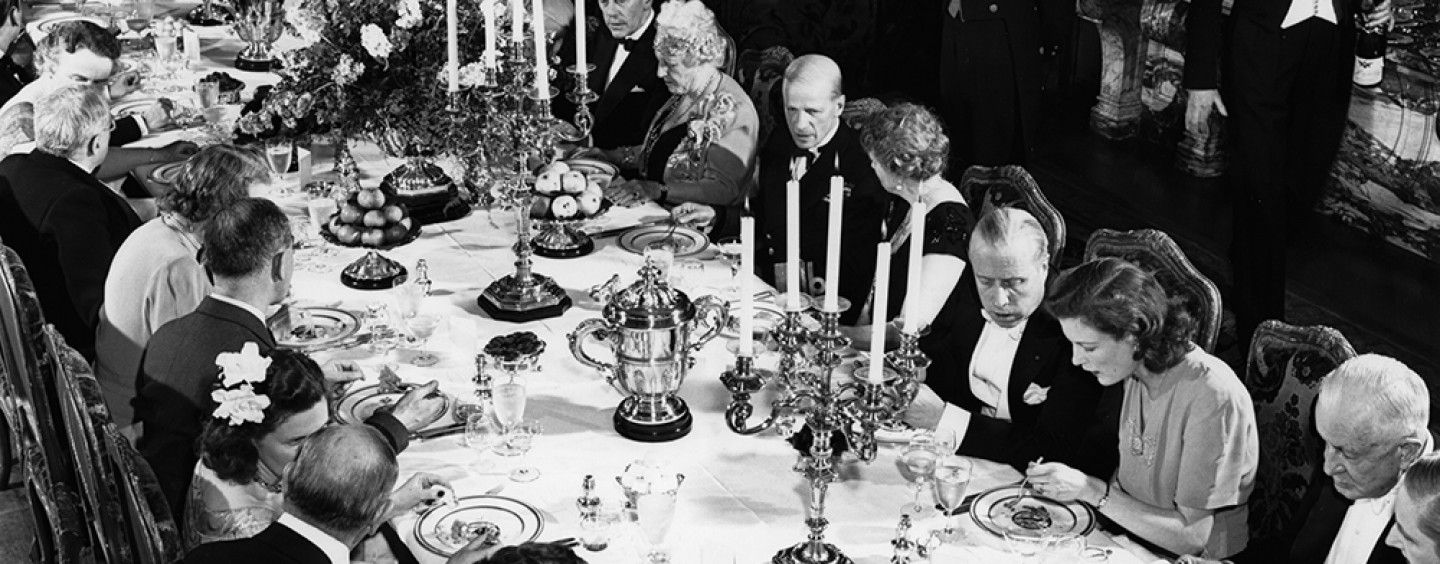


Table manners in 1939


Etiquette in 1939 pic


How does one know which knife and fork to use when there is an unusually big array at an important dinner ?

No difficulty arises if one remembers that the various knives, forks and spoons are laid in the order in which they will be required, beginning with those on the outside.

When the dinner starts with hors d’oeuvres—those tasty morsels of smoked salmon and sardine, Russian salad and the like—the appropriate silver knife and fork will be placed on the plate. Similarly a fork will be supplied with the plate, or found on the extreme right of the silver, if oysters come first.

Soup is taken with the large spoon found on the right. Next, to the right and left, you will find the fish knife and fork, then a fork, or knife and fork for the entrée, according to its nature. Following will be the large knife and fork for the meat or poultry course, a spoon and fork for the sweet, and finally a knife for cheese.

When dessert is served a small knife and fork will be handed to you with the dessert plate.

Should you by any mischance pick up the wrong knife or fork—or both—do not feel terribly embarrassed. Just ask the waiter quietly for another set when the course arrives for which the utensils were intended.

The dessert course always worries me at a dinner —and generally on that account I refuse it! How should one deal with apples, pears, bananas and so forth?

Apples and pears are held on the dessert fork and peeled with the dessert knife. Then the fruit is cut into quarters, the core removed and smaller portions cut if desirable.

Peaches and similar fruits are held on the fork and skinned with the knife. The fruit is cut into halves, the stone removed with the aid of the knife and fork. Bananas are peeled with knife, cut into pieces and eaten with the fork. Grapes are squeezed into the mouth singly, the skin being kept in the fingers. The fork should be placed to the lips to receive the seeds.

I have noticed that some people use a fork and spoon for the sweet course in a dinner, while other use a fork only. Which is correct ?

Whenever the nature of a dish permits, a fork only should be used. This applies not only to sweets but also to other courses. When the entree, for instance, is a patty or the like, that should be eaten with a fork. A spoon should never be used alone; always use a fork as well, even for such dishes as custard and milk pudding.

With most of the courses of a dinner the procedure is obvious. Others are not so simple to deal with. How should one eat oysters, for instance, or asparagus? Continue reading

‘At Homes’, tea parties, and tea dances: social etiquette in 1939

ADN-Zentralbild/ Archiv Berlin 1926 Im Garten des Berliner Hotels "Esplanada" spielt zum 5 Uhr-Tee eine Jazzband. 17187-26

The always informative and entertaining Everybody’s Best Friend (n.d. but c 1939) devotes many pages to modern etiquette, some of which reminds us today of how much has changed over the intervening years.

Take, for instance, the etiquette of social occasions. ‘ At Homes ‘ were once common. Here is some advice.

I am attending a formal “At Home “ shortly. As this will be my first experience of this event, what may I expect the procedure to be?

Unless you receive a card stating a particular hour, do not arrive at the house earlier than 3.30 p.m., nor later that 5.30.A heavy coat or a rain-coat should be left in the hall, but the hat is not removed. You will be greeted by your hostess and introduced to other guests.

Usually the hostess will offer a cup of tea and a morsel of bread and butter or cake.

A visit on an “ At Home “ day normally lasts for twenty minutes to half an hour. You should not stay longer unless especially asked to do so by your hostess. Take your leave quietly. Friends who arrive later will not be leaving at the same time, so you do not want to interrupt the proceedings by your departure. Shake hands with your hostess and just smile and bow to the others.

There were specific rules for tea parties too.

I am thinking of asking to a little tea party some of the girls in the office where I worked before marriage. What sort of invitations should be issued and what should I put on the table?

Invitations to a tea-party take the form of little notes something like this:-

“ Dear _____,

“ I am having a few friends to tea on Saturday next, December18, at 4.30p.m., and should be happy if you would join us.

                                                                                “Yours sincerely,

                                                                                  ______________”

Continue reading

Early Edwardian Warwickshire pea-pickers

Found at Jot HQ a little volume of rural sketches by Herbert W. Tompkins, a specialist in topographical writing who flourished in the late nineteenth and early twentieth century. His home ground was Middlesex and Hertfordshire and his best known book is arguably Highways
and Byways in Hertfordshire
(1902), which was illustrated by the visionary etcher F .L. Griggs, who hailed from Hitchin.

Jot 101 pea pickers Broom

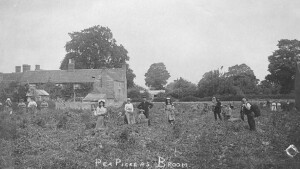
By the time The Complete Idler appeared in 1905 Tompkins was living in Southend – on- Sea, but among the bucolic sketches in this collection there is nothing on Essex. Instead the author focused on places in his home territory with the odd venture out into Hampshire and Warwickshire. It was the latter that inspired one of the more enlightening cameos in the book—‘Warwickshire Pea Pickers’.


To say that Tompkins was inspired by the tradition of pea-picking in or around Clifford Chambers, near Stratford-in-Avon, is not quite true. Impressed by an account of this activity by the well-known American dramatic critic and leading light of the Pfaff Bohemians, William Winter, that had appeared in the pages of Harper’s Magazinearound 1870, Tompkins decided to investigate himself with a friend who owned a crop of peas. Looking back at this visit Tompkins admits that Winter’s account ‘might have been penned yesterday ‘. Here is Tompkins:


‘Our adventures began when we crossed the railroad at the swing gates and found our trap promptly surrounded by a dozen hungry-looking, half-clad wayfarers, as destitute in their appearance as those hunger-bitten peasants seen in sunny France by Arthur Young. They were pea-pickers—men, women, and children—and were eager to learn from my friend, who had bought the standing crop thereabouts, when and where they should next go picking. They were worthy of study.
Continue reading

The ‘’Best’ in 1974, according to two Americans, one of whom had been a child prodigy


The best Champagne

‘,…Short of the best—which some may find an extravagance at eight pounds—it doesn’t make sense to buy champagne. The five pound variety is rarely worth the price. Since competitive alternatives can be had for half as much. From France, the dry sparkling wines of Seyssel are often the equal of medium-priced champagne. California “ champagne” ( the long arm of the French labelling law does not reach across the Atlantic ) can also be quite decent; the best are Korbel Natural and Hans Kornell.

The best college at Oxford

Screen Shot 2020-12-12 at 12.06.52 PM‘Magdalen, both the most beautiful and the most intellectually diverse. Christ Church is an unreconstructed sanctuary of the worst in British snobbery; Balliol is like an American law school, full of politics and ambition. Magdalen has everything : class warfare on even terms, superb tutors, an immense spectrum of interests and tastes’.      Other colleges are available…
The best diet

‘The crashing bore of it all. Everyone knows what the best diet is…Lean meat, cottage cheese. Skim milk, an occasional slice of bread or a baked potato, fresh fruit and veggies; no skipping breakfast, apples and carrot sticks for snacks, plenty of leafy greens to prevent the inevitable…The only thing wrong with the diet—besides the fact that no one in his right mind would stick to it –is that calorie recommendations are too generous, even for the intended audience… Continue reading

Coffee and Kafka, anyone?

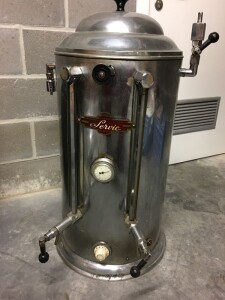
In an issue dated June 4th1954 of Desiderata, the weekly publication ‘providing a direct link between library and bookseller‘ we find the following news snippet from the back page:coffee machine 1950

A Sussex bookseller has set up a coffee-bar at the back of his spacious shop with a counter, decorated in red and gold and equipped with the latest type of coffee machine, fitted into a tall bookcase. He claims, no doubt correctly, that it is the only coffee-bar to be found in any bookshop in the country and says, according to a press report, that in installing it he had in mind the coffee-houses of the 18thcentury “ at which it was customary for people interested in books to meet to discuss literature”.

A  good idea, perhaps, but not our cup of tea.

The report does not state whether the unnamed bookseller/barista sold second hand books or new ones, or both, but since most of the content of Desideratais devoted to the ‘wants‘ of provincial libraries and second hand booksellers (the eminent dealer Charles Traylen is featured in this particular issue), we can reasonably suppose that the bookseller in question dealt in second hand books.

We have absolutely no idea why this dealer should be so certain that his shop was a pioneer in providing coffee, but the tone of the report seems to suggest that to the journalists who covered this story such a service was a great novelty. Nor are we told whether this coffee was offered free to customers as a sales gimmick, or had to be paid for. We at Jot 101 pose this question because we remember well back in the 1990s a certain book dealer in Hitchin, Hertfordshire ( alas now gone) who supplied comfy seats on which customers could drink their free cup of very good percolated coffee. This most welcome bonus only lasted a few years, but at the time your Jotter felt it to be a rather clever way of establishing good relations with the clientele. Before then and since coffee, when it featured at all in bookshops, which was rare enough, it had to be paid for.

We looked in vain on the Net for book dealers of the 1950s who might have emulated the Sussex dealer’s example, but good ideas in marketing are almost always copied in some form or other by rivals, so there must have been a few takers for this coffee ‘n’ books scheme. Certainly many dealers over the years have tried to inculcate in their premises an informality akin to that found in a private library. In the 1980s the legendary Shakespeare & Co on the Left Bank in Paris positively encouraged customers to become literary flaneurs by providing sofas for them to lounge around on. And an earlier Jot featured a certain bookseller in the USA who made her small shop a simalcrum of a some arty person’s back parlour, with tasteful bric a brac jostling for attention with rare books. [R. M. Healey]


E.V. Knox on oysters

Still-Life-Cornelis-de-Heem-oil-painting

Cornelis de Heem (via Ocean’s Bridge with thanks)

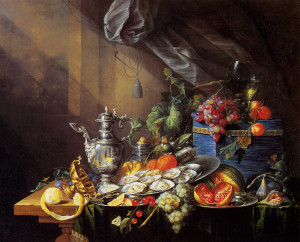
Found – a typed manuscript with inked corrections in the hand of its author ‘Evoe’ i.e .E.V. Knox. Probably a contribution by him to Punch, or possibly read out by him at a feast or function. He attended many and was often called upon to entertain. No date, but posssibly late 1940s, the annotations being in biro. In format and sound it has echoes of the British Grenadiers song (‘..some talk of Alexander and some of Hercules..’) or Lear’s The walrus and the Carpenter. Take it away Evoe–


Of Fishes and Food

OYSTERIA

The oysters of Great Britain

Were bought to Julius Caesar;

He bolted them in unbitten

And smiled like Mona Lisa.

 
The Emperor Augustus

Preferred them put in patties.

His cook, whose name was Justus,

Could never serve him satis.

 
The Emperor Tiberius,

A man debased and selfish,

Was never wholly serious

Except about these shellfish.

Continue reading

Eating healthily the Focus way


Focus Purpose announcement 001

In an earlier Jot we looked at the June 1928 issue of Focus, a pocket monthly magazine, published in London, which was devoted to alternative medicine, healthy eating and what today we might call  ‘New Age’ concerns. Little is known about this publication, apart from the fact that the publishers were the fringe medicine outfit C.W.Daniel. However, from the issue of December 1928 we now discover that although Focushad begun life just two years before, the publishers had decided to close it down and replace it, starting in January 1929, with a quarterly periodical to be called Purpose.

Readers of Focuswere left to imagine what the successor might turn out to be. All that was said was that the aims of the new magazine were to be the same as ever, that is to say, the promotion of ‘the ethics of mind and body’.

As for this final issue of Focus, it was the usual eclectic mixture of articles on philosophy, literary philosophy ( with H.G.Wells and Tolstoy examined), left-field speculations on medicine ( the common cold revisited) and metaphysics , and longest of all these, a fascinating item on healthy eating that focussed on daily menus. All this supplemented by a solid twenty pages of adverts for radical books, a directory of vegetarian boarding houses and ‘Nature Cure Establishments‘ . Continue reading

Literary drinkers

roy_campbell

The actual book being discussed is entitled ‘More Literary Drinkers’, but as we at Jot 101 haven’t read Pete Bunten’s ‘Literary Drinkers’, we will start with this sequel.

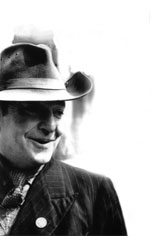
Bunten assembles the usual suspects in alphabetical order rather than in their degrees of bibulousness, which in some cases is not why they are in his book. They are: the Brontes, Roy Campbell (left), J.P.Donleavy, Ian Fleming, John Fothergill, Oliver Goldsmith, W.W.Jacobs, Jerome K Jerome, D.H.Lawrence, C.S.Lewis and J.R.R.Tolkein,Norman McCaig, Julian Maclaren Ross, Thomas Nashe, Eugene O’Neill, Dorothy Parker, Joseph Roth, Shakespeare, R.S.Surtees, Graham Swift , and Evelyn Waugh.

The book is well written, as it should be, considering that Bunten, who is ( or was ) a schoolteacher, is a graduate in  English from Cambridge. And there are some amusing pen portraits. One of the best concerns the belligerent South African poet Roy Campbell, who comes across as a near-alcoholic, quite capable of downing 4 ½ litres of wine a day. Bunten is right to see him as a victim of his own determination to project himself as macho through reckless physical activity and alcohol. His fiancee’s father warned her against marrying a ‘dipsomaniac‘, but she ignored his advice and paid the price. The discovery of her affair with Vita Sackville West sent Campbell off on a lengthy bender, which seems to us the sign of an emotionally weak person, rather than a manly one. And is it manly, one asks, to physically attack an unarmed Stephen Spender and Geoffrey Grigson, who Bunten calls ‘ timid ‘,with a knobkerrie ?  To evade such a drunken assault, as Grigson did, after having learnt that Spender had already been hit by Campbell, is hardly the action of a timid person. Later, Anthony West commented on the encounter   with the gruff ‘ You should have kicked him in the balls ‘.In his brilliant Recollections (1984) Grigson recalls being  a witness to another example of  Campbell’s boorish behaviour.

Continue reading

The Devon hotel where Waugh wrote Brideshead Revisited

BridesheadIf you fancied a change of scene during WW2 there were problems that needed to be considered if you chose to stay in a hotel or B & B. In his wartime edition of Let’s Halt Awhile(1942) ‘ Ashley Courtenay ‘ offered this advice to the holidaymaker.
Book your accommodation well in advance. Do not assume “You will get in somewhere,”, it is very unlikely, and they do not encourage sleeping on the sands in war time.

If you want to get a meal en route, telephone ahead, or arrive very early. Pot luck means no luck and an empty pot.

Take your Ration Book with you AND your soap.

If you are lucky enough to have drinks of your own, there are few licensed hotels which would object to your bringing them with you. It would be polite to mention the matter, and invite the Proprietor to have one.

When traveling by long distance train, be on the platform half an hour before the train is due to start, that is to say if you want a seat.  If there is a Restaurant Car on the train, get a ticket from the Attendant immediately you have fixed your seat.

If your Leave is unfortunately cancelled, have the courtesy to telegraph or telephone  

the Proprietors at once. Someone else going on unexpected Leave might be glad of your room. Remember that British Hotels have limited single room accommodation, so share when you can.

Ashley Courtenay who, like the Good Food Guidefounder, Raymond Postgate (see previous Jots) who came later, compiled his accommodation guide both from personal visits and from the recommendations of others, had a lot of good things to say of the Easton Court Hotel, near Chagford, Devon. Continue reading

The Good Food Guide is launched

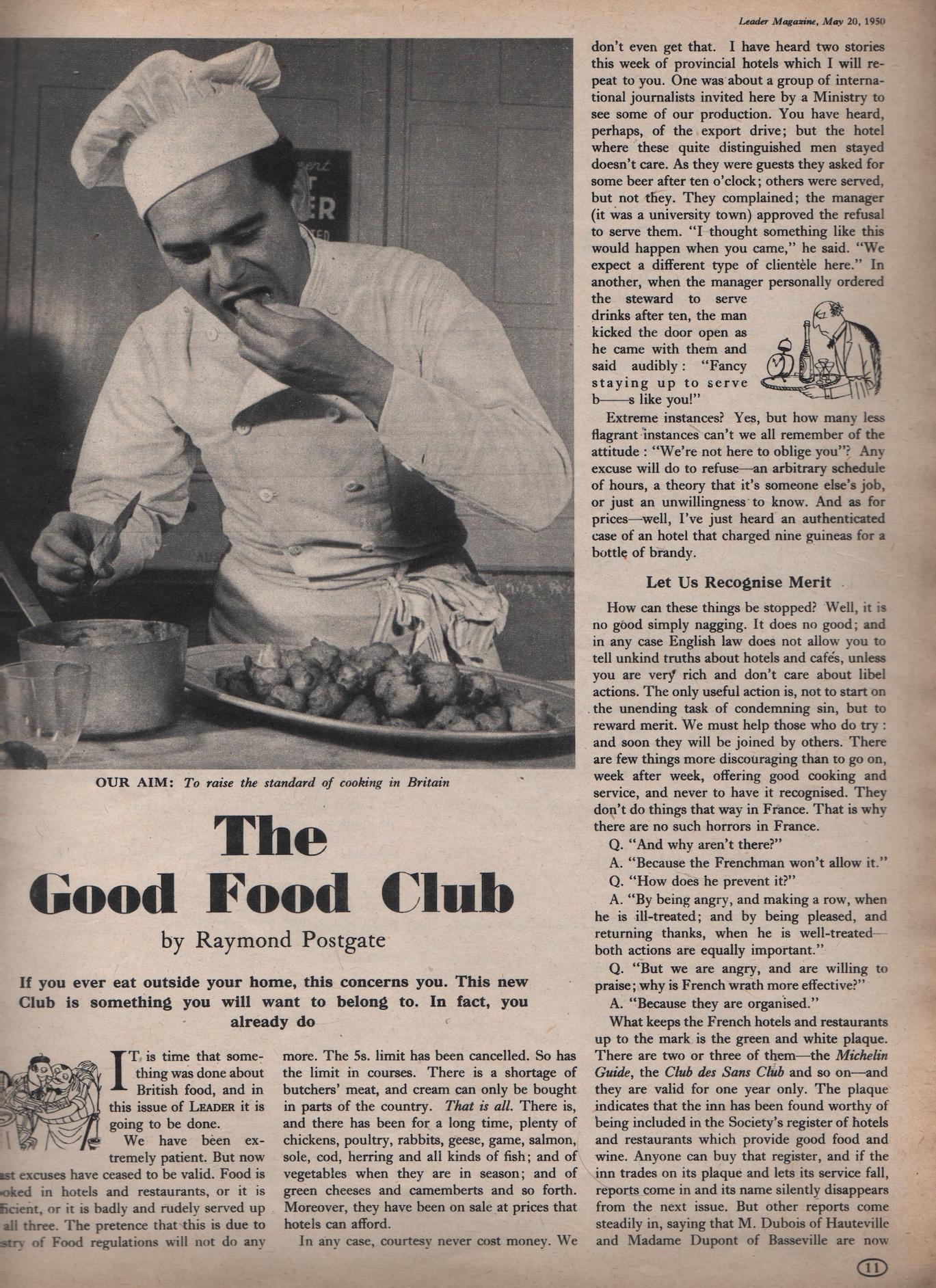
Good Food Guide Leader mag pic 001Last year we featured some Jots based on entries taken from the 1960 -1 edition of the Good Food Guide. Recently we were lucky to find among a run of the entertaining Leader magazine dated 20 May 1950 an article by the Guide’s founder, social historian Raymond Postgate, announcing the launching of ‘The Good Food Club’, as it was then known.

The tone of the article is a refreshing mixture of enthusiasm for the future of British eating-out and a denunciation of hospitality practices present and past. ‘We have been extremely patient ‘, Postgate complains, ‘but now the last excuses have ceased to be valid, Food is ill-cooked in hotels and restaurants, or it is insufficient, or it is badly and rudely served up—or all three ‘.

By 1950 much of the rationing to which much home produce had been subjected for ten years was gone, as had the 5s ( 25p) meal limit imposed by the Ministry of Food ( see a previous Jot). So, in Postgate’s opinion, hotels and restaurants now had no excuses not to serve up generous portions of good quality food with courtesy. But as Leonard P Thompson demonstrated in his account of poor hospitality in 1948 ( see recent jot) such experiences were the rule rather than the exception.

The article brings up some revealing points. We had no idea that back then drinks could not normally be served in hotels after 10 o’clock at night. That rule seems absurd today. However, we were aware that sixty odd years ago the Basil Fawlty style of hotelier cited by Postgate was more common than today—the reason possibly being that Cleese’s character acted as a corrective to poor service. It is also interesting to discover that in 1950 ‘ English law does not allow you to tell unkind truths about hotels and cafes, unless you are very rich and don’t care about libel actions ‘. Today, thanks to the excellent Trip Advisor, the angry recipient of poor accommodation and disgusting food can do just that with no fear of a letter from Messrs Sue, Grabbit and Runne landing on the doormat. Which is how it should be. Continue reading

The Great British Tea

Found in Old Inns of Suffolk, an often consulted work by local historian 440px-Customers_enjoying_afternoon_tea_at_Lyon's_Corner_House_on_Coventry_Street,_London,_1942._D6573Leonard P Thompson, is a complaint about the ‘catchpenny ‘afternoon teas served up by typical road houses and other mediocre eating places.
Writing in 1948,Thompson argues that excellent and value for money teas can still be found in Britain, but that the ones offered by hotels and similar outfits are invariably unimaginative, mean and ridiculously expensive.

Thompson begins his complaint with a eulogy to a tea he once had at The Fleece, Boxford, near Sudbury, once the home village of the late Peter Haining, the doyen of paste and scissors anthologists, from whose archive ( now owned by Jot 101) Old Inns of Suffolk may have come.

It was a Tea of an essentially home-made order. There was plenty of bread-and-butter. There was potted meat and home-made jam. There were biscuits, there was cake. And there was a pot of refreshing, honest to-goodness tea. The price was extraordinarily reasonable. And it all pointed to this moral: if one country inn can observe the ancient traditions of its proud place in England’s social history, so can others. Some, indeed, do, but they are all too few; and of that few, the majority are completely unimaginative. Hotel Teas display the least imagination; two or three wafers of rather dry bread, lightly smeared with a mixture of margarine and butter; perhaps a couple of diminutive sandwiches of indefinable and often dubious content; a piece of dry cake, or an equally dry and hideously plain bun. Such is the usual composition of the average Hotel Tea . Continue reading

Food products named after writers

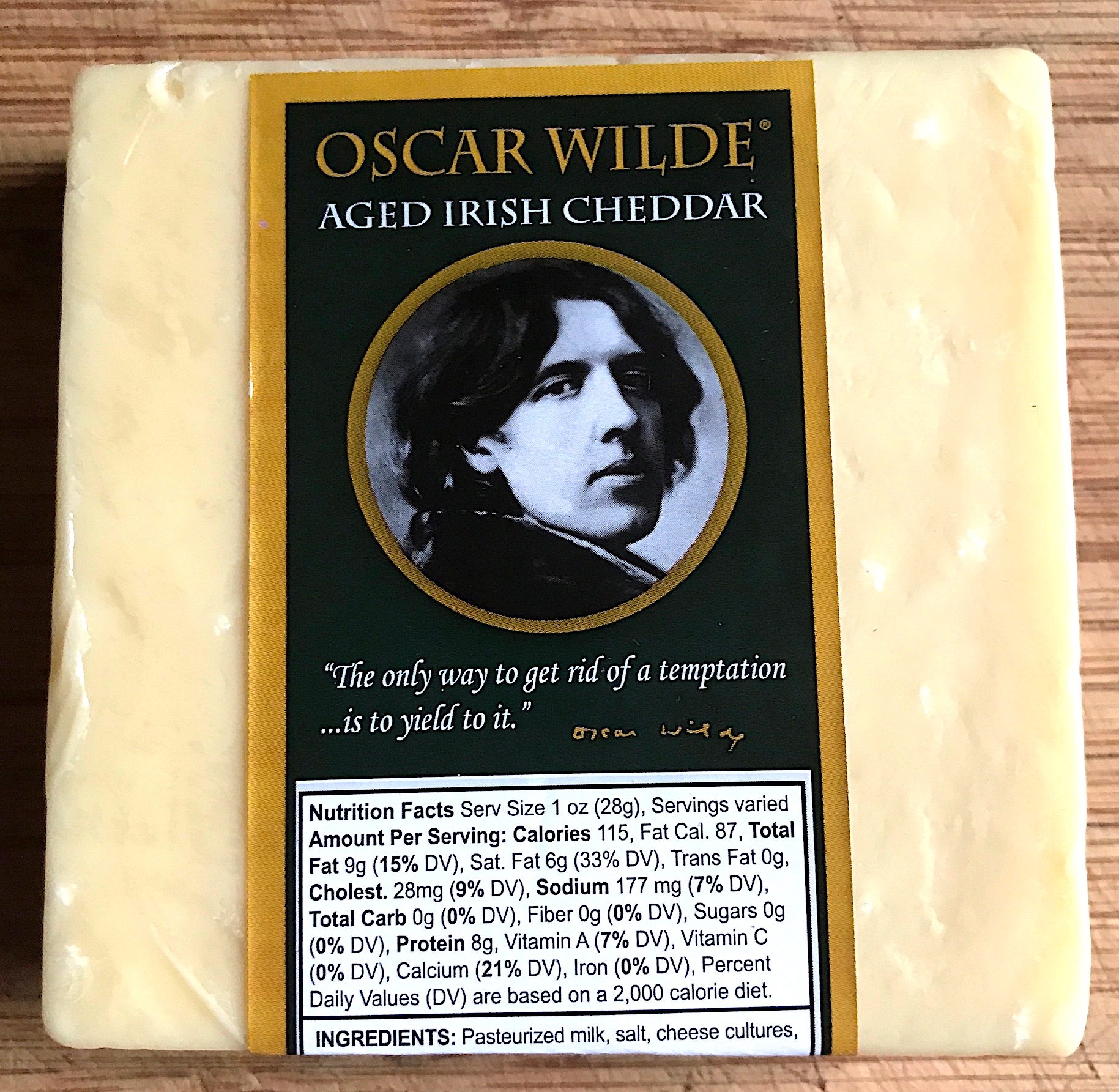
IMG_4443Spotted in California at De Luxe Foods this American/ Irish cheese named after Oscar Wilde. Aged two years. Probably very decadent. There are not that many commercial foods and beverages named after writers and artists. Plenty of dishes, however, like Omelette Arnold Bennett, Peach Melba, Chateaubriand etc.,- Wikipedia has an extensive list.)  I have also seen a Jack London wine (a Cabernet Sauvignon with a wolf motif  on the label) and a Conradian coffee called ‘Heart of Darkness.’ Back in Europe there is a very more-ish chocolate biscuit called Leibniz, the name taken from the great thinker and mathematician. Jerry Garcia was the inspiration for Benn and Jerry’s ‘Cherry Garcia’ and in France there is a champagne named after the Marquis de Sade- at 35 euros a bottle it is not cruelly expensive.  The Wildean cheese was $6 for just over half a pound. News of any other such products would be welcome. Why isn’t there a small sponge cake with a distinctive shell-like shape named after Proust?  Or a Balzac coffee (did he not sometimes drink 50 cups a day?)

Over tipping

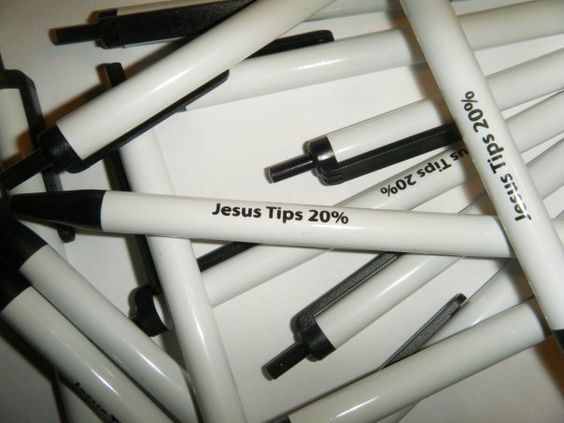
A few brief notes on tipping. Tipping is a controversial business – in some cultures it is deemed insulting, in others almost obligatory. Are wealthy people  expected to give larger tips? I spoke to a taxi driver who drove Ringo to Liverpool from London in the 1970s and the great drummer gave him a £100 tip, the best he had ever had. There is the story of the rich man who was so impressed by the service of a waiter that he bought the restaurant and gave it as a tip – in some versions of this tale the waiter is said to be the hotelier Cesar Ritz. In  one of  John Le Carré’s novels  a character suggests that people (like him) who over-tip are held in contempt by waiters etc., The idea is that the over-tipper is a sad, inadequate person trying to be liked, or at very least, showing off his wealth..

67b5291fbdca5a7d5b5b028fe3673abe

Francis King wrote of  his time escorting  extremely wealthy fellow author Somerset Maugham around Japan is the early 1960s – “..in a restaurant he gave a vast tip to two charming and attentive waitresses. Seeing that I was astonished he told me: ‘Never believe the idiots  who tell you that people despise those who overtip. That’s a fiction put about by the miserly. On the contrary, people are always delighted if you give them more than they expect.’

One wonders whether Henry James was an over-tipper. His advice  was: ‘Three things in human life are important: the first is to be kind; the second is to be kind; and the third is to be kind.’

A Flight of Fancy: Lee-on-Solent’s Swordfish Hotel

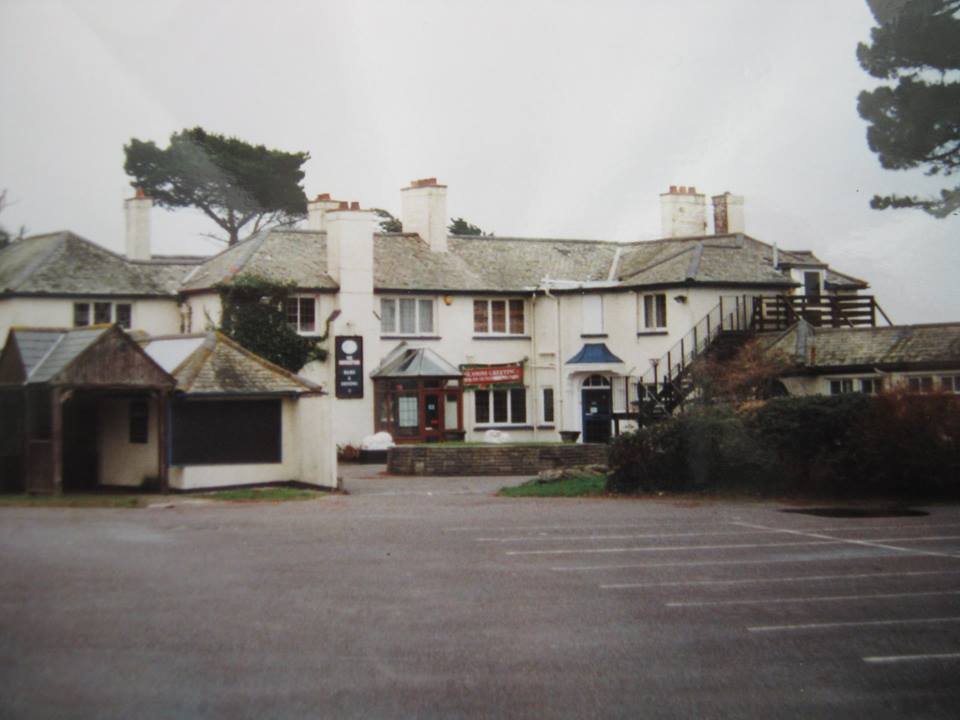
Swordfish hotelAlas, good eating places, whether pubs, hotels or restaurants, often come to sticky ends. They close down and when they re-open are often a shadow of their former selves. They frequently burn down, either deliberately to claim insurance, or by accident when a deep fat fryer goes up in flames.

Destruction by fire was the fate of one of the more unusual eating places in the 1961 Good Food Guide. The Swordfish Hotel, on Crofton Cliffs in Lee – on- Solent was a much-loved attraction on the Hampshire coast, between Gosport and Southampton. It boasted a superb view of the Solent, had its own beach, and in 1961 was serving weird starters, such as fried silk worms and roasted caterpillars. More significantly, its chef was trained, in the words of Raymond Postgate ‘at that nursery of good cooks, the Westminster Technical College ’. Continue reading

The Authors’ Good Food Guide for 1961 – 1962

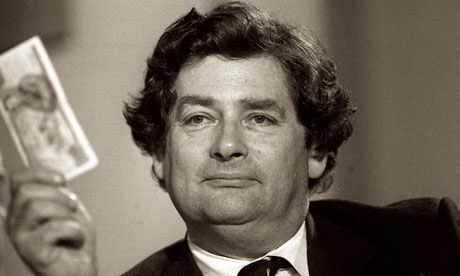
Nigel-Lawson-in-1985-008Some of the celebs who ‘approved’ restaurants and inns in The Good Food Guide of 1961 – 62 were poets, journalists, novelists and literary translators. Two of them—Keidrych Rhys (1915 – 87), the Welsh poet and veteran editor of the literary magazine Wales, and Michael Meyer, the prize-winning translator and biographer of Ibsen and Strindberg, and a friend of Raymond Postgate—feature prominently in the London section of the Guide.

Along with drama and good conversation , the greatest passion of Meyer (1921 – 2000), according to a friend, was food. He writes about his passion for it in his autobiography, Not Prince Hamlet (1985), and doubtless he was instrumental in recommending good eating places to his friend Raymond Postgate. Certainly, he is one of the more frequent ‘approvers‘ to appear in the Guide and at one point was expected to succeed as its editor. Eclectic in his tastes and apparently prepared to trawl London for good places to eat, one of his favourite restaurants was Fiddlers Three in Beauchamp Place, Kensington, very close to the trendy Parkes ( see earlier Jot). Appropriately for such a fan of European culture, the food seems to have had a pronounced East European flavour; dishes included ‘ goulash, boiled silverside and dumplings, whole small pigeon, stuffed baby marrows, prune and orange jelly, home-made soups, kedgeree with cheese sauce, and home-made cream cheese’. Translation work often pays well, which explains why Meyer was also able to afford Chelsea’s La Carafe, a branch of the famous fish restaurant Wheeler’s, where lobster Cardinal ( 15/-) and 32 varieties of sole were on the menu. Continue reading

Help the Spanish cause – don’t drink Port (1936)

spanishFound in a pamphlet called Spain and Us. (Holborn and West Central London Committee for Spanish Medical Aid, London 1936) this contribution by  Louis Golding suggesting a boycott of the drink Port. Quite early in the history of political boycotting of products. Other contributors to this rare booklet included J. B. Priestley, Rebecca West, Stephen Spender, Ethel Mannin, Francis Meynell,  T. F. Powys, J. Langdon-Davies, and Catherine Carswell.

Drink no port.

The aeroplanes are still entering Portugal for the assistance of the gallant Generals, Franco and Mola. So are the shells, the rifles. Perhaps the poison-gas bombs are on their way by now.

And Port is still leaving Portugal.

We must drink no Port.

I know that the Port we might deny ourselves tonight is not the Port which left Portugal a fortnight from now is not likely to be balanced on adept palates for another ten, twenty, fifty years. Ten years from now there may be no docks at Oporto for the disembarkation of its Port, nor docks on the Thames for its reception. Continue reading

Let them learn cookerie and laundrie

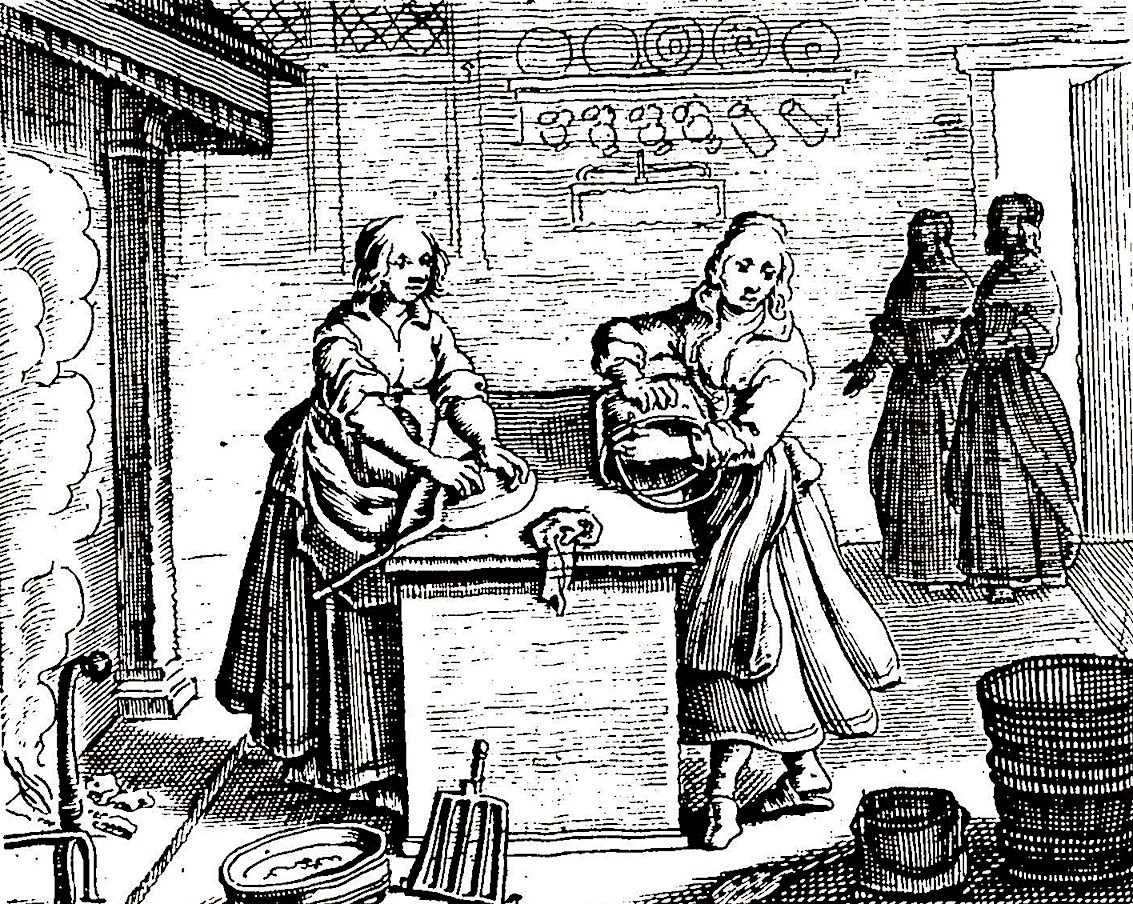
Elizabethan housewife picGuaranteed to madden the sisterhood are these disdainful words by a certain Thomas Powell in his Welch Bate, Or a Looking Back Upon The Times Past (1603) which is included in Charmers and Caitiffs (1930), an anthology of prose and verse written by men about women:

Instead of songes and musicke, let them learne cookerie & laundrie; & instead of reading in Philip Sidney’s Arcadia, let them reade the Groundes of Good Huswiferie. I like not a female poetesse at any hand…’ 

Although there is no doubting the author of this advice, there is a problem with the full title of Mr Powell’s book. According to the editors of Charmers and Caitiffs , the full title of the collection is A Welch Bate, or a Looking Back Upon the Times Past. However, in the DNB entry for Thomas Powell we find that the work in question is entitled A Welch Bayte to Spare Prouender. The Internet has little or anything to say about Powell, and although both the DNB and The Dictionary of Welsh Biography (1959) sketch out a brief biography, neither is certain about the year of his birth and death.

What we can say is that he was born around 1572 in Diserth, Radnorshire, studied at Gray’s Inn for one year and served as solicitor-general in the marches of Wales, 1613 – 22. More interested in literature than in law, he published various works in poetry and prose, including the book in question, a justification of Queen Elizabeth’s treatment of papists and puritans, which was suppressed. However, he is better known for his pioneer work on the public records. His Direction in Search of Records remaining in the Chauncerie, Tower, Exchequer etc appeared in 1622, while A Repertorie of Records followed in 1631. He died around 1635.

[R.M.Healey]

Parkes’ Restaurant—eating place of the swinging sixties

Beauchamp_Place_In his Good Food Guide of 1961-62 Raymond Postgate describes the trendy Parkes’ Restaurant at Beauchamp Place (above) in Kensington as ‘ a personal restaurant, dependent upon Mr Ray Parkes, the chef and owner, who offers in his basement at high prices what is claimed to be , and up to date is, haute cuisine.’

Postgate then complains of the ‘ exasperating whimsicality ‘ of such named dishes as ‘ Mr Goldstein’s Prawns’ (15/6), ‘Ugly Duckling’ (25/-), ‘Sweet Mysteries of Life’ (21/-). However, Postgate admires the fact that the ‘very inventive ‘ Parkes was always creating new dishes and provided such large helpings that ‘ the place isn’t quite as dear as it sounds’. Some Jot readers who dined at Parkes’ might recall what these whimsically named dishes actually were.

Parkes is credited with being a pioneer of the nouvelle cuisine revolution that properly began in the seventies, but the conventionally named dishes cited by Postgate, including ‘fillet of beef en croute’ and ‘duck and truffle pate’ don’t sound particularly ‘ nouvelle’. Nevertheless, in his time Ray Parkes was rightly considered an ‘original genius ‘. Egon Ronay described him as ‘ absolutely unique ‘, and the author of British Gastronomy, Gregory Houston Bowden, wrote: ‘ Many experts rate him almost on a par with the chef that he himself admired most, Ferdnand Point of the ‘Restaurant de la Pyramide’ in Vienne.

In addition to his eccentricy as a chef, Parkes was also unusual in that he had no licence. Diners were invited to bring their own wine. Another attraction for the many show-biz clientele that tended to eat at Parkes’ was the fact that it might be open until 2.30 in the morning. [R.M.Healey]

Dining out at a time of rationing

Rationing at the Ritz 001When William Bently Capper, an acknowledged authority on hotel management, and incidentally brother of the famous suffragette Maude Capper, published his booklet Dining Out? in 1948, the War had only finished less than three years before. Rationing was still a problem, particularly for diners out. What was likely to be offered at a good West-end restaurant? Was it worth the expense and effort to eat out there?

The whole aim of Dining Out? was to assure gourmets that there was little to fear. Restaurants were not exempt from rationing, but as long as diners recognised that certain rules instituted in 1942 by the Ministry of Food’s supremo, Lord Woolton (promoter of the infamous Woolton Pie), applied to eating places, a pleasant meal with wine could be had almost as easily as in the pre-war era. In his chapter entitled ‘Utility meals for Austerity Times’ Capper outlines what problems gourmets were likely to encounter.

Every meal served in a public restaurant, breakfast, luncheon, tea and dinner, is limited and regulated by a four-page document known officially as the Meals in Establishments Order…Public meals are restricted to three courses—but that is not the half of it. Certainly, the restaurateur must not serve you more than three courses, but he is also restricted by law as to what he serves in those three courses. You may not have, for instance, more than one main dish; that is, a dish containing more than 25 per cent of its total weight in meat, poultry or game. You may not have more than two subsidiary dishes: dishes containing less than 25 per cent of the foods specified. If you have a main dish, you may have only one subsidiary dish in addition.

Thus, you may have hors d’oeuvres ( a subsidiary dish), followed by meat or chicken, and then a sweet or cheese. Instead of hors d’oeuvres, you may have white fish ( but not fresh water fish!), or soup or, if you forego the sweet, you may have soup, fish and a main dish. Continue reading