Tales from the Second Hand Book Trade 2

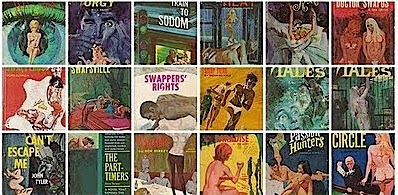
A bookseller specialist buys a large academic collection from an old professor--mostly sexology, sexual politics,folklore censorship and moral studies. He gets them for a reasonable sum, but part of the deal is that he takes 10,000 porno paperbacks stored in the outhouse. Reluctantly he hauls them all out and takes the paperbacks to the recycling where they are pulped. Pulp to pulp.

Painstakingly he lists the scholarly works and offers them to a University library that he has ties with. They reply that, sadly, they have most of these books and what they really need is actual porn paperback fiction, 'we have all the books on censorship' the librarian says 'what we need to work on is the material that was being censored - we need thousands of them, but I'm afraid we can only pay $10 each.'

Baja, the ancient Baiæ – worth a detour?

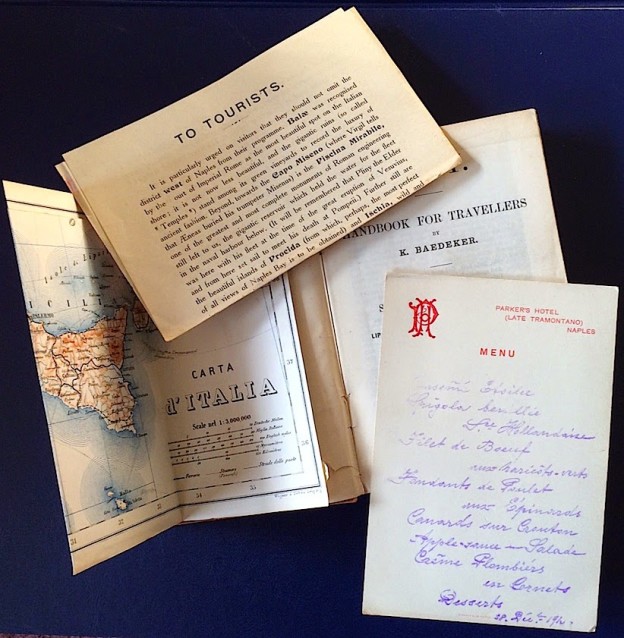
Found in Baedeker's Guide to Southern Italy and Sicily ((9th Ed., Leipzig 1887) a loose flyer/2 sided handout, entitled To Tourists. Baedeker's are often a repository of travel ephemera and this one yielded an opera ticket for the Metropolitana in Siena and a map of Naples supplied by the grand looking Parker's Hotel, also a dinner menu that notes the hotel had formerly been known as the Tramontano*. The leaflet, in perfect English and by one GPB, attempts to lure visitors to the ancient town of Baiae (now known as Baja.) Baedeker is rather dismissive of it (see below) so it may have needed some publicising. The leaflet reads thus:

Continue reading

John Osborne’s review slip

This review slip was found in a book from the library of the playwright John Osborne (1929 – 1994). It was loosely inserted in Bertrand Russell's Fact and Fiction (Allen & Unwin, London 1961) with a handwritten signed letter written on headed notepaper from The Daily Herald, P.O. Box 196, 2-12 Endell Street, Long Acre, London W.C.2., dated October 11th 1961 and addressed to Osborne from their literary editor Frederick Laws. Consisting of about 40 words it says he is not sure if Osborne can find time for reviewing but hopes that the enclosed will interest him.

The typed slip from the same address is a standard covering note for reviewers saying the review is for their 'Book a Day' feature and gives details of how long the review should be and how it should be presented. Finally he says: ' Should you decide that the book is not worth reviewing, will you let us know as soon as possible? We do not want to notice books which are uninterestingly bad and unlikely to mislead anyone.  If, however, the book strikes you as important but you are unable to review it, please return it to Frederick Laws'.

Not sure if Osborne ever reviewed the book; there is very little evidence that he read it. In our experience reviewers seldom return review copies to source, free books that can be later sold are one of the few perks open to reviewers...

The Dealer in Images

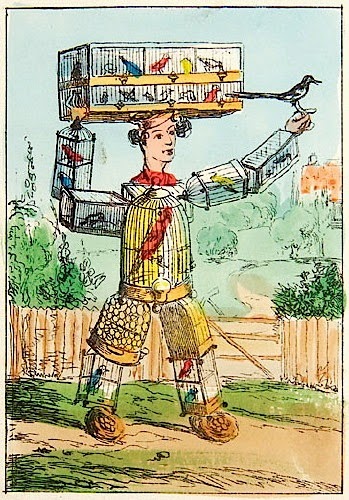
Found - in London Cries Illustrated for the Young (Darton & Co, London, circa 1860). 11 charming hand-coloured plates depicting street vendors each composed of their wares, i.e. the brush maker is made of brushes and the image seller, above, is made of prints and images. A rather rare collectable juvenile book of some value. Marjorie Moon's slightly used copy sold at Bloomsbury Auctions in London for £500 in 2005. The text is aimed at quite young persons - for the image seller it reads thus:

Poor Pedro! what a strange load he bears! He has become one mass of images from top to toe. Well may he cry "images", in hopes that some one will ease him of his burden. They are very cheap. There is the head of Shakespeare, and of our gracious Queen; Tam o'Shanter and Souter Johnnie; Napoleon, parrots and I know not what besides, all made out of plaster of Paris, by poor Pedro in his little attic, which serves him for bed-chamber, sitting room and workshop. Have you ever seen these poor Italians at their work? I have, and very poorly are they lodged and fed, I can assure you. One would wonder what can make them leave their sunny Italy, where fruits hang thick as leaves upon the tress, to come and toil in darkness and dirt in our narrowest streets. But I suppose they little know what London is till they are settled down with very distant prospect of return. They hear of it as famous city, paved with gold  - that is the old story, you know - where every one can make his fortune; and they come to try. Poor Pedro, he had a happy home once, too; but a terrible earthquake shook that part of Naples which contained his little hut. The earth shook so violently that houses and walls tottered and fell, nay, in many parts whole streets not only fell but were swallowed up by the gaping earth, which opens at these times just like a hungry mouth, and closes again over all that falls in.  

The Seller of Songbirds

It was in the night this earthquake came; and Pedro, than a little boy, was roused by the cries of his father and mother, who felt their house shaking round them. Out into the open air they all rushed, with nothing but a few clothes they had on. The streets were full of people, who knelt and prayed aloud to God to spare their lives. The bells in all the churches clashed wildly, as the towers rocked to and fro. It was a dreadful day, and Pedro will never forget it. By morning many of the houses were buried in the earth, and others lay in heaps of ruin on the ground. Amongst these was the poor hut of Pedro's father. It has been a shabby little home, but still it was their home and held all their wordily goods, and sorely they wept over it destruction. The little garden, too, was all laid waste. Some kind people gave money to build up once more the ruined houses; but, whilst this was being done, there was sore want and famine, and many left their native lace to try their fortunes elsewhere. And so it was that Pedro came, with many more, to earn his living by selling images in London streets.

Tales from the Second Hand Book trade 1

In the dog days of summer we present a post from our former site Bookride. It was billed there as one of several 'Tall Tales from the Trade' but as I recall it is pretty much true except that Pecksniff's may have been called Greasby's. There are other racy tales from this exciting (and vanished) world to follow...

It's 1977, in the year of the Jubilee, punk rock is in the air, Big Jim Callaghan is in Downing Street and a bookseller in King's Cross London is involved in a long - running dispute over rent with a corrupt and greedy landlord. The landlord, call him Rachman, wants him out so that he can develop the building into flats and keeps raising the rent and hassling the young bookseller at every opportunity.

Continue reading

An indignant Susan Hill answers her critics

A cri de coeur from the 18 year old debut novelist Susan Hill on the perils of sensationalist journalism and pre-publication hype can be found in the Autumn 1960 issue of the Coventry-based arts magazine Umbrella. On first reading 'A Sudden Smash of Fame' this seems an  unusually vehement complaint  for a teenaged first time author to make, but perhaps not when we consider that 1960 was the year of the ‘Lady Chatterley Trial’.

Hutchinson had accepted Hill’s debut novel The Enclosure while she was still an eighteen year old pupil at Carr’s Hill School in Coventry. Somehow the papers had sniffed out the story and all hell broke loose. The Daily Mail (quelle surprise) was the worst offender. The young author was accused of having written a ‘sex-ridden sensational novel’ ‘(Hill’s words) and the press generally was condemned for  exploiting a teenager’s naïf responses to questions from hard-bitten reporters anxious for a salacious story, and of making things up. For instance, from an innocent refusal of a cigarette one reporter had written that Hill disliked smoking. When, in reply to a question on whether she liked the novels of Francoise Sagan, Hill had replied ‘I like her style very much, but not her themes ‘, this appeared as ‘I think her themes are trite---she is finished’.

Continue reading

The World’s Worst Author makes an enquiry

Here it is in the letters pages of The First Edition (September -October1924) a curious letter from Amanda (McKittrick) Ros, not quite latching on to the idea of collecting or what the magazine was about.

Poor Amanda---blissfully unaware that her books weren’t collected for their literary merit, but for their production of unintended hilarity. At Oxford in the 1920s undergraduates like Evelyn Waugh and John Betjeman were admirers and it is said that the Inklings, whose members included C.S.Lewis and J.R.Tolkien , held competitions to see how much of a novel or poem by Amanda Ros could be recited before the reader began to laugh uncontrollably. Because most of her books were published privately in small editions, copies weren’t easy to come by. They have remained quite scarce ever since, largely due to loyal followers, who eagerly snap them up. However, today, with her star slightly on the wane, copies, including very early editions, can be found on the Net for under £70.

Continue reading

The wrong Winston Churchill

Winston Churchill - the novelist

The British prime minister, historian and wartime leader Winston Churchill became Winston S. Churchill to distinguish himself from the now forgotten and somewhat unsaleable U.S. novelist Winston Churchill (no relation.) His friendly and diplomatic letter on the subject  is a model of its kind and has been preserved.**

Pretty decent thing to do, but at the time (1899) the American novelist was well known and his books selling very well. To add to the confusion the novelist Winston was also a passable painter. Also our own Churchill wrote one novel, Savrola, in 1900. The American Churchill wrote many novels mostly with titles beginning with C - The Celebrity, The Crisis, The Crossing, Coniston etc., They occasional show up on eBay being sold as if by the great politician ( the American Churchill also dabbled in politics). Wikipedia says "...the two are still occasionally confused, mostly by sellers of second-hand books…" - slightly  dismissive, but possibly not untrue.  They are known to have met at least once and also to have corresponded; a signed letter from WSC to WC would be quite a valuable item!

A good WSC oil painting now goes for several hundred thousand pounds, the American Churchill (who appears to have been more than a Sunday painter) cannot be in this league. Must check an art price site…

Continue reading

Talking Beast 3

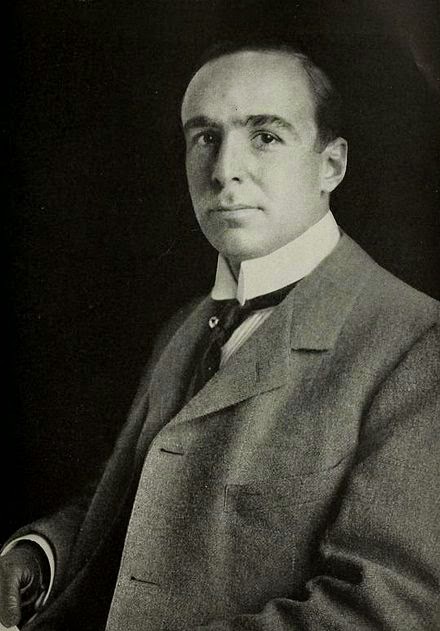
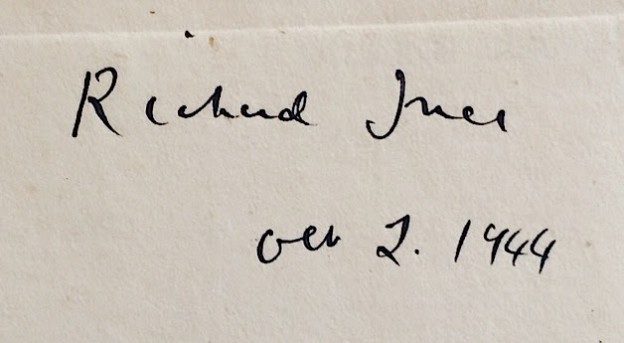
The final part of Richard Ince's Talking Beast. A candid inquiry into the nature of homo vulgaris. (London: W. Hodge & Co., 1944.) It is a heartfelt and still interesting polemic from the 1940s. Ince acknowledges as his inspiration (and mentor) Archibald Weir, the Buddha of Marley Common:

 "...it might be supposed that I am a disciple of Archibald Weir.. I am a disciple of no one, preferring to seek truth wherever I discern it. In the East they have a saying: "Where there is no Buddha hurry on, and where there is a Buddha, do not linger." The paradox would certainly have been approved by Weir, who wrote: "I do not seek to formulate tenets or to make disciples. The intent of these books would be frustrated entirely if any such success were obtained among their readers. All that I can wish to offer is assistance to earnest minds in the effort to think for themselves...'

Having found a signed and jacketed copy (at a sadly low price) we can reprint the blurb from the inside flap and also a press-cutting pasted to the rear endpaper. This review from The Field leads one to think this may have been Ince's own copy and the book was reviewed by this horsey magazine because it was about an animal...

Continue reading

The year 1975 in prophecy

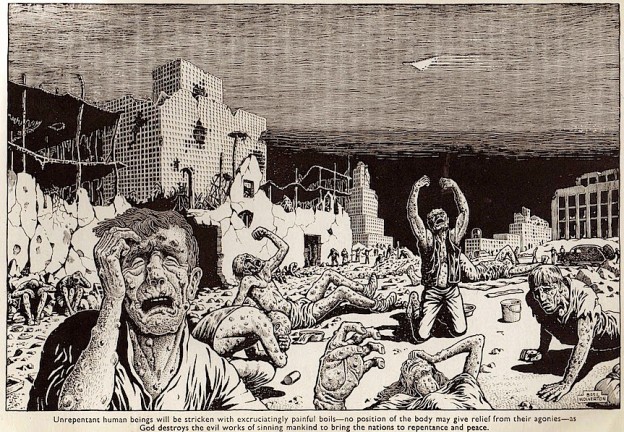
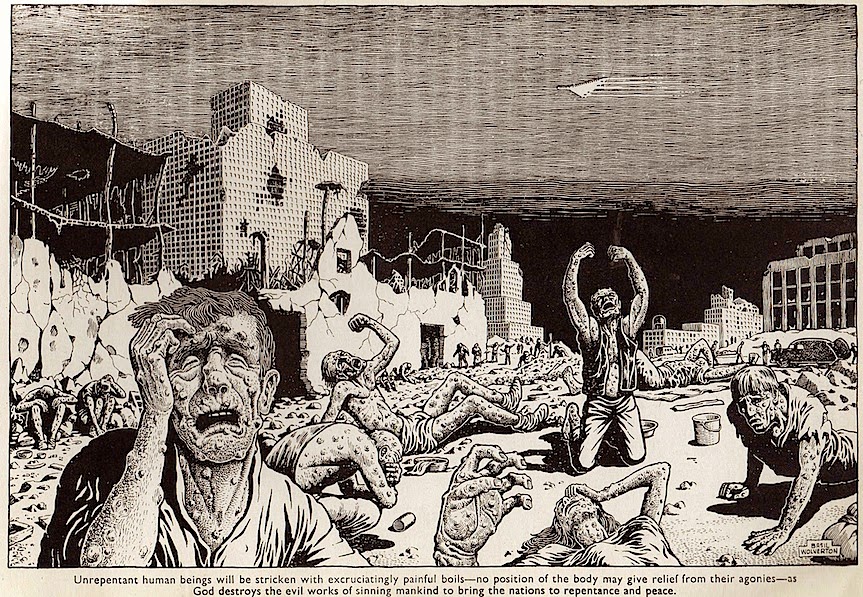
If you ignore the boils, this could be a scene from any number of war zones around the world today. But it isn’t. It’s the vision of destruction that Mad Magazine cartoonist Max Wolverton has conjured up after having read the blistering anti-technology rant of American Radio evangelist Herbert W Armstrong entitled 1975 in Prophecy. 

This pamphlet of some 32 pages contains other examples of Wolverton’s artwork, including a rather chilling reminder of 9/11 in which bodies are shown falling from a cliff to their deaths. There are also photographs of the technological miracle that was post-war West Germany—all to show how the 'fantastic push button world' brought to us by scientists and technologists was likely to turn us into a 'western world of soft degenerates, irresponsible, immoral, sick of mind and diseased of body’  prey to a take-over by Communism, and even, more absurdly, Neonazism.

Continue reading

Rosemary for Remembrance

Found in an old herbal by the great botanist, apothecary and herbalist John Parkinson (1567 - 1650) a 'sovereign balsam' - a recipe for a curative oil made from rosemary, probably the most prolific of all herbs in Britain. The title of this splendid folio is: Paradisi in sole paradisus terrestris : Or a garden of all sorts of pleasant flowers which our English ayre will permit to be noursed up: with a kitchen garden of all manner of herbes, rootes, and fruites, for meate or sause used with us, and an orchard of all sort of fruit-bearing trees and shrubbes fit for our land: together with the right ordering, planting, and preserving of them; and their uses and vertues. Collected by Iohn Parkinson Apothecary of London. Printed by Humfrey Lownes and Robert Young at the Signe of the Starre on Bread-Street Hill, London 1629. True to Ophelia's sad words in Hamlet ('There's rosemary. That's for remembrance. Pray you,love, remember...')  the herb was long associated with preserving and invigorating the memory. The remedy calls for a fortnight's immersion in warm horse dung. As not many now have immediate access to  hot horse manure, an airing cupboard might do for brewing the potion or the warm part of  maturing compost. The 'strong glasse' could be replaced by a Kilner jar...

Rosemary is almost of as great use as Bayes, or any other herbe both for inward and outward remedies, and as well for civill as physicall purposes. Inwardly for the head and heart; outwardly for the sinewes and joynts: for civill uses, as all doe know, at weddings, funerals, &c. to bestow among friends : and the physicall are so many, that you might bee as well tyred in the reading, as I in the writing, if I should set down all that might be faid of it. I will therefore onely give you a taste of some, desiring you will be content therewith. There is an excellent oyle drawne from the flowers aloneby the heate of the Sunne, availeable for many diseases both inward and outward, and accounted a soueraigne Balsame:it is also good to helpe dimnesses of sight, and to take away spots, markes and scarres from the skin ; and is made in this manner. Take a quantitie of the flowers of Rosemary, according to your owne will eyther more or lesse, put them into a strong glasse close stopped, let them in hot horse dung to digest for fourteene dayes, which then being taken forth of the dung, and unstoppcd, tye a fine linnen cloth over the mouth, and turne downe the mouth thereof into the mouth of another strong glasse, which being let in the hot Sun, an oyle will distill downe into the lower glasse ; which preserve as precious for the uses before recited, and many more, as experience by practice may enforme divers,  viz. for the heart, rheumaticke braines, and to strengthen the memory, whereof many of good judgement have had  experience.

The Umbrella Club

Let no-one accuse Jot 101 of being Londoncentric. We at Jot HQ welcome quirky Jots on provincial goings-on and just to prove it here is one issue of the quarterly house journal of a Coventry-based arts organisation called The Umbrella Club.

The club, which was opened by The Goons in 1956 operated first from humble premises in Little Park Street, bang in the city centre, a three minute walk from the controversial new cathedral. In 1960 it described itself as:

‘an independent, non-political, non profitmaking organisation for encouraging interest in art music, music, literature, the theatre and kindred subjects. It arranges lectures, recitals, dramatic performances and many related activities’ 

Its house journal was a well produced quarterly anthology of poetry, short stories, reviews and art work entitled, rather imaginatively, Umbrella, which by 1960 was already into its second volume. In the Spring issue, editor T.C.Watson, a local English teacher, urges potential contributors to submit material that paints a portrait of life in the Midlands, and which reflect or interpret:

‘such problems as labour relations, race relations, the world of the teenager, the changing patterns of family life in a mobile society and the attitudes of the citizen of today to the established institutions of the past’

An earnest ambition this, at the start of a decade which saw sociology take over from English as the coolest degree option. However, it seems that many of the contributors to Umbrella were English graduates, with a strong bias towards that coolest of all English Universities in the sixties, Keele. Of the wannabe Amises, Drabbles and Larkins who contributed to  two of the 1960 issues, only two names stands out---local wunderkind novelist Susan Hill, then just 18, and Keele graduate Zulfikar Ghose, who handled the magazine’s poetry review pages. Hill, now 72, went on to become a sort of heir to Daphne du Maurier, while Ghose, a little older, is an acclaimed poet now based in the United States.

We should add that Hill, whose first scandalous novel had a theatrical background, was also a budding playwright, and must have attended many a production at the Umbrella Club while a sixth former at Coventry’s Barr’s Hill School, while Philip Larkin who, after all was born in Coventry, had at least one poem published in Umbrella. As a jazz nut he may also have heard some pretty cool notes in Little Park Street.[RH]

Canon John Vaughan, forgotten botanist

Found - an illuminating pencilled note by one Christopher Bell in the front of  The Wild-Flowers of Selborne: and other Papers, by John Vaughan (London, John Lane, 1906.) It has more information than has been currently available on Canon Vaughan (1855 - 1922) - a distinguished botanist and writer on natural history, unknown to the DNB and Wikipedia. COPAC record 10 books by him including: A short memoir of Mary Sumner: founder of the Mothers' Union / A short history of Portchester Castle (his first work from 1894) Lighter studies of a country rector / The music of wild flowers (his last work from 1920) A mirror of the soul, short studies in the Psalter /Winchester Cathedral close: its historical and literary associations.  Bell writes:

I knew John Vaughan and worked with him as my fellow curate (and senior) in the Parish of Alton. He was then (1884) considered the best botanist in all Hampshire and had a fine herbarium (pp 62, 85). He generally had bog bean and other plants in his room and was a very interesting preacher. I got hints from him and started collecting plants for a herbarium after his example. I went to Selborne and found Monotropa on the Hanger. In 1909 - after 25 years - I met him at Walberswick Church at H. C. AV 8. AM. He said he knew me at once. He always had a charm of language - a literary style with a touch of magniloquence (as on page 115 may be seen) that contrasted with his modest and somewhat reserved sort of manner. He married the vicar's daughter - Miss Whyley. [1911]

The magniloquent ('high flown, fancy, flowery') passage referred to on page 115 reads thus:

When prehistoric man reared his barrows to tumuli over the remains of his distinguished dead, there is no reason to doubt that then, as now, the frog-orchis blossomed on Old Winchester Hill, and the autumnal gentian was abundant on Crawley Down. When the Druid priest, clothed in white raiment and bearing a golden sickle, went forth to cut the mistletoe, the Selago flourished on the heath, and the Samolus by the running stream. When the Romans made their straight road from Portchester to Winchester, through the dense forest of Anderida, the dogwood and the spindle tree fell before their axes, and the wild daffodil was trampled under their feet. When the black boats of the Northmen made their way up the Hamble River, the marsh sapphire covered the muddy banks, and the sea holly blossomed on the shore. Unnoticed and uncared for, the wild flowers, then as now, each in their own season throughout the changing year, "wasted their sweetness on the desert air".

Huckleberry Pudding

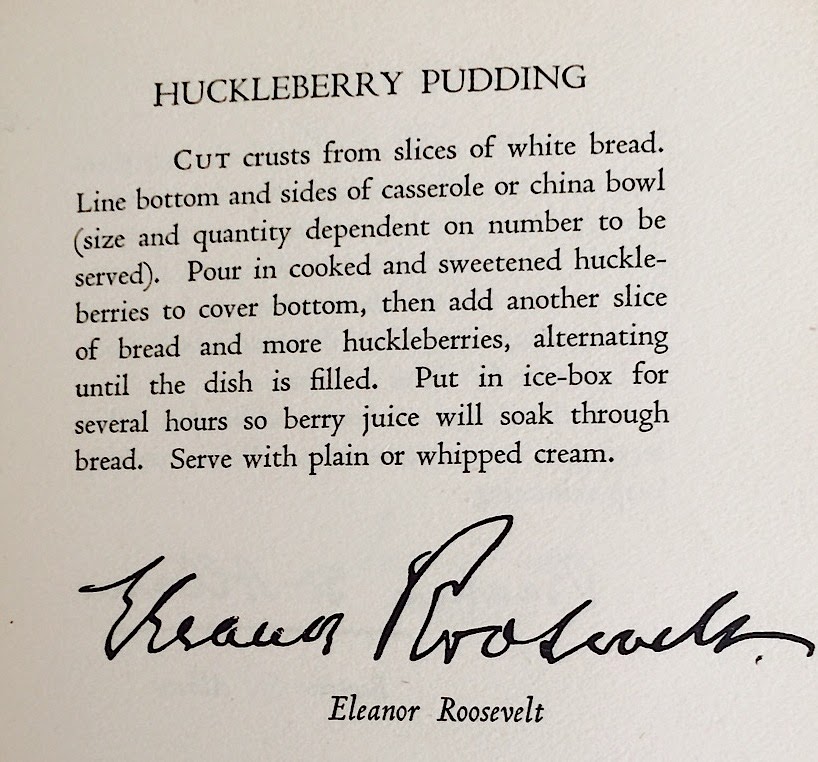
From "As We Like it" Recipes by Famous People edited  by Kenneth Downey  (Arthur Barker, London 1950.) Famous people included Joyce Grenfell, Georgette Heyer, Leslie Charteris, Douglas Fairbanks, Christopher Fry, Celia Johnson Vivian Leigh, Richard Mason, Charles Morgan, Ivor Novello Laurence Olivier, Wilfred Pickles, Freya Stark, Richard Rogers, Eleanor Roosevelt ,Katherine Hepburn, Enid Blyton and Clementina Churchill. The book has a forward by Edwina Mountbatten of Burma and she writes that every penny from the sale of the book will go to the funds of the Returned Prisoners of War Association.

There is much mention of rationing and tinned food but in this recipe from America's first lady whipped cream is called for with the huckleberries. The recipe is very similar to the British one for Summer Pudding - made with blackberries, black and red currants, raspberries etc., In that the soaking tends to be overnight and a good weight on top is advised. The bread should not be completely juice sodden, and a piebald appearance is favoured.

HUCKLEBERRY PUDDING

Cut crusts from slices of white bread. Line bottom and sides of casserole or china bowl (size and quantity dependent on number to be served). Pour in cooked and sweetened huckleberries to cover bottom, then add another slice of bread and more huckleberries, alternating until the dish is filled. Put in ice-box for several hours so berry juice will soak through bread. Serve with plain or whipped cream.

Eleanor Roosevelt.

The return of the Italian Restaurants 1961

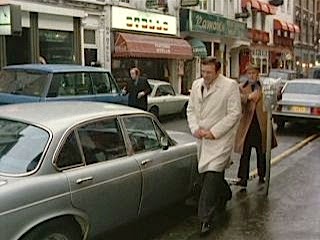
From 'Minder' circa 1982 - Arthur Dailey leaving Otello's

Found in The Good Food Guide 1961-1962, this review of an Italian restaurant in Soho. It shows  how restaurants reflect London's recent history, and although this was the beginning of the swinging 60s it was written only 15 years after WW2 ('war wounds are healing.'). Otello Scipioni died recently aged 91 and the restaurant is now called Zilli. He also owned the grander Italian restaurant Villa dei Cesari near the Tate Gallery.  As the 60s progressed the Italians came to dominate the catering scene - Italian trattorias being a great hangout for the beautiful, the rich and the famous. Fortunes were made. Note the GFG's feedback system -- the names at bottom being unpaid food enthusiasts who had written in - the bit about singing waiters is probably a quote from one of them them. Longo Intervallo = long gap.

Continue reading

Talking Beast 2

Beast of the Earth (Falnama: Book of Omens, circa 1580)

Three more chapters from  the complete text of Richard Ince's 1944 polemic Talking Beast. It was subtitled 'A Candid look into the Nature of Homo Vulgaris.' The title comes from Sir Philip Sidney's Arcadia 'This Man, this Talking Beast, this Walking Tree.' There is some element in it of Oprah's favourite guru Eckhart Tolle and it is also a sort of prequel to British philosopher John Gray's 2002 classic  Straw Dogs: Thoughts on Humans and Other Animals.

Continue reading

Stephen Long bookplate

This modest bookplate pasted into a copy of The New Forget Me Not (1929), a miscellany of entertaining short pieces by contemporary authors, including Belloc, Beerbohm, Harold Nicholson, J.C.Squire, Vita Sackville West and Hugh Walpole, with superb decorations by Rex Whistler, came from the estate of the interior designer and antiques dealer Stephen Long, who died in his eighties in 2012.

From all that has been said about him since his death Long, a specialist in early nineteenth century china, whose eclectic shop in the Fulham Road was for decades a Mecca for lovers of the unusual  and 'shabby-chic', seems to have almost single-handedly invented the modern taste for interiors of painted furniture, naïve artifacts and stylish, if sometimes distressed ceramics. Indeed, a profile of his shop featured in the very first issue of The World of Interiors.

I attended the memorable sale at which  the contents of Long’s shop and flat were dispersed ,and as with other sales of iconic figures in the world of design and lifestyle—Andy Warhol and Elizabeth David come to mind—the prices paid by many punters (dealers included) for cracked pots and framed prints--  seemed to be greatly inflated. I was not tempted by most of the lots, but did buy some books, among which was this Forget-Me-Not.

There is no doubt that this dealer of the ‘old school’ possessed an extraordinary ‘eye’. I wish I’d met him. [RMH]

I once met… Anna Pavlova (and Adolf Hitler)

Found in Words Etc.,: A Miscellany (Wordspress, Haslemere 1973) this piece by author, art teacher, botanist and curator Wilfrid Jasper Walter Blunt (1901 - 1987). His meeting with Hitler is admittedly fleeting, his meeting with Pavlova slightly  more substantial, but he tells both anecdotes well..

My Friendships with the Famous

Name-dropping is a pleasant and a fairly innocuous pastime, indulged in even by Shakespeare's Hipolyta: "I was with Hercules and Cadmus once…". At a party, when conversation is flagging, I sometimes like to electrify the company by saying, quite casually, "The first time I met Hitler was…". Then, before I can be subjected to an embarrassing interrogation, I change the subject.

No publisher has ever shown the slightest eagerness to publish a full-length book on my relationship with the Führer; yet I feel that the world ought no longer to be deprived of some account of my first (and alas! last) unforgettable meeting with him. I cannot, unfortunately, remember the exact date but it was some time in the year 1929. I had gone with a German friend to the Café Hecht, in the Hofgarten in Munich; Hecht means "pike", but little did I guess how big a fish I was about to land. At the table next to ours six people were sitting - three men and three women - and on that table was a funny little flag with a swastika on it; I assumed that they were adherents of some esoteric oriental religious cult. The men were dressed in brown (like our Capuchins), and one of them sported a ridiculous little moustache.

Continue reading

Talking Beast. A Candid Enquiry..Part 1

Found - a fascinating book by a forgotten writer, Richard Ince (1881 to circa 1960). Although the author of 20+ books he has no Wikipedia page and there is not a lot about him on the web. He mainly looks up through his sister Gertrude's fortunate marriage into the engineering/ industrial dynasty De Ferranti. With her he edited her late husband's papers - The Life and Letters of Sebastian Ziani de Ferranti (Williams & Norgate London, 1934). He wrote novels,humorous works, biographies etc., One of his books, a collection of stories from 1926 At the Sign of Sagittarius, makes into Bleiler's Checklist of Science Fiction and Supernatural Fiction. The work we have scanned Talking Beast (Hodge & Co, London 1944) is a sort of self-help slightly ranting philosophical/ religious polemic, of its time with some ideas now unpalatable but a bold, fresh  work. The title comes from Sir Philip Sidney's Arcadia 'This Man, this Talking Beast, this Walking Tree.' Here are the first 3 chapters...

Continue reading

I once met….Sir Felix Dennis

The sad recent death of amateur poet, multimillionaire media mogul, and manic tree planter reminds me of the day I interviewed him back in 2008. Preparation is everything and knowing that this most eligible bachelor was rather fond of attractive young ladies, my magazine sent me to meet him with a pretty Dutch photographer in her twenties whose dress of choice was a very clinging all-leather cat suit. I can’t for the world think why she chose this particular outfit, but there you are.

In the Forest of Dennis
Continue reading