The MP’s Chart 1964 (Andrew Roth)

Andrew Roth

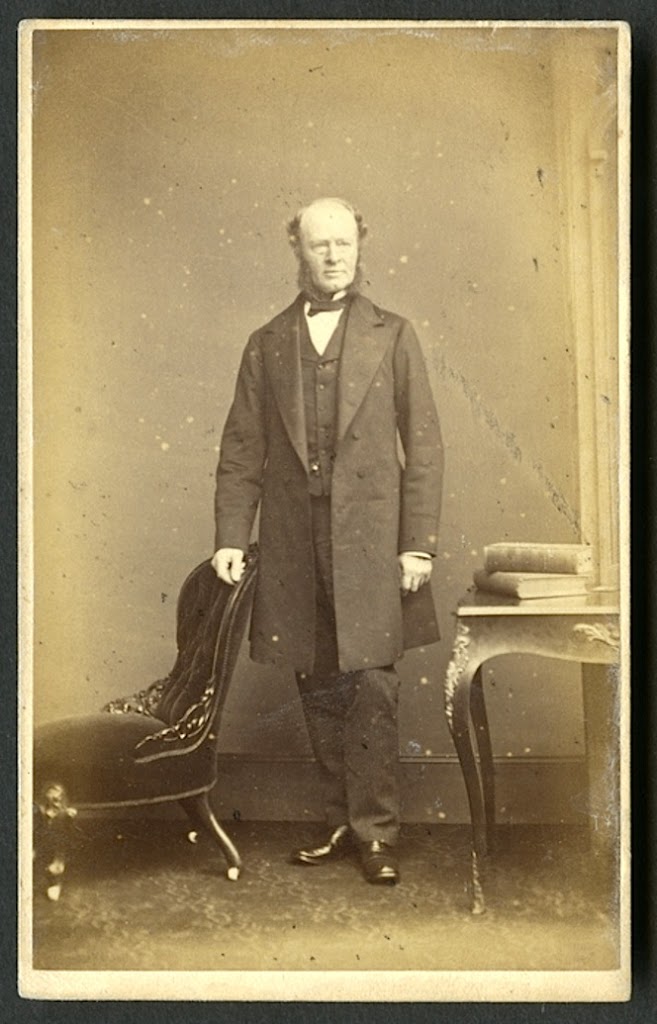
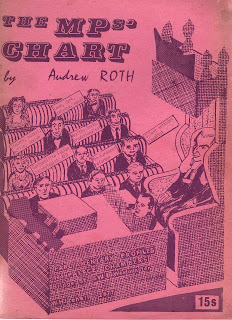
The left leaning American-born political satirist Andrew Roth (1919 – 2010) produced these handy guides to the Commons personnel from 1955 and this particular issue, which seems to have been hurriedly hammered out on an electric typewriter (it is full of typos) is interesting in that it includes the first long-term Labour cabinet for over a decade and also a few MPs who became prominent in subsequent Tory administrations and who ended up being elevated to the Upper House. It also has something to say on a certain recently departed former PM, then a little known Tory backbencher of some 5 years standing.

Continue reading

Rant against War (Charles Richet)

An impressivee  rant against war by the Nobel Prize winning French scientist Charles Richet published about 1925 in his book Idiot Man or The Follies of Mankind (L’Homme Stupide.) A now rare and undeservedly forgotten book in which Richet seems to see ahead to all the millions of deaths in wars of the next 90 years...

  When I evoke the vision of war–bloody, cruel, hideous war– burning, shuddering pictures instantly swarm into my mind, so numerous and vivid that I am dazed by them.
  Thanks to war, the proofs of human ineptitude are so blatant that any words could only weaken them. But I shall do my best to dam this overwhelming flood of ideas and to calm my indignation.
  It is futile to reiterate that war means death, death, and yet again death. But it is not these countless deaths that are my chief charge against it. After all, we must all die someday. A little sooner, a little later, what does it matter?
  There are fifteen hundred million human beings on the face of the globe, and glorious war of 1914–18 was only able to destroy fifteen millions. That's nothing, for these fifteen millions represent a mere fraction of mankind; one per cent, which is next to nothing. Two years of increased fertility will make up for this holocaust. And I am almost tempted to use the words of Napoleon, who murmured with a kindly smile as he gazed on all the corpses which his vain glory had piled up on the field of Eylau: "One night in Paris will make up for all of this."

Continue reading

Fancy cycling 1901

A splendid work lent to Jot101 by a visitor: Fancy Cycling : Trick Riding for Amateurs / by Isabel Marks.[Sands, London 1901]

From Ms Marks preface:

In the following pages it will be my humble endeavour to give an account of the many graceful, daring, and altogether fascinating feats which may be accomplished by any rider possessed of an ordinary amount of nerve, the virtue of determination, and a few spare moments secure from the rude intrusion of unsympathising spectators.

It may safely be assumed that this same practice of trick riding does not diminish the zestful country excursions, nor the pleasures and pains of the annual tour, for to the cyclist no side of the sport is devoid of interest, and among the most ardent the merry trickster prominently figures. More especially are such riders fitted to cope with the difficulties presented by those mountainous regions whose charms appeal so strongly to the lover of beautiful scenery; to them ascents present no difficulties, to them descents are naught.

Very pretty it is to see two ladies ,secure in the knowledge of each other's skill, confident with the trust born of tried experience of each other's capacity, coasting side-by-side,  their hold of handle- bars relinquished, their bicycles moving as one,  their figures gently swaying in graceful unison,  their fingers lightly touching each other's shoulders, their eyes  bright with the joy of motion  and with the pleasure of congenial comradeship.

Continue reading

Association copy – Betjeman & Giles

A signed presentation from the poet John Betjeman to the cartoonist (Carl) Giles:

'The mighty cartoonist Carl Giles is [Summoned by Bells] by his admiring fellow Islingtonian John Betjeman...'

A pretty good 'association copy' - both light humourists, Londoners and cherished British eccentrics.

Coded Diaries etc.,

I had been reading about nicknames coined by Swinburne for some of his contemporaries - Fuxton Boreman for Buxton Forman and Soddington Symonds for John Addington Symonds when this piece arrived about a diary of that period with sexual code. Of course Pepys used a mixed language code and Anne Lister (1791–1840) the wealthy Yorkshire landowner, mountaineer and traveller kept coded diaries which chronicled the details of her daily life, including her lesbian relationships. RH who obviously  possesses a good size archive of ephemera and manuscript material sent in this. He is our third contributor and we could use many more who want to share their collections with a waiting world.

Continue reading

Little Inns of Soho – the Koh-i-Noor

From a small book Little Inns of Soho (1948) this review of one of the few London Indian restaurants at that time.

The book is by Penelope Seaman (daughter of Owen?).

KOH- I- NOOR
29 Rupert Street
Telephone GER. 3379
Closes 11 p. m. Open on Sundays till 11 p. m. Unlicensed.

From vegetarianism to Indian food seems rather a long step. But many delicious Indian dishes are made with a vegetable base, such as dhal (of lentils, onions and curry sauce) and, of course, all the various accoutrements that go with a good Indian curry. Pickles and chutney are difficult to obtain nowadays and one substitute used consists of strips of onion flavoured with red pepper. One very delicious chutney is made from onions and mint. Bay leaves are also frequently used for all flavourings.

There are some four Indian restaurants in the West End of London; and the Koh-i-Noor is one of five run by the brothers Vir in Great Britain. Krishna Vir, who comes from Delhi, looks after the London, Cambridge and Brighton restaurants and his brothers run the ones at Oxford and Manchester.

Continue reading

The other Kate Middletons

There are at least two other well known Kate Middletons. The American (or possibly Australian) Dr. Kate Middleton author of Stress How to De Stress Without Doing Less and several recent works on eating disorders including First Steps Out of Eating Disorders. Also the Ulster poet Kate Middleton author of Into the Wind (1974) married to the Irish artist John Middleton (who drew the cover.) The first has a slight association/ resonance in her medical angles and the second, poet Kate, has a poem which recalls the famous song I've danced with a man, who's danced with a girl, who's danced with the Prince of Wales - written in 1927 by Herbert Farjeon at the height of the popularity of Edward, Prince of Wales.

KM's poem is called I live here too:

I have dined with a man
who danced with a girl
who lived with a man
who died in a fight
on a Derry barricade

I spoke with a man
who drank with a girl
who loved a man
who carried the can
for a guy who planted a bomb

a neighbour of mine
knew one of the girls
who lost her legs
in the Abercorn**

My neighbour's friend
had been to the house
heard the shouts
saw the tears.

** A paramilitary attack that took place in a crowded city centre restaurant and bar (the Abercorn) in Belfast on 4 March 1972. The bomb explosion claimed the lives of two young women and injured over 130 people.

1920s Rare Book ‘Wants’ list

An old list (a 24 page pamphlet) put out by a superior antiquarian bookshop (Walter T. Spencer) in 1920s London. The bookseller has noted almost every single desirable book at that time. Many titles are now forgotten, no longer wanted, impossible to find OR still extremely valuable or even more wanted now than then (e.g. Jane Austen, The Brontes, Beardsley, Wilde.)


BOOKS AND PRINTS 

SPECIALLY WANTED TO BE PURCHASED 

- BY - 

WALTER T. SPENCER, 

27, NEW OXFORD STREET, LONDON, W.C. 

(Opposite Mudie's Library and near the British Museum). 

Telephone No. 5847 Central. Telegraphic Address- "Phiz, London." Private Address- CULVER HOUSE, THE ESPLANADE, SHANKLIN, ISLE OF WIGHT.


Bankers - LONDON & COUNTY (New Oxford St. Branch).


Any Parcels of Books sent, I willingly pay carriage both ways, if we do not come to terms.


Cash always sent by Return Post. Established 1884


→ Shall be glad to hear of Imperfect Copies or Odd Vols of any Books or odd plates in this List.

Continue reading

Inadvertencies

I have found a curious pamphlet from the rather neglected Mill House Press which was run by Edward Gathorne- Hardy whose pic is below. Printed on mould made paper in 1963 It is one of 200 copies only and called Inadvertencies collected from the works of several eminent authors.

Basically a collection of inadvertently obscene passages from mostly 19th century classics. The double entendre game. This passage from Charles Dickens gives the flavour -- 'She touched his organ; and from that bright epoch, even it, the old companion of his happiest hours, incapable, as he had thought, of elevation, began a new and deified existence.' My favourites are from Henry James. There is always a faint air of embarrassment with the Master anyway and Gathorne- Hardy has found some corkers.

"'Oh, I can't explain,' cried Roderick impatiently, returning to his work. 'I've only one way of expressing my deepest feelings - it's this.' And he swung his tool." (Roderick Hudson)

"You think me a queer fellow already. It's not easy to tell you how I feel, not easy for so queer a fellow as I to tell you in how many ways he's queer." (Passionate Pilgrim)

'What an intimacy, what an intensity of relation, I said to myself, so successful a process implied! It was of course familiar enough that when people were so deeply in love they rubbed off on each other....' (The Sacred Fount)

Continue reading

An enigma inside a maze

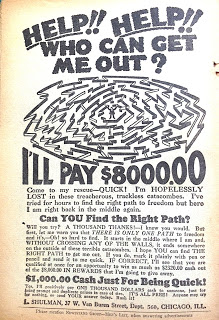
Found this ad in a pulp magazine Clues - A Magazine of Detective Stories from November 10 1930. The advertiser pleads:

Help! Who can get me out?  I'll pay $8000. Come to my rescue – quick. I'm HOPELESSLY lost in these treacherous, trackless catacombs.

I've tried for hours  to find the right path to freedom but here I am right back in the middle again. Can you find the right path? Will you try? 1000 thanks! – I knew you would. But first let me warn you there is only one path to freedom and it's oh so hard to find... Mark it plainly with pen or pencil and send it to me fast. If correct, I'll see that you are qualified at once for an opportunity to win as much as $2320 cash out of the $8000 in rewards that I'm going to give away. It's all free...

Is this an eccentric millionaire, or a wily entrepreneur garnering the addresses of mug punters, or a publicity stunt?

The clue is the word 'qualified'. Surely this is a forerunner of the Nigerian scams? The maze is probably not that difficult-- you send in your solution and soon hear that you have qualified to win a big prize and must send in, say, $10 (a useful sum in 1930) to enter for the big prize. After that you never hear from him again or are asked for further sums for even bigger prizes. Chap was based in Chicago.

Bay Psalm Book, 1640

This is an edited  reposting from our sister site Bookride first posted in June 2007. Sotheby's NY is selling a copy in November 2013 and expecting $30 million. It is about to go on a tour of America. Sadly our archive does not have a copy although it is worth noting that the same printing press (shipped over by the pilgrims) also produced some ephemera...

"...we have therefore done our endeavor to make a plain and familiar translation of the psalms and words of David into English metre, and have not so much as presumed to paraphrase to give the sense of his meaning in other words; we have therefore attended herein as our chief guide the original, shunning all additions, except such as even the best translators of them in prose supply, avoiding all material detractions from words or sense." From the introduction to the Bay Psalm Book, 1640.

THE WHOLE BOOKE OF PSALMES. Faithfully translated into English Metre. (The Bay Psalm Book.) [Cambridge, Mass.] : Imprinted by S. Daye, 1640. Compiled and translated by John Cotton; Richard Mather; John Eliot; Thomas Weld; Stephen Day; Matthew Day; Adrian Van Sinderen.

The Bay Psalm Book was the common hymnal of the Massachusetts Bay colony. An American icon, a piece of heroic history - it was both the first book printed in the Colonies and it was also the first book entirely written in the Colonies. Printed 20 years after the first arrivals in Plymouth in 1620 on the first printing press in New England which was purchased and imported from London specifically to print this book. In 1639 the press printed first the Freeman’s Oath and then an almanac, no copies of which are extant. The mind boggles at the value that could be attached to these.

Continue reading

Slang glossary 1962

From a cult novel by old Etonian Robin Cook who later changed his name to Derek Raymond to avoid being confused with schlock novelist Robin 'Coma' Cook. As Raymond his books became very dark and gory but persisted with varieties of slang for which his first book The Crust on Its Uppers (1962) was known. A rich source book of slang, some unique, some well worn and some highly ephemeral. Here is a small selection:

Angst = trouble

Archbishop = Archbishop Laud = fraud

Baize, the = Bayswater Road

Binns= spectacles (dark binns- dark glasses)

Blag= a bluff, a tall story (Fr. 'blague?) Also as verb

Bubble=bubble-and-squeek= Greek (thus Archbubble= ArchGreek or Greek-in-chief)

Cat's-meat gaff= hospital

Charver= to have sex with

Deviator= a crook (devious= crooked; deviation= a crime)

Drum= a room or flat

Duke= duke of Kent= rent

Exes= expenses

44X= extreme, i. e. '44X angst' = big trouble

Continue reading

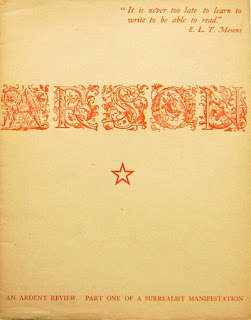
British Surrealism – Arson – an Ardent Review (1942)

Toni del Renzio. ARSON. AN ARDENT REVIEW. Part One of a Surrealist Manifestation. London, 1942.

Although billed as 'Part One' this was the only issue of this surrealist magazine of 'incendiary innocence' ever to appear. Several other magazines, mostly smaller in format and associated with E.L.T. Mesens appeared and all have become quite hard to find and consequently expensive. Del Renzio was a key figure in British Surrealism, never a burgeoning movement but oddly attractive and now quite collectable. Under the headline 'SUPERDAD' the art journal 'Studio' published this obituary for him in Febuary 2007:-

Toni del Renzio has died aged 91. Truer than life always, he was born to a landed Italian family outside St Petersburg, where his father was a diplomat to the Tsarist court. He had a legendary and varied life, not least in contributing to Studio International, with whose editor, Peter Townsend, he established a natural rapport. Fluent in several languages, he had fought in the Spanish Civil War but ended up in the lap of the Surrealist movement in Paris. On eventual arrival in London, he founded the Surrealist magazine Arson.

In 1951 he joined the Institute of Contemporary Arts and was involved on exhibition panels and juries. For a time back in Italy, he became the Fashion Editor for Harpers Bazaar, and then reorganised the Milanese magazine Novita as Vogue Italia. He staggered his friends and acquaintances much later on by becoming, at the age of 70, the father of quadruplets, two sons and two daughters: and then wrote about it as if it was the most natural thing in the world, which for del Renzio, it was. His métier was the surrealist collage. He became distinguished as a teacher, both at Bath and subsequently at Canterbury, where he was Head of Art and Design History. Vale, ti saluto, Toni del Renzio, maestro.

Antonio Romanov del Renzio dei Rossi di Castelleone e Venosa (to give him his full name) was a mercurial character and as a surrealist spent a lot of time engaged in aesthetic and political arguments, being at one time being considered a monster by the Mesens crowd. His key work 'Arson' was partially financed by Ithell Colquhoun whom he married in 1943 and divorced in 1948. He was also, briefly, the lover of the surrealist painter Emmy Bridgwater.

In 1942 de Renzio also mounted a London exhibition entitled Surrealism resulting in more general recognition for the movement. Arson was printed on turquoise stock and decorated on the front cover with surrealistic appropriations of steel engravings, printed in purple. Collage was a favourite medium for del Renzio. Contributors included Robert Melville, Giorgio de Chirico, Conroy Maddox, Nicolas Calas, Pierre Mabille + an interview with André Breton. Books by TDR are quite collectable--his 1968/ 1969 paperback on hippies 'The Flower Children' is very uncommon and his 1971 book After a Fashion is highly elusive.

A Ballooning Humourist

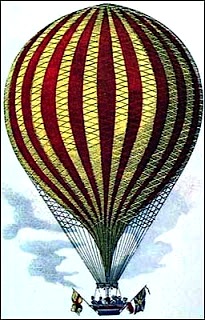
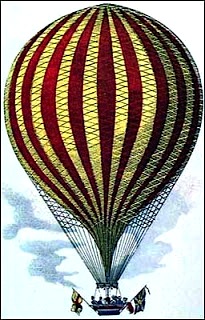
Albert Smith ( 1816 - 60 ), a qualified physician turned humorist, who unlike some of the more famous writers for Punch, is rather forgotten now, was, for a short while, an enthusiastic balloonist, until he came a cropper. One of the letters featured here is addressed to a certain Barton, and may refer to an impending ascent, because 'Vauxhall Station' is described as 'a meeting place' and we know that in this period many balloons took off from Vauxhall Gardens. In the other letter, written on a Monday night, he warns ‘Sir Edwin ‘ (possibly the painter Landseer ) that he has a morning ‘ascent’ on Tuesday morning ( no date, alas), but will come to see him in the late afternoon, when he has landed.

The letter to Sir Edwin may refer to an impending balloon flight from Cremorne in July 1847 in which Smith and nine other passengers, who included fellow Punch contributor Shirley Brooks. The ecstatic Smith recalled the novelty of his experience thus:

‘ The first sensation experienced was not that we were rising, but that the balloon remain fixed whilst all the world below was falling away; while the cheers with which they greeted our departure grew fainter, and the cheerers themselves began to look like the inmates of many sixpenny Noah’s Arks grouped upon a billiard table…’

Continue reading

A scrap of Cole Porter

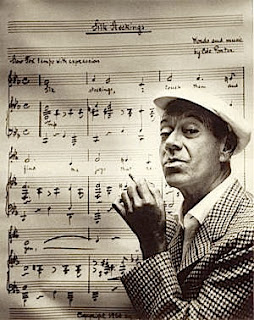
Cole Porter (1891 – 1964) is arguably the greatest popular songwriter of the twentieth century. I read somewhere that he composed around 1,000 songs, not all of which are as brilliant as ‘Night and Day’, ‘I get a Kick out of You ‘ and ‘Anything Goes ‘. One is called ‘Ours ‘and was written for the rather forgotten comedy musical of 1936 ‘Red Hot and Blue ‘, in which Bob Hope, Ethel Merman and Jimmy Durante starred. Somehow or other, along with some unrelated letters, I acquired a tiny fragment of the original manuscript which the maestro had given to a lady to give to a young man he had taken to. This information was typewritten on a slip of paper that came with the fragment. Here are the words on it:

‘Inclosed (sic) is the original hand writing of Cole Porter…This is a number that Cole Porter gave to Mother to give to one of her pupils, whom Cole Porter was particularly interested in. Mother knows him, and was out to his Beverley Hills home on an interview for this same pupil. Cole Porter is a great artist, and as modest and unassuming and sincere as all artists be.
I know nothing of this Mother, the child who typed the slip, the mysterious male pupil, or whether Cole Porter’s interest in him was purely professional or romantic. It would be nice to solve this little mystery and perhaps trace the remainder of the musical manuscript. I presume that the pupil allowed Mother to cut off the heading as a keepsake of the great man.[R.H.]

Oscar and the Oxford bullies

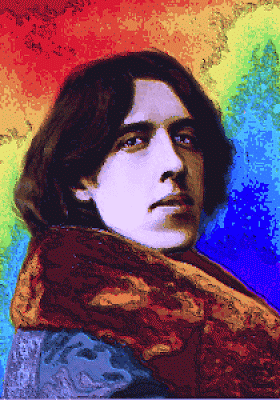
T. Earle Welby (1881-1933) is an almost forgotten writer, columnist and character. He is at present unknown to Wikipedia although Bill Greenwell writes about him at his blog about the New Statesman competition.  It's odd that this should be his only memorial as he was somewhat right wing and hostile to democracy.He enjoyed conversation, and was known for a mannerism whereby he used a sideways movement of his hand for emphasis, which, since it was often associated with his reminiscence of India, was described by a wit as 'the Calcutta Sweep.' His collection of literary essays has a review of a memoir by the actor manger Sir Frank Benson who was at Oxord with Oscar Wilde. Welby writes:

Oscar Wilde, a contemporary at another college, was, (Sir Frank) tells us, so far from being in those days 'a flabby aesthete' that only one man in that college was physically his match. Four raggers having decided to wreck his rooms, Wilde knocked down three, picked up the fourth and carried that vainly struggling enemy to his rooms, piled up all his furniture on top of the poor wretch, and then invited a crowd which had changed its allegiance to celebrate the triumph in the wines of that parsimonious creature. Excellent! and, disapproving of those who engage in horseplay with ass-sense, were I capable of tampering consciously with the sacred text of Peacock I should comment :

'The wines of beasts provide our feast,
And their overthrow our chorus.'

But, and alas! it is very evident Sir Frank Benson thinks that if Wilde had kept to throwing hefty men downstairs he would have written something better than that matchless play, The Importance of Being Earnest, which is at once the perfect comedy of manners and the perfect parody of the comedy of manners.

**Welby is included in The Oxford Dictionary of Humorous Quotations for this piece from his culinary book The Dinner Knell : '"Turbot, sir," said the waiter, placing before me two fishbones, two eyeballs, and a bit of black mackintosh…'

The real Downton Abbey

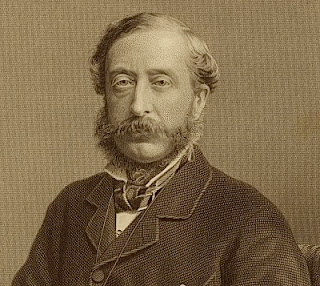
Every fan of ITV’s Downton Abbey will know that is filmed at Highclere Castle in Hampshire, the ancestral home of the Earls of Carnarvon. The third Earl built the present Castle, but it was his son, the fourth Earl (1831 – 90), who in his second term as a Tory Secretary of State for the Colonies achieved notoriety as the man who, through his policies of the enforced confederation of South Africa, indirectly caused the Boer Wars.

Earl of Carnarvon ('Twitters')

Carnarvon was clearly not a man to be trifled with. In January 1864 he had a number of fliers printed and circulated to his neighbours, informing them that 'the want of definite regulations for  admission to or through' his park had obliged him to revise the 'rules'. One of those who received a flier* was the Rector of Highclere, Philip Menzies Sankey, a graduate of Oxford who claimed among his friends, the influential proto-aesthete, Walter Pater. Presumably Rev. Sankey had been obliged to traverse the park in order to get to his church and so a copy of the new 'rules' that governed access would have been useful. Unfortunately, Sankey’s copy of the amended rules, together with his pass-card, which were originally included with the flier, are now missing, which means that we don’t know what these new rules were. However,  I’m sure that 'Twitters', Carnarvon’s nickname on account of his various nervous tics, was scrupulously fair to his neighbours.

Continue reading

Herbert Horne (1855 – 1916)

An article from the long defunct Anglo - Italian Review, October 1918. Edited by Edward Hutton, an English  Italophile who wrote several Italian travel books and featuring articles by Nobel Prize winner Grazia Deledda, Norman Douglas & Benedetto Croce. This piece is by the novelist Reginal Turner and is an affectionate tribute to his friend Herbert Horne - art historian, art dealer, architect, typographer and Arts and Craft movement designer. The photo below is of him with his friend and colleague the architect  A.H. Mackmurdo (standing) and an older woman, possibly AHM's mother at a house ('Brooklyn') in Enfield. The story of Horne finding  two Michelangelo drawings for a penny each in the Fulham Road is hard to top...

HERBERT PERCY HORNE, who died in Florence

in May, 1916, belonged to the numerous band of interesting Englishmen who made Italy their home, and the memory of whose sojourns there does not pass with their death. He did not found a family there as did Walter Savage Landor. He took no part in public life as did Waddington, who went casually to Perugia and remained there to become Syndic. It may even be said that to the majority of Italians as to Englishmen his name was unknown. He had an almost morbid love of retirement ; those who knew him well could not but be amazed at his slight suspicion--there is no other word--of hospitality. Yet Herbert Horne was known to a large circle which included some of the best-known and ‘many of the most talked about of his contemporaries: most of them loved him, all of them respected him, and he was recognised by them as one of the most learned, one of the wisest, and one of the most reliable men of his time.   Continue reading

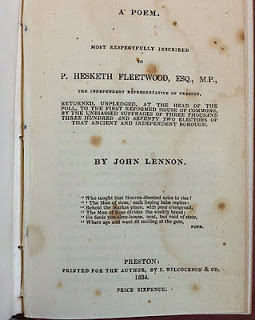
The other John Lennon

A curious find in a box of old poetry -- the completely unknown John Lennon's Rossall Hall. A Poem (Printed for the Author, Preston 1834.) It was bound up with 6 other books including a book of Epicurean Recipes (1832) and Memoirs of Madame Malibran de Beriot by Isaac Nathan author of The Hebrew Melodies. All in a small rust coloured moiré cloth-bound book with a leather label on the spine with the word 'Miscellanies' lettered in gold. Decent condition with some occasional foxing to text. The John Lennon book appears to be, like its author, completely unknown-- no copies at WorldCat, Copac or the vast Karlsruhe database which has the complete catalogues of many worldwide libraries.

It is a mere 36 pages and is mostly devoted to unadulterated praise of the great local landowner and philanthropist Sir Peter Hesketh-Fleetwood (1801 - 1866) who founded the town of Fleetwood, in Lancashire and was squire of Rossall Hall. At the time he also owned most of Southport. The work is dedicated to him and some of the verses may have been used in his election campaign. At the 1832 general election, Fleetwood was elected M.P. for Preston, in the first parliament following the Reform Act. The poem's style is very slightly thumping, far better than McGonagall, but Swinburne he was not:

Continue reading

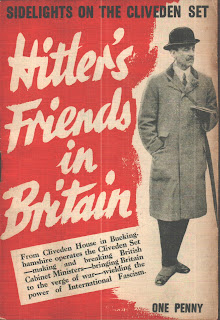
Communist attack on Cliveden Set 1938

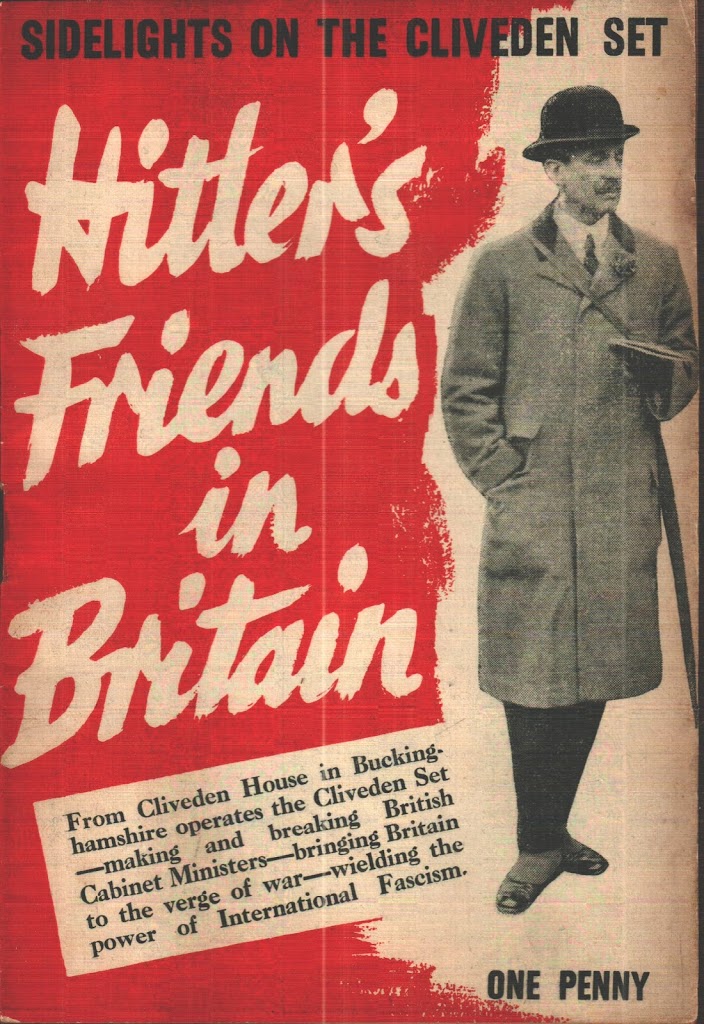
Found in the Chips Channon collection a pamphlet produced by the Communist Party of Great Britain attacking his friends in the Cliveden set. Produced in an edition of 10000 in March 1938 it also has much on the Spanish Civil war - they demanded 'immediate assistance for Spain...the withdrawal of Hitler and Mussolini's armies and airplanes..protection of all shipping in Spanish Republican ports.' Channon himself is attacked along with Lennox Boyd 'open pro-Fascists who got ministerial posts.' The first page reads:

Cliveden House at Taplow, Buckinghamshire, country home of Lord and Lady Astor, meeting-place of powerful secret diplomats. Week-end parties at Cliveden House have made and broken British Cabinet Ministers. Decisions taken there have brought Europe to the verge of war. Friends of Hitler and enemies of the people are welcome there. Many of the “National” Government’s betrayals of peace have begun with a Cliveden week-end party. The Cliveden set  . . . their power reaches through British banking, transport, journalism- through Britain’s Parliament, across the seas to International Fascism. But their power can be broken. . . .

'The Astors are a very wealthy American family..'

Cliveden was, of course, to be back in the news 24 years later with the breaking of the Profumo scandal in 1962.