Author Archives: Jot 101

A Byron forgery—rediscovered

Lord Byron

Forgery has always fascinated historians of literature, whether it takes the form of a whole manuscript or annotations in a printed book, or (of much rarer occurrence) a whole book or books, as in the case of Thomas Wise. The manuscript forgeries of the self-styled Major George Gordon De Luna Byron, alias De Gibler, alias Monsieur Memoir, were of some key Romantic poets, including Byron, Shelley and Keats. The one that concerns us here was a quatrain and a long prose note supposedly written by Lord Byron on the fly leaves of a copy of the fifth edition ( 1777) of the works of the eighteenth century poet, William Shenstone.

This particular forgery was well known to bibliophiles for many years, but had been long lost until our own Jot 101 CEO bought this particular copy in a book sale about eight years ago. Details were then handed on to Byron scholar Andrew Nicholson, who discussed them in a paper published in The Byron Journal in 2010.     We at Jot 101 HQ are grateful to the late Mr Nicholson for his assiduous research which focuses on the nature of the forgery. It  had been acquired by a certain Mr Young from the library sale in 1851 of John Wilks, MP, a well known collector of manuscripts.

The forgeries, penned in black ink, appeared in several volumes of the Works, as follows:

Volume 1: on the first fly-leaf at the head of the page

Trin. Coll. 1807

Byron

Continue reading

Cooked to death

vegimite

A typescript found in the Haining Archive, and possibly published, contains potted accounts of many examples of horrible or ridiculous deaths involving food. Here are a few of them:

A Gruelling Fate

Few cooks have suffered a more bizarre fate than Richard Rosse, a well-known London chef in the sixteenth century. In the year 1530 he was appointed to the household of the Bishop of Rochester and appears to have satisfied his master until the autumn. Then, says an account of his life published in Remarkable Trials and Notorious Characters ( 1850):

     It was declared that he had poisoned some gruel being made for the Bishop and imprisoned in Smithfield. Here he was boiled to death.

Continue reading

Praise for Everyman’s Encyclopaedia

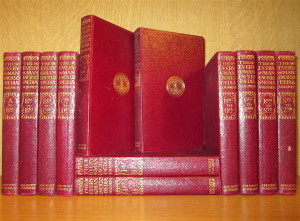
Everyman's EncyclopaediaFound-  a bookmark advertising the virtues of Everyman’s Encyclopaedia.  For obvious reasons the set is now of very little value, except as decoration. In the 1920s, when these were written it was a (relatively) portable fount of all knowledge – hence these brief encomiums from the great and the good (and the titled). Sets could be bought with their own small book-case ‘in unstained oak’ and the deluxe versions in full leather (£7 10 shillings.)  It boasted 7 million words and 2700 illustrations plus a World Atlas.

Some opinions on Everyman’s

Prof. Sir J. Arthur Thomson

What an encyclopaedia! So comprehensive and yet so compact. It is like a well-arranged series of levers, releasing a wealth of potential energy with minimum effort.

H. G. Wells

I think it remarkably good value.

Viscountess Snowden

A wonderful production. These 12 volumes form a library in themselves, a never-failing source of information and delight.

Continue reading

Literature – The Rivals

Found among some papers of the late John Symonds  (1914-2006) novelist, biographer (Aleister Crowley), playwright and writer of grendel001children’s books – this letter. The sender’s name has been clipped off but he or she was obviously something of a power in the literary world. It displays two opposing views of the writer John Gardner. The second letter was written to propose Symonds for a literary position and talks of Gardner in glowing terms, the first letter (to Symonds) declares that he is ‘…one of the worst novelists in the world.’ This is the world of Martin Amis’s The Information, his great novel of literary rivalry.

Dear John, … You must excuse me for coupling your name with John Gardner’s in the way I do: it was but for policy and diplomacy. In my opinion John Gardner was one of the worst novelists in the world. But he was also just about the most famous American novelist of the past 20 years, in terms of the publicity he got and the huge sums of money he made and the general ballyhoo that went with his name. And the fact that I knew him gives a certain credence to my suggestion that you are another of the same. You and I needn’t tell them that we know you aren’t, praise be! I also enclose a little essay which might interest you, which isn’t to say you have to model yourself on me. But if you get the job let me know and I will give you a few hints which you can regard or disregard as you think fit. Tra la! Dear Sir, .I understand that my friend John Symonds is making an application to succeed John Gardner as resident novelist …May I say a few words in support of his application? As novelists, Gardner and Symonds had something in common: both brought a new perception to the writing of novels; they were (and Symonds still is) in the old sense, Makers. No American novelist has written novels quite in the way John Gardner did; no English novelist, in the way Symonds does. I am sure you will find this to be so when you look at his work when considering his application. Such novels as ‘Prophecy and the Parasites’, ‘The Shaven Head’, and ‘The Guardian of the Threshold’ are unique in English – and each is equally distinct when contrasted with the others. By a coincidence, I knew John Gardner well …I watched his early success as a novelist with the pleasure of a friend. And I can tell you that John Symonds is man (in his own, different way) of the same stamp. He would bring to the task of teaching the novel the same qualities as John Gardner had – a fresh viewpoint, having no truck with mere convention for its own sake, a lifetime of experience in many kinds of literary activities, wide practical experience in journalism and publishing, enthusiasm, insight, and a deep dedication to the art of writing. Indeed, I can think of no more fitting successor to John Gardner…You may already know some of John Symonds’s work – his important study of the Shakers, ‘Thomas Brown and The Angels’, for example, and his life of Madame Blavatsky. There is also his definitive biography of Aleister Crowley. Symonds began to publish novels in 1946, and has now published fourteen. You may also have seen the first two volumes of this ‘Collected Plays’, a publication still in progress. I hope these remarks may be helpful, and please call upon me if I can assist you further.  

The Army of the Planes

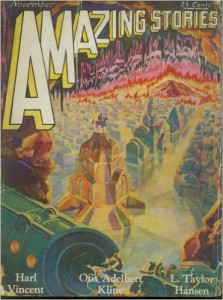
51v-xtwfTSL._SX369_BO1,204,203,200_Found in  The Poetry of Flight, an Anthology (edited by Stella Wolfe Murray, published by Heath Cranton, London 1925) this stirring poem by the American poet Minna Irving (1857 – 1940) Her real name was Minnie Odell Michiner and she was from Tarrytown, New York. She published a poetry collection, “Songs of a Haunted Heart” in 1888, and published poems in turn-of-the-century periodicals such as Munsey’sThe Smart Set, and The Gray Goose. She also wrote a science fiction story  “The Moon Woman” which appeared in the November 1929 issue of Amazing Stories (right.) She has no Wikipedia entry.  The anthology, which has pieces by Homer, Swinburne, Duncan Campbell Scott and W.H. Davies is dedicated ‘..to the memory of all have given their lives for aeronautical progress.’ Her poem could have been written by an Italian Futurist and has all  the excitement of the early days of aviation.

The Army of the Planes
They are coming with the drumming of a million pinions humming
And the purr of mighty motors that are all in time and tune
Proudly soaring with the roaring of the thousand northers pouring
Through the vast and hollow spaces sacred to the sun and moon
They are racing into places filled with radiant star faces

Following the meteor’s speedways and the comet’s ancient lanes,
And the universe is shaking, and the waking earth is quaking
At the terror and the marvel of the army of the planes
Wings of wonder as they thunder sweep the rolling clouds asunder
Sailing great uncharted oceans of the empyrean blue;
Struts are singing, wires are ringing, swift propeller blades are flinging
Spray of diamond dust and silver when they cut a star in two.
Hail the aerial squadrons forming through the fields of azure storming, Battle birds the crimson war god to celestial combat trains,
Swooping down from viewless regions to the aid of earthly legions—
Hail the glorious, victorious, valiant army of the planes!

Gabriel Fielding—a neglected British novelist

Gabriel_Fielding1Listing British novelists or poets who were also medics is a fun party game. Going right back to the eighteenth century one can think of Goldsmith and Smollett. From the nineteenth, I suppose Keats can be included, although without a degree in medicine, he can’t be classed as a physician. Thomas Lovell Beddoes is a less well known example, as is Samuel Warren, who ought to be better known, especially as his ground-breaking Passages from the Diary of a late Physician heavily influenced the Bronte sisters. Among the twentieth century poets there are a few, including Dannie Abse and Alex Comfort and I dare say one or two writers studied medicine, but never practised it. I don’t think Somerset Maugham did, apart from a stint in the Red Cross. And then there is Gabriel Fielding (1916 – 86).He certainly practised. In fact he was a GP and a prison doctor based in Maidstone for many years until literary fame allowed him to give up medicine and try his luck in America. With a mother who was a descendant of Henry Fielding, he certainly possessed the literary credentials to succeed, and indeed he did, but not so much in his native land, where he is still little known. The reputation of Alan Gabriel Barnsley (his real name) is well documented in a review dated April 6th 1963 from the Haining Archive. In it, John Horder, himself a doctor and writer, marks the publication of Fielding’s fourth novel, The Birthday King, which had just appeared in the States, with the statement that in America he was acknowledged as ‘ one of our leading novelists, along with Graham Greene, Muriel Spark and Iris Murdoch’. According to Horder, Gabriel’s obsession with ‘the darkness in man ‘ was present from the start. In his debut novel, Brotherly Love (1954), for instance, Fielding’s hero, David Blaydon, who is based on the author’s eldest brother George, gets pushed into the Church, becomes entangled in the lives of various women in his parish and eventually falls ‘a great height from a tree to be found dead by one of his brothers in one of the most horrifying scenes in fiction’. Continue reading

The tragic death of a famous Savoyard

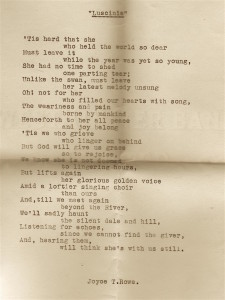
Savoyard Luscinia tribute 001Found— an envelope crammed with an intriguing collection of newspaper cuttings and Velox snaps, most dating to 1931. The majority of the cuttings concern the failing health of forty three old Bertha Lewis, the famous ‘Savoyard’, who at the height of her singing career with the D’Oyly Carte Opera, was badly injured when a car driven by fellow singer, Sir Henry Lytton, veered off the road and rolled down an embankment during a violent rainstorm between Huntingdon and Cambridge.

The couple were returning from Manchester, when, according to Lytton, the front wheels of the car skidded on a patch of oil. After somersaulting, the vehicle came to rest the right way up. Lytton sustained injuries to his legs and kidneys, but Lewis was rendered unconscious and had serious spinal injuries. Both were rushed to hospital, but while Lytton was discharged after a few days, and later returned to work, Lewis, according to the bulletins which were issued daily to the newspapers, gradually succumbed to her injuries and died after five days.

Continue reading

How to walk – The rule of the pavement

From Correct Conduct, or, Etiquette for Everybody (M. Woodman. London: W. Foulsham 1922) this piece about the etiquette of walking and pavements. This is the world of the early Downton series or for older viewers The Forsyte Saga. The gentleman has to know what to do in complicated situations ‘…a man who meets his parlourmaid in the street is in a quandary’ – here tipping the hat is suggested (but no nodding…)

hatsoffThe rule of the pavement used to be to walk to the right. The “Safety First” Committee is endeavouring to induce public opinion to favour walking on the left. Instinct suggests the right, common sense the left. Pedestrians should appreciate the fact that this change is being made, and act according to their own dictates. 

When walking with friends, do not proceed along the pavement more than two abreast, and then take to single file on passing other people.

Always give way to perambulators; they certainly are a nuisance, but a necessary nuisance. When a lady is walking with a gentleman, she should take the inside. This is survival of the days when all roads were muddy and passing vehicles splashed those nearest.

Continue reading

A verse on the 1908 London Marathon

Found- a rare and forgotten slim volume Verses by one Norman Grieve privately published in 1912.  A handwritten note loosely inserted in the book says that Norman William Grieve was director of the Anglo-Ceylon and General Estates Company Ltd. (12950 acres, half tea, 40% forest – the rest cocoa, coffee and cardamons.) He  had interests in Mauritius and also dealt in rubber. The poems are on a variety of subjects – Canada, Golf, Marconi and this topical poem about the Italian runner Dorando Pietri. Pietri finished first in the marathon at the 1908 Summer Olympics in London but was subsequently disqualified. He became something of a hero at the time and met the Queen…

Dorando_portret

The Marathon Race

(Olympia Dorando in First but Disqualified)

“Only a Race,” you say, and yet conceive

The bitter pangs of that brave heart –

Foremost of all the runners, there in sight

The goal, then deathly weariness

And the overwhelming shout of all those watchers:

What anguish! the longed-for laurels

Almost in his grasp, and yet how distant.

O God, to my tired body give

Strength to run out the Course and gain the wreath

Continue reading

London A to Z (1953)

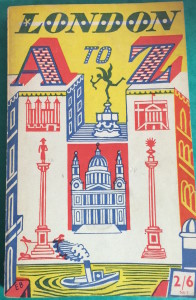
IMG_1381Found – this rare and attractive paperback guide to London published by Andre Deutsch in 1953 and illustrated by Edward Bawden. This extract of three entries gives the flavour
of the book. How many people raise their hats (head-gear?) when passing the Cenotaph in 2016? How many people still possess bowler hats and who could still call its football team ‘poor old Chelsea.’?

BOWLER HAT. The possession on of the correct type of bowler, hairy, not too large and curly-brimmed, is as essential to the young man about town as a pair of trousers. It is worn e either in the hand which is not carrying the rolled umbrella, or, sometimes, even on the head, tilted forward over the eyes at the angle adopted by villains in Victorian melodrama. The most London of all headgear…

IMG_1382CENOTAPH. Designed by Sir Edwin Lutyens, the simple and auster national memorial to the dead of the Commonwealth in both world wars stands in the middle of Whitehall.  It is the focal point of the nation’s morning on Remembrance Day. Men raise their hats when they pass it.

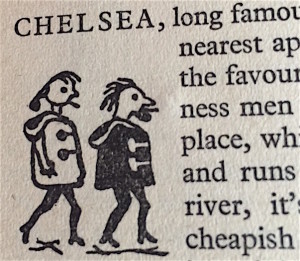
CHELSEA. Long famous as the home of artists, London’s nearest approach to a Latin Quarter, is now the favourite area of civil servants and businessmen as well.

An attractive and friendly place, which centres around the Kings Road and runs from Sloane Square down to the river, it’s studded with some very good cheapish restaurants, antique shops, drinking clubs. Both the men and women wear corduroy trousers. It also houses the Chelsea Football Club (at Stamford Bridge), long known as ‘poor old Chelsea,’ the despair and the delight – mostly the former – of its supporters.

What a Knit ! The 1947 Home Industries Exhibition

Charing cross underground Cripps homemade 001From the wonderful El Mundo archive here is a press photo of the post-war Labour Chancellor of the Exchequer, Sir Stafford Cripps, with Lady Reading, chairwoman of the Women’s Voluntary Service, among products featured in the 1947 Home Industries Exhibition sponsored by the WVS, which was held, rather bizarrely, in the entrance hall of Charing Cross Underground Station (now renamed Embankment) in London.

Apparently, far from resembling the rather naff home produced textiles that can still be found in countless craft fairs and garden fetes round the kingdom, these products were rated good enough to be part of a post-war export drive. The exhibits shown in the photo attest to the quality of the textiles.
Indeed, the seat covers on show were probably amongst the six examples which Queen Mary herself created for the exhibition and which were later sold for $10,000 in the United States! The Queen also wove panels which were later sewn together by other craftswomen to form a carpet that was presented to the National Gallery of Canada. Later, the Queen Mother got in on the act by contributing one or more of the seventy-two tapestry kneelers commissioned by the Washington National Cathedral.

The example shown by members of the Royal Family was doubtless a fillip to Women’s Home Industries, as the enterprise became known, with the result that before too long the flood of high quality textiles being supplied by home craftswomen from all over the UK became so enormous that a shop in West Halkin Street, around the corner from Harrods, was opened

By 1964 there were 3,000 home knitters supplying products to the London store and by the end of the decade some of the best known figures in textile design had become associated with the enterprise, which survived into the early seventies. [R.M.Healey]

Odyssey of a Barbarian

Found in a Penguin Odyssey translated by the classical scholar Dr E. V. Rieu a typed signed letter from the novelist, playwright and the biographer of Aleister Crowley John Symonds to Dr Rieu. EVR’s reply is witty and good-natured…

IMG_1375Methuen and Co., Ltd.

36 Essex Street, London W.C.2

22nd September 1961

Dear Sir,

Some years ago I bought your version of THE ODYSSEY and THE ILIAD, and put them on a shelf beside my bed, intending one night to begin reading them, and thus fill a literary gap. And there they remained until the month when I took down THE ODYSSEY removed the paper wrapper, felt the fine blue cloth binding, gazed at the clear print and began reading.

Splendid and immortal yarn! But what a barbarian Odysseus is! He is like a comic-strip superman of the Daily Mirror. And then I came to Book XXII which you describe in your introduction as “the magnificent climax”. What is magnificent about it? The cruelty of Odysseus appalled me. Merciless butcher, without charity! He won’t even spare the tearful women. The horrors described on page 324 made me feel sick and I flung the book into the fireplace.

Continue reading

Professor Louisa Stanley—pioneer of healthy US diets

American nutrition guru 001Found in the fascinating El Mundo archive is this intriguing photo of Dr Louisa Stanley( 1883 – 1954), pioneer of practical home economics, shown standing in front of the Good Housekeeping home which was one of the twelve Homes of Tomorrow exhibited at the 1933 World’s Fair in Chicago.

At the time Stanley, as Bureau head of Home Economics, was the highest paid woman in the United States Department of Agriculture, where her brief was to improve the diets of ordinary Americans. Unlike the TV chefs of today, she came to the important issues of well-balanced diets and a healthy lifestyle, from the standpoint of a chemist. The nearest we have had to such a celebrity nutritionist was the seventies TV guru Dr Magnus Pyke—he of the waving arms and rapid fire delivery—but at the moment Jamie ‘The Naked Chef’ Oliver is doing something similarly serious to change our attitude towards dangerously fattening carbohydrates, notably sugar..

Back in 1930s America, sugar was not denounced as public enemy number one, and Stanley saw it as part of a well balanced diet. There is even a photo of her judging a pie competition. But she did champion the benefits of healthy home cooking based on sound nutrition. One of the issues she promoted was the canning of home-grown vegetables.The health benefits of soya beans was something else she supported. Much of her promotional work was mediated through radio broadcasts.

In the photo the lettering on the large cards displayed inside the four rooms of the Good Housekeeping Home is too small to read easily, but we can just make out a statement to the effect that a ‘well balanced diet’ is the key to safeguarding health. In another room the same family appear to be engaged in some communal activity (possibly listening to the radio), while behind them on the wall is that hardy perennial of the statistician, the pie chart, which though invented in 1801, wasn’t really used until 1858.

Louise Stanley went on to become a sort of national treasure in the United States. In 1940 she became the first woman to receive an honorary doctorate and in 1961 a building at her alma mater, the University of Missouri, was named after her. [R.M.Healey]

Miguel de Unamuno on Fuerteventura

unamunoFound in Essays and soliloquies by Miguel de Unamuno (London: Harrap 1924) this preface written on the windswept Spanish island of Furteventura. The island is now mainly a holiday destination, although there is an impressive statue of Unamuno by the main road and also a life size statue of him on a side street. Unamuno was exiled to Fuerteventura in 1924 by the Spanish Government for his political ideas. His friend J.E. Crawford Flitch visited him there and prepared (and translated) this selection.

Author’s preface

I am writing these lines, today the 6th of June, 1924, in this island of Fuerteventura, an island that is propitious to calm thinking and to a laying bare of the soul, even as this parched land is bare, bare even to the bone. Here I have been confined now for nearly three months, no reason for my confined having been given other than the arbitrary mandate of the military power that is de-civilising and debasing my native country.

Hither came my friend Mr. J. E. Crawford Flitch to bear me company. He was entrusted by Mr. Alfred A. Knopf with the task of making an anthology or florilegium of my shorter articles and extracts from my more extensive writings which should present a conspectus of my whole literary work. It is he, my friend and translator, who is responsible for the selection of the pieces which form this anthology…

Continue reading

Vera Wainwright, poem on Powys

An excerpt from a signed typed letter addressed to the feminist bookseller and Powys specialist, Joan Stevens from Phil Coram (among other things the bibliographer of Hugo Manning.)

Vera Wainwright… have you heard of her Joan? She met the Powys family in 1927 and was “greatly enriched by this meeting”… a curious tie-up here… she was published in COMMENT, the very magazine which Hugo had such difficulty in getting hold of. She was also a good friend of Victor Neuburg and Austin Osman Spare… both of whom were involved with Aleister Crowley. In fact I have a copy of POEMS & MASK by Vera Wainwright which is illustrated by Austin O. Spare (and not published till 1968… 13 years after Spare’s death). These illustrations, as far as I know, are not published in any of Spare’s other books. The thing which may be of interest to you however is the first poem in the collection… at the risk of copyright here goes…

For John Cowper Powys

The sad sea shell that murmurs all the day

Its memories faint; the lost, abandoned stone;

Continue reading

Jane Grigson at 27—-a lost etching

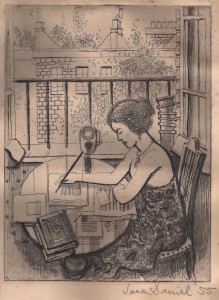
Grigson Jane etching 1955 001Arguably one of the two greatest twentieth century English writers on food (the other being Elizabeth David), Jane Grigson ( 1928 – 1990) was the subject of this intriguing etching by the artist Jack Daniel, who knew her in the early fifties when she was living in west London as a young picture researcher working for the publisher George Rainbird.

The etching, which is signed by Daniel and dated retrospectively ‘1955’ was given to me by the artist when I met him about 20 years ago at his home. I was researching the life of Jane’s husband, the poet and critic Geoffrey Grigson, and had somehow discovered Daniel’s address. I found him very friendly and forthcoming about Jane and Geoffrey, whom she had met while he was editing the encyclopaedia People, Places, Things and Ideas for George Rainbird. He was particularly informative about their early relationship (they met when Geoffrey was already married) and just before I left, he sought out one of his portfolios and fished out this etching. It must have meant much to him, considering he had kept it for over forty years.

I seem to recall that Daniel shared part of the house with Jane, who is depicted working at a table in her flat, next to a window through which can be seen the rooftops and chimney pots of neighbouring houses. She seems to be writing something—probably nothing to do with gastronomy, for she had yet to specialise in this field. Indeed, it was a chance meeting with an archaeologist living in one of the cave houses at Troo, on the Loir near Vendome, that propelled her into this new career. She took over his research and the book which resulted from it was published in 1966 as the famous Charcuterie and French Pork Cookery. With this her future was assured. [R.M.Healey]

A Club for Millionaires

IMG_1366

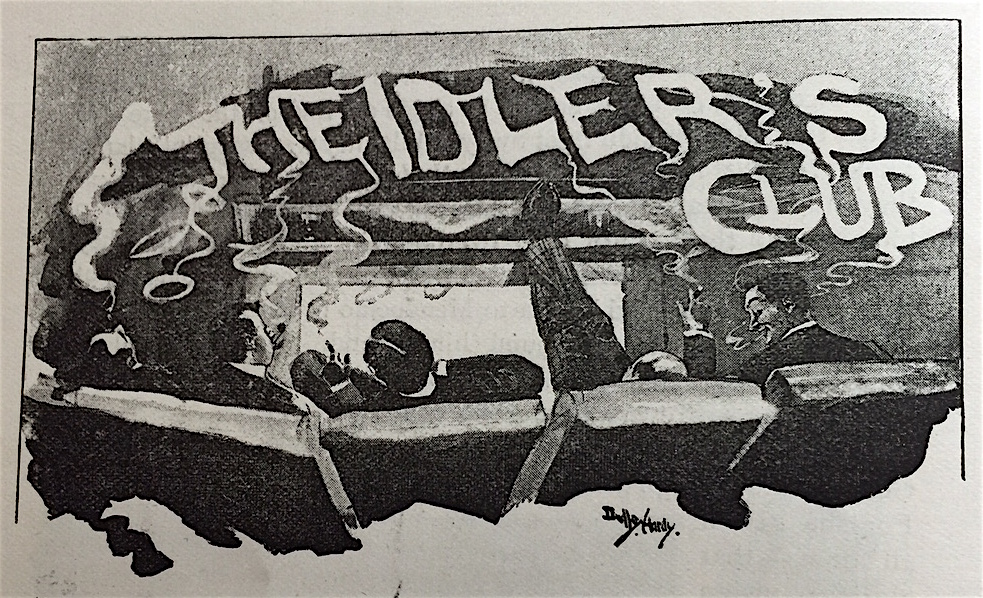
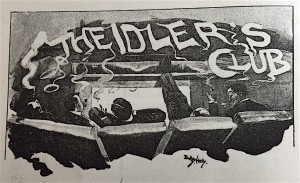
Illustration by Dudley Hardy

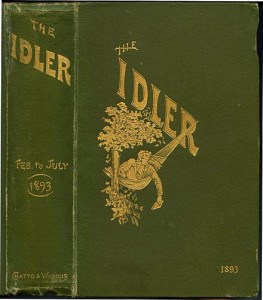
Found in The Idler Magazine (Chatto & Windus, 1892. Volume 1, February to July. pp 109-110) this piece by regular contributor Barry Pain. The Idler was edited by Robert Barr and Jerome K Jerome. It ran from 1892-1911.

Over the years, the roster of writers who contributed to various issues was impressive: O. Henry, Mark Twain, Conan Doyle, Eden Phillpotts, Marie Corelli, Barry Pain, Israel Zangwill, Grant Allen, W. W. Jacobs, and Robert Louis Stevenson. At a single sitting, the pages took the reader from travel adventures to cultural appreciations of events in the home island nation. “The Idler‘s Club” was a standard feature of most issues. Various writers sketched out opinions in ironic and exaggerated language. This piece was found there. It was Barry Pain’s second idea in this issue – his first was that amateur dramatics would be much improved if performed in total darkness and thus they would also be able to avoid paying a licence fee…His idea for a club follows:

Barry Payn (sic) sympathises with the millionaires.
IdleraMy second proposal is to establish a club for millionaires. We see suffering all around us, and it is useless to close our eyes to it. There are millionaires in our midst; and, whether we like it or not, they are out brothers and sisters. Putting it on grounds which will appeal to everyone – I mean the lowest possible grounds – we cannot afford to miss an opportunity of making a little out of them. If we explore the region of the docks, we find separate homes there for sailors of every nationality; there is even a home for lost dogs. But nowhere do we find a home for millionaires. I propose to establish a proprietary club for them, a little room with a sanded floor, where they will find that absence of luxury which they must miss so much. They will be able to get a chop or steak they; wine will not be served, but a boy will fetch them beer if they feel that they don’t want it; a large cup of cocoa will be one penny, and a small one will be half-a-crown.

I have forgotten my reason for that last regulation, but I remember that it was logical. One of the cheaper evening papers will be taken, and members of the club can have it in turn; or, if they prefer it, they can do without it. I have no wish to limit their liberty more than is absolutely necessary for their own discomfort. Everything that can done to make the place nasty will be done. I intend, for the protection of the general public, to make the club exclusive. Only millionaires will be eligible. There will be an entrance fee of a thousand guineas and an annual subscription of one hundred. The subscription, together with a statement of the place of their birth, if any, must be forwarded in advance to the proprietor. I shall be the proprietor myself. I have other proposals to make, but these are enough for the present. I may have occasion to refer to the subject again, but I make no threats.


Bright Young Things Schoolboy Party

Found- an American press photograph from 1932. On the back is typed “Schoolboy Party Society Stunt. The latest fad of society in London is the schoolboy party, one of which took place at the Punch Club. The invitations were entrance forms to ‘St Barnacle’s School’ and many prominent society members attended dressed in appropriate costumes. Above are some of the guests in ‘uniform’. In centre is Lady Ashley (without hat) and third from left is Elsie Randolph.. Acme Press 7/25/32.” 
IMG_20160312_0001
 This is the world of Evelyn Waugh’s 1930 novel Vile Bodies. The  hero of the novel, Adam, becomes a society columnist – ‘Oh Nina, what a lot of parties’ he complains to his girlfriend – and the narrator adds:

“…Masked parties, Savage parties, Victorian parties, Greek parties, Wild West parties, Russian parties, Circus parties, parties where one had to dress as somebody else, almost naked parties in St John’s wood, parties in flats and studios and houses and ships and hotels and night clubs, in windmills and swimming-baths, tea parties at school where one ate muffins and meringues and tinned crab, parties at Oxford where one drank brown sherry and smoked Turkish cigarettes, dull dances in London and comic dances in Scotland and disgusting dances in Paris – all that succession and repetition of massed humanity … Those vile bodies…” 

The 25 Favourite Sinatra Songs

Found among Peter Haining’s  papers a typed sheet, possibly from a 1980 newspaper article, listing the results of a poll of Frank Sinatra’s most loved songs. It is possible he was planning a book on Sinatra…

Frank_Sinatra_in_Till_the_Clouds_Roll_ByThe 25 Favourite Sinatra Songs

In 1980, Frank’s public relations firm, Solters and Roskin, conducted a poll to establish the singer’s most popular recordings. A total of 7600 fans from more than 11 counters were polled, and replies came from Britain, Canada, Australia, America, Japan, Brazil, France, Sweden, West Germany, Holland as well as various other place. In all 587 individual Sinatra titles were selected by fans, but the eventual winner proved to be a 25 years old recording, “I’ve Got You Under My Skin” with words and music by Cole Porter, released by Capitol in 1956! (Note; It has been suggested that the number 3 song on the list given as “Chicago” should, in fact, be “My Kind of Town”.)

The list, with dates of recording, is as follows:

1. I’ve Got You Under My Skin (January 26, 1956)

2. The Lady is a Tramp (November 26, 1956)

3. Chicago (August 13, 1957)

Continue reading

Sir Frederick Treves on the smell of Nice

Found in The Riviera of the Corniche Road (Cassell896d404c280cb8f898f970a1ff20cf15, London 1921) by Sir Frederick Treves (1853 – 1923) this description of the old town part of Nice. Treves, of course, is well known as a prominent British surgeon  and for his friendship with Joseph Merrick, “the Elephant Man”. He was also a distinguished writer on travel, as well as surgery. In 1906 he had written on Dorset, the county of his birth, in the Highways and Byways series. He is particularly good on the smell of the old town. Odours are often neglected by travel writers. Does the area still smell the same?

 The old town of Nice is small and well circumscribed. It occupies a damp and dingy corner at the foot of the Castle Hill. It seems as if it had been pushed into this corner by the over-assertive new town. Its lanes are so compressed and its houses, by comparison, so tall that it gives the idea of having been squeezed and one may imagine that with a little more force the houses on the two sides of a street would touch. It is traversed from end to end by an alley called the Rue Droite.
This was the Oxford Street of the ancient city. A series of narrower lanes cross the Rue Droite ; those on one side mount uphill towards the castle rock, those on the other incline towards the river.

The lanes are dark, dirty and dissolute-looking. The town is such a one as Gustave Dore loved to depict or such as would be fitting to the tales of Rabelais. One hardly expects to find it peopled by modern mechanics, tram conductors, newspaper boys and honest housewives; nor do electric lights seem to be in keeping with the place. Its furtive ways would be better suited to men in cloaks and slouched hats…

The only thing that has not changed is the smell. It may be fainter than it was, but it must be centuries old. It is a complex smell ” a mingling of cheese and stale wine, of salt fish and bad health, a mouldy and melancholy smell that is hard to bear even though it be so very old. The ancient practice of throwing all refuse into the street has drawbacks, but it at least lacks the insincere delicacy of the modern dustbin…

From any one of the windows may protrude a mattress ” like a white or red tongue “..