Disability ! What disability ? The Amazing Constance Smedley

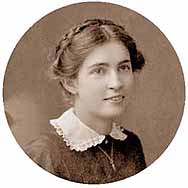
In her sixty six years Constance Smedley (1875 - 1941) managed to pack more into her life than most centenarians would do. Despite being on crutches from her early years and confined from her thirties to a wheelchair (due to some unidentified disability, possibly a hip problem) this Birmingham-born fireball, who married the gay artist Maxwell Armfield, was at various times a crusading feminist, suffragist  and journalist, an artist,  novelist, playwright, organiser of pageants and folk dances, and perhaps most notably, the founder of the world’s first arts and science club devoted entirely to women.
It is on the notepaper of the London-based Lyceum Club, which the twenty-eight  year old Smedley helped to found in 1903, that this featured letter (below) also shows her to be a tireless encourager of talent among women—especially budding musicians and actresses. Here she writes to an actress and fellow feminist Annie Schletter, inviting her to a ‘ semi dress rehearsal ‘where she will witness the enormous promise of a twenty three year old thespian called Gwenol Satow:

‘…I feel Miss Satow has great gifts, but they are entirely undeveloped: her intelligence is far before her technique---& she needs the discipline of training . She is ineffective for lack of technique & is very self-conscious. If she stayed with us & really worked day by day & all day, she might be very, very good.
It is a very hard profession---and she has a great opportunity with us—but I don’t know if she quite realises what a lot of hard work she has to put in, if she is to make good …’


Alas, Miss Satow does not appear to have made the most of her extravagant gifts. In fact, there is no record of her lighting up the professional stage in any way. She became the second wife of the brilliant songwriter David Heneker, also born in 1907, and the composer responsible for such hit musicals as Irma La Douce, Charlie Girl and Half-a-Sixpence. Indeed, Heneker credits his wife for bringing Tommy Steele’s musical into being. According to him she ‘suddenly sat up in bed one night and produced the idea for Half-a-Sixpence ‘. So, in her ninety years perhaps Satow did contribute something to the success of the British theatre, although it is unlikely that Constance Smedley would have been impressed. [RR]

A rare British Museum Library ticket

There are plenty of biographical anecdotes concerning the experiences of writers using the facilities of the old British Museum Library —from Washington Irving through Karl Marx up to David Lodge and beyond. When the famous round Reading Room was built many incorporated into their fiction memories of studying there. However, we have little idea today of the process by which books were ordered in the very early years of the Library.

So when an actual ordering slip from this period turns up —and one signed by a well known author—it is a rare event. Surely such ephemera are scarcer even than Shillibeer omnibus tickets and must rank among other celebrity souvenirs, such as non-presented cheques signed by Hollywood film stars and the like.

This particular ordering slip was made out by the poet Thomas Campbell (1777 – 1844), whose Pleasures of Hope  was a minor success in 1799, and who remained a well known, though hardly revered, figure of the Romantic period. The book he ordered was The History of Edward the Second by Sir Francis Hubert, which first appeared in 1629. We know the book was asked for on August 23rd , but with no year date present we must examine the style of the vestigial remnant of the printed part of the form and guess that the order was made sometime between 1803, when Campbell settled in London, and 1819, when he brought out his Specimens of the British Poets.

If the order was made before 1810 it would be interesting to know if Campbell had problems obtaining a ticket to the Museum, or whether his celebrity as an author removed any barriers to entry. After this date the ticket system was abolished, which made it much easier to access the Library, although readers often had to wait for many hours, sometimes days, for their books to arrive. [RMH]

J. W. Samuel B.A

From the papers of L.R. Reeve* this record of a remarkable educationalist, mathematician and speaker. He is unknown to  Wikipedia and online research reveals very little.  He contributed some photographs to the Country in Town  exhibition (July 2 to July 16, 1908) at  Whitechapel Art Gallery to illustrate 'Day Educational Rambles' in the education section. He appears to have received a double honours degree at London University in Anglo- Saxon and Early English (1901?.) As with many of Reeve's subjects he was a remarkable speaker...

J. W. SAMUEL, B.A.

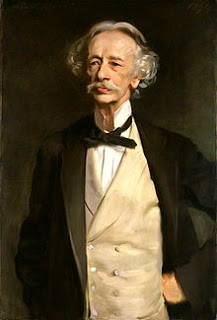
It was during a conference at the Memorial Hall, Farringdon Street, London, that I first saw J. W. Samuel. He was delivering an address, and I recall vividly the profound impression he made upon me, for I was listening to a man who was one of the most effective speakers in London. He had every attribute required for the highest standard of oratory, and his first essential gift was a perfect delivery. His cultured accent, smoothly expressed, would certainly be my aim if I were to enter a competition in debate, and for some mysterious reason which I could not quite explain, his voice always made me think of Earl Balfour, one of England's greatest statesmen.
  Additionally he was a remarkably handsome man, tallish, with a magnificent head of white wavy hair. He had a truly extensive vocabulary, which made him a most persuasive speaker who could, in a debate, demolish most of an opponent's points and, when he occasionally felt that way, would add a little sarcasm to complete his triumph.
Continue reading

The art of being very annoyed, very politely

Found -- this rather unusual author's notice in a copy of the 1885 edition of George Long's translation of Marcus Aurelius' Meditations. It is printed where the frontispiece should be.  A little digging reveals the following.

The first edition of Long's translation was published in 1862.  By 1864 a pirated edition appeared by Ticknor & Fields, Boston. Long's notice appeared first in the 1869 British 2nd edition published by Bell & Daldry, London, and was still appearing several printings later in 1885.

Long's consideration of a Confederate dedication to a pirated Union publication is an excellent example of being politely very rude, and his opening paragraph pure stoicism!

[Submitted by P.Hatcher / Many thanks]

I once met A. S. Eddington

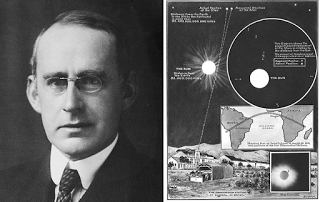
Found in the papers of L.R. Reeve (see A.J. Balfour for background on him) this piece on the British astronomer, physicist, and mathematician Sir  Arthur Eddington (1882 - 1944.) He did his greatest work in astrophysics and also wrote books on philosophy and popular science. L.R. Reeve actually met him and gives an amusing account of the slightness of this encounter but has good information on Eddington's appearance and his lecturing style. He ends with quite a good joke, relatively speaking…Some may remember that David Tennant played him in the BBC/HBO film Einstein and Eddington (2008.)

A. S. EDDINGTON

For several years I expressed my homage to Semprini, the pianist of genius; then when I heard him declare on the radio that if he were on a desert island his choice of a book would be The Nature of the Physical World by Sir Arthur Eddington, O.M., F.R.S., my obeisance was beyond all description, for I look upon Eddington as the greatest astronomer of my era.
Continue reading

The Secret Places XI & XII

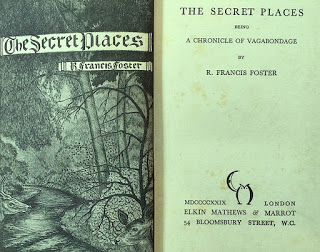
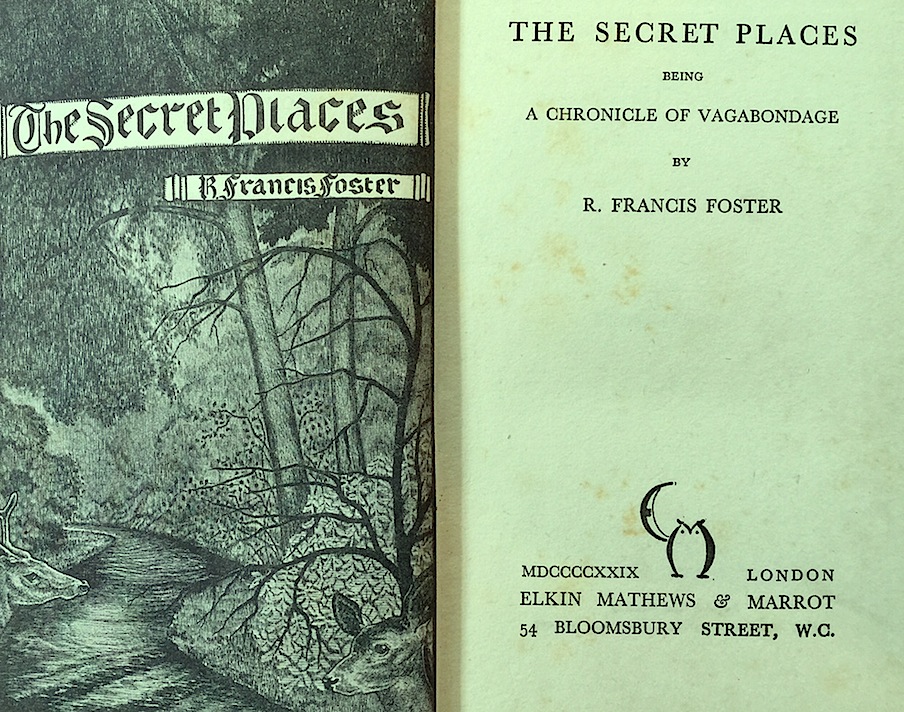
Two more chapters of The Secret Places (Elkin Mathews & Marrot London 1929) - a chronicle of the 'pilgrimages' of the author, Reginald Francis Foster (1896-1975), and his friend 'Longshanks' idly rambling in Sussex, Kent and Surrey. See our posting of the first chapters for more on Foster and this book, including a contemporary review in The Tablet.

XI

THE FRIARY IN THE HILLS

It chanced that I had to go over into Surrey hm Sussex to pay a visit to the Franciscan Friary whence we had started on our wanderings. Leaving Longshanks, therefore, in an inn at Chidding in the fold country, whither we had gone in search of a man who claimed to be a direct descendant of Earl Godwin–though what he was doing here in the south I do not know–I went through the gap in the hills to Guildford and, being weary, took a ‘bus thence to Chilworth.
  Because I was stupid with sleep I left that ‘bus at the wrong place, and, being unfamiliar with the country west of the Friary, I sought direction from a butcher and a queer man who carried a lighted lantern, though it was yet mid-afternoon. Thereafter I walked two miles, as I had been told, I came at last to a large crucifix by the roadside and entered the Friary grounds.
Continue reading

Cicely Mary Barker

CMBarkerc1920

A Fairy Orchestra*

Found in the Peter Haining archives this long piece from 1995 about the great Flower Fairy illustrator Cicely Mary Barker. It is likely to be the fruit of research by PH's good friend the amazing W.O.G. 'Bill' Lofts. Cicely Mary Barker's beautiful illustrations are still much loved and have become something of an industry. She also produced some deeply religious illustrations which are also of very high quality.

CICELY MARY BARKER

Wander into almost any stationers', gift or book shop, and you will see them - on cards and calendars, notelets and writing pads, diaries and address books, pencil tins and wrapping paper - even on tins of tea and Wedgwood china collectors' plates! The Flower Fairies suddenly seem to be everywhere.

They never really went away, of course - since they first appeared over 70 years ago, they have continued to work their magic on generations of children and adults alike. If all at once they seem more popular than ever before, it is because 1995 marks the 100th anniversary of the birthday of their creator, Cicely Mary Barker. To celebrate the centenary in June, and hand-in-hand with a big marketing campaign, Warnes are due to publish the first ever study of the artist: “Cicely Mary Barker and her Art” by Jane Laing. This superbly produced book, lavishly illustrated with colour plates of the artist's work and family photographs, is an absolute "must" for any collector of Barker's work, and guaranteed to add to her ever-increasing circle of admirers world-wide.

Continue reading

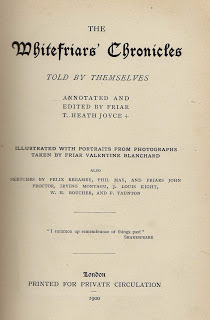
Literary Cranks of London– The Whitefriars Club

This was established in 1868 in three rooms at Radley’s Hotel, in New Bridge Street, Blackfriars. The authors don’t mention the fact, but  in the 1820s Radley’s was known as Walker’s Hotel and was infamous as the HQ of the generally despised Constitutional Association, the reactionary group dubbed by William Hone, the ‘Bridge Street Gang’, which harassed radical booksellers  it accused of circulating seditious libels--- usually the pirated works of Thomas Paine.

By the time it had come to house the Whitefriars ( incidentally, a humorous reference to the nearby Blackfriars) Radley’s was a respectable family business with ‘ an old-fashioned cuisine and an excellent cellar of wines ‘. Of the three rooms occupied by the Club, the one used as a dining room had ‘three windows looking out on Ludgate Hill Station, filled with heavy furniture and black horse-hair sofas of a late Georgian period’. Behind this was a smaller room dedicated to ‘smoking and writing’, which  commanded a view behind the Bridewell gaol ‘of a neglected bit of ground, on which flourished rank grass, oyster shells , and dead cats…and a row of picturesque and irregular backs of ancient houses, delightful for their finely-toned red brick, their old red tiles and their quaint chimney pots ‘. By 1900, when the history of the Club was privately published, Radley’s Hotel had been pulled down ‘for improvements’.

Continue reading

The Secret Places IX & X

Two more chapters of The Secret Places (Elkin Mathews & Marrot London 1929) - a chronicle of the 'pilgrimages' of the author, Reginald Francis Foster (1896-1975), and his friend 'Longshanks' idly rambling in Sussex, Kent and Surrey. See our posting of the first chapters for more on Foster and this book, including a contemporary review in The Tablet.

IX

MY LADY OF THE MIST

To tell of the incidents of every day of our wanderings would be monotonous and wearisome, and so I make no effort to do so. Moreover, what is of interest, or gives happiness, to Longshanks and myself is not necessarily entertaining to anyone else. And because we had no aim but aimlessness–which is good for men sometimes–we wandered from county to county as the spirit moved us, having no regard for even a daily itinerary or for a settled account when our adventures should be written down.
  It was at Small Dole–which is in Sussex–that we discussed, the relative merits of hot and cold shoeing with the big blacksmith, and when we had worked him to a passion of rage at our obstinacy, so that he stuck out his big fan of a beard at us and cursed us with a strange oath, we were minded to continue our journey to the Downs. It was not long after dawn, and October rime still lay where the sun had not yet thawed it.
Continue reading

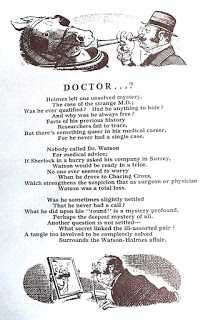
Sherlock’s Watson — was he a bad doctor?

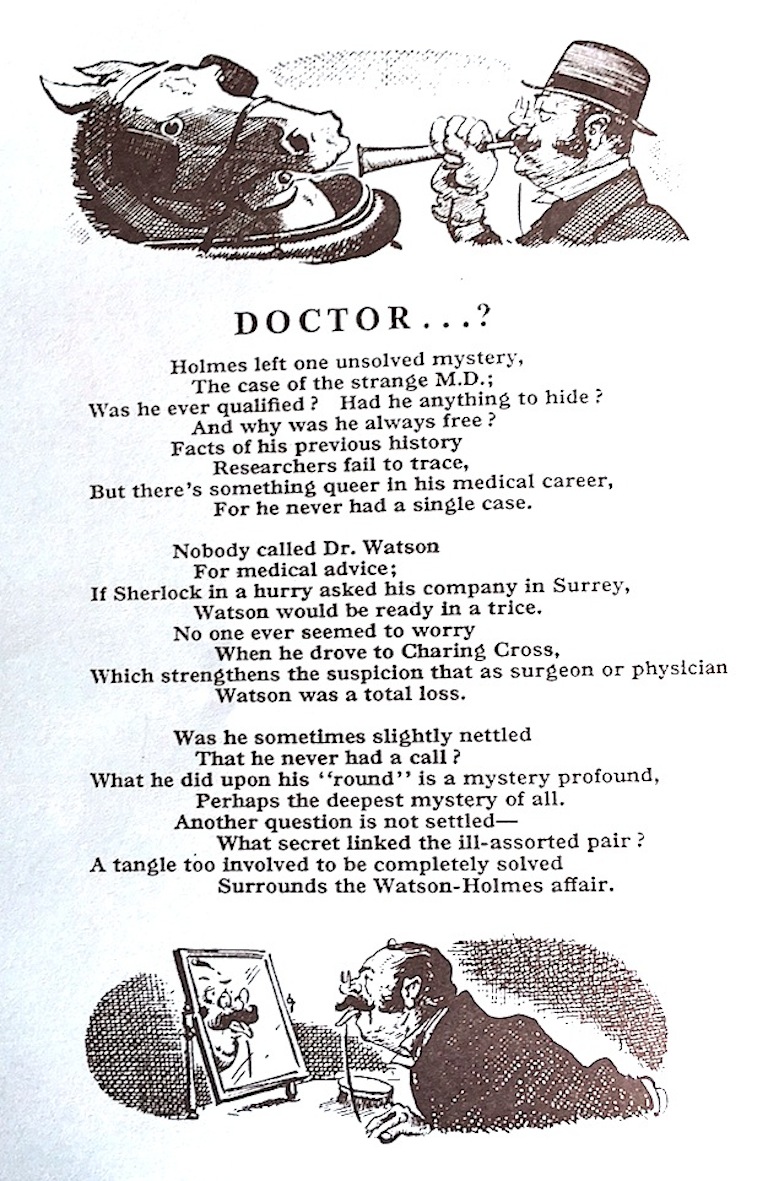
Found in The London Mystery Magazine of April/May 1951 this amusing Sherlockian poem casting doubt on Watson's medical credentials…The author 'Sagittarius' was a journalist named Olga Katzin* who wrote several humorous and satirical books, some in rhyme. A short life  is appended below. The London Mystery Magazine began in 1949 and went on into the mid 1950s. It gave its address as 221b Baker Street. Adrian Conan-Doyle (Arthur's son) 'not uncharacteristically' sued the magazine, but lost the case.

Illustrated by 'Figaro'

DOCTOR…?

Holmes left one unsolved mystery,
The case of the strange M. D.;

Was he ever qualified?

Had he anything to hide?
And why was he always free?
Facts of his previous history
Researchers fail to trace,

But there’s something queer in his medical career,
For he never had a single case.

Nobody called Dr Watson
For medical advice;
If Sherlock in a hurry asked his company in Surrey,
Watson would be ready in a trice.
No one ever seemed to worry,
When he drove to Charing Cross,
Which strengthens the suspicion that as surgeon or physician
Watson was a total loss.

Continue reading

E. M. Forster, the Rajah and his tutor

Most people who know E.M.Forster’s Passage to India (1924) also know that the background research for the novel was undertaken while the author worked as private secretary to the Maharajah of Dewas, senior, who ruled a tiny State in north central India. In 1953, many years after the novel appeared, and sixteen years after the Maharajah had died, Forster published as The Hill of Devi  recollections of his time in  what he called ‘ the oddest corner of the world outside Alice in Wonderland’.

Forster had first met the young ruler, who bore the rather cumbersome cognomen of  Sir Tukoji Rao III, in 1912 , while he was the guest of the high-flying administrator  Malcolm Darling, who had himself arrived in India in 1904.  ‘His Highness’, or H.H., as the Rajah styled himself, was then just in his early twenties, having succeeded his father in 1900 at the tender age of twelve. In 1906 Darling was appointed his tutor and mentor, and in October 31st, 1907 the two men, together with the usual retinue, including possibly the Rajah’s beloved brother, embarked on what might today be called a ‘ fact -finding ’ tour of ’ All-India’ and Burma , which is briefly mentioned by Forster in his book. Various members of the party were responsible for taking snaps of the sights along the way. The Rajah himself can be seen in many of the photos, and Darling features in at least one. The camera used seems to have been a Kodak, which had become popular early in the 1890s—and it is this photographic record, mounted in a Kodak album, with brief identifying captions by the Rajah, that has recently come to light in a provincial auction house in the UK.

Continue reading

Dr Elsa H. Walters

Found in the papers of L.R. Reeve (see A.J. Balfour for background on him) this piece about the West Indian writer, educational psychologist and teacher Dr Elsa H.(Hopkins) Waters. There is little online about her and Reeve's piece will add substantially to knowledge of her life. Her first book Ability and Knowledge. The Standpoint of the London School (Macmillan, London) came out in 1935 she wrote about five more (several published by the National Froebel Foundation)  and her last book Principles of education: with special reference to teaching in the Caribbean was published by the O.U.P. in 1967. She was probably born about 1900 and was still alive when Reeve wrote this piece about 1970.

DOCTOR ELSA WALTERS

There came into our compartment at Newton Abbot station a well-dressed West Indian girl. She asked timidly if the train went to Paignton. Answered in the affirmative she lifted her suitcase on to the rack and responded readily to our inquisitive questions, then joined quietly in the general conversation. She informed us that she was a student at the Institute of Education, London.
  After Torquay, the young student and I were the only passengers in the compartment and she continued the story of her early life in the West Indies. Could she, I asked, tell me anything about Dr Walters, a university lecturer who had gone to her country. "Do you mean Miss Elsa Walters?" At my affirmative nod she informed me that she had heard of the lady but had never seen her. Strange, I thought, that a young West Indian scholar could give me the elusive, forgotten Christian name of an acquaintance.
Continue reading

The Secret Places VII & VIII

Two more chapters of The Secret Places (Elkin Mathews & Marrot London 1929) - a chronicle of the 'pilgrimages' of the author, Reginald Francis Foster (1896-1975), and his friend 'Longshanks' in Sussex, Kent and Surrey. See our posting of the first chapters for more on Foster and this book, including a contemporary review in The Tablet.

THE WOOD OF MYSTERY

Leatherhead used to be famous for its "nappy" ale, as King Henry the Eighth's laureate knew, for he wrote a song about the mistress of the Running Horse Inn and praised the brew, as a man should. And the Mole, which chatters its way half round the town, was famous for its trout. Alas! in these days the ale there is no better than it should be, and of trout there are none–at least Longshanks and I were not served with any.
  But Leatherhead has its distinction even now, and you shall mark it whether you proceed thither by train, by car, or on foot. For at Leatherhead the rather threadbare rusticity of the country south of London ends, and when you have climbed the steep hill beyond the bridge on the Guildford road you are in a new land. In the little rectangle of which one side is the main road between Leatherhead and Dorking, and the opposite side an imaginary line running through Little Bookham and Effingham and ending roughly five miles due ; west of Dorking, you may get lost an hundred times.
  I scruple to say how this may be done, for when a horde of people get lost together there is no mystery nor any fear; only paper bags and bottles left on the eternal hills and in the secret places of the woodland. And so I shall be vague.
Continue reading

The Folk Revival, Skiffle and Protest Songs of the early 1960s

Found in the Haining archive - part of a typed article, possibly never published, by the writer and folklorist Leslie Shepard. He was particularly interested in street literature and broadsides and this piece is inspired by what he saw as a revival of broadside literature which came with a renewed interest in folk music in the early 1960s, also the time of Skiffle…

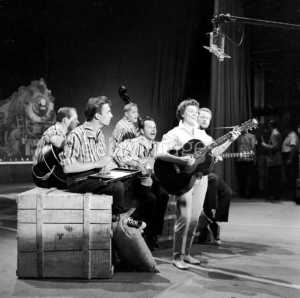
Chas McDevitt Skiffle Group with Nancy Whiskey*
Twentieth Century Ballads - Leslie Shepard. The Arts in Society

At the dawn of the twentieth century even the broadsides had disappeared, while the countryman had little to sing about. In a more material age people read prose newspapers instead of the verse broadsides and studied practical affairs instead of a romantic past. Both traditional and printed pieces became museum relics, of interest to scholars, country parsons and antiquarians rather than to a modern world - until the folk song revival of barely ten years ago.

Continue reading

60 years of ‘Dumbing Down’?

Found in the bookseller's magazine Desiderata from September 1955 this piece reprinted  from Atticus in the Sunday Times.

Teenagers may care to try to name the authors of the following 12 books:

An American Tragedy, 
Babbitt,
The Canterbury Tales,
Gulliver's Travels,
Leaves of Grass,
The Old Wives' Tale
Utopia,
Vanity Fair, 
The Origin of Species,
The Wealth of Nations 
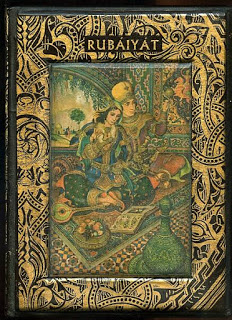
The Rubaiyat
Tom Jones 

...then compare their standard of education with that of the average American college graduate, aged 21.  According to a recent Gallup poll, 9% of graduates could not give the author of a single one, 39% could not name more than three, and 52% could name only four.

At least three titles may have dated too much since 1955 - An American Tragedy, Babbitt and The Old Wive's Tale - they could be replaced, say, by The Hobbit, To Kill a Mockingbird and Ulysses. It was a slightly odd list to start with (no Shakespeare, Dickens, Austen, Poe) but you have to start somewhere. Surely there must have been the occasional bright spark who could name the lot? 60 years on people constantly lament 'dumbing down' but it would be interesting to see if figures have greatly changed  for the worse…

Coventry Patmore rejects his uninspiring ‘vegetables’

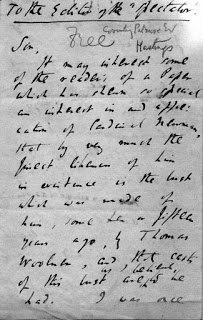
The poet who composed the long love poem, The Angel of the House, which appeared in four volumes from 1854, became, like many of his generation, a convert to Catholicism, and so his remarks, voiced in a letter to the editor of the Spectator  regarding a bust of Cardinal Newman by the pre-Raphaelite sculptor Thomas Woolner, come as no real surprise.

The original letter, written from Hastings, was discovered in a pile of similar autographed material.

‘It may interest some of the readers of a Paper which has shewn so special an interest in and affection of Cardinal Newman, that by very much the finest likeness of him in existence is the bust which was made of him some ten or fifteen years ago by Thomas Woolner…I was once in a room containing first-rate busts of all the most famous men of the past generation. That of Newman made all the others look like vegetables, so wonderfully was it loaded with the great Cardinal’s weight of thought and character.’

We don’t know who the sitters for other busts were, or the identity of the sculptors, but we do know that as a friend of Woolner, as indeed he was of Dante Rossetti, W. Holman Hunt, and other Pre-Raphaelites, Patmore was bound to defend the merits of the Newman bust over perhaps some more conventional works of art. As a child, Patmore himself wanted to be an artist and at the age of fifteen won the Silver Palette of the Society of Arts. The poverty of his father made such an ambition impossible and Patmore ended up in the British Museum library. In later life, spurred on by his association with the Pre-Raphaelites, he wrote on Art, but he is best known today as the author of The Angel of the House, although it is generally recognised that his best poems, which have strong spiritual qualities, were written towards the end of his life. [R R]

Etching of Farringdon Road bookstalls in the 1930s

Photographs exist of the famous bookstalls in Farringdon Road, dating from the nineteen forties and fifties, and the one by Moholy-Nagy that illustrates the excellent London Street Markets, was taken in the thirties. But as far as I know, the stalls were never the subject of an etching, of whatever date. Here, dated 1934, is an etching by the brilliantly talented Nathaniel Sparks (1880 – 1956), one of the most popular masters of this art, which of course became moribund almost overnight as a result of the Wall Street Crash.

During the American-led collecting craze, which began just before the First World War, Sparks produced a huge number of etchings, many of them of notable London landmarks such as Westminster Abbey and Tower Bridge, and it is surely a sign of its fame in the thirties that Sparks regarded Farringdon Road as a fit subject for an etching. At that time he was doubtless a customer at the stalls himself, and it is known that in his last sad months, when poverty and illness had him holed up as a lodger in Somerton, he comforted himself by collecting old books. It is also likely that in the last half of a largely peripatetic life, which saw him living with gypsies and farmers in Somerset and the New Forest, he was forced to jettison many of the books he had picked up over the years, in favour of his paints and paper.

Naturally shy, physically slight, and all too aware of the severe rhinophyma which disfigured his face, Sparks sometimes cut a pathetic figure. He could not help compare his ill luck with the fame and fortune that attended his much older cousin, Thomas Hardy, and recorded his resentment in an unpublished satire. Things came to a head in 1940 when an enemy bomb smashed his printing press and he was forced to abandon etching entirely and eke out a living producing pellucid watercolours of scenery in his beloved Somerset.

[R.M.Healey]

The author is grateful for the excellent Nathaniel Sparks Gallery for allowing him to reproduce the two etchings.

Now have proof positive that the etching is of Exmouth Market! (ed.)

General Jan Christiaan Smuts

From the L.R. Reeve* collection- this (partly) eyewitness portrait of Jan Smuts, South African and British Commonwealth statesman, military leader and philosopher (1870 - 1950.) His fame may have significantly lessened since Reeve wrote this (about 20 years after Smuts' death).Probably he would no longer be up there with Darwin and Milton..

GENERAL SMUTS

At least half a dozen books have been written about the late General Smuts, and I am certain that more will continue to be published not only in South Africa, but in England, the United States of America and other countries.
  Due to his early, unusual environment and a formidable, but attractive personality, Smuts possessed a unique quality and became one of the most remarkable men of his generation. No one will ever be able to render a comprehensive account of his notable service to mankind. The most that can be done will be to collect the evidence of many writers, and portray a composite figure.
  I would select for personal interest, the biographies A Sight of General Smuts at Cambridge, and Sarah Gertrude Millen's Life. He was a brilliant scholar, and certainly brought distinction to a great university. I emphasize brought because I find that college guides quite understandably remember to inform visitors of the distinguished men who have graduated.
Continue reading

Dolf Wyllarde—crazy name, crazy gal

The actress Annie Schletter had a number of enthusiastic correspondents not all of whom were necessarily connected with the theatre. One of these was Dolf Wyllarde (1871 – 1950), whose real name was Dorothy Margarette Selby Lowndes . A prolific author of adventure and romance novels, she was  popular in her day, but is largely forgotten now, though her books turn up regularly in secondhand bookshops and online at Abebooks. Wyllarde appears to have done well through her writing and at least one of her novels was filmed. By 1927 she was living in some splendour at the seventeenth century Oldmixon Manor, near Weston-Super-Mare. Why Lowndes chose her particular pseudonym will probably never be known. Perhaps she thought a masculine name might attract more readers. However, she could well have been interested in the ramifications of sexual identity. In The Lavender Lad (1922) a talented actress disguises herself as a ‘ragged urchin’ in order to work on a lavender farm.

We should remember that this was the period when female impersonators were a common sight on the English Music Hall stage. Interestingly, she doesn’t appear to have used her real female name when creating   her ‘ romance’ stories. She even uses her pen name when writing to friends, as in this chatty epistle to Schletter, which is dated 12 December 1927. In it she describes domestic life at Oldmixon, which seems idyllic and very far from some of her swashbuckling fiction. She begins by announcing that she plans to send her friend a turkey through the post for Christmas —a practice, incidentally, performed by middle class country folk from at least the eighteenth century onwards—but warns her friend that this might be the last she receives from them.

‘…I am afraid we shall have none to send next year as we are thinking of giving them up. They are so difficult to rear, and my gardener’s wife has to get up at five o’clock in the spring to feed the chicks…We are very busy and very domestic ! I have an energetic little cook who positively likes using my grandmother’s recipes and I find myself involved in old-fashioned jams (crab apple is really delicious) and hams pickled with things that remind me of the White Knight’s pudding in “ Alice through the looking glass “. I am not sure that gunpowder and blotting-paper are not among the ingredients. We are all supposed to rub the ham in turn. I went and looked at it in its pickle, but the treacle and juniper berries, the old beer and the black pepper, were so awful that I fled !...’  

Wyllarde features in a few reference works on popular Edwardian fiction, but little or anything is known about her personal life. She died in 1950, aged 79. Her former home, Oldmixon Manor, has survived, but is now divided into apartments. [R.H]

Post-war British pulps

Found - part of a letter to Peter Haining from W.O.G. ('Bill') Lofts about an intended book on post-war British pulps. Neither WorldCat or Copac show such a book among Lofts's oeuvre.The manuscript could possibly be among Haining's papers which we are still sifting through. Almost all  of the authors mentioned can be found at the Sf Encyclopaedia site but even there details can be quite scant. Some of these pulps are now quite valuable - There Were No Asper Ladies, for example, features an occult detective (Lucian Carolus) and is a full blown vampire novel.

Dear Peter,

Many thanks for your list of fifties books. An interesting little list as well. As I said, I'll return the favour at the top of the list and work my way down (so expect some jumping about!).

I don't; know anything about David Scott-Moncrieff, apart from the act that he had a second collection of horror stories. They were published in 1948 and 1949.

Continue reading