The catalogue issued in 1946 (previous Jot) by the directors of Elkin Mathews Ltd of Takeley, 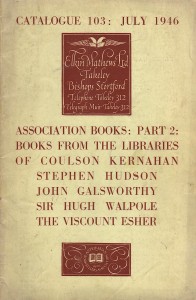 near Bishops Stortford, probably contained descriptions of books and manuscripts by one of the directors, Ian Fleming, an avid book collector. It’s tempting to imagine the future creator of James Bond trawling through some of the items in the catalogue in search of likely material.
We don’t know what language skills his fellow directors, B. K. Muir and C. H. Muir had, but we know that before the Second World War Fleming attended universities in Munich and Geneva to work on his language skills and visited Moscow in 1933 while working for Reuters. It is likely that he was responsible for translating some, if not all, of the foreign language manuscripts being sold by Elkin Mathews.
First, he may have examined a letter from the disciple of Karl Marx and founder of the Social Democratic Party, A. Bebel (1840 – 1913), which was written in German in 1893.In it Bebel complains that ‘since the abolition of the ban very few intellectuals and university folk have joined the party, or if they have done so, have abandoned it later on, out of fear or for reasons of social ambition’. He attacks the evolutionary socialist Rodbertus, who was opposed to Marxism and the University- Socialists.
This letter of ‘great importance ‘ was priced at 9 guineas.
There is also a holograph MS of Maxim Gorki’s “From my Diary” consisting of 12 folio pages in Russian and priced at a bargain £40—more than a month’s salary for a British University lecturer in Russian in 1946.
You could also buy a letter from the Swedish Nobel prize winner Selma Lagerlof ( who she ?,Ed ) for £2 10s,a ‘ very fine letter ‘ from the Nazarene painter J.F.Overbeck dated 1852 for 10/- less and ( a real bargain, this) ten letters from the German impressionist painter Liebermann, a victim of Nazi prejudice, for £2 15s. A single letter from the gifted German draughtsman A. von Menzel, to which were attached ‘ ‘three fine pen-and-ink drawings’, could be yours for £20. Continue reading
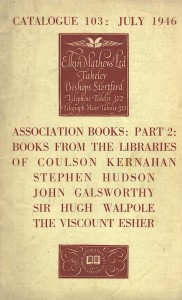 was issued by the well-established book dealer Elkin Mathews Ltd in July 1946, just a year or so after the close of the Second World War.
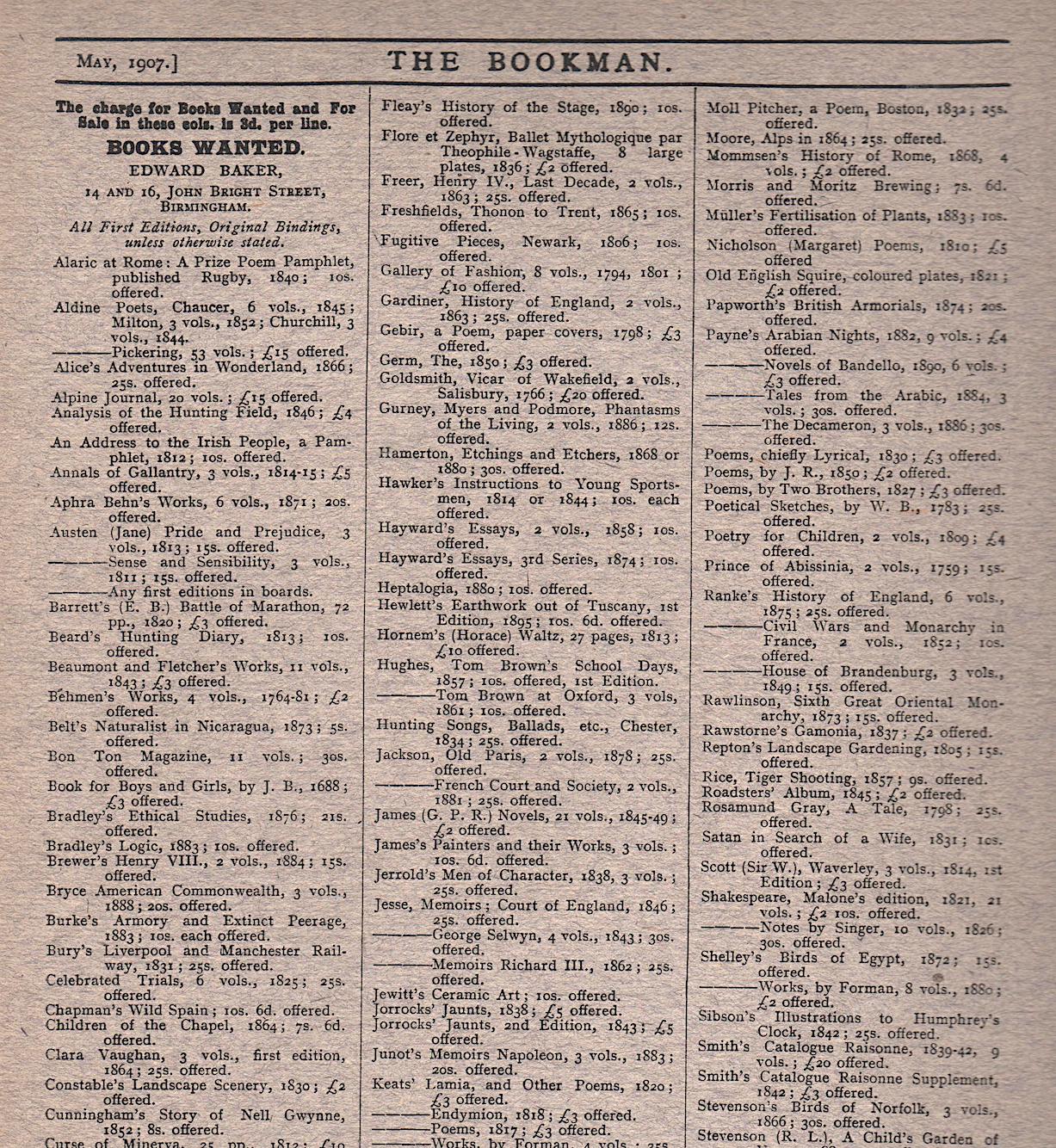
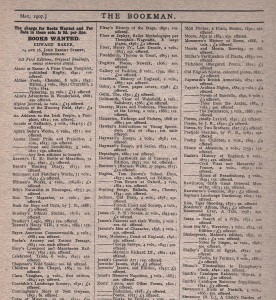 Before we report on the bargains available in May 1908 at Edward Baker’s Great Bookshop in John Bright Street, Birmingham (contrast it with Birmingham City Centre today, where there is not a single second hand bookshop ), let us examine what Mr Baker was prepared to give for top-end first editions in 1907 as advertised in The Bookman for May of that year.
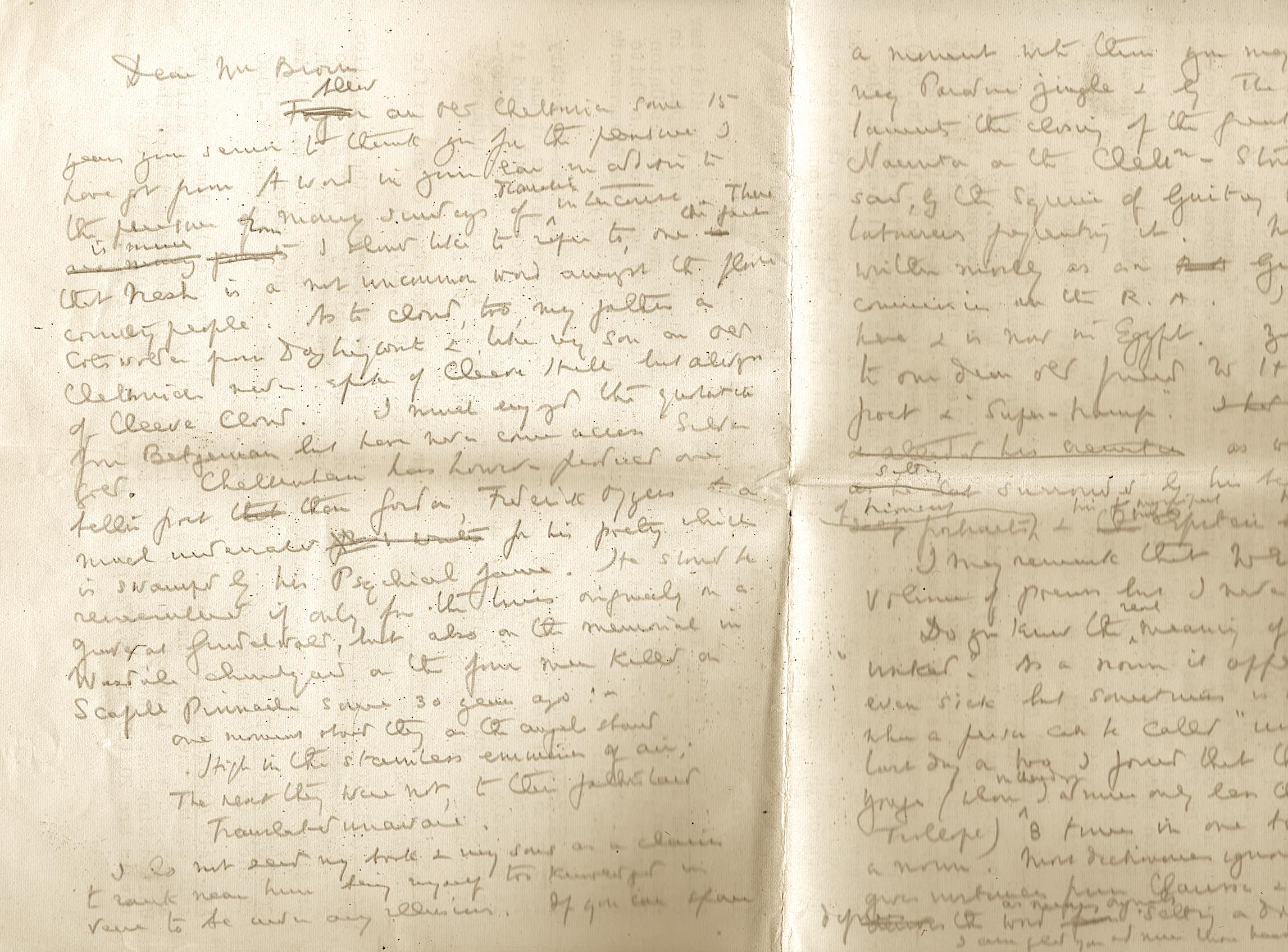
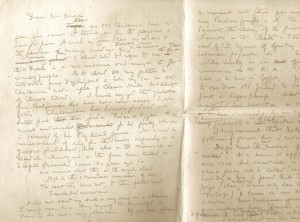 Found in a pile of papers around a year ago at Jot HQ is this draft of a barely decipherable ( hence the gaps and possible misreadings of words ) and incomplete letter written in pencil on the back of a typed Roneoed page headed ‘ The Association of British Chambers of Commerce/5thOctober, 1942/Parliamentary Bulletin No 462A/Information by question and answer. The draft letter is addressed to ( Ivor ) Brown, author of A Word in your Ear( 1942), a book that explores the history of certain words. The writer cannot be identified from any clues in the letter , though what clues there are might open up paths for Jot fans who are familiar with Cheltenham and the Cotswolds. Any with information are welcome to write in.


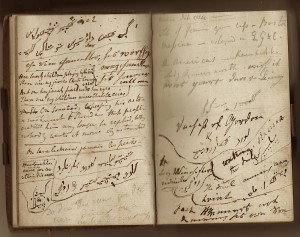 The front part is a short record of travels in Germany and Belgium in which the anonymous male diarist, who is accompanying his mother, at one point tells us that he was born in 1802, is very scathing about the appearance of most of his travelling companions. In one instance he remarks that the young son of the parson in the party ‘seemed to be as ugly as his father and as vulgar as his cousin’. He is singularly unimpressed by most of the foreigners he encounters along the way. For instance, he notes that his fellow diners at the Table d’Hote, were ‘12 disgusting looking Germans who luckily eat enormously & spoke little ‘. The following evening diners at the same table were’ rather more disgusting in their appearance & manner of eating than the day before ‘. Predictably, he is also critical of the meals he is obliged to eat and the inns that serve and accommodate him. In one inn he accuses the landlord of serving him a dish of greyhound puppy. Our diarist certainly places himself above the common lot. He seems knowledgeable about art and is a little snooty regarding the collections he views, suspecting that most of the paintings were copies from the masters. More positively, he is often ecstatic about the scenery and buildings he encounters and he particularly praises cathedrals and castles. We yearn for more, but unfortunately, the diary stops abruptly after thirty pages.